Building on recent reform progress In Brazil

By Falilou Fall, Priscillia Fialho, and Jens Arnold, OECD Economic Department
Brazil’s economy has recovered strongly from the consecutive shocks of the last years says the latest OECD Economic Survey of Brazil. This year, buoyed by good weather and a record-high harvest, the economy is expected to grow at 3%, which is far above its long-term growth trend over the last decade. Unemployment is at its lowest level since 2015, while inflation has returned to the central bank’s target after having risen to almost 12% in mid-2022. Even if in the next years growth will fall short of the exceptional performance of 2023, the current OECD projections of 1.8% in 2024 and 2.0% in 2025 are strong in historical comparison, and are largely driven by expanding domestic demand.
The time has now come to re-focus on the pressing structural challenges that Brazil is facing. These include limited fiscal capacity that hampers necessary investments, weak productivity performance, and the need to end deforestation in the Amazon, after visible increases during 2018-2022.
Building fiscal space will help to focus on policy priorities
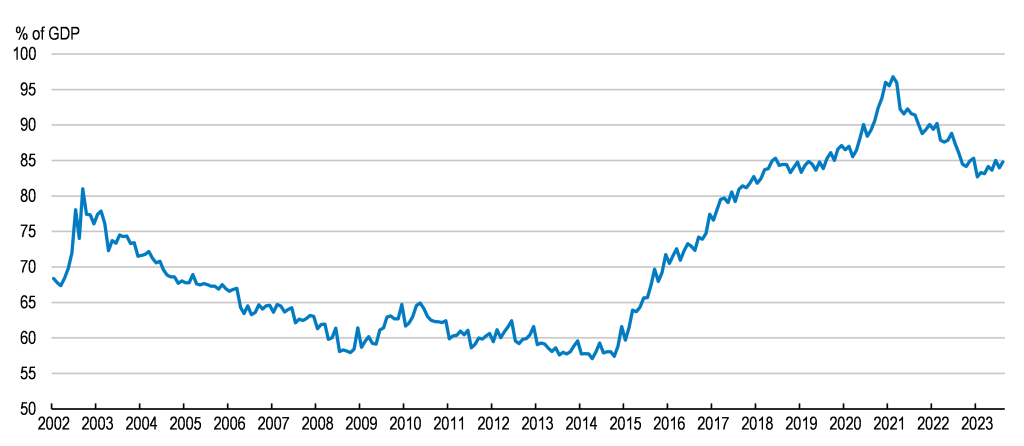
With gross public debt exceeding 80% of GDP (Figure 1), rebuilding fiscal buffers is important to ensure that the public sector can undertake the necessary investments in education, social protection and infrastructure in the future. This will require credible deficit targets that guide fiscal policy over the next years. A recently legislated new fiscal framework is expected to become an essential tool in this context, as it combines a clear path for fiscal outcomes with safeguards for public investment, which has all too often fallen victim to fiscal adjustments in the past.
Figure 1. Rebuilding fiscal space is important
Evolution of public debt
Source: CEIC; Central Bank of Brazil.
Making the most out of scarce fiscal space will also require more agile budgeting processes. These are currently characterised by widespread revenue earmarking and mandatory spending floors that commit 91% of the budget. This limits the government’s ability to address priority policy challenges.
Further important fiscal reforms are either ongoing or planned. A fundamental overhaul of Brazil’s notoriously complex system of consumption taxes has just been approved by Congress. Moving from a fragmented system of consumption taxes towards a unified value-added tax system will make tax compliance much easier for firms and reduce a number of tax-induced distortions that hold back growth. Beyond consumption taxes, there is scope to reform personal income taxes, including with a view towards making them more progressive.
Raising productivity and growth inclusiveness
Productivity has been on a declining trend since 2010, and compared to other emerging market economies, Brazil’s per capita growth has been substantially weaker (Figure 2). This is particularly worrying in light of rapid population ageing. A young population has underpinned economic growth in the past, as more and more people were joining the labour force. Over the next 25 years, however, population ageing is expected to reverse the entire growth dividend that Brazil has reaped from more favourable demographics since the turn of the millenium.
Figure 2. Weak productivity performance and infrastructure competitiveness are impeding stronger growth
Average annual GDP per capita growth, 2012-2021
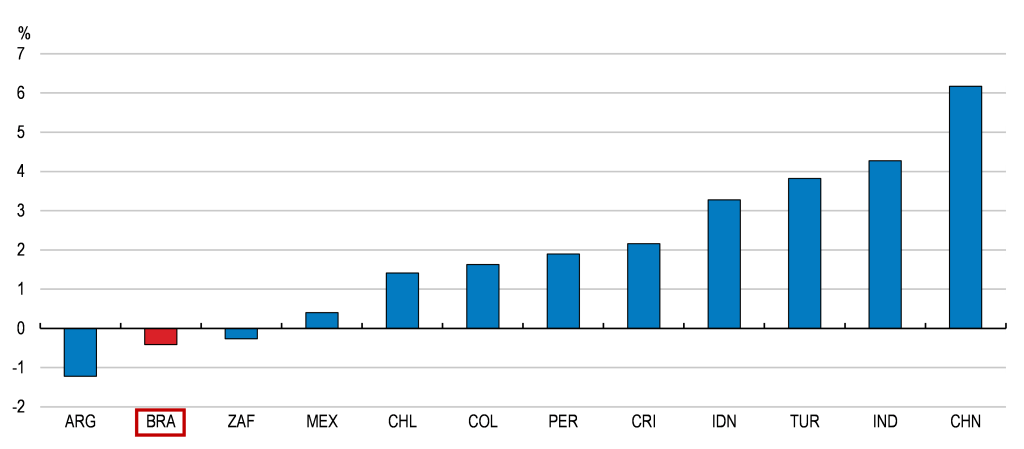
Source: World Bank; and OECD calculations.
Years of insufficient infrastructure investment have given rise to logistics bottlenecks and high transportation costs, which are one factor behind Brazil’s weak productivity performance. But scarce resources are not the only challenge. Improvements in planning and project execution could substantially improve the performance of many infrastructure projects. As a result of challenges in project management, public infrastructure investment has delivered results that have often fallen short of expectations.
Competition, another key driver of productivity growth, has been held back by complex regulations and administrative burdens, some of which shield incumbent firms from potential new market entrants. Recent regulatory reforms have led to improvements in this area, but market entry barriers in services sectors remain above the OECD average. Further regulatory reforms in professional services, including the abolition of exclusive rights for certain ancillary tasks, can stimulate competition in crucial markets. Manufactured goods remain subject to elevated trade barriers, with average import tariffs approximately eight times higher than in Mexico. Lowering these trade barriers can facilitate access to foreign markets and foster a deeper integration into global value chains.
Mobilising currently underutilised labour resources and improving education outcomes is equally essential for sustaining stronger long-term economic growth. Womens’ labour force participation and employment rates lag approximately 20 percentage points behind those of men. The pandemic has exacerbated educational disparities by leaving a stronger mark on children from disadvantaged backgrounds. Prioritising investments in the early years of schooling and expanding access to early childhood education, especially for children from disadvantaged backgrounds, have the potential to reduce gender inequality and equip children with better opportunities later in life.
Making growth more sustainable
Deforestation, the largest contributor to greenhouse gas emissions, has increased since 2018, but policy priorities have changed and early indicators now suggest a decline in 2023. Strengthening enforcement of the Forest Code, coupled with allocating more resources to enforcement agencies, will aid in tackling deforestation. Emissions from agriculture, the second-largest source of greenhouse gas emissions, primarily arise from livestock (Figure 3). Better regulations and stronger incentives for more sustainable production hold significant potential for reducing these emissions. Energy emissions are already fairly low given the significant share of hydroelectric energy sources, but also solar and wind energy, where Brazil’s still untapped potential could turn into a major competitive advantage in the future. The planned introduction of carbon pricing mechanisms will be a milestone in the transition towards a lower-carbon economy.
Figure 3. Deforestation and agriculture are the main sources of greenhouse gas emissions
Million tonnes of CO2 equivalent, 2021 or latest

Source: OECD environment database; Estimativas Anuais de Emissões de Gases de Efeito Estuda no Brasil (6ª Edição), Ministério da Ciência, Tecnologia e Inovação; and OECD calculations.
References
OECD (2023), OECD Economic Surveys: Brazil 2023, OECD Publishing, Paris, https://doi.org/10.1787/a2d6acac-en