Overcoming persistent obstacles to growth in South Africa

By Nikki Kergozou and Lilas Demmou, OECD.

South Africa, under the Presidency’s Operation Vulindlela, has embarked on bold reforms to address key obstacles to economic growth. Keeping this reform momentum is critical: GDP growth has averaged only 0.7% per year over the past decade. The persistently sluggish pace of GDP growth has failed to significantly raise GDP per capita, expand labour market participation, or improve living standards for the majority of South Africans. The economy’s high emissions intensity presents an additional challenge, as renewed growth may amplify environmental pressures.

In this context, the new 2025 OECD Economic Survey of South Africa (OECD, 2025) contains four main messages:

  1. The macro-economic policy framework needs to be strengthened to make the economy more resilient.
  2. Transforming the electricity sector to ensure energy security is vital for economic growth and would, in addition, facilitate the green transition.
  3. Greater inclusion of South Africans in the labour market is essential for social cohesion and poverty reduction.
  4. The prospect of higher growth requires speeding up reforms to reduce emissions.

An enhanced macro-economic framework is a prerequisite for stronger sustainable growth. South Africa’s 3-6% inflation target is high and its mid-point is well-above that of other major trading partners. Lowering the inflation target and considering reducing the band around it would help achieve lower inflation and support competitiveness. Public debt has surged from 31.5% of GDP in 2010 to a projected 77% in 2025 (National Treasury, 2025) and rising debt-servicing costs of around 5% are squeezing fiscal space, limiting the government’s capacity to finance social programmes and public investment. Stricter spending controls through reinforced spending rules, and improved governance would help improve the fiscal position and eventually reduce debt. Enhancing the efficiency of tax services, while raising value-added and property taxes, would also contribute to increase revenue collection.

A key structural reform to ensure that growth can be higher in a sustainable way is to ensure that electricity provision is sufficient for businesses to operate. Power outages, or “loadshedding” were estimated to have reduced economic growth by 1.5 percentage points in 2023 (SARB 2024). In addition to directly reducing efficiency, a loss of confidence in the electricity system weakens incentives to invest and deters new market entrants. Significant progress has been made but a lot remains to be done to put electricity outages behind us. Priority should be given to establishing a competitive wholesale electricity market, expanding the transmission grid, and improving municipality’s capacities to deliver electricity effectively. Reforms to municipal management and financing should prioritise earmarking electricity revenues to reduce cross-subsidisation, enhancing property tax collection and exploring distribution concessions.

Many South Africans struggle to find work: the country has the lowest employment rate and the highest unemployment rate among G20 economies. Reforms are needed to help firms create more jobs and to also help workers better connect with job opportunities. Restrictive regulations constrain firms’ ability to enter the market and expand, limiting job creation. Urban sprawl and insufficient public transport lead to lengthy, expensive commutes that pose challenges for workers to connect with employment. Promoting densification, and prioritising housing near public transport and development corridors would help.

As reforms leading to higher growth would put upward pressure on greenhouse gas emissions, South Africa will face additional challenges in meeting its climate goals. In addition, the country is highly vulnerable to the changing climate. A greener economy requires higher carbon prices, an enhanced policy framework for faster implementation of policies, and improved public transport so that people use their cars less often. In parallel, adaptation to climate change needs to be accelerated, notably by reducing the severe under resourcing of municipalities, who have a key role to play in climate policies.

References


Boosting EU productivity through a stronger Single Market

3 young adults running with the EU flag

By Martin Borowiecki and Federico Giovannelli, Economics Department

Strengthening productivity remains a key challenge

Productivity has grown more slowly in the EU than in the United States. Since 2000, labour productivity growth in the EU has been on average half a percentage point lower each year than in the United States (Figure 1, panel A).

Productivity developments have been particularly weak in the largest EU economies. In contrast, some Northern as well as Central and Eastern European countries recorded stronger productivity growth. Nevertheless, productivity levels in Central and Eastern Europe remain relatively low (Figure 1, panel B).

The productivity growth difference compared to the United States is mainly due to the services sector (Figure 2). In particular, productivity growth in the information and communication sector, as well as in professional services, has been weaker in the EU. These are two sectors that make strong use of digital technologies. This reflects industry structure as well as the greater ability of U.S. companies to develop and utilise digital technologies. In contrast, the EU has made significantly less use of the benefits of digital technologies (van Ark, O’Mahony and Timmer, 2008; Schivardi and Schmitz, 2019).

Overall, investment as a share of GDP is relatively high in the EU, which is due to high residential investment. In contrast, productivity-enhancing investments (excluding residential investment) – as shown in Figure 3 (panel A) – have grown less dynamically than in the United States since the early 2000s. In particular, after the financial crisis, investment rates between the EU and the United States began to diverge significantly.

The divergence in investment spending is mainly due to lower expenditures on intellectual property, particularly on research and development (R&D) as well as information technologies (Figure 3, panel B). This affects all sectors but is especially pronounced in information and communication technology. It reflects the higher R&D spending of U.S. high-tech companies as well as their larger size. In contrast, business R&D spending in the EU tends to be concentrated in medium-tech sectors such as the automotive industry. The lower level of innovation activity in the EU, along with the specialisation in medium-technology sectors, has contributed to the EU falling behind the United States, and increasingly China, in cutting-edge technologies such as artificial intelligence (Filippucci, Gal and Schief, 2024; Fuest et al., 2024).

One factor behind the weak innovation activity in Europe is weak business dynamism and the low level of investment in young innovative companies. Firm entry and exit rates have been declining in both the manufacturing and services sectors (Figure 4). Promoting the growth of successful companies and the market entry of new firms is crucial to fully unlock the potential of the private sector and to boost innovation and productivity growth.

The Single Market is key for productivity

A more integrated Single Market will be key to boost productivity. Market integration is particularly low in the services sector (Figure 5). A fragmented Single Market puts European companies at a disadvantage, as firms in larger markets can achieve economies of scale more easily and tend to be more productive and innovative.

In its latest Economic Survey of the EU and euro area, the OECD provides policy recommendations to boost productivity (OECD, 2025).

First, a more integrated Single Market with fewer regulatory barriers for businesses would strengthen productivity. Well-designed EU regulations can reduce compliance costs for companies in the Single Market compared to the inefficiencies of fragmented national rules. However, in practice, a growing EU regulatory burden is slowing down business dynamism. Subjecting EU regulatory proposals to rigorous cost-benefit analysis would help reduce the EU regulatory burden, including documentation requirements and reporting obligations for businesses. In addition, a common EU corporate law (“28th regime”) would help innovative firms scale, strengthen dynamism, and set minimum standards for registration and bankruptcy.

Another challenge is the still relatively low labour mobility within the EU. Cross-border labour mobility is hindered by limited mutual recognition of qualifications. To this end, mutual recognition of qualifications should be improved, and all unjustified and disproportionate restrictions on professional services removed.

Third, a deepening of European capital markets would also help to promote productivity growth. Capital markets in the EU remain underdeveloped. The fact that the high savings rates in the EU do not translate into productive investments is partly due to the insufficient risk appetite of the predominantly bank-based financial system. In particular, young and innovative companies suffer from the lack of alternatives to bank loans. Strengthening competition in savings and investment products could help deepen the pool of long-term capital available for investment. This could be paired with a stronger uptake of privately funded pensions to strengthen the institutional investor base.    

Fourth, while the EU’s science base is strong, a major weakness lies in the translation of science into breakthrough innovation. However, EU-level public R&D spending is limited. This makes it all the more important that EU public R&D expenditures are consistently targeted at addressing this innovation deficit. This calls for rigorous evaluations of R&D programmes based on clear key performance indicators, closing underperforming programmes, and shifting funding to well-performing programmes.

Finally, unilateral national industrial policies pose risks to the Single Market. The EU announced to make the state aid framework simpler and more flexible to support investment in strategic sectors until 2030. Such an approach to industrial policy raises risks for the Single Market as countries with more fiscal space may provide excessive support. To protect the level playing field within the Single Market, state aid rules should not be relaxed.

For more information about the latest OECD Economic Survey of the European Union and euro area, please visit the economic snapshot page.

References

Filippucci, F., P. Gal and M. Schief (2024), “Miracle or Myth? Assessing the macroeconomic productivity gains from Artificial Intelligence”, OECD Artificial Intelligence Papers, No. 29, OECD Publishing, Paris, https://doi.org/10.1787/b524a072-en.

Fuest, C. et al. (2024), EU-Innovation Policy: How to Escape the Middle Technology Trap?, Policy Report of the IEP/TSE/EconPol-CESifo European Policy Analysis Group.

OECD (2025), OECD Economic Surveys: European Union and Euro Area 2025, OECD Publishing, Paris, https://doi.org/10.1787/5ec8dcc2-en.

Schivardi, F. and T. Schmitz (2019), “The IT Revolution and Southern Europe’s Two Lost Decades”, Journal of the European Economic Association, Vol. 18/5, pp. 2441-2486.

van Ark, B., M. O’Mahony and M. Timmer (2008), “The Productivity Gap between Europe and the United States: Trends and Causes”, Journal of Economic Perspectives, Vol. 22/1, pp. 25-44.


Boosting business sector productivity in Canada

Katja Schmidt & Gilles Thirion, OECD.

Canada’s economy has shown resilience to crisis, including the recent Covid19-crisis. However, growth in per capita GDP has lagged in recent years. Business investment per worker in Canada has remained significantly below that of peer OECD countries, particularly in key areas such as information and communication technology (ICT), machinery and equipment, and intellectual property products. Moreover, the business innovation intensity remains comparatively low, despite the availability of various government support programmes. As a result, productivity growth has remained subdued (Figure 1). Between 2015 and 2023, labour productivity per hour worked grew by just 0.8% annually, below the OECD average and significantly behind the United States.

The Canadian economy is now facing new headwinds in the form of rising tariffs from its most important trading partner, the US. The effective tariff rate on US imports from Canada is expected to rise by about 13 percentage points, up from a near-zero effective bilateral tariff rate. Although the tariff exemptions under the United States-Mexico-Canada Agreement will help shield the Canadian economy from more severe impacts, the tariffs will still significantly weigh on economic growth. They could also further undermine productivity growth. However, if tariffs help to prompt structural reforms, particularly those weighing on productivity, this could help mitigate some of the negative effects of tariffs in the long-term.

In this context, the new 2025 OECD Economic Survey of Canada highlights four key priorities to strengthen business sector productivity:

  • Reduce interprovincial barriers to trade and labour mobility to strengthen the efficiency and integration of the internal market;
  • Enhance competition and support firm growth by removing remaining regulatory restrictions in network sectors, improving access to financing for young and innovative firms, and reinforcing competition policy;
  • Scale up and streamline government innovation support schemes to increase accessibility;
  • Ensure full utilisation of skills by addressing labour market mismatches, reducing underemployment, and improving pathways for credential recognition and upskilling.

Canada’s interprovincial trade barriers have been widely recognised as undermining the efficient allocation of resources across the country and effectively reducing the size and integration of its internal market. These barriers span a range of areas, including occupational licensing, transportation and procurement regulations, and divergent technical standards. Accelerating the reduction of these barriers, such as by expanding the scope and enforcement powers of the Canadian Free Trade Agreement, would enhance market efficiency, foster competition, and support productivity growth.

Interprovincial barriers also constrain labour mobility, particularly in skilled trades and professional services. Differences in provincial certification requirements continue to hinder mutual recognition, limiting the ability of workers to move freely. Policy efforts should focus on further harmonising standards and expanding mutual recognition frameworks across provinces.

Policies to enhance competition and business dynamism span multiple policy domains. One possible area of reform is the removal of existing foreign entry restriction in some key network sectors, such as telecommunications. Another area is to support the growth of small and medium-sized enterprise (SME), which struggle to scale. Addressing this requires different tools, such as reviewing the preferential small business corporate tax rate; improving access to affordable financing; and strengthening managerial capabilities. In addition, ensuring a robust competition policy framework in digital markets is essential to foster innovation

Third, existing government support programmes for business innovation should be better coordinated and simplified, to increase Canada’s comparatively low business R&D spending (Figure 2). R&D incentives should be harmonised across small, medium-sized, and large firms to ensure neutrality. Additionally, there is scope to reallocate public R&D funding towards some more direct support instruments, which tend to be more targeted. The proposed Canada Innovation Corporation (CIC), envisioned as a new nationwide platform for supporting business R&D, represents a promising step toward streamlining and enhancing the effectiveness of R&D incentives.  

Finally, the Survey highlights opportunities to better harness the potential of Canada’s highly educated labour force, notably by better integrating immigrants and enhancing female participation. Overqualification remains prevalent among immigrants. Expanding mutual recognition agreements for foreign qualifications could help mitigate the risk of skill underutilisation of immigrants. In addition, women continue to be under-represented in some key technical fields and leadership positions. Policy efforts should focus on continuing expanding access to affordable childcare, promoting equal parental leave, enforcing pay equity, and supporting flexible work arrangements.

Visit the OECD’s Canada Economic Snapshot page for further information.

References:

OECD (2025), OECD Economic Surveys: Canada 2025, https://doi.org/10.1787/28f9e02c-en, OECD Publishing, Paris.


Convertir la incertidumbre global en oportunidad: Una agenda de competitividad para América Latina

Por Jens Arnold, Aida Caldera, Priscilla Fialho, Paula Garda, Alberto González Pandiella, Michael Koelle, Alessandro Maravalle, Dimitris Mavridis, Claudia Ramírez y Adolfo Rodriguez-Vargas, OCDE.

El contexto global, marcado por una alta incertidumbre política y fragmentación, plantea nuevos desafíos para América Latina, pero también abre nuevas oportunidades para fortalecer su competitividad y reducir vulnerabilidades.

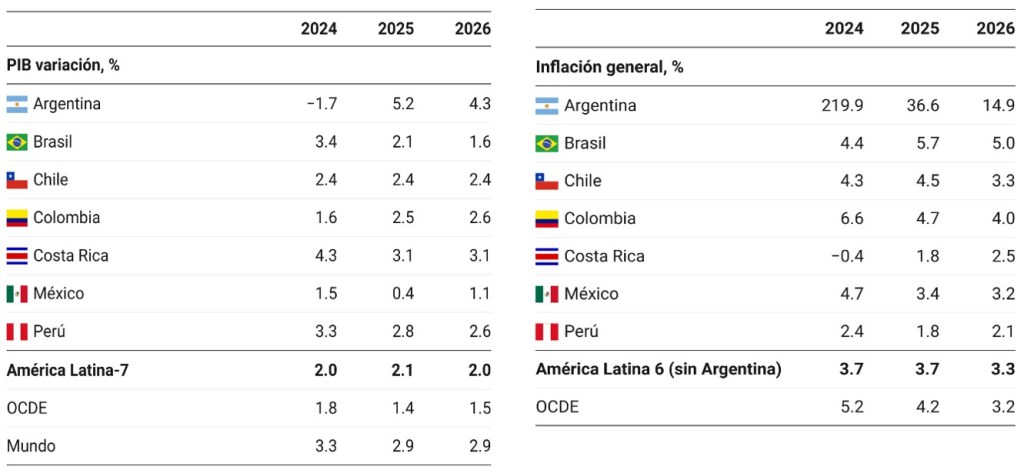
Se espera que el PIB en América Latina crecerá 2.1% en 2025 y 2% en 2026, lo que refleja una desaceleración generalizada en la región. Estas cifras son más bajas que las previstas a fines del año pasado y se sitúan por debajo del promedio de otras economías emergentes. Aunque se espera una fuerte recuperación en Argentina, el crecimiento se mantiene débil en la mayoría de los países, con revisiones a la baja para Brasil, México y Colombia (Tabla), en un contexto generalizado de una débil demanda externa y la alta incertidumbre.

Cuadro. Perspectivas económicas para los países de América Latina

Nota: América Latina 7 es la media ponderada por el PIB a valores de paridad del poder de compra de los 7 países en la tabla para el PIB. América Latina 6 es la media simple de los países incluidos en el cuadro para la inflación excluyendo a Argentina.
Fuente: OCDE Perspectivas Económicas No. 117, junio de 2025.

La desinflación avanza, pero persisten las presiones inflacionarias. La inflación se mantiene por encima del objetivo en muchos países. En cambio, Argentina ha logrado avances significativos gracias a una combinación de consolidación fiscal y una política monetaria más restrictiva. Con la excepción de Argentina y Brasil, los bancos centrales de la región deberían continuar con su flexibilización monetaria prudente y gradual para asegurarse que la inflación se acerque al objetivo, manteniéndose alerta ante riesgos de salidas de capitales y nuevas presiones inflacionarias.

Los riesgos para las perspectivas son a la baja. Un aumento de los aranceles comerciales y menor dinamismo al previsto en socios comerciales clave podría debilitar aún más las exportaciones y presionar a la baja los precios de las materias primas. Los costos comerciales podrían ralentizar más de lo esperado la desinflación en las economías avanzadas y prolongar tasas de interés globales más altas. Una elevada deuda pública y unas condiciones financieras globales más restrictivas de lo previsto, podrían retrasar la tan necesaria inversión. Si se intensifican las salidas de capital, los bancos centrales podrían tener menos margen de maniobra para flexibilizar la política monetaria.

Una agenda de competitividad para tiempos inciertos

En este complejo entorno global, la región necesita más que nunca mejorar sus políticas domésticas. Un área donde es posible avanzar, y urgentemente necesario, es en competitividad, comercio e inversión. Estas no son prioridades nuevas, pero los cambios globales en el comercio, las cadenas de suministro y la transición hacia economías más sostenibles aumentan su relevancia estratégica. Los países que ofrezcan estabilidad institucional, apertura y baja carga administrativa estarán mejor posicionados para atraer inversión y expandir sus mercados.

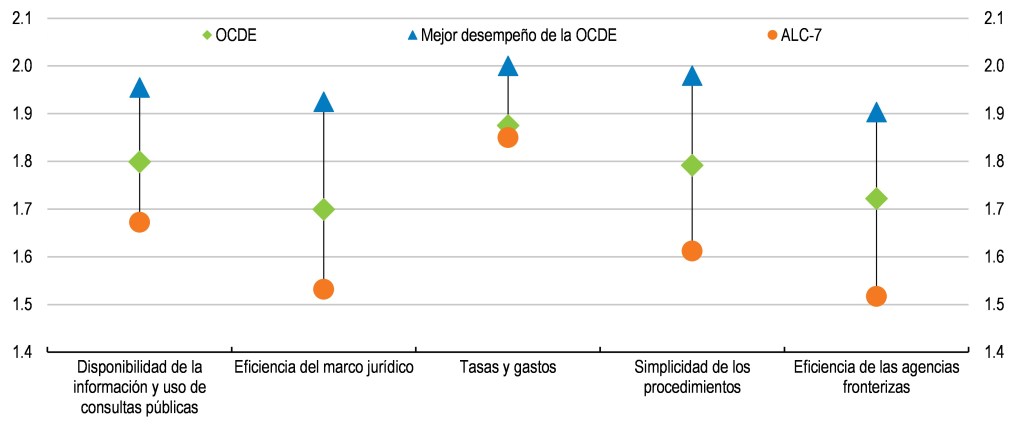
Mejorar los procedimientos aduaneros representa una oportunidad clara. Según los Indicadores de Facilitación del Comercio de la OCDE, América Latina aún enfrenta altos costos comerciales debido a procedimientos aduaneros complejos, inspecciones redundantes y poca coordinación entre agencias fronterizas (Figura). Hay amplio margen para mejorar el procesamiento, levante y despacho de mercancías, en particular mediante una mayor automatización y una mejor coordinación entre las agencias aduaneras, sanitarias, tributarias y otras agencias fronterizas. Medidas prácticas como la cooperación entre agencias de distintos países en la frontera, la agilización de los procesos judiciales y una mayor digitalización pueden beneficiar a los exportadores, especialmente a las pequeñas empresas, y atraer inversión. Además, estas medidas reducen los costos de operar formalmente, lo que incentiva a más empresas a salir de la informalidad.

Figura. Las políticas de facilitación del comercio pueden mejorarse en América Latina

2 = Mejor desempeño

Nota: Disponibilidad de la información y uso de consultas públicas es la media de los indicadores de la facilitación del comercio (TFI, por sus siglas en inglés) A y B. Eficiencia del marco jurídico es la media de los indicadores TFI C y D. Simplicidad de los procedimientos es la media de los indicadores TFI F, G y H. Eficacia de las agencias fronterizas es la media de los indicadores TFI I, J y K. ALC-7 es la media de Argentina, Brasil, Chile, Colombia, Costa Rica, México y Perú.
Fuente: Estadísticas sobre los Indicadores de Facilitación del Comercio de la OCDE (TFI, por sus siglas en inglés).

La facilitación del comercio debe ir acompañada de reformas más amplias que fomenten la productividad. Impulsar la competitividad de las exportaciones y la productividad empresarial también requiere un entorno empresarial más dinámico, una mayor competencia doméstica, un mejor acceso a la financiación, más capacitación y capacidad de innovación. Estas reformas se refuerzan mutuamente: las empresas más productivas tienen mayor probabilidad de exportar, invertir y formalizarse.

El fortalecimiento de la integración regional sigue siendo relevante en América Latina, especialmente en un mundo donde las cadenas de valor están cambiando y los centros regionales cobran mayor importancia. El enfoque debe centrarse en la cooperación: mejorar la cooperación entre organismos fronterizos, el reconocimiento mutuo de normas, el intercambio de datos, los sistemas interoperables y el reconocimiento de estándares técnicos comunes. La región también cuenta con un potencial sin explotar en el comercio de servicios, gracias a idiomas compartidos y husos horarios similares; sin embargo, el comercio interregional de servicios sigue siendo bajo en comparación con los estándares mundiales.

América Latina debe adoptar una visión más orientada hacia el exterior. Acuerdos comerciales como el de la UE-Mercosur, y la participación en marcos plurilaterales como la Alianza del Pacífico o el CPTPP pueden ayudar a diversificar mercados de exportación, atraer inversión, fortalecer la participación en las cadenas globales de valor y aprovechar nuevas tecnologías. Sin embargo, para aprovechar al máximo los beneficios de estas iniciativas, los países deben mejorar su capacidad de implementación y garantizar la coherencia entre las políticas comerciales, de inversión y regulatorias.

América Latina cuenta con ventajas reales: vastas reservas de minerales críticos, abundante energía renovable, una fuerza laboral joven y cada vez más cualificada, y proximidad a mercados clave. Al impulsar reformas concretas que mejoren la competitividad, reduzcan las barreras comerciales y atraigan inversión de calidad, la región puede convertir los desafíos actuales en oportunidades y sentar las bases para un crecimiento más sólido y resiliente.

Referencias:

OECD (2025), OECD Economic Outlook, Volume 2025 Issue 1, OECD Publishing, Paris, doi – Reporte completo en inglés con las proyecciones macroeconómicas, los principales desafíos estructurales e información detallada por país.

Perspectivas económicas de la OCDE para países de América Latina, Junio 2025.

Información detallada por país: Argentina | Brasil | Chile | Colombia | Costa Rica | México | Perú


Restoring high growth and securing the pension system for future generations in Luxembourg

Photo outside the European Convention Centre

Read the blog in French l Lire le blog en français

By Cyrille Schwellnus and Simone Romano

Despite several major shocks and the recent slowdown, Luxembourg has grown vigorously over recent decades. Living standards are among the highest in the OECD. The stable institutional framework, responsive regulation and a relatively favourable tax regime have attracted foreign investment and foreign workers.

Yet, the growth model based on rapid labour force expansion has reached its limits. Productivity has stagnated over the past 15 years, congestion has increased and housing has become less affordable for many residents. Moreover, Luxembourg faces rapidly rising pension expenditure over the next decades, as the number of pensioners will more than triple over 2024-2070.

Policies fostering the transition to a more sustainable growth model based on skills and innovation need to be prioritised, while ensuring the sustainability of the pension system and addressing climate change.

In this context, the new 2025 OECD Economic Survey of Luxembourg contains three main messages:

•             A comprehensive reform to curb pension expenditure and raise revenue is needed in the near term to secure the system for future generations and prevent more disruptive changes at a later stage.

•             Boosting skills by upgrading training, refocusing public support for innovation and strengthening competition, especially in services, would help to reinvigorate stagnating productivity.

•             Continuing to develop public transport and alternative mobility options, while bringing fuel prices more in line with neighbouring countries and making the tax regime less advantageous for cars with internal combustion engines, would help Luxembourg reach its climate targets.

Balancing the pension system in the long term while safeguarding inter-generational fairness and competitiveness requires a multipronged approach and fast implementation. The horizon over which periodic reviews assess the balance of the system needs to be extended from 10 to 50 years. Setting a steady-state contribution rate that balances the system over 50 years and phasing it in early would ease the burden on future generations by allowing larger working-age cohorts to contribute more, while the pension reserve fund would grow through financial returns.

Raising the effective retirement age, which is the lowest in the OECD, would further help to put the system on a sustainable footing. Eligibility for early retirement should be tightened by removing educational years from the calculation of contributory years, aligning benefits with actual work history. At the same time, early and statutory retirement ages should be raised to match gains in life expectancy.

Pension benefits need to be brought more in line with other OECD countries, as the relative income of older people is the highest in the OECD. Shortening the transition to the lower replacement rates of the 2012 reform from 40 to 25 years would contribute to a slower depletion of assets in the pension reserve fund. Switching from nominal wage indexation of pensions in payment to inflation indexation – as is common in OECD countries – would ensure that current pensioners contribute to the reform effort.

Transitioning from a growth model based on rapid labour force growth to a model based on skills and innovation requires reforms to innovation, skills and competition policies. Establishing a coordination mechanism between the main actors providing public innovation support, shifting more from institution to project-oriented support and strengthening the role of public-private partnerships would crowd-in more business R&D investment.

Quality standards for training providers could be strengthened through the creation of a national accreditation agency, as well as the tightening of quality control on training providers. Enhancing the targeting of financial incentives for adult learning and more proactive guidance would increase the participation of low skilled and older workers. Requiring full disclosure of the identity of interest groups and public officials that were involved in lobbying activities and introducing sanctions for lobbyists who do not enrol in the dedicated public register would limit the scope for incumbents and larger firms to shape regulation in their favour at the expense of smaller firms. The quality of regulation could be further improved by introducing ex-ante and ex-post evaluations of the impact of regulation on competition and requiring the use of plain language in drafting new laws.

Luxembourg has made substantial progress in reducing emissions, but further efforts are needed to reduce emissions in sectors not covered by the EU Emissions Trading System by 55% by 2030 and to reach net zero emissions by 2050. Continuing to expand the public transport infrastructure and increasing the frequency and capacity of trains would help to ease congestion and boost overall system capacity. Measures are also needed to limit congestion during peak hours, including by better linking land planning and public transport development.

The reliance on combustion engine cars is high, supported by low taxes on cars and fuel. Setting a clear, forward-looking trajectory for the taxes on motor fuels that goes well beyond 2027 and brings the final fuel price more in line with that of neighbouring countries would reduce fuel tourism and the use of private cars. Increasing the registration tax on new cars and making it dependent on emissions, while introducing road tolls and reserving road lanes for buses and carpooling would encourage the transition to more sustainable commuting options.

For more information, visit the Luxembourg snapshot page.

References

OECD (2025), OECD Economic Surveys: Luxembourg 2025, OECD Publishing, Paris,
https://doi.org/10.1787/d01c660f-en.


Unlocking Chile’s productivity growth

By Claudia Ramirez Bulos and Adolfo Rodriguez-Vargas

Thanks to its strong macroeconomic framework, the Chilean economy has weathered significant challenges in recent years showing resilient growth. The economy recovered in 2024 from weak growth compared to 2023, and the economy is projected to grow around 2.2% on average in 2025 and 2026, as detailed in the recently published 2025 Economic Survey of Chile.  However, the Chilean economy is about 50% less productive than the average OECD country, and productivity has failed to catch up over the last decade. Chile can reverse this trend and accelerate productivity growth to allow more sustainable increases in living standards by encouraging efficient resource allocation and taking advantage of its digital connectivity and vast natural resources. To address productivity challenges and leverage the opportunities created by the digital and green transitions, including the development of the lithium and hydrogen industries, it will be necessary to foster women’s participation in the labour market, enhance skills development, promote investment and a more dynamic innovation environment, while improving business and environmental regulations, as described in the 2025 Economic Survey of Chile.

Fully unlocking the labour market potential

Fostering women’s participation in the labour market can lead to a better allocation of talent, increasing the country’s potential growth. OECD estimates suggest that fully closing gender gaps in labour market participation and hours worked by 2060 could lift Chile’s potential GDP per capita by over 0.25 percentage points per year—a bigger boost than the OECD average. Yet, women’s participation still lags 16 percentage points behind men at 77.6%, remaining below the OECD benchmark (Figure 1, Panel A). Unlocking women’s full economic potential requires addressing unpaid work imbalances and closing education gaps in high-skill fields. Policies that expand access to high-quality childcare and elderly care, improved parental polices, alongside efforts to encourage more women into STEM careers by addressing gender stereotypes from a young age, will be key to closing gender gaps.

Enhancing skills development

Chile’s workforce needs a skills upgrade to fully seize the opportunities of the digital and green transitions. As industries evolve, workers will need to adapt—but many currently lack the necessary capabilities. In 2023, only 11.7% of Chilean adults were proficient in problem-solving in technology-rich environments, far below the OECD average of 32.3%. Additionally, 41% of employed adults felt underqualified for their jobs, citing inadequate computer or software skills, close to the OECD average of 42%. The green transition adds another layer of complexity. Chile’s green transition plans require sufficiently skilled workers to set up, operate, and improve equipment based on novel technologies, some of them still in development. Strengthening education and training systems will be crucial. Raising teaching quality, integrating more digital skills into the national curriculum, and expanding access to tailored digital training for workers can help ensure that Chile’s workforce is prepared for the jobs of the future.

Promoting investment and innovation while improving business and environmental regulations

Promoting the diffusion of knowledge across firms is key to taking advantage of Chile’s good digital connectivity and vast natural resources. Encouraging the adoption of advanced technologies can stimulate innovation and yield significant productivity gains. However, Chile invests relatively little in R&D, at 0.3% of GDP, well below the OECD average of 2.1% in 2022, with most resources coming from the public sector (Figure 1, Panel B). Furthermore, the percentage of companies that introduced technological innovations was 16.7% in 2019-2020, compared to 35% in the rest of the OECD. Simplifying access to public research and development support can help boost innovation, while strengthening the collaboration between businesses and universities, that in Chile remains low, would also help. In the medium-term, increasing R&D spending based on cost-benefit analysis would be advisable.

Figure 1. A more efficient resource allocation is needed to accelerate productivity growth

Note: LAC is a simple average of Argentina, Colombia, Costa Rica, and Mexico. Panel B: Data for Chile refer to the year 2020.
Source: OECD Labour force statistics; OECD Main Science and Technology indicators database.

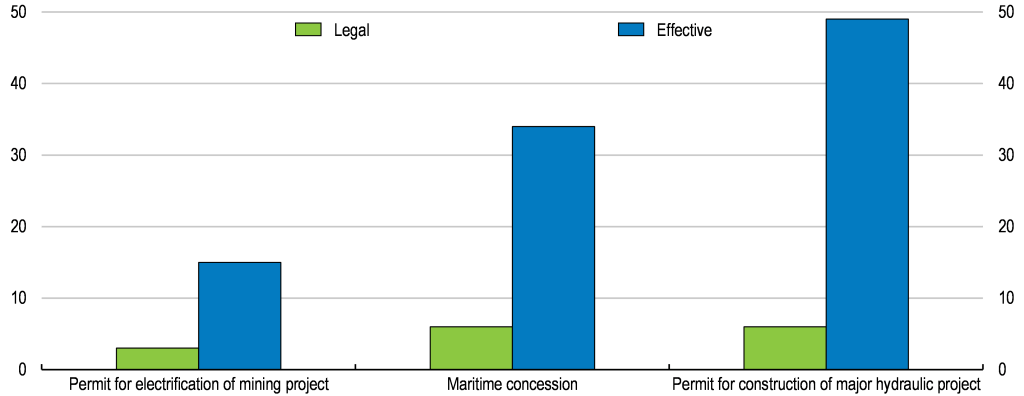
Chile is well positioned to benefit from increased world demand for lithium, as it has the largest share of known lithium reserves and produces around a quarter of world lithium. The country has a unique opportunity to create jobs, attract investment, and move up the lithium value chain. At the same time, the government envisions a strong state role in lithium development alongside the private sector. However, committing to multiple high-profile initiatives risks diluting efforts. A more focused approach would yield better results. Prioritizing key areas—such as strengthening state mining companies’ lithium expertise, establishing the planned National Lithium and Salt Flats Technological and Research Institute, and ensuring sustainable extraction practices—should be a priority. Strategic partnerships with private firms can also help bridge the knowledge gap and accelerate development.  Additionally, regulatory and administrative burdens remain comparatively high in Chile, with complex sectoral permitting processes that lack systematised and readily available supporting information, with long durations (Figure 2). Reducing administrative burdens on businesses and strengthening competition can create a more dynamic economic landscape conducive to growth.

Figure 2. The review of permits often exceeds legal times

Permit reviewing times, months, 2018-2022 average

Source: Consejo Nacional de Evaluación y Productividad, 2023, Análisis de los permisos sectoriales prioritarios para la inversión en Chile.

Read more:

OECD Chile Economic Snapshot – https://www.oecd.org/en/topics/sub-issues/economic-surveys/chile-economic-snapshot.html


The heat is on: Heat stress, productivity and adaptation among firms

By Hélia Costa, Guido Franco, Filiz Unsal, Sarath Mudigonda, Maria Paula Caldas.

The pace of temperature increase has been steadily accelerating over the past decades (IPCC, 2021). The increasing frequency and intensity of heat stress episodes due to climate change poses significant threats to the global economy, including through its effects on productivity. Despite recent more stringent mitigation efforts and the expectation that climate targets will be met, temperatures are still projected to rise, raising concerns about the economic costs associated with climate change.

One key channel through which temperature affects economic outcomes is labour productivity. As temperatures increase, both the cognitive and physical capacity of workers decrease, and extreme temperatures can also increase absenteeism due to heightened health issues and transport disturbances. Beyond its direct effect, heat stress can further impact productivity through disruptions to infrastructure (such as energy), increased production costs, or disruptions to supply.

Against this backdrop, our new paper (Costa et al., 2024) presents novel cross-country firm-level evidence on the effect of heat stress – both slow onset events (gradual temperature increases) and extreme weather events (heatwaves) – on labour productivity. The analysis builds on a unique dataset gathering detailed weather and financial information for more than 2.7 million manufacturing and services firms across 23 advanced economies between 2000 and 2021, complemented with country-level information on adaptation investment. The newly constructed dataset reveals that the number of warm days and the incidence of heatwaves present an increasing pattern in the period of analysis in most locations (Figure 1).

Figure 1. The number of warm days increased in most locations in the sample period

Note: The maps show the change in the average number of days in the year where the daily maximum temperature rose above 30°C, in the last five years of the analysis period (2016-2021) relative to the first five years (2000-2004).
Source: Costa et al. (2024) based on data from Orbis and ERA-5 reanalysis data (Copernicus Climate Change Service).

How do extreme temperatures affect firm productivity?

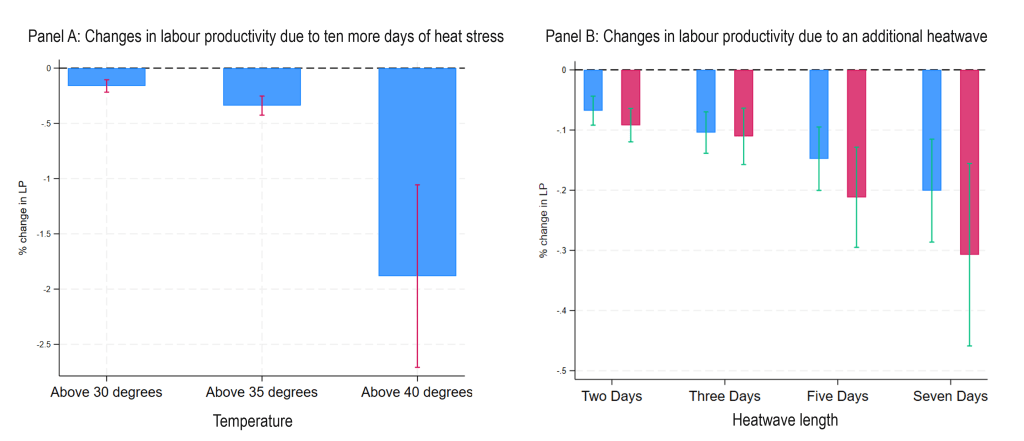
We find that both more frequent high-temperature days and the occurrence of heatwaves lead to substantially reduced labour productivity (Figure 2). Ten extra days above a temperature of 35 degrees Celsius in a year result in a 0.3% reduction in firms’ annual labour productivity. This effect is comparable, for example, to the decrease in productivity following a 5% rise in energy prices (André et al., 2023). One additional heat wave lasting at least five days, in turn, causes a 0.2% reduction in firms’ annual labour productivity.

Figure 2. Higher temperature negatively affects productivity

Note: Bars represent estimated coefficients and vertical lines the respective confidence intervals. Each bar is a different estimation. In Panel A each estimation differs with respect to the definition of the temperature variable, which is either the number of days above 30ºC, or above 35ºC or above 40ºC. In Panel B, each estimation differs with respect to the definition of heat wave, varying both the temperature threshold above which temperature has to rise for a heat wave to have occurred (90th and 95th percentile of the local historic mean) and the minimum number of consecutive days this temperature needs to have occurred.
Source: Costa et al. (2024)

This effect is more pronounced in less productive and smaller firms, and exacerbated by longer heat waves, high humidity, and low wind speeds. We also find that the negative productivity impacts exhibit a non-linear relationship with rising temperatures and persist for two years before fading. The heterogeneity of the impact across firms suggests differences in not only exposure but also vulnerability to heat stress. Larger firms, for instance, may have greater resilience to rising temperatures thanks to better financial resources, access to advanced technology, and knowledge of behavioural adaptation practices.

The analysis suggests some degree of adaptation may have already taken place. Firms in warmer locations and those more used to experiencing heatwaves exhibit lower productivity losses under similar temperature extremes. Additionally, both the implementation of National Adaptation Plans and firm-level investment in adaptation are also linked to reduced adverse effects of heat stress on productivity. However, the extent of current adaptation remains limited: higher temperatures relative to an already warm average result in more significant productivity losses, and there is no evidence of adaptation to severe extreme temperatures.

Directions for policy

In highlighting the substantial economic impacts of temperature-related changes, our analysis underscores important productivity and growth challenges posed by both gradual and disaster-driven climate impacts, providing valuable insights for policy making. First, sustained efforts in climate change mitigation are key to attenuating the increase in temperatures and the intensity and frequency of heat waves. This is particularly important given the non-linearity of costs to extreme temperatures and the limits to the effectiveness of adaptation suggested by our analysis.

Second, our results stress the urgent need to limit the economic impacts of heat stress through enhanced adaptation measures, tailored to different national and regional contexts to account for relevant heterogeneities in impacts and capacity. Where barriers to effective private sector engagement exist, like information and knowledge gaps, financial constraints, or coordination failures, policy efforts could prioritise promoting private sector adaptation. For example, while more than 60% of firms in the European Union report being impacted by the physical risks of climate change, only slightly over one-third have taken concrete steps to build resilience (EIB, 2023).

Policymakers can support firms, particularly small and medium-sized enterprises, through targeted economic incentives such as subsidies or tax breaks to encourage investments in heat-resilient infrastructure and technical measures, like green roofs or advanced cooling systems. Additionally, providing information to firms can drive behavioural changes, such as adjusting work schedules to avoid peak heat periods. Complementary direct public investment may be necessary, for example in changing urban structure, climate-proofing transport systems, or investing in adaptation technology R&D.

Lastly, heat stress is just one of many climate-related challenges confronting economies. Other slow onset and extreme weather events can pose significant risks for firm-level performance and broader macroeconomic outcomes. Our upcoming research dives into these risks from two angles: we explore how flooding impacts firm performance – focusing on output, capital, and investment – and how regional macroeconomic results are impacted by extreme weather events. Together, these efforts aim to provide a more comprehensive understanding of the economic risks posed by climate change and inform the development of robust macroeconomic structural models.

References

André, C. et al. (2023), “Rising energy prices and productivity: short-run pain, long-term gain?”, OECD Economics Department Working Papers, No. 1755, OECD Publishing, Paris, https://www.oecd.org/en/publications/rising-energy-prices-and-productivity-short-run-pain-long-term-gain_2ce493f0-en.html.

Costa, H. et al. (2024), “The heat is on: Heat stress, productivity and adaptation among firms”, OECD Economics Department Working Papers, No. 1828, OECD Publishing, Paris, https://doi.org/10.1787/19d94638-en.

EIB (2023), “European Overview – EIB Investment Survey”, European Investment Bank (EIB), Vol. ISBN: 978-92-861-5609-0, https://www.eib.org/en/publications/20230285-econ-eibis-2023-eu.

IPCC, 2021. Climate Change 2021: The Physical Science Basis, Contribution of Working Group I to the Sixth Assessment Report of the Intergovernmental Panel on Climate Change, https://www.ipcc.ch/report/ar6/wg1.


Greece: Boosting firm growth and innovation to raise living standards 

Cover of the greece economic survey 2024

By Antoine Goujard and Timo Leidecker

The Greek economy has weathered recent crises well and GDP growth has outpaced the euro area since early 2021. As headwinds are subsiding, the economy is emerging with significant gains in competitiveness, growing investment and more high-tech exports, and historically low levels of unemployment. Helped by solid growth, inflation and fiscal consolidation, public debt levels dropped significantly, and Greece regained the investment grade rating of its sovereign debt in 2023. GDP growth is expected to continue to outpace the Euro area over the next two years, with real incomes picking up and European funds supporting investment.  

While Greece’s performance has been strong, boosting firm growth and innovation remains a key challenge to support long-term gains in living standards. As highlighted in the  2024 OECD Economic Survey of Greece (OECD, 2024), despite recent improvements, productivity remained 40% below the OECD average in 2023, reflecting performance gaps that are visible in all sectors of the economy. Business investment has declined following the Great Financial Crisis and has just started to rebound in recent years (Figure 1). More than in most other OECD countries, the business sector is dominated by micro and small firms, which often struggle to seize the opportunities of new technologies, innovate and grow. Skill shortages are high and prevent firms from growing and implementing new technologies. This is despite the high -albeit declining- unemployment of 9.8% in October 2024, and reflects the fact that many workers do not have the skills needed by firms. The 2024 OECD Economic Survey of Greece identifies three policy areas where further action could help to strengthen firm growth and innovation.   

Figure 1. Business investment and innovation remains low despite recent progress 

Panel A. Data refer to the business sector excluding real estate activities, public administration and defence, compulsory social security, education and human health and social work activities. 
Source: Panel A: Eurostat (2024) National Accounts database ; Panel B: OECD (2024), Business enterprise R&D expenditure. 

One area with further scope for reforms is to continue removing regulatory burdens. Greece’s regulatory framework has become more business-friendly in recent years, recording the largest improvement in the OECD Product Market Regulation Indicator over 2018-23. However, restrictive regulations persist for professional services and hold back business innovation. Tools to identify and revise burdensome regulations are being applied but have yet to be used to their full potential. Improving the quality and scope of regulatory impact assessments and formalising the review of the stock of existing regulations together with stakeholders would be one way forward. Denmark, for example, does this well with its Business Forum for Better Regulation. In addition, Greece could also minimise regulatory burdens arising from new legislation by implementing its existing rules for quality control and consultations more systematically. Ensuring the effective and timely consultation of stakeholders on new draft legislation is key to continue to improve the business environment.  

Another important avenue will be to make more of the current labour force and improve skills. Better activating youths, women and foreign-born workers, would boost productivity and employment, as would equipping workers with the skills required by rapidly changing technologies. Vocational Education and Training (VET) should be developed further by increasing apprenticeships and the role of employers in the design of curricula. The roll-out of compulsory traineeships in 2024 and the more direct involvement of social partners in the design of vocational training are welcome steps, but there is space to devise a better combination of school and work-based programmes, an area where the success of Germany and Switzerland can provide useful lessons. Policies to support those already in the labour market, so-called “active labour market policies”, are still too much focused on low-effective direct-job creation programmes, and some of that spending could be redirected to training programmes for workers and the unemployed, while regularly assessing and certifying the quality of training providers. Barriers to labour market participation should also be removed, notably by continuing to expand childcare facilities and making it easier to recognise prior learning and skills gained abroad.  

Greek firms could grow stronger by boosting their access to finance. Low business investment, including in research, development and innovation, limits growth prospects, and there are only limited spillovers from foreign direct investment to domestic firms. Greece has made extensive use of loan-guarantee and subsidised lending programmes to improve access to finance, but these programmes should be regularly evaluated to avoid the risks of locking in resources in low-productivity firms and crowding out alternative financing sources. Bank health has improved greatly but non-performing loan exposures remain sizeable in the banking sector and among loan servicing companies. Reducing the length of court procedures, building on the recent bankruptcy law and the 2024 reform of the judicial system, would help restructure non-performing assets. With growing EU and national funding for business innovation and entrepreneurship, regular evaluations will also be key to enhance the effectiveness of public incentives for business innovation.  

Boosting productivity and innovation is not just a short-term priority for Greece—it is fundamental for achieving more sustainable and inclusive growth, especially as Greece’s population ages and the share of those in working age decreases.  

Reference: 
OECD (2024), OECD Economic Surveys: Greece 2024, OECD Publishing, Paris, https://doi.org/10.1787/a35a56b6-en


Miracle or Myth? Assessing the macroeconomic productivity gains from Artificial Intelligence

By Francesco Filippucci, Peter Gal and Matthias Schief, OECD Economics Department.

Artificial Intelligence (AI) could unleash productivity gains, boost growth, and raise incomes. Indeed, many firms are looking to the technology to increase productivity, with large documented gains in workers’ performance from using Generative AI tools (e.g. Large Language Models similar to ChatGPT) in business contexts such as customer service, business consulting, or software development. Moreover, given its rapidly expanding capabilities, AI is widely heralded as a new General-Purpose Technology (GPT) that could lift macroeconomic productivity growth, as it was the case with the internet and personal computers or with previous breakthrough innovations like the steam engine and electricity (Agrawal, Gans and Goldfarb, 2019; Lipsey, Carlaw and Bekar, 2005; Filippucci et al, 2024).

But can current micro-level productivity gains really lead to large productivity gains from AI at the macroeconomic level over the next decade? To answer this question, one needs to consider what share of economic activities would experience productivity gains if AI was adopted (“exposure to AI”), and how quickly firms will adopt AI. Additionally, at the macroeconomic level, one needs to consider that productivity gains can also depend on broader economic factors, such as sectoral linkages, demand responses, or labour and capital market frictions.

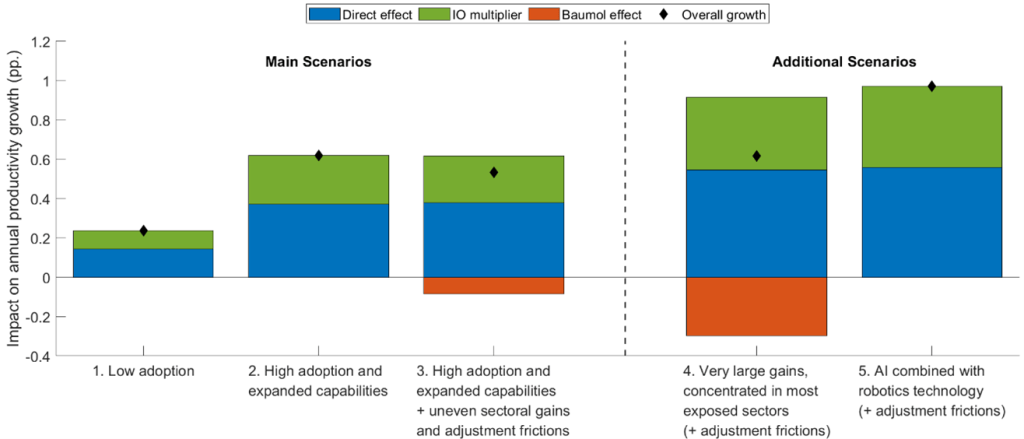
A new working paper by the OECD Economics Department (Filippucci, Gal and Schief, 2024) considers these mechanisms and assesses the macroeconomic productivity gains from AI over the coming 10-years. The results suggest that AI could contribute significantly to aggregate productivity growth over the next decade, contributing between 0.25 to 0.6 percentage points to annual Total Factor Productivity (TFP) growth in the United States (or 0.4 to 0.9 percentage points to annual labour productivity growth) in our main scenarios (Figure 1). Estimates for other economies are of similar magnitude, though somewhat lower given that adoption of AI is expected to be slower. These estimates imply a substantial improvement in the context of the weak productivity growth across the OECD over the past decades, which has been in the range of 1-1.5% per year.

Figure 1: Macro-level productivity gains from AI over

Estimated impact on annual growth rates over a 10-year horizon

Note: The bars correspond to different scenarios regarding the adoption, capabilities, and micro-level gains of AI (as in Figure 1). In scenarios 1 and 2, demand is assumed to be relatively elastic, and the factors of production (labour and capital) can reallocate freely across sectors. In scenarios 3-5 with adjustment frictions, demand is assumed to be very inelastic, and factors cannot reallocate across sectors. See more details in section 3 of Filippucci, Gal and Schief (2024).

The aggregate productivity gain from AI is the sum of three effects: 1) a direct effect of increasing productivity at the sectoral level; 2) an input-output multiplier effect as productivity gains in one sector also benefit other sectors through reduced costs of intermediate inputs; and 3) a negative reallocation effect in the spirit of Baumol’s growth disease (Baumol, 1967; Nordhaus, 2008) that arises if the sectors with limited productivity growth increase as a share of GDP.

A key insight that emerges from this analysis is that the macroeconomic impact of AI will depend primarily on the adoption speed and the degree to which AI can benefit economic activities across a wide range of sectors in the economy. Current adoption varies strongly across firms and sectors, with country-level adoption rates being generally low, in the range of 5-15%, as reported by official statistics of businesses and firm-level studies (e.g. Calvino and Fontanelli, 2023). Fast and productive integration of AI in a wider range of economic activities through expanded AI capabilities (e.g. further integration with other digital tools) is necessary for the emergence of large macroeconomic gains (Scenario 2 vs 1).

However, even with high adoption rates and expanded capabilities, general equilibrium effects working through prices could reduce the overall macroeconomic gain if the productivity benefits of AI remain concentrated in a few sectors (knowledge intensive services such as ICT, finance and professional services) (Scenarios 3 and 4). Demand for these services can become saturated, and growth will thus be limited “not by what we do well but rather by what is essential and yet hard to improve” (Aghion, Jones and Jones, 2019). In contrast, macroeconomic gains would be larger if AI gains were more widespread across sectors, for instance in the case of further integration with robotics technology, which would enable not only cognitive but also manual-intensive activities to benefit from AI (Scenario 5).

Overall, AI holds significant promise to revitalise productivity growth in OECD countries and beyond. Governments can also play a role in shaping the macroeconomic gains for AI, for example by resolving legal uncertainties around accountability, which may hold back productive AI adoption by firms (OECD, 2024a). At the same time, governments can foster a competitive environment (both in the AI-using as well as the AI-producing sectors; see Aghion and Bunel, 2024; OECD, 2024b) which is conducive to innovation and experimentation, while monitoring potential labour market disruptions and supporting workers as they transition into new roles in the AI economy (e.g. Acemoglu, Autor and Johnson; Baily, Brynjolfsson and Korinek, 2023; OECD, 2023).

References

Acemoglu, D. (2024) “The Simple Macroeconomics of Artificial Intelligence”, Economic Policy, 2024, eiae042, https://doi.org/10.1093/epolic/eiae042

Acemoglu, D., D. Autor and S. Johnson (2023), Can we Have Pro-Worker AI? Choosing a path of machines in service of minds, MIT Shaping the Future of Work Initiative, Policy Memo, https://shapingwork.mit.edu/wp-content/uploads/2023/09/Pro-Worker-AI-Policy-Memo.pdf

Aghion, P. and S. Bunel (2024), “AI and Growth: Where Do We Stand?”, https://www.frbsf.org/wp-content/uploads/AI-and-Growth-Aghion-Bunel.pdf

Aghion, P., B. Jones and C. Jones (2019), “Artificial Intelligence and Economic Growth”, in: The Economics of Artificial Intelligence: An Agenda, p. 237-82, University of Chicago Press, https://www.nber.org/system/files/working_papers/w23928/w23928.pdf

Agrawal, A., J. Gans and A. Goldfarb (2019), “Economic Policy for Artificial Intelligence”, Innovation Policy and the Economy, Vol. 19, https://doi.org/10.1086/699935

Baily, M., E. Brynjolfsson and A. Korinek (2023), Machines of mind: The case for an AI-powered productivity boom. Brookings Institution, https://www.brookings.edu/articles/machines-of-mind-the-case-for-an-ai-powered-productivity-boom/

Baumol, W.J. (1967). “Macroeconomics of Unbalanced Growth: The Anatomy of Urban Crisis?” The American Economic Review. 57 (3): 415–426. 

Calvino, F. and L. Fontanelli (2023), “A portrait of AI adopters across countries: Firm characteristics, assets’ complementarities and productivity”, OECD Science, Technology and Industry Working Papers, No. 2023/02, OECD Publishing, Paris, https://doi.org/10.1787/0fb79bb9-en.

Filippucci, F., P. Gal and M. Schief (2024), “Miracle or Myth? Assessing the macroeconomic productivity gains from Artificial Intelligence”, OECD Artificial Intelligence Papers, No. 29, OECD Publishing, Paris, https://doi.org/10.1787/b524a072-en. 

Filippucci, F., P. Gal, C. Jona-Lasinio, A. Leandro and G. Nicoletti (2024), “The impact of Artificial Intelligence on productivity, distribution and growth: Key mechanisms, initial evidence and policy challenges”, OECD Artificial Intelligence Papers, No. 15, OECD Publishing, Paris, https://doi.org/10.1787/8d900037-en.

Lipsey, R., K. Carlaw and C. Bekar (2005), Economic Transformations: General Purpose Technologies and Economic Growth, Oxford University Press, Oxford UK.

Nordhaus, W. D. (2008), “Baumol’s Diseases: A Macroeconomic Perspective”, The B.E. Journal of Macroeconomics, vol. 8, no. 1 https://doi.org/10.2202/1935-1690.1382

OECD (2023), OECD Employment Outlook 2023: Artificial Intelligence and the Labour Market, OECD Publishing, Paris, https://doi.org/10.1787/08785bba-en

OECD (2024a), Recommendation of the Council on Artificial Intelligence, https://legalinstruments.oecd.org/en/instruments/OECD-LEGAL-0449  

OECD (2024b), “Artificial intelligence, data and competition”, OECD Artificial Intelligence Papers, No. 18, OECD Publishing, Paris, https://doi.org/10.1787/e7e88884-en.


Impulsando la prosperidad regional: Cómo Colombia puede cerrar las brechas económicas

Por Michael Koelle, Aida Caldera Sánchez y Paula Garda, Departamento de Economía de la OCDE

Blog para dar seguimiento al lanzamiento del Estudio Económico Colombia 2024. También disponible en inglés.

Abordar las disparidades regionales en la productividad en Colombia es crucial para mejorar los niveles de vida y garantizar el bienestar económico de todos los colombianos. Las brechas regionales del PIB per cápita de Colombia se encuentran entre las más altas de la OCDE (Figura 1), impulsadas en gran medida por diferencias profundamente arraigadas en productividad, como se destacó en el reciente Estudio Económico de la OCDE sobre Colombia 2024. Estas disparidades se han desarrollado a lo largo de muchos años, exacerbadas por décadas de conflicto, un acceso desigual a la infraestructura, la educación, la capacitación y las oportunidades del mercado laboral, y también debido a desafíos institucionales.

Figura 1. Las brechas del PIB per cápita entre las regiones colombianas son amplias

Nota: El PIB per cápita es para grandes regiones TL2 (departamentos en Colombia) y para 2022 o el último año disponible.

Colombia se encuentra ante una oportunidad única para impulsar su economía y garantizar que todas las regiones se beneficien. Las tendencias globales, como los cambios en los patrones comerciales, el nearshoring y la transición ecológica, presentan desafíos, pero también grandes oportunidades. El gobierno colombiano ha hecho del desarrollo regional una parte clave de su plan para revitalizar, diversificar y transformar la economía. Para aprovechar este momento y llevar prosperidad a todas las regiones, el Estudio Económico de la OCDE sobre Colombia 2024 describe un conjunto de acciones en varias áreas de política:

  1. Mejorar la infraestructura para mejorar la conectividad: La calidad de la infraestructura de Colombia se ha visto frenada durante mucho tiempo por la falta de inversión, el conflicto armado, y la geografía del país. Por ejemplo, puede llevar más de ocho horas recorrer los 250 km que separan Bogotá de Medellín. Si bien las carreteras troncales han experimentado algunas mejoras recientes gracias a las asociaciones público-privadas, el siguiente paso es desarrollar y conectar puertos, ríos, ferrocarriles y carreteras de manera más eficiente. Además, la mejora de los caminos rurales es fundamental para conectar a las comunidades remotas con las ciudades y los mercados cercanos.
  2. Reducir la burocracia para las empresas:  Losaltos costos administrativos y las complejas regulaciones hacen difícil que las empresas, sobre todo las pequeñas, prosperen en Colombia. La expansión de las ventanillas únicas empresariales (VUE) digitales para permisos y licencias a más municipios, incluyendo más trámites y soluciones de pago digital, particularmente en áreas remotas, ayudaría a más pequeños negocios a formalizarse, crear empleos y contribuir a las economías locales.
  3. Equipar a los adultos jóvenes con habilidades para el trabajo: Muchos adultos jóvenes abandonan la escuela sin las habilidades que necesitan para tener éxito en la fuerza laboral, especialmente en áreas rurales donde los colegios están lejos. Los programas de formación profesional de segundo ciclo han sido un salvavidas para muchos, ya que ofrecen competencias valiosas y buenos resultados. La expansión de estos programas en regiones vulnerables donde las opciones educativas son limitadas puede ayudar a cerrar la brecha entre la escuela y el trabajo.
  4. Fortalecer las capacidades y las finanzas de los gobiernos subnacionales: Muchos gobiernos subnacionales, especialmente los municipios en áreas remotas y rurales, tienen unas capacidades fiscales y administrativas limitadas. Una reforma para fortalecer los mecanismos de igualación de ingresos fiscales y mejorar la recaudación directa de impuestos mejoraría las capacidades fiscales. La implementación en curso del catastro multipropósito es un paso importante en este camino. El desarrollo de la capacidad administrativa debe ir de la mano con la delegación de autoridad, la clarificación de las responsabilidades de gasto y la mejora de la coordinación intergubernamental. Estas recomendaciones están en línea con las recomendaciones de la Comisión de Descentralización de Colombia.
  5. Luchar contra la corrupción, especialmente en las zonas rurales:  La corrupción afecta más a las regiones más pobres y rurales de Colombia, erosionando la confianza y bloqueando el progreso. El fortalecimiento de las regulaciones sobre el financiamiento privado de las campañas políticas, una mejor protección de los líderes de la sociedad civil y la mejora de la transparencia en las transacciones financieras son pasos fundamentales para garantizar que el progreso beneficie a todos los colombianos.
  6. Implementar el Acuerdo de Paz para impulsar el desarrollo rural: El Acuerdo de Paz de 2017 abrió la puerta para el crecimiento en zonas afectadas por el conflicto, especialmente en las regiones rurales. Al mejorar la infraestructura y garantizar la paz, estas áreas pueden participar en el comercio y beneficiarse del fuerte turismo de Colombia. Sin embargo, el ritmo de aplicación ha sido lento y se necesitan más recursos para aprovechar plenamente los beneficios de la paz.

Cerrar las brechas de prosperidad entre las regiones de Colombia es esencial no solo para fomentar la equidad, sino también para impulsar la productividad del país. Al mejorar la infraestructura, reducir las barreras a las empresas y empoderar a los gobiernos locales, Colombia puede construir un futuro mejor en el que todos los ciudadanos, sin importar dónde vivan, puedan compartir el crecimiento del país.

Referencia

OECD (2024), Estudios Económicos de la OCDE: Colombia 2024, OECD Publishing, Paris, https://www.oecd.org/es/publications/estudios-economicos-de-la-ocde-colombia-2024_e61e16ad-es.html.