Promoting stronger and more sustainable growth for all people across Spain

También disponible en español

By Bertrand Pluyaud and Adolfo Rodríguez-Vargas, OECD Economics Department

Before the COVID-19 pandemic, the Spanish economy experienced a period of sustained and more balanced economic growth, less dependent on the construction sector, and with a healthier financial system. The pandemic and Russia’s war of aggression against Ukraine were successive shocks that required strong government support to protect businesses and households, as noted in the 2023 Economic Survey of Spain. Output has recovered to its pre-pandemic level, and growth has held up well since the second half of 2022 and it is expected to remain solid in 2024.

The recovery from the pandemic has been steady following the large fall of GDP in 2020

Gross Domestic Product, Volume, base 2019Q4 = 100


Made with Flourish

Spain has also introduced several major reforms to address longstanding labour market issues, promote business growth and innovation, ensure pensions’ sustainability, and boost vocational education. However, structural weaknesses remain that weigh down Spain’s growth potential. The 2023 Economic Survey discusses policy options to tackle these issues in four areas.

Addressing fiscal challenges

Government action was decisive for the recovery, but it was costly. Public debt, which was already high before the pandemic, has increased by 13 percent points of GDP since 2019.  Sustained fiscal consolidation is required to keep debt on a downward path and to make room for ageing-related spending and growth-enhancing items, like education and green transition. This consolidation should rely on both mobilising additional revenues and on enhancing spending efficiency.

Increasing the relatively low tax intake should encompass gradually broadening the value added tax base and raising environment-related taxes, but also reducing tax avoidance and enhancing tax collection. Spending reviews should continue to be used to define growth-enhancing spending priorities, and evaluation of public policies should become the norm.

Public debt remains high

Public debt, Maastricht definition, % of GDP


Made with Flourish

Source: Eurostat.

Raising productivity

Low investment in R&D, inefficient public spending on education and training, and an insufficient stock of ICT capital have dragged down productivity growth, which in the last decade has averaged 0.6% per year compared to 0.9% for the OECD. The share of innovative companies is also comparatively low. All this weighs on potential growth, which with rapid population ageing is expected to weaken even more.

Promoting collaboration and knowledge transfer between businesses and universities, fostering entrepreneurship,  reducing regulatory barriers, and improving regulation can increase innovation and business growth. Continuing with an effective implementation of the investment and reforms under the national Recovery, Transformation and Resilience Plan should remain a priority, as it can help overcome structural deficiencies and boost productivity.

Promoting opportunities for all people across Spain

Despite recent improvements, income inequalities remain significant. Poverty is high compared to the OECD, and Spain has the highest child poverty rate in Western Europe, at 22%. This makes it urgent ensuring that public assistance is sufficient and reaches those who need it more. The survey recommends improving the targeting of social benefits, particularly towards poor families with children, boosting the take-up of the minimum income guarantee, and reducing administrative burdens for users.

Young people in Spain face a challenging transition to an independent, productive, and happy adult life. The risk of poverty among them is particularly high, although it has fallen. That is why the special topic of this survey is how can Spain increase opportunities for its young.

Educational and labour market outcomes have improved, but many young people still leave the education system with low education levels or skills, and youth labour-market integration remains difficult. The share of temporary contracts has decreased after the 2021 labour market reform, but it is still high. The survey recommends training teachers to identify and assist students at risk and maintaining support for students to enrol in vocational education, including by fostering the participation of SMEs to offer places. Furthermore, to ease school-to-work transitions it encourages greater employer involvement in the design of university curricula, and improving access to financing for young entrepreneurs.

Housing is a pressing concern for many people in Spain, especially the young. To increase housing supply, the survey recommends expanding the very low stock of social rental housing and relaxing stringent rent controls.

Young people face high poverty risks

Risk of poverty or social exclusion, %


Made with Flourish

Note: OECD Europe includes European OECD countries and excludes Türkiye.
Source: INE.

Addressing environmental challenges

Spain has made progress in the fight against climate change, as environmental protection expenditure has increased and renewable energies are becoming more prevalent in the energy mix. To keep reducing its dependence on fossil fuels, Spain should accelerate the shift towards greener transportation, improve storage and grid interconnections, and continue promoting renewable energies.

A more environment-friendly tax regime is also needed, as environmental tax revenue as a share of GDP is low compared to most OECD European countries. The base for environment-related taxation can be broadened, including by phasing out exemptions and gradually increasing the tax rate on emissions, while compensating partially and temporarily the most vulnerable.

Persistent drought in some regions has lowered water availability, and intense agriculture production has affected water quality. These problems could be addressed through more efficient irrigation, reuse and recycling of waters, and a more sensible use of fertilizers.

Improving water availability and quality is urgent

Groundwater stations with poor quality standards, %


Made with Flourish

Note: Groundwater stations failing to meet the drinking water standard under the EU Nitrates Directive
Source: European Environment Agency (EEA).

Government action helped Spain to overcome two major successive shocks. Evidence-based public policies can also help to solve Spain’s longstanding structural weaknesses to increase growth and raise wellbeing for all people across Spain.

References

OECD (2023), OECD Economic Surveys: Spain 2023, OECD Publishing, Paris,  https://doi.org/10.1787/5b50cc51-en  


Pathways to Prosperity: Key Reforms for a Thriving Peru

También disponible en español

By Paula Garda and Michael Koelle, OECD Economics Department

Peru has made significant strides over the past two decades in reducing poverty and improving living standards, outperforming many Latin American peer countries as highlighted in the 2023 Economic Survey of Peru.  The basis for this progress was the country’s robust macroeconomic framework and ambitious structural reforms implemented in 1990s. These reforms have catalysed macroeconomic stability, high economic growth, low inflation and low public debt.

The COVID-19 pandemic, however, exposed remaining challenges. Peru experienced one of the most severe economic contractions and excess mortality rates of any country. The economy bounced back in 2021, thanks to its fiscal buffers. The recovery was short-lived and a series of shocks, including Russia’s war of aggression in Ukraine, social unrest and extreme weather events led to inflationary pressures and economic slowdown. The economy is projected to gradually recover with inflation returning to the target range by early 2024. However, Peru faces long-standing structural issues like a large informal sector, infrastructure gaps, and a weak rule of law. These not only magnify the impact of adverse shocks and socio-economic inequalities but also hold up Peru on its path towards better standards of living.

As Peru embarks on its journey towards OECD accession, the process represents a transformative opportunity for the country to design and implement a comprehensive reform agenda to foster convergence to higher living standards for all Peruvians. The 2023 Peru Economic Survey highlights four key priority areas of reforms:

Fostering Long-Term Growth

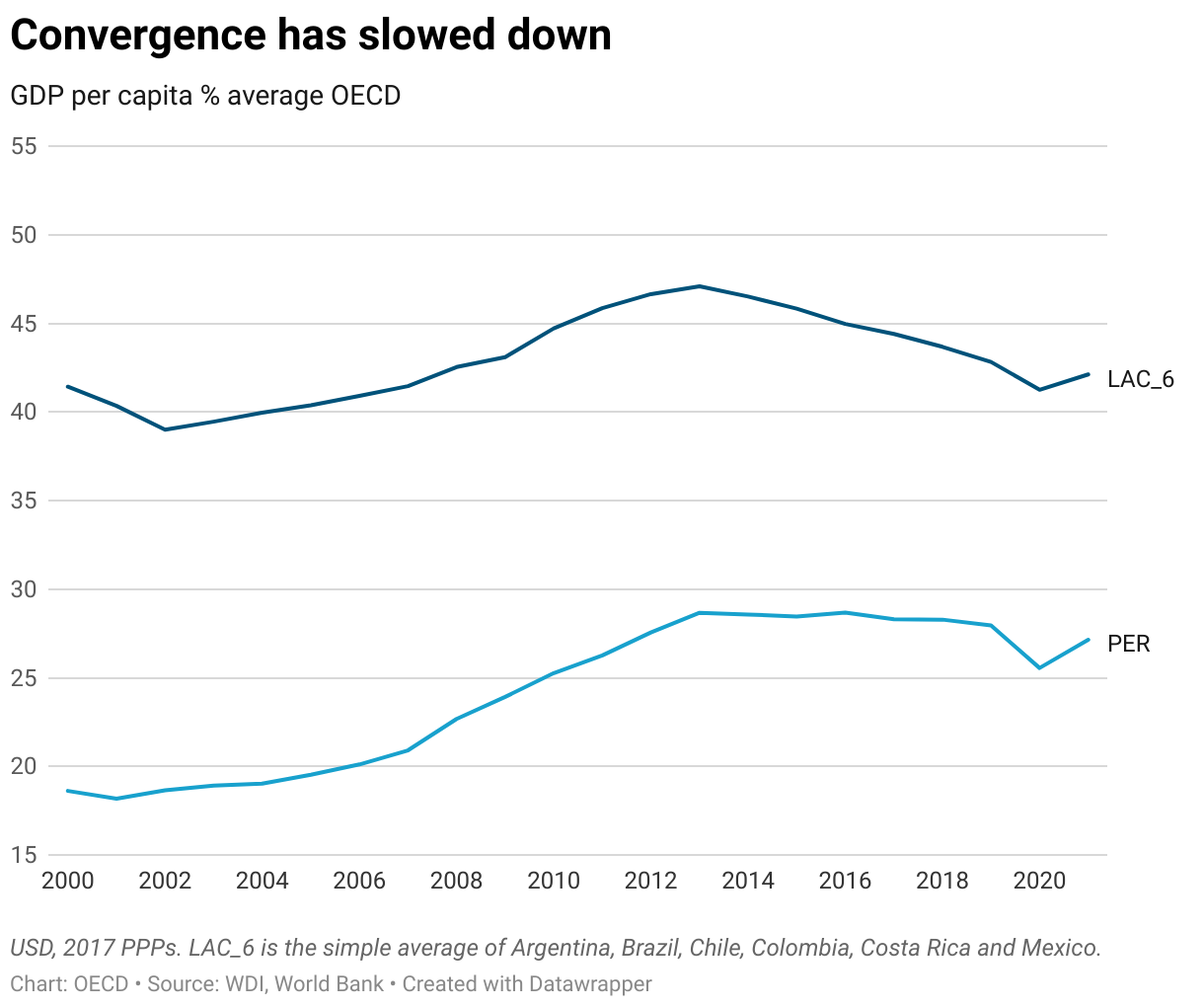
Income convergence to more advanced countries stalled in 2014 with the end of the commodity price boom, making it of utmost importance to boost productivity and investment. While commodities, particularly minerals, have fuelled past growth, there is a need to expand the economy’s productive base. High concentration of market power in a few major business groups reduces market dynamism. This calls for strengthening competition enforcement and simplifying regulations to boost productivity. Additionally, better public spending efficiency would help close infrastructure gaps and deliver essential services while boosting potential growth. This entails enhancing local government capabilities, improving infrastructure planning, and modernising the civil service to enhance overall state capacity. Strengthening the rule of law by fighting corruption and improving judicial independence and efficiency is equally important, as it not only encourages investment but also restores trust in institutions.

Tackling Informality

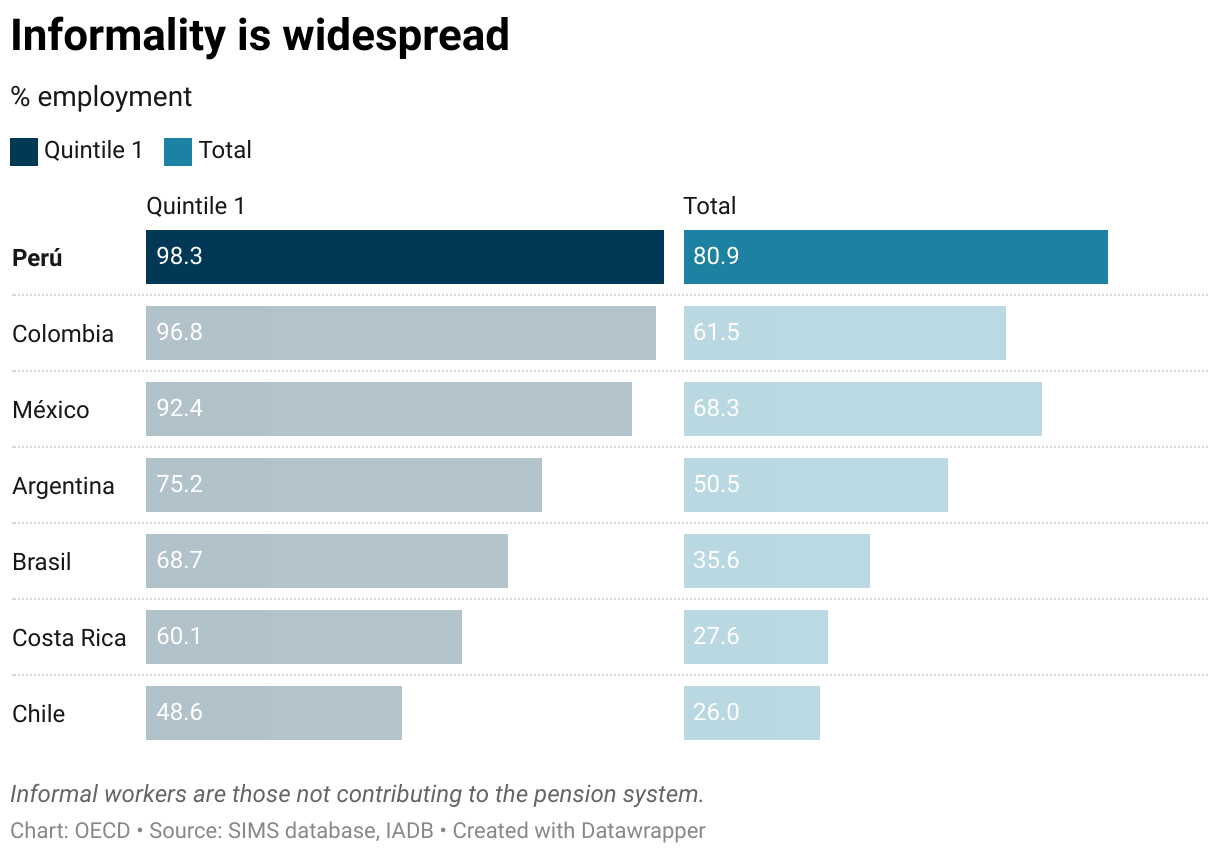
The challenge of informality looms large in Peru, with around 80% of workers in informal jobs, without social and labour protection, and on the margin of the formal tax and benefit system. Though there is no silver bullet solution as the roots of informality are multi-dimensional, fostering formality through a comprehensive reform package is essential for reducing poverty and inequality, boosting productivity, and improving tax collection. Ensuring universal access to basic social benefits – health, pensions, and social assistance – for both formal and informal sector workers alike, could remove some distortions that incentivise informality. This requires increased social spending funded by general taxation instead of by social contributions that make formal job creation expensive incentivising informal job creation. Providing universal access to pensions and health services financed by general taxation offers the possibility of reducing social contributions for low-income workers, promoting formal employment, and boosting productivity. Improving access to high-quality education tackles another root cause of informality, low labour productivity. Closing the gap in learning outcomes, especially among disadvantaged students, requires improving teachers’ training and addressing school infrastructure gaps.

Strengthening Public Finances

Peru’s current tax revenues, at 17% of GDP, lag both OECD and regional peers. A key challenge for Peru is sustaining fiscal responsibility while addressing social and infrastructure needs. Addressing this gap requires a multifaceted approach: improving spending efficiency while strengthening tax administration, reducing tax expenditures, modernizing property registries, and streamlining corporate tax schemes.

Confronting Climate Change

Climate change poses another significant challenge for Peru. The country is highly vulnerable to extreme weather events and is committed to achieving carbon neutrality by 2050. To achieve this goal, the country must combat deforestation—a major contributor to greenhouse gas emissions—and accelerate the use of renewable energy sources implementing stricter regulations and consistent price signals to reduce reliance on fossil fuels, tapping the enormous potential that the country has in this area.

As Peru navigates these multifaceted challenges, its process of accession to the OECD can offer a framework for long-term reforms that address existing vulnerabilities and allow the convergence to higher living standards. This roadmap, grounded in evidence and best practices, should build on the successes of the past, such as the robust macroeconomic setup that fuelled Peru’s economic growth. Realising this transformation demands political consensus, evidence-backed policies, and collaborative efforts.

References

OECD (2023), OECD Economic Surveys: Peru 2023, OECD Publishing, Paris, https://doi.org/10.1787/081e0906-en


Avanzando juntos: Reformas claves para un Perú próspero

Also available in English

Por Paula Garda y Michael Koelle, Departamento de Economía de la OCDE

Perú ha logrado significativos avances en las últimas dos décadas hasta 2019 en la reducción de la pobreza y la mejora de los niveles de vida, superando a muchos países de América Latina, como se destaca en el Estudio Económico de la OCDE de Perú 2023.  La base de este progreso fue un sólido marco macroeconómico y ambiciosas reformas estructurales implementadas en la década de 1990. Estas reformas han logrado darle al país estabilidad macroeconómica, alto crecimiento económico, baja inflación y una de las menores ratios de deuda pública- PIB en la región.

Sin embargo, la pandemia de COVID-19 puso de manifiesto los desafíos estructurales pendientes. Perú experimentó una de las contracciones económicas y tasas de mortalidad más altas de todos los países. La economía se recuperó en 2021, gracias a los existentes amortiguadores fiscales. Pero la recuperación fue transitoria y una serie de shocks, como la guerra de agresión de Rusia en Ucrania, conflictos sociales y el fenómeno del Niño, provocaron presiones inflacionistas y una ralentización económica. Se prevé que la economía se recupere gradualmente y que la inflación vuelva al rango objetivo a principios de 2024. Sin embargo, Perú se enfrenta a problemas estructurales de larga data, como una alta proporción de empleos informales, amplias brechas en infraestructuras básicas y un débil Estado de Derecho. Estos problemas no sólo magnifican el impacto de shocks adversos y las desigualdades socioeconómicas, sino que también frenan a Perú en su camino hacia mejores niveles de vida.

A medida que el Perú se embarca en su viaje hacia la adhesión a la OCDE, el proceso representa una oportunidad transformadora para que el país diseñe e implemente una agenda integral de reformas para fomentar la convergencia hacia mejores niveles de vida para todos los peruanos. El Estudio Económico del Perú 2023 destaca cuatro áreas prioritarias de reformas:

Fomentar el crecimiento de largo plazo

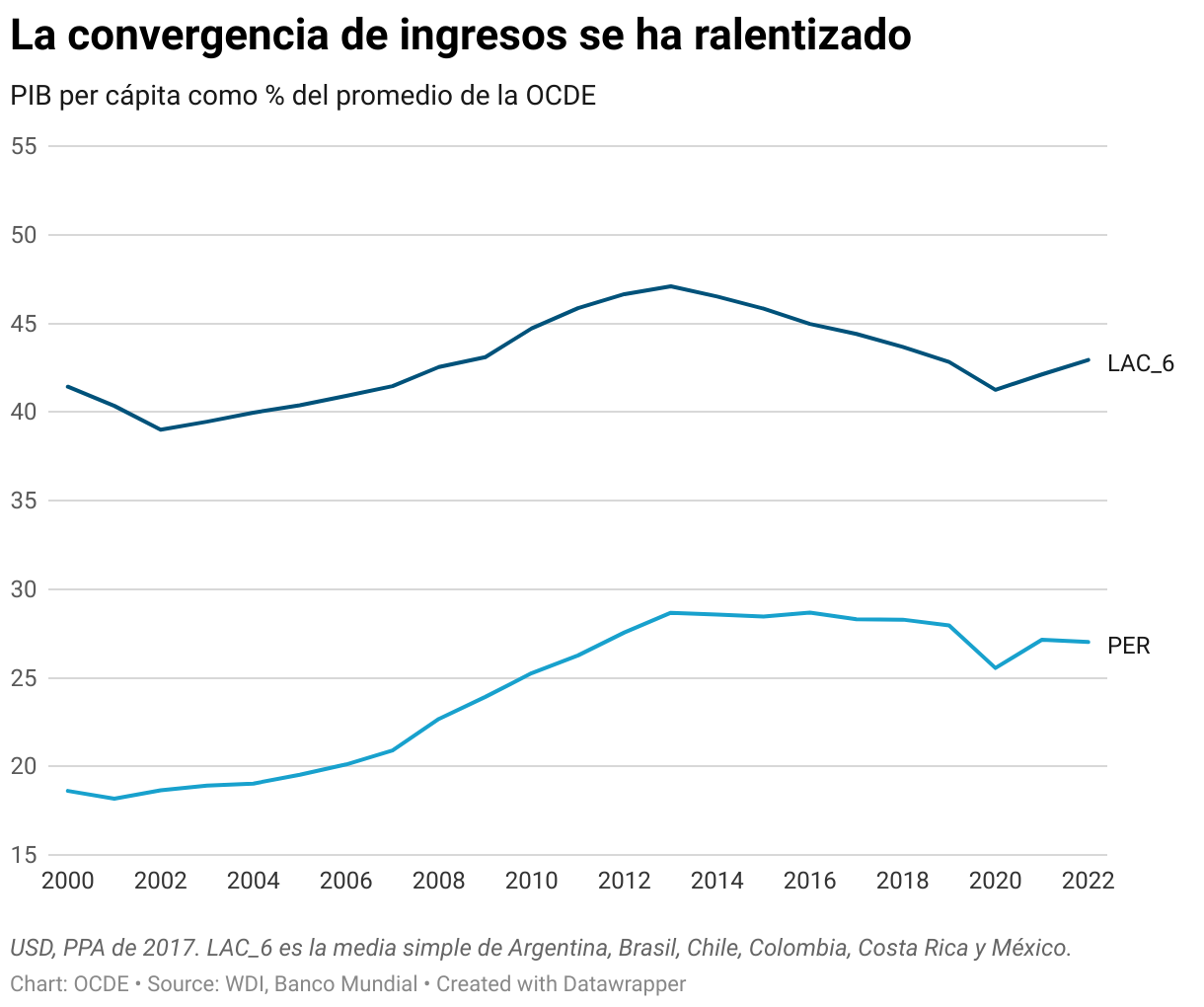
La convergencia de ingresos hacia los países más avanzados se estancó en 2014 con el fin del auge de los precios de las materias primas, por lo que es de suma importancia impulsar la productividad y la inversión. Aunque las materias primas, en particular los minerales, han impulsado el crecimiento en el pasado, es necesario ampliar la base productiva de la economía. La elevada concentración del poder de mercado en unos pocos grandes grupos empresariales reduce el dinamismo del mercado. Esto exige reforzar la aplicación de las leyes de competencia y simplificar las regulaciones y licencias para impulsar la productividad. Además, una mayor eficiencia del gasto público ayudaría a cerrar las brechas en infraestructuras y a prestar servicios públicos esenciales, impulsando al mismo tiempo el crecimiento potencial. Ello implica reforzar las capacidades de los gobiernos subnacionales, mejorar la planificación de las infraestructuras y modernizar el servicio civil para aumentar la capacidad de implementación del Estado. El fortalecimiento del Estado de Derecho mediante la lucha contra la corrupción y la mejora de la independencia y la eficiencia del sistema judicial es igualmente importante, ya que no sólo fomenta la inversión, sino que también puede restablecer la confianza en las instituciones.

Luchar contra la informalidad

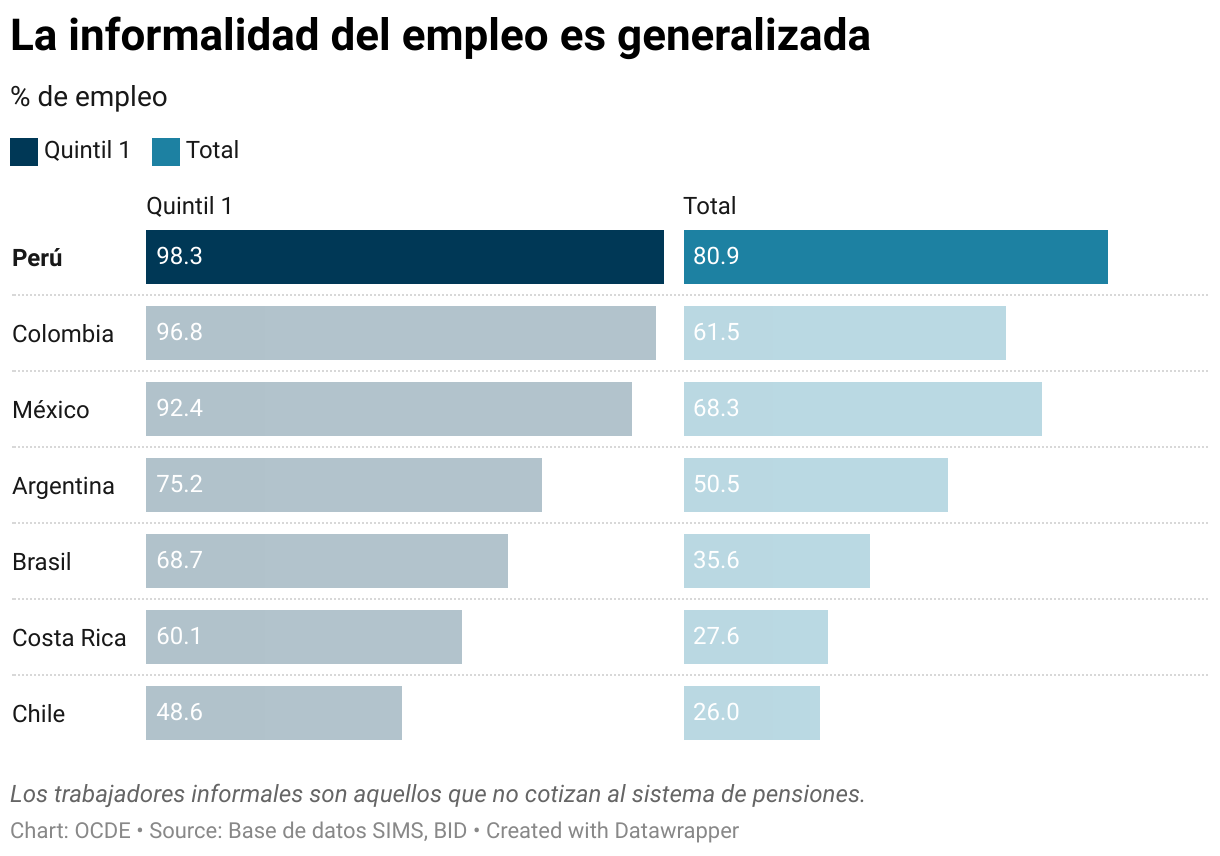
La informalidad representa un gran desafío para Perú, con cerca del 80% de los trabajadores en empleos informales, sin protección social o laboral, y al margen del sistema formal de impuestos y transferencias. Aunque no existe una solución milagrosa, ya que las raíces de la informalidad son multidimensionales, fomentar la formalidad a través de un paquete integral de reformas es esencial para reducir la pobreza y las desigualdades, impulsar la productividad y mejorar la recaudación tributaria. Garantizar un acceso universal a unos servicios básicos de protección social – en salud, pensiones y asistencia social – tanto para los trabajadores formales como informales, podría eliminar algunas distorsiones que incentivan la informalidad. Para ello es necesario aumentar el gasto social financiado con impuestos generales en lugar de con contribuciones sociales que encarecen la creación de empleo formal incentivando así la creación de empleo informal. Proporcionar un acceso universal a las pensiones y a los servicios de salud financiados por impuestos generales ofrece la posibilidad de reducir las contribuciones sociales de los trabajadores de bajos ingresos, promoviendo el empleo formal e impulsando la productividad. Mejorar el acceso a una educación de alta calidad aborda otra de las causas fundamentales de la informalidad, la baja productividad laboral. Cerrar la brecha en los resultados de aprendizaje, especialmente entre los estudiantes desfavorecidos, requiere mejorar la formación de los maestros y abordar las deficiencias de las infraestructuras escolares.

Fortalecer las finanzas públicas

Los ingresos tributarios del Perú, del 17% del PIB, son inferiores a los de sus pares de la OCDE y de la región. Un reto clave para Perú es mantener la responsabilidad fiscal al tiempo que se abordan las necesidades sociales y de infraestructura. Enfrentar este desafío requiere un enfoque multidimensional: mejorar la eficiencia del gasto público al tiempo que se refuerza la administración tributaria, se reducen los gastos tributarios, se moderniza el catastro y se racionalizan y simplifican los regímenes del impuesto a la renta de sociedades.

Afrontar el cambio climático

El cambio climático plantea otro desafío importante para Perú. El país es muy vulnerable a los fenómenos meteorológicos extremos y se ha comprometido a alcanzar la neutralidad de carbono para 2050. Para lograr este objetivo, el país debe combatir la deforestación -un importante contribuyente a las emisiones de gases de efecto invernadero- y acelerar el uso de fuentes de energía renovables aplicando regulaciones más estrictas y señales de precios coherentes para reducir la dependencia de los combustibles fósiles, aprovechando el enorme potencial que el país tiene en energías renovables.

Mientras Perú navega por estos desafíos multidimensionales, el proceso de adhesión a la OCDE puede ofrecer un marco para reformas que aborden las vulnerabilidades existentes y permitan la convergencia hacia niveles de vida más altos para todos los peruanos. Esta hoja de ruta, basada en evidencia y buenas prácticas, debería aprovechar lo que ha funcionado bien, como el sólido marco macroeconómica que ha impulsado el crecimiento económico de Perú. Llevar a cabo esta transformación exige consenso político, políticas basadas en evidencia y esfuerzos de todos los peruanos.

Referencias

OECD (2023), OECD Economic Surveys: Peru 2023, OECD Publishing, Paris, https://doi.org/10.1787/081e0906-en


Making growth more inclusive by enhancing social protection: the case of Malaysia

By Abu Zeid Mohd Arif, Economist, Country Studies Branch, OECD Economics Department

Growth can be more inclusive by pursuing policies that enable improvements in a country’s living standards while sharing gains more equitably across the population. Inclusive growth incorporates a focus on relative – not just absolute – income and wealth inequality, and on well-being, which depends on both monetary and non-monetary conditions, such as access to quality education, employment, housing and healthcare.

Malaysia’s success in alleviating poverty has been achieved despite the absence of an integrated and comprehensive social protection system. Households benefit from near-universal access to electricity, clean water, healthcare and transport, but income support for disadvantaged persons (such as the unemployed, single parents, disabled and elderly) remains ad hoc, insufficiently targeted and inadequate in providing basic living standards (OECD, 2016a).

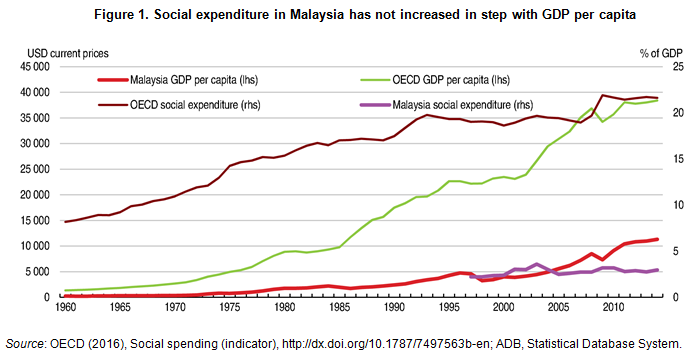
Malaysia’s social protection expenditure is lower than in all South East Asian countries for which data are available and than in all but a handful of countries in the Asia Pacific region. Public expenditure on social protection as a proportion of GDP typically rises in step with GDP per capita, as observed in OECD countries. Malaysia displays a different pattern (Figure 1). This would be the case even when adding in zakat, a compulsory Islamic charitable mechanism that in 2013 represented over one fifth of the level of government social spending excluding health.

malaysia-blog-3-fig-1

The low level of social protection expenditure is further reflected in the low redistributive power of the tax-and-transfer system: pre and post‑tax and transfer Gini coefficients for income barely differ, like in Turkey (Figure 2).

malaysia-blog-3-fig-2

Social expenditure is highly fragmented, being provided through a multitude of small-scale, specific-purpose programmes by a diverse range of ministries. It is essential that Malaysia develop a comprehensive social protection and income transfer system that provides targeted and timely support to those in need, while retaining strong incentives and facilitation mechanisms to maximise labour market participation. This calls for undertaking a comprehensive assessment of social protection needs and optimal strategies to meet them. Malaysia could utilise global best practice toolkits such as the Inter Agency Social Protection Assessments toolkit (ISPA, 2016) and draw lessons from the OECD Development Centre’s work to develop social protection systems in the region (OECD, 2016b).

A key priority is the introduction of an employment insurance scheme that integrates job‑matching services, reskilling and income smoothing to prevent a temporary setback from becoming an entrenched disadvantage. This scheme should also include temporary income smoothing payments to further reduce financial barriers to re-employment and overall income inequality.

References

ISPA (2016), Inter Agency Social Protection Assessments.

OECD (2016a), OECD Economic Surveys: Malaysia 2016: Economic Assessment, OECD Publishing, Paris.

OECD (2016b), The EU Social Protection Systems Programme, OECD Publishing, Paris.