The Foundations for Growth and Competitiveness

Builder working on foundations

OECD economies are facing new growth opportunities but also challenges. Taking the most out of these opportunities while addressing the challenges will be key to revitalise productivity and secure higher living standards for future generations.

by Stefano Scarpetta, OECD Chief Economist and G20/G7 Finance Deputy


Across the OECD and beyond, the foundations of economic growth are under strain. Over the past two decades, labour productivity growth has slowed markedly in most countries. This slowdown reflects a combination of structural bottlenecks: subdued business investment, declining firm dynamism, slowing technology diffusion and a weakening pace of human capital accumulation. While employment growth has been resilient, many countries are facing significant population ageing, which will affect the potential for labour to sustain growth.

At the same time, rapid advances in artificial intelligence and digital technologies offer the potential of a new wave of sustained productivity gains. Whether new technologies translate into sustained productivity gains will depend crucially on structural policy settings.

This first edition of Foundations for Growth and Competitiveness arrives at a pivotal moment. Structural reform momentum has slowed across many OECD countries but there is heightened need for countries to remain competitive and resilient in a global landscape characterised by unprecedented structural transformations and geopolitical and trade shocks. To help countries meet these challenges, the report offers practical tools for policy makers, including a comprehensive online data platform to identify structural policy bottlenecks and tailored reform priorities for 48 countries developed through an iterative dialogue with national authorities.

Sustainable prosperity rests on strong enabling conditions: high-quality human capital, sound institutions,
effective governance, reliable infrastructure, affordable and secure energy supply and macroeconomic stability. Across countries, strengthening skills systems and lifelong learning emerges as one of the most frequent reform priorities in this report also to promote an effective adoption of digital and in particular AI tools. As artificial intelligence and digitalisation reshape production and the way businesses work, workforce adaptability becomes a decisive competitive advantage. Countries that strengthen vocational education, expand access to lifelong learning and deepen links between universities and labour markets will be better placed to adapt to evolving business needs.

Institutional quality and efficient regulatory processes are equally critical. Predictable, transparent and well-designed regulatory frameworks foster trust and reduce uncertainty. Strong institutions improve the allocation of resources and underpin market incentives. In an era of heightened geopolitical and economic uncertainty, macroeconomic stability and sound fiscal frameworks remain essential anchors.

Yet enabling conditions alone are not sufficient. Markets must also function efficiently to promote economic
dynamism, technological diffusion and business investment. But when these forces are weakening, policies that strengthen competition and reduce regulatory barriers become more important. Accordingly, improving product market regulation and insolvency regimes is another central reform priority identified across countries. Recommendations also emerge in the tax space, given that poorly designed tax systems can distort incentives and discourage investment.

Labour mobility and participation also remain central to competitiveness and for enhancing access to quality jobs for workers. Reducing barriers to participation – particularly for women, older workers and underrepresented groups – while strengthening work incentives, employability and expanding access to affordable childcare can raise both equity and efficiency. Housing policies that facilitate mobility and tax systems that broaden the base while limiting distortions can further enhance allocative efficiency.

With strong foundations and effective market incentives in place, governments can more successfully guide economic activity toward strategic priorities. Innovation policy, energy security and the clean energy transition are areas where well-designed, targeted interventions can address market failures and support long-term growth. Public support for research and development, when combined with strong human capital and competitive markets, can unlock private investment. Energy market reforms that reduce entry barriers and encourage investment in renewables can strengthen both resilience and competitiveness.

A central message of this edition is that structural reforms are most powerful when they are coherent and complementary. Product market reforms enhance the impact of human capital-augmenting policies. Sound fiscal frameworks reinforce confidence and enable reform to endure. Policy complementarities are particularly important in the context of major technological and demographic transformations.

While the long-term benefits of reform are well documented, the political feasibility of reforms often hinges on near-term effects on policies. By providing examples of how some reforms affect economic performance in the short run, this edition provides food for thought in designing and implementing reform packages that are both economically effective and have strong and broad support. Understanding transitional effects, anticipating distributional impacts and deploying complementary measures can help sustain reform momentum.

Structural reforms also play a crucial role in strengthening fiscal sustainability. At a time of elevated public
debt and rising spending pressures, growth-enhancing reforms offer a path to improving debt dynamics without relying exclusively on fiscal consolidation. By broadening tax bases, improving government efficiency and boosting economic dynamism, reforms can reinforce both resilience and long-term prosperity.

Ultimately, competitiveness is not a zero-sum concept. Economies that strengthen their domestic foundations contribute to a more dynamic and resilient global economy. The objective is not simply faster growth, but growth that is durable, innovation-driven and aligned with environmental sustainability and social cohesion.

The OECD economies are facing new growth opportunities but also challenges. Taking the most out of these opportunities while addressing the challenges will be key to revitalise productivity and secure higher living standards for future generations.

The foundations of growth must now be rebuilt deliberately and decisively.

Editorial from the OECD Foundations for Growth and Competitiveness

References:

OECD (2026), Foundations for Growth and Competitiveness 2026, OECD Publishing, Paris, https://doi.org/10.1787/40a7532f-en.


What’s holding back competition in energy markets?

Electricity and natural gas markets power modern economies. They fuel industrial production and transportation services, enable digital infrastructure, and meet households’ everyday energy needs. Because electricity and gas are inputs needed in almost every economic activity, how these markets perform matters beyond the energy sector itself.

By Cassie Castle, OECD Economics Department

Lire en français/French version


A large body of evidence shows that well-designed, competitive energy markets can discipline prices, strengthen investment incentives, and support innovation. Competition forces firms to improve efficiency, adopt new technologies and respond to consumer needs. When competition is weak, those pressures fade (OECD, 2022). The result is not only higher energy bills, but wider consequences for businesses, households and economic performance.

According to a new OECD working paper based on the OECD Product Market Regulation (PMR) indicators, countries have already undertaken significant reforms to support competition. For much of the 20th century, electricity and natural gas sectors were mostly organised as vertically integrated state-owned monopolies, with limited incentives for efficiency or innovation. A major wave of liberalisation reforms, particularly during the 1990s, transformed this model. Many countries made significant steps to unbundle monopoly networks, regulate third-party access to infrastructure and open generation and retail markets to new entrants.

Despite this progress, important gaps remain. The new OECD working paper examines the current state of the regulatory framework in the electricity and natural gas markets across 50 countries. It evaluates the extent to which these frameworks support competition by lowering entry barriers, ensuring non-discriminatory access to monopoly network services and reducing switching costs across the supply chain. Drawing on the latest update of the OECD PMR indicators, the paper shows that while legal liberalisation is widespread, key regulatory shortcomings continue to limit the full benefits of competition (see Figure).

The PMR Sector Indicator for Energy: Latest results

Four issues stand out:

First, in some countries the monopoly network infrastructure — transmission and distribution grids — remains weakly separated from competitive activities like generation, storage and retail supply. In electricity, around 10% of surveyed countries impose only accounting separation or no separation at all. In natural gas, this rises to around 16% of countries. Where vertical integration persists, firms have both the incentive to favour their own affiliates and restrict rivals’ access to essential networks. Stronger forms of unbundling, such as legal or ownership separation, provide more robust safeguards and are widely recognised as best practice.

Second, a number of countries continue to restrict households and small businesses from choosing their retail energy supplier and maintain broad retail price regulation beyond targeted support for vulnerable households. This is usually the case when the market is not yet fully competitive. Where entry barriers persist, switching costs are high, or wholesale markets do not function effectively, premature liberalisation can lead to poor outcomes for consumers. However, concerns about price volatility may offer an additional explanation for why regulated retail tariffs remain in place, sometimes alongside market-based offers, particularly following the 2021-2023 energy crisis. Sharp price swings prompted some countries to extend or maintain retail price regulation for small consumers, even in otherwise well-developed markets. The paper explores this tension further. While price controls can provide stability in periods of stress, open-ended measures risk distorting price signals, weakening competitive pressures over time and reducing the benefits of open markets.

Third, even where consumers are free to choose, many lack the tools to engage effectively in retail markets. Retail competition can only deliver meaningful benefits if consumers have access to the information needed to make informed decisions when choosing their supplier. Most countries require suppliers to provide detailed consumption and cost data in monthly bills, but only a few also offer independent price comparison tools. The low rate of roll-out of smart meters also limits the information available to consumers to understand their patterns of consumptions and select the most suitable tariff. Without active support to help consumers make informed choices, the time and effort required to compare offers and change supplier acts as a barrier, even when cheaper offers exist. Lowering these switching costs is essential to making competition work in practice.

Fourth, in electricity markets, demand-side flexibility is increasingly important for grid stability and cost efficiency, helping manage peak demand and integrate variable renewables. However, explicit demand response is not universally available. Around 21% of the countries surveyed do not allow these programmes, and among those that do, roughly one-third restrict participation to industrial users, leaving smaller consumers, in particular households, largely excluded. Expanding household participation requires smart meter deployment to enable time-of-use and dynamic tariffs, alongside regulatory frameworks that permit dynamic pricing and aggregator participation. When these conditions are in place, households can shift consumption away from peak periods, reducing their energy bill, while limiting system costs and strengthening grid stability.

These findings point to an unfinished reform agenda. Legal liberalisation has advanced considerably, yet structural gaps still limit countries from enjoying the benefits of effective competition. Closing these gaps is becoming more urgent as energy systems shift toward higher shares of renewable and decentralised generation. Integrating variable supply requires greater flexibility through responsive demand and clear price signals. Competitive markets are key to delivering these adjustments efficiently. Completing the reform process is therefore not only about improving outcomes within the energy sector, but about supporting a more resilient energy system that underpins productivity and growth across the wider economy.

References

Castle, C. and C. Varriale (2026), “Building competitive energy markets: Regulatory insights from the OECD PMR indicators”, OECD Economics Department Working Papers, No. 1863, OECD Publishing, Paris, https://doi.org/10.1787/f47862f5-en.

OECD (2022), “Competition in Energy Markets”, OECD Roundtables on Competition Policy Papers, No. 290, OECD Publishing, Paris, https://doi.org/10.1787/e2e1b9be-en.

For more information, please visit the OECD Product Market Regulation (PMR) webpage: https://www.oecd.org/en/topics/product-market-regulation.html


Why Regulating Lobbying Matters for Competition: New Insights from the OECD PMR Indicators

By Cristiana Vitale, OECD Economics Department.

Effective competition is central to vibrant economies. It keeps prices low for consumers, encourages firms to improve their products, foster an efficient use of resources, and helps innovative new firms enter markets. But market competition depends on well-designed regulation and critically, on the way policymakers interact with the stakeholders affected by those rules. A new OECD working paper highlights how stakeholder consultation is a key part of an effective regulatory framework, but inadequate transparency and accountability in interactions with interest groups risk tilting the playing field in favour of well-resourced incumbent firms.

A growing body of research shows that well-connected firms often use political influence to shape rules in ways that protect their market position by pushing for complex regulatory requirements that are disproportionately costly for smaller or newer competitors, or to obtain preferential access to contracts and loans. Political connections can help less productive firms survive while preventing more innovative ones from scaling up. The consequences are clear: markets become less contestable, innovation slows, and productivity growth suffers.

The latest update of the OECD Product Market Regulation (PMR) indicators, which track laws and regulations across 47 countries, shows that most governments require stakeholders to be consulted when new laws and regulations are drafted. This could improve policy design as stakeholder engagement helps policymakers to better understand the real-world effects of regulatory intervention. But the same data also reveal major gaps in how countries manage lobbying activities and ensure integrity standards, leaving policymaking vulnerable to undue influence (see Figure 1 below).

It is notable that more than one-half of the surveyed countries lack basic integrity safeguards for public officials involved in regulatory processes. One-third lack comprehensive conflict-of-interest rules, and over one-third do not require any cooling-off period if senior officials leave office for the private sector. Strikingly, the two countries in the survey that have none of these two integrity standards are OECD members.

Transparency in lobbying interactions is even more limited. Only two countries—Chile and Poland—meet all four key disclosure requirements assessed in the PMR data, including maintaining a public lobbyist registry and requiring policymakers to disclose both their meeting agendas and the identities of the interest groups they meet. Twelve countries have none of these obligations.

Even when lobbying registries exist, they often cover only some types of interest groups or are voluntary. Public officials’ disclosure obligations are also rare: just 28% of countries require officials to reveal which interest groups they meet, and only 23% require meeting agendas to be published online.

As governments increasingly use industrial policies to promote innovation, encourage decarbonisation, and support strategic sectors, strong safeguards against undue influence are becoming more important. Lobbying is not inherently negative; policymakers benefit from engaging with stakeholders who understand the real-world effects of regulations. However, unregulated lobbying can redirect subsidies and support toward well-connected incumbents rather than potential innovators. This undermines the effectiveness of public spending and entrenches market power instead of encouraging technological dynamism and reducing barriers to the entry and growth of new companies.

With evidence of rising market concentration across advanced economies, the risk that lobbying will impede competition is likely to grow. The new PMR data reveal a clear message: while most countries value stakeholder engagement, many do too little to ensure transparency and integrity in lobbying practices. Strengthening rules on conflicts of interest, expanding disclosures by both lobbyists and public officials, and ensuring open registers of interest groups would help restore trust and support competitive markets.

References

Vitale, C. and R. Bitetti (2026), “Regulating lobbying activities to protect competition: New evidence from the OECD PMR indicators”, OECD Economics Department Working Papers, No. 1855, OECD Publishing, Paris, https://doi.org/10.1787/ad88f58a-en.

Akcigit, U., S. Baslandze and F. Lotti (2023), “Connecting to Power: Political Connections, Innovation, and Firm Dynamics”, Econometrica, Vol. 91/2, pp. 529-564, https://doi.org/10.3982/ecta18338.

Alexander, R., S. Mazza and S. Scholz (2009), “Measuring Rates of Return for Lobbying Expenditures: An Empirical Case Study of Tax Breaks for Multinational Corporations”, SSRN Electronic Journal, https://doi.org/10.2139/ssrn.1375082.

Faccio, M. (2006), “Politically Connected Firms”, American Economic Review, Vol. 96/1, pp. 369-386, https://doi.org/10.1257/000282806776157704.

Koltay, G., S. Lorincz and T. Valletti (2023), “Concentration and Competition: Evidence From Europe and Implications For Policy”, Journal of Competition Law & Economics, Vol. 19/3, pp. 466-501, https://doi.org/10.1093/joclec/nhad012.


New time-series data shed light on regulatory trends in energy, transport, and telecoms since 1975

By Cassie Castle, OECD.

The OECD has released the 2023 update of its Energy, Transport & Communication Regulation (ETCR) indicators.

This harmonised annual time series spans from 1975 to 2023 and captures the scope and development of regulatory frameworks in six network sectors: electricity and natural gas; transport by air, road, and rail; and telecommunications by focusing on key dimensions such as barriers to entry; the degree of concentration of market participants; and the degree of public ownership.

The data cover 34 countries, including all OECD members except the most recent additions (Colombia, Costa Rica, Latvia and Lithuania). The ETCR indicators range between 0 and 6, with higher scores reflecting a less competition friendly regulatory framework. For details on how the ETCR indicators are constructed, see the methodology slides here.

Figure 1 presents the ETCR scores over the 50-year period for which data have been collected and shows a marked decline across all six network sectors since the 1980s, reflecting a broad trend toward more competition-friendly regulation across OECD members. The pace of liberalisation was particularly rapid during the late 1990s and early 2000s.

Figure 1. ETCR over time, OECD average

To fully capture the effects of regulation in network sectors, the OECD has also published the Regulatory Impact (REGIMPACT) indicators. The REGIMPACT indicators capture how regulation in network sectors indirectly affects downstream industries that rely on them for intermediate inputs. Given that network sectors supplied approximately 20% of the intermediate inputs used by other industries in 2022, understanding both direct and indirect regulatory impacts is crucial for evaluating their broader economic significance.

REGIMPACT indicators are calculated by combining ETCR indicators with measures of sectoral exposure derived from input-output tables. The time-series is available annually from 1975 to 2023 for the 34 OECD countries covered by the ETCR. The REGIMPACT indicators are calculated for 21 downstream sectors, with coverage varying by country and sector based on data availability.

A recent OECD study uses the updated ETCR and REGIMPACT indicators to assess the long-run impact of pro-competition reforms in network sectors on economic performance. The paper, ”Regulation and growth: Lessons from nearly 50 years of product market reforms” (Andrews et al., 2025), finds that the lack of pro-competitive reforms in upstream network sectors, particularly those aimed at removing barriers to entry, significantly hampers growth in downstream industries.

On average across the OECD, liberalising network sectors between 1980 and 2023 is estimated to have raised labour productivity by around 5 percent cumulatively, driven by gains in value added (6 percent), employment (2 percent), and capital stock (4 percent). Notably, the productivity gains in manufacturing, which relies heavily on inputs from regulated upstream sectors, were more than twice as large.

The study further finds that rapid reforms in the late 1990s and early 2000s added approximately 0.25 percentage points annually to labour productivity growth. As reform momentum slowed, their positive effects weakened, possibly contributing to as much as one-sixth of the slowdown in productivity growth since 2005.

Yet, there is still room for improvement. Countries with more regulated network sectors could still raise productivity by up to 1.7% by aligning with the most liberalised peers. The findings underscore the continued value of pro-competitive reforms, especially where regulatory barriers remain high.

To learn more about the OECD’s Product Market Regulation indicators, please visit the PMR webpage.

References

Andrews, D., B. Égert, C. de La Maisonneuve and C. Castle (2025), “Regulation and growth: Lessons from nearly 50 years of product market reforms”, OECD Economics Department Working Paper No. 1835, https://doi.org/10.1787/3b3285df-en.


Ensuring high but sustainable growth in Türkiye

A tower in the historic part of Istanbul

By Sébastien Turban, Economist, OECD

Türkiye has been one of the fastest-growing economies in the OECD over the past decade, leading to a significant improvement of labour market and social outcomes. However, the income gap with OECD countries remains large. In addition, growth had become unsustainable in the years following the Covid crisis since it relied excessively on domestic demand, which lead to large internal and external imbalances in 2022, notably very high inflation and a sizeable current account deficit.

In this context, the new 2025 OECD Economic Survey of Türkiye (OECD, 2025a) contains four main messages:

  1. Prudent macroeconomic policies are a pre-requisite for sustainable growth.
  2. Higher productivity gains are needed to speed up convergence towards other OECD economies.
  3. The economy would hugely benefit from a higher labour force participation of women.
  4. A greener economy requires more ambitious policies, notably transitioning away from coal.

Following the May 2023 elections, a more prudent macro-economic policy mix has been implemented. The Central Bank has gradually raised interest rates, and the government is planning a fiscal consolidation for the coming years. This policy has started to bear fruits, with a reduction of imbalances, including a gradual fall in inflation (Figure 1). Maintaining tight monetary policy and fiscal discipline will be essential until inflation is firmly under control. Over the long term, improving public finances will require structural reforms. This includes reducing the scope of reduced VAT rates, a broader income tax base (in particular by tackling informality), and targeting better social assistance to help reduce the high level of inequalities.

Productivity has increased faster in Türkiye than other OECD countries in the last decades, but potential GDP per worker remains relatively low. Higher productivity gains, in particular in services sectors, require supporting innovation, upskilling the labour force, and reducing barriers to the conduct of business activity. The Economic Survey discusses three important steps in this respect.

  • Firstly, Türkiye could boost homegrown innovation by supporting collaborations between businesses and research to promote broader technology adoption.
  • Secondly, the skills of the labour force could be improved to adapt to future challenges. Important skills mismatches remain and incentives for tertiary education institutions to offer courses more aligned with labour market needs could be further enhanced.
  • Finally, business dynamism in Türkiye remains hampered by tighter regulations relative to other OECD countries (Figure 2). In particular, barriers in professional services could be lowered.

Boosting the participation of women in the labour force would hugely benefit the economy. This would increase the pool of talents the economy needs, especially as population is ageing, with a contribution to growth of working-age population set to decline. The labour force participation of women aged between 15 and 64 years old, at 40.9% in 2023, remains significantly below the OECD average of 66.7% (Figure 3). A combination of policies would help closing the gap between women and men on labour markets, such as expanding public investment in early childhood education and care (ECEC), introducing shareable paid parental leave, and increasing child-related benefits.

Finally, achieving the ambitious target of zero net emissions of carbon by 2053 will require more ambitious policies since greenhouse gas emissions are still growing. Türkiye has made recent progress in its climate change strategy by ratifying the Paris Agreement in 2021, updating its Nationally Determined Contribution in 2023 and documenting strategies and action plans thoroughly. However, current policies are likely to be insufficient to achieve the ambitious objectives. In particular, two important steps can be taken to bring the reduction in emissions forward. First, the effective carbon tax should be higher. Today, the effective price of carbon in Türkiye is EUR 8 per ton of CO2 equivalent, against EUR 62 in the OECD (OECD, 2023). Second, Türkiye will need to transition away from coal for energy supply as this polluting energy source still represents 26% of energy supply (against 12% in the OECD) and contributes to emissions of fine particulates with significant adverse health effects (OECD, 2025b).

References

OECD (2025a), OECD Economic Surveys: Türkiye 2025, OECD Publishing, Paris,
https://doi.org/10.1787/d01c660f-en.

OECD (2025b), Environment at a Glance Indicators, OECD Publishing, Paris,
https://doi.org/10.1787/ac4b8b89-en.

OECD (2023), Effective Carbon Rates 2023: Pricing Greenhouse Gas Emissions through Taxes and Emissions Trading, OECD Series on Carbon Pricing and Energy Taxation, OECD Publishing, Paris, https://doi.org/10.1787/b84d5b36-en.


Weighing up the Growth Dividends from Structural Reforms

by Balázs Égert and Peter Gal, OECD Economics Department

In many OECD countries, economic growth has yet to recover the lost ground suffered in the aftermath of the financial crisis. In some of them, unemployment has been persistently high, investment rates disappoint, and productivity is extremely sluggish – a “low growth trap”. Put differently, all three sources of sustainable long-run growth under-perform. This jeopardizes societies’ ability “to make good on its promises to current and future generations – to create jobs and develop career paths for young people, to pay for health and pension commitments to old people”. (OECD, 2016). While this partly reflects the persistent weakness of demand in some cases (Mann, 2016), there are policy tools available that affect the long-run productive capacity of the economy, or potential growth. Our recent work takes a fresh view on the relative payoffs in terms of raising future growth (Égert and Gal, 2016). We study how various product and labour market policies and regulations affect per capita income growth over different horizons and through the three supply-side channels: multi-factor productivity (MFP), capital deepening and employment.

We find that product market regulation (PMR) reforms have the largest overall direct policy impact: reducing regulatory barriers to competition induce a cumulative increase of 0.7% of GDP per capita over a 5-year horizon. Other policies with considerable overall effects include increased spending on active labour market policies (ALMPs), a reduction in labour tax wedge, in the minimum wage or in the length of maternity leave with impacts ranging from 0.3% to 0.5%. Typical reforms in other policy areas tend to have a smaller impact on per capita income (Figure 1).

impact-reforms-on-gdp-egert1.

Different policies have different impacts on the separate supply-side components. For instance, PMR affects each of them, while labour market policies tend to impact only employment. Exceptions are ALMPs, which affects both productivity and employment, and EPL, which drives both capital deepening and employment. Finally, the corporate tax has an effect only on capital deepening, while R&D impacts only productivity (Figure 2).

The policy effects differ over longer horizons. For instance, the overall long-term effects on GDP per capita of PMR, employment protection (EPL) and ALMP spending are considerably larger than the 5-year impacts. This is mainly due the fact that MFP and capital are slower to react to reforms, compared to employment (Figure 1).

These results are based on past policy changes and assume that the impacts are uniform across countries and various institutional settings. But the estimation results shown in Figures 1 and 2 could be used as a starting point to provide precious help for policy makers for the elaboration of comprehensive structural reform packages. Depending on the ease with which reforms can be implemented, policies could be picked to reach policy objectives in terms of overall impact on per capita income. A natural follow-up to our paper would be to extend it to take into account country specificities and differences in the initial policy and institutional settings. Also, the enriched framework could be used to build an interactive policy simulator, which would help policy-makers to figure out the impact of planned reforms and to design comprehensive policy packages to achieve objectives such as a given increase in per capita income over a given horizon.

struc-ref1struc-reform-gal

Note: *Typically observed reforms are measured as the average improvements in the policy indicators over all two year windows that show improvements in both periods (see Table 5, column 4). The employment rate effects use all three aggregation approaches, and the size of the effects is indicated by numbers for the aggregation using demographic groups. See details in Egert and Gal (2016)
Source: Égert, B. and P. Gal (2016), “The quantification of structural reforms in OECD countries: a new framework”, OECD Economics Department Working Papers, No. 1354, OECD Publishing, Paris.

References

Égert, B. and P. Gal (2016), “The quantification of structural reforms in OECD countries: a new framework”, OECD Economics Department Working Papers, No. 1354, OECD Publishing, Paris.

Mann, C. L. (2016), “Deploy effective fiscal initiatives and promote inclusive trade policies to escape from the low-growth trap” ECOSCOPE, November 28.

OECD (2016), “Economic Outlook”, Vol 2016(1).


Product market reforms under the microscope

by Alexander Hijzen, Senior Economist, Directorate for Employment, Labour and Social Affairs, OECD and  Peter N. Gal, Economist, Economics Department, OECD

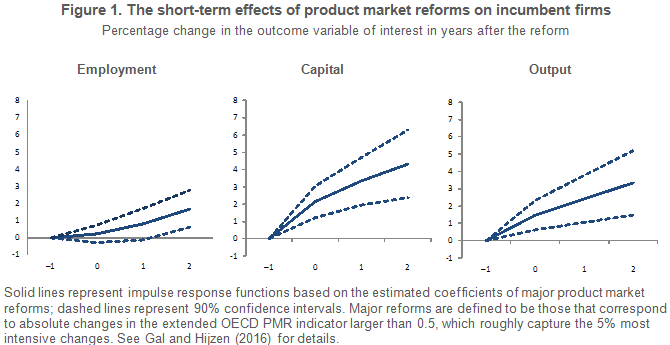
Given the secular decline in productivity growth and the persistent weakness of the economic recovery in many advanced economies, increased attention is being paid to the potential role of structural reforms for restoring economic growth. While structural reforms concern many policy areas (e.g. banking supervision, property right laws and employment-protection rules), product market regulation (PMR) feature particularly prominently on the agenda of many advanced economies (OECD, 2015). Understanding the dynamics effects of reforms in this area may provide important insights with respect to the way such reforms are designed, the political economy of reforms and the potential need for complementary policies. In a recent paper (Gal and Hijzen, 2016), we attempt to open up the black box of pro-competition product market reforms by providing a comprehensive analysis of their short-term impacts across firms that differ in terms of the main sector in which they operate, the size of their operations and their financial health.

Our main findings on the impacts of major product market reforms are as follows:

  • First, the short-term, firm-level effects of reducing regulatory barriers to product market competition are positive and strengthen over time (Figure 1). The effects are immediate for both output and investment, and increase further to 4% and 3% respectively after two years. The effects for employment are considerably smaller and only materialize after two years.

gal-on-pmr-1

  • Second, there are systematic and plausible differences in the effects of reforms across firms of different sizes across different industries (Figure 2). More specifically, in network industries, small firms tend to benefit most from pro-competitive product market reforms, while larger ones downsize to reduce costs and maintain market shares. By contrast, in retail trade, large and potentially more efficient firms tend to benefit more from such reforms.

gal-on-pmr-2

  • Third, financial difficulties faced by firms weaken the short-term impact of product market reforms on investment. These findings highlight the importance of addressing the problem of weak bank balance sheets when considering product market reforms, and points to the complementary role of financial sector reform more generally. This is particularly relevant in those countries where the flow of credit is still weak and the case for product market reform is relatively strong (e.g. some countries in Southern Europe).

 In sum, the present findings confirm the positive effects of pro-competitive product market reforms on economic performance in the medium to longer term, while also providing rich new insights on the way the effects of such reforms materialize over time across different types of firms. More specifically, these findings help to understand why it can be difficult to implement product market reforms in certain sectors, but less so in others. For example, the pace of product market reforms could be slowed down in network industries since large incumbent firms have a tendency to lose out in terms of jobs and profitability. The tendency of financial difficulties to mitigate the impact of product market reforms on investment may also suggest that the effects of product market reforms materialize more slowly in times when the economy is depressed and credit is hard to get by.

These insights can be used to enhance the design of product market reforms and to motivate the need for complementary measures to promote aggregate demand, restore bank balance sheets and to alleviate the social cost of adjustment (IMF, 2016; OECD, 2016).

References

Gal, P. N. and A. Hijzen (2016), “The Short-Term Impact of Product Market Reforms : A cross-country firm-level analysis”, OECD Economics Department Working Papers No. 1311.
Also appeared as IMF Working Paper No. 16/116.

IMF (2016), World Economic Outlook, Chapter 3, April, International Monetary Fund, Washington, D.C.

OECD (2015), Economic Policy Reforms: Going for Growth, Organization for Economic Cooperation and Development, Paris.

OECD (2016), “Short-term labour market effects of structural reforms: Pain before the gain?”, in OECD Employment Outlook 2016, OECD Publishing, Paris.


Birds of a feather do business together

by Jean-Marc Fournier,
Economist, Public Economics Division,
OECD Economics Department

Numerous international agreements and free trade areas have reduced trade and foreign investment restrictions dramatically. This is one factor that has boosted international trade, which has risen about one and a half times faster than GDP since the Second World War. Globalisation has made it possible to reap economies of scale and has given access to cheaper goods.

Beyond the explicit barriers to international trade and investment, firms also face national regulatory hurdles. Firms have to deal with numerous specific rules in other countries which can be complex. This complexity has a cost. Simplification and harmonisation of regulations boost trade and FDI.

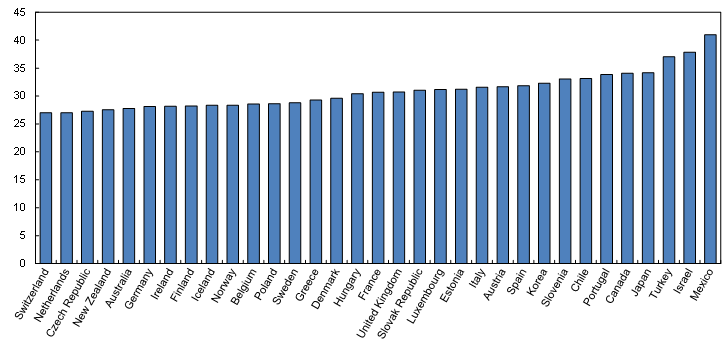
The OECD collects detailed data on product market regulations that hamper competition, including, for instance, the involvement of the state in business operations, licencing systems or sector-specific regulations (e.g. regulations of telecommunication firms). Regulations that do not discourage competition (e.g. safety requirements applied to all firms) are excluded. These data allow one to look at differences of regulatory settings between country pairs. This reveals that there is a sizeable heterogeneity in regulatory settings across countries (Figure 1).

Figure 1. Product market regulation heterogeneity

Average bilateral heterogeneity, 2013, per cent

Fournier

Note: The bilateral heterogeneity is the share of answers to the OECD product market regulation questionnaire that differ between pairs of countries; it is computed for each country pair. The US PMR data are available until 2008 only, and hence the United States is not shown in this figure.
Source: OECD, Product Market Regulation database and OECD calculations.

My research shows that firms prefer to invest in a country with a similar regulatory environment. A broad reform package that would cut regulatory differences by one fifth could increase foreign direct investment by about 15%. Such a pace of convergence has been observed between 2008 and 2013 for pairs of countries such as Austria and the Slovak Republic. Regulatory differences in some fields reduce FDI more than others. This is especially the case for antitrust exemptions, regulatory barriers in service sectors, command and control regulations and barriers in network sectors. Belonging to the EU Single Market has a positive effect on foreign direct investment, reflecting the implementation of common area-wide rules. My work also confirms that the stringency of explicit FDI restrictions reduces foreign direct investment, which was also found in many other studies. Last, the stringency of employment protection legislation and the complexity of regulations also have a large negative impact on foreign direct investment.

Reducing regulatory differences and regulatory stringency also boosts trade as shown in this working paper. For instance, a broad reform package that would align product market regulation to the average of the best performers and, at the same time, cut regulatory heterogeneity by one-fifth can increase trade intensity within the European Union by more than 10%. There is also specific evidence that anti-competitive regulations in network sectors such as airlines and telecom reduce trade.

Find out more

Fournier, J.-M. (2015a), “The Negative Effect of Regulatory Divergence on Foreign Direct Investment”, OECD Economics Department Working Papers, No. 1268, OECD Publishing.

Fournier, J.-M. (2015a), “The Heterogeneity of Product Market Regulations”, OECD Economics Department Working Papers, No. 1182, OECD Publishing.

Fournier, J.-M. et al. (2015), “Implicit Regulatory Barriers in the EU Single Market: New Empirical Evidence from Gravity Models”, OECD Economics Department Working Papers, No. 1181, OECD Publishing.