Why Argentina needs a labour market reform

Argentina is going through one of the most comprehensive reform efforts in its history. Since late 2023, the authorities have taken unprecedented measures to reform fiscal, monetary, trade and regulatory policies, all of which have triggered significant improvements in the business environment. For this transformation to translate into new jobs and better living standards, policymakers need to continue reducing institutional and market frictions that impose costs on the reallocation of workers from low- to high-productivity sectors.


By Priscilla Fialho, OECD Economics Department

Argentina’s recent reform efforts are bearing fruits, and key macroeconomic indicators have improved significantly. Growth has likely exceeded 5% in 2025 and is projected to remain above 4% in 2026. Annual inflation fell from more than 200% in late 2023 to slightly above 30% in December 2025, and the government achieved a balanced budget for two consecutive years. Despite tighter fiscal policy and domestic financial conditions, labour markets have remained resilient and the poverty rate fell from a peak of 53% in early 2024 to about 32% in the first half of 2025. Following the introduction of a more flexible exchange rate framework in January 2025, foreign reserve accumulation has finally resumed. Markets have responded positively, and the country risk declined to levels consistent with a potential return to international capital markets.

The ambitious reform programme quickly led to improvements in sectors where Argentina has vast comparative advantages. Investments accelerated in the oil and gas and the mining sectors, both of which will help reduce external vulnerabilities in a durable manner. Lower export taxes are encouraging an expansion of agricultural production. More competitive manufacturing sectors are expected to expand at the expense of more traditional ones, thanks to lower prices for imported inputs and capital goods. At the same time, less stringent foreign exchange regulations and the expansion of private credit are supporting financial intermediation and knowledge-based sectors.

But expanding activity has not always come with sizeable increases in formal employment. Out of 19 sectors, only 6 officially increased their staffing levels in the last two years. Where employment has increased, this was mostly driven by informal jobs, which already account for about half of employment. Widespread informality can limit growth opportunities in the future, as informality often keeps resources trapped in low-productivity activities, discourages on-the-job training and undermines the public sector’s capacity to deliver high-quality public services. More visible improvements in labour market and social outcomes would also bolster public support for further reforms. In a nutshell, one challenge ahead is to ensure that growth translates into higher-quality employment.

Labour market regulations have been historically rigid

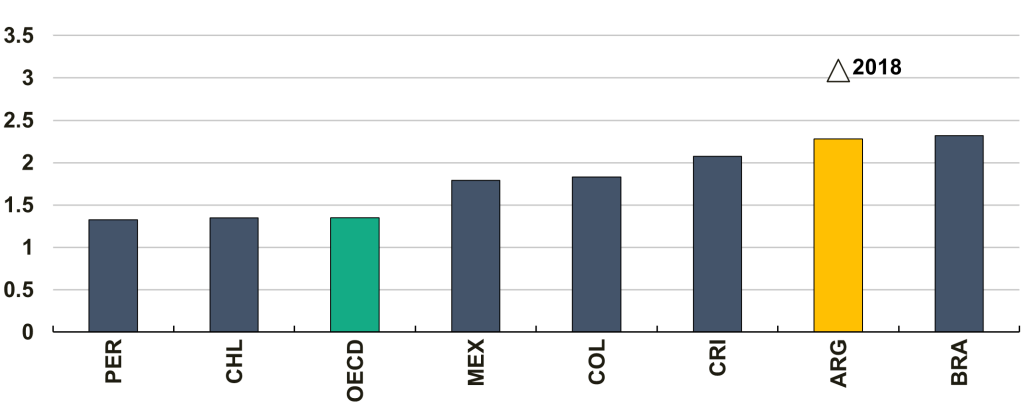
Despite recent improvements, Argentina still has stricter labour market regulations than other countries, based on the OECD Employment Protection Indicators that compare the stringency of hiring and dismissal rules across countries (Figure 1).

Figure 1. Argentina has stricter labour market regulations than peers
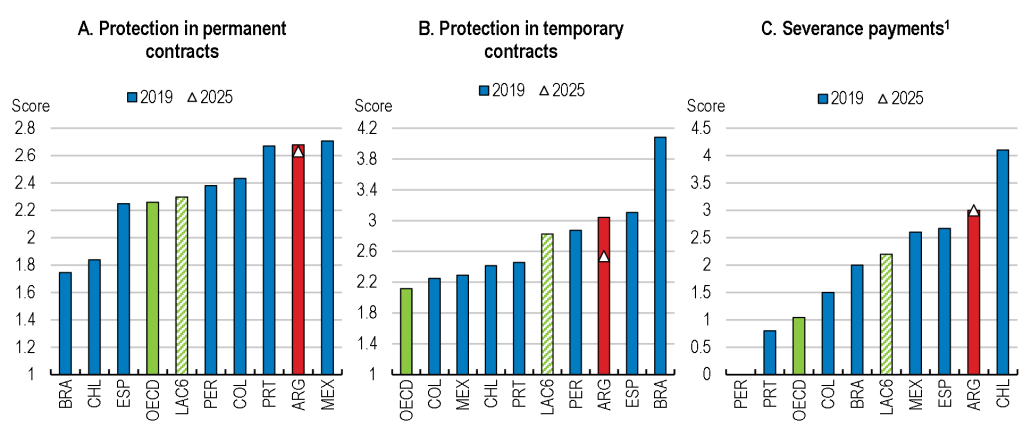
Note: The OECD indicators of employment protection are synthetic indicators of the strictness of regulation on dismissals and the use of temporary contracts, expressed on a scale from 0 (least restrictive) to 6 (most restrictive). For each year, indicators refer to regulation in force on the 1st of January. LAC6 includes Argentina, Brazil, Chile, Colombia, Mexico and Peru.
Source: OECD Strictness of employment protection.

In Argentina, employers can only dismiss workers in cases explicitly defined by law. This holds both for individual dismissals – where employers wish to separate from individual employees- and to collective dismissals – where firms wish to downsize there workforce. The definition for collective dismissals is exceptionally restrictive in Argentina and the administrative procedure particularly onerous. In addition, court cases can take a long time – on average, between two to four years – and can be filed up until two years after a dismissal, exposing firms to elevated uncertainty and contingent litigation risk. Severance payments, the compensation that firms have to pay in case of dismissal, are also high in international comparison, significantly exceeding those in regional peers. These payments amount to one month of salary for every year of service in most cases, without any cap.

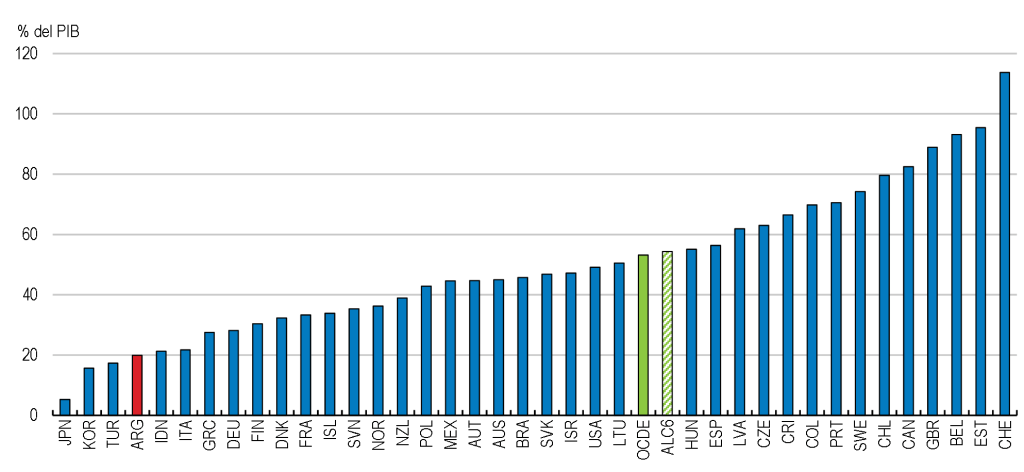
In addition, Argentina has the highest average labour tax wedge in Latin America, above most OECD countries (Figure 2). The labour tax wedge is the difference between what it costs a firm to employ someone and the worker’s take-home pay, which in the case of Argentina can be almost fully attributed to social security contributions. High social contributions discourage demand for and supply of formal labour.

Finally, the collective bargaining system is another source of labour market rigidities. Collective bargaining is organised at the sectoral level, where the labour unions and employer organisations with the highest number of members have the monopoly to bargain on behalf of all firms and employees in the sector. Agreements made between the signatory parties are then automatically extended to the entire sector. Firm-level agreements are strictly regulated by higher-level agreements and cannot apply less favourable terms for employees. Agreements remain valid until a new negotiation takes place, and outdated agreements often last over long periods of time, making it difficult for firms to adapt to changing environments.

Figure 2. The labour tax wedge increases the unit cost of labour
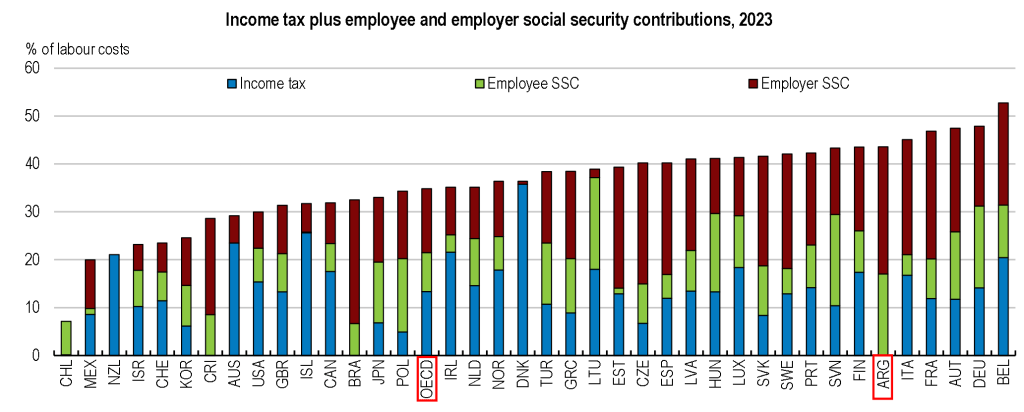
Note: Brazil (2019). Single individual without children at the income level of the average worker. It includes payroll taxes where applicable. Data for Argentina refers to 2013/2016.
Source: OECD Taxing Wages in Latin America and the Caribbean 2016, OECD Taxing Wages 2024 – Country details, IBGE, OECD Taxing Wages in Selected Partner Economies: Brazil, China, India, Indonesia and South Africa in 2019.

Strict labour market regulations hurt particularly the most vulnerable

An extensive international academic literature suggests that rigid labour market institutions and limited opportunities for job mobility are associated with lower investment, formal employment, productivity and output. First-time jobseekers without relevant experience, older workers who struggle to keep up with new technologies, or less-educated workers, may be particularly affected. Smaller and younger firms may also be at a disadvantage, struggling to compete with large firms that often find it easier to bear the resulting compliance costs.

The last OECD Economic Survey of Argentina provides several policy recommendations to enhance the flexibility of labour market regulations and increase incentives for formal employment. The Survey recommends reducing the amount of severance payment mandated by law. In Chile, for example, severance payments are limited to 330 days of service. The report also encourages the wider application of schemes that provide a voluntary alternative to standard severance payment rules, such as individual worker accounts that can be accessed for income support at the termination of employment, and whose remaining balances can be carried over to new jobs. Moreover, the Survey provides examples of OECD countries that introduced temporary opt-out clauses, allowing the suspension or the firm-level renegotiation of sectoral agreements in cases of economic difficulties. Finally, the Survey discusses options to reduce the labour tax wedge, in particular social contributions, without jeopardising Argentina’s fiscal consolidation efforts. One option would be to unify the current array of available social benefits into a universal multi-pillar system that includes informal workers and provides better incentives for formal job creation. A recent OECD report expands on that discussion, quantifying the estimated fiscal cost of such reforms.

The time for reform is now

Argentina’s Congress is currently debating a labour market reform proposal. The proposal seeks to address some of Argentina’s main challenges:

  • More flexible employment protection. The bill aims to reduce uncertainty and contingent litigation risk upon dismissal by clarifying that severance pay is the only compensation that can be claimed upon the termination of an employment contract, thus excluding the possibility of additional civil appeals and indemnities.  In addition, it seeks to introduce a voluntary Labour Assistance Fund to cover severance payments from monthly employer contributions of 3% of workers’ remuneration.
  • Lower labour tax wedge. Employers adhering to the above-mentioned fund will have a 3% reduction in pension contributions.
  • Modernise collective wage negotiations. The draft bill proposes that firm-level agreements can prevail over agreements of a broader scope, whether prior or subsequent. It also intends to limit the automatic extension of clauses once an agreement expires.

Research shows that the timing of labour market reforms matters. Labour market reforms that facilitate the reallocation of workers are much more likely to have positive short-term and long-term effects on employment during economic expansions, and Argentina’s economy is currently growing strong. The timing for a labour market reform could hardly be better.

References

OECD (2025), OECD Economic Surveys: Argentina 2025, OECD Publishing, Paris, https://doi.org/10.1787/27dd6e27-en.

Fortaleciendo las reformas en favor del crecimiento en Argentina 

Man at work, wearing protective stuff, handling boxes in a warehouse in a car factory in Campana, Buenos Aires, Argentina

También disponible en inglés.

Por Adolfo Rodríguez Vargas y Priscilla Fialho 

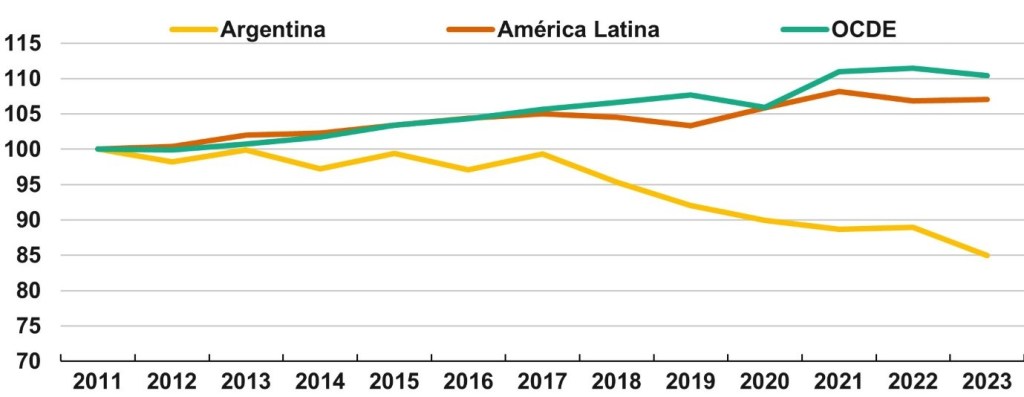
Argentina ha implementado medidas decisivas para estabilizar su economía y abordar sus desequilibrios macroeconómicos de larga data. La inestabilidad macroeconómica ha sido un elemento que ha frenado el crecimiento, pero factores más estructurales también pueden ayudar a explicar la disminución de la productividad laboral de Argentina, que ha reducido el potencial de crecimiento de la economía a solo 0,5% anual (Gráfico 1). Argentina ha comenzado a enfrentar estos factores estructurales a través de ambiciosas reformas en una amplia gama de áreas de política. El Estudio Económico de la OCDE sobre Argentina 2025 revisa los avances y desafíos pendientes y presenta recomendaciones de política para impulsar aún más la productividad y el crecimiento. 

Gráfico 1. Asegurar el impulso de las reformas puede reactivar el crecimiento de la productividad  

PIB por persona ocupada, USD en paridad constante de poder adquisitivo en 2021, índice 2011 = 100 

Nota: La OCDE es un promedio de los países de la OCDE. América Latina es un promedio de Argentina, Brasil, Chile, Colombia, Costa Rica, México y Perú.  
Fuente: Banco Mundial, Indicadores del desarrollo mundial. 

Haciendo que los mercados domésticos sean más competitivos 

Durante décadas, altas barreras de entrada han reducido la competencia en sectores clave, y las regulaciones han impuesto altas cargas financieras y administrativas a las empresas argentinas. Reformas recientes para hacer que las regulaciones sean más favorables a la competencia, y para reducir barreras de entrada han mejorado el ambiente empresarial (Gráfico 2). La aplicación de normas de silencio positivo, la simplificación de procedimientos y requisitos en muchos sectores, como la agricultura y el comercio minorista, y la eliminación de requisitos técnicos injustificados para productos industriales han sido elementos clave de estas reformas. También se han reducido las barreras de entrada en sectores de redes como el transporte y las comunicaciones, y se han reducido los controles de alquileres y otros controles de precios.  

Estimaciones presentadas en el Estudio Económico de la OCDE sugieren considerables aumentos del producto potencial a partir de las reformas regulatorias que se han logrado hasta ahora. Para 2050, se espera que la producción sea un 2,7% más alta en comparación con una situación en la que la regulación se habría mantenido como en 2018. Implementar nuevas reformas en la próxima década para alinear las regulaciones con las mejores prácticas de la OCDE podría impulsar los ingresos en otro 6,8%. 

Sin embargo, se puede hacer más para fortalecer la competencia en los mercados nacionales. El Estudio Económico se centra especialmente en las barreras de entrada en los sectores de servicios y en las cargas administrativas para el establecimiento de nuevas empresas. Barreras de entrada impuestas por gobiernos provinciales persisten en varios servicios profesionales, las actividades minoristas aún enfrentan muchas restricciones y los empresarios deben hacer frente a procedimientos que requieren mucho tiempo al iniciar sus negocios. El Estudio también recomienda evaluar sistemáticamente los efectos de los cambios regulatorios sobre la competencia para evitar daños colaterales sobre la competencia derivados del diseño de nuevas reglas. El establecimiento de una autoridad independiente de defensa de la competencia, como exige la ley, podría crear un fuerte impulso para promover la competencia. 

Gráfico 2. Hacer que las regulaciones sean más favorables a la competencia puede impulsar la productividad y el empleo 

Indicador de la Regulación de los mercados de productos (PMR) 

Nota: Indicador de la Regulación de los mercados de productos (0 = mejor – 6 = peor). Los datos reflejan las leyes y reglamentos que estaban vigentes al 1 de enero de 2025 para Argentina; al 1 de enero de 2024 para Hungría, Países Bajos, Estados Unidos, Bulgaria, China, Chipre, Indonesia, Malta y Perú; y al 1 de enero de 2023 en todos los demás países.
Fuente:  Base de datos de Regulación de los mercados de productos OCDE-WBG.

Derribando las barreras comerciales 

Argentina comercia relativamente poco con otros países para una economía de su tamaño, y participa poco en las cadenas globales de valor. Mejorar su integración en la economía mundial permitiría a las empresas acceder a insumos y tecnología de mayor calidad, lo que podría impulsar su productividad.   

Las reformas recientes han incluido la reducción de los obstáculos al comercio, en particular mediante medidas de facilitación del comercio. Se ha eliminado un impuesto especial sobre todas las importaciones y se han reducido significativamente los aranceles aplicados a muchos productos, incluyendo bienes de consumo e insumos industriales. Las barreras no arancelarias también se han reducido o incluso se han eliminado por completo. Se ha eliminado un engorroso régimen de licencias de importación no automáticas y se han relajado los requisitos técnicos para muchos productos. También se han reducido los obstáculos a las exportaciones, aunque se mantienen los impuestos a la exportación para algunos de los principales productos exportados. Un área en la que un mayor progreso podría respaldar un mejor desempeño de las exportaciones es la calidad de la logística comercial, que se mantiene por debajo de la media de la OCDE y se ha deteriorado. 

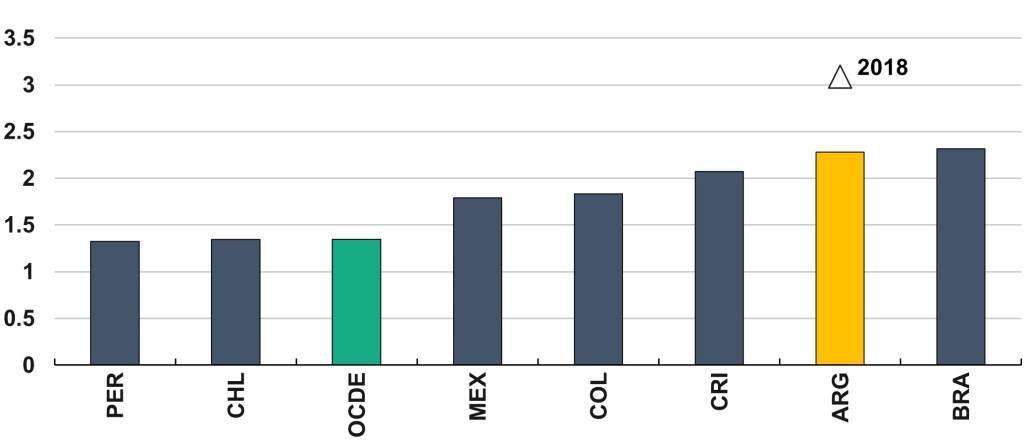
En el Estudio Económico se examinan las posibles formas de promover una mayor integración en los mercados mundiales. Estos incluyen nuevos recortes arancelarios, especialmente sobre insumos intermedios y bienes de capital, y seguir ajustando barreras comerciales no arancelarias, como reglamentos técnicos injustificados. La eliminación gradual de los impuestos a la exportación también debería ser una prioridad, especialmente porque se pueden movilizar otras fuentes de ingresos públicos. La ventanilla única para el comercio exterior podría mejorarse aún más garantizando la interoperabilidad y el intercambio de datos entre las aduanas y otros organismos para abarcar todos los procedimientos relacionados con la exportación. Continuar trabajando en pro de la plena implementación de los tratados de libre comercio también puede abrir aún más mercados a los productores argentinos y exponer a los productores nacionales a la disciplina de la competencia internacional. La reducción de los topes de capital extranjero restantes puede ayudar a aumentar el atractivo de Argentina para la inversión extranjera directa, que no ha alcanzado a otras economías de mercados emergentes (Figure 3). 

Gráfico 3. Argentina necesita aumentar su atractivo para la IED 

Entradas de IED, 2023 

Notas: Los datos excluyen las entidades de propósito especial (SPE). ALC6 es un promedio no ponderado, y la OCDE es un promedio ponderado. 
Fuente: Base de datos de la OCDE – Principales agregados de IED, BMD4. 

Mejorando la infraestructura, las competencias y la eficiencia judicial 

Mejoras adicionales en la competitividad podrían derivarse de reformas para afrontar la baja eficiencia judicial, invertir en capacidades e infraestructuras digitales y promover sistemas alternativos de resolución de litigios. Simplificar los procedimientos administrativos a nivel local puede ayudar a acelerar el despliegue de la infraestructura digital y fomentar la digitalización. El fortalecimiento de la integridad del sector público, por ejemplo, mediante la actualización de la Ley de Ética Pública y la realización de consultas sistemáticas a la Oficina Anticorrupción por parte de los organismos gubernamentales, puede apoyar los esfuerzos en curso en la lucha contra la corrupción. 

Se ha logrado mucho en un corto período de tiempo, pero sólo manteniendo el actual impulso de reforma podrá Argentina estar a la altura de su potencial económico y aumentar los ingresos de manera duradera. 

Para más información, visite la página web de la OCDE Panorama económico de Argentina.

Referencia

OECD (2025), OECD Economic Surveys: Argentina 2025https://doi.org/10.1787/27dd6e27-en, OECD Publishing, Paris.


Strengthening pro-growth reforms in Argentina 

Man at work, wearing protective stuff, handling boxes in a warehouse in a car factory in Campana, Buenos Aires, Argentina

Read the Spanish version here.

By Adolfo Rodríguez Vargas and Priscilla Fialho 

Argentina has taken decisive steps to stabilise its economy and address long-standing macroeconomic imbalances. Macroeconomic instability has been one element holding back growth, but more structural factors can also help explain Argentina’s declining labour productivity, which has reduced the economy’s growth potential to just 0.5% annually (Figure 1). Argentina has begun to tackle these structural factors through ambitious reforms across a wide range of policy areas. The 2025 OECD Economic Survey of Argentina reviews advances and pending challenges and presents policy recommendations to further boost productivity and growth. 

Figure 1. Securing reform momentum can revive productivity growth  

GDP per person employed, constant 2021 purchasing power parity $, Index 2011 = 100 

Note: OECD is an average of OECD countries. Latin America is an average of Argentina, Brazil, Chile, Colombia, Costa Rica, Mexico and Peru.  
Source: World Bank World Development Indicators. 

Making domestic markets more competitive  

For decades, high entry barriers have reduced competition in key sectors and regulations have placed high financial and administrative burdens on Argentinian firms. Recent reforms to make regulations more competition-friendly and reduce entry barriers have improved the business environment (Figure 2). The implementation of silence-is-consent rules, the streamlining of procedures and requirements in many sectors including agriculture and retail, and the removal of unjustified technical requirements for industrial products have been key elements of these reforms. Entry barriers have also been lowered in network sectors like transport and communications. Rent controls and other price controls have also been scaled back.

Estimates presented in the OECD Economic Survey suggest considerable potential output gains from the regulatory reforms that have been achieved so far. By 2050 output is expected to be 2.7% higher compared with a situation where regulation would have remained as in 2018. Implementing further reforms over the coming decade to align regulations OECD best practice could boost incomes by another 6.8%. 

But more can be done to strengthen competition in domestic markets. The Economic Survey focuses particularly on entry barriers in services sectors and administrative burdens for establishing new firms. Barriers to entry imposed by provincial governments persist in several professional services, retail activities still face many restrictions, and entrepreneurs must cope with time-consuming procedures when starting their businesses. The Survey also recommends to systematically assess the effects of regulatory changes on competition to avoid collateral damage on competition from the design of new rules. Establishing an independent competition authority, as mandated by law, could create strong momentum for promoting competition. 

Figure 2. Making regulations more competition-friendly can boost productivity and employment

Product Market Regulation overall indicator 

Note: Product Market Regulation overall indicator (0 = best – 6 = worst). Data reflect laws and regulations that were in force by January 1st, 2025 for Argentina; by January 1st, 2024 for Hungary, the Netherlands, the US, Bulgaria, China, Cyprus, Indonesia Malta and Peru; and by January 1st, 2023 in all other countries. 
Source: Product Market Regulation OECD-WBG database. 

Tearing down trade barriers 

Argentina trades relatively little with other countries for an economy of its size, and participates little in global value chains. Enhancing its integration into the world economy would allow firms to access higher-quality inputs and technology, potentially boosting their productivity.   

Recent reforms have included reductions in trade barriers, including through measures in  trade facilitation. A special tax on all imports has been eliminated, and tariffs on many products have been significantly reduced, including consumer goods and industrial inputs. Non-tariff barriers have also been reduced or even dropped entirely. A cumbersome non‑automatic import licensing regime has been scrapped and technical requirements have been eased for many products. Barriers to exports have also been lowered, although export taxes remain in place for some major exported goods. One area where further progress could support stronger export performance is the quality of trade logistics, which remains below the OECD mean and has deteriorated. 

The Economic Survey discusses possible ways to promote further integration into world markets. These include further tariff cuts, especially on intermediate inputs and capital goods, and continuous adjustments of non-tariff trade barriers, like unwarranted technical regulations. Phasing out export taxes should also be a priority, especially as other public revenue sources can be mobilised. The one-stop shop for foreign trade could be further enhanced by ensuring interoperability and data exchange between customs and other agencies to cover all export-related procedures. Continuing to work towards the full implementation of free trade agreements can also open even more markets to Argentinian producers and expose domestic producers to the discipline of international competition. Reducing remaining foreign equity ceilings can help to increase Argentina’s attractiveness for foreign direct investment, which has fallen short of other emerging-market economies (Figure 3). 

Figure 3. Argentina needs to increase its attractiveness to FDI 

FDI inward positions, 2023 

Notes: Data exclude Special Purpose Entities (SPE).LAC6 is an unweighted average, and the OECD is a weighted average. 
Source: OECD database – FDI main aggregates, BMD4. 

Improving infrastructure, skills and judiciary efficiency 

Further improvements in competitiveness could result from reforms to tackle low judicial efficiency, by investing in digital skills and infrastructure and promoting alternative dispute resolution schemes. Streamlining administrative procedures at the local level can help to accelerate digital infrastructure deployment and encourage digitalisation. Strengthening the integrity of the public sector, for example by updating the Public Ethics Law and ensuring systematic consultations of the Anticorruption Office by government agencies, can support ongoing efforts in the fight against corruption. 

Much has been achieved in a short period of time, but only by maintaining the current reform momentum can Argentina live up to its economic potential and lift incomes in a durable manner. 

For more information, please visit the OECD’s Economic Snapshot of Argentina webpage.

References

OECD (2025), OECD Economic Surveys: Argentina 2025https://doi.org/10.1787/27dd6e27-en, OECD Publishing, Paris.


Argentina: Consolidando la recuperación económica 

Biking through one of Beunos Aires' many parks

Por Priscilla Fialho y Jens Arnold 

Blog para el lanzamiento del Estudio Económico Argentina 2025. También disponible en inglés.

En las últimas décadas, Argentina no supo desarrollar su potencial económico, y su crecimiento quedó por detrás de muchos pares regionales. El gasto público superó continuamente la capacidad de recaudar, y sucesivos gobiernos siguieron recurriendo a la creación de dinero para cubrir la brecha. Esto alimentó la inflación, comprometió la estabilidad macroeconómica y redujo la confianza de los inversores y los consumidores. Controles de capital, restricciones a la importación y racionamiento de divisas se introdujeron en varias ocasiones para evitar mayores crisis financieras y económicas, pero a expensas de deprimir el crecimiento de la productividad, reducir el empleo y los ingresos reales, y aumentar la pobreza.  

Reconociendo que la debilidad de los fundamentos fiscales estuvo a la raíz de la inestabilidad macroeconómica de Argentina durante años, una nueva administración se embarcó en un impresionante proceso de consolidación fiscal en 2024. Desde entonces, se han registrado superávits primarios casi todos los meses, algo que la Argentina no había visto en décadas. El ajuste fiscal en 2024 alcanzó más del 5% del PIB. La historia tiene pocos ejemplos de un proceso de consolidación fiscal tan grande y ninguno de los intentos de estabilización anteriores de Argentina logró reducir las vulnerabilidades fiscales de manera tan decisiva.  

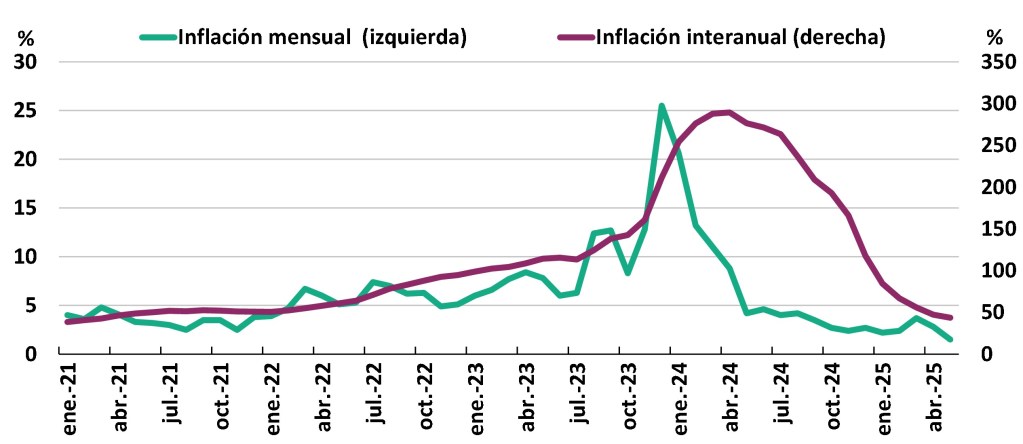
El marcado ajuste fiscal puso fin a años de financiamiento monetario de los déficits fiscales, lo que, junto con las mejoras en el balance del Banco Central, fue fundamental para reducir la alta inflación. La inflación bajó del 211% interanual en diciembre de 2023 a menos del 45% en mayo de 2025. A medida que la inflación retrocedió y se incrementó el gasto social bien focalizado, la pobreza volvió a disminuir a finales de 2024 hasta situarse por debajo de los niveles observados en 2022. Los aumentos de los salarios reales respaldaron la recuperación del consumo privado y la inversión, lo que ayudó a impulsar el crecimiento.  

Gráfico 1. La inflación ha caído a niveles no vistos en años 

Argentina: La inflación ha caído a niveles no vistos en años
Fuente: Banco Central de la República Argentina. 

Además, se han adoptado medidas de política estructural para mejorar el entorno empresarial y volver la Argentina más atractiva para la inversión. Por ejemplo, para simplificar la regulación, se ha introducido en los procedimientos administrativos una norma de que el silencio equivale consentimiento. Con el fin de promover la competencia, se han simplificado varios procedimientos de autorización, registro e importación en los ámbitos de la agricultura, el transporte y el comercio al por menor. También se han eliminado gradualmente los controles de precios, mientras que las barreras comerciales se han reducido para una serie de productos. 

Para hacer frente a las vulnerabilidades externas, en abril de 2025 se puso en marcha un nuevo régimen cambiario con un tipo de cambio flotante dentro de bandas que se ampliarán cada mes. El nuevo régimen mejorará la resiliencia a los shocks externos, al tiempo que fortalecerá la confianza económica. Un programa recientemente aprobado por el FMI de 20.000 millones de dólares apoyará las reservas internacionales a corto plazo, hasta que los cambios estructurales favorezcan mejores perspectivas para las cuentas externas.  

Los esfuerzos de reforma han comenzado a dar frutos, y la economía se encamina hacia a una sólida recuperación en los próximos dos años. Argentina entra ahora en una nueva etapa, que requerirá un ajuste de sus políticas para mantener la prudencia fiscal de manera duradera y, al mismo tiempo, impulsar el crecimiento potencial. El Estudio Económico de la OCDE sobre Argentina 2025 propone varios temas de reflexión.  

A pesar de las recientes mejoras, el gasto público en Argentina sigue siendo alto en comparación internacional y aún hay margen para mejorar la eficiencia del gasto. Una opción para seguir avanzando es seguir recortando los subsidios ineficientes. Los subsidios a la energía se implementaron después de la profunda crisis económica de 2001-02 a través de una combinación de limitación de precios y una amplia compensación gubernamental a los proveedores de energía. Estos subsidios han tenido efectos distributivos principalmente regresivos. Además, al crear una brecha entre el precio pagado por los usuarios finales y los costos de producción, reducen los incentivos para ahorrar energía. Los subsidios a la energía se han reducido progresivamente en 2024, pero aún representan alrededor del 1% del PIB. Continuar eliminándolos y reorientar parte de los recursos fiscales hacia formas más eficientes de protección social mejoraría la eficiencia del gasto.  

La eliminación gradual de los impuestos más distorsivos, introducidos a lo largo de los años para financiar aumentos continuos del gasto público y responder a las necesidades de financiación a corto plazo, ayudaría a mejorar la eficiencia fiscal y favorecería una asignación de recursos más eficiente en toda la economía. La eliminación gradual de estos impuestos requiere identificar fuentes alternativas de ingresos, a fin de mantener los esfuerzos de consolidación fiscal en curso. La ampliación de las bases impositivas sobre los ingresos y el consumo, y la mejora del cumplimiento del impuesto sobre el valor agregado, podrían ser soluciones. Los ingresos por impuestos sobre los ingresos personales representan solo el 2,5% del PIB en 2022, en comparación con el 8,6% del PIB en los países de la OCDE. Un mínimo no imponible alto, que supera el salario promedio y hace que solo alrededor del 10% de la población activa pague impuestos sobre los ingresos personales, explica la mayor parte de la diferencia. Además, Argentina tiene exenciones del impuesto sobre los ingresos personales y otras deducciones fiscales generosas que son inusuales en la comparación internacional.  

Gráfico 2. Los ingresos por impuestos sobre la renta son bajos en comparación internacional

Argentina: Los ingresos por impuestos sobre la renta son bajos en comparación internacional
Fuente: OCDE Estadísticas de ingresos; MECON, Secretaría de Hacienda, Subsecretaría de Ingresos Públicos. 

El federalismo fiscal argentino siempre se ha caracterizado por un importante desequilibrio entre los recursos propios de las provincias y sus gastos. En 2022, las provincias llevaron a cabo el 42,2% de todo el gasto público, mientras que sus ingresos propios representan solo alrededor del 16% de los ingresos públicos totales. En respuesta, se ha desarrollado un complejo sistema de transferencias intergubernamentales. Sin embargo, a lo largo del tiempo la distribución de las transferencias entre las provincias no ha respondido a los cambios en el nivel de demanda de servicios públicos entre las provincias y hoy parece arbitraria. Tan pronto como las finanzas públicas se hayan fortalecido de manera más duradera, Argentina podría fortalecer el vínculo entre los recursos y las necesidades de gasto entre las provincias. Esto reduciría la necesidad de transferencias discrecionales a las provincias, que con frecuencia se han utilizado para fines políticos. 

Es necesario reconocer y elogiar el renovado compromiso de la Argentina de abordar las debilidades y distorsiones de larga data. El impulso de las reformas debe continuar para mantener a la economía argentina en una senda de crecimiento sólido, lo cual es esencial para elevar los niveles de vida de manera duradera. 

Para más información, visite la página web de la OCDE Panorama económico de Argentina.

Referencia

OECD (2025), OECD Economic Surveys: Argentina 2025https://doi.org/10.1787/27dd6e27-en, OECD Publishing, Paris.


Argentina: Consolidating the economic recovery 

Biking through one of Beunos Aires' many parks

Blog post accompanying the launch of the 2025 Economic Survey of Argentina. Read the version in Spanish here.

By Priscilla Fialho and Jens Arnold

Over the last decades, Argentina has struggled to realise its economic potential as growth fell behind many regional peers. Public spending continuously exceeded revenue capacity, and successive governments kept resorting to money creation to fill the gap. This fuelled inflation, compromised macroeconomic stability and weighed on investor and consumer confidence. Capital controls, import restrictions, and foreign currency rationing were introduced on several occasions to avoid major financial and economic crises, but at the cost of depressing productivity growth, reducing employment and real incomes, and increasing poverty.  

Recognising that weak fiscal fundamentals have been at the core of Argentina’s macroeconomic instability for years, a new administration embarked on an upfront fiscal consolidation process in 2024. Primary surpluses have been recorded almost every month since, something Argentina had not seen for decades. The fiscal adjustment in 2024 reached more than 5% of GDP. History holds few examples of such a sharp fiscal consolidation process and none of Argentina’s previous stabilisation attempts managed to reduce fiscal vulnerabilities so decisively.  

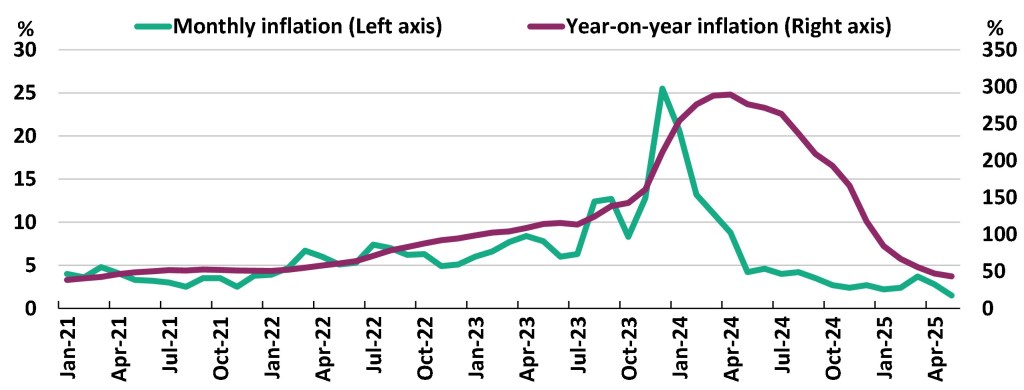
The marked fiscal adjustment put an end to years of monetary financing of fiscal deficits, which together with improvements in the central bank’s balance sheet, was instrumental for taming high inflation. Inflation fell from 211% year-on-year in December 2023 to less than 45% in May 2025. As inflation receded and well-targeted social spending has been scaled up, poverty decreased again at the end of 2024 to below levels observed in 2022. Real wage gains supported the recovery of private consumption and investment, helping to boost growth.  

Figure 1. Inflation has fallen to levels not seen in years 

Argentina: Inflation has fallen to levels not seen in years 
Source: Banco Central de la República Argentina. 

In addition, structural policy measures have been taken to improve the business environment and Argentina’s attractiveness for investment. For example, to simplify regulation, a silence-is-consent rule has been introduced in administrative procedures. To promote competition, several authorisation, registry and import procedures have been streamlined in the areas of agriculture, transport and retail trade. Price controls have also been phased out, while trade barriers have been scaled back for a series of products. 

To address external vulnerabilities, a new exchange rate regime was put in place in April 2025, allowing the exchange rate to float within bands that are set to widen every month. The new regime will improve resilience to external shocks, while also strengthening economic sentiment. A recently approved IMF programme of USD 20 billion will support international reserves in the short term, until structural changes favour better prospects for external accounts.  

Reform efforts have started to bear fruit, and the economy is set for a robust recovery in the next two years. Argentina is now entering a new phase, which will require further fine-tuning of its policies to maintain fiscal prudence in a durable way while also boosting potential growth. The OECD Economic Survey of Argentina 2025 proposes several avenues for consideration.  

Despite recent improvements, Argentina’s public expenditure remains high in international comparison and there is still scope for enhancing spending efficiency. One avenue for further progress is to continue cutting back inefficient subsidies. Energy subsidies were implemented after the deep economic crisis of 2001-02 through a combination of price caps and broad-based government compensation to energy providers. These subsidies have had mostly regressive effects on income distribution. Moreover, by creating a gap between the price paid by end-users and production costs, they reduce incentives to save energy. Energy subsidies have been progressively scaled back in 2024, but still represent about 1% of GDP. Continuing to phase them out while redirecting some of the fiscal resources to more efficient forms of social protection would improve spending efficiency.  

Phasing out the most distortionary taxes, introduced over the years to finance continuous increases in public spending and respond to short-term financing needs, would help enhance tax efficiency while also favouring a more efficient allocation of resources across the economy. Phasing out these taxes requires identifying alternative revenue sources, to safeguard on-going fiscal consolidation efforts. Broadening income and consumption tax bases, and improving Value-Added tax compliance, could be potential solutions. Personal income tax revenues amounted to only 2.5% of GDP in 2022, compared to 8.6% of GDP in OECD countries. A high basic allowance, which exceeds the average wage and results in only about 10% of the active population paying personal income taxes, explains most of the difference. In addition, Argentina has Personal Income Tax exemptions and other generous tax deductions that are unusual in international comparison.  

Figure 2. Revenues from taxes on personal income are low in international comparison 

Argentina: Revenues from taxes on personal income are low in international comparison 
Source: OECD Revenue Statistics; MECON, Secretaría de Hacienda, Subsecretaría de Ingresos Públicos.  

Argentina’s fiscal federalism has always been characterised by a significant imbalance between provinces own resources and their expenditure. In 2022, provinces carried out 42.2% of all public expenditures, while own-revenues of provincial governments account only for about 16% of total public revenues. A complex system of intergovernmental transfers has been developed in response. However, the distribution of transfers across provinces has not responded to changes in the level of demand for public services across provinces over time and appears arbitrary by now. As soon as public finances have strengthened more durably, Argentina could strengthen the link between resources and spending needs across provinces. This would reduce the need for discretionary transfers to provinces, which have frequently been used as a political bargaining chip. 

Argentina’s renewed commitment to tackling long-standing weaknesses and distortions needs to be recognised and praised. The reform momentum needs to continue to maintain Argentina’s economy on a solid growth path, which is essential to lift living standards in a durable manner. 

For more information, please visit the OECD’s Economic Snapshot of Argentina webpage.

References:

OECD (2025), OECD Economic Surveys: Argentina 2025https://doi.org/10.1787/27dd6e27-en, OECD Publishing, Paris.


Convertir la incertidumbre global en oportunidad: Una agenda de competitividad para América Latina

Por Jens Arnold, Aida Caldera, Priscilla Fialho, Paula Garda, Alberto González Pandiella, Michael Koelle, Alessandro Maravalle, Dimitris Mavridis, Claudia Ramírez y Adolfo Rodriguez-Vargas, OCDE.

El contexto global, marcado por una alta incertidumbre política y fragmentación, plantea nuevos desafíos para América Latina, pero también abre nuevas oportunidades para fortalecer su competitividad y reducir vulnerabilidades.

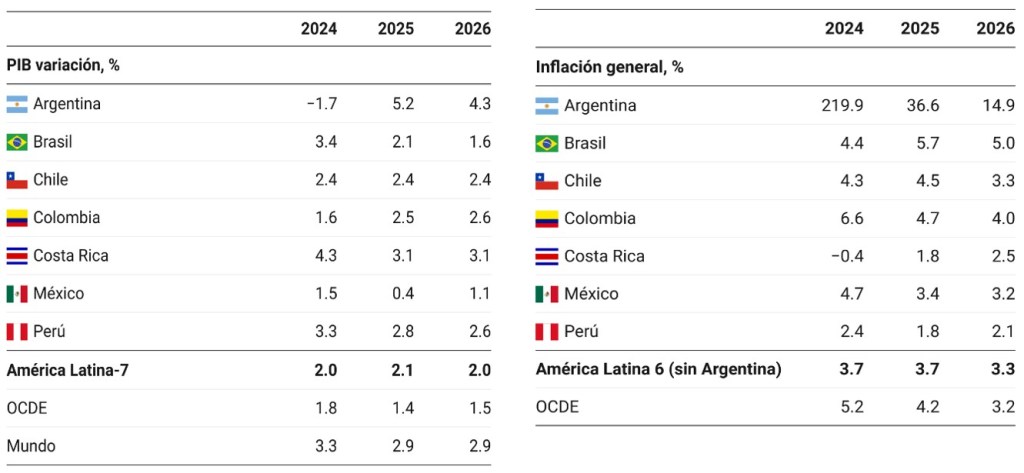
Se espera que el PIB en América Latina crecerá 2.1% en 2025 y 2% en 2026, lo que refleja una desaceleración generalizada en la región. Estas cifras son más bajas que las previstas a fines del año pasado y se sitúan por debajo del promedio de otras economías emergentes. Aunque se espera una fuerte recuperación en Argentina, el crecimiento se mantiene débil en la mayoría de los países, con revisiones a la baja para Brasil, México y Colombia (Tabla), en un contexto generalizado de una débil demanda externa y la alta incertidumbre.

Cuadro. Perspectivas económicas para los países de América Latina

Nota: América Latina 7 es la media ponderada por el PIB a valores de paridad del poder de compra de los 7 países en la tabla para el PIB. América Latina 6 es la media simple de los países incluidos en el cuadro para la inflación excluyendo a Argentina.
Fuente: OCDE Perspectivas Económicas No. 117, junio de 2025.

La desinflación avanza, pero persisten las presiones inflacionarias. La inflación se mantiene por encima del objetivo en muchos países. En cambio, Argentina ha logrado avances significativos gracias a una combinación de consolidación fiscal y una política monetaria más restrictiva. Con la excepción de Argentina y Brasil, los bancos centrales de la región deberían continuar con su flexibilización monetaria prudente y gradual para asegurarse que la inflación se acerque al objetivo, manteniéndose alerta ante riesgos de salidas de capitales y nuevas presiones inflacionarias.

Los riesgos para las perspectivas son a la baja. Un aumento de los aranceles comerciales y menor dinamismo al previsto en socios comerciales clave podría debilitar aún más las exportaciones y presionar a la baja los precios de las materias primas. Los costos comerciales podrían ralentizar más de lo esperado la desinflación en las economías avanzadas y prolongar tasas de interés globales más altas. Una elevada deuda pública y unas condiciones financieras globales más restrictivas de lo previsto, podrían retrasar la tan necesaria inversión. Si se intensifican las salidas de capital, los bancos centrales podrían tener menos margen de maniobra para flexibilizar la política monetaria.

Una agenda de competitividad para tiempos inciertos

En este complejo entorno global, la región necesita más que nunca mejorar sus políticas domésticas. Un área donde es posible avanzar, y urgentemente necesario, es en competitividad, comercio e inversión. Estas no son prioridades nuevas, pero los cambios globales en el comercio, las cadenas de suministro y la transición hacia economías más sostenibles aumentan su relevancia estratégica. Los países que ofrezcan estabilidad institucional, apertura y baja carga administrativa estarán mejor posicionados para atraer inversión y expandir sus mercados.

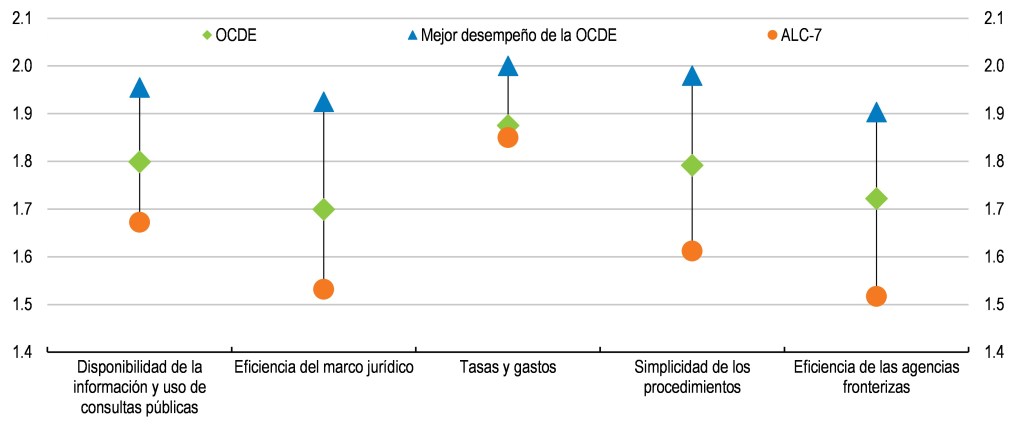
Mejorar los procedimientos aduaneros representa una oportunidad clara. Según los Indicadores de Facilitación del Comercio de la OCDE, América Latina aún enfrenta altos costos comerciales debido a procedimientos aduaneros complejos, inspecciones redundantes y poca coordinación entre agencias fronterizas (Figura). Hay amplio margen para mejorar el procesamiento, levante y despacho de mercancías, en particular mediante una mayor automatización y una mejor coordinación entre las agencias aduaneras, sanitarias, tributarias y otras agencias fronterizas. Medidas prácticas como la cooperación entre agencias de distintos países en la frontera, la agilización de los procesos judiciales y una mayor digitalización pueden beneficiar a los exportadores, especialmente a las pequeñas empresas, y atraer inversión. Además, estas medidas reducen los costos de operar formalmente, lo que incentiva a más empresas a salir de la informalidad.

Figura. Las políticas de facilitación del comercio pueden mejorarse en América Latina

2 = Mejor desempeño

Nota: Disponibilidad de la información y uso de consultas públicas es la media de los indicadores de la facilitación del comercio (TFI, por sus siglas en inglés) A y B. Eficiencia del marco jurídico es la media de los indicadores TFI C y D. Simplicidad de los procedimientos es la media de los indicadores TFI F, G y H. Eficacia de las agencias fronterizas es la media de los indicadores TFI I, J y K. ALC-7 es la media de Argentina, Brasil, Chile, Colombia, Costa Rica, México y Perú.
Fuente: Estadísticas sobre los Indicadores de Facilitación del Comercio de la OCDE (TFI, por sus siglas en inglés).

La facilitación del comercio debe ir acompañada de reformas más amplias que fomenten la productividad. Impulsar la competitividad de las exportaciones y la productividad empresarial también requiere un entorno empresarial más dinámico, una mayor competencia doméstica, un mejor acceso a la financiación, más capacitación y capacidad de innovación. Estas reformas se refuerzan mutuamente: las empresas más productivas tienen mayor probabilidad de exportar, invertir y formalizarse.

El fortalecimiento de la integración regional sigue siendo relevante en América Latina, especialmente en un mundo donde las cadenas de valor están cambiando y los centros regionales cobran mayor importancia. El enfoque debe centrarse en la cooperación: mejorar la cooperación entre organismos fronterizos, el reconocimiento mutuo de normas, el intercambio de datos, los sistemas interoperables y el reconocimiento de estándares técnicos comunes. La región también cuenta con un potencial sin explotar en el comercio de servicios, gracias a idiomas compartidos y husos horarios similares; sin embargo, el comercio interregional de servicios sigue siendo bajo en comparación con los estándares mundiales.

América Latina debe adoptar una visión más orientada hacia el exterior. Acuerdos comerciales como el de la UE-Mercosur, y la participación en marcos plurilaterales como la Alianza del Pacífico o el CPTPP pueden ayudar a diversificar mercados de exportación, atraer inversión, fortalecer la participación en las cadenas globales de valor y aprovechar nuevas tecnologías. Sin embargo, para aprovechar al máximo los beneficios de estas iniciativas, los países deben mejorar su capacidad de implementación y garantizar la coherencia entre las políticas comerciales, de inversión y regulatorias.

América Latina cuenta con ventajas reales: vastas reservas de minerales críticos, abundante energía renovable, una fuerza laboral joven y cada vez más cualificada, y proximidad a mercados clave. Al impulsar reformas concretas que mejoren la competitividad, reduzcan las barreras comerciales y atraigan inversión de calidad, la región puede convertir los desafíos actuales en oportunidades y sentar las bases para un crecimiento más sólido y resiliente.

Referencias:

OECD (2025), OECD Economic Outlook, Volume 2025 Issue 1, OECD Publishing, Paris, doi – Reporte completo en inglés con las proyecciones macroeconómicas, los principales desafíos estructurales e información detallada por país.

Perspectivas económicas de la OCDE para países de América Latina, Junio 2025.

Información detallada por país: Argentina Brasil Chile Colombia Costa Rica | México Perú


Reaching out to informal workers in Latin America: Lessons from COVID-19

By Jens Arnold, Paula Garda, Alberto Gonzalez-Pandiella, OECD Economics Department

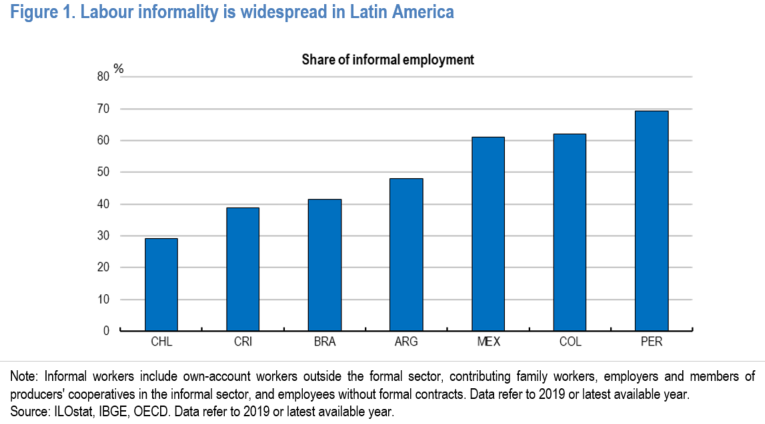
Social distancing has led to sharp declines in mobility and activity across Latin America. Widespread informality creates particular challenges for the livelihoods of many workers. As their activities are shut down to contain the spread of COVID-19, informal workers or small entrepreneurs are usually not covered by social protection. Largely out of reach of the public sector, they easily fall through the cracks of emergency income support measures. This has highlighted a major need to rethink and strengthen social protection mechanisms in Latin America. Providing more complete social safety nets that are not tied to formal employment and that can react rapidly to income losses would be one solution. In many countries in the region, such safety nets could be built on the basis of existing conditional cash transfer programmes.

Informal workers and small entrepreneurs account for a significant share of the workforce across Latin America (Figure 1). Most of them have no access to social protection, and almost no savings to carry them through the trough. Informal employees were the first to lose their jobs, while self-employed entrepreneurs such as street sellers and small service providers were left with no source of income as streets became empty. Working from home may be a solution for educated middle-class workers, but it is out of reach for the most vulnerable (Mongey and Weinbergy, 2020).

The crisis has exposed shortcomings in existing social protection mechanisms

Governments in Latin America responded swiftly to the unprecedented challenges posed by COVID-19. Many countries designed temporary support measures, building on existing instruments such as formal-sector unemployment insurance and cash transfers. Formal-sector employees benefitted from more flexible access to unemployment benefits, for example in Brazil and Chile, while temporary short-time work schemes, wage subsidies or lower labour contributions helped to preserve formal labour contracts Brazil, Colombia, Costa Rica and several Mexican states. Cash transfer schemes targeted to low-income households play important roles in Argentina, Bolivia, Brazil, Chile, Colombia, Costa Rica, Ecuador, Mexico and Uruguay, among others. These cash transfer schemes are typically based on large locally-maintained registries of low-income households that can consider both formal and informal incomes. Providing additional resources to these schemes allowed to raise benefit levels and/or expand coverage, including by eliminating previous enrolment waiting lists, as in the cases of Brazil, Chile, Colombia and Peru.

The COVID-19 policy response, however, has also exposed significant gaps in existing social safety networks. Amid policy support for formal workers and for the poor, vulnerable households whose livelihoods depend on informal activities are often left without any social protection mechanism to fall on. Before the pandemic, many of these had successfully escaped poverty and gained incomes above the threshold where they would qualify for cash transfers, but without gaining access to the kind of social protection in place for formal employees. As distancing measures led to unprecedented declines in demand, many of these households were left without any income.

Reaching informal workers is a challenge for public policies and has required innovative ideas. Beyond the grasp of income tax systems, and with no access to social benefits, many informal workers have traditionally been outside the radar of the state. In addition, they often lack access to banking services, so governments had to respond creatively and ensure the creation of basic bank accounts for emergency benefit recipients. More than 50 million Brazilians used a smartphone application to receive an emergency benefit established after the outbreak. Colombia has been similarly successful, paying out benefits to 1.5 million households previously not covered by social benefits, and including free digital banking products. Chile is supporting more than 2 million vulnerable and informal households through different cash transfers, handing out debit cards to those without a bank account. Costa Rica’s new cash transfer also offers the creation of a bank account. Such programmes have replaced significant shares of pre-crisis incomes for low-income households (Busso et al., 2020).

Lessons for the future

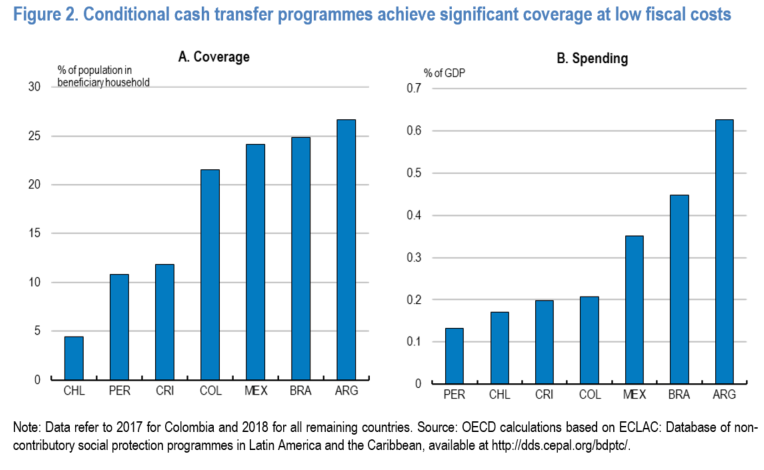
Building more effective universal social safety nets that include informal workers and entrepreneurs emerges as one of the main lessons from the COVID-19 crisis and the social unrest during 2019. Given their wide reach in many countries, existing cash-transfer programmes would be the most straightforward basis for effective social safety nets (Figure 2, Panel A). In several countries, eligibility is in principle universal, but in practice, enrolment processes are too slow or cumbersome to help people in the face of sudden income losses. An important step would therefore be to make cash transfer programmes more agile, so that they can disburse quickly when people lose their livelihoods, following the examples of the UK’s Universal Credit or Malaysia’s BSH programme. More universal social safety nets based on means-tested cash transfers could also help to reduce the widespread fragmentation of social programmes, and strengthen their effectiveness.

Financing universal social safety nets will require additional resources, but building on existing programmes may make the cost manageable. Cash transfer schemes are among the most cost-efficient social expenditure programmes, and they cost relatively little (Figure 2, Panel B). Brazil’s successful Bolsa Família programme, for example, currently only costs 0.5% of GDP, compared with 12% spent on formal social security schemes. During the COVID-19 pandemic, additional spending of 0.04% of GDP was enough to eliminate an accumulated queue of 1 million benefit applicants. Building on existing citizen identification systems and digital technologies could further reduce costs.

Social protection for informal workers should go along with efforts to foster formalisation. Reviewing non-wage labour costs can help to reduce informality, as illustrated by Colombia’s 2012 tax reform. Costly and complex business regulations, including those for starting a formal business, also hamper the formalisation of firms and jobs. Expanding the use of one-stop shops for business regulations would be one way forward. Social programmes could increasingly integrate training and lifelong learning for informal workers. This could create a virtuous circle between formal employment, growth and equity.


Informality and weak competition – a deadly cocktail for growth and equity in emerging Latin America

By Piritta Sorsa, Jens Arnold and Paula Garda, OECD Economics Department

Why is growth persistently low and so unevenly distributed in emerging Latin America compared to emerging Asia despite a huge potential? Potential growth is ranging around 2-3% in the region. Some refer to dependence on commodities, poor education, weak business environments or corruption as possible causes. But the question is deeper and more complex. A crucial factor for Latin America is low productivity, often related to a poor use of available resources. Across the region, many workers and significant amounts of capital are stuck in activities that are not efficient. The reasons for this are many, but two important forces stand out: high informality and weak competition.

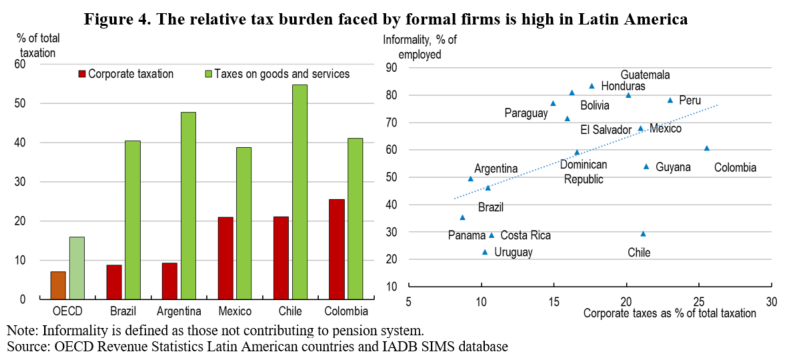
High and persistent informality in the region leaves workers more vulnerable and deprives them from social protection, thus contributing to inequality. For example, old age poverty in Colombia is high as low-skilled workers spend much of their working lives in informal employment, without pension contributions (OECD, 2019[1]). In Brazil and Argentina, informal workers retire later than others for the same reason, until they eventually reach the age to benefit from a non-contributory pension (OECD, 2019[2]; OECD, 2018[3]). In Mexico, poverty and informality are highly correlated among regions (OECD, 2019[4]). Informality also tends to maintain companies small with often low productivity as growing would face high costs of formalisation. Indeed, informal-sector productivity in the average LAC country is only between 25 and 75 percent of total labour productivity, and productivity decreases as informality rises (Loayza, 2018[5]). Informality also reduces the tax base for corporate and personal income taxes, reducing the capacity of the public sector to boost productivity and reduce inequality, and requires a higher tax burden on larger formal companies.

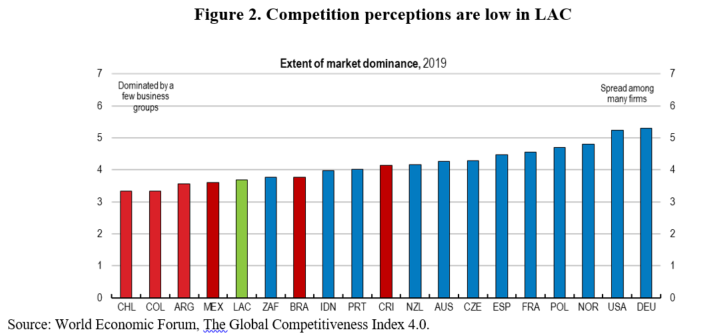
Weak competition is a second reason behind low productivity and is often reflected in high concentration (Figure 2). Entry barriers can protect existing activities that have little future growth potential at the cost of new dynamic and productive firms. Weak competition creates rents and lowers the share of wages in value-added worsening income distribution. Higher prices for consumers reduce purchasing power, affecting disproportionally low-income households.

Reducing informality for productivity and equity

The causes of informality are multiple. Informality is often a consequence of high costs of hiring formal workers, both wage and non-wage, especially in relation to labour productivity, given low educational outcomes.

Where high informality and weak competition coincide, as is the case in many Latin American countries, the consequences for both growth and equity can be particularly severe. For emerging Latin America to grow stronger and better share the fruits of growth, dealing with informality and competition should be priority.

Labour informality is often caused by rigid labour regulation. High firing costs of workers can discourage formal-sector hiring and promote inequality (Loayza, 2018[5]; OECD, 2018[6]; Heckman and Pages, 2000[7]). In Mexico, a labour reform in 2012 reduced hiring and firing costs, introduced different models of contracting and brought changes to the resolution of labour conflicts. Formal salaried jobs increased in the aftermath (OECD, 2019[4]). Minimum wages can be high compared to productivity or average wages keeping most workers informal. In Colombia, the minimum wage is close to the median wage and two thirds of workers earn less than that (OECD, 2019[1]). High payroll taxes can also have a detrimental effect on informality rates (Bobba, Flabbi and Levy, 2018[8]). Antón and Rastaletti (2018[9]) show how lowering employer social security contributions could lead to a substantial increase of labour formalisation. At a minimum, lower employer contributions could be offered temporarily for hiring low-skilled workers that enter the formal sector for the first time (OECD, 2017[10]). Lowering payroll taxes in Colombia helped reduce informality after the 2012 reform (Kugler et al., 2017[11]; Morales and Medina, 2016[12]; Fernández and Villar, 2016[13]; Bernal et al., 2017[14]). While incentives are crucial, better enforcement also needs to be part of any formalisation strategy.

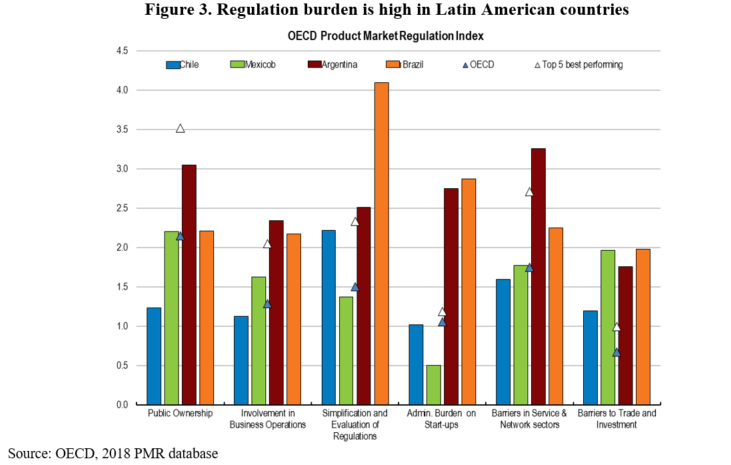
Cumbersome administrative barriers and high taxes can keep companies informal. Latin America stands out in this respect (Figure 3). The tax burden on formal companies is also high compared to the OECD and positively associated to informality rates (Figure 4). To promote formalisation, regulatory and tax systems should be simple, with gradual increases in the tax burden as firms grow, so as not to discourage growth, and keep marginal tax rates as low as possible (Loayza, 2018[5]). These characteristics are crucial to encourage investment and employment in growing and larger companies.

Many countries in the region have implemented simplified schemes and reduced costs for small taxpayers with the aim of reducing informality. For example, Mexico introduced a special simplified regime for SMEs (Regimén de Incoporación Fiscal, RIF) in 2014, which induced 1.5 million informal firms to join the tax system (OECD, 2018[15]). In Brazil, a special tax regime for microenterprises (Microemprendedor Invididual, MEI) reduced the cost of formalisation and contributions to social security as of 2008. This regime helps explain the rising formalisation of the self-employed, including of women (OECD, 2012[16]). In Argentina, a simplified tax regime called Monotributo helped formalise self-employed workers. In Colombia, the tax reform in 2018 introduced a new simplified tax scheme (Simple) for small firms, and there are signs of positive impact on firm formalisation during 2019. At the same time, these regimes have to be designed carefully. When participation thresholds for special SME tax regimes are set too high, the effectiveness for formalisation declines while fiscal cost and threshold effects rise, as in the case of Brazil’s Simples Nacional (OECD, 2018[3]). At times, simplifying the general tax regime may be preferable over creating exceptions.

Education and skill levels are also linked with informality. Countries with lowest informality rates tend to have significantly higher levels of human capital (Docquier, Müller and Naval, 2017[17]). It is not a coincidence that the decrease in informality over recent decades in Latin America went hand in hand with steady progress towards universal education. Evidence shows that improvements in education have been an important driving force behind falling informality in Colombia and Brazil (International Monetary Fund, 2018[18]; OECD, 2018[3]).

Increasing competition for productivity and equity

In Latin America, the same complex rules that discourage formal job creation often coincide with overly strict regulations that stifle competition. Competition is affected by how easily firms can enter or exit markets, by the extent of license requirements for starting or expanding a business and by competitive pressures from imports. Relatively high trade protection adds to this in a number Latin American countries, shielding domestic producers from international competition (OECD, 2018[3]). All of this tends to raise prices for consumers and keep resources in low-productivity activities where informality is widespread, for both workers and firms.

These circular relationships suggest that it is important for the public sector to take stock of burdens that even well-intended regulations and codes can impose on private activity. Disincentives for firms to go formal will inevitably preclude workers from the benefits of formal jobs, while unnecessary barriers to competition will keep more jobs in activities with limited potential for productivity and wage growth. To foster formal job creation, all parts of a country’s regulatory framework should be simple and clear, promote competition, and facilitate both market entry and exit of firms (Loayza, Oviedo and Serven, 2005[19]).

Getting there

A comprehensive strategy is needed to deal with both informality and competition. It involves simplifying labour regulations, keeping administrative burdens and license requirements for companies as easy as possible, facilitating market entry and reducing trade barriers. Bringing more workers and firms into the formal sector would bring about broader social and labour protection, fairer wages, a more even tax burden and higher potential growth. Many of these policies are politically difficult as they involve dealing with vested interests and require appropriate sequencing. But that is not an excuse for inaction. These reforms should be accompanied with training and other active labour market policies for affected workers, as the informal sector often fulfils the function of absorbing excess labour supply, especially during transitions or economic recessions. Reforms to improve quality and relevance of education to raise worker productivity and policies that can raise investment and boost firm productivity should be also part of the strategy.

References

Antón, A. and A. Rasteletti (2018), Imposición al trabajo en contextos de alta informalidad laboral: Un marco teórico para la simulación de reformas tributarias y de seguridad social, Inter-American Development Bank, Washington, D.C., http://dx.doi.org/10.18235/0001467.

Bernal, R. et al. (2017), “Switching from Payroll Taxes to Corporate Income Taxes: Firms’ Employment and Wages after the Colombian 2012 Tax Reform”, IDB Technical Note, No. 1268, Inter-American Development Bank.

Bobba, M., L. Flabbi and S. Levy (2018), “Labor Market Search, Informality and Schooling Investments”, Interamerican Development Bank, https://publications.iadb.org/en/publication/12928/labor-market-search-informality-and-schooling-investments.

Docquier, F., T. Müller and J. Naval (2017), “Informality and Long-Run Growth”, The Scandinavian Journal of Economics, Vol. 119/4, pp. 1040-1085, http://dx.doi.org/10.1111/sjoe.12185.

Fernández, C. and L. Villar (2016), “The Impact of Lowering the Payroll Tax on Informality in Colombia”, No. 72, Fedesarrollo, http://hdl.handle.net/11445/3300.

Heckman, J. and C. Pages (2000), “The Cost of Job Security Regulation: Evidence from Latin American Labor Markets”, NBER working paper, No. 7773, National Bureau of Economic Research, http://dx.doi.org/10.3386/w7773.

International Monetary Fund (2018), “Colombia: Selected Issues”, Country Report, No. 18/129, http://www.imf.org.

Kugler, A. et al. (2017), “Do Payroll Tax Breaks Stimulate Formality? Evidence from Colombia’s Reform”, NBER Working Paper Series, http://www.nber.org/papers/w23308.

Loayza, N. (2018), “Informality : Why Is It So Widespread and How Can It Be Reduced?”, Research and Policy Briefs, No. 20, World Bank, http://documents.worldbank.org/curated/en/130391545228882358/Informality-Why-Is-It-So-Widespread-and-How-Can-It-Be-Reduced.

Loayza, N., A. Oviedo and L. Serven (2005), “The impact of regulation on growth and informality – cross-country evidence”, Policy, Research working paper World Bank 3623, http://documents.worldbank.org/curated/en/212041468134383114/The-impact-of-regulation-on-growth-and-informality-cross-country-evidence.

Morales, L. and C. Medina (2016), “Assessing the Effect of Payroll Taxes on Formal Employment: The Case of the 2012 Tax Reform in Colombia”, Borradores de Economia, Banco de la Republica, http://www.banrep.gov.co/en/borrador-971.

OECD (2019), Economic Surveys: Colombia, https://doi.org/10.1787/e4c64889-en.

OECD (2019), Economic Surveys: Mexico, https://doi.org/10.1787/a536d00e-en.

OECD (2019), OECD Economic Surveys: Argentina 2019, OECD Publishing, Paris, https://dx.doi.org/10.1787/0c7f002c-en.

OECD (2018), Economic Surveys: Chile, https://doi.org/10.1787/eco_surveys-chl-2018-en.

OECD (2018), Getting it Right: Strategic Priorities for Mexico, OECD Publishing, Paris, https://dx.doi.org/10.1787/9789264292062-en.

OECD (2018), OECD Economic Surveys: Brazil 2018, OECD Publishing, Paris, https://dx.doi.org/10.1787/eco_surveys-bra-2018-en.

OECD (2017), OECD Economic Surveys: Argentina 2017: Multi-dimensional Economic Survey, OECD Publishing, Paris, https://dx.doi.org/10.1787/eco_surveys-arg-2017-en.

OECD (2012), Closing the Gender Gap ACT NOW: Brazil Country note, OECD, Paris, France, http://www.oecd.org/gender/closingthegap.htm.


Positive economic outlook for the main economies in Latin America but downward risks have intensified

Alvaro S. Pereira (Director) and Latin American desks, Economics Department, Country Studies Branch, OECD

The global economy is navigating rough seas. Global GDP growth is strong but it has peaked. In many countries unemployment is well below pre-crisis levels, labour shortages are biting and inflation remains tepid.  Yet, global trade and investment have been slowing on the back of increases in bilateral tariffs while  many emerging market economies are experiencing capital outflows and a weakening of their currencies. The global economy looks set for a soft landing, with global GDP growth projected to slow from 3.7% in 2018 to 3.5% in 2019-20. However, downside risks abound and policy makers will have to steer their  economies carefully towards sustainable, albeit slower, GDP growth.

The economic recovery in the Latin American economies has become dissimilar. While in some countries, growth has been revised downwards, in others it has been revised upwards. This disparity is closely linked to how these economies have evolved in the face of the financial stress and increased financial volatility in recent months. The region’s economies with the best macroeconomic fundamentals, independent central banks, countercyclical monetary policies, sound fiscal policy framework and no major currency mismatches in corporate or sovereign debt, were better able to sail the adverse global financial conditions that led to capital outflows, weakening their currencies.

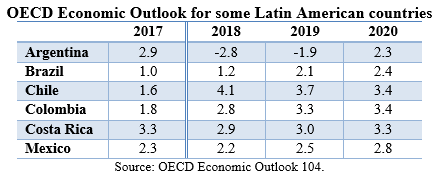
Table LAC EO104

While Chile and Colombia have gained momentum, Brazil has shown lower growth and Argentina has fallen into recession. Mexico and Costa Rica have also experienced less momentum than expected. Growth in Argentina, Brazil, Chile, Colombia, Costa Rica and Mexico, countries covering about 85% of Latin America’s GDP, is expected to be around 1.4% this year and to accelerate to 2.0% in 2019 and 2.7% in 2020 (weighted average) (see Table). However, downside risks abound while the region is vulnerable to the global context. Several indicators, such as the fiscal and current account deficits have been accentuated in the last decade in most of these economies (Figure), suggesting that the region is still vulnerable. Needs to be noted that the situation is uneven and a broader list of indicators should be analysed.

Figure LAC EO104

An accumulation of risks could create the conditions for a harder-than-expected landing. First, further trade tensions would take a toll on trade and GDP growth, generating even more uncertainty for business plans and investment. Second, tightening financial conditions could accelerate capital outflows from the region and depress demand further. Third, a sharp slowdown in China would hit Latin America and other emerging economies, but also advanced economies if the demand shock in China triggered a significant decline in global equity prices and higher global risk premia.

Looking ahead, it will be necessary to strengthen the macroeconomic policy framework to reduce vulnerabilities where necessary. Most of the region’s economies are starting, or will start in the near future, more restrictive monetary policies, while also undertaking fiscal consolidation. Depending on each country, it will be important to find a balance between the needs for social spending and public investment, with the need to put debt on a sustainable path. In Chile, Colombia and Mexico, this consolidation can be done gradually, but Argentina, Brazil and Costa Rica need to do it more urgently. Pension or tax reforms will be necessary in this regard.

Given the limited scope for countercyclical policies, in the face of external risks and a more pronounced slowdown, the time to promote the necessary structural reforms is now to guarantee a future with a sustained increase in productivity and greater inclusion. Many countries in the region have scope to reform the tax system and make it more effective in improving investment incentives and raising more resources. Depending on the characteristics of each country, possible measures may include limiting the use of tax exemptions and reduced rates, particularly in VAT, but also in corporate taxes, extending the tax base by including more people in personal income taxes, reducing evasion or making greater use of property, inheritance or environmental taxes. Other priorities should focus on export promotion and diversification, which would help reduce current account deficits. Investing in quality and innovative human capital, closing infrastructure and logistical gaps, and curbing corruption would support exports and their diversification, strengthening growth. Encouraging women’s participation in the labour force, reducing precariousness and informality in the labour market, as well as pension reforms are also urgent in several countries of the region and necessary to increase productivity and reduce inequalities.

Argentina: A combination of massive fiscal and monetary tightening will keep the economy in recession during 2018 and 2019. Private consumption and investment will remain depressed due to lower real incomes and high interest rates, and unemployment will rise. However, a better harvest and a lower real exchange rate will support stronger exports.

Brazil: Growth will gain momentum during 2019 and 2020 as private consumption, supported by improvements in the labour market, will increase. Recovering credit and greater policy certainty as a new administration takes office will buttress the recovery. Political uncertainty around the implementation of reforms remains significant and could derail the recovery, but if uncertainty fades and reforms advance as assumed, investment will become stronger.

Chile: Growth is projected to remain strong over the next two years. With an uncertain external environment, solid domestic demand will underpin growth, aided by a stable inflation environment, public infrastructure projects and a tax reform. Inequality, though  decreasing, remains high, as informality and unemployment remain high and social transfers low.

Colombia: Growth is projected to pick up as infrastructure projects, lower corporate taxes and higher oil prices will boost investment. Improving confidence and financing conditions will support consumption. As growth gains traction, unemployment will edge down. Social indicators are improving but informality and inequality remain high.

Costa Rica: Growth is projected to recover to around 3¼ per cent in 2020 and be broad-based, underpinned by both domestic and external demand. However, uncertainty, particularly surrounding the planned fiscal reforms, is weighing on growth in the near term. The projections are based on the assumption that the fiscal reforms will be implemented from 2019, with modest fiscal tightening holding back growth in 2019 and 2020.

Mexico: Growth is projected to pick up to 2¾ per cent in 2020. Low unemployment, strong remittances and the recovery of real wages  will support household consumption. Investment, which has been persistently low, will strengthen on the back of announced public investment plans and increased confidence associated with the US-Mexico-Canada trade agreement. Exports will decelerate owing to less favourable global conditions, especially in the United States. Inflation has been pushed up by rising energy prices, but expectations and core inflation remain anchored and within the central bank’s target band. Informality is slowly declining but remains elevated,  contributing to persistently high inequalities and low productivity.

To read more about the Economic Outlook and the main structural challenges visit the english and spanish/portuguese version (it includes OECD forecasts and a chapter on decoupling of wages and productivity and the implications for public policy).

References:

OECD (2018), OECD Economic Outlook, Volume 2018 Issue 2: Preliminary version, OECD Publishing, Paris, https://doi.org/10.1787/eco_outlook-v2018-2-en.


Las perspectivas económicas son positivas en los principales países de América Latina pero los riesgos a la baja se han acentuado

Alvaro S. Pereira (Director) y mesas de países latinoamericanos, Departamento de Economía, Directorado de estudios de países, OCDE

La economía mundial está navegando mares agitados. El crecimiento del PIB mundial es fuerte, pero ha alcanzado su punto máximo. En muchos países, el desempleo está por debajo de los niveles anteriores a la crisis de 2008, la escasez de mano de obra se empieza a sentir, aunque la inflación sigue siendo templada. Sin embargo, el comercio y la inversión mundiales se han desacelerado como consecuencia del incremento de aranceles bilaterales y de mayor incertidumbre política, mientras que varias economías emergentes están experimentando salidas de capitales y un debilitamiento de sus monedas. La recuperación del crecimiento global  comenzará a desacelerarse, mientras que los riesgos a la baja se han acentuado. Se prevé que el crecimiento del PIB mundial disminuya del 3,7% en 2018 a 3,5% en 2019-2020. Sin embargo, abundan los riesgos de recesión y los responsables políticos tendrán que orientar cuidadosamente sus economías hacia un crecimiento sostenible, aunque más modesto, del PIB.

En las principales economías de América Latina, la recuperación económica se ha vuelto despareja. Mientras que en algunas, el crecimiento se ha revisado a la baja, en otras se ha revisado al alza. Esta disparidad está estrechamente ligada a cómo estas economías han evolucionado frente al estrés financiero e incremento de volatilidad financiera de los pasados meses. Las economías de la región con mejores fundamentos macroeconómicos, bancos centrales independientes, políticas monetarias contracíclicas, un marco de política fiscal sólido y sin grande descalce de monedas en la deuda corporativa o soberana, fueron los que sortearon mejor las condiciones financieras globales adversas que sometieron a varios países a una repentina salida de capitales y debilitamiento de sus monedas.

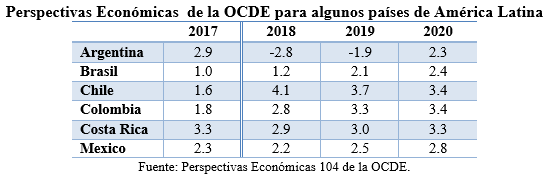
Table LAC EO104 Esp

Mientras que Chile y Colombia han ganado ímpetu, Brasil ha mostrado menor crecimiento y Argentina ha caído en recesión. México y Costa Rica también han experimentado menor ímpetu al esperado. Se espera que el crecimiento en Argentina, Brasil, Chile, Colombia, Costa Rica y México, países que cubren alrededor del 85% del PIB de América Latina, se sitúe en torno al 1.4% este año y se acelere a 2.0% en 2019 y 2.7% en 2020 (promedio ponderado) (Tabla). Sin embargo, abundan los riesgos a la baja, mientras que la región se encuentra vulnerable al contexto global. Algunos indicadores, como los déficits fiscales y de cuenta corriente (Figura) se han acentuado en la mayoría de estas economías en la última década, sugiriendo que la región es aún vulnerable. Debe notarse que la situación es dispar y se debe mirarse una lista más amplia de indicadores.

Una acumulación de riesgos podría crear las condiciones para una desaceleración de crecimiento más acentuada de la esperada. En primer lugar, nuevas tensiones comerciales afectarían al comercio y al crecimiento del PIB, generando aún más incertidumbre para las empresas y la inversión. En segundo lugar, el endurecimiento de las condiciones financieras globales podría acelerar las salidas de capitales y deprimir aún más las monedas de la región. En tercer lugar, una fuerte desaceleración en China afectaría a la región y otras economías emergentes, pero también a las economías avanzadas si el shock de la demanda en China provocara un descenso significativo de los precios mundiales de las acciones y un aumento de las primas de riesgo mundiales.

Figure LAC EO104Esp

De cara al futuro, será necesario reforzar el marco de las políticas macroeconómicas para reducir vulnerabilidades donde sea necesario. La mayor parte de las economías de la región están comenzando, o lo harán en el futuro próximo, políticas monetarias más restrictivas, al tiempo que también deben llevar a cabo una consolidación fiscal. Dependiendo de las holguras de cada país, será importante encontrar un ritmo que balancee las necesidades de gasto social y de inversión pública, con la necesidad de poner la deuda en una senda sustentable. En Chile, Colombia y México, esta consolidación se puede llevar a cabo de manera gradual, pero Argentina, Brasil y Costa Rica necesitan hacerlo de manera más urgente. Reformas pensionales o tributarias serán necesarias en este sentido.

Dado el escaso margen para hacer políticas contracíclicas ante la realización de riesgos externos y una deceleración más acentuada, el momento de impulsar reformas estructurales necesarias es ahora, para garantizar un futuro con incremento sostenido de la productividad y mayor inclusión. Muchos países de la región tienen margen para reformar el sistema tributario y hacerlo más eficaz para mejorar los incentivos a la inversión y recaudar más recursos. Según las características de cada país, posibles medidas pueden incluir limitar el uso de exenciones tributarias y tasas reducidas, en particular en el IVA, pero también en los corporativos, extender las bases de imposición incluyendo más personas en los impuestos a los ingresos personales, reducir la evasión o hacer mayor uso de impuestos a la propiedad, a la herencia o impuestos ambientales. Otras prioridades deberían focalizarse en fomentar las exportaciones, y diversificarlas, lo que ayudaría a reducir los déficits de cuenta corriente. Invertir en capital humano de calidad e innovación, cerrar las brechas de infraestructura y logística y frenar la corrupción apoyarían a las exportaciones y su diversificación, fortaleciendo el crecimiento. Alentar la participación de la mujer en la fuerza laboral, reducir la precariedad e informalidad del mercado laboral, así como reformas al sistema de pensiones son también urgentes en varios países de la región y necesarios para aumentar la productividad y bajar las desigualdades.

Argentina: La economía seguirá en recesión en 2018 y 2019 debido a un endurecimiento fuerte y simultáneo de políticas monetarias y fiscales. El consumo privado y la inversión seguirán siendo bajos a causa del descenso de los ingresos reales y de los elevados tipos de interés, y aumentará el desempleo. Sin embargo, una mejor cosecha y un tipo de cambio real más competitivo contribuirán al aumento de las exportaciones.

Brasil: El crecimiento cobrará impulso en 2019 y 2020 gracias al aumento del consumo privado, respaldado por mejoras en el mercado laboral. La reactivación del crédito y el descenso de la incertidumbre política una vez que el nuevo gobierno tome posesión apuntalarán la recuperación económica. La incertidumbre política sobre la implementación de reformas sigue siendo importante y podría frenar la recuperación pero, si desaparece y las reformas siguen adelante como se supone que deberían hacerlo, aumentará la inversión.

Chile: Según las proyecciones, el crecimiento seguirá aumentando en los próximos dos años. Ante una incierta coyuntura externa, el crecimiento estará respaldado por la sólida demanda interna con ayuda de un entorno de inflación estable, proyectos de infraestructuras públicas y una reforma fiscal. A pesar que las desigualdades han disminuido, permanecen altas, debido a que la informalidad y el desempleo siguen siendo elevados y las transferencias sociales escasas.

Colombia: Las proyecciones indican que el crecimiento repuntará, ya que los proyectos de infraestructuras, el descenso del impuesto de sociedades y la subida de los precios del petróleo potenciarán la inversión. La mejora de la confianza y de las condiciones de financiamiento respaldará el consumo. A medida que el crecimiento se vaya afianzando, el desempleo descenderá. Los indicadores sociales están mejorando, aunque la informalidad y la desigualdad se mantendrán en niveles elevados.

Costa Rica: Según las proyecciones, el crecimiento se recuperará hasta el 3¼ aproximadamente en 2020 y será generalizado, sostenido tanto por la demanda interna como externa. Sin embargo, la incertidumbre, particularmente respecto a las reformas fiscales planificadas está lastrando el crecimiento a corto plazo. Las proyecciones parten del supuesto de que las reformas fiscales se aplicarán a partir de 2019, con un modesto ajuste fiscal que frenará el crecimiento en 2019 y 2020.

México: Está previsto que el crecimiento repunte hasta el 2¾ por ciento hacia 2020. El bajo nivel de desempleo, fuertes remesas y la recuperación de los salarios reales reforzarán el consumo de los hogares. La inversión, que ha sido persistentemente baja, se reforzará a consecuencia de los planes de inversión públicos anunciados y del aumento de la confianza vinculado al acuerdo comercial entre Estados Unidos, México y Canadá. El crecimiento de las exportaciones se reducirá debido a unas condiciones internacionales menos favorables, en especial en Estados Unidos. La subida de los precios de la energía ha empujado la inflación al alza, pero las expectativas y la inflación subyacente siguen ancladas y dentro del rango meta del banco central. El alto nivel de informalidad contribuye a que haya una gran desigualdad y una escasa productividad.

Para leer en más detalle sobre las proyecciones macroeconómicas, así como los principales desafíos estructurales ir al reporte en la versión español/portugués o inglés (que incluye proyecciones para países de la OECD, principales desafíos y un capítulo especial sobre la desvinculación de los salarios y la productividad y las implicancias en términos de políticas públicas).