Promoting stronger and more sustainable growth for all people across Spain

También disponible en español

By Bertrand Pluyaud and Adolfo Rodríguez-Vargas, OECD Economics Department

Before the COVID-19 pandemic, the Spanish economy experienced a period of sustained and more balanced economic growth, less dependent on the construction sector, and with a healthier financial system. The pandemic and Russia’s war of aggression against Ukraine were successive shocks that required strong government support to protect businesses and households, as noted in the 2023 Economic Survey of Spain. Output has recovered to its pre-pandemic level, and growth has held up well since the second half of 2022 and it is expected to remain solid in 2024.

The recovery from the pandemic has been steady following the large fall of GDP in 2020

Gross Domestic Product, Volume, base 2019Q4 = 100


Made with Flourish

Spain has also introduced several major reforms to address longstanding labour market issues, promote business growth and innovation, ensure pensions’ sustainability, and boost vocational education. However, structural weaknesses remain that weigh down Spain’s growth potential. The 2023 Economic Survey discusses policy options to tackle these issues in four areas.

Addressing fiscal challenges

Government action was decisive for the recovery, but it was costly. Public debt, which was already high before the pandemic, has increased by 13 percent points of GDP since 2019.  Sustained fiscal consolidation is required to keep debt on a downward path and to make room for ageing-related spending and growth-enhancing items, like education and green transition. This consolidation should rely on both mobilising additional revenues and on enhancing spending efficiency.

Increasing the relatively low tax intake should encompass gradually broadening the value added tax base and raising environment-related taxes, but also reducing tax avoidance and enhancing tax collection. Spending reviews should continue to be used to define growth-enhancing spending priorities, and evaluation of public policies should become the norm.

Public debt remains high

Public debt, Maastricht definition, % of GDP


Made with Flourish

Source: Eurostat.

Raising productivity

Low investment in R&D, inefficient public spending on education and training, and an insufficient stock of ICT capital have dragged down productivity growth, which in the last decade has averaged 0.6% per year compared to 0.9% for the OECD. The share of innovative companies is also comparatively low. All this weighs on potential growth, which with rapid population ageing is expected to weaken even more.

Promoting collaboration and knowledge transfer between businesses and universities, fostering entrepreneurship,  reducing regulatory barriers, and improving regulation can increase innovation and business growth. Continuing with an effective implementation of the investment and reforms under the national Recovery, Transformation and Resilience Plan should remain a priority, as it can help overcome structural deficiencies and boost productivity.

Promoting opportunities for all people across Spain

Despite recent improvements, income inequalities remain significant. Poverty is high compared to the OECD, and Spain has the highest child poverty rate in Western Europe, at 22%. This makes it urgent ensuring that public assistance is sufficient and reaches those who need it more. The survey recommends improving the targeting of social benefits, particularly towards poor families with children, boosting the take-up of the minimum income guarantee, and reducing administrative burdens for users.

Young people in Spain face a challenging transition to an independent, productive, and happy adult life. The risk of poverty among them is particularly high, although it has fallen. That is why the special topic of this survey is how can Spain increase opportunities for its young.

Educational and labour market outcomes have improved, but many young people still leave the education system with low education levels or skills, and youth labour-market integration remains difficult. The share of temporary contracts has decreased after the 2021 labour market reform, but it is still high. The survey recommends training teachers to identify and assist students at risk and maintaining support for students to enrol in vocational education, including by fostering the participation of SMEs to offer places. Furthermore, to ease school-to-work transitions it encourages greater employer involvement in the design of university curricula, and improving access to financing for young entrepreneurs.

Housing is a pressing concern for many people in Spain, especially the young. To increase housing supply, the survey recommends expanding the very low stock of social rental housing and relaxing stringent rent controls.

Young people face high poverty risks

Risk of poverty or social exclusion, %


Made with Flourish

Note: OECD Europe includes European OECD countries and excludes Türkiye.
Source: INE.

Addressing environmental challenges

Spain has made progress in the fight against climate change, as environmental protection expenditure has increased and renewable energies are becoming more prevalent in the energy mix. To keep reducing its dependence on fossil fuels, Spain should accelerate the shift towards greener transportation, improve storage and grid interconnections, and continue promoting renewable energies.

A more environment-friendly tax regime is also needed, as environmental tax revenue as a share of GDP is low compared to most OECD European countries. The base for environment-related taxation can be broadened, including by phasing out exemptions and gradually increasing the tax rate on emissions, while compensating partially and temporarily the most vulnerable.

Persistent drought in some regions has lowered water availability, and intense agriculture production has affected water quality. These problems could be addressed through more efficient irrigation, reuse and recycling of waters, and a more sensible use of fertilizers.

Improving water availability and quality is urgent

Groundwater stations with poor quality standards, %


Made with Flourish

Note: Groundwater stations failing to meet the drinking water standard under the EU Nitrates Directive
Source: European Environment Agency (EEA).

Government action helped Spain to overcome two major successive shocks. Evidence-based public policies can also help to solve Spain’s longstanding structural weaknesses to increase growth and raise wellbeing for all people across Spain.

References

OECD (2023), OECD Economic Surveys: Spain 2023, OECD Publishing, Paris,  https://doi.org/10.1787/5b50cc51-en  


Maintaining and reinforcing achievements in Costa Rica

By Alberto Gonzalez Pandiella and Alessandro Maravalle, OECD Economics Department

Costa Rica has made remarkable economic progress over the past two decades, such as achieving life expectancy at par with the OECD average. Thanks to a strong commitment to trade, it has succeeded in attracting foreign direct investment and in increasing the level of sophistication of its export basket. However, the challenges to safeguard these achievements and further improve living standards are substantial. Growth prospects were deteriorating before the pandemic and going forward population ageing will take an additional toll (Figure). Unemployment is high, at a two-digit rate since 2018, as well as informality, affecting nearly half of the labour force. The fiscal situation improved in 2021 and 2022, thanks to the 2018 fiscal reform, but with public debt at around 70% of GDP, public finances remain a critical vulnerability requiring sustained efforts to contain spending and boost public sector efficiency. Nearshoring trends, by which companies seek reducing supply chain disruption risks by locating closer to their final markets, are providing new investment opportunities. Costa Rica is a front runner in environmental protection and renewables generation, and the global transition to net zero greenhouse gas emissions can further increase the country’s competitiveness.

The latest OECD Economic Survey (OECD, 2023) argues that continuing and stepping up structural reform efforts would be the best way for Costa Rica to respond to these challenges and seize new opportunities. Reforms to boost productivity are particularly critical to uphold growth in GDP and living standards. Strengthening competition is especially a promising avenue to boost productivity. Weak competition tends to translate into relatively high prices of goods and services for consumers and firms. Valuable and bold steps have been recently taken to boost competition in key markets, such as rice or professional services. Steps are also being taken in cooperation with the private sector to reduce regulatory burden, by identifying regulations and procedures susceptible to be phased out, including also specific deadlines for their elimination. Providing the national competition authority with the budget granted by law is a pending challenge that would be particularly beneficial at the current juncture when measures to improve regulations and open up key sectors of the economy are being taken. Effective competition authorities, by promoting stronger economic growth, can also have a positive fiscal impact by supporting higher tax revenues.

Informality, at around 45% of total employment, remains high and is both a cause and a consequence of low productivity. A comprehensive strategy is required to reduce it, with actions needed in several policy areas, such as reducing non-wage labour costs, facilitating the creation of formal firms, including by reducing the bureaucratic and economic cost of establishing a formal firm, helping more Costa Rican to acquire the skills needed to access formal jobs, simplifying taxes and enhancing enforcement mechanisms. Experience in some OECD countries, such as Colombia, indicates that reducing non-wage costs, by cutting employer payroll charges, can help to reduce informality. Employer payroll charges in Costa Rica are high in comparison with the OECD average, indicating that there is ample room to move in this direction.

Virtually universal health care and primary education and one of the highest pension coverage in the region have led to remarkable social outcomes. However, Costa Rica faces substantial social challenges, such pas poverty remaining largely unchanged at around 20% over the last 25 years and increasing income inequality. There is room to improve social programmes targeting, as in some cases more than 40% of the beneficiaries are middle and high-income households. There is also room to reduce fragmentation, as 21 institutions are in charge of delivering more than 35 schemes. Better targeting and lower fragmentation would facilitate reinforcing social protection in key areas and reduce inequality.

Improving the quality and efficiency of education and training is also key to support growth and equity in Costa Rica. Even if spending on education is high in Costa Rica, where it amounts to more than 6.5% of GDP, one of the highest shares across OECD countries, educational outcomes remain poor and educational exclusion is still high, with too many Costa Ricans leaving school without an upper-secondary education. A more targeted support to students with learning gaps, improving teachers’ selection and training and expanding access to education to children below four years would help increase equity of opportunities and help more Costa Ricans access better paid formal jobs and firms fill easier their vacancies.

Figure. Without reforms the economy’s growth potential will fall as the demographic bonus fades

Contributions to potential growth, % pts

References:

OECD (2023), OECD Economic Surveys: Costa Rica 2023, OECD Publishing, Paris.


Improving economic opportunities for all in Belgium

By Nicolas Gonne and Müge Adalet McGowan, OECD Economics Department.

Belgium has low income inequality overall, thanks to extensive tax and transfer policies and strong institutionalised social dialogue. However, as in other OECD countries, there is scope to improve equality of opportunities. Indeed, Belgium’s good overall performance regarding income distribution hides an unequal access to life chances, with considerable disparities according to, notably, parental background and country of origin.

Improving economic opportunities for all in Belgium would promote well-being and potential growth by better allocating talents, but also help alleviate fiscal sustainability challenges by reducing the need for redistribution. Based on new OECD evidence from survey microdata (Périlleux et al., forthcoming), the latest Economic Survey of Belgium identifies three key barriers to equal opportunities: low labour market transitions, inequity in compulsory education and a lack of affordable housing. The Survey discusses policies that can tackle these barriers, with a particular focus on the situation of vulnerable groups, such as the low-skilled, people with a migrant background and single mothers. As competencies concerning the labour market, education and housing spread across different levels of government, some recommendations are more relevant to specific regions and communities according to their policy needs and priorities.

Improving the labour market outcomes of vulnerable groups

Important reforms have contributed to increasing the participation of low wage earners and older workers in Belgium. Yet, employment gaps remain particularly large for disadvantaged groups, such as non-EU migrants, the low educated and people with disabilities (Figure 1), in part reflecting weak digital skills and low participation in training. Lifelong learning programmes and actors involved should be streamlined and vulnerable groups prioritised for face-to-face career guidance, as complexity is particularly detrimental to their participation.

Figure 1. Employment gaps are particularly large for disadvantaged groups

Note: Employment gap defined as the difference between the employment rate of prime-age men (aged 25-54) and that of the group, expressed as a percentage of the employment rate of prime-age men (more details).
Source: OECD calculations based on OECD Employment database, OECD International Migration database, OECD Education Database and OECD Family database.

The planned introduction of the individual training account, as recommended in the previous Economic Survey of Belgium, is a major step in the direction of increasing lifelong learning efficiency and inclusiveness, but successful implementation requires the provision of high quality training in areas of skill needs and coordination across regions. Moreover, the use of statistical profiling tools for delivering employment services to target vulnerable groups should be expanded. As low employment rates also reflect gaps in individual support for sickness and disability beneficiaries, individual placement and support programmes should be scaled up further, conditional on their evaluation. Finally, introducing in-work benefits for low-wage workers with children would strengthen their work incentives, as low-income single parents and second earners with children face among the highest participation tax rates in the OECD.

Enhancing equal opportunities in compulsory education

Belgian students’ overall academic performance is at par with peer countries. However, student achievement strongly depends on parental background (Figure 2), leading to large disparities across schools and programmes due to a cumulative process of socio-economic self-sorting and academic selection. Schools are incentivised to diversify their student intake, but not to achieve good educational outcomes for weaker students. Reliable performance indicators and other data on successful study progression should be used to inform school funding based on educational improvements made with disadvantaged students. Moreover, schools should be further encouraged to organise programmes across the general and vocational tracks and to enable transfers between them, as low mobility between tracks reduces the prospects of students from disadvantaged backgrounds. Finally, stronger incentives and training for new teachers can reduce attrition and attract teachers to schools with a high concentration of disadvantaged pupils, through strengthening induction programmes and rewarding teaching in disadvantaged schools with financial incentives or improved and stable career prospects.

Figure 2. Student achievement strongly depends on parental background

Note: OECD calculations based on regressions of PISA test scores in reading on the index of economic, social and cultural status (ESCS).
Source: OECD (2019), PISA 2018 Results (Volume II): Where All Students Can Succeed, OECD Publishing, Paris.

Promoting affordability and quality on the housing market

In Belgium, housing conditions overall are among the best in the OECD according to the OECD Better Life Index. However, access to affordable housing has become increasingly challenging for low-income households, who bear a high burden from housing costs (Figure 3). The supply of social housing is too low, especially in large cities, such as Brussels, and price differentials with the private housing market hinder moves, thereby distorting work incentives. The regions should expand rental allowances to cover low-income private market tenants, while proceeding to increase the social housing stock.

Figure 3. Low-income households bear a high burden from housing costs

Note: Households on the private rental market; low-income households belong to the bottom income quintile; overburden is more than 40% of disposable income on total housing costs (more details).
Source: OECD Affordable Housing database.

References

Adalet McGowan, M.  and N. Gonne (2022), “Addressing medium-term fiscal challenges to address future shocks in Belgium”, Ecoscope, Blog posted on 14 June 2022.

Gonne N. (2022), “Improving economic opportunities for all in Belgium”, OECD Economics Department Working Papers, No. 1722, OECD Publishing, Paris,
https://doi.org/10.1787/662d50d9-en

OECD (2022), OECD Economic Surveys: Belgium 2022, OECD Publishing, Paris, https://doi.org/10.1787/01c0a8f0-en.

OECD (2020), OECD Economic Surveys: Belgium 2020, OECD Publishing, Paris, https://doi.org/10.1787/1327040c-en.

Périlleux, G., N. Gonne, S. Cassimon and M. Adalet McGowan (forthcoming), “Upward income mobility and vulnerable households in Belgium: Evidence from survey microdata”, OECD Economics Department Working Papers, OECD Publishing, Paris.


Reviving Italy’s Growth

by Mauro Pisu and Tim Bulman, Italy Desk, OECD Economics Department

In Curno, 50 km north east of Milan, is the headquarters of Brembo, the Italian company supplying brakes for Teslas and Ferraris as well as for mass market cars and motorcycles. Founded in 1961, its 255 employees generate over USD 3 billion of revenue from production facilities across 15 countries.

1500 km away,
in Sicily’s south-east, Gaetana Jacono runs the Valle dell’Acate winery. She is
bringing to six generations of wine making tradition new production
technologies and distribution approaches that are developing exports to large
new markets.

Enterprises like Brembo and Valle dell’Acate have helped
Italy in recent years gradually recover from its extended recession. These are
mostly medium sized enterprises that are highly productive and have grown
activity and created jobs though investment and exports, supported by
government policies such as the Industry 4.0 programme or labour market and
education reforms.

But Italy’s recovery stalled in late 2018, before
Italy could reverse the deep losses in incomes and well-being suffered during
the extended recession. Overall, income per capita today is near its level in
2000, and economy-wide productivity has been stagnant. This lack of progress
has seen poverty rates rise, especially among the young and families. The
OECD’s latest projections are for GDP to contract by 0.2% in 2019 and to expand
by 0.5% in 2020.

What will it take to restart and extend Italy’s
recovery?

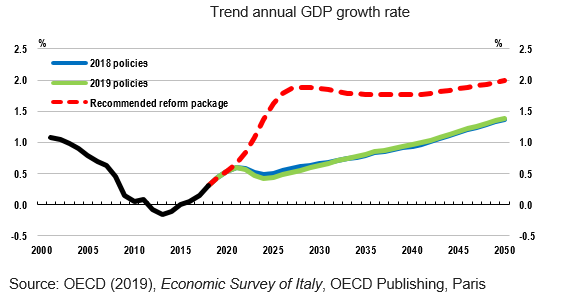
A clear multi-year reform programme to boost employment and productivity, while reducing steadily public debt, would lift average annual growth rates and improve inclusiveness. This is among the key policy insights of the OECD’s 2019 Economic Survey of Italy, launched on 1 April 2019 by the OECD Secretary General and Italy’s Minister of Finance. Compared current polices, this reform programme would raise growth rates by about 1.5 percentage points by 2030, expand employment and reduce inequalities.

Increasing productivity growth is key. Boosting productivity
will require enhancing competition in markets that are still protected, such as
professional services and local public services; raising innovation and
business dynamics, including through strengthening targeted incentives connected
to the Industry 4.0 plan; removing incentives for SMEs to stay small and
obstacles hampering their growth; and completing the reform of insolvency
regime.

Among the reforms proposed in the Survey, those concerning the efficiency of public administration
and justice system would have the largest impact on GDP growth by strengthening
the rule of law, thus supporting investment and productivity growth. The
expansion of active labour market programmes and reducing social security
contributions would also generate large benefits by boosting employment and
social inclusion.

Reducing the public debt ratio by steadily raising the
primary budget surplus to above 2% is essential to address the risk to the
broader economy of the high public debt ratio. Lower interest rates have
reduced interest payments on the public debt to a record low of 3.5% of GDP in
2018, which is however near what Italy spends on education.

Italy can raise the primary budget surplus by incorporating in the annual budget through and effective spending reviews that help rationalise current spending by reducing waste and reallocating resources towards more effective programmes. Closing the early retirement scheme introduced in 2019 would free resources to boost employment and opportunities for young people in addition to improving inter-generational equity. Implementing this programme would help Italy’s successful enterprises develop and new enterprises to follow their path, generating opportunities for Italians across the country. A future blog will discuss how this reform programme can address the large disparities between the regions such as those around Brembo’s headquarters and those around Valle dell’Acate.

References
OECD (2019), OECD Economic Surveys: Italy 2019, OECD Publishing, Paris.


Sweden’s schools: lessons from history to build a better future

by Jon Pareliussen, Sweden Desk, OECD Economics Department

Swedish schools entered
the 1990s from a position of strength, as one of the top performers in early
international school surveys, including the OECD Programme for International
Student Assessment (PISA). School governance was centralised, and implemented locally
by regional education boards. A suite of sweeping reforms in the early 1990s
decentralised the school system from the central to the municipal level and
introduced choice, competition and management by objectives. The general
direction of reform was common to several OECD countries at the time, some of
which perform well in international comparison.

However, the reforms seem
to have contributed to weakening results in Sweden. Implementation was not optimal,
as some municipalities were ill-prepared to take on the new tasks, and key
stakeholders, notably among teachers and school principals, were opposing the
new model. The reform design also had weaknesses. Regional education boards
were closed and municipalities were granted full autonomy over school funding, weakening  governance structures considerably, at a time
when the introduction of liberal entry for private (for-profit and non-profit)
school providers would have called for stronger governance and control.  

The latest vintage of PISA points to a brighter future for Sweden’s schools. Average results improved, reflecting at least partly recent government interventions. However, today is no time for complacency, as Sweden’s educational performance only climbed back to close to the OECD average. Inequalities across pupils and schools are widening, and children are increasingly segregated into schools with pupils from similar backgrounds. These developments are partially driven by broader societal trends, notably increasing income inequality and immigration. Nevertheless, the school system reinforces segregation instead of counteracting it, running the risk of depriving pupils of equal opportunities.

Against this backdrop, the
special chapter of the OECD Economic
Survey of Sweden 2019
describes and analyses the challenges facing primary
and lower secondary education in Sweden. A set of recommendations is outlined,
focussing on three main areas:

  • Economies of scale and the need for coordination
    calls for a partial recentralisation of some aspects of education policy. A
    centrally set minimum funding norm based on pupils’ socio-economic
    caracteritics would target funding better to needs and equity objectives. The
    norm should be non-binding and integrated in the existing system for cost- and income
    equalisation between municipalities, in line with established governance
    principles in Sweden. A regional arm of the central government governance
    structure should be re-built to enhance cooperation, improve skill development,
    promote continuous quality improvements, and instil accountability at every
    level of the school organisation.
  • Competition and school choice can be powerful
    tools to improve school quality, but private interests in many cases differ
    from the interests of society as a whole. Effective regulation and governance
    therefore need to steer private providers to deliver for the public good. Ensuring
    that grades fairly represent pupils’ skills and knowledge would reduce
    information asymmetries. Private schools’ admission procedures need regulation
    to hold back school segregation. Municipalities should adjust how they assign
    pupils to schools by promoting more socially mixed pupil groups while toning
    down the current strong focus on proximity. Investments in new school capacity
    can help counteract segregation, notably if coordination between municipalities
    and private providers improves.
  • High-quality teachers are a school’s most
    important asset, and Sweden faces teacher shortages. Teaching needs to become
    more attractive to recruit motivated and skilled students and retain high
    quality teachers in the profession. Better teacher education with a stronger
    research base and more teaching practice would help. Once in a job, teachers
    should face clearer career paths, incentives to progress, perform and take on
    challenging tasks as well as clear accountability for key outcomes, coupled
    with more cooperation, feedback and support between colleagues. A new regional
    arm of the central government governance structure should have a central role.

Sweden is now
moving towards a new round of school reforms, largely along these lines. A
clear lesson from the previous three decades of Swedish education history is
that reforming complex systems, warranted or not, can also be a risky
undertaking. The end result depends on reform design, implementation and intricate
interactions within the system undergoing reform as well as with the external
environment.

The need to adjust
to unintended consequences as complex reforms progress is inevitable, but accurately
identifying strengths, weaknesses and causality is challenging in hindsight,
and even more in real time. Not knowing exactly where you are and how you got
there reduces the likelihood of ending up where you want to be. Therefore, decision
makers should integrate experimentation, quantitative research and evaluations
into reform design in the next round of Swedish school reforms.

References:

OECD (2019), OECD Economic Surveys: Sweden 2019, OECD Publishing, Paris.


The key to breaking cycle of poverty in Israel lies in education

By Gabriel Machlica and Claude Giorno, Israel Desk, Economics Department

Inequality and relative poverty in Israel remain high, particularly among Arab-Israelis and Haredim (Ultra-Orthodox). Israel’s social policy follows a “welfare-to-work” approach to tackle poverty in order to avoid measures that may harm work incentives among the Haredi, who value the time dedicated to religious studies, and the Arabs, who have cultural barriers to female employment. The government’s strategy of encouraging employment among previously non-working families has met with substantial success. The Israeli labour market has improved markedly, and more and more Haredim and Israeli-Arabs have been able to find jobs. Moreover, the average real income of poor households has risen by almost 3% annually in the last six years, while the average annual real income of wealthier households has increased by only 2.2%.

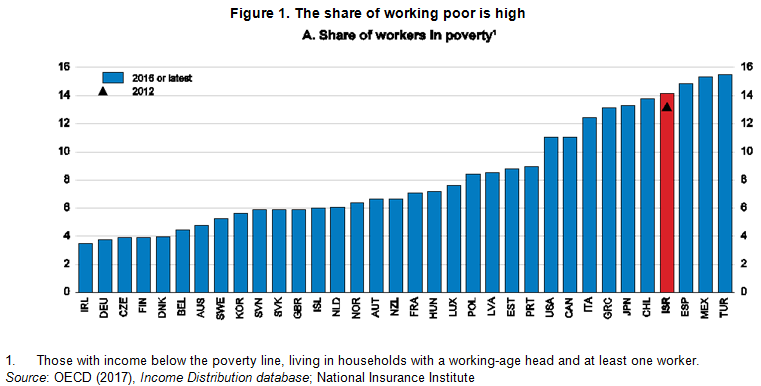
However, inequalities remain internationally high, and the current strategy without complementary steps has its limits. Many disadvantaged workers have been able to find jobs, but their families remain poor, since in most cases these jobs are low-paid. Indeed, the share of the working poor has risen in recent years and is comparatively high (Figure 1).

Israel 2018 blog 2 fig 1

This is particularly true for the Haredim and Israeli-Arabs, who earn on average only 70% and almost 90% of the median hourly wage, respectively, mostly due to the differences in skills and typically have families with only one breadwinner. Given the current tax-transfer system and large number of children in these households, especially in the Haredi community, even two full-time working spouses would not be enough to escape from poverty (Figure 2).

Israel 2018 blog 2 fig 2

Therefore the current government strategy should be accompanied by additional measures. Extensive poverty in Israeli society is to a significant extent due to the wide dispersion of skills. The government should improve the education outcomes of the disadvantaged groups to boost their future productivity and wages. As the 2018 OECD Survey on Israel argues, the education system needs to become more inclusive by giving all children opportunities for good-quality education to improve their skills. The government should also focus on programmes for adults who have already left initial education without proper skills. In addition, it should further expand in-work benefits to boost take-home pay of the average eligible worker.

References:

OECD (2018), OECD Economic Surveys: Israel 2018, OECD Publishing, Paris, http://dx.doi.org/10.1787/eco_surveys-isr-2018-en.


The refugee crisis: a challenge but also an opportunity for improving policies to integrate immigrants into the Dutch labour market

By Gabor Fulop, Analyst, & Rafal Kierzenkowski, Senior Economist
The Netherlands Desk,  Country Studies, OECD Economics Department

The ongoing refugee crisis in Europe has particularly affected the Netherlands. Asylum requests surged in 2015 to nearly 60 000 (Panel A), more than three times the yearly average of 2010-14. This is a significant challenge for the authorities, who need to provide decent housing and help these people finding a job for the time they will stay in the Netherlands as refugees, which could be much longer than expected. Getting work is key for refugees to develop social contacts and economic independence, and acquiring new skills could be helpful for those refugees who eventually return to their own country. Therefore, good policies to facilitate the labour market integration for migrants are critical.

The past record of integrating immigrants is mixed. Although at about the OECD average, the skills of first- and second-generation immigrants are well below those of natives and below those of immigrants in the best performing OECD countries (Panels B and C). In parallel, the gap in labour force participation—those who have jobs or are looking for a job—between first-generation immigrants and natives is the largest in the OECD (Panel D). Many policies that would support job prospects of immigrants would also benefit refugees. Studies of past inflows of refugees show that the proportion of those of working age participating in the labour market is around 45% after being five years in the Netherlands (Vluchtelingenwerk, 2014), which is much lower than the 80% of natives.

Skills and labour market outcomes of immigrants are weak

netherlands

Source: Statistics Netherlands (2016), “Asylum requests” in Population, Statline, January; OECD (2013), PISA 2012 Database; OECD (2013), OECD Skills Outlook 2013: First Results from the Survey of Adult Skills; and OECD (2015), “Employment, unemployment and participation rates by sex and place of birth“, OECD International Migration Statistics (database), October.

The 2016 Economic Survey of the Netherlands  highlights the following reforms for improving the labour market integration of immigrants, which could also benefit refugees:

  1. Ensuring high equity of compulsory education

Raising the quality of early childhood education and care would help immigrant children, including by improving language proficiency. Stepping up training would provide teachers with the tools to work with students with disadvantaged backgrounds, and reflecting such skills in wages would attract more qualified teachers. Raising student mobility between tracks at secondary schools would foster the development of skills, including for students with immigrant background, and would avoid those with low socio-economic background being trapped in low-qualified jobs.

  1. Recognising and upgrading skill sets

Better recognition of foreign qualifications and informal skills would help immigrants to find work that matches their skills. Creating programmes that combine work experience and on-the-job training beyond formal education, especially for immigrants with low qualifications, would help them to demonstrate and upgrade their informal skills. Developing language courses would also support access to jobs.

  1. Promoting job search and recruitment

Further lowering the cap on severance payments would make permanent contracts more attractive to employers, which would help refugees and immigrants to find jobs and to support their skills because permanent work tends to come with more skill development. The government has recently increased the earned income tax credit for lower income-earners, which is welcome. Further reduction of effective tax rates on labour income would sharpen incentives to get a job. Reinstating an equal employment policy would help to overcome discrimination on the basis of race or ethnicity.

Whereas the refugee crisis poses an immediate challenge, it also provides an incentive to improve labour market integration policies of immigrants. This would result in better job prospects benefiting all parties involved, the migrants and the Netherlands.

References

Vluchtelingenwerk (2014), IntegratieBarometer 2014 (Integration Barometer 2014).

OECD (2016), OECD Economic Surveys: Netherlands 2016, OECD Publishing.