The investor base for sovereign debt: Recent developments and potential implications

Long-term sovereign bond yields have risen as fiscal pressures mount and central banks step back from bond markets. With private investors playing a larger role, borrowing costs may remain higher and markets may become more volatile, raising important questions for debt management and financial stability.

By Masatoshi Ando, Ben Conigrave, Álvaro Pina and Caroline Roulet, OECD Economics Department.


Long-term sovereign bond yields have risen in recent years and the spread between 30- and 10-year bond yields has widened (Figure 1, Panel A). This reflects investor concerns about the sustainability of public debt given persisting budget imbalances in many advanced economies and rising spending pressures from defence, ageing and climate change. At the same time, as discussed in the December 2025 OECD Economic Outlook, there have been marked changes in the mix of investors purchasing government bonds since the pandemic. These changes in the investor base likely contribute to the upward pressure on yields and may also be a source of future market volatility.

One key factor has been the shift from quantitative easing to quantitative tightening by the major central banks. The balance sheets of central banks expanded after the onset of the global financial crisis, and were boosted significantly further during the pandemic, primarily through sovereign debt purchases. More recently, with the shift to quantitative tightening in many jurisdictions, central banks have reduced their sovereign bond holdings either passively, by not reinvesting maturing securities, or by actively selling bonds. The share of total outstanding domestic sovereign debt held by the central bank is now largely back to pre-pandemic levels, including in the United States and the euro area (Figure 1, Panel B).

Figure 1. Long-term yields have risen and central bank bond holdings have shrunk

Note: Panel A shows weekly data, with the latest observation dated 20 February 2026. In panel B, ECB denotes the European Central Bank, US Fed the US Federal Reserve, BOC the Bank of Canada, and RBA the Reserve Bank of Australia. Domestic sovereign bonds held by central banks at the end of each year are expressed as a share of total domestic sovereign bonds outstanding. Data for 2025 data refer to Q3.
Source: Australian Bureau of Statistics; Bank of Canada; European Central Bank; Federal Reserve; Reserve Bank of Australia; Statistics Canada; LSEG; and OECD calculations.

A counterpart to this is that the private sector has absorbed a rising share of new bond issuance, with the composition of investors becoming more dispersed and heterogenous (Figure 2). Over the year to 2025Q3 there were higher net purchases relative to GDP by banks and money market funds in all four economies displayed, and by other financial intermediaries such as investment funds and securities dealers in Australia, the euro area and the United States. In contrast, net purchases of sovereign bonds by traditional institutional investors, including pension funds and insurers, often declined relative to GDP.

The shift in the balance of sovereign bond purchases from central banks to price-sensitive private sector investors could affect the required rate of return on sovereign bonds (OECD, 2025; IMF, 2025). Yields might be more elevated to sustain demand for government debt in coming years, particularly in countries where fiscal trajectories may be viewed as unsustainable, pushing up the cost of government borrowing.

A related risk is that sovereign bond markets become more volatile. Some non-bank financial institutions have comparatively light regulatory frameworks, allowing them to operate with higher leverage. An example is hedge funds, which have been playing a growing role in the sovereign debt markets of many countries, including the US. High leverage could reduce their capacity to absorb new bond issuance at times of market stress due to a need for higher liquidity to meet potential investor redemptions and to offset changes in the value of their existing collateral (ECB, 2023; Sengupta and Jacobs, 2025). Higher bond market volatility may itself raise liquidity needs due to margin calls or redemptions from leveraged investment funds, potentially forcing asset sales including sovereign bonds.

Reforms affecting pension funds and associated financial intermediaries, coupled with a more uncertain environment, will also reduce the demand for very long-term bonds. For example, UK regulatory adjustments for liability-driven investment (LDI) funds introduced after the 2022 gilt market dislocation (LDI funds allow pension funds to match the interest sensitivity of their assets and liabilities through the use of derivatives) — including tighter leverage limits, higher liquidity buffers, and more conservative collateral management practices — reduced their capacity to maintain large, leveraged positions in long-dated gilts (BIS, 2025). In Japan, higher yields and elevated policy uncertainty have made life insurers moderate their demand for very long‑term sovereign bonds, at least temporarily (Reuters, 2025). The shift from defined benefit to defined contribution schemes in countries such as the Netherlands and the United Kingdom has also reduced the emphasis on duration matching of fixed liabilities for pension funds, diminishing their demand for long-term sovereign bonds (PIMCO, 2023).

For a given maturity distribution of debt issuance, such reforms potentially raise yields and volatility at the long end of the yield curve, though the increasing demand for safer assets such as government bonds from funded pension systems as the population ages will have the opposite impact. Some debt management offices have also shifted issuance toward shorter maturities to mitigate rising interest expenditures, although this may heighten refinancing risks and governments’ sensitivity to fluctuations in short‑term interest rates.

Figure 2. Net purchases of sovereign bonds by investor type in selected advanced economies

Quarterly averages

Note: The figure shows net purchases of general government debt securities of all maturities, consolidated to eliminate intra-government transactions. Quarterly averages are presented for three periods: the latest quantitative easing (QE) episode, the subsequent period of quantitative tightening (QT), and the most recent four quarters with available data for all four jurisdictions (which often overlaps the QT period). QE and QT periods follow central bank announced implementation dates. When both QE and QT take place in the same quarter, none is retained unless one clearly outweighs the other. “Other financial intermediaries” include non-money market investment funds (among which hedge funds), securities dealers and non-bank money lenders. “Institutional investors” refers to insurance companies and pension funds. “Real sectors” encompass households, non-profit organisations, and non-financial corporations. Data are seasonally adjusted and expressed as a share of contemporaneous quarterly GDP. For the United States, net purchases by households are likely overstated, and those by foreign hedge funds (included in the rest of the world) concomitantly understated, since 2023 (Barth et al., 2025).
Source: Australian Bureau of Statistics; European Central Bank; Federal Reserve; Statistics Canada; OECD National Accounts Databases; and OECD calculations.

References

BIS (2025), BIS Quarterly Review, September, Bank for International Settlements.

Barth, D., Beltran, D., Hoops, M., Kahn, J., Liu, E., and M. Perozek (2025), The Cross-Border Trail of the Treasury Basis Trade, Federal Reserve Board of Governors, FEDS Notes, October.

ECB (2023), Financial Stability Review, November 2023.

IMF (2025), “Shifting ground beneath the calm: Stability challenges amid changes in financial markets”, Global Financial Stability Report, October, International Monetary Fund, Washington D.C.

OECD (2025), Global Debt Report 2025: Financing Growth in a Challenging Debt Market Environment, OECD Publishing, Paris.

Pimco (2023), The End of the Dutch Defined Benefit Model A Steeper Euro Swap Curve Ahead, July.

Reuters (2025), Japan’s major life insurers plan to trim yen bond holdings in Oct-March, October.

Sengupta, R. and J. Jacobs (2025), The Changing Investor Composition of U.S. Treasuries, Part 2: Who’s Buying U.S. Treasuries?, Economic Bulletin, Federal Reserve of Kansas City, July.


Greater fiscal prudence would help sustain growth in the Netherlands

The Hague, Netherlands

Scrapping the most inefficient expansionary measures
and further enhancing the fiscal framework would contribute to preserving sound public finances.


By Daniela Glocker and Nicolas Gonne, OECD Economics Department

Sound public finances have largely contributed to the resilience of the Dutch economy. Years of fiscal discipline allowed the country to build up substantial budgetary buffers. These enabled the government to support households and businesses during recent downturns. They also provide the fiscal space needed to implement structural reforms.

However, current budgetary plans reflect a shift in priorities, towards increasing purchasing power in the short run and away from policies that support productivity, enhance competitiveness, and accelerate the green transition. The deficit is projected to widen from 0.9% of GDP in 2024 to 2.3% in 2025 and 2.8% in 2026 (Figure 1).

Figure 1. Public finances are projected to deteriorate

General government fiscal balance (% of GDP)

Source: OECD Economic Outlook: Statistics and Projections (database).

Should it not correct its course, the Netherlands could face a “Significant Deviation Procedure” under the preventive arm of the EU Stability and Growth Pact. Such a scenario is unlikely, as the government is strongly committed to remaining in compliance with EU Treaty limits for deficit and debt levels, and because supply bottlenecks often led to underspending in recent years. Yet, proactive fiscal adjustments would provide greater policy certainty and credibility, as discussed in the latest OECD Economic Survey of the Netherlands.

Budgetary plans should aim at expanding supply, not boosting demand

The fiscal stance is expansionary, with significant increases in spending on healthcare and housing, and with lower revenue from personal, corporate, and environmental taxation. Several new spending and tax measures are costly and lack targeting, including the reduction in out-of-pocket payments for medical care and the introduction of a new, lower-rate bracket for personal income taxation.

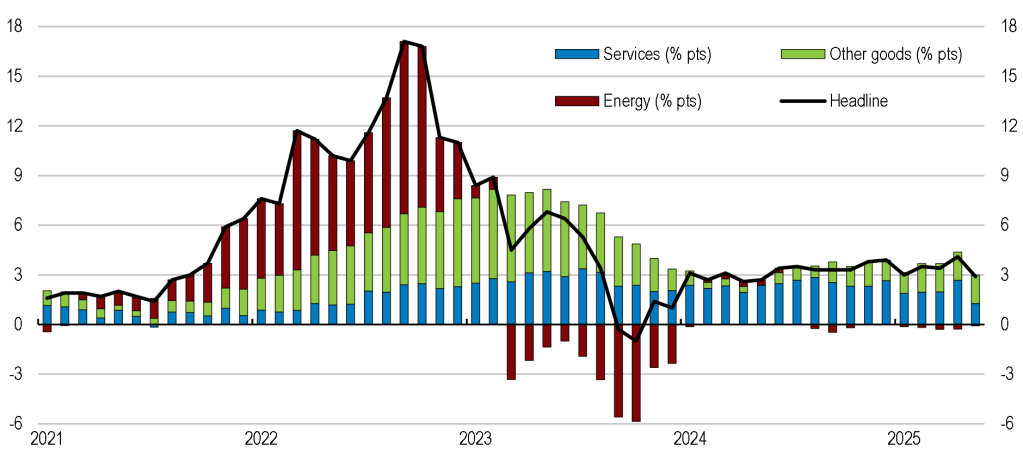
The expansion risks exacerbating inflationary pressures given persistent supply constraints, most notably the tight labour market. Labour costs have been rising relatively quickly since the post-pandemic recovery, pushing up the cost of labour-intensive services and contributing to elevated inflation (Figure 2). Further supply bottlenecks include electricity grid congestion, skills mismatch, and the knock-on impact of the nitrogen crisis. At the same time, spending cuts on education and R&D, while partially offsetting the fiscal cost of expansion, will weigh on growth potential and productivity.

Figure 2. Wage-driven price pressures remain

Contributions to consumer price inflation (y-o-y % change)

Source: OECD Eurostat Harmonised Index of Consumer Prices (database).

Fiscal prudence is key to supporting the economy and sustaining growth, by avoiding excessive demand stimulus and promoting supply-side expansion. Scrapping the most inefficient expansionary measures should be a priority. Reallocating expenditure towards efficiency-enhancing public investments would further promote growth potential, while reconsidering proposed cuts to public spending on knowledge, skills, and innovation would further help productivity, an increasingly pressing challenge for the Dutch economy.

Fiscal reforms are necessary to safeguard sound public finances

Under current budgetary plans, the fiscal balance is expected to deteriorate steadily over the medium run, particularly from 2029 onwards. This is despite the Dutch trend-based fiscal framework, which has been instrumental so far in maintaining fiscal space while enabling automatic stabilisers to fully operate –a particularly important feature to absorb global shocks in an open economy like the Netherlands’.

Most aspects of Dutch multi-year fiscal strategy are regarded as best practice under the OECD Spending Better Framework. However, the expenditure framework is fixed over the government’s term, while budgetary measures are announced on an annual basis. This limits the framework’s ability to address long-run fiscal pressures and can create incentives to postpone politically difficult but necessary decisions on revenue-raising measures and spending cuts.

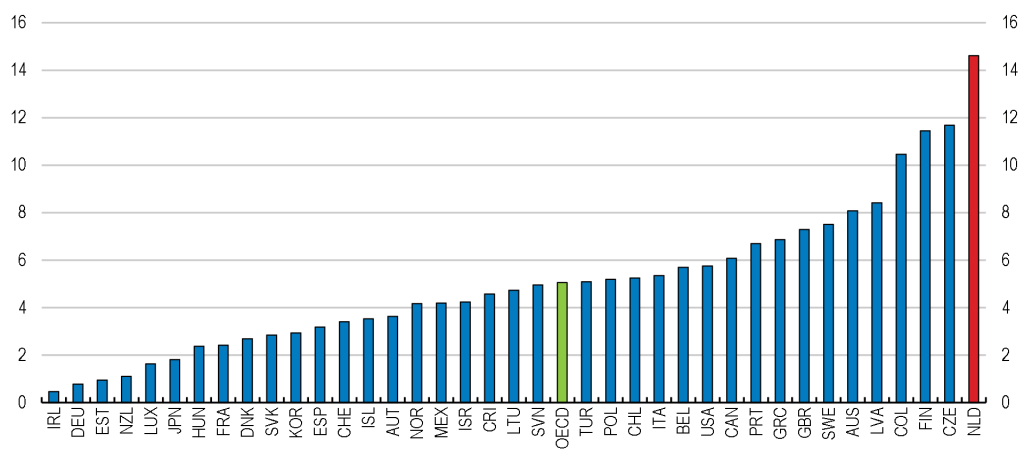
Rolling forward expenditure ceilings every year to keep a constant spending horizon would provide greater predictability, enhance transparency, and further support fiscal sustainability, while keeping the benefits of the current framework, including fiscal discipline on the expenditure side and macroeconomic stabilisation on the revenue side. This would be conducive to greater fiscal prudence, creating the conditions for achieving a balanced combination of revenue-raising measures and targeted spending cuts, including by reducing inefficient tax expenditures (Figure 3).

Figure 3. There is room to streamline tax expenditures

Tax expenditures (% of GDP), 2024 or latest available year

Source: Global Tax Expenditure Database.

For more information, please visit our Netherlands Economic Snapshot page.

REFERENCES

Borowiecki M., J. Pareliussen, and D. Glocker (2021), “Chasing the frontier: Digitalisation for stronger productivity in the Netherlands”, OECD Economics Department Working Papers, No. 1680, OECD Publishing, Paris, https://doi.org/10.1787/e800ee1d-en.

CPB (2025), “Centraal economisch plan 2025 [Central economic plan 2025]”, Netherlands Bureau for Economic Policy Analysis, The Hague.

OECD (2025), OECD Economic Surveys: The Netherlands 2025, OECD Publishing, Paris, https://doi.org/10.1787/2dd1f4aa-en.

Gonne, N. (2023), “Lifting labour supply to tackle tightness in the Netherlands”, OECD Economics Department Working Papers, No. 1771, OECD Publishing, Paris, https://doi.org/10.1787/df5448fe-en.


The return of industrial policies

By Valentine Millot and Łukasz Rawdanowicz

Industrial policies have again risen in prominence in advanced economies with the series of economic crises, rising geopolitical risks and increased awareness of environmental challenges.

In our recent paper (Millot and Rawdanowicz, 2024), we contribute to renewed debates about these policies by discussing the pros and cons of industrial policies motivated by different objectives, and propose a few principles to inform policy guidelines.

What is industrial policy and how much is happening?

While discussions about industrial policies are intensifying, their exact definitions and their differences with trade, environment, innovation and tax policies are debated. Industrial policies commonly refer to government financial and non–financial support to businesses to boost or reshape specific economic activity. Government support to businesses can be broadly available to all firms across the economy (i.e. horizontal) or be more narrowly targeted based on activity, technology and/or location. In our paper, we focus primarily on targeted measures, which are both increasingly used in recent years and raise more concerns about their implications for domestic and international markets and rules-based trade.

Assessing the scope and scale of government industrial policies, and their evolution over time, is notoriously difficult (Warwick and Nolan, 2014; Terzi, Singh and Sherwood, 2022; OECD, 2023). This is due to a persistent lack of reliable and cross-country comparable data (OECD, 2023; Juhász, Lane and Rodrik, 2023) and the absence of consensus about the definition of industrial policies.

The OECD has made headway in filling the data gaps. Through the QuIS project and sectoral studies for selected industries, the OECD has gathered harmonised data that facilitate the benchmarking of industrial strategies across countries in terms of industrial policy expenditures, priorities, instruments and recipients (Criscuolo et al., 2023; OECD, 2023).

Available data suggests that many governments around the world have actively provided various forms of support to selected industries, though with different intensity across time and countries, and that industrial policies are an important part of economic policies in advanced and emerging-market economies.

Recently, several advanced economies have revived industrial polices to support green and digital transitions as well as employment. For example, to meet these objectives, the US government implemented in 2022 the CHIPS and Science Act and the Inflation Reduction Act (IRA). These initiatives have been partly motivated by the perceived need to respond to the growing economic power of China, which has been using large-scale state interventions for decades. In response to strategic and environmental challenges and, in some cases, also in reaction to US and Chinese industrial policies, several OECD economies have proposed or implemented similar measures.

Industrial policies should be justified by cost-benefit considerations

Industrial policies can play a role in addressing important economic, social and environmental challenges that markets cannot deal with on their own. When they are successful, industrial policies can bring large benefits for the nation concerned. They could also have positive international spillovers, for instance if they lower the cost of the climate transition.

However, industrial policies entail costs, including fiscal ones. They can create market distortions that have negative effects on innovation and the availability and prices of goods and services. Costs can be particularly high when measures effectively limit competition and increase protectionism. Ultimately, they may reduce market contestability and undermine the rule-based trading system.

Debates about industrial policies have not yet been resolved in view of challenges with their evaluation and the existence of both negative and positive examples (Karp and Stevenson, 2012). Still, a serious assessment of costs and benefits should be attempted to inform policy makers. It should extend beyond measuring the short-term direct impact on the targeted sectors, firms or technologies. Analysis should focus on overall effects in the longer term, including domestic and international spillovers and on a wide range of fiscal costs. The uncertainties surrounding the estimates of the costs and benefits calls for considering various alternative scenarios of possible outcomes. The distributional impact of industrial policies across firms, households and taxpayers should also be assessed.

Despite well-grounded economic, social and environmental justifications for some industrial policies, there are legitimate concerns that the benefits of some of these policies could be limited and the costs high. This mainly relates to measures curbing competition and the practical and political challenges in designing and implementing effective measures.

Thus, while governments may want to experiment with future and welfare‑oriented industrial policies, they should exert moderation in scope, exercise caution in design and implementation, and be mindful of possible negative international implications that can undermine the rule-based trading system.

Towards policy guidelines

While our understanding of industrial policies is imperfect and continues to evolve with new data and evidence, basic principles inform tentative policy guidelines for governments planning to use targeted industrial policies:

  • Be clear and realistic about what they are trying to achieve. Industrial policies can help to deliver urgent climate objectives, improve economic security and resilience, and support distributional outcomes, but to a varying extent.
  • Prioritise areas where existing structural challenges cannot be addressed solely by markets and other government policies and where these challenges imply high and growing societal costs. Consider whether industrial policies are effective and efficient to pursue those objectives, and what other government policies will be needed for the full range of expected benefits to be achieved.
  • Design tailored, proportionate and comprehensive measures based on the diagnosis of main problems and experience. This will help to boost benefits and to minimise the economic and fiscal costs, both domestically and internationally. Favour measures that:
    • do not restrict competition and encourage the development of markets and new entrants rather than favouring incumbents.
    • minimise negative spillovers on international markets and help promote international co‑operation and rules-based trade. 
    • are limited in time and size, using for example sunset clauses and claw-back arrangements. Still, ensure that policies are sufficiently persistent and predictable to be able to change the behaviour of firms and individuals, including by clear and consistent messaging on the duration and terms of policies.
    • are transparent to enable public debate and independent analysis as well as to protect against domestic capture.
    • incorporate evaluation from the start. Ensure that data necessary to undertake it are collected. Establish regular review and feedback mechanisms and adapt policies as you learn. Introduce institutional safeguards for ending the government support where objectives are not being achieved or unintended consequences alter the cost‑benefit assessment of programmes.

    • ensure a competitive, non-discriminatory and transparent design of the selection process of businesses to be helped, to avoid favouring incumbents and deterring new entrants. Consider delegating such selection processes to expert institutions free from political pressures, while safeguarding democratic oversight and accountability.

  • Work with stakeholders when identifying the main obstacles to achieving the policy objectives as well as the need for and appropriate design of industrial policy measures, including to mobilise public support.

References

– Criscuolo, C. et al. (2023), “Quantifying industrial strategies across nine OECD countries”, OECD Science, Technology and Industry Policy Papers, No. 150, OECD Publishing, Paris, https://doi.org/10.1787/5f2dcc8e-en.
– Juhász, R., N. Lane and D. Rodrik (2023), “The New Economics of Industrial Policy”, NBER Working Papers, No. 31538, National Bureau of Economic Research, Cambridge, MA, https://doi.org/10.3386/w31538.
– Karp, L. and M. Stevenson (2012), “Green Industrial Policy – Trade and Theory”, CUDARE Working Papers, No. 123637, https://doi.org/10.22004/ag.econ.123637.
– Millot, V. and Ł. Rawdanowicz (2024), “The return of industrial policies: Policy considerations in the current context”, OECD Economic Policy Papers, No. 34, OECD Publishing, Paris, https://doi.org/10.1787/051ce36d-en.
– OECD (2023), “Government support in industrial sectors: A synthesis report”, OECD Trade Policy Papers, No. 270, OECD Publishing, Paris, https://doi.org/10.1787/1d28d299-en.
– Terzi, A., A. Singh and M. Sherwood (2022), “Industrial Policy for the 21st Century Lessons from the Past”, European Economy – Discussion Papers, No. 157, Directorate General Economic and Financial Affairs (DG ECFIN), European Commission, https://economy-finance.ec.europa.eu/publications/industrial-policy-21st-century-lessons-past_en.
– Warwick, K. and A. Nolan (2014), “Evaluation of Industrial Policy: Methodological Issues and Policy Lessons”, OECD Science, Technology and Industry Policy Papers, No. 16, OECD Publishing, Paris, https://doi.org/10.1787/5jz181jh0j5k-en.


Higher defence spending will add to the pressures on the public finances

by Mauricio Hitschfeld, Álvaro Pina and Enes Sunel

For several decades the ‘peace dividend’ enabled governments to reduce the share of defence spending in total public expenditure, creating space to help meet demands for additional public expenditure on social protection and health. Growing geopolitical tensions are prompting reassessments of this strategy, with several countries announcing plans to increase defence spending over the next few years. These plans, which are already being implemented in some countries, will compound the rising pressures on the public finances from ageing societies, the climate transition and rising debt-service costs, as noted in the September 2023 OECD Interim Economic Outlook.

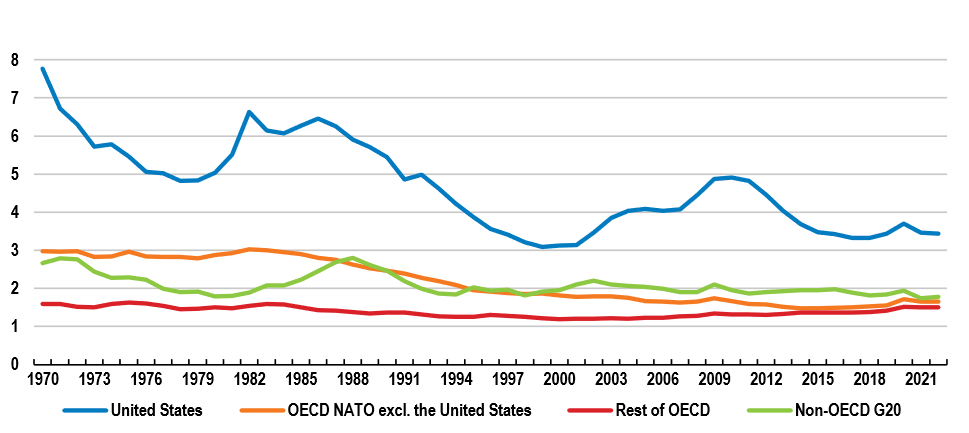
Across G20 countries as a whole, defence spending relative to GDP has declined in the past 50 years, from an average of about 3.8% in the 1970s to 2.4% in the 21st century. However, there have been marked differences across countries. US defence expenditure fell particularly sharply, from 6.0% of GDP in the 1980s to an average of 3.9% of GDP since the turn of the century (Figure 1). In relative terms, the gains from the end of the cold war were even larger for other OECD countries who are longstanding NATO members, with their joint spending declining from 2.8% of GDP in the 1980s to 1.6% of GDP since the year 2000. Military spending in non-NATO OECD members such as Australia, Japan and Mexico has in general been lower and more stable over time.

Figure 1. Global defence spending has declined since the 1970s

Defence spending, per cent of GDP, current prices

Note: OECD and NATO based on current membership. Aggregates show averages weighted by GDP at market prices in USD. Their composition changes over time due to data availability. Saudi Arabia is excluded from the non-OECD G20 aggregate due to the very high volatility of its defence spending.
Source: Stockholm International Peace Research Institute; and OECD calculations.

The reduction in spending has also been more modest in non-OECD G20 economies, a highly diverse group of countries. For instance, defence spending in China has become the second largest in the world in absolute terms, but relative to GDP is estimated to be close to the G20 median. Russia’s spending in per cent of GDP has remained internationally high since the mid‑1990s, particularly over the past decade.

Many OECD countries have begun to raise defence spending as a share of GDP over the last 2-3 years. There have been particularly strong increases in Greece and some Central and Eastern European countries, including Finland, Latvia, Lithuania and Poland, but also in many economies in Western Europe, partly reflecting military aid to Ukraine.

Further spending increases, sometimes sizeable, are likely in the coming years. France, Germany and Japan have started to implement detailed medium-term plans for that purpose, aiming at increases of about 0.4% of GDP, 0.7% of GDP and 1% of GDP respectively. In other countries, a long‑term target exists that implies higher defence spending (for instance, 2% of GDP in Canada and Italy, as per NATO commitments, and 2.5% of GDP in the United Kingdom) but medium-term plans to reach these levels have not yet been released. In contrast, the two OECD G20 countries where military expenditures as a share of GDP are highest, the United States and Korea, do not currently plan to further increase that share. Non‑OECD G20 countries have in general not increased defence spending as a share of GDP in the recent past (Russia is an exception), nor have they announced plans to do so in the medium term.

As with other areas of public spending, improvements in the efficiency of defence spending could help to contain the budget costs of achieving the intended improvement in military effectiveness. Options to enhance efficiency may differ across countries given, among other factors, the variation in the composition of defence spending (Figure 2). The average share of defence budgets spent on investment in equipment in the countries shown is 20% and on personnel costs 48%, with an average 29% devoted to maintenance and single-use equipment and 4% to other spending items, but there are large differences between countries.

Figure 2. The composition of defence spending differs substantially across countries

Shares in total defence spending, per cent, 2012-21 average, current prices

Note: Durable military equipment corresponds to gross fixed capital formation (GFCF), personnel to compensation of employees and maintenance and single-use equipment (such as ammunition) to intermediate consumption. Since GFCF is often volatile, a 10-year average is considered. Values for Korea correspond to the 2012-20 average.
Source: OECD Classification of the Functions of Government (COFOG) database; and OECD calculations.

References

OECD (2023), OECD Economic Outlook, Interim Report September 2023: Confronting Inflation and Low Growth, OECD Publishing, Paris, https://doi.org/10.1787/1f628002-en.


How can independent fiscal institutions support the resilience of public finances?

By Scott Cameron, Stéphane Jacobzone and Lisa von Trapp (OECD Directorate for Public Governance); Jörg Haas, Łukasz Rawdanowicz and Sébastien Turban (OECD Economics Department).

Public finances will face significant challenges after the Covid-19 crisis and due to the consequences of the Russian invasion of Ukraine. Government debt has reached the highest levels in decades, albeit interest payments are at historical lows. Population ageing and climate change will weigh on government budgets. Fiscal policy may also need to provide more macroeconomic stabilisation if monetary policy remains constrained by low interest rates.

While providing adequate responses to these challenges, governments will confront political economy biases. These biases have contributed in the past to higher deficits, a tendency towards short-termism (e.g. by cutting public investment disproportionately after the Global Financial Crisis (GFC)), and a procyclical fiscal policy stance.

In this blog post, building on our recent paper: Constraints and demands on public finances: Considerations of resilient fiscal policy (Rawdanowicz et al., 2021), we discuss how credible and transparent fiscal frameworks can contribute to sustainable fiscal policies by minimising those biases. In particular, we focus on independent fiscal institutions (IFIs), reviewing their increasing popularity and taking stock of recent country experiences.

What are IFIs?

IFIs are public institutions with a mandate to critically assess and, in some cases, provide non‑partisan advice on fiscal policy and performance (von Trapp, Lienert and Wehner, 2016). Examples include the Congressional Budget Office in the United States, the Bureau for Economic Policy Analysis (or CPB) in the Netherlands, the Office for Budget Responsibility in the United Kingdom and Spain’s Independent Authority for Fiscal Responsibility.

In contrast to audit institutions, their assessments are forward-looking (Kopits, 2011) and unlike independent central banks, they do not have the authority to make policy. Rather, they ensure that unbiased information about the government’s fiscal policies and their consequences is available. This additional transparency enhances the quality of the political debate, making governments more accountable for their policy choices and more credible vis‑à‑vis citizens and financial markets. IFIs thus support the sustainability of public finances.

In most countries, IFIs were established after the GFC, though in a few they have existed for more than 50 years (Table 1). The main motivations for establishing IFIs were improving the transparency of the budgetary process and monitoring compliance with fiscal rules in the context of high debt.

Table 1. Most independent fiscal institutions are young

Timing of foundation

Note: Norway’s Advisory Committee for Fiscal Policy Analysis has recently had its mandate extended to independently assess the sustainability of fiscal policy, bringing it closer to some European IFIs. The Norwegian ministry of finance acts as its secretariat and one committee member is employed by the ministry, though this member is not involved in assessing the sustainability of fiscal policy.
Source: OECD Independent Fiscal Institutions Database 2021; OECD Secretariat.

IFIs are common but their functions differ

Today, there are IFIs in three out of four OECD economies, although they vary widely with regard to their mandate and resources (Figure 1). A new OECD dataset (OECD, 2021a) shows that typical tasks of IFIs include assessing long-term fiscal sustainability, endorsing or producing economic and fiscal forecasts, monitoring compliance with rules, and estimating costings of policies. IFIs with more demanding mandates, particularly those involved in cost estimations, tend to have more staff at their disposal, for example in Korea, the Netherlands and the United States. By contrast, IFIs in some of the largest OECD economies, such as Germany and France, have limited mandates and relatively few staff.

Figure 1. Mandates and resources of IFIs vary widely across the OECD countries

Note: Several OECD countries have chosen to have their official macroeconomic forecasts supplied by an independent organisation other than an IFI, for example, Austria (the Austrian Institute of Economic Research), Finland (an independent body within the Ministry of Finance), Luxembourg (STATEC, the national statistics advisor), Slovenia (the Institute of Macroeconomic Analysis and Development), and Sweden (the National Institute of Economic Research). Canada takes its macroeconomic assumptions from an average of private-sector forecasts.
Source: OECD Independent Fiscal Institutions Database 2021.

IFIs contribute to fiscal stability but they do not guarantee it

While research has tentatively associated IFIs with increased fiscal rule compliance, more accurate forecasts (Fall et al., 2015; Beetsma et al., 2018), and less pro-cyclical fiscal policy (Debrun and Kinda, 2017), they are neither a necessary nor a sufficient condition for sustainable public finances. Some countries with a reputation for fiscal prudence and transparency have a small fiscal council with a very limited mandate, like Sweden, or none, like New Zealand. IFIs may not need to be strong to maintain compliance with fiscal rules if there is a political consensus in favour of low deficits. Conversely, even an IFI with a far-reaching mandate will not be able to keep a government from circumventing fiscal rules that are not supported by the electorate. The interaction between the elements of a fiscal framework plays a key role.

Still, there are numerous examples of how IFIs can contribute to fiscal performance across various areas:

  • Assessing long-term fiscal sustainability. The Canadian Parliamentary Budget Officer produces an annual fiscal sustainability report covering all levels of government and public pension plans. The analysis has been used to challenge official narratives in several high-profile policy debates on changes to the age of eligibility for elderly benefits and adjustments to subnational transfer programmes for health care (Parliamentary Budget Office of Canada, 2021).
  • Endorsing or producing economic and fiscal forecasts. Italy’s Parliamentary Budget Office is mandated with endorsing the budget’s macroeconomic assumptions under domestic legislation to meet requirements of the EU’s fiscal surveillance framework. In 2016, the Italian IFI determined that the government’s forecast was optimistic and declined to endorse it. Following a parliamentary hearing, the government revised its plans using more conservative assumptions (Ufficio parlamentare di bilancio, 2019).
  • Monitoring compliance with rules. The Irish Fiscal Advisory Council is required to confirm the government’s compliance with the domestic implementation of the EU fiscal rules. To do so, it developed innovative methods to estimate Irish potential GDP and the output gap, which are notoriously volatile in Ireland under the EU’s commonly agreed methodology, owing to distortions from capital flows and activity related to foreign-owned multinational enterprises (OECD, 2021b).
  • Costing of policies. The US Congressional Budget Office played a pivotal role in informing debate on the multi‑trillion dollar Coronavirus Aid, Relief and Economic Security (CARES) Act. It published a preliminary costing of the Act and responded to subsequent requests from Congress to evaluate other aspects of the economic impact of the Act (OECD, 2020). In the Netherlands, the CPB assesses the fiscal and economic effects of parties’ election platforms and the coalition agreements after the elections. These analyses have raised awareness of the need, at a political level, for prudent and sustainable budget policies (von Trapp, Lienert and Wehner, 2016).

IFIs during the pandemic

For IFIs established following the GFC, the COVID-19 pandemic was their first major test. As traditional channels of parliamentary oversight faced operational constraints and emergency legislative protocols, IFIs stepped in to provide independent scrutiny of emergency spending programmes and real-time forecasts of the rapidly evolving economy and public finances (OECD, 2020). Over 90% of national IFIs in the OECD published rapid analyses of the economic and budgetary impact of the pandemic (see Figure 2 for a breakdown). They were an important source of analysis, with government either focused on fast responses or reluctant to publish analysis given the high degree of uncertainty. IFIs thus contributed to an open and democratic debate about public finance issues. They also supported governments activating escape clauses to suspend fiscal rules to ensure much-needed support to households and businesses through a transitory and unprecedented stress. The crisis showed that IFIs’ varied mandates allowed them to respond in a meaningful way and to influence public debate. IFIs will continue to be critical partners during recovery as governments seek to restore sustainable and resilient public finances.

Figure 2. Breakdown of rapid analyses by IFIs during the Covid-19 pandemic

Number of IFIs

Note: The dataset includes 40 IFIs, covering institutions within the OECD (including two sub-national IFIs and one independent advisory body established at the European level) and Brazil.
Source: OECD (2020).

References

Beetsma, R. et al. (2018), “Independent Fiscal Councils: Recent Trends and Performance”, IMF Working Papers, No. 68, International Monetary Fund, https://www.imf.org/en/Publications/WP/Issues/2018/03/23/Independent-Fiscal-Councils-Recent-Trends-and-Performance-45726.

Debrun, X. and T. Kinda (2017), “Strengthening Post-Crisis Fiscal Credibility: Fiscal Councils on the Rise – A New Dataset”, Fiscal Studies, Vol. 38/4, pp. 667-700, https://doi.org/10.1111/1475-5890.12130.

Fall, F. et al. (2015), “Prudent debt targets and fiscal frameworks”, OECD Economic Policy Papers, No. 15, OECD Publishing, Paris, https://dx.doi.org/10.1787/5jrxtjmmt9f7-en.                

Kopits, G. (2011), “Independent Fiscal Institutions: Developing Good Practices”, OECD Journal on Budgeting, https://dx.doi.org/10.1787/budget-11-5kg3pdgcpn42.

OECD (2021a), OECD Independent Fiscal Institutions Database, Version 2.0, https://www.oecd.org/gov/budgeting/ifi-database.htm (accessed on  January 2021).

OECD (2021b), Statement on a Two-Pillar Solution to Address the Tax Challenges Arising From the Digitalisation of the Economy, https://www.oecd.org/tax/beps/statement-on-a-two-pillar-solution-to-address-the-tax-challenges-arising-from-the-digitalisation-of-the-economy-july-2021.pdf.

OECD (2020), “Independent Fiscal Institutions: Promoting Fiscal Transparency and Accountability during the Coronavirus Covid-19 Pandemic”, https://doi.org/10.1787/d853f8be-en

Parliamentary Budget Office of Canada (2021), Fiscal Sustainability Report, https://www.pbo-dpb.gc.ca/en/blog/news/RP-2122-010-S–fiscal-sustainability-report-2021–rapport-viabilite-financiere-2021.

Rawdanowicz, Ł. et al. (2021), “Constraints and demands on public finances: Considerations of resilient fiscal policy”, OECD Economics Department Working Papers, No. 1694, OECD Publishing, Paris, https://dx.doi.org/10.1787/602500be-en.

Ufficio parlamentare di bilancio (2019), 2019 Budgetary Policy Report, https://www.euifis.eu/download/pbo_2019_budgetary_policy_report_web.pdf

von Trapp, L., I. Lienert and J. Wehner (2016), “Principles for independent fiscal institutions and case studies”, OECD Journal on Budgeting, https://dx.doi.org/10.1787/budget-15-5jm2795tv625.


Debt sustainability and low interest rates: A word of caution

By David Crowe, Jörg Haas, Valentine Millot, Łukasz Rawdanowicz and Sébastien Turban, OECD Economics Department

Debates about sovereign debt sustainability have revived in light of the massive increases in debt since the 2008 economic crisis and more recently during the COVID-19 pandemic. In this context, some argue that debt sustainability risks are significantly reduced as long as the interest rate is lower than the rate of GDP growth. We offer a word of caution in our recent paper: Constraints and demands on public finances: Considerations of resilient fiscal policy (Rawdanowicz et al., 2021).

While it is true that such a negative interest rate-growth differential (the so-called r-g) helps to stabilise debt in the very long term, debt dynamics in the near term depend also on the primary budget balance, and a continued increase in debt cannot be excluded with large primary budget deficits. Conversely, debt could fall substantially with moderate primary deficits. We should also note that maintaining high debt raises countries’ vulnerability to interest rate surges and growth declines, and increases debt rollover risks. This is all the more important given the uncertainty about, and the volatility of, r-g (Orszag, Rubin and Stiglitz, 2021; Mauro and Zhou, 2020).

Negative r-g does not eliminate risks to debt sustainability and fiscal authorities should pay attention to primary budget balances, which reflect the political choices in terms of revenues and spending, thus contributing to shape the strength of the economy through various channels.

Government interest payments declined despite rising gross debt

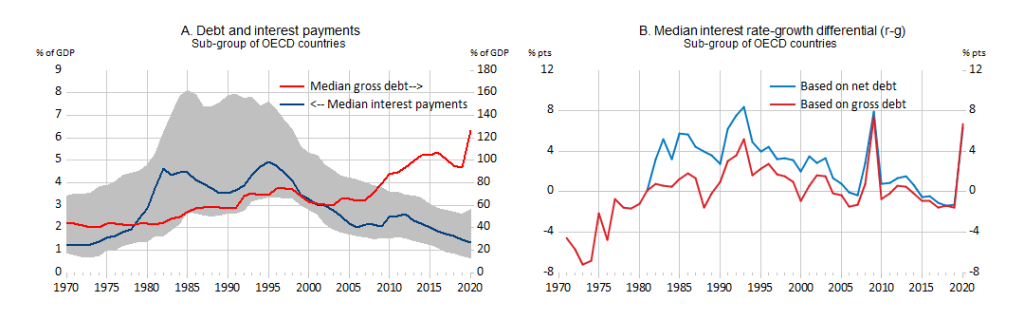
The fiscal response to the COVID-19 crisis prevented larger declines in employment, income and output, and is paving the way for a sustainable recovery. At the same time, government debt relative to GDP has reached the highest levels in several decades, adding to a pre-crisis upward trend in sovereign debt (Figure 1, Panel A).

Figure 1. Government interest payments and r-g declined despite rising gross debt

Note: In Panel A, the median and the inter-quintile range between the first and fourth quintiles (shaded area) refer to the distribution of general government interest payments as a per cent of GDP. Gross debt refers to the OECD definition of general government financial liabilities. In Panel B, the lines indicate the medians of the distribution of interest rate-growth differentials. See Annex B in Rawdanowicz et al., (2021) for the definitions of the two versions of the interest rate-growth differentials. The sub-group of OECD countries refers to countries for which long time series are available: Austria, Belgium, Canada, Denmark, Finland, France, Germany, Italy, Japan, the Netherlands, Spain, Sweden, Switzerland, the United Kingdom and the United States. As the start of time series differs slightly within the country group, medians and the first and fourth quintiles are calculated only when data for at least 75% of the number of countries in the group are available.
Source: OECD Economic Outlook database; and authors’ calculations.

Despite rising debt, government interest payments have declined since the 1980s, reaching just above 1% of GDP in the median OECD economy (Figure 1, Panel A). This was possible due to falling nominal and real yields on longer‑term government bonds that started in the late 1980s and the early 1990s. The falling interest rates helped lower the trend in the effective r-g, mitigating the impact of the increase in gross debt on public finances (Figure 1, Panel B).

Negative r-g always stabilises debt, but potentially at high levels

Persistently negative r‑g helps lower debt. Together with moderate levels of primary budget deficits, debt reductions can be substantial in these circumstances, especially at high initial debt levels as shown in stylised and illustrative simulations (Figure 2).

Figure 2. Negative r-g can reduce the debt-to-GDP ratio significantly when primary deficits are modest

Note: Stylised simulations assume that primary balances (pb, in % of GDP) and the interest rate-growth differentials (r-g, in percentage points) remain unchanged at the indicated levels over the simulation period. Simulations assume no government financial assets (net and gross debt are identical) and no statistical discrepancy.
Source: Authors’ calculations.

Actually, debt will stabilise with any constant primary budget deficit when r-g is negative. However, depending on the level of the primary budget balance and r-g, this stabilisation may only occur after a prolonged and large increase in debt. To demonstrate this point, in our working paper we presented stylised and purely illustrative simulations for different values of initial debt, the primary budget balance, and the level of r-g. Both the size of the negative r-g and the primary budget balance are fundamental for determining the speed and the level at which the debt to GDP ratio stabilises, while initial debt is less important.

High debt carries risks for public finances

As debt can stabilise at a high level and only in a distant future despite a negative r-g, two additional issues are important in assessing debt sustainability.

First, increasing and elevated debt can lead to higher interest rates and make public finances vulnerable to changes in economic conditions in general, and interest rates in particular. For instance, declines in GDP can bring about big increases in the debt-to-GDP ratio through the same mechanism through which negative r-g can help stabilise debt levels, exacerbated by cyclical deteriorations in the primary budget balance. Such debt increases may be difficult to reverse if growth is low and budget deficits remain large several years after a recession. Moreover, the longer-term evolution of government bond yields is highly uncertain (Orszag, Rubin and Stiglitz, 2021) and current low effective interest rates in relation to GDP growth do not exclude a possibility of future high sovereign yields (Mauro and Zhou, 2020). In general, high debt may limit the fiscal space to accommodate negative shocks and thus result in sub-optimal fiscal responses to future recessions (Jordà, Schularick and Taylor, 2016).

Second, at current debt levels, OECD countries will have to issue significant amounts of bonds in coming years. Some of the rollover risks could be mitigated by managing debt maturity to avoid concentration of large debt rollovers. Central banks’ purchases of government bonds could also help mitigate rollover risks, but maintaining positive confidence may require very large (gross) purchases.

References

Jordà, Ò., M. Schularick and A. Taylor (2016), “Sovereigns versus banks: Credit, crises, and consequences”, Journal of the European Economic Association, Vol. 14/1, pp. 45-79, http://dx.doi.org/10.1111/jeea.12144.

Mauro, P. and J. Zhou (2020), “r minus g negative: Can We Sleep More Soundly?”, IMF Working Papers, Vol. 20/52, http://dx.doi.org/10.5089/9781513536071.001.

Orszag, P., R. Rubin and J. Stiglitz (2021), “Fiscal resiliency in a deeply uncertain world: The role of semiautonomous discretion”, PIIE Policy Brief, No. 21-2, Peterson Insitute for International Economics, https://www.piie.com/publications/policy-briefs/fiscal-resiliency-deeply-uncertain-world-role-semiautonomous-discretion.

Rawdanowicz, Ł. et al. (2021), “Constraints and demands on public finances: Considerations of resilient fiscal policy”, OECD Economics Department Working Papers, No. 1694, OECD Publishing, Paris, https://dx.doi.org/10.1787/602500be-en.


Insights from past large and prolonged sovereign debt reductions in OECD countries

By David Crowe, Valentine Millot and Łukasz Rawdanowicz, OECD Economics Department

Due to the COVID-19 crisis, sovereign debt in relation to GDP has increased massively, reaching the highest levels in several decades in many countries. Current low interest rates reduce concerns about debt sustainability, but high debt makes public finances vulnerable to negative shocks. Thus, governments will have to balance the need to minimise the risk of fiscal stress and the need to satisfy growing demands on public finances.

In this context, in our recent paper Constraints and demands on public finances: Considerations of resilient fiscal policy (Rawdanowicz et al., 2021), we analyse 17 episodes of large and prolonged sovereign debt reductions in OECD countries since the 1970s. We find that such debt reductions were achieved primarily by increasing budget surpluses, supported by a context of strong nominal GDP growth (on average 7%). Debt reduction episodes were initiated in response to rising debt and interest payments, sometimes resulting from economic crises. It is noteworthy that in some cases debt reduction episodes were accompanied by revamping fiscal frameworks.

There are many examples of large and prolonged debt reductions

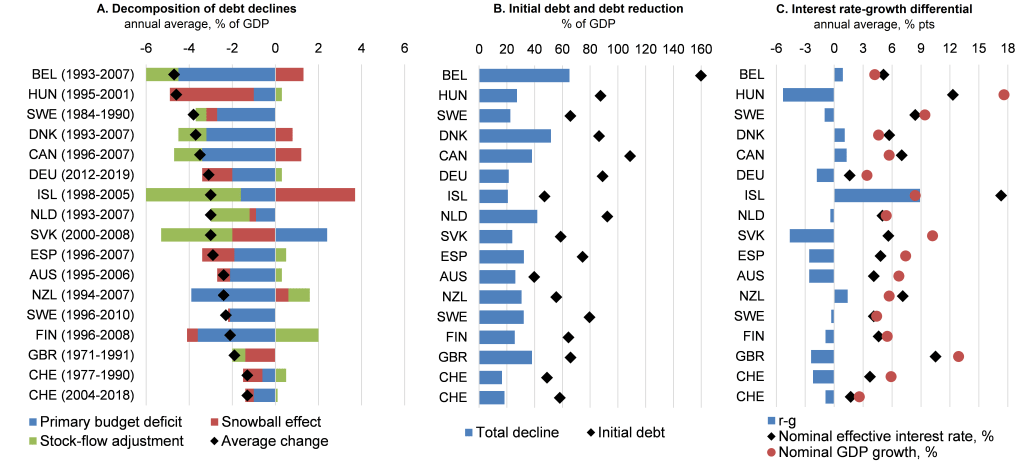
We identify 17 episodes that involved persistent reductions in gross debt (spanning at least five years, but allowing for temporary debt reversals) of at least 15% of GDP, in contrast to a traditional focus in the literature on fiscal consolidations which are measured by changes in budget balances – e.g. (Molnár, 2012) (Figure 1). Most of the episodes started in the 1990s and ended before the global financial crisis. On average across the episodes, debt was reduced by just over 30% of GDP over 11 years, but the size and duration varied across the episodes (Figure 1, Panel A). In many episodes, initial debt was no higher than 80% of GDP and, in most cases, the debt‑to‑GDP ratio was reduced by less than half (Figure 1, Panel B).

Figure 1. Episodes of large and prolonged sovereign debt reductions: main statistics

Note: Episodes selected based on data availability in the OECD Economic Outlook database. The snowball effect captures the product of lagged gross debt and the interest rate-growth differential (see Annex B of Rawdanowicz et al. (2021) for explanations on the debt dynamics decomposition).
Source: OECD Economic Outlook database; and authors’ calculations.

High budget surpluses and strong GDP growth were instrumental in lowering debt

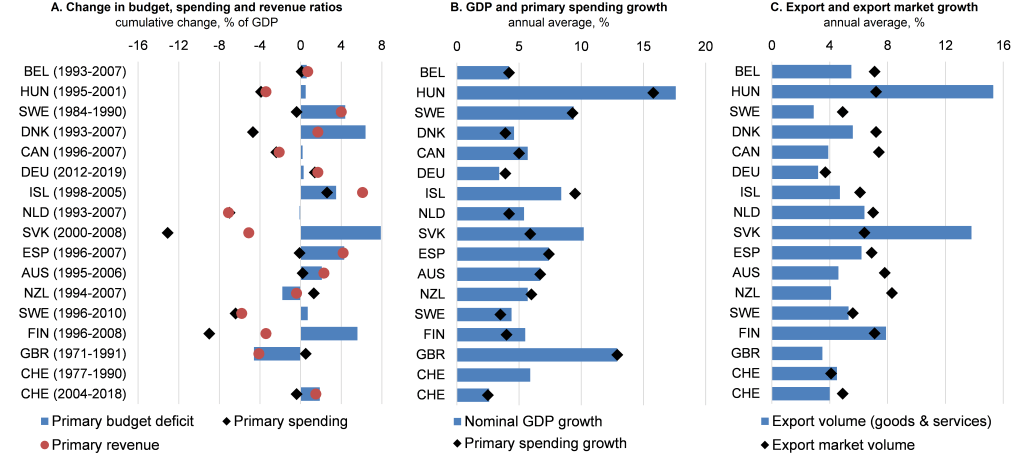
Most of the debt reductions took place in an environment of high nominal GDP growth (on average 7% across countries and years; Figure 1, Panel C), in particular in Hungary and the United Kingdom. The notable exceptions are Germany and Switzerland (2004-2018), where nominal growth was modest but still r-g was negative and the budget surpluses were high. In line with this, in most cases, the primary budget balance‑to‑GDP ratio improved as primary revenue increased by more or declined by less than primary spending (Figure 2, Panel A). In addition, average growth in nominal primary expenditure was not higher than average nominal GDP growth (Figure 2, Panel B). In some countries (e.g. Finland and Canada), the debt reduction episode also coincided with a substantial depreciation of the domestic currency, helping export growth (Figure 2, Panel C).

Decomposing the annual average changes in debt (see details in Annex B of Rawdanowicz et al. 2021) shows that in most of the episodes a high primary budget surplus reduced debt – on average by 2% of GDP per annum, but in some cases by more than 3% of GDP (Figure 1, Panel A). In two thirds of the episodes, higher growth than interest rates lowered the debt-to-GDP ratio (Figure 1, Panel C), with a total contribution of the snowball effect to the debt reduction (i.e. a combined effect of the interest rate growth differential and the lagged level of gross debt) on average close to 1% of GDP per year. A few countries benefited also from favourable stock flow adjustments (i.e. all changes in the debt ratio that are not explained by the budget balance and the snowball effect, like sale or purchase of financial assets). This was particularly the case in Iceland and the Slovak Republic due to very large interest earnings and a sizeable reduction in the ratio of government financial assets to GDP, respectively.

Figure 2. Episodes of large and prolonged sovereign debt reductions: additional statistics  

Note: Episodes selected based on data availability in the OECD Economic Outlook database. Export market is calculated as a weighted average of trading partners’ import volumes.
Source: OECD Economic Outlook database; and authors’ calculations.

While the economic and political context triggering debt reductions varied across countries, there were a few common themes

Growing fiscal pressures. In several episodes, debt reductions were initiated following prolonged and large debt accumulations. Falling interest rates and subsequently government interest payments helped the debt reductions in the 1990s. In some countries, at the beginning of debt reductions, interest payments amounted to at least 5% of GDP and in Belgium and Canada around 10% of GDP, crowding out other spending.

Fiscal rules and frameworks encouraged actions to reduce debt. In several EU countries, the requirement to fulfil the Maastricht fiscal criteria (budget deficit no higher than 3% of GDP and government debt below 60% of GDP) ahead of adoption of the euro contributed to public debt reductions. In Canada, to help deal with large budget deficits of provincial and federal governments in the early-1990s, many provinces voluntarily adopted fiscal rules. The Federal government introduced the Spending Control Act between 1992 and 1995 and since then has generally used non-legislated fiscal targets, helping to achieve high budget surpluses in the subsequent years. In New Zealand, fiscal discipline was accompanied by the introduction of a new budgetary framework (the 1994 Fiscal Responsibility Act), building on responsible fiscal management principles. The Act also enforced greater transparency about the fiscal situation and fiscal policies.

Negative economic shocks. In a few countries, severe economic crises required fiscal adjustments, thereby securing popular support for adjustment. For instance, in Finland the deep recession following a financial crisis in the early 1990s prompted the government to implement large cuts in government spending (including social benefits, public sector wages, subsidies, investment, and transfers to sub-central governments), with the aim to restore confidence in financial markets and to achieve a non-inflationary recovery. The impact of these measures on debt reduction was strengthened by the move to a floating exchange rate that led to a sharp depreciation of the local currency. In Sweden, the severe banking and economic crises in the early 1990s led the government to implement several structural reforms covering governance of the public finances, tax reforms, liberalisation of the economy, reforming the welfare state (pensions especially), and promoting an export-oriented growth model. However, we should acknowledge that for these countries, favourable global economic conditions boosted exports, contributing to the resumption of economic growth and debt reduction.

References

Molnár, M. (2012), “Fiscal consolidation: What factors determine the success of consolidation efforts?”, OECD Journal: Economic Studies, https://dx.doi.org/10.1787/eco_studies-2012-5k8zs3twgmjc.

Rawdanowicz, Ł. et al. (2021), “Constraints and demands on public finances: Considerations of resilient fiscal policy”, OECD Economics Department Working Papers, No. 1694, OECD Publishing, Paris, https://dx.doi.org/10.1787/602500be-en.


How can public finance reforms boost economic growth and enhance income equality?

by Boris Cournede, Head of Public Finance Workstream, OECD Economics Department

Most OECD countries have very large government sectors: public expenditure amounts to 43% of economic activity, measured by GDP, on average across OECD countries. This proportion exceeds 50% in four OECD countries. The programmes on which governments spend have thus deep implications for people’swell-being and a country’s economic fortunes. Similarly, the choice and design of taxes that fund expenditure will also shape economic decisions and influence people’s  choices to work, invest and consume.

New OECD empirical work has identified lessons provided by the experience of OECD countries over the past three decades. These empirical investigations shed light on the effects of public finance on economic activity as well as on the distribution of income across households.

First, large governments can be compatible with high levels of economic activity: the condition is that governments provide their services very efficiently. The Nordic countries display the levels of government effectiveness at which governments can be large without weighing on growth. Where governments are less effective, reducing their size can be expected to lead to higher growth; however, reducing the size of government typically entails arise in income inequality, because public expenditure, and especially transfers, are a powerful equaliser of incomes.

Second, leaving aside questions about government size, many public finance reforms that change the composition of spending or the mix of taxes offer the potential to boost economic activity and household incomes:

  • Some reforms can boost overall economic activity while reducing income gaps:
    • One important reform of this nature is to reduce the effective tax that low-income workers face (taking into account the withdrawal of benefits) and funding this change through proportional increases in other taxes.
    • Another reform that belongs in this win-win category for higher activity and less inequality is to increase inheritance taxes and use the proceeds to reduce other taxes proportionally.
  • A number of public finance reforms can increase activity without altering income differentials, thereby “lifting all boats”roughly equally. They include:
    • Higher public investment, while reducing other spending programmes by the same amount;
    • Higher recurrent property taxes, while lowering other taxes by as much;
    • Lower effective rates of corporate income tax,while increasing other taxes.
  • One public finance change that benefits the poor with no substantial effect on overall activity is to expand spending on family policy while reducing other spending programmes by the same amount.
  • Finally, a number of changes to the structure of public finance can be expected to boost economic activity but widen relative income gaps yet leave no income group worse of in absolute terms. Such reforms include:
    • Lowering public subsidies, while increasing other expenditure categories by as much, giving priority to the most favourable for growth such as investment and education;
    • Lowering net wealth taxes while raising other taxes by the same amount;
    • Easing the tax burden on workers earning above-average wages while increasing other taxes to make up for the revenue shortfall.

The empirical work shows that reforms of sizes that correspond to changes that have been observed in OECD countries in the past three decades can have substantial effects on economic activity (Figure). This work can help select reform priorities in the light of their expected overall economic benefits and their distributional consequences, which will determine how inclusive, and therefore acceptable in political terms, they are likely to be. Importantly, the exact choice and design of the reforms will also have to reflect country specificities in terms of institutions and preferences.

Read more:

  • Cournède, B., J.-M. Fournier and P. Hoeller (2018), “Public Finance Structure and Inclusive Growth, “  OECD Economic Policy Paper, No. 25.    https://www.oecd-ilibrary.org/economics/public-finance-structure-and-inclusive-growth_e99683b5-en
  • Akgun, O., D. Bartolini and B. Cournède (2017),“The Capacity of Governments to Raise Taxes”, OECD Economics Department Working Papers, No. 1407, OECD Publishing, Paris, http://dx.doi.org/10.1787/6bee2df9-en.
  • Akgun, O., B. Cournède and J. Fournier (2017),“Effects of the Tax Mix on Inequality and Growth”, OECD Economics Department Working Papers, No. 1447, OECD Publishing, Paris, http://dx.doi.org/10.1787/c57eaa14-en.
  • Fournier, J. (2016), “The Positive Effect of Public Investment on Potential Growth”, OECD Economics Department Working Papers,No. 1347, OECD Publishing, Paris, http://dx.doi.org/10.1787/15e400d4-en.
  • Fournier, J. and Å. Johansson (2016), “The Effect of the Size and the Mix of Public Spending on Growth and Inequality”,OECD Economics Department Working Papers, No. 1344, OECD Publishing, Paris, http://dx.doi.org/10.1787/f99f6b36-en.
  • Hagemann, R. (2018), “Tax Policies for Inclusive Growth: Prescription versus Practice,OECD Economic Policy Paper, No.24.  https://www.oecd-ilibrary.org/economics/tax-policies-for-inclusive-growth_09ba747a-en


Does public spending foster inclusive growth in your country?

by Debbie Bloch, Public Economics Division, Economics Department

Governments today need to balance the policy goals of boosting economic growth and improving equity when making budget decisions.  How can public spending choices promote inclusive growth?  What can be learned from previous spending decisions in times of crisis?

As it becomes increasingly important for policymakers to look at public finances in terms of both growth and income equality, a new set of indicators has been developed to help governments assess how public spending can be geared toward achieving these twin goals.

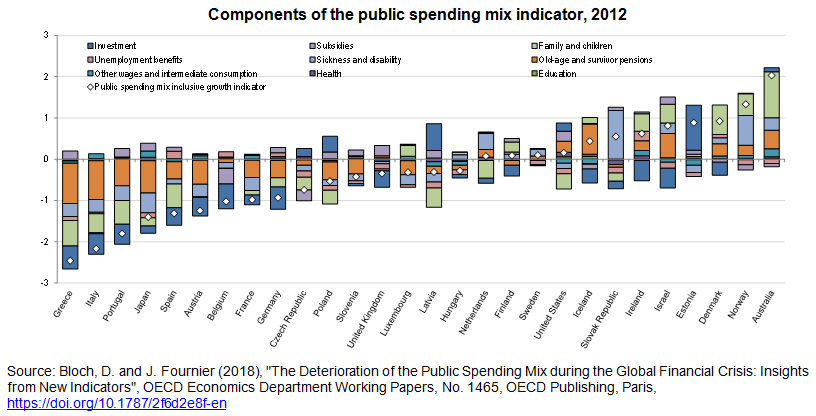
A first set of indicators combines information on the mix of public spending. Each spending item share is multiplied with an estimated coefficient from growth and inequality equations to build both a growth and an income distribution component, which is then summed up to an aggregate inclusive growth indicator.  The outcomes show that public investment and family and child benefits help butress inclusive growth, while old age pensions and government subsidies hurt the most. The indicator below shows that the public spending mix is least conducive to inclusive growth in Greece and most conducive in Australia.

publicspending-components-blog debbie

Taking the analysis further, a second set of indicators adds information on the size and effectiveness of governments to the public spending mix analysis, providing an overall indicator on the effects of public spending on inclusive growth.  This indicator shows that countries with large but efficient governments, such as Nordic countries, along with those favouring inclusive-growth friendly spending items do well in the indicator ranking, while those with less-effective governments, and with high old-age pension spending tend to do worse.


public-spending-components blog debbie2
Policymakers need to be aware of these effects when facing hard choices, particularly during times of economic crisis.  Analysis based on these new indicators have shown there is a striking link between the growth component of the public spending mix indicator and the output gap: the capacity of the public finances to support inclusive growth deteriorated markedly in the countries hardest hit during the recent crisis, as governments slashed budgets with little regard to which items would underpin inclusive growth.

What can we take away from this?  Countries facing pressure to reduce spending during an economic downturn need to consider which spending items would be most – and least – condusive to inclusive growth, to ultimately help them come out stronger after a crisis.  Increasing public investment and family benefits, for example, while targetting reductions in less productive spending items should help assure healthier, fairer economies.

Reference:

Bloch, D. and J. Fournier (2018), “The Deterioration of the Public Spending Mix during the Global Financial Crisis: Insights from New Indicators”, OECD Economics Department Working Papers, No. 1465, OECD Publishing, Paris, https://doi.org/10.1787/2f6d2e8f-en.

Further reading:

Fournier, J. and Å. Johansson (2016), “The Effect of the Size and the Mix of Public Spending on Growth and Inequality”, OECD Economics Department Working Papers, No. 1344, OECD Publishing, Paris, https://doi.org/10.1787/f99f6b36-en.

Johansson, Å. (2016), “Public Finance, Economic Growth and Inequality: A Survey of the Evidence”,OECD Economics Department Working Papers, No. 1346, OECD Publishing, Paris,https://doi.org/10.1787/094bdaa5-en.

Bloch, D. et al. (2016), “Trends in Public Finance: Insights from a New Detailed Dataset”, OECD Economics Department Working Papers, No. 1345, OECD Publishing, Paris,https://doi.org/10.1787/4d3d8b25-en.


An empirical investigation on the drivers of income redistribution across OECD countries

By Orsetta Causa, OECD Economics department

Income inequality has increased in most OECD countries over the past two decades. This has come about both because incomes before taxes and transfers have become more unequally distributed, and because the extent of redistribution through taxes and transfers has fallen (“Income redistribution through taxes and transfers across OECD countries”). A new OECD paper by Orsetta Causa, Anna Vindicis and Oguzhan Akgun provides an empirical investigation on the drivers of the widespread decline in income redistribution across OECD countries over the last two decades.

The results suggest that the size of the redistribution system plays a major role for income redistribution, in particular on the spending side, confirming previous OECD findings. Hence, the relatively widespread decline on cash transfers to the working-age population is found to have contributed to the decline in income redistribution to the working-age population.

On the revenue side, the empirical analysis uncovers an interaction between increased economic integration and the capacity of personal income taxes to reduce income inequality. Indeed, the results suggest that stronger trade ties across countries have made a given level of tax receipt through personal income taxes less effective at reducing income inequality. The estimated marginal effect of the personal income tax to GDP (PIT-to-GDP) ratio on redistribution thus depends on the degree of countries’ openness (Figure 1): for around half of OECD countries, the effect of the PIT-to-GDP ratio on redistribution is significantly positive but this effect declines with openness levels. For a country at the OECD average level of trade openness, a one percentage point increase in the PIT-to-GDP ratio is associated with a 2% increase in redistribution. For the countries for which such effect is statistically significant, it ranges from 3.7% (USA) to around 1.5% (Korea).

sizeofpitblogcausa1

For a given overall size of the tax and transfer system, the estimation results suggest that changes in specific tax and transfer instruments have contributed to the decline in redistribution. Most important among these are:

  • Reductions in the progressivity of personal income taxes, driven by a flattening of the tax schedule in the upper-part of the wage distribution as well as by a decline in top personal income tax rates and in the taxation of dividend income at the personal level.
  • Reductions in the generosity and duration of unemployment-related transfers, including cuts to social assistance for the long-term unemployed, which have often taken place in combination with increases in spending on active labour market policies. This finding is thus likely to reflect the effect of policy reforms to boost work incentives among target groups and to shift from passive to active support for the unemployed.

At the same time, not all policy changes went in the direction of reducing redistribution: the decline in redistribution has been partly mitigated by progressive family-friendly policies, such as widespread increases in spending on early education and childcare, as well as by tax cuts to low wage earners.

These estimates are used to simulate the income redistribution effect of selected tax and transfer reform scenarios, taking into account the countries’ relative starting point in each policy area. Transfer reform scenarios deliver larger effects than tax reform scenarios. The scenarios consistently point to major redistribution gains in countries where social spending on working-age population is relatively low and/ or weakly targeted to low-income households (Figure 2). Increases in long-term unemployed- related transfers to married couples deliver major redistribution gains where these transfers are low or non-existent  (e.g. Chile, Greece, Italy, Turkey and the United States)  The magnitude of these effects reflects the large implied size of the simulated reforms for these countries and should therefore be interpreted in light of alternative policy objectives, in particular efficiency objectives in terms of job search incentives, alongside budgetary constraints.  Still, those same countries that exhibit comparatively low passive support for the long-term unemployed tend to also exhibit comparatively low active support. As a result, policy packages that would combine more generous cash transfers with more effective activation and training for jobseekers would likely meet equity and efficiency objectives. The United States and Turkey would also boost redistribution by increasing spending on early education and childcare; and so would Mexico and Japan. This would not only increase redistribution but also help narrowing gender gaps and curbing child poverty. Reforms to enhance access to quality childcare for disadvantaged families are likely to maximise policy synergies between efficiency and equity.

sizeofpitblogcausa2

References: 

Causa, O., A. Vindics and O. Akgun (2018), “An empirical investigation on the drivers of income redistribution across OECD countries“, OECD Economics Department Working Papers, No. 1488, OECD Publishing, Paris, https://doi.org/10.1787/5cb47f33-en.