On the path to the top league: sustaining Croatia’s convergence

By Tim Bulman, OECD Economics Department

Croatia, with a population of four million and independent as of three decades ago out-performs in many fields. The successes of its sports teams and of its leading athletes, and the beauty of its natural landscapes and the cities and islands along its sparkling coastline are well known. It is now aiming to achieve similar renown for its economy and quality of life.

An ambitious programme of reforms and investments over the past decade are bearing fruit and Croatia is advancing up the league tables. The economy is expanding and diversifying, generating jobs and raising incomes, and making poverty increasingly rare. The country navigated the COVID-19 and energy price shocks well, achieving robust rebounds in output and employment. The quality of the environment and of public services has improved, contributing to a markedly more optimistic outlook among younger generations. The country is also becoming increasingly attractive to immigrants. Croatia’s integration into the euro- and Schengen areas at the start of 2023 is recognition of these changes and strengthens the base for continued progress.

Indeed, strong progress will need to continue if Croatia’s is to move to the top of the league tables. For future generations to enjoy the incomes of the average OECD country, the economy will need to expand by 3% annually on average for the next thirty years, at the same time as it addresses the twin challenges of climate change and population ageing. The 2023 Economic Survey of Croatia, the first prepared by the OECD and which is being launched in the context of Croatia’s accession process to the OECD, identifies three groups of policy actions that can enable Croatia to build its form.

Robust growth will need to continue for Croatia to converge with OECD incomes

GDP per capita, 2015 prices and PPPs, thousand USD                                  


Made with Flourish

Note: ‘Peers’ is the unweighted average of Czech Republic, Hungary, Slovak Republic, and Slovenia.
Source: OECD Annual National Accounts (database).

Ensure public finances and prudential supervision support sustainable growth

Inflation is abating only gradually from its surge in 2022, when it peaked at 13.0% year-on-year in November, the highest rate since the 2000s. The labour market is tight, and employers report growing recruitment challenges. Meanwhile integration into the euro- and Schengen-areas are adding to demand from exports and investment, while banks have increased lending capacity. The government plans to shift the budget from a modest surplus in 2022 to a small deficit in 2023 and a larger deficit in 2024, further adding to demand pressures.

Avoiding fiscal stimulus while inflation remains high would ensure fiscal policy is counter-cyclical, and help inflation in Croatia return to the level of its peers. Vigilantly monitoring banks’ new lending can support macroeconomic stability.

Consumer prices are still rising faster than in the euro area

Consumer price inflation, year-on-year


Made with Flourish

Note: ‘Peers’ is the unweighted average of Czech Republic, Hungary, Slovak Republic, and Slovenia.
Source: OECD Price Statistics database.

Support a more dynamic business environment where productive firms can grow

Croatia has a lively start-up scene, and many new firms are relatively productive. But they grow less than in other countries. Instead, entrenched, lower-productivity firms dominate much of the business sector. Many firms’ lagging productivity reflects low investment, especially foreign direct investment that brings new technologies, and investment in digitalisation and more innovative management.

Firms identify the time and resources spent on complying with regulations as a major constraint. Continuing to review, streamline and simplify regulations, and closely monitoring whether regulatory burdens are indeed diminishing can ensure progress.

In practice, businesses report that complying with regulations is burdensome


Made with Flourish

Many legal disputes remain slow to resolve, despite some recent gains, and many businesses report a lack of confidence in the legal system. Efforts to develop alternative dispute resolution, digitalise legal processes and better communicate legal decisions can help.

State-owned enterprises (SOEs) continue to play an over-sized role in Croatia’s economy, but many under-perform in how well they use their assets and workers and in the quality of the goods and services they deliver. Making SOE governance, arms-length from the government and more transparent about performance and returns can help. Listing state-owned enterprises where there is not a core justification for government ownership can also boost the firms’ performance and the dynamism of Croatia’s economy.

Strengthen skills and activate those out of the workforce to raise incomes and inclusiveness

Croatia’s growing and increasingly diverse economy requires ever higher levels of workforce skills. Many workers have solid intermediate skills, but investors report difficulties hiring higher-level skills. A big push to improve adult education can help. The strong take-up of a new adult education voucher scheme demonstrates that demand exists for a well-designed system, i.e. one that identifies workers’ skill needs, adapts to their schedules and circumstances, and is affordable.  Better connecting school and vocational education with employers’ current and future needs would better prepare students for a dynamic economy.

Addressing barriers to adult education can raise participation


Made with Flourish

Alongside raising skills, a relatively large share of Croatia’s younger and older adults is not in the labour force. These people are among those most at risk of poverty. Many have few skills and little experience of working formally. Tailored activation services that develop skills and offer work experience can enable them to move into lasting jobs. Lagging areas with few opportunities are likely to need extra policy attention. Assisting older adults stay in work longer would help ensure they can enjoy adequate incomes and quality of life in retirement.

Croatia’s reform and investment programme reflects its ambitions. Full implementing these efforts will take ongoing effort and energy. The benefits of graduating to the top league will be well worth the effort.



Tackling tightness in the Dutch labour market

Labour-saving innovation alone is unlikely to reduce overall labour demand. To lift supply, childcare, immigration, and adult training need an overhaul.

By Daniela Glocker and Nicolas Gonne, OECD Economics Department

The Netherlands has a very strong labour market. The employment rate is one of the highest in the OECD, while unemployment is low. Workers are paid well on average and experience significantly less job strain than in many other OECD countries. This contributes to making the Netherlands a country with a high reported life satisfaction.

But the Dutch labour market is also very tight. Job openings are plenty and available workers are scarce (Figure 1). Pervasive labour shortages across occupations and regions prevent businesses from operating at their desired production level. Shortages are reported in many OECD countries, reflecting the unprecedented speed of the post-pandemic recovery. However, labour market tightness is structural in the Netherlands: the number of people available for work, either unemployed or inactive, has declined steadily in recent years.

Figure 1. Dutch labour market tightness predates the pandemic

Labour market tightness
vacancies per 100 unemployed

Note: OECD (resp. EA17) average based on 23 (resp. 17) countries for which data are available.
Source: OECD Labour Market Statistics (database); Eurostat Job Vacancy Statistics.

Lifting labour supply to tackle tightness is urgent in the Netherlands: not only do enduring shortages generate wage inflation, but they also hold back the green and digital transitions, weighing on potential growth. In complement to raising productivity, the latest Economic Survey of the Netherlands identifies areas for policy reform that together have the potential to increase labour supply.

Strengthening incentives to work full time

More than a third of employees work fewer than 30 hours per week in the Netherlands, by far the highest incidence of part-time work in the OECD, with a particularly unequal distribution between genders. The system of taxes and benefits implicitly promotes the “one-and-a-half earner model” (Figure 2, Left), whereby one partner (often a man) works full-time and the second earner (often a woman) works relatively few hours. Expensive or unavailable childcare weighs on incentives to work more (Figure 2, Right), as looking after a child is the main reason for part-time employment in the Netherlands.

Figure 2. Stronger incentives on moving to full-time employment and more affordable childcare would increase labour supply

Note: LHS refers to second earners with two children. (more details). Source: OECD Benefits, Taxes and Wages (database); OECD Social and Welfare Statistics (database).

Reducing work disincentives arising from childcare, school hours, and leave arrangements is a necessary complement to the steady reduction in the effective tax rate on moving to full-time employment. The planned reform to make childcare free for all working parents is expected to worsen staff shortages in childcare facilities, raising doubts about feasibility. Phasing in the reform gradually, monitoring access and evaluating the repeal of the link between hours worked and the amount of the childcare support would help.

Realising the potential of migration

While labour market participation overall is high, the gap between the native-born and the foreign-born is the largest in the OECD (Figure 3), especially for migrants from outside of the European Union. Most highly educated foreign-born work in jobs that require a lower level of formal education than what they hold or are not in employment. Moreover, the immigration system is not responsive to labour market needs, and no migration scheme exists for medium-skill workers, despite their importance for the green transition.

Figure 3. Better migrant integration could attenuate labour shortages in some occupations


Made with Flourish

Source: OECD Migration Statistics (database).

Streamlining and accelerating the processes of recognition and validation of qualifications acquired abroad for shortage skills would improve employment outcomes for underemployed groups and partially address labour shortages. Repealing labour market tests, whereby employers are required to search for applicants from the Netherlands or other EU countries before turning to non-EU migrants, would increase supply for the middle-skill segment of the labour market and for occupations related to the low-carbon transition.

Promoting a culture of lifelong learning

Training needs are important in the Netherlands, given the massive number of new jobs that will be necessary for the low-carbon transition and the continued digitalisation of the economy. Yet, the country only allocates a relatively little share of active labour market policy spending to training (Figure 3). In a first approximation, a threefold increase in public spending on training is necessary to achieve the required reskilling and upskilling. Moreover, concerns have surfaced regarding the quality and relevance of some trainings subsidised under the recently discontinued individual learning scheme STAP.

Figure 4. Higher spending on quality public training would promote growth in expanding industries


Made with Flourish

Source: OECD Statistics on Labour Market Programmes (database).

Major scaling-up and stronger incentives for co-financing by employers are needed to deliver on the stated objective of promoting a new culture of lifelong learning. Focusing expenditure on adult learning related to occupations where shortages are the most pressing would reduce the overall fiscal cost and better channel labour towards the tightest segments of the labour market. More emphasis should be placed on ensuring that providers maintain training quality, including renewing providers’ accreditation regularly, assessing the outcomes of education activities, and ensuring that the ensuing information is transparent and publicly available.

References

Borowiecki M., J. Pareliussen and D. Glocker (2021), “Chasing the frontier: Digitalisation for stronger productivity in the Netherlands”, OECD Economics Department Working Papers, No. 1680, OECD Publishing, Paris, https://doi.org/10.1787/e800ee1d-en

Abendschein M., O. Causa, N. Luu, E. Soldani and C. Soriolo (2022), “The post-COVID-19 rise in labour shortages”, OECD Economics Department Working Papers, No. 1721, OECD Publishing, Paris, https://doi.org/10.1787/e60c2d1c-en.

Gonne N. (2023), “Lifting labour supply to tackle tightness in the Netherlands”, OECD Economics Department Working Papers, OECD Publishing, Paris, forthcoming.


Enhancing labour-market integration of immigrants in Canada

by David Carey, Head of Canada Desk, OECD Economics Department

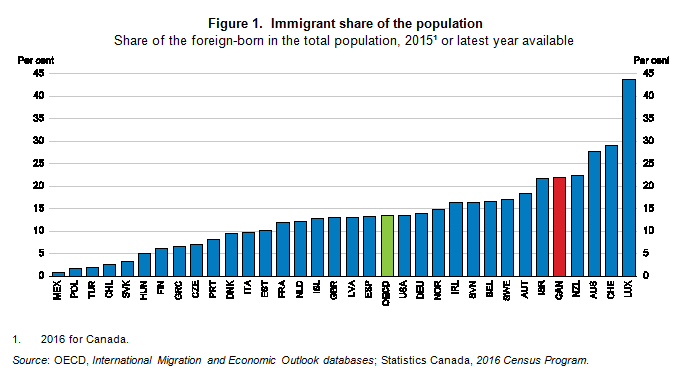
Canada has long taken in more immigrants relative to its population than most other countries. Immigration policy in Canada aims to promote economic development by selecting immigrants with high levels of human capital, to reunite families and to respond to foreign crises and offer protection to endangered people. Economic immigrants, who are selected for their skills, are by far the largest group. The immigration system has been highly successful and is well run. Outcomes are monitored and policies adjusted to ensure that the system’s objectives are met. Immigrants and their children are better integrated in Canada based on a variety of indicators than in most other countries. Immigrants selected for their skills earn substantially more than other immigrants, indicating that selection is succeeding in identifying immigrants with the greatest potential for labour market integration.

Canadaimmigrationblog 2018

A problematic development is that immigrants’ entry earnings fell sharply relative to those of the comparable native-born in recent decades. Important causes of the fall include weaker official language skills and a decline in the returns to pre-immigration labour market experience.

Canadaimmigrationblog2 2018

In response, immigration policy has been changed to select immigrants with better earnings prospects. More are selected for their human capital, and greater weight has been given to official language competence, age (inversely related to foreign work experience) and Canadian work experience. Recently, the selection system was overhauled with the introduction of Express Entry, which only invites candidates with the highest point scores to apply for permanent residence and gives employers a greater role in selection. The system would be still more effective if more weight were given to skilled Canadian work experience in selection and applications from candidates with skilled work experience and a relevant job offer were processed before others.

Canada also has an extensive array of programmes that facilitate integration. The Targeted Employment Strategy for Newcomers facilitates foreign-credentials recognition and helps immigrants gain Canadian work experience in their profession. Bridge programmes, which help with post-secondary credentials recognition in regulated occupations, and mentoring programmes, which help immigrants overcome underrepresentation in high-quality jobs by developing professional networks, have proved effective and should be expanded. The federal government’s settlement programmes are extensively used but it is not clear whether utilisation patterns reflect differences in needs or availability. There are large differences in efficiency of government language programmes, pointing to possibilities for reorganisation to improve outcomes.

References:

OECD (2018), OECD Economic Surveys: Canada 2018,  OECD Publishing, Paris.


The refugee crisis: a challenge but also an opportunity for improving policies to integrate immigrants into the Dutch labour market

By Gabor Fulop, Analyst, & Rafal Kierzenkowski, Senior Economist
The Netherlands Desk,  Country Studies, OECD Economics Department

The ongoing refugee crisis in Europe has particularly affected the Netherlands. Asylum requests surged in 2015 to nearly 60 000 (Panel A), more than three times the yearly average of 2010-14. This is a significant challenge for the authorities, who need to provide decent housing and help these people finding a job for the time they will stay in the Netherlands as refugees, which could be much longer than expected. Getting work is key for refugees to develop social contacts and economic independence, and acquiring new skills could be helpful for those refugees who eventually return to their own country. Therefore, good policies to facilitate the labour market integration for migrants are critical.

The past record of integrating immigrants is mixed. Although at about the OECD average, the skills of first- and second-generation immigrants are well below those of natives and below those of immigrants in the best performing OECD countries (Panels B and C). In parallel, the gap in labour force participation—those who have jobs or are looking for a job—between first-generation immigrants and natives is the largest in the OECD (Panel D). Many policies that would support job prospects of immigrants would also benefit refugees. Studies of past inflows of refugees show that the proportion of those of working age participating in the labour market is around 45% after being five years in the Netherlands (Vluchtelingenwerk, 2014), which is much lower than the 80% of natives.

Skills and labour market outcomes of immigrants are weak

netherlands

Source: Statistics Netherlands (2016), “Asylum requests” in Population, Statline, January; OECD (2013), PISA 2012 Database; OECD (2013), OECD Skills Outlook 2013: First Results from the Survey of Adult Skills; and OECD (2015), “Employment, unemployment and participation rates by sex and place of birth“, OECD International Migration Statistics (database), October.

The 2016 Economic Survey of the Netherlands  highlights the following reforms for improving the labour market integration of immigrants, which could also benefit refugees:

  1. Ensuring high equity of compulsory education

Raising the quality of early childhood education and care would help immigrant children, including by improving language proficiency. Stepping up training would provide teachers with the tools to work with students with disadvantaged backgrounds, and reflecting such skills in wages would attract more qualified teachers. Raising student mobility between tracks at secondary schools would foster the development of skills, including for students with immigrant background, and would avoid those with low socio-economic background being trapped in low-qualified jobs.

  1. Recognising and upgrading skill sets

Better recognition of foreign qualifications and informal skills would help immigrants to find work that matches their skills. Creating programmes that combine work experience and on-the-job training beyond formal education, especially for immigrants with low qualifications, would help them to demonstrate and upgrade their informal skills. Developing language courses would also support access to jobs.

  1. Promoting job search and recruitment

Further lowering the cap on severance payments would make permanent contracts more attractive to employers, which would help refugees and immigrants to find jobs and to support their skills because permanent work tends to come with more skill development. The government has recently increased the earned income tax credit for lower income-earners, which is welcome. Further reduction of effective tax rates on labour income would sharpen incentives to get a job. Reinstating an equal employment policy would help to overcome discrimination on the basis of race or ethnicity.

Whereas the refugee crisis poses an immediate challenge, it also provides an incentive to improve labour market integration policies of immigrants. This would result in better job prospects benefiting all parties involved, the migrants and the Netherlands.

References

Vluchtelingenwerk (2014), IntegratieBarometer 2014 (Integration Barometer 2014).

OECD (2016), OECD Economic Surveys: Netherlands 2016, OECD Publishing.