The hidden carbon markets: how forests can balance emissions

Positive effects of forests can offset greenhouse gas emissions
How OECD Economic Surveys reveal the drivers of deforestation, and the policy tools to stop it


By Michael Koelle, OECD Economics Department

Tropical forests cover vast swaths of land in many OECD member and accession countries, including more than 75% of Costa Rica’s territory, and over half of Brazil, Colombia, Indonesia and Peru. In these countries, emissions from land use, land use change and forestry (LULUCF), largely driven by forest loss and degradation, account for a large share of total emissions (Figure 1). In fact, land use emissions are in some cases the main driver of national emission trends. But forests can also be part of the solution, as the experiences of Finland and New Zealand, two forest-rich OECD members, teach us.

For many countries, forests are no longer just a conservation issue, they are central to climate mitigation plans. Turning forests into carbon sinks is one of the most cost-effective ways to offset hard-to-abate emissions from agriculture, transport and energy. Finland and New Zealand have long had negative LULUCF emissions thanks to sustainable forest management and afforestation. Costa Rica managed to turn around LULUCF emissions, converting its forests into a carbon sink. Indonesia aims to achieve net negative emissions from LULUCF by 2030 while in Peru and Brazil, LULUCF accounts for 65% and 38% of planned emissions reductions by 2050, respectively. The economic case for protecting forests, through stronger enforcement, property rights, sustainable agriculture, and better incentives, has never been clearer. 

Insights from Economic Surveys: What’s really driving deforestation?

What do Brazil, Costa Rica, Colombia, Finland, Indonesia, New Zealand, and Peru have in common? They are all forest-rich economies, and each has been subject of in-depth analysis in OECD Economic Surveys. These studies go beyond emissions reporting. They dig into the underlying economic drivers of deforestation and discuss what can be done to turn forests into carbon sinks. While each country has its own context, common drivers of deforestation emerge. Forest loss is rooted in economic structures and incentives, from the rapid expansion of agriculture to unclear or unenforced property rights and misalignment between individual incentives and broader societal goals. Developing forest-based activities that generate sufficient economic value while keeping forests intact is far from impossible, given that cleared forest land is often used for low-profitability activities. Moreover, as seen in Finland and New Zealand, afforestation can be one of the least costly ways to reduce net greenhouse gas emissions. Tackling deforestation therefore requires structural policy responses that make choosing forests the economically sensible option, not just environmental regulation.

Fostering sustainable agriculture

Across all countries studied the expansion of the agricultural frontier is the main driver of deforestation. In Peru, OECD research shows that 90% of all deforested land is used for agriculture and livestock-rearing (Garcia Soto and Koelle, 2025). Moreover, 75% of these lands are identified as mixed-use, where farmers combine crop growing and livestock grazing on relatively small plots. In Brazil, cattle is a major pressure; in Indonesia, palm oil plantations continue to push into forest areas. Cattle grazing was also a main driver of deforestation in Costa Rica and Colombia. Most of these activities have low productivity and profitability, making extensive use of underpriced land. As Finland’s experience shows, managing soil emissions from agriculture and forestry can become a crucial issue even when forest stocks have stabilised.

To address this, OECD Economic Surveys recommend:

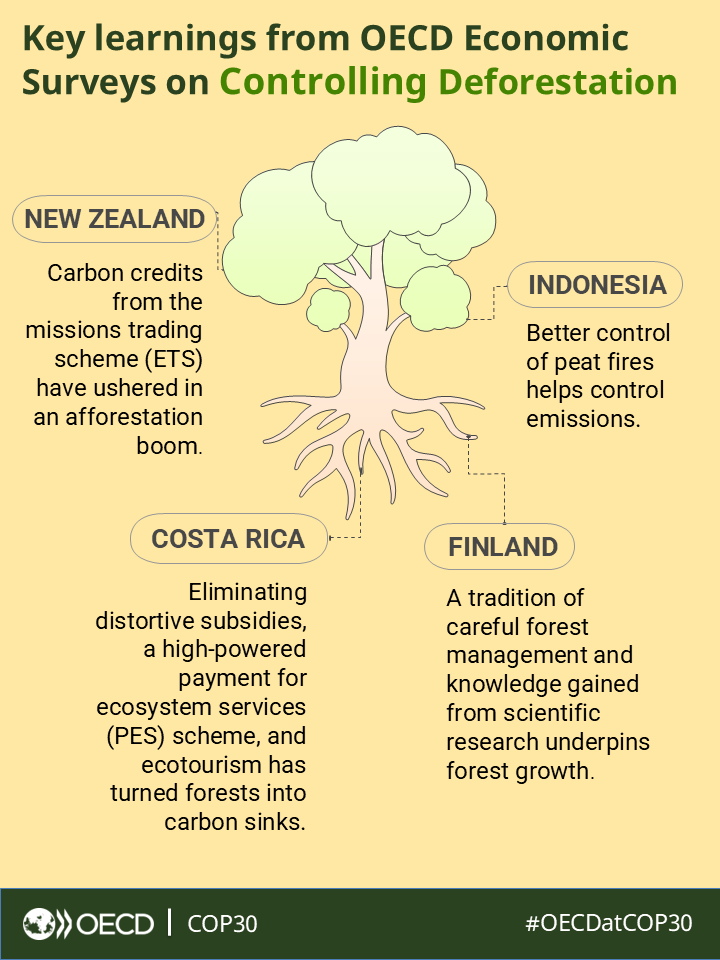
  • Eliminating environmentally harmful agriculture subsidies, such as cattle ranching subsidies, which contributed to successful reforestation in Costa Rica.
  • Improving scientific knowledge of agriculture, soils and forests, which provides the basis for cost-efficient emissions reduction and carbon storage activities in Finland.
  • Boosting productivity on existing land, to reduce pressure to expand the agricultural frontier.
  • Incentivising agroforestry and sustainable land-use practices and enforcing compliance with the law and regulations tied to land rights.

Strengthening property rights

Most deforestation occurs on land that is either publicly owned or of unclear or unenforced property rights. In Peru, state lands without designated purpose are at the highest risk for deforestation. In Colombia, land rights are often unclear and ambiguous after decades of conflict and displacement of rural populations. In Brazil, a strong framework exists, but enforcement is a challenge. Indigenous communities are especially vulnerable in defending their property rights, even if formally recognised.

OECD Economic Surveys recommend:

  • Creating comprehensive land registries using modern technology.
  • Strengthening property rights and law enforcement in remote areas, including based on satellite imagery.
  • Recognising and enforcing indigenous land rights, which are linked to lower deforestation rates.

Aligning incentives with climate goals

Even with secure land rights and strong enforcement, forest conservation must make economic sense. Intact forests need to generate real value for communities and landowners. Payment for ecosystem services (PES) that provide payments to forest owners for forest preservation are an essential policy tool. Costa Rica’s model stands out: funded by an earmarked portion of fuel taxes it covers 40% of all the nation’s forests, even if financing needs to be put on a broader footing. Other countries have significantly underfunded PES systems or rely mostly on international mechanisms like REDD+ and Article 6 of the Paris Agreement that provide a global mechanism for protecting the world’s remaining forests, but implementation is slow and partly untested. The possibility to sell carbon credits through emissions trading schemes (ETS) can provide powerful incentives for reforestation. New Zealand’s pioneering inclusion of forestry in its ETS, where forest owners can earn carbon credits for capturing carbon through tree growth and must surrender credits if they deforest, provides useful lessons on how such schemes should be designed in forest-rich countries. There should be differentiation according to the emissions removal potential of different forest types, and the design should ensure a sufficiently high carbon price to incentivise carbon-efficiency in non-LULUCF sectors.

The OECD Economic Surveys call for:

  • More robust, broader, and sustainably financed payment for ecosystem services schemes and the expansion and integration of emissions trading schemes.
  • Better integration of eco-tourism, agroforestry, pisciculture and sustainable timber industry into regional economic development and planning.
  • Public incentives that complement, not contradict, private-sector logic.

Conclusion

To truly value forests, governments must embed them into national budgets, tax systems and investment frameworks. Forest conservation must be seen as a sensible investment into preserving the nation’s natural wealth and resources. The cost of these investments is often relatively modest but strong leadership and coordination is needed to ensure that institutions and incentives all work in the same direction.  At COP30 in Belem, forest rich countries have a chance to lead, not just in emission reductions, but also in showing how forests can support climate goals and the economy.

Infographic
REFERENCES

OECD Economic Surveys: Costa Rica 2025, https://doi.org/10.1787/048cf07b-en

OECD Economic Surveys: Finland 2025, https://doi.org/10.1787/985d0555-en

OECD Economic Surveys: Peru 2025, https://doi.org/10.1787/76f6eb73-en

OECD Economic Surveys: Colombia 2024, https://doi.org/10.1787/a1a22cd6-en

OECD Economic Surveys: Indonesia 2024, https://doi.org/10.1787/de87555a-en

OECD Economic Surveys: New Zealand 2024, https://doi.org/10.1787/603809f2-en

OECD Economic Surveys: Brazil 2023, https://doi.org/10.1787/a2d6acac-en

Garcia Soto and Koelle (2025): “Deforestation in Peru: Key facts and main drivers”. OECD Economics Department Working Paper No. 1846, https://doi.org/10.1787/e7786877-en



Laying the foundations for strong, sustainable growth in Finland

By David Carey, OECD Economics Department

After a large drop in the first half of 2020, Finland regained its pre-COVID-19 GDP level by mid-2021, which was faster than many other OECD countries (Figure 1). Policies to support incomes during and after the pandemic contributed to the powerful economic rebound. However, Russia’s war of aggression against Ukraine has boosted inflation, slashing household spending power and consumer confidence, and weakened Finland’s main export markets. Consequently, economic growth is set to stall in 2023 but to recover in 2024 when the adverse effects of the energy shock will have passed.

Figure 1. The economy recovered quickly from the COVID-19 shock but is set to slow

Source: OECD Economic Outlook database.

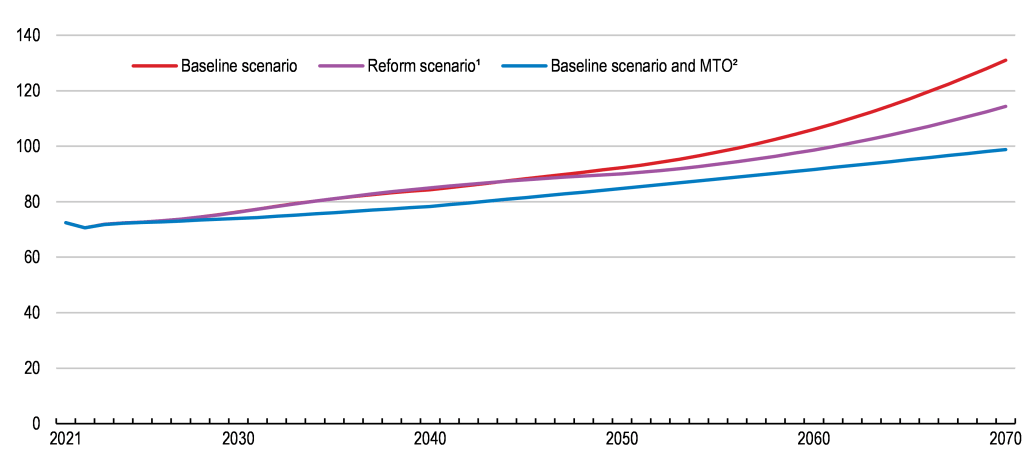
Russia’s war in Ukraine has also increased the government’s budget deficit. On current policies, the budget deficit adjusted for the business cycle is set to be around 2% of GDP in 2023-24. With increases in spending related to population ageing on the horizon, the OECD projects that gross government debt will rise to 130% of GDP by 2070 (Figure 2). This increase would be considerably smaller if the deficit were constantly limited to Finland’s medium-term target of 0.5% of GDP beyond 2030. To this end, comprehensive spending reviews should be undertaken to identify consolidation measures and the incentives in the healthcare reform for counties to increase efficiency reinforced, if necessary.

Figure 2. Government debt would increase substantially under unchanged policies

Gross general government debt, % of GDP

1. In the reform scenario, improvements in the innovation system increase the level of GDP by 3% over the baseline by 2050 and work-based immigration rises gradually from the current level (1 500 per annum) in 2030 to 7 500 per annum in 2050-70. In addition, fixed capital is assumed to grow faster (at 2% per year throughout the projection) than in the baseline scenario (0.9% per year from 2040 onwards). Higher growth in the fixed capital-to-labour ratio is the main factor increasing growth in labour productivity (to 1.4%) and output (to 1.1%) in the reform scenario.
2. In the MTO scenario, Finland continuously meets its medium-term budgetary objective of a structural financial balance of minus 0.5% of GDP from 2030.
Source: OECD.

Finland is on track to meet its gross greenhouse gas abatement targets for 2030 and 2035. However, the cost of reducing emissions is unnecessarily high. To lower these costs, the share of biofuels mandated in the transport sector should be reduced to the minimum level required by the European Union and, to compensate, the carbon price used to calculate carbon tax rates on heating fuels aligned with that used for transport fuels. Furthermore, heat production using peat, which is highly CO2 emissions intensive, should be subject to the same tax regime as other fossil fuels and policies to reverse car dependency in cities strengthened.

Finland is not on track to meet its forestry and other land-use targets. It needs to reduce forestry and land-use emissions from 2 CO2-eq. in 2021 to minus 17 and minus 21 Mt CO2-eq. by 2030 and 2035, respectively. To this end, instruments should be created to encourage the cultivation of wetted peatlands and forestry should be subject to carbon pricing.

Finland needs to reboot its innovation ecosystems, which comprise innovation partnerships between various public and private actors like universities, firms and research institutions, to lift weak productivity growth (0.5% on average over the past decade). The government’s legal commitment to boost R&D spending to 4% of GDP by 2030, from 2.9% currently, will help to strengthen innovation ecosystems. It will be important that additional spending and innovation support schemes be regularly assessed for their impact and improved continuously. Innovation support should also become more mission oriented, directing applied research toward solving the most pressing socio-economic challenges.

Another key challenge for Finland’s innovation ecosystems is the severe shortage of qualified workers with skills to develop advanced technologies or adopt successfully technologies developed elsewhere. The government has an ambitious goal of raising the tertiary attainment of young adults to 50% by 2030, from 40% today (Figure 3). To realise this goal, it should commit to a credible plan to increase tertiary study places, fund them and improve the allocation of study places across study fields to better reflect the skill needs of the labour market.

Figure 3. Tertiary educational attainment among young adults is relatively low

Percentage of 25-34-year-olds having completed tertiary education, 2021

Note: Data refer to 2020 for Chile.
Source: OECD (2022), Education at a Glance 2022.

Attracting more foreign talents is also important for alleviating skill shortages and better linking innovation activities with those in other countries. The government aims to increase annual work-based immigration by at least 50 000 by 2030. It will be important that these immigrants also find good jobs in Finland, which currently is not always the case.

References:

OECD (2022), OECD Economic Surveys: Finland 2022, OECD Publishing, Paris,
https://doi.org/10.1787/516252a7-en.


Finland’s Zero Homeless Strategy: Lessons from a Success Story

By Laurence Boone, Boris Cournède, OECD Economics Department; and Marissa Plouin, OECD Directorate for Employment, Labour and Social Affairs 

Following a period when homelessness rose in many countries, the onset of the COVID-19 pandemic prompted governments across the OECD area to provide unprecedented public support – including to the homeless. In the United Kingdom, for instance, people who had been living on the streets or in shelters were housed in individual accommodations in a matter of days. And in cities and towns across the OECD, public authorities worked closely with service providers and other partners to provide support to the homeless that had previously been considered impossible.  

How can countries build on this momentum and ensure more durable outcomes? The experience of Finland over the past several decades – during which the country has nearly eradicated homelessness – provides a glimpse of what can be possible with a sustained national strategy and enduring political will.  

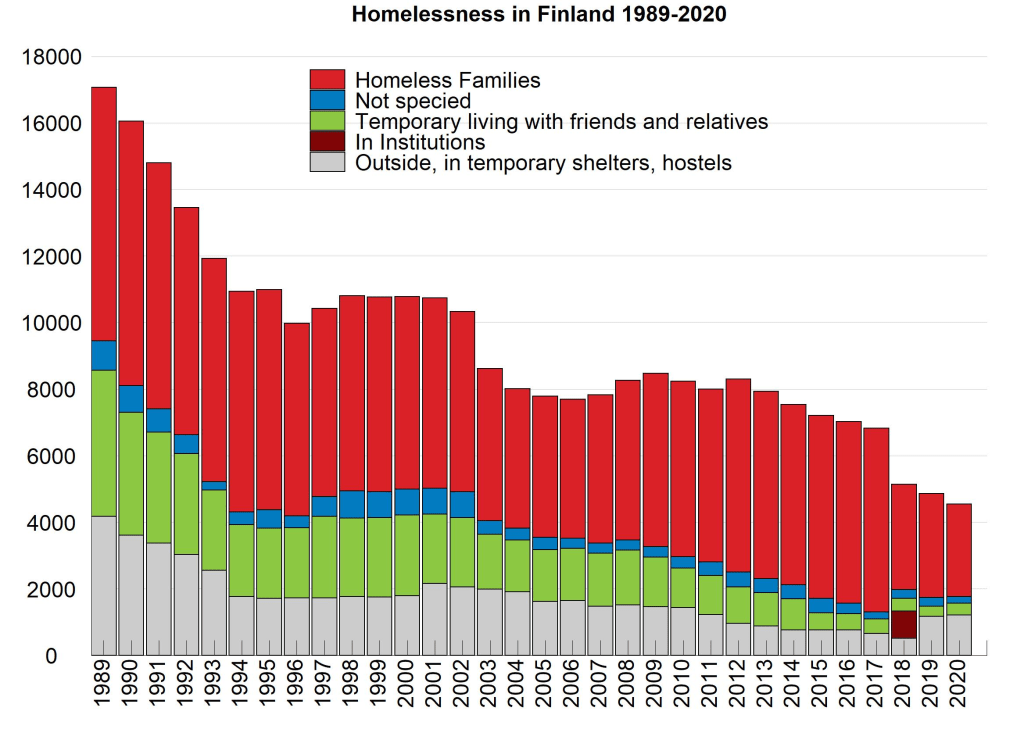
The number of homeless people in Finland has continuously decreased over the past three decades from over 16 000 in 1989 to around 4 000, or 0.08% of the population (Figure 1). This is a very low number, especially considering that Finland uses a relatively broad definition of homelessness, whereby in particular it includes people temporarily living with friends and relatives in its official homelessness count. In 2020, practically no-one was sleeping rough on a given night in Finland.  

Figure 1. Homelessness has shrunk remarkably in Finland

Source: Report 2021: Homelessness in Finland 2020, The Housing Finance and Development Centre of Finland (ARA).

This is undoubtedly a remarkable success, even if comparing homelessness statistics across countries is fraught with difficulties (OECD, 2020). Many homeless people live precariously, with the implication that statistical tools such as household surveys typically fail to accurately measure their living conditions. Furthermore, countries define homelessness very differently, for instance counting people who temporarily live with friends or relatives as homeless (as Finland does) or excluding them from homelessness statistics. While there is no OECD-wide average against which to compare Finland’s homeless rate of 0.08%, other countries with similarly broad definitions of homelessness provide points of reference, such as neighbouring Sweden (0.33%) or the Netherlands (0.23%).1

Finland’s success is not a matter of luck or the outcome of “quick fixes.” Rather, it is the result of a sustained, well-resourced national strategy, driven by a “Housing First” approach, which provides people experiencing homelessness with immediate, independent, permanent housing, rather than temporary accommodation (OECD, 2020). A key pillar of this effort has been to combine emergency assistance with the supply of rentals to host previously homeless people, either by converting some existing shelters into residential buildings with independent apartments (Kaakinen, 2019) or by building new flats by a government agency (ARA, 2021). Building flats is key: otherwise, especially if housing supply is particularly rigid, the funding of rentals can risk driving up rents (OECD, 2021a), thus reducing the “bang for the buck” of public spending.  

The Finnish experience demonstrates the effectiveness of tackling homelessness through a combination of financial assistance, integrated and targeted support services and more supply: using just one of these levers is unlikely to work. Financial assistance comes from the social benefits systems, which includes a housing allowance for low-income people (mostly jobless persons with no or low unemployment benefits) covering about 80% of housing costs (Kangas and Kalliomaa-Puha, 2019). Emergency social assistance funding can complement the housing allowance if it is insufficient. Social services provide housing before other interventions that are targeted to beneficiaries’ needs (such as, to pick one example, providing health services to help overcome substance abuse). These efforts require dwellings: investment grants by Finland’s Housing Finance and Development Centre financed the construction of 2 200 flats over 2016-19 for long-term homeless people (ARA, 2021). Indeed, investing in housing development should be a priority for OECD governments as they navigate the recovery from the crisis: over the past two decades, public investment in housing development has dropped to just 0.06% of GDP across the OECD on average (OECD, 2021b). 

Another important driver of Finland’s success is the integration of efforts to fight homelessness with other parts of the social safety net. When a housing need is identified in any part of the social service system, housing is provided first, to provide a solid basis for employment, long-term health and/or family assistance (OECD, 2020). This integrated approach avoids the pitfalls that can arise, for instance, when benefits are preconditioned on having an address, or when obtaining a flat requires a minimum income. There are indications that, by facilitating the integration of previously homeless people in society, the upfront Finnish investment that provides people with housing first, pays off by reducing subsequent costs incurred by social services. Evaluations point to annual savings in public expenditure in the range of EUR 9 600-15 000 per person who had previously experienced homelessness (Y-Foundation, 2017; Ministry of the Environment, 2011).  

Overall, Finland’s achievements illustrate the benefits of integration, balance and continuity in policies to tackle homelessness: integration across housing and social assistance programmes, balance between demand and supply, and political continuity over time have helped to maximise the results of the country’s investment to end homelessness. Not only has this approach resulted in a steady decline in homelessness, but it has also made the system more resilient to shocks, including the COVID-19 crisis. Indeed, the pandemic was less of a strain to Finland’s homeless support system compared to other countries, given that many vulnerable people were already housed and supported in individual flats (Fondation Abbé Pierre – FEANTSA, 2021).  

These lessons can be transposed to other OECD countries as they look to build on the momentum and lessons learned from the COVID crisis. 

References 

ARA (2021), Report 2021: Homelessness in Finland 2020, The Housing Finance and Development Centre of Finland (ARA). Fondation Abbé Pierre – FEANTSA (2021), Sixth Overview of Housing Exclusion in Europe, FEANTSA – Abbé Pierre.  

Kaakinen, J. (2019), “Time to act: Let’s end homelessness for good,” OECD Forum Network Series on the New Societal Contract. 

Kangas, O. and L. Kalliomaa-Puha(2019), “ESPN Thematic Report on National Strategies to Fight Homelessness and Housing Exclusion: Finland”, European Social Policy Network (ESPN), European Commission, Brussels.

Ministry of the Environment (2011), Asunnottomuuden vähentämisen taloudelliset [Economic effects of reducing homelessness], Ympäristöministeriön.

OECD (2020), “Better data and policies to fight homelessness in the OECD”, Policy Brief on Affordable Housing, OECD, Paris, http://oe.cd/homelessness-2020

OECD (2021a), Brick by Brick: Building Better Housing PoliciesOECD, Paris. 

OECD (2021b), OECD Affordable Housing Database, indicator PH1.1, OECD, Paris.  

Pleace, N. et al. (2021), European Homelessness and COVID 19, European Observatory on Homelessness.  


Technology, Labour Market Institutions and Early Retirement: Evidence From Finland

by Naomitsu Yashiro*, Tomi KyyräƗ, Hyunjeong Hwang* and Juha Tuomalaǂ

@ Shutterstock/ SpeedKingz

Across OECD countries, promoting longer working lives is an important policy agenda for mitigating fiscal pressures from increasing pension and healthcare expenditures. There are, however, two significant barriers to increasing employment of older workers, especially in the context of digitalisation. First, workers engaged in codifiable, routine tasks are prone to being displaced by computers and robots (Gentile et al., 2020), a trend that may have been accelerated by the COVID-19 pandemic (Baldwin, 2020; Chernoff and Warman, 2021). Older workers are particularly exposed to this risk because, with shorter remaining working lives, they have weaker incentives to acquire new skills that would allow them to switch to tasks that are less likely to be automated. They may instead choose to retire early when facing rapid technological change (Ahituv and Zeira, 2011; Hægeland et al., 2007). Second, a number of OECD countries have in place institutions that encourage early retirement, such as exceptional entitlements for older workers or looser criteria for unemployment and disability benefits than for other workers. These two factors reinforce each other in pushing older workers out of employment: older workers who are more exposed to new technologies are more likely to exit the labour market when they have access to institutional pathways to early retirement; and older workers who have access to early retirement pathways are more likely to use them when they are more exposed to technological change. 

Our paper explores such complementarity for Finland, a country renowned for its intensive use of digital technologies but also with a considerably lower employment rate for older individuals than in other Nordic countries (OECD, 2020). The latter is driven importantly by early retirement through the so-called unemployment tunnel, which is the combination of the entitlement to unemployment benefit of up to 500 working days and the extension of unemployment benefit until the retirement age reserved for the unemployed aged 61 or over who have exhausted their regular unemployment benefit entitlements. From an empirical analysis exploiting a rich Finnish employee-employer database and the OECD data capturing exposure to digital technologies, we find that: 

  • An individual aged 50 or above in occupations exposed to a standard deviation higher than the average risk of automation (computed by Nedelkoska and Quintini, 2018) faces a 1.1 percentage point higher probability of exiting employment every year, if he or she does not have access to the unemployment tunnel. 
  • This probability is 2.2 percentage points higher if the individual has access to the tunnel. 
  • Gaining access to the unemployment tunnel increases the exit probability of an individual exposed to an average level of automation risks by 1.8 percentage points. 
  • The overall impact of higher automation risks and the unemployment tunnel therefore amounts to 4 percentage points, which implies an 80% increase in the probability of exiting employment for individuals aged 57-58. 

We obtain similar results when using other indicators to capture the exposure to digital technologies, such as intensity in routine tasks (Marcolin et al., 2016) or ICT skills (Grundke et al., 2017). Using the estimated coefficients, we simulate the impact of reforms that tighten access to the unemployment tunnel. Figure 1 illustrates that such reforms extend substantially the working lives of older workers exposed to high automation risks, but have little effect on individuals exposed to low automation risks.

This paper underscores the importance of labour market reforms that tighten access to institutionalised early retirement pathways in ensuring the inclusion of older workers in the future of work. While previous policy discussion often emphasised boosting lifelong learning opportunities, older workers will only have weak incentives to take up such opportunities if these early retirement pathways are left open. The recent decision by the Finnish government to abolish extended unemployment benefit by 2025 for persons born in 1965 or after is likely to encourage older workers relatively exposed to technological change to work longer and participate in upskilling opportunities. This, however, calls for targeted measures to increase the employability of groups most affected by this reform, namely low- and middle-skilled male workers in occupations exposed to high automation risks, involving more routine tasks and less use of ICT skills. Highly tailored training programmes as well as effective schemes for identifying the training needs of these older workers and certifying their acquired skills are important for boosting their upskilling efforts (OECD, 2020; 2019). Policy makers should also step up measures for getting older workers displaced by new technologies back into employment. In the case of Finland, such measures may include strengthening the capacity of the employment service to provide these workers with more personalised counselling and better monitoring of their activation requirements (OECD, 2020), as well as enhancing the role of social partners in facilitating job transitions even before dismissals take place, as in Sweden (OECD, 2016). 

*OECD Economics Department / ƗVATT Institute for Economic Research and IZA Institute of Labour Economics / ǂVATT Institute for Economic Research

Further reading

Naomitsu Yashiro, Tomi Kyyrä, Hyunjeong Hwang, Juha Tuomala (2021) “Technology, labour market institutions, and early retirement” VoxEU.org, 12 March 2021.

Yashiro N., Kyyrä, T., Hwang, H. and J. Tuamola (2021), “Technology, labour market institutions and early retirement: evidence from Finland”, OECD Economics Department Working Papers 1659.

OECD (2020), OECD Economic Surveys: Finland 2020, OECD Publishing, Paris.

OECD (2019), Working Better with Age, Ageing and Employment Policies, OECD Publishing, Paris.

Reference

Ahituv, A. and J. Zeira (2011), “Technical progress and early retirement”, Economic Journal, 121, 171–193.

Baldwin, R. (2020) “Covid, hysteresis, and the future of work” VoxEU.org, 29 May

Chernoff, A. and C. Warman (2021) “Down and out: Pandemic-induced automation and labour market disparities of COVID-19” VoxEU.org, 2 February. 

Gentile, E., S. Miroudot, G. De Vries and K. M. Wacker (2020) “Robots replace routine tasks performed by workers” VoxEU.org, 8 October.

Grundke, R. et al. (2017), “Skills and global value chains: a characterisation”, OECD Science, Technology and Industry Working Papers, 2017/05.

Hægeland,T., D. Rønningen and K. Salvanes (2007), “Adapt or withdraw? Evidence on technological changes and early retirement using matched worker-firm data”, NHH Dept. of Economics Discussion Papers, No. 22/07.   

Marcolin, L., S. Miroudot and M. Squicciarini (2016), “The routine content of occupations: new cross-country measures based on PIAAC”, OECD Science, Technology and Industry Working Papers, 2016/02.

Nedelkoska, L. and G. Quintini (2018), “Automation, skills use and training”, OECD Social, Employment and Migration Working Papers, No. 202.

OECD (2020), OECD Economic Surveys: Finland 2020, OECD Publishing, Paris.

OECD (2019), Working Better with Age, Ageing and Employment Policies, OECD Publishing, Paris.

OECD (2016), Back to Work: Finland: Improving the Re-employment Prospects of Displaced Workers, OECD Publishing, Paris.


Boosting employment in post-COVID Finland

by Naomitsu Yashiro, OECD Economics Department

In the context of the large economic contraction and debt build-up in the wake of the COVID-19 pandemic, the government of Finland is formulating reforms to raise employment by 80 000 persons by 2029. Achieving this would raise the employment rate from the estimated 70.8% in 2020 to 73.7% in 2029, reversing the labour market damage caused by COVID-19 and reducing, but not eliminating the structural budget deficit.

Before the pandemic, Finland’s employment rate was 73% in 2019, lagging behind the average of Scandinavian Nordics (76%).The largest contribution to the employment rate gap was made by the 60-64 year-old age group. Finland grants to older workers with sufficiently long working period unemployment benefit entitlements that are not only longer than those for younger workers but can also be extended from the age of 61 up to the statutory retirement age. This extension, often dubbed the unemployment tunnel, provides strong disincentives to continue working. It also induces employers to target older workers in redundancies, even though large employers are obliged to finance a part of the unemployment benefits claimed by their former employees who entered the tunnel. The risk of unemployment increases markedly as workers near the age at which they become eligible to the unemployment tunnel (Figure 1). Past reforms that raised the eligibility age in steps from 59 to 61 have pushed back the timing of the sharp rise in unemployment risks each time, effectively lengthening the working lives of older workers (Figure 1). The 2020 Economic Survey of Finland, published in 10 December 2020, recommended abolishing the unemployment tunnel. A week later, the government announced its decision to abolish the tunnel by 2025.

In Finland, inflow into disability benefits has often increased when access to other early retirement pathways was tightened by policy changes. Early retirement via disability benefits is facilitated by more lenient eligibility criteria for awarding disability benefits applied to individuals aged 60 and over, which include non-medical factors. The Survey recommends aligning the criteria between older and younger individuals, namely by not taking into account non-medical factors. This is important for avoiding the surge of inflow into disability benefits as the unemployment tunnel is being phased out.

In order to ensure that these supply-side reforms result in higher employment, additional policy efforts to place older workers in jobs are needed. Activation requirements for the older unemployed should be applied with the same vigour as for other unemployed persons. The capacity of the public employment service needs to be strengthened by focusing resources on providing essential services like face-to-face counselling while making more use of private providers expertise and digital technologies. Ample upskilling opportunities should be provided to workers with higher risks of jobs loss at old age, such as those with jobs exposed to automation risks (Yashiro et al., 2021). Although the participation in adult education in Finland is relatively high, old and unskilled workers participate much less, as in other OECD countries. Finland’s adult education is biased toward formal education at higher education institutions, making it less attractive to the low skilled. The government should bolster targeted trainings, referencing successful examples in other OECD countries, such as the Unionlearn scheme in the United Kingdom where Union Learning Representatives help workers identify their training needs and arrange learning opportunities within their companies.

Another population group contributing to Finland’s relatively low employment rate vis-à-vis its Scandinavian peers is young women (30 to 34). However, the lower employment rate among this group is mainly due to differences in the statistical treatment of maternity leave between Finland and Sweden. The work attendance rates, which measure the share of persons who were at work during the surveyed week, are about the same between the two countries. However, the attendance rates are still considerably lower in Finland among mothers of children aged up to three years old, owing to the generous social benefit granted for taking care of children at home instead of using childcare services provided by municipalities. Removing this financial disincentive would encourage return to work by young mothers, thereby avoiding their career development being hampered by a long absence from work, which would help reduce the large gender pay gap.

Further reading:

OECD (2020), OECD Economic Surveys: Finland 2020, OECD Publishing, Paris.  

REFERENCE

Yashiro et al. (2021), “Technology, labour market institutions and early retirement: evidence from Finland”, OECD Economics Department Working Papers, Forthcoming, OECD Publishing, Paris.


Finland: Recovering from the COVID-19 crisis

By David Carey, Economics Department.

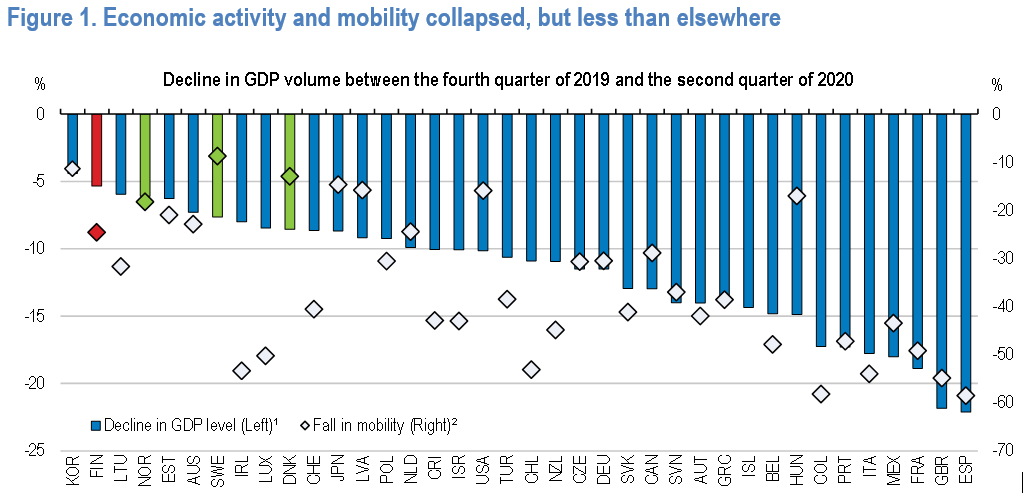
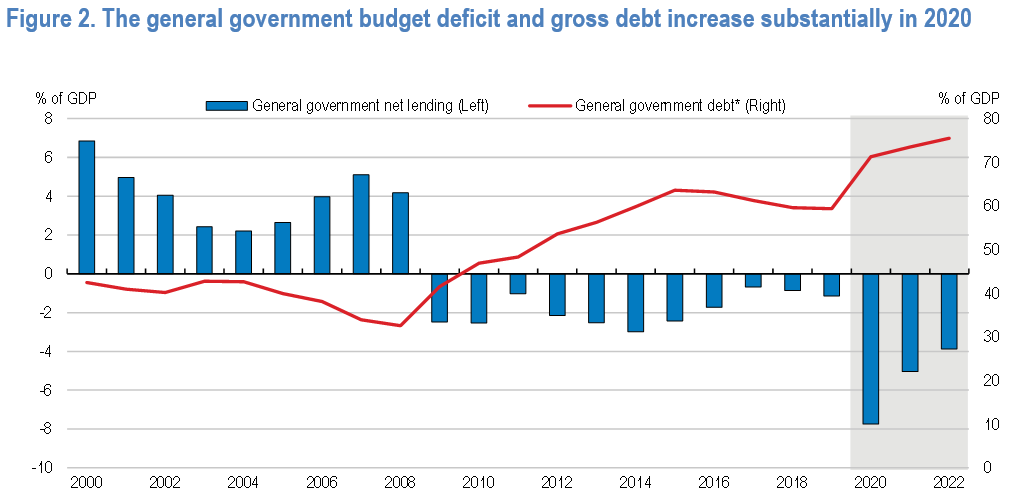
The COVID-19 pandemic has plunged Finland into a deep recession, albeit milder than in most other countries partly thanks to more targeted confinement measures and a relatively small loss of mobility (Figure 1). The economy is projected to shrink by 3.3% in 2020 and recover gradually with growth of 2.1% in 2021 and 1.8% in 2022, led by private consumption and exports. The government provided substantial financial support to protect jobs and help households and businesses get through the crisis. Public finances deteriorated as a result (Figure 2).Once the recovery is underway, fiscal consolidation will be needed to achieve the government’s aim to stabilise the debt-to-GDP ratio by the end of the decade. To this end, the government has set an objective of increasing employment by 80 000 at that horizon. Increasing the employment rate toward the average level of the Scandinavian Nordic countries could make a substantial contribution to the necessary fiscal consolidation and, together with stronger productivity growth, help to reverse the long-term erosion in relative living standards. The 2020 OECD Economic Survey of Finland provides an in-depth analysis of these challenges and offers policy recommendations for meeting them.

Note: 1. % difference between 2019Q4 and 2020Q2 GDP levels.  2. Fall in mobility from the baseline between 1st of March and 27th of June.
Source: OECD, National Accounts database; Google LLC, Google COVID-19 Community Mobility Reports, https://www.google.com/covid19/mobility/.

The greatest potential for increasing employment lies in extending working lives. The employment rate for older workers (aged 55-64 years) is 13 percentage points lower than the average for other Nordic countries, where access to early retirement arrangements is much more limited. The extension of the unemployment benefit from age 61 until 65, combined with a longer entitlement to the unemployment benefit for persons aged 58 or more, results in a spike in layoffs from the late-50s. To increase the employment rate of older workers, extended unemployment benefit should be phased out and non-medical criteria for awarding disability benefits to applicants aged 60 or more no longer taken into account.  

Labour productivity growth weakened substantially in the past decade. A factor that undermines productivity growth in Finland is skills shortages, largely resulting from relatively low tertiary education attainment. This makes it difficult for more productive firms to hire the qualified workers needed to innovate and expand market shares. To boost the supply of tertiary educated workers, the government plans to streamline the resident permit process to attract more high-skilled immigrants. It also aims to increase the tertiary attainment of 25-34 year olds from 42% to 50%. To this end, the number of study places in the highly selective tertiary education admission system is being raised but further increases will be needed.

Reducing relatively high regulatory barriers to competition in upstream service sectors, such as transport, energy and retail, which hold back incumbents’ efforts to reallocate resources more efficiently, would also boost productivity growth. Similarly, repealing the legal restriction that prevents some employers from using the enterprise-bargaining flexibility clauses in their sector collective agreement, as planned, would give these employers greater scope to reorganise their businesses to make them more productive.

Finland is on track to meet its 2020 EU-burden-sharing objective for reducing GHG emissions but will need to implement further cost-effective measures, including making full use of available flexibility mechanisms, to realise its 2030 and 2035 objectives. To reduce transport emissions, which is vital for achieving abatement targets, the government should support the rollout of electric vehicle (EV) charging facilities to lift EV diffusion substantially. There will also need to be an expansion in wind power generation both to meet increased demand for charging EVs and to enable the substitution of electricity for fossil fuels in residential and commercial heating and in industry. 

Note: General government debt refers to Maastricht definition.
Source: Statistics Finland; Ministry of Finance.

Further reading:

OECD (2020), OECD Economic Surveys: Finland 2020, OECD Publishing, Paris, https://doi.org/10.1787/673aeb7f-en.


A balancing act: Why inequality increased in the Nordics

Mr. Jon Pareliussen, Economist, Sweden/Finland desk, Economics Department

The Nordics are rightly renowned for being inclusive societies with low inequality compared to other OECD countries. However, some of the largest inequality increases over the past few decades took place in Sweden, Finland and Denmark. A newly released article  building on previous OECD work discusses how market forces, demographic trends and redistribution together shaped the income distribution of the Nordics.

It may seem like a paradox that the Nordics, which are very open economies, heavily integrated in global value chains and front-runners in the use of new technologies, have not seen even more widening distributions of market incomes. However, the extent to which skill-biased technological change and other forces widening the earnings distribution of workers will actually drive up inequality depends on a number of factors, and key policies and institutions in the Nordics play a dampening role. First, institutions such as unions and collective bargaining, employment protection legislation and minimum wages dampen the direct effect of market trends on earnings. Second, higher demand for skills are met by publicly-funded higher education, increasing the supply of skilled workers and thus holding back skills premiums. Third, a widening earnings distribution among workers coincided with increasing employment, limiting the overall effect on inequality.

Nordic1.JPG

With a relatively modest overall impact from market forces, explanations for increasing inequality must be sought elsewhere:

  • Demographic trends have been relatively strong drivers of inequality in the Nordics. Household structure, with more single-headed households has widened income dispersion in Denmark, Finland, Norway and Sweden. Ageing has increased inequality significantly in Finland, and immigration has increased inequality in Norway, Denmark and Sweden.
  • Redistribution through taxes and transfers has weakened significantly in Denmark, Finland and Sweden, notably due to less insurance transfers (i.e. unemployment, sickness, disability insurance) and only partially offset by more assistance (i.e. means-tested) transfers. Income taxes have played a less important and more heroegneous role, as progressivity increased in Sweden while it decreased in Denmark and Iceland.

Technological and demographic pressures are set to continue going forward, and these challenges need to be embraced. Continued flexibility and constructiveness of the social dialogue and improvements to education are essential to seize opportunities from technological change and avoid a widening wage distribution. Making social insurance and welfare transfers more flexible and agile would improve workers’ protection in a rapidly changing world of work. Improving benefit system design so that work always pays, notably in Denmark and Finland, and linking benefits to real-time income registries are important steps to this end.

The Nordics demonstrate that equity and efficiency can be compatible if incentives are right. Low inequality and strong safety nets can even be an advantage in today’s globalised world, which requires constant adaptation. Reaping the full benefits from globalisation and technological progress requires broad support, which is easier to muster when the social dialogue is constructive and representative, when everyone is given opportunities to fulfil their potential, risks are shared and losers compensated.

References:
Pareliussen, J. K., Hermansen, M., André, C. and Causa, O. (2018), Income Inequality in the Nordics from an OECD perspective, Nordic Economic Policy Review 2018.


Finland: growing and reforming, but no time for complacency

By Christophe André and Jon Kristian Pareliussen, OECD Economics Department

After a long period of lacklustre economic performance, robust growth has resumed. The Finnish economy suffered a series of sizeable adverse shocks alongside the global financial and economic crisis, facing major difficulties in the electronic and forest industries, in addition to a severe recession in Russia. Sound fundamentals and policy settings helped weather the impact of those shocks, and by early 2017 the economy had regained strong momentum. The recovery is broad-based across economic sectors, employment is picking up, and high business and consumer confidence point to a strong expansion going forward.

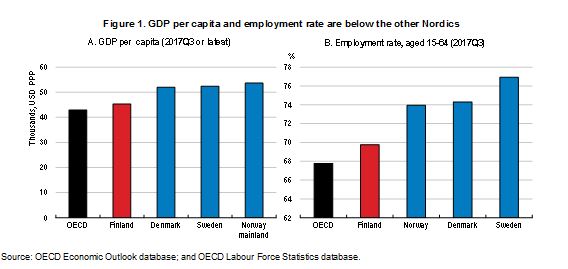
But challenges remain, as the 2018 OECD Economic Survey of Finland shows. GDP per capita exceeds the OECD average, but is significantly lower than in Denmark, Germany and Sweden, reflecting differences both in productivity and labour utilisation (Figure 1). A rapidly ageing population reduces labour supply and puts pressure on public finances. Hence, future growth and well-being will hinge on a higher employment rate and productivity gains, both in the private and public sectors. Reassuringly, these challenges are well understood by the government, which has been implementing structural reforms across a wider range and with more determination and coherence than in most other OECD countries.Finland2.JPG

Many of these reforms concern the labour market. The 2016 Competitiveness Pact between the government and the social partners lowers unit labour costs by about 4% from 2017 by internal devaluation. The social partners have also moved from a system of national-level collective agreements towards a system of “organised decentralisation”, where sector-level collective agreements are coordinated following the lead of export industries, and more leeway is given to local-level bargaining. Furthermore, the duration of unemployment benefits was reduced by 100 days in 2017, a job search requirement and a new activation model for the unemployed were introduced, the trial period for new hires was extended and education made more modular and nimble to better respond to evolving skill needs.

The health, social services and regional government reform will shift the responsibility for organising health care and social services from municipalities to 18 newly created autonomous counties from January 2020, bringing the sub-national government structure closer to that of the other Nordic countries. Goals of the reform include providing people with more equal services, increasing freedom of choice and improving the sustainability of general government finances. The reform is welcome, and its success is crucial to meet the needs of an ageing population and ensure long-term fiscal sustainability (Figure 2).

Finland no time for complacency2

The strong pick-up in economic growth and an impressive reform record are reasons for optimism, not complacency. Social welfare reform could boost employment further, as many unemployed today will see only small net income increases or even incur a loss upon return to work. Coordinating the tapering of various working-age benefits against earnings could drastically improve work incentives and transparency, while preserving the current level of social protection, and is hence a more promising route for future reform than a basic income. Furthermore, specific measures could lift work incentives for parents and older workers. Combined with the new income registry linking benefit payments to real-time incomes from 2019, such reforms would make for a truly efficient and inclusive benefit system, adapted to evolving work patterns. Work incentives could be further strengthened by reducing the tax burden on labour while further increasing indirect and property taxes and reducing tax expenditures. Such a tax shift, along with measures to support business development and entrepreneurship could also give productivity a welcome boost.

References

OECD (2018), OECD Economic Surveys: Finland 2018, OECD Publishing, Paris.
http://dx.doi.org/10.1787/eco_surveys-fin-2018-en


Why would a universal credit be better than a basic income for Finland?

By Jon Kristian Pareliussen, Economist, OECD Economics Department

“If you don’t know where you are going, you might wind up someplace else.”

– Yogi Berra

Many Finns seem to agree that the social welfare system should be reformed, but there is no agreement as to which form such change should take. Recognising that the decades-long process of piecemeal welfare reform responding to the pressing issues of the day is behind many of the current problems, the OECD Economic Survey of Finland 2018 argues for developing a common vision for the future of social welfare in Finland, so that upcoming reforms can consistently pull towards the same goal.

In Finland, as elsewhere, income taxation and the withdrawal of benefits reduce the pay-off for individuals who go from benefits to work. Multiple benefits interact in complex ways, trapping individuals in unemployment, underemployment or inactivity. Complex benefit rules combine with administrative practices to create “bureaucratic traps” when individuals taking up temporary, part-time or unstable employment face a real or perceived risk of losing eligibility or receiving benefits with a delay as their claims are re-evaluated. This can further reduce the attractiveness of work for risk-adverse, often cash-strapped, recipients. A third weakness of existing welfare systems is that they are built around traditional employer-employee relationships, and are thus ill-adapted to the future of work, which is likely to involve more changes in careers, part-time work, self-employment and platform work.

Two different benefit reform scenarios are developed in the Survey to inform a common vision for the future of social welfare in Finland. The first is a uniform benefit for all, a universal basic income. The second is a universal tapering rule inspired by the universal credit welfare reform in the United Kingdom. This scenario radically simplifies the existing benefit system and makes it more transparent by merging various benefits and withdrawing them at a single and moderate rate as income from work increases.

Comparing these scenarios with the current system illustrates the inevitable trade-offs between work incentives, inclusiveness and fiscal cost, the policy trilemma at the heart of social insurance and redistribution policy. Neither a basic income nor a universal credit can defy the laws of gravity. But some specific incentive issues can be resolved without much sacrifice by improving benefit design, and the general direction of reform has great consequences for outcomes.

A universal credit would consistently improve work incentives and reduce complexity, with limited changes to the income distribution and limited fiscal cost. A basic income would also remove some incentive traps, but would entail a major redistribution of income, widening inequality and increasing poverty. This happens because the design of a basic income with one uniform benefit for all is too simple to achieve the redistribution of the current system or a universal credit, where benefits are targeted to those who need them more. Assuming that the distribution of income in a longstanding democracy reflects Finns’ social preferences, it seems clear that merging and simplifying existing benefits is a better solution for Finland than a universal basic income. This conclusion is also likely to be relevant for other developed countries with solid and targeted social safety nets.

Finland.JPG

Simulating reforms is one thing but implementation can be a quite different story: experience has shown that major welfare reforms can come with significant costs. Implementation should hence be stepwise and build on the existing institutional context. Important technical building blocks, such as harmonised tax treatment and income definitions for different benefits as well as the new income registry should be fully operational and tested before reforming the overall architecture of the system.

Moreover, many current weaknesses, such as the cliff-edge loss of unemployment benefits once an individual works a certain amount of hours per week, the extended unemployment insurance for older workers and barriers to work for mothers created by childcare fees and the homecare allowance, can be overcome with relatively limited changes to the current system. Such measures should be taken without delay, but every step forward should be a stride towards an agreed vision for the future of Finnish social welfare – a vision where benefits continue to support Finnish citizens throughout their lives, protecting them from shocks and misfortune, but in a coherent, transparent and flexible way, fit for the future of work.

References

OECD (2018), OECD Economic Surveys: Finland 2018, OECD Publishing, Paris.  http://dx.doi.org/10.1787/eco_surveys-fin-2018-en

Pareliussen, J., H. Viitamäki and H. Hwang (2018a), “Basic income or a single tapering rule? Incentives, inclusiveness and affordability compared for the case of Finland”, OECD Economics Department Working Papers, forthcoming, OECD Publishing, Paris.