Estonia’s new car tax and registration fee: Are they changing consumer demand?

By Zuzana Smidova and Vaiva Šeckute, OECD

At the beginning of the year, Estonia introduced a vehicle registration fee and an annual car tax linked to the vehicle’s greenhouse gas (GHG) emissions. Until then, it was one of the few European countries without motor vehicle taxes.

OECD countries increasingly use vehicle taxation to encourage drivers to switch to cleaner cars and reduce emissions, as well as to raise revenue, by linking these taxes to emissions. Although motor fuels are already taxed, consumers tend to undervalue the long-term savings from choosing more efficient vehicles, so registration fees can help change purchasing patterns.

Estonia’s car fleet is one of the oldest in the EU and has some of the largest engines (Figure 1). Transport emissions account for around one fifth of Estonia’s total greenhouse gas emissions. Achieving the target of a 25% decrease by 2035 compared to the 2005 level is proving challenging with emissions remaining stable in recent years.

In 2023, the average CO2 emissions per kilometre from new passenger cars were among the highest in the EU (Figure 2).  This partly reflects reliance on purchases of second-hand cars from western Europe and the absence of an emissions-based motor vehicle tax.

Data from the first eight months of the year show that, since the tax was introduced, purchasing has moved more rapidly than before towards cars emitting less emissions (Figure 3). The overall number of passenger car registrations dropped as many consumers who had planned to buy a car did their purchases last year in anticipation of the tax. Looking at the breakdown by vehicle type, there has been a shift towards cleaner vehicles. The data shows that the registrations of electric vehicles increased, while registrations of hybrid cars declined less than petrol and diesel cars compared to the same period of last year. As a result, the share of electric vehicles rose from about 5% last year to 10% and the share of hybrid vehicles grew from some 25% to almost 40%. Encouragingly, based on these first estimates, average emissions from newly registered cars also fell by 10% (ERR, 2025).

Introducing the registration fee and annual tax are a significant achievement and the link to emissions and engine size seem to be bearing fruits. Nevertheless, some of its features could be improved further. The annual tax decreases with vehicle age. While this aims to make it more affordable for those on low incomes who tend to have old cars, it undermines the incentives to switch to more efficient cars. Instead, a targeted car scrappage scheme for older vehicles financed by the revenues from the motor tax could be considered.

Decreasing emissions from transport will require strong incentives on multiple fronts – increasing availability of public transport, introducing stricter minimum emission standards and moving towards distance-based charging, which can allow for higher charges where alternatives for cleaner modes of transport exist (OECD, 2024; van Dender, 2019).

References

ERR (2025): Automaks on pannud ostma väiksema heitega autosid

OECD (2024), OECD Economic Surveys – Estonia, OECD Publishing, Paris.

Van Dender, K. (2019), Taxing vehicles, fuels and road use: Opportunities for improving transport tax practice, OECD Taxation Working Papers No. 44, OECD Publishing, Paris.


Boosting efforts to improve health in Estonia

Picture of a woman putting together a puzzle of an outline of a human head, with one piece missing

By Srdan Tatomir, OECD

This week is European Mental Health Awareness week, which aims to raise understanding of mental health. In Estonia, mental health problems are significant. Adult suicide rates are high and above most OECD countries (Figure 1). The first Estonian National Mental Health Survey in 2022 found that a quarter of adults was at risk of anxiety and depression. Lower income groups, particularly men, were more likely to be affected (OECD, 2024). Among adolescent children, almost 30% report feeling depressed every week, and this has risen over time (TAI, 2025). Ill mental health carries a high human toll and is estimated to cost Estonia 2.8% of GDP each year (OECD, 2021).

Estonia has recognised this and expanded its efforts to improve mental health. The 2021 Green Paper on Mental Health developed the foundations and is being implemented through the Mental Health Action Plan for 2023-26. A new mental health department has been established within the Ministry of Social Affairs and funding for mental healthcare services has more than tripled to EUR 7 million in 2023. New surveys to monitor and better understand the issues have been put in place. This year, Estonia adopted its first Suicide Prevention Action Plan for 2025–2028.

These policies aim to create a comprehensive, intersectoral and multi-level mental health system and broaden access to both community-based and specialist healthcare services.

Better health of Estonia’s people, highlighted by the OECD’s 2024 Economic Survey, can be achieved in other areas as well. Life expectancy at birth has risen by around 8 years over the past two decades to 78.8 years by 2023. This is higher than in neighbouring Baltic countries but below most European and OECD countries. Around a third of the deaths can be avoided through faster treatment and more prevention. For example, with more than half of adults obese, physical activity levels need to increase and nutrition could be healthier. To address this, Estonia should introduce a tax on sugar-sweetened beverages and could tax unhealthy foods more broadly as done in Hungary.

Furthermore, alcohol consumption is among the highest in the OECD. Reducing affordability by raising alcohol excise duties and linking them to inflation as well as reducing availability through restricting opening hours and density of alcohol sales outlets can help lower consumption. To maximise their effectiveness, policies on alcohol need to be coordinated with other Baltic countries.

The number of healthcare staff, crucial to improving health outcomes, should increase. The number of health workers relative to the population is low compared to other OECD countries. In 2022, there were 6.6 practising nurses per 1 000 people, well below most OECD and EU countries. The ratio of practising doctors was 3.5 per
1 000 people, slightly below the OECD average and lower than in most EU countries. More nurses, school and clinical psychologists, and psychiatrists are needed in particular to deliver more mental health services (Sisask, 2023). Given that the workforce is ageing quickly, raising nurse and doctor training levels is paramount. This should be complemented by better remuneration and working conditions to make the healthcare profession more attractive, as discussed in the 2024 OECD Economic Survey of Estonia.

Estonia’s total spending on healthcare is among the lowest in the OECD (Figure 2). Population ageing is driving up demand for more healthcare and new services will ultimately require additional resources. Better use of technology, improved administration and enhanced financial incentives can free up more resources. This year’s increase in user charges for specialised care is a step in the right direction as it will help both raise revenues and lead to more efficient use of specialist services. Nevertheless, more revenues will be needed to fund public healthcare services and to ensure out-of-pocket spending does not cause financial difficulties for vulnerable households.

Better healthcare will improve the quality of life in Estonia, allow people to stay active longer and contribute to a stronger economy with higher tax revenues.

For further information, please visit the Estonia Economic Snapshot page.

Learn more about Mental Health Awareness Week.

References

OECD (2021), A New Benchmark for Mental Health Systems: Tackling the social and economic costs of mental ill-health, OECD Health Policy Studies, OECD Publishing, Paris; https://doi.org/10.1787/4ed890f6-en.

OECD (2024), OECD Economic Surveys: Estonia 2024, OECD Publishing, Paris; https://doi.org/10.1787/33e6beee-en.

Sisask, M. (ed.) (2023), Estonian Human Development Report 2023: Mental Health and Well-Being, Estonian Cooperation Assembly, Tallinn.

TAI (2025), Andmebaas – Health Statistics and Research Database, accessed on 28 April, 2025.


Estonia: Getting back on track to strong, more inclusive and more sustainable growth

By Zuzana Smidova

The Estonian economy has been hit hard in recent years, contracting since the onset of Russia’s war of aggression against Ukraine in February 2022. At the end of last year, output was 6% below the level seen at the end of 2021.

Although trade with Russia and Belarus represented only 10% of imports and 4% of exports in 2022, inputs from the eastern neighbours played an important role in Estonian exports, notably in wood, manufacturing and fuel re-exports. Following the surge in energy prices, Estonia’s inflation peaked at 25% in August 2022, hitting household consumption. On top of these, a slowdown in key Nordic export markets led to a further decrease of trade.

Economic prospects should improve this year, with GDP contraction easing from -3.1% in 2023 to -0.4% and the economy returning to growth during the year (Figure 1). Inflation will continue to subside, although higher value added tax, excise duties, as well as recent increases in public sector wages and the minimum wage, will slow the disinflation process. With lower inflation and stronger foreign demand, growth should accelerate to 2.6% in 2025. Estonia is a small open economy, so much of its performance hinges on economic developments elsewhere.

Figure 1. Estonian economy should return to growth 

To facilitate return to strong, inclusive and sustainable growth Economic Survey of Estonia released today sets out the following priorities:

Firstly, fiscal policy needs to carefully balance the need to rebuild fiscal buffers with ensuring macroeconomic stabilisation. It provided support to households, but the public finances are now in deficit. A consolidation is under way, although some measures for 2025 still need to be approved. With new spending priorities such as defence and family policy, the authorities should carry out planned spending reviews and explore avenues for increasing the revenues in the medium term.

Secondly, strong growth in the years ahead needs to be underpinned by improvements in productivity. Productivity levels remain below OECD average and productivity growth was slowing before the pandemic, while the labour market has been marked by a considerable skills mismatch. Despite Estonia’s innovative ICT sector and advanced e-government, traditional sectors lag in the use of digital technologies. Expanding upskilling programmes can help firms to upgrade managerial and digital skills, keystones for advancing digitalisation and boosting productivity.

Thirdly, to improve health as the population continues to age, healthcare should remain a priority (Figure 2). The authorities should extend health coverage to all permanent residents and reduce out-of-pocket expenses for low-income households. To address staff shortages, better working conditions and more training is needed. Given that financing of the healthcare system has come under a strain, more revenues from general taxation or higher contribution rates will ultimately need to be mobilised.

Figure 2. Life expectancy is below OECD average and Nordic countries

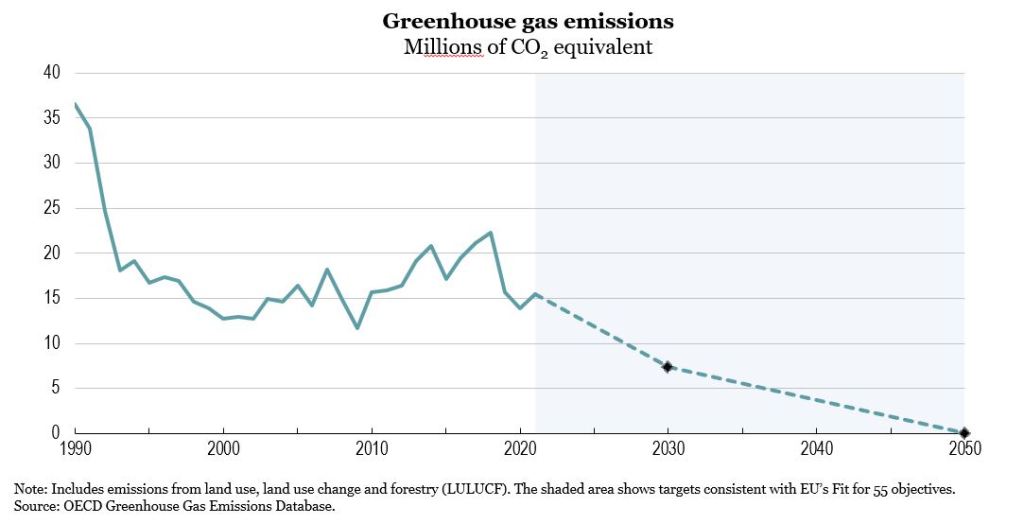
Finally, to meet Estonia’s climate objectives (Figure 3) and advance the transition to carbon neutral economy, the authorities should adopt the car tax, expand public transport and carbon pricing as well as continue investments in the electricity grid. At the same time, moving away from oil shale in the energy production, as planned by the government, is a must given the high share of emissions from the energy sector.

Figure 3. Accelerating climate transition required sustained policy action

Reference:

OECD (2024), OECD Economic Surveys: Estonia 2024, OECD Publishing, Paris, https://doi.org/10.1787/33e6beee-en.


Estonia’s digital future: how to go from e-government to e-business?

by Margit Molnar and Jon Pareliussen, Estonia Desk, Economics Department

Estonia ranks already among the top countries in e-government. Citizens can do basically anything online except for a very few things like getting married or divorced and selling or buying real estate. The X-road, the secure communication protocol underlying e-government services, was built on the same principles as the block chain, even before the word block chain was invented.

However, despite a number of successful unicorns, digitalisation, is yet to be fully embraced by the business sector, which uses fewer robots, back-office functions and customer-oriented services than in other countries. Automation with proven digital technologies can bring about considerable efficiency gains. Since the technology frontier is shifting constantly, Estonia should seize the opportunity to leapfrog and invest in digital infrastructure. The benefits could be significant. New OECD research shows that the potential to boost productivity by intensifying digitalisation in the private sector is considerable (Figure 1). An Estonian firm increasing the share of employees using computers for work purposes by 10 percentage points could for example see 1.5 percentage points higher annual productivity growth and create positive externalities of a similar magnitude to other firms in the sector.

Such a boost to productivity would come at the right time given the sluggish recovery of productivity growth following the Global Financial Crisis, in Estonia and many other OECD countries. Several factors hinder digital adoption at the enterprise level, including the lack of awareness, small scale, lack of the necessary skills that could be complementary to technologies, lack of access to high-quality infrastructure and to financing. The 2020 Economic Survey of Estonia highlights the following policy priorities:

• To raise awareness, success stories should be better advertised and access to digital diagnostics, a government-co-sponsored exercise should be streamlined to help firms determine their needs.

• To address the issue of small scale of most Estonian firms, the government could support industrial associations in providing platforms and smart digital solutions in areas such as joint marketing, supplier interactions and customer support.

• To acquire the necessary skills, the drive to strengthen teachers’ performance in teaching digital skills should be reinforced and cooperation between the public sector, labour unions and employers to boost vocational education and training and continuous learning enhanced. In the same vein, implementing a programme to increase the use of high-performing managerial and organisational practices with a strong element of network-building to disseminate good practice and mutual learning could underpin skill use and innovations.

• To enhance access to high-quality infrastructure, better coverage of ultra-fast broadband should be provided at an affordable cost, including subsidising last-mile rollout for smaller enterprises.

• To improve access to financing, alternative sources should be promoted.

Sources:

OECD (2019), Economic Survey of Estonia. OECD Publishing, Paris.

Pareliussen, J. and N. Mosiashvili (2020), “Digital technology adoption, productivity gains in adopting firms and sectoral spill-overs – Firm-level evidence from Estonia”, OECD Economics Department Working Papers, OECD Publishing, Paris, forthcoming.


Getting the most out of Fintech in Estonia

By Caroline Klein, Estonia Desk, OECD Economics Department and Olena Havrylchyk, Professor of Economics at the University of Paris 1 Panthéon Sorbonne

Pioneers of the Estonian Fintech need a fair level playing field. Estonia, at the forefront of alternative finance should seize the moment to set framework conditions right.

Estonia is a frontrunner in alternative finance and a host to some of the most innovative Fintech start-ups in the OECD – i.e. start-ups using technology and technology-facilitated new business models in the provision of financial services. Some Fintech companies based or born in Estonia have a world-wide reach. These include one of the largest European peer-to-peer lending platforms for unsecured consumer loans, the first worldwide secondary market for venture capital and a platform that allows individuals and small businesses to transfer money between international accounts at much lower cost than traditional banks.

For some, Fintech will revolutionize the traditional banking industry as we know it today, but for the moment, the platforms finance mostly risky projects. At one end of the platform, there are retail investors who choose whom they would like to finance. On the other end, there are SMEs and start-ups that do not go to banks, often because they cannot provide standard guarantees. The platforms generate profits from the origination and servicing fees that they charge to funders and fundraisers. The investors bear all investment risks, providing a natural ‘bail-in’ mechanism. Equity crowdfunding platforms can complement angel- and venture-capital, by allowing individuals to invest in start-ups and buy shares which are not listed on the regulated stock market.

For the moment the scale of finance channelled through Fintech platforms remains limited (Figure 1) and peer-to-peer lending to SMEs lags far behind consumer lending. The 2017 Economic Survey of Estonia stresses that a sustainable development of this ‘alternative finance’ requires a creation of a level playing field between the traditional and the alternative sources of credit in terms of access to information, regulation, and taxation.

Estonia Fintech

To build confidence in these new financing forms, a necessary condition to their development, consumer protection of Fintech users should be reinforced.  The Estonian authorities should introduce licencing and transparency requirements and require the platforms to have resolution plans in place to ensure that repayments continue to be collected in case of bankruptcy. By establishing a well-designed credit information-sharing scheme covering all borrowers (firms and individuals) it could help to move the industry forward, by facilitating the use of big data and algorithms to screen and monitor borrowers. Finally, the level playing field should be established also when it comes to taxes. Taxation of investment via Fintech platforms should be harmonised with that of bond and equity securities, by allowing investors to deduct their losses from their income tax base.

References

OECD (2017), OECD Economic Survey of Estonia, OECD Publishing, Paris.


As Estonian exporters lead the way, policy needs to adapt

by Zuzana Smidova, Estonia Desk, OECD Economics Department

International trade plays an important role in the Estonian economy (Figure 1). Around a half of the private sector employment is sustained by foreign demand, twice as much as the OECD average. By another measure, over 40% of the value added created in the economy is linked directly or indirectly to exports, largely in the services sector. Yet, value added per worker produced in Estonia and consumed abroad remains low, even if comparable to its EU peers.

Estonia Suzana blog

International trade and foreign direct investment can serve as a ladder for climbing up the value added chain as they are major channels of technology diffusion and productivity growth. Exporters display higher productivity and innovation than companies oriented on the domestic market, and this is true in Estonia too, as new research shows (Benkovski et al, 2017, forthcoming) (Figure 2). Exporters are faced with tough global competition and have to meet international standards.

Estonia Suzana2blog

To increase export potential and value-added drawn from trade, innovative capacity and transfer of knowledge from highly productive firms to the rest of the economy need to improve. For the moment, innovation of the typical Estonian firms is limited as spending on business R&D is low. In this vein, nurturing cooperation between the researchers and business is crucial, as highlighted in the new Economic Survey of Estonia (OECD, 2017). The new industrial policy green paper, initiated by the business community and focused on digitalisation of traditional industries is welcome. It has the potential to improve the productivity and innovation capacities of these sectors. Furthermore, policy efforts should concentrate on strengthening adult education and allowing for immigration of talents, since shortage of skilled labour is starting to show as a major obstacle for further business growth and investment. This can also help with improving the innovative capacities.

By giving access to a wider variety of goods and services at cheaper prices, international trade raises well-being and consumers’ purchasing power. It also means fast transmission of global shocks, requiring a robust social safety net and adjustment policies. To ensure that all benefit from opportunities created by globalisation, the Estonian policymakers should focus on two policy areas. Firstly, those who can work need to have the right skills and incentives to participate in the labour market. Secondly, those who are out of the labour market should be supported by an effective and adequate social safety net, conducive to upskilling and maintaining work incentives. This means for instance increasing the level of subsistence of benefits and relaxing eligibility conditions for unemployment benefits, not least to improve participation in active labour market measures.

References:

Beņkovskis, K.,Masso, J., Tkasevs, O., Vahter, P., Yashiro, N. (2017), “Export and productivity in Global Value Chain: Evidences from Latvian and Estonian firms” OECD Economics Department Working Paper, OECD Publishing, Paris, forthcoming

OECD (2017), OECD Economic Surveys: Estonia 2017, OECD Publishing.


Estonia: Using fiscal space for a more inclusive growth

By Pierre Beynet, Head of Division, OECD Economics Department

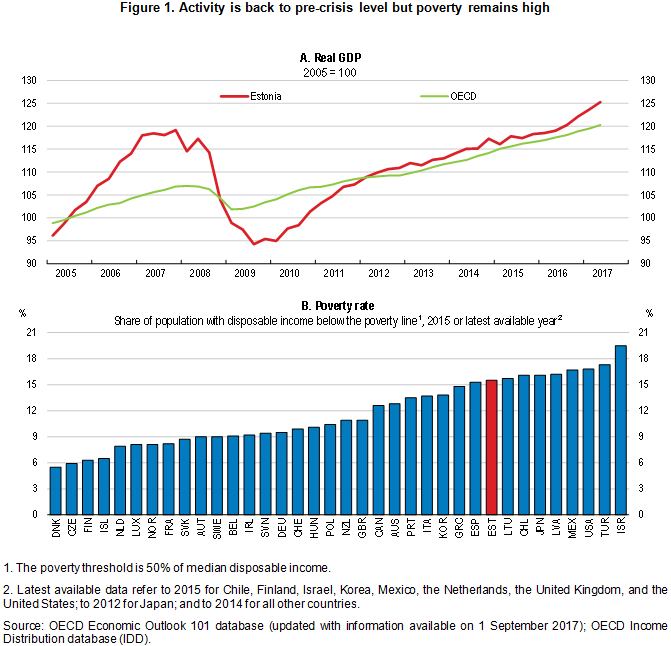
Estonian growth is picking up again strongly in 2017 and the level of activity has finally surpassed its pre-crisis level, almost 10 years after the outset of the financial crisis (Figure 1, panel A). However, poverty remains among the highest in the OECD (Figure 1, Panel B).

To make growth more inclusive, the 2017 OECD economic survey argues that Estonia should make its tax and benefits policies more redistributive, but also use more actively its large fiscal space by allowing a small fiscal deficit in the longer term (OECD, 2017).

Beynet estonia

Market income inequality is high (Figure 2, Panels A), but the redistributive effects of the Estonian tax and benefit system is low (Figure 2, Panel B). It leaves a considerable proportion of the population at risk of poverty, notably the unemployed, disabled and low-educated. The old-aged are also more at risk of poverty, in particular because of the relatively low level of pensions.

Beynet2esto

The government is already working on important redistributive measures. For instance, the planned increase in the personal income tax allowance, which is steeper at lower wage levels, will improve the progressivity to the tax system from 2018. However, the lowest income earners will not benefit from this measure since they are exempt from the personal income tax. Besides, the level of spending allocated to protection of the most vulnerable is low: around 31% of total public spending in 2014 went on social spending, some 9 percentage points less than the EU average. The targeting of social programmes is also poor, with means-tested measures accounting for a low share in total social spending.

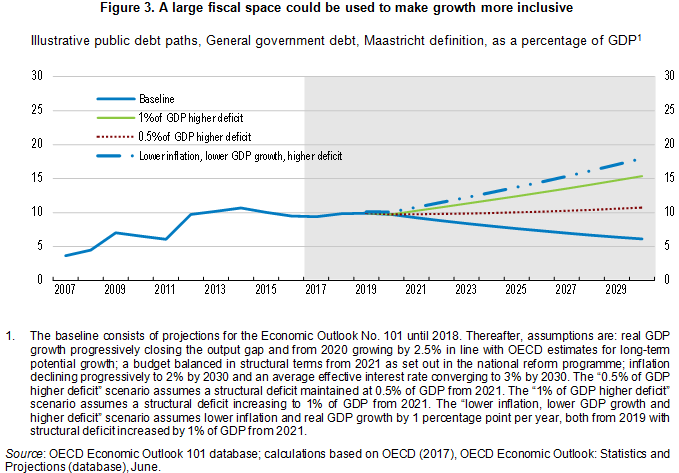
Fiscal room is available for further measures to make growth more inclusive. Estonia has the lowest gross public debt relative to GDP in the OECD (Maastricht debt is at around 10%) and a structural budget surplus since 2009. Fiscal policy has been tight over past years, despite economic slack. The government plans a small structural deficit in 2018, 2019 and 2020, which is welcome, but the current fiscal rule imposes a return to a balanced budget in structural terms from 2021.

Beyond 2020, financing growth-enhancing measures could require revising the fiscal rule. Maintaining a small structural deficit for an extended period would not undermine the long-term sustainability of public finances. For instance, a persistent deficit of 0.5% of GDP would result in Maastricht debt reaching less than 11% of GDP in 2030 (Figure 3). In the same vein, increasing the deficit by 1% of GDP would still maintain a prudent debt level, even if coupled with 1 percentage point lower inflation and GDP growth (Figure 3).

Beynt3esto

References

OECD (2017), OECD Economic Survey of Estonia, OECD Publishing, Paris.