Promoting stronger and more sustainable growth for all people across Spain

También disponible en español

By Bertrand Pluyaud and Adolfo Rodríguez-Vargas, OECD Economics Department

Before the COVID-19 pandemic, the Spanish economy experienced a period of sustained and more balanced economic growth, less dependent on the construction sector, and with a healthier financial system. The pandemic and Russia’s war of aggression against Ukraine were successive shocks that required strong government support to protect businesses and households, as noted in the 2023 Economic Survey of Spain. Output has recovered to its pre-pandemic level, and growth has held up well since the second half of 2022 and it is expected to remain solid in 2024.

The recovery from the pandemic has been steady following the large fall of GDP in 2020

Gross Domestic Product, Volume, base 2019Q4 = 100


Made with Flourish

Spain has also introduced several major reforms to address longstanding labour market issues, promote business growth and innovation, ensure pensions’ sustainability, and boost vocational education. However, structural weaknesses remain that weigh down Spain’s growth potential. The 2023 Economic Survey discusses policy options to tackle these issues in four areas.

Addressing fiscal challenges

Government action was decisive for the recovery, but it was costly. Public debt, which was already high before the pandemic, has increased by 13 percent points of GDP since 2019.  Sustained fiscal consolidation is required to keep debt on a downward path and to make room for ageing-related spending and growth-enhancing items, like education and green transition. This consolidation should rely on both mobilising additional revenues and on enhancing spending efficiency.

Increasing the relatively low tax intake should encompass gradually broadening the value added tax base and raising environment-related taxes, but also reducing tax avoidance and enhancing tax collection. Spending reviews should continue to be used to define growth-enhancing spending priorities, and evaluation of public policies should become the norm.

Public debt remains high

Public debt, Maastricht definition, % of GDP


Made with Flourish

Source: Eurostat.

Raising productivity

Low investment in R&D, inefficient public spending on education and training, and an insufficient stock of ICT capital have dragged down productivity growth, which in the last decade has averaged 0.6% per year compared to 0.9% for the OECD. The share of innovative companies is also comparatively low. All this weighs on potential growth, which with rapid population ageing is expected to weaken even more.

Promoting collaboration and knowledge transfer between businesses and universities, fostering entrepreneurship,  reducing regulatory barriers, and improving regulation can increase innovation and business growth. Continuing with an effective implementation of the investment and reforms under the national Recovery, Transformation and Resilience Plan should remain a priority, as it can help overcome structural deficiencies and boost productivity.

Promoting opportunities for all people across Spain

Despite recent improvements, income inequalities remain significant. Poverty is high compared to the OECD, and Spain has the highest child poverty rate in Western Europe, at 22%. This makes it urgent ensuring that public assistance is sufficient and reaches those who need it more. The survey recommends improving the targeting of social benefits, particularly towards poor families with children, boosting the take-up of the minimum income guarantee, and reducing administrative burdens for users.

Young people in Spain face a challenging transition to an independent, productive, and happy adult life. The risk of poverty among them is particularly high, although it has fallen. That is why the special topic of this survey is how can Spain increase opportunities for its young.

Educational and labour market outcomes have improved, but many young people still leave the education system with low education levels or skills, and youth labour-market integration remains difficult. The share of temporary contracts has decreased after the 2021 labour market reform, but it is still high. The survey recommends training teachers to identify and assist students at risk and maintaining support for students to enrol in vocational education, including by fostering the participation of SMEs to offer places. Furthermore, to ease school-to-work transitions it encourages greater employer involvement in the design of university curricula, and improving access to financing for young entrepreneurs.

Housing is a pressing concern for many people in Spain, especially the young. To increase housing supply, the survey recommends expanding the very low stock of social rental housing and relaxing stringent rent controls.

Young people face high poverty risks

Risk of poverty or social exclusion, %


Made with Flourish

Note: OECD Europe includes European OECD countries and excludes Türkiye.
Source: INE.

Addressing environmental challenges

Spain has made progress in the fight against climate change, as environmental protection expenditure has increased and renewable energies are becoming more prevalent in the energy mix. To keep reducing its dependence on fossil fuels, Spain should accelerate the shift towards greener transportation, improve storage and grid interconnections, and continue promoting renewable energies.

A more environment-friendly tax regime is also needed, as environmental tax revenue as a share of GDP is low compared to most OECD European countries. The base for environment-related taxation can be broadened, including by phasing out exemptions and gradually increasing the tax rate on emissions, while compensating partially and temporarily the most vulnerable.

Persistent drought in some regions has lowered water availability, and intense agriculture production has affected water quality. These problems could be addressed through more efficient irrigation, reuse and recycling of waters, and a more sensible use of fertilizers.

Improving water availability and quality is urgent

Groundwater stations with poor quality standards, %


Made with Flourish

Note: Groundwater stations failing to meet the drinking water standard under the EU Nitrates Directive
Source: European Environment Agency (EEA).

Government action helped Spain to overcome two major successive shocks. Evidence-based public policies can also help to solve Spain’s longstanding structural weaknesses to increase growth and raise wellbeing for all people across Spain.

References

OECD (2023), OECD Economic Surveys: Spain 2023, OECD Publishing, Paris,  https://doi.org/10.1787/5b50cc51-en  


How Climate Policies Shape Borrowing Costs and Investment through the Banking Channel

by Filippo Maria D’Arcangelo, Tobias Kruse, Mauro Pisu and Marco Tomasi

Limiting global warming and the economic and social losses it will cause requires a drastic increase in investments in low-carbon infrastructures and technologies. Global annual investments in low-carbon energy alone will have to increase threefold by 2030 compared with the level in 2022 (IEA, 2022). Private capital plays a pivotal role in financing these investments. However, investors responsible for capital allocation decisions need clear policy signals and the capacity to correctly assess firms’ exposure to the risks and opportunities mitigation policies entail (i.e. transition risks). For example, mitigation policies might drive technological changes, accelerate the obsolescence of certain assets and cause changes in demand, which affect firms differently based on their environmental and economic performance.

A new OECD working paper (D’Arcangelo et al., 2023) assesses to what extent climate policies lead sophisticated investors (i.e. lenders in the syndicated loan market) to discriminate across borrowers’ environmental performance and how this affects borrowers’ investment decisions. The study investigates how changes in the stringency of mitigation policies impacts the syndicated loans’ spread (i.e. the interest rate of syndicated loans minus a benchmark interest rate) of borrowers with good and bad environmental performance – measured by firms’ emission intensities, patents in climate-change mitigation technologies, and Environment, Social and Governance (i.e. ESG) scores.

Stringent climate mitigation policies decrease the cost of debt of ‘green’ firms and increase that of ‘brown’ firms

Firms with good environmental performance (measured by low emission intensity or high patenting activity in climate change mitigation technologies) benefit from a lower cost of debt, as measured by syndicated loans spread. These effects can be large when mitigation polices are stringent but disappears when they are not (Figure 1). For example, when carbon prices are above EUR 50/t CO2, firms in the top 25% of mitigation-technology patent’s distribution enjoy a loan spread that is 30% lower than firms in the bottom 25%. This is equivalent to EUR 1.5 million less in yearly interest payments for the median syndicated loan deal (or 41 basis points lower loan spread).

ESG scores are weak proxies of firms’ actual environmental performance and their exposure to transition risks

Sophisticated investors reward firms with good ESG scores irrespective of mitigation policies’ stringency, though they do not appear to rely on ESG scores to price transition risks. Firms disclosing an ESG score benefit from lower syndicated loan spreads and this advantage increases with better scores. However, the effect of ESG scores on loan spreads is disconnected from the stringency of climate policy. This finding supports the view that ESG scores are weak proxies of firms’ actual environmental performance ​(Berg, Kölbel and Rigobon, 2022; OECD, 2022a)​.

Pricing transition risks result in higher investments by ‘green’ firms and lower investment by ‘brown’ firms

Mitigation policies might encourage or discourage investment through the cost of debt. Simulations based on the empirical estimates indicate that a EUR 10/tCO2 increase in CO2 taxes (equivalent to the average increase between 2002 and 2018 for countries that have a CO2 tax) raises investment by 12% for the top green innovators. It decreases investment by 11% for the top emitters. These effects are also economically significant for technology-push policies. Increasing technology support policy (in line with what observed in the 2002-18 period) is associated with a 5.2% increase in investment for the top green innovators and a 2.7% decline in investment for the top emitters.

Aligning private capital with the net-zero transition needs better and more widespread data on firms’ environmental performance

The results suggest that investors operating in the syndicated loan market assess transition risks based on mitigation policies’ stringency and firms’ actual environmental performances. However, assessing and pricing firms’ transition risks may require detailed firm-specific information and the capacity to analyse them that only large and sophisticated investors (as those considered in this analysis) can afford. Relying on ESG and the Environmental pillar scores is not a viable substitute, as such scores do not provide yet sufficient information to assess firms’ transition risks.

Improving the quality of ESG scores is especially important for less sophisticated and passive investors, which tend to rely on such metrics to gauge transition risks and make investment decisions accordingly. Making strides in this direction, which include among other things improving the quality of corporate transition plans and establishing mandatory emission reporting (OECD, 2022b; OECD, 2022a), will mobilise larger private capital flows towards firms able to thrive as mitigation policies become more stringent and thus align capital allocation decisions with the net-zero transition. 

References

Berg, Florian, Julian Kölbel, and Roberto Rigobon. 2022. “Aggregate Confusion: The Divergence of ESG Ratings.” Review of Finance 26 (6): 1315-1344. doi:https://doi.org/10.1093/rof/rfac033.

D’Arcangelo, Filippo Maria, Tobias Kruse, Mauro Pisu, and Marco Tomasi. 2023. “Corporate cost of debt in the low-carbon transition: The effect of climate policies on firm financing and investment through the banking channel.” OECD Economics Department Working Papers 1761. doi:https://doi.org/10.1787/35a3fbb7-en.

IEA. 2022. “World Energy Investment 2022.” doi: https://www.iea.org/reports/world-energy-investment-2022.

OECD. 2022a. “ESG ratings and climate transition: An assessment of the alignment of E pillar.” doi:https://doi.org/10.1787/2fa21143-en.

OECD. 2022b. “Policy guidance on market practices to strengthen ESG investing and finance a climate transition.” doi:https://doi.org/10.1787/2c5b535c-en.


Decarbonising the Housing Sector: Pathways to Net-Zero Emissions by 2050 

By Volker Ziemann, OECD Economics Department

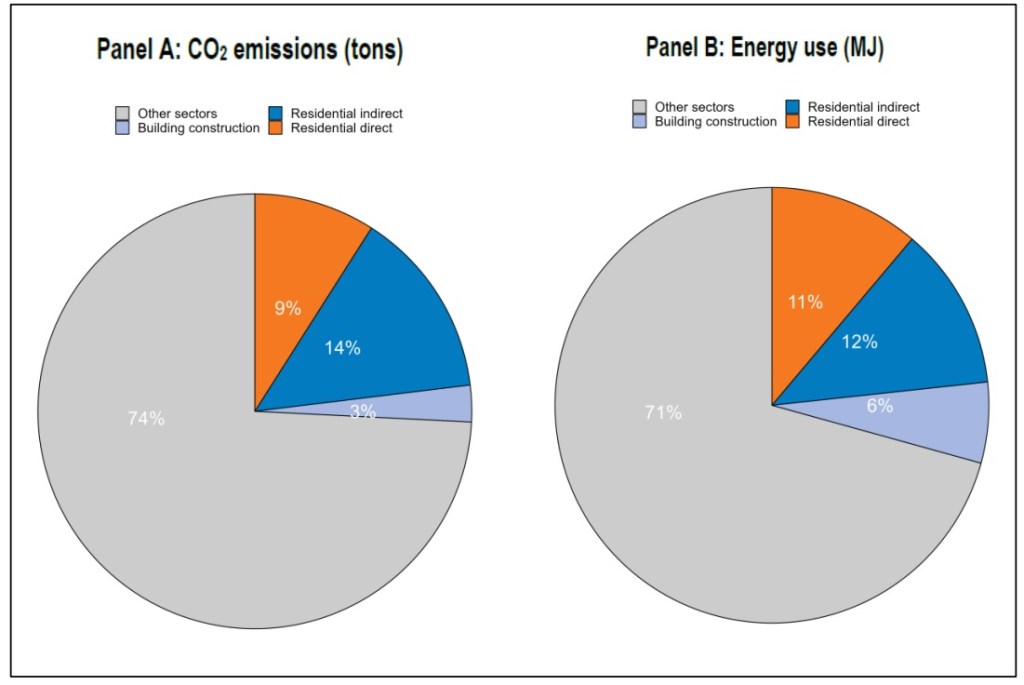
In 2020, over a quarter of total CO2 emissions in the OECD originated in the housing sector. These emissions are generated through space and water heating, cooling, ventilation, lighting, and the use of appliances and other electrical plug loads. Homebuilding is also emission-intensive, accounting for 6% of total CO2 emissions.

Figure 1. Housing accounts for a large share of CO2 emissions

Sectoral decomposition of OECD CO2 emissions and energy use, 2020

Source: Energy Efficiency Indicators (IEA, 2021[7]), Emission Factors database (IEA, 2021[8]), and OECD calculations.

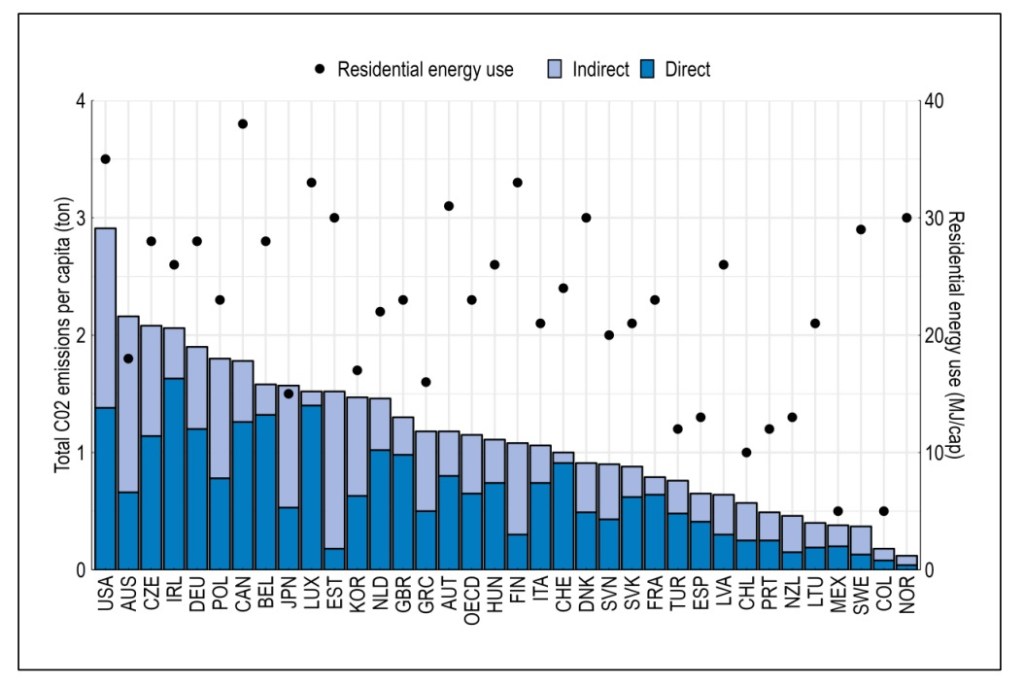
CO2 emission levels vary considerably across countries ranging from nearly three tonnes per capita in the United States to almost zero in Norway. These vast differences indicate that even countries with harsh climates can achieve low emission levels. One of the keys to decarbonising the housing sector is to reduce direct emissions from on-site combustion of fossil fuels such as oil and natural gas for heating and cooking. Electrification and energy efficiency improvements are the primary vehicles to get there. Reducing indirect emissions, those originating from electricity use, then hinges on decarbonising electricity production.

Figure 2. Several countries have high home energy needs, but low CO2 emissions

Total CO2 emissions and energy use of the residential sector, 2020

Source: Energy Efficiency Indicators (IEA, 2021[7]), Emission Factors database (IEA, 2021[8]), and OECD calculations.

Most OECD countries have pledged to reach net-zero emissions by 2050, and some have set even more ambitious targets to achieve this goal earlier. Bringing the housing sector on track to meet these targets requires stepping up efforts and going beyond environmental regulation and encompassing economic, social, innovation, tax, and spending policies.

The recent OECD working paper, “Home, Green Home: Policies to Decarbonise Housing“, delves into the various policy options for rapidly decarbonising the housing sector and recommends to:

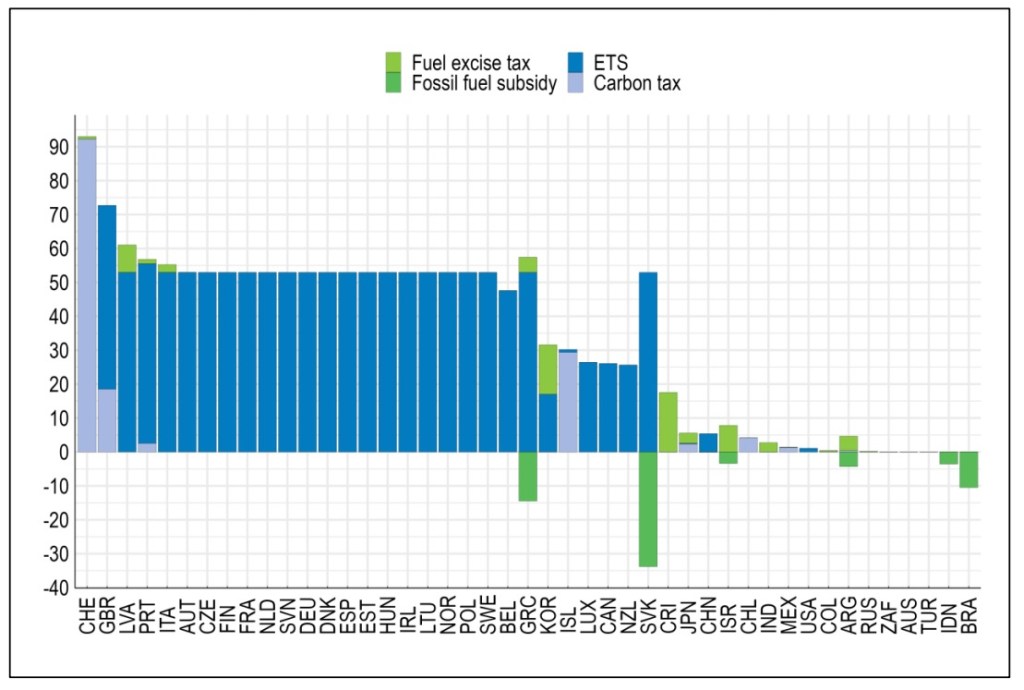
  • Align carbon prices of energy used in homes with those that apply to other sectors. This can be achieved by explicitly taxing the carbon content of energy sources or by emission trading (applied to energy suppliers).

Figure 3. Effective carbon rates are a long way from being similar across sectors and countries

EUR per tonne of CO2

Panel A: Building use

Source: OECD (2022), Pricing Greenhouse Gas Emissions: Turning Targets into Climate Action, OECD Publishing, https://www.oecd-ilibrary.org/deliver/cbda8bad-en.pdf?itemId=%2Fcontent%2Fpaper%2Fcbda8bad-en&mimeType=pdf.

Panel B: Electricity sector

Source: OECD (2022), Pricing Greenhouse Gas Emissions: Turning Targets into Climate Action, OECD Publishing, https://www.oecd-ilibrary.org/deliver/cbda8bad-en.pdf?itemId=%2Fcontent%2Fpaper%2Fcbda8bad-en&mimeType=pdf.

  • Ensure carbon-free electricity generation, as a lot of the decarbonisation of homes will have to come from their electrification.

  • Overcome the split incentive problem between landlords and renters by allowing landlords to recover part of the energy bill saving from energy-efficiency improvements when rent levels are updated.

  • Extend energy performance certification to all properties, not only those for sale.

  • Strengthen energy efficiency standards on appliances and new buildings to align with the net-zero emission target.

  • Offset adverse effects of mitigation measures on vulnerable social groups without blunting incentives to save energy.

  • Focus on retrofitting the worst existing housing units.

  • Abolish remaining subsidies for fossil fuel boilers.

  • Lead the way by building new and retrofitting existing social housing units according to high environmental standards.

  • Promote greater international comparability and transparency of green building standards to facilitate alignment of green real estate assets with the net-zero target.

  • Ensure local-level regulations, spending power, and resources are consistent with national decarbonisation goals.

Implemented together, these policy instruments can decarbonise housing at a pace compatible with climate targets and in a way that is consistent with social-inclusion objectives while avoiding unnecessary economic costs.

References:

Hoeller, P. Ziemann, V. , Cournède, B. and M Bétin (2023), “Home, green home: Policies to decarbonise housing “, OECD Economics Department Working Papers, No. 1751, OECD Publishing, Paris, https://doi.org/10.1787/cbda8bad-en.


Different paths to net-zero: Assessing the effectiveness of diverse climate mitigation approaches

By Mauro Pisu (OECD), James Roaf (IMF), Florence Jaumotte (IMF), Ian Parry (IMF), Andrew Prag (OECD), Kurt Van Dender (OECD)

In the historic 2015 Paris Agreement, virtually the entire world signed up to the goal of limiting global temperature increases to 1.5-2C above preindustrial levels. Since then, more than 130 countries have set ambitious greenhouse gas emission (GHG) reduction targets to reach net zero GHG emissions by around mid-century.

However, this is where the similarities end, as the detailed targets and policies countries have so far implemented, or plan to implement, to meet those targets differ greatly.

One thing is clear: at the aggregate level, countries’ near-term ambition and policies are insufficient to bring global GHG emissions on track to meet the Paris temperature goals or to reach net zero emissions by mid-century. Without major policy changes, we may be heading for warming of 3C or more. This would be catastrophic, especially for the poorest and most vulnerable. To avoid the Paris temperature goals slipping permanently out of reach, GHG emissions would have to decline by 25-50 percent below recent levels by 2030, requiring a significant acceleration in emission reductions and drastic policy changes.

The current energy crisis adds to these challenges as it has exposed links and short-term trade-offs between safeguarding energy security and climate goals. The search for alternative sources of energy to oil and gas from Russia has shifted relative prices and, in some countries, increased the use of more polluting fossil fuels, such as coal, at least temporarily. At the same time, the crisis could become a major accelerator of the clean energy transition over the longer-term. For that to happen, international cooperation remains critical to ensure energy security and overcome policymakers’ concerns that other countries may not do their fair share in cutting emissions and relatedly that their industries might lose competitiveness. Aligning energy security with climate goals requires stronger international co-operation underpinned by a shared understanding of the impact of the diverse mitigation policy approaches countries are pursing.

To curtail emissions, countries might use carbon pricing – either via carbon taxes or emissions trading schemes – or other price-based incentives like tradeable emissions standards, feebates and feed-in tariffs for renewable electricity. Or they might use non-pricing instruments such as regulations and green investment and technology subsidies. In fact, countries typically use a combination of these measures, according to their individual circumstances. Identifying the individual and combined effects of the many measures composing countries’ mitigation policy mixes is challenging.

In a new report, the IMF and OECD have joined forces to support the German G7 Presidency on these issues. The report focuses on three key areas to improve the comparison of the impacts of different mitigation policy approaches on emissions and the broader economy:

Stocktaking of mitigation policies. Identifying and documenting countries’ diverse policy approaches requires systematically collecting information on a larger set of mitigation policies in more countries and sectors, and at a more granular level, than is currently possible. Such information, covering price-based and non-price-based policies, will provide much additional information for policy makers and will be key to estimating the emission reduction effects of policies in a consistent way across countries and sectors. Such a stocktaking can build on and go beyond the inputs from already available stocktakes such as OECD’s Effective Carbon Rates, Taxing Energy Use, International Programme for Action on Climate (IPAC), and Environmental Policy Stringency index (Figure 1). A new stocktake can provide more detailed information on the emission coverage and enlarging the set of mitigation policies being covered.

Figure 1. OECD Environmental Policy Stringency and stocktaking of climate change policies

  A. The 2021 Environmental Policy Stringency Index


B. EPS sub-indicators across countries, 2020

Note: Panel A shows the aggregation structure of the updated EPS index (referred to as “EPS21”). ELV is short for Emission Limit Value. Panel B shows the contribution of the policy components to the EPS across countries for the year 2020. The blue bars show the contribution of non-market based policies to the EPS. The red bars show the contribution of market based policies. The green bars show the contribution of technology support policies. Data for Colombia, Costa Rica, Latvia and Lithuania were not available.
Source: OECD.

Agreeing on and implementing a clear methodology for estimating the impact of policies on emissions. This would strengthen countries’ capacity to monitor progress towards climate change targets and improve the comparability of reporting such progress. Figure 2 shows a stylized example for such policy comparisons, applied to G20 economies. Different policy combinations currently planned for 2030 are mapped onto a common base of emissions reductions. These policies can then be compared to a common metric (such as the “carbon price equivalent”, which is the carbon price that would achieve the same overall mitigation effect as a package of other policies). As shown in the chart, countries differ strongly both in the mix of policies and in their overall effectiveness, with most countries’ stated policies still falling short of their Nationally Determined Contributions, let alone their longer-term net-zero targets.

Figure 2. Estimated economywide CO2 reductions

Source: IMF staff using the Climate Policy Assessment Tool.  

Assessing the broader economic effects of different climate policies, including cross-country spillovers. Understanding these effects would help to design policy approaches that allay concerns about competitiveness, carbon leakage, and burden sharing of global mitigation efforts. Figure 3 shows for example that different climate policies by the G7 countries, in the electricity sector (on the left) or in both the electricity and energy intensive and trade exposed sectors (on the right), are associated with different impacts on their international trade shares (i.e. they have different competitiveness effects). In the electricity sector, different policies have relatively similar effects, except feed-in subsidies that would reduce emissions while avoiding losses in trade shares. Feed-in subsidies policy, however, would cause comparatively higher GDP costs because of the need to finance the subsidy by raising taxes. In the energy intensive and trade exposed industries, policy makes a major difference: regulation affords firms less flexibility than a carbon price and model simulations suggest this results in a significant negative effect on trade shares of hard-to-decarbonize industries, contrary to carbon pricing.

Figure 3. Effect of pricing and non-pricing climate policies on the international trade share of energy intensive and trade exposed industries in G7 countries

Percentage point deviation from baseline in 2030

Note: EITIE denotes energy intensive and trade exposed industries.
Source: IMF staff using IMF-ENV model.

The methodologies discussed in this new paper are still work-in-progress but they provide a sound framework for comparing mitigation efforts and a roadmap to advance work supporting international policy co-operation initiatives. These could include: the Climate Club established by Germany’s G7 Presidency; the International Carbon Price Floor proposal put forward by IMF staff; the OECD’s Inclusive Forum on Carbon Mitigation Approaches (which will undertake stocktaking, mapping and estimating the effectiveness of mitigation policies); the UNFCCC’s Enhanced Transparency Framework; carbon border adjustment mechanisms and other mitigation initiatives discussed in international fora.


Towards net zero emissions in Denmark

By Andrew Barker, Hélène Blake and Patrick Lenain, OECD Economics Department

Denmark has embarked on an impressive climate policy agenda with ambitous emissions targets, carbon pricing, innovation, public investment and regulatory policies. The share of renewables in electricity generation has grown from less than 10% in the mid-1990s to over 80% in 2020. This has been the key driver behind the sharp cuts in greenhouse gas emissions by 36% between 1990 and 2019, making Denmark one of the least carbon-intensive countries in the OECD. Emission cuts have been achieved without compromising economic or jobs growth, with progress in wind generation in particular contributing to the development of an important export industry.

Denmark intends to go further with a a legally-binding commitment to cut emissions by 70% by 2030 from 1990 (Figure 1). This will require halving emissions from 2019 levels – a similar reduction in the next decade as has been achieved in the past 30 years. Cutting emissions at such a fast pace will be challenging, with substantial disruptions and socioeconomic challenges. Radical technological changes and vast resource reallocation will take place throughout the economy, similar to the transformational change in the Danish electricity sector since the mid-1990s. Greater certainty on policy measures to meet these targets will be important to send strong signals to investors. Additional investment in the order of 1% to 2% of GDP will be needed, which could largely come from the private sector with the right incentives.

Job losses to date in high-carbon activities have been offset by new opportunities in green industries – workers with skills in offshore oil and gas have for instance retrained to work in offshore wind. The succesful Danish “flexicurity” system, which combines a safety net with support for skill building and job search, will continue to play a key role to facilitate this sizeable transformation.

Figure 1. Meeting targets will require further progress in all sectors

Source: UNFCCC GHG Data Interface; Danish Climate Law.

The energy sector must continue its transition towards renewable sources. Scarce supplies of sustainable woody biomass, on which Denmark has relied for low-emissions district heating, will need to be freed up for the difficult-to-decarbonise sectors, while continuing to protect security of supply as wind generation expands. A low-carbon economy will rely heavily on renewable energy, which can be promoted by further decreases in taxes on renewable electricity, as well as technological breakthroughs allowing large-scale conversion of electricity into sustainable fuels such as hydrogen, methane or ammonia.

Progress in reducing transport emissions has been slow to date, despite more environmentally-friendly vehicles, as the number of cars has continued to increase as well as the reliance on road transport (Figure 2). Agriculture is also a major and growing source of greenhouse gases. Low-hanging fruit such as rewetting of peatlands and improved manure management are available to cut emissions with limited impact on activity, while also reducing other environmental damages. Denmark needs to work with other EU member states towards further reform to green the Common Agriculture Policy, as agriculture is highly exposed to international trade and emissions could increase elsewhere if Denmark proceeds without international cooperation.

Figure 2. Increasing car use has pushed up transport emissions despite greener vehicles

Source: OECD estimation based on EEA; Statistics Denmark; ITF.

The Danish government has made substantial progress to overcome many of the challenges linked to deep emission cuts. In the past year and a half, for example, the government has removed restrictions in district heating to support a move away from biomass, agreed measures to reduce greenhouse gas emissions in agriculture, and increased support for green vehicles and electric charging infrastructure. Further policy actions are being discussed among various stakeholders, including more uniform emission pricing. Denmark’s past and planned efforts to decarbonise quickly and achieve net zero in 2050 are an inspiring example for other countries, as highlighted in the 2021 OECD Economic Survey of Denmark.  


At the cross-roads of a low-carbon transition: what can we learn from the current energy crisis?

By Laurence Boone and Assia Elgouacem, OECD Economics Department

When it rains it pours. The energy crisis we face today is the result of a confluence of several forces at play: persistent underinvestment in the energy sector and fragile market regulation coupled with unfavourable weather events and insufficient buffers (Figure 1A) (IEA, 2021b). Together with the strong COVID-related demand recovery, they created an unsettling mismatch in our global energy markets leading to skyrocketing energy prices, in particular in Europe (Figure 1B). The crisis has brought to bear the multiple sources of tension that could threaten the stability and reliability of our energy system. It has also triggered a multiplicity of emergency measures to contain costs for households and firms at a time when the energy transition is set to accelerate. As countries embark on what promises to be the most ambitious energy transformation of our times, the current events show how transition to a climate neutral world needs to minimise the risk of such disruptions while securing public support.

Note: Panel A shows the filling rate of European natural gas storage over 2020, 2021 and the 10 year average filling rate. Panel B uses the EEX EGIX THE Index (European Energy Exchange European Gas Index) as the reference price for natural gas for one month ahead contracts. It is based on exchange trades which are concluded in the respective current front month contracts (THE). The EGIX corresponds to the current market price for gas deliveries in the next month at any time.
Source: Panel A: Aggregated Gas Storage Inventory, AGSI+ (gie.eu). Panel B: Refinitiv.

Between calls for greater energy security and energy affordability, particularly at a time when mounting inflation pressures are already raising concerns about people’s purchasing power (OECD, 2021c), this crisis is very much exposing difficulties governments will face to stay on course towards a climate neutral world. Countries representing around 70% of the world’s global carbon emissions have already announced climate neutrality targets by mid-century (IEA, 2021a), which necessitates a rapid and unprecedented transformation of the way we produce and consume our goods and services. Yet the steps to achieving this transformation remain unclear in many jurisdictions.

According to the recently published IEA World Energy Outlook, a net-zero emissions world requires accelerating clean electrification of many energy uses, improving energy efficiency, substantially reducing methane emissions and boosting innovation (IEA, 2021c). This requires a major shift in investment (Figure 2), R&D, regulation and carbon pricing.

Note: The scenarios are from the IEA World Energy Outlook 2021. The Announced Pledges Scenario maps out a path in which the net zero emissions pledges announced by governments so far are implemented in time and in full. The Net Zero Emissions Scenario sets out what needs to be done to move beyond these announced pledges towards a trajectory that would reach net zero emissions globally by mid-century, which is consistent with limiting global warming to 1.5 ˚C.
Source: (IEA, 2021c).

Reasons for the current shortages are multiple, but some of them reflect future challenges that could be linked to decarbonisation. The post-Covid demand surge is partly responsible for a global shortage of energy, but it coincides with an undersupply due to a lack of investment in clean energy at a time when investment in brown energy has been receding over the past decades (IEA, 2021b) .

In short, the current situation should provide lessons to prepare better for the transition to a climate neutral world through strengthening our energy systems as our energy infrastructure morphs into one that relies much more on variable renewable energy sources. Policy makers thus need not only steer incentives towards clean energy but they should also ensure that as energy systems become cleaner they remain reliable and affordable. This requires larger and more timely investment, a focus on electricity system flexibility, and better pricing systems. The IEA estimates that investment in clean energy projects and infrastructure needs to more than triple over the next decade to reach net-zero emissions (Figure 2).

Failure to better prepare our energy system would only exacerbate public finances pressure while weakening the price signals. Countries are currently scrambling to provide aid to their citizens to soften the blow from rising energy prices at the cost of higher emissions. Interventions range from means-tested transfers to low-income households, energy tax cuts, caps on energy prices, and excess profit taxes on energy companies (Table 1). While protecting vulnerable households is necessary, it is important that such measures remain time limited and not undermine incentives for clean energy.

The OECD has long since highlighted the importance of policy alignment and how a comprehensive, inclusive and cost-effective strategy to address climate change will require bringing in complementary policy areas and exploiting synergies among them (OECD, 2015e) (OECD, 2021a). The current episode highlights this further, especially since higher energy prices could render already contentious policies, such as carbon taxes, even less palatable and politically tenable (Politico, 2021). To this end, governments need to strengthen targeted social support to vulnerable populations, including through well-designed revenue-recycling schemes, and to bolster active labour market support to help workers and encourage a more efficient reallocation of labour (OECD, 2021d) (Vona, forthcoming). They need to upgrade market regulation to ensure greater stability as well as competition, and to encourage investment in energy system flexibility. Reforming financial sector regulation is also key, such as requiring greater disclosure in financial markets to better account for climate risk and mobilise private funds (OECD, 2021b). Lastly, transparency, better communication and carefully assessing compensation packages would be necessary for garnering public support so as to not derail the energy transition.


References

IEA (2021a), Net Zero by 2050: A Roadmap for the Global Energy Sector, OECD Publishing, Paris, https://doi.org/10.1787/c8328405-en.

IEA (2021b), What is behind soaring energy prices and what happens next?, https://www.iea.org/commentaries/what-is-behind-soaring-energy-prices-and-what-happens-next.

IEA (2021c), World Energy Outlook 2021, OECD Publishing, https://doi.org/10.1787/14fcb638-en.

OECD (2021a), Economic Policy Reforms 2021: Going for Growth: Shaping a Vibrant Recover, OECD Publishing, https://doi.org/10.1787/3c796721-en.

OECD (2021b), Financial Markets and Climate Transition, https://www.oecd.org/finance/Financial-Markets-and-Climate-Transition-Opportunities-Challenges-and-Policy-Implications.pdf.

OECD (2021c), OECD Economic Outlook, Interim Report September 2021: Keeping the Recovery on Track, OECD Publishing, https://doi.org/10.1787/490d4832-en.

OECD (2021d), The Inequalities-Environment Nexus, https://www.oecd-ilibrary.org/environment/the-inequalities-environment-nexus_ca9d8479-en.

OECD (2015e), Aligning Policies for the Low-carbon Economy, https://www.oecd.org/fr/gov/aligning-policies-for-a-low-carbon-economy-9789264233294-en.htm.

Politico (2021), Soaring power prices drive anxiety over EU climate plans, https://www.politico.eu/article/soaring-power-prices-anxiety-eu-climate-plans/.

Vona, F. (forthcoming), Managing the Distributional Effects of Environmental and Climate Policies: The Narrow Path for a Triple Dividend.