Belgium: Reforms to put public finances on a sustainable path      

By Jonathan Smith, Caroline Klein, OECD Economics Department

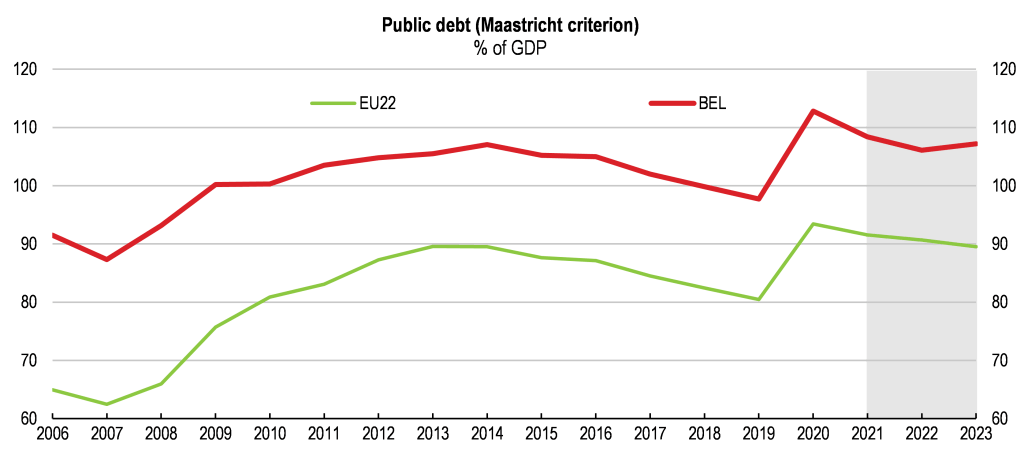
Belgium coped well with the pandemic and energy crisis, but fiscal support to mitigate their impact has brought higher fiscal deficits and further increases in public debt. The ratio of public debt to GDP is among the highest in the EU; it stood at 105% in 2023. Absent of fiscal consolidation, the sustainability of public finances is at risk. Demographic change is exacerbating the challenge of ensuring fiscal sustainability. Costs related to ageing, particularly spending on pensions and long-term care, are projected to increase by 3.7 percentage points of GDP by 2060, much larger than the average EU country (European Commission, 2024). Furthermore, the digital and green transitions require substantial public investment, accentuating the fiscal challenge.

The 2024 Economic Survey of Belgium discusses the key elements needed to put public debt onto a sustainable path. Long-run fiscal projections currently suggest that without such measures the debt-to-GDP ratio could exceed 200% by 2050 (Figure 1).

Figure 1: Bringing public debt on a sustainable path requires substantial fiscal efforts

Gross government debt as a share of GDP
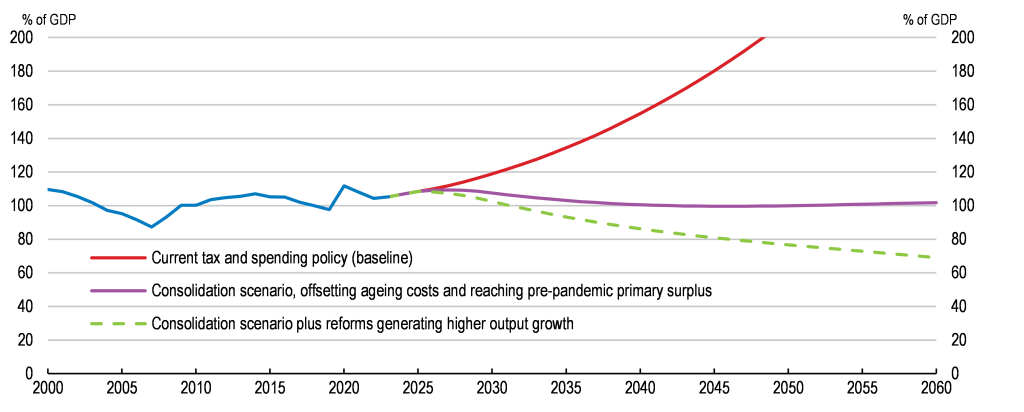
Note: The “Current tax and spending policy” scenario is based on the OECD Economic Outlook 115 projections until 2025, the OECD long-term model thereafter. The scenario assumes a continuation of the policy stance with the primary fiscal balance remaining constant at its 2025 level (-2.5%) before accounting for net ageing-related costs. Net ageing costs are defined as changes in expenditure on old-age pensions, health, and long-term care minus changes in expenditure on education, which will add on average an additional 3.7 percentage points of GDP to annual government spending from 2025 to 2060 assuming no-policy change. The “Consolidation” scenario assumes that the primary budget surplus reaches 0.6% of GDP by 2030 and is maintained until 2060, which requires tax and spending measures after 2025, including to offset rising net ageing costs. The “Consolidation scenario plus reforms generating higher output growth” scenario additionally assumes higher GDP growth from the implementation of the ambitious package of structural reforms reported the Economic Survey.
Source: OECD (2024).

First, addressing the fiscal challenge requires a credible consolidation strategy involving all of Belgium’s regions and communities. The new EU fiscal rules should help strengthen Belgium’s budgetary discipline. Nevertheless, more needs to be done to improve coordination across governments. Regions and communities account for an increasing share of Belgium’s gross debt, but the current system of Cooperative Agreements across governments is not working. Despite finalisation in 2013, the Cooperative Agreements have never been implemented; this suggests a need for reform. Binding multiannual spending rules should be introduced for all governments to support fiscal discipline and improve clarity for policymakers, businesses and households on the consolidation path.

Second, raising public spending efficiency should be the cornerstone of fiscal consolidation. Public expenditure in Belgium is among the highest in the OECD and has increased sharply since 2019 from 51.9% to 54.6% of GDP in 2023. Spending reviews can help identify efficiency gains and can support consolidation when carried out with clear savings objectives and followed by concrete actions. Belgium has progressed on this front, but there is scope for more. It should build on experiences from pilot spending reviews and move to comprehensive reviews to cover a larger share of government spending. Spending reviews should be systemically integrated into the budgetary planning cycles as already done in some regions.

Reforms are needed to ensure the sustainability of the pension system, which makes up a substantial share of the costs related to population aging. Belgium is projected to have one of the highest public pension expenditures in the European Union by 2045. While two sets of pension reforms have been carried out since 2020, they have focused on improving pension adequacy for pensioners rather than limiting increases in long-term costs for the public at large. Part of the problem is the gap between the effective and the legal retirement age, which is the highest in the OECD (OECD, 2023). In light of this, Belgium should place greater emphasis on incentivising and enabling older workers to stay in employment. This should be achieved both via financial incentives such as penalties for early retirement, but also through complementary non-pecuniary reforms to extend working lives, such as developing the prevention of work-related health risks and upskilling programmes.

Lastly, Belgium must improve the efficiency and fairness of its tax system. The extensive use of special tax provisions narrows the tax base and weighs on revenue, often with little or no evidence of concrete socio-economic benefits. Furthermore, the tax mix is unduly skewed toward labour income taxes. Belgium has one of the highest tax burdens on labour income in the OECD – which, inter alia, disincentivises work. Targeted cuts in effective labour income taxation are needed to strengthen incentives to remain in employment, expand working hours, or return to work if unemployed. Attention to the incentives for low-wage workers is particularly important. The taxation of capital income is relatively flat and low but mainly because of the absence of a capital gains tax, which Belgium should consider introducing. Finally, indicators point to a relatively high level of tax revenue losses from non-compliance vis-a-vis other EU countries. Efforts for a comprehensive tax reform that would advance on a number of these issues have been put on hold. Major tax reform should be resumed to support economic growth, employment, and fiscal sustainability.

References

European Commission (2024) “The 2024 Ageing Report – Economic and budgetary projections for the EU Member States (2022-2070)” Directorate General for Economic and Financial Affairs. https://doi.org/10.2765/022983  

Guillemette, Y. and D. Turner (2018), “The Long View: Scenarios for the World Economy to 2060”, OECD Economic Policy Papers, No. 22, OECD Publishing, Paris, https://doi.org/10.1787/b4f4e03e-en.

OECD (2024) OECD Economic Surveys: Belgium 2024, OECD Publishing, Paris, https://doi.org/10.1787/c671124e-en.

OECD (2024), OECD Economic Outlook, Volume 2024 Issue 1: An unfolding recovery, OECD Publishing, Paris, https://doi.org/10.1787/69a0c310-en.

OECD (2023), Pensions at a Glance 2023: OECD and G20 Indicators, OECD Publishing, Paris, https://doi.org/10.1787/678055dd-en.


Improving economic opportunities for all in Belgium

By Nicolas Gonne and Müge Adalet McGowan, OECD Economics Department.

Belgium has low income inequality overall, thanks to extensive tax and transfer policies and strong institutionalised social dialogue. However, as in other OECD countries, there is scope to improve equality of opportunities. Indeed, Belgium’s good overall performance regarding income distribution hides an unequal access to life chances, with considerable disparities according to, notably, parental background and country of origin.

Improving economic opportunities for all in Belgium would promote well-being and potential growth by better allocating talents, but also help alleviate fiscal sustainability challenges by reducing the need for redistribution. Based on new OECD evidence from survey microdata (Périlleux et al., forthcoming), the latest Economic Survey of Belgium identifies three key barriers to equal opportunities: low labour market transitions, inequity in compulsory education and a lack of affordable housing. The Survey discusses policies that can tackle these barriers, with a particular focus on the situation of vulnerable groups, such as the low-skilled, people with a migrant background and single mothers. As competencies concerning the labour market, education and housing spread across different levels of government, some recommendations are more relevant to specific regions and communities according to their policy needs and priorities.

Improving the labour market outcomes of vulnerable groups

Important reforms have contributed to increasing the participation of low wage earners and older workers in Belgium. Yet, employment gaps remain particularly large for disadvantaged groups, such as non-EU migrants, the low educated and people with disabilities (Figure 1), in part reflecting weak digital skills and low participation in training. Lifelong learning programmes and actors involved should be streamlined and vulnerable groups prioritised for face-to-face career guidance, as complexity is particularly detrimental to their participation.

Figure 1. Employment gaps are particularly large for disadvantaged groups

Note: Employment gap defined as the difference between the employment rate of prime-age men (aged 25-54) and that of the group, expressed as a percentage of the employment rate of prime-age men (more details).
Source: OECD calculations based on OECD Employment database, OECD International Migration database, OECD Education Database and OECD Family database.

The planned introduction of the individual training account, as recommended in the previous Economic Survey of Belgium, is a major step in the direction of increasing lifelong learning efficiency and inclusiveness, but successful implementation requires the provision of high quality training in areas of skill needs and coordination across regions. Moreover, the use of statistical profiling tools for delivering employment services to target vulnerable groups should be expanded. As low employment rates also reflect gaps in individual support for sickness and disability beneficiaries, individual placement and support programmes should be scaled up further, conditional on their evaluation. Finally, introducing in-work benefits for low-wage workers with children would strengthen their work incentives, as low-income single parents and second earners with children face among the highest participation tax rates in the OECD.

Enhancing equal opportunities in compulsory education

Belgian students’ overall academic performance is at par with peer countries. However, student achievement strongly depends on parental background (Figure 2), leading to large disparities across schools and programmes due to a cumulative process of socio-economic self-sorting and academic selection. Schools are incentivised to diversify their student intake, but not to achieve good educational outcomes for weaker students. Reliable performance indicators and other data on successful study progression should be used to inform school funding based on educational improvements made with disadvantaged students. Moreover, schools should be further encouraged to organise programmes across the general and vocational tracks and to enable transfers between them, as low mobility between tracks reduces the prospects of students from disadvantaged backgrounds. Finally, stronger incentives and training for new teachers can reduce attrition and attract teachers to schools with a high concentration of disadvantaged pupils, through strengthening induction programmes and rewarding teaching in disadvantaged schools with financial incentives or improved and stable career prospects.

Figure 2. Student achievement strongly depends on parental background

Note: OECD calculations based on regressions of PISA test scores in reading on the index of economic, social and cultural status (ESCS).
Source: OECD (2019), PISA 2018 Results (Volume II): Where All Students Can Succeed, OECD Publishing, Paris.

Promoting affordability and quality on the housing market

In Belgium, housing conditions overall are among the best in the OECD according to the OECD Better Life Index. However, access to affordable housing has become increasingly challenging for low-income households, who bear a high burden from housing costs (Figure 3). The supply of social housing is too low, especially in large cities, such as Brussels, and price differentials with the private housing market hinder moves, thereby distorting work incentives. The regions should expand rental allowances to cover low-income private market tenants, while proceeding to increase the social housing stock.

Figure 3. Low-income households bear a high burden from housing costs

Note: Households on the private rental market; low-income households belong to the bottom income quintile; overburden is more than 40% of disposable income on total housing costs (more details).
Source: OECD Affordable Housing database.

References

Adalet McGowan, M.  and N. Gonne (2022), “Addressing medium-term fiscal challenges to address future shocks in Belgium”, Ecoscope, Blog posted on 14 June 2022.

Gonne N. (2022), “Improving economic opportunities for all in Belgium”, OECD Economics Department Working Papers, No. 1722, OECD Publishing, Paris,
https://doi.org/10.1787/662d50d9-en

OECD (2022), OECD Economic Surveys: Belgium 2022, OECD Publishing, Paris, https://doi.org/10.1787/01c0a8f0-en.

OECD (2020), OECD Economic Surveys: Belgium 2020, OECD Publishing, Paris, https://doi.org/10.1787/1327040c-en.

Périlleux, G., N. Gonne, S. Cassimon and M. Adalet McGowan (forthcoming), “Upward income mobility and vulnerable households in Belgium: Evidence from survey microdata”, OECD Economics Department Working Papers, OECD Publishing, Paris.


Addressing medium-term fiscal challenges to address future shocks in Belgium

By Müge Adalet McGowan and Nicolas Gonne, OECD Economics Department

The large-scale support to mitigate the economic and social impact of the pandemic put additional strain on government finances in Belgium, as in other OECD countries. The temporary measures against increasing energy prices and the automatic indexation of public wages and social benefits to inflation will weigh further on public finances in the near term. The additional defence spending and the inflow of Ukrainian refugees arising from the war will also increase costs.

The new Economic Survey of Belgium shows that with unchanged policies, Belgium’s high debt-to-GDP ratio, which is high at 108.4% in 2021 (Figure 1), is not expected to stabilise in the medium term. Fiscal challenges will be exacerbated by population ageing: total ageing costs (health, long-term care and pensions) will rise by 5.7% to 25.8% of GDP by 2070. Hence, a credible and transparent fiscal consolidation strategy to lower the budget deficit and to ensure a steady reduction of the debt-to-GDP ratio, including every level of government, is needed.

Figure 1. The crisis exacerbated fiscal challenges

Source: OECD Economic Outlook: Statistics and Projections (database).

The 2022 OECD Economic Survey of Belgium highlights four areas to improve medium-term fiscal sustainability:

  • Increasing public spending efficiency through spending reviews: Public spending at 55% of GDP in 2022 is among the highest in the OECD and there is room to improve spending efficiency in some areas (e.g. education). Federal and regional spending reviews are starting to be used, and the national recovery plan includes a commitment to better integrate them into the annual budget process. Better coherence and consistency in methodology and objectives across different levels of government should be ensured to link spending reviews to the medium-term expenditure frameworks to gradually bring down public expenditures.
  • Improving the fiscal framework and rules: Budgetary coordination between the different government levels is not effective. The cooperation agreement of December 2013, which aimed at ensuring the budgetary coordination of all levels of government, has not been fully implemented in practice. The lack of endorsement of the budgetary targets proposed by the High Council of Finance by the federal, regional and community governments prevents the High Council from fulfilling its mandate of monitoring outcomes and the use of a credible multi-annual budget planning. The introduction of medium-term budgetary planning and expenditure rules for all levels of government can increase transparency and consistency of fiscal policy and support medium-term expenditure reforms. Strengthening the mandate of the High Council of Finance to provide transparent, uniform and highly visible in-depth analysis and monitoring of public finances at different levels of government, even if it cannot impose binding targets or recommendations, can also help.
  • Implementing the planned tax reform: High labour taxes discourage more people from working or looking for a job. While previous tax reforms reduced the tax burden on labour for the lowest income earners, they remain above the OECD average. The planned tax reform should broaden tax bases and reform capital taxation to lower misallocation of capital. Given fiscal sustainability challenges, it is important to ensure that the labour tax reduction for low-wage workers is fully financed.
  • Implementing pension reforms: Pension expenditures are projected to increase from 12.2% to 15.2% of GDP by 2070, and the effective retirement age remains low at 60.5 (Figure 2). There is a need to upskill older workers, whose participation in lifelong learning is relatively low, to lengthen their working lives. Increased access to information and guidance regarding training are key. Introducing penalties and bonuses for those retiring before and after the statutory retirement age could strengthen the links between working careers and pensions in the early retirement system and encourage a rise in the effective age of exit from the labour market.

Figure 2. The effective retirement age is low

Note: The average effective age of retirement is defined as the average age of exit from the labour force during a 5-year period, while the statutory age is defined as the age of eligibility of all schemes combined, based on a full career after labour market entry at age 22.
Source: OECD (2021), Pensions at a Glance.

References

OECD (2022), OECD Economic Surveys: Belgium 2022, OECD Publishing, Paris, https://doi.org/10.1787/01c0a8f0-en


Addressing labour market challenges in Belgium

By Müge Adalet McGowan, Belgium desk, OECD Economics Department

Job creation has lowered the unemployment rate to record low levels at 5.2% in the third quarter of 2019, but the Belgian labour market still faces many challenges, including those related to the changing nature of work. The main ones are low employment, primarily due to high levels of inactivity, and a large employment gap for disadvantaged groups. Low employment rates reflect barriers to finding a job such as low levels of skills and weak work incentives (Hijzen et al., 2020). The 2020 Economic Survey of Belgium discusses policies that could help to address these challenges and promote a more inclusive labour market.

Rising skill shortages, especially in information and communication technology, signals a need to better align skills with labour market needs and re-skilling (Figure 1). In addition, the success of recent pension reforms will depend on keeping older workers attached to the labour market, which requires more incentives for them to work, but also more willingness of companies to hire them. Participation in lifelong learning is key for that purpose. However, at 8.5% in 2018, it is below the EU average of 11.1% and training requirements, which are at the firm level, do not guarantee that workers that need it the most benefit from it. The 2020 Economic Survey of Belgium recommends the introduction of individual training allowances, with guidance support on training programmes, and targeted support, such as higher training time and/or funding requirements, for disadvantaged workers.

Self-employment, at around 15% of total employment, is higher in Belgium than a number of peer countries (Figure 2). Non-standard employment can provide greater flexibility for workers and firms, facilitate the emergence of new business models and could provide a stepping stone to standard employment for some. However, they can also raise concerns about job quality and potentially increase disparities, which might require a fundamental change in labour market, skills and social policies. Belgium has already made much progress in this area, but more can be done. The 2020 Economic Survey of Belgium recommends further aligning the pensions system of the self-employed with that of dependent employees, for example through the harmonisation of contribution rates and pension calculations.

While the unemployment rate has declined, the long-term unemployment rate remains high at around 50%. Given the significant disparities in labour market outcomes in Belgium, targeting of activation measures could be improved further, and the benefits of public employment services making greater use of statistical profiling tools are likely to be substantial. Extending the use of tools for the profiling of individualised risks can be a good way to identify job-seekers who are more at risk of becoming long-term unemployed and boost their employment.

References:
Hijzen et al. (2020), “Lowering employment barriers in Belgium and Norway”, OECD Jobs Strategy Implementation Note, February.
OECD (2020), OECD Economic Surveys: Belgium 2020, OECD Publishing, Paris.


How to make Belgian firms more productive

by Manav Frohde, Economist, OECD Economics Department

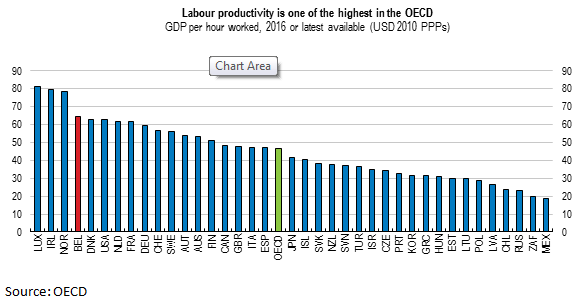
A combination of market-based policies and a redistributive welfare state have helped Belgium achieved among the highest living standards in the OECD. While the economy remains highly productive, productivity growth has slowed  over the past two decades (Figure 1 & 2). Reinvigorating productivity growth will be necessary to sustainably increase economic prosperity over the coming years.

Belgium Manav1

Belgium Manav2With a particular focus on the business environment and skills and labour market policies the 2017 OECD Economic Survey of Belgium identifies several measures that could help improve long-term productivity growth.
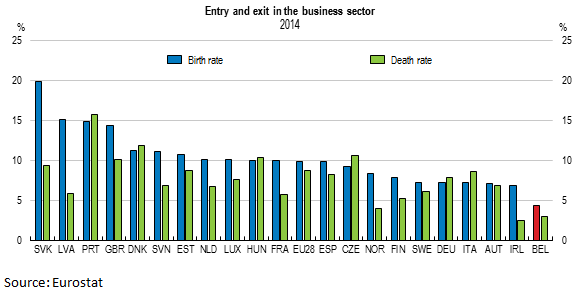
The general framework conditions in Belgium are by and large favourable for private sector activity. Nevertheless business dynamism, as measured by entry and exit rates, is weak (Figure 3). This is important because international evidence suggests that young firms contribute more than proportionately to innovation, productivity growth and job creation. The low rates of entry and exit in the business sector may reflect a dominating presence of large, established firms. Relatively high administrative burdens on start-ups, including the low threshold from which firms are required to register for VAT, and a high minimum capital requirement for establishing a firm also act as barriers to entry. Many young, innovative firms also face financing constraints, particularly in the scale-up phase, suggesting that increased access to venture capital would enhance firm dynamism.

Belgium Manav3

At around 2.5% of GDP Belgium’s spending on research and development (R&D) is above both the EU and OECD averages. However, it falls short of the Lisbon target of 3% of GDP. Moreover, the share of business enterprise R&D in total R&D spend

ing has declined over the past two decades. Public support programmes for R&D and innovation could be streamlined to improve their effectiveness, while the effectiveness of existing tax incentives for private companies should be critically assessed. Public sector entities at the different levels of government could also step up their innovation co-operation, and could do more to foster collaboration between universities and research centres, and private companies.

Belgium Manav4Productivity growth has also been held back by low public investment, particularly in transport infrastructure. Public investment declined from close to 6% of GDP in the early 1970s to just above 2% of GDP since the 1990s (Figure 4). Antwerp and Brussels are among Europe’s five most congested urban centres. Given limited fiscal space, public investment could be financed through a combination user fees, well-designed public-private partnerships, reductions in inefficient public spending, and higher non-distortionary taxes.

References:

OECD (2017), OECD Economic Surveys: Belgium 2017, OECD Publishing, Paris.