Addressing Austria’s growing flood risks

by Sébastien Turban

Intense storms have affected central Europe in recent days, causing substantial flooding, including in Austria. Although it is too soon to assess the role of climate change in this particular event, global warming will most likely significantly increase the prevalence of floods in Austria in the future. Austria is particularly exposed to flood risk and its consequences: 15% of built-up land is situated close to a river, the fifth largest percentage in the OECD. Partly in consequence, a larger share of the population is exposed to flood risk than most OECD countries (Maes et al (2022) and Figure 1). Meanwhile a relatively small share of households and businesses take out flood insurance. As discussed in the recent 2024 OECD Economic Survey of Austria (OECD, 2024), reducing the negative impact of frequent and severe floods requires a two-pronged strategy: reducing exposure through better land use and protective investments, and compensating losses through wider insurance coverage.

Figure 1. A large share of the population in Austria is exposed to floods

Share of population exposure to river flooding with a 10-year return period, 2020
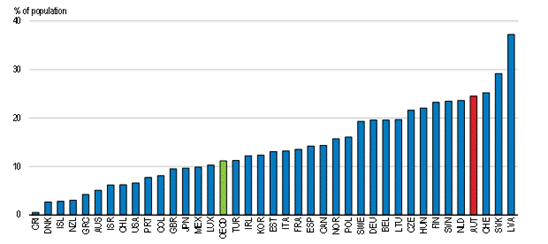
Note: A return period is the average or estimated time that a flood event is likely to recur.
Source: IEA/OECD (2023), “Climate-related hazards: River flooding”, Environment Statistics (database), https://oe.cd/dx/58w.

One reason for Austria’s high exposure to flood risk is that a lot of land has been sealed or artificialised in recent years, so called “land take”. Building residential properties on land close to rivers mechanically increases the number of people who can be affected by a flood. Sealing land, for instance through building, can weaken the ground’s capacity to absorb rainwater, thus increasing the risk of flooding. Between 2012 and 2018, the rate of land take was higher than the EU average, relative to country size, and higher than population growth (European Commission, 2022). In October 2021, the Austrian Conference on Spatial Planning was mandated to develop the first Soil Strategy for Austria, which aimed to reduce land take from 11.5 hectares per day to 2.5 in 2030 (Schamann, 2022). The strategy was to be presented at the end of 2022 but has been delayed several times. Therefore, our first recommendation is to Finalise the Soil Strategy, to reduce land take based on a quantitative objective.

Increasing the effectiveness of natural flood protection mechanisms, and deploying structural flood mitigation investments, are key levers to reduce the consequences of floods. Evidence from Austria suggests that forests can reduce run-offs into rivers including after heavy rainfall, thus limiting the risk of flooding (Markart et al., 2022). However, many of Austria’s forests are not in a good shape to perform this role; and there is room for improving their condition. Other nature-based solutions to building flood resilience can complement infrastructure investment in urban areas, such as the “eco-street” project in the municipality of Ober-Grafendorf which provides roadside green spaces to increase water absorption and reduce the run-off of rainwater into the water treatment system. Nature-based solutions are often less costly than infrastructure and can provide additional climate mitigation benefits. However, structural flood mitigation investments, such as dams, levees, and reservoirs, can be particularly cost effective in urban built-up areas. Improvements in drainage systems and the installation of permeable pavement can also improve absorption capacity. One example is the Danube side channel built by Vienna between 1972 and 1988 in order to provide flood relief.

A particular constraint for consistent policy on reducing land take and increasing adaptation investments is that spatial planning, building regulations, and infrastructure investment are typically the responsibility of local authorities. Nationwide regulations on land take could be considered. For instance,  Portugal imposes regulations restricting urban development in areas adjacent to rivers. Incentives to reduce land take and foster investment could also be provided through adjustments in fiscal equalisation transfers (a type of transfers made from central to local government). Adjustment could also be made to the coverage provided by the Austria’s Catastrophes Fund, a public fund financed by federal taxes which pays for preventive and compensation measures against natural catastrophes. Similarly, private investment by households and SMEs in adaptation measures can be incentivised by subsidised loans. In France, adapation measures can be financed by the “fonds de prévention des risques naturels majeurs” which is financed by the “Catnat” premium, a mandatory contribution from all property insurance policies (Covéa, 2023).  

Even with additional preventive measures, some of Austria’s households will remain vulnerable to the consequences of floods when they occur. Expanding the coverage of flood insurance will then be essential to reduce the socioeconomic costs of floods. Today, take up of private insurance coverage against flooding is relatively low in Austria: it has been estimated that the insurance market penetration (measured by the share of assets’ values that are covered by insurance) against river flooding was 5% in Austria in 2022 against 40% in Germany or 100% in France and Switzerland, where coverage is compulsory (Insurance Europe, 2022). Because Austria is highly exposed to future flood risk, an estimation by the European Commission suggests that it has the largest protection gap in the EU (the protection gap provides an estimation of the share of future climate-related disaster losses which is uninsured today) (Radu, 2022).

Enhancing public awareness of flood risk would help raise the take up of insurance. Recent initiatives by the Austrian government have proven particularly helpful. It has developed an online mapping tool, HORA, in collaboration with the Austrian Insurance Association. The tool enables individuals to make an initial assessment of the flood risk of their dwelling. Other informational materials available to the public include CLIMA-MAP, which maps climate change impacts in Austria’s municipalities and regions.

Greater public awareness needs to be accompanied by fundamental changes to flood insurance. The objective should be broad coverage at an affordable price while being able to cover large losses. Experiences from European and OECD countries suggest that this could be achieved by mandating the inclusion of flood insurance as part of general housing insurance products, while providing public reinsurance for catastrophic losses (OECD, 2005; Kuik et al., 2017). In France, for example, private insurers must include insurance against flood risk in property insurance policies. Coverage is funded from a fixed share of all premiums. Insurers in turn benefit from government-backed reinsurance through the “Catnat” system. A state guarantee ensures that damages from extreme events can be covered. Austria could consider an approach along these lines; mandating comprehensive flood insurance in homeowners’ insurance policies and setting the Catastrophes Fund as a public reinsurer.

References

Covéa (2023), “Livre Blanc – Risque Climatique : Quelles préventions ?”, https://www.covea.com/sites/default/files/2023-05/livre_blanc_covea_risque_climatique_quelles_preventions_202305.pdf.

European Commission (2022), “Environmental Implementation Review”, https://eur-lex.europa.eu/legal-content/EN/TXT/?uri=comnat%3ASWD_2022_0274_FIN.

Insurance Europe (2022), “Property catastrophe insurance – Austria”, https://assets.foleon.com/eu-central-1/de-uploads-7e3kk3/48290/property_catastrophe_insurance_-_austria.9122c134f1a1.pdf.

Kuik, O. et al. (2017), “Insurance of weather and climate-related disaster risk”, European Commission, https://data.europa.eu/doi/10.2834/40222.

Maes, M. et al. (2022), “Monitoring exposure to climate-related hazards: Indicator methodology and key results”, OECD Environment Working Papers, No. 201, OECD Publishing, Paris, https://doi.org/10.1787/da074cb6-en.

Markart, G. et al. (2022), “Flood Protection by Forests in Alpine Watersheds: Lessons Learned from Austrian Case Studies”, in Protective Forests as Ecosystem-based Solution for Disaster Risk Reduction (Eco-DRR), IntechOpen, https://doi.org/10.5772/intechopen.99507.

OECD (2024), OECD Economic Surveys: Austria 2024, OECD Publishing, Paris, https://doi.org/10.1787/60ea1561-en.

OECD (2005), Catastrophic Risks and Insurance, Policy Issues in Insurance, No. 8, OECD Publishing, Paris, https://doi.org/10.1787/9789264009950-en.

Radu, D. (2022), “Disaster Risk Financing: Limiting the Fiscal Cost of Climate-Related Disasters”, European Commission Discussion Paper 174, https://economy-finance.ec.europa.eu/publications/disaster-risk-financing-limiting-fiscal-cost-climate-related-disasters_en.

Schamann, M. (2022), “First Soil Strategy of Austria”, SURFACE Final Conference, https://www.ufz.de/export/data/464/262037_First%20Soil%20Strategy%20of%20Austria.pdf.

Austria: Addressing three major challenges for a stronger and more sustainable recovery

By Dennis Dlugosch and Rauf Gönenç, OECD Economics Department

Austria faces several challenges. Beyond the immediate task to minimise the human and economic costs of the pandemic, structural reforms to ensure the long-run sustainability of public finances, to promote more and better employment and the transition to a greener economy are key priorities for delivering on stronger and greener growth than before the pandemic.

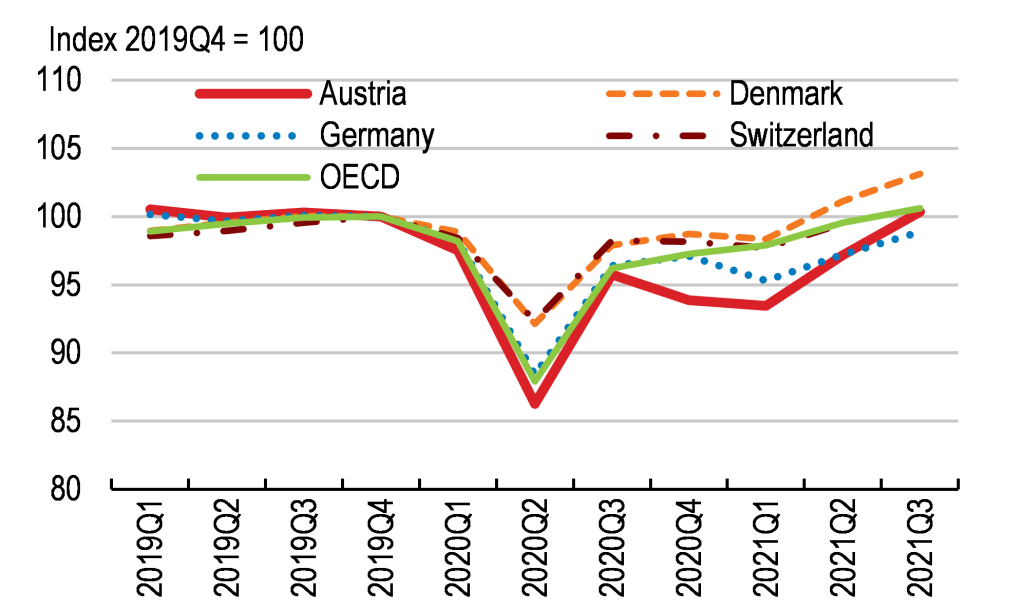
While the country-wide lockdown to contain the fourth wave of COVID-19 infections weighed on growth during the last two months of 2021, GDP is projected to recover quickly and grow by around 5% in 2022 and 2.5% in 2023. Bold fiscal stimulus, using the fiscal space made available by prudent management in the past, supported the resilience and recovery of the economy and limited job losses and bankruptcies. Subsequently, economic activity grew faster than expected in the first three quarters of 2021 and the level of economic activity has surpassed its pre-crisis levels already in the summer of 2021 (Figure 1).

Figure 1. The economy is recovering fast from a severe shock

Real GDP

Source: OECD (2021), OECD Economic Outlook: Statistics and Projections (database).

Near-term risks to the outlook are tilted to the downside. New sanitary restrictions would reduce growth prospects, notably in hospitality sectors which contribute significantly to Austria’s incomes and regional cohesion by providing jobs in remote areas.

The OECD Economic Survey of Austria 2021 highlights three key economic policy challenges. First, policymakers need to restore medium-term fiscal sustainability. This will help to address the high level of public debt as compared to national standards following the ample economic and social supports mobilised during the pandemic. The second big challenge is to boost labour force participation, particularly of women and seniors. Shortfalls in labour force participation are weighing on economic growth and public finances, and denting individuals’ living standards. The third key policy challenge is aligning total greenhouse gas emissions with the intendent trajectory. Plans to phase in carbon prices starting from 2022 are welcome. Reaching the ambitious 2040 goal – 10 years before the EU target date – will nevertheless be difficult.

I. Ensuring long-term fiscal sustainability

Following effective anti-COVID fiscal supports, the gross public debt is projected to increase from 70.6% in 2019 to around 80% of GDP by 2022 (Maastricht definition). This level is elevated compared to national historical standards and may restrict the authorities’ fiscal room of action in the future.

New spending pressures are arising from population ageing and other policy needs, such as investments in decarbonisation and digitalisation of the economy. The share of public spending in GDP is already high, at around 50% of GDP in 2019. The additional demands for public investment and expenditure will require new prioritisation procedures to protect fiscal sustainability. A medium-term fiscal consolidation strategy, including a strengthened medium-term expenditure framework covering the federal government, Lander and municipalities, that spars room for needed fiscal action in the future should complement the prioritisation procedures.

II. Creating more and better jobs

The pandemic has exacerbated vulnerabilities on labour markets. Long-term unemployment soared in the second half of 2020, although from a relatively low rate, before declining partially. Skill mismatches have increased in all regions and labour and skill shortages constitute a major impediment to faster activity growth in many sectors. These shortages have been amplified as some immigrant workers have returned to their home country during the pandemic. There is considerable potential for higher labour force participation by certain population groups, including women and seniors.

Facilitating the participation of senior workers who retired too early from the labour force is essential. Key in this regard would be to improve rehabilitation and up-skilling measures, further reform access to disability pensions, and enhance incentives to continue working at an old age by adapting working conditions.

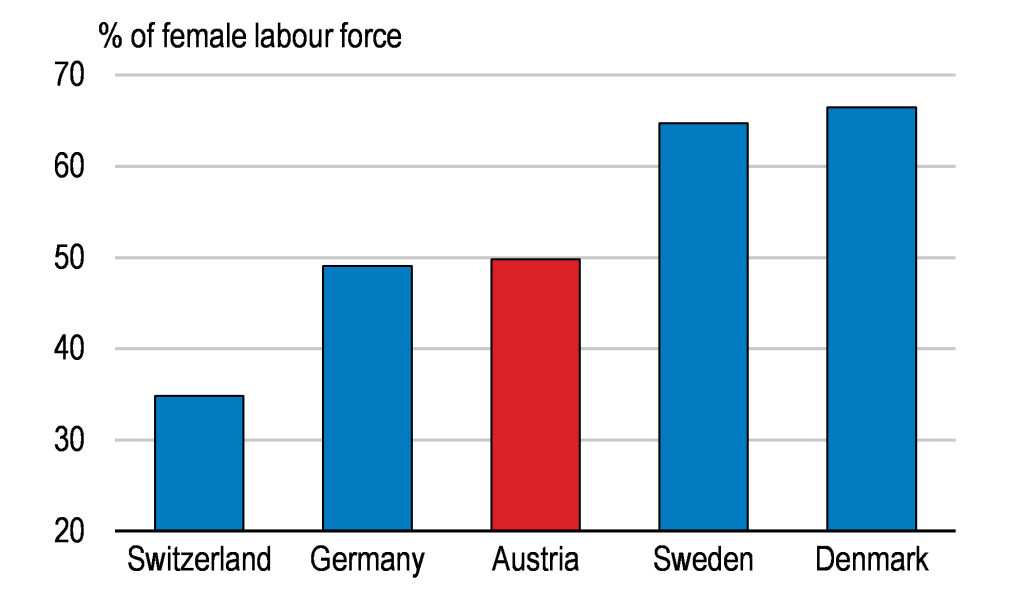
Figure 2. Labour force participation of women could improve further

Full-time female employment rate, 20-64 year-olds, 2020

Source: Eurostat (2021), Labour Force Survey Statistics.

Full-time employment of working-age women in Austria needs to increase. It currently stands at only 50%, well below the EU average of 65% (Figure 2). The Survey recommends to bolster the availability and quality of early child care services throughout the country, including in rural areas. Austria has one of the lowest enrolment rates in early childhood education and care in the OECD. The OECD also recommends encouraging the balance use of parental leaves for a more equal sharing of paid and unpaid work between mothers and fathers.

III. Ensuring a fair and efficient transition towards a green economy

Austria’s ambitious target of carbon neutrality by 2040 – 10 years earlier than the EU goal – is welcome. Austria has already a high share of renewables in total energy supply and a new law that aims to shift the country to 100% carbon-free electricity by 2030. However, the carbon intensity of the economy has not declined in the most recent years, and has fallen behind comparable countries.

The recently announced Eco-Social Tax Reform is a major step forward in the pricing of emissions. It will help foster a market-oriented approach to carbonless growth. Further emission cuts will nevertheless be needed across all sectors, particularly in transportation, buildings and industrial processes, where the potential is large.

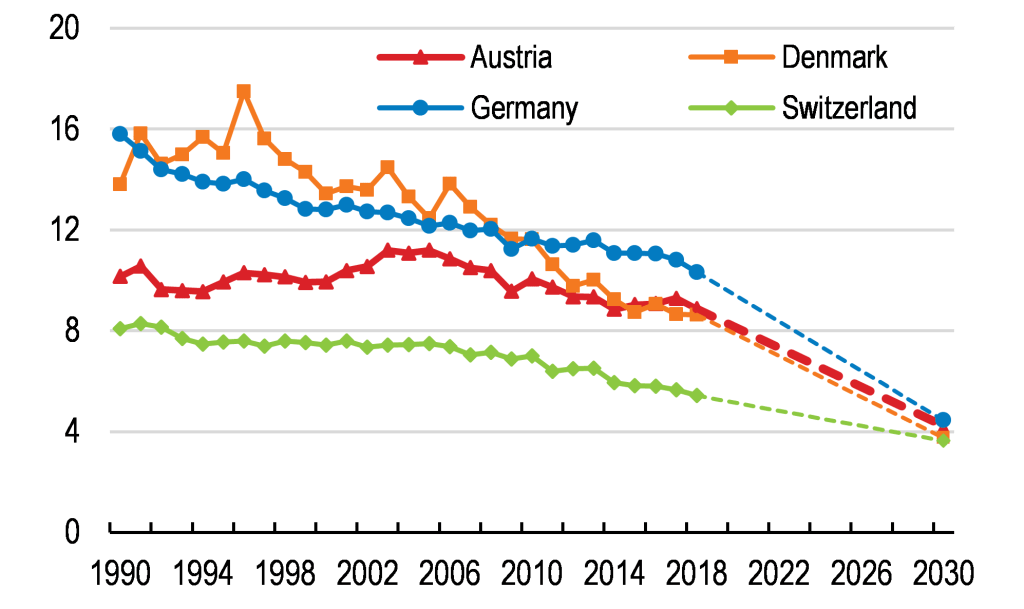
Figure 3. Austria is not on track to reach its Paris agreement targets

Per capita metric tons of CO2 equivalent

Note: Total GHG emissions exclude LULUCF (land-use, land-use change and forestry). Scatters in 2030 indicate IMF implied unconditional nationally determined contribution (NDC) economy-wide target levels on GHGs excluding LULUCF. The population estimate for 2030 is based on the UN population data with the medium-variant projection. Dotted lines refer to the linear emission trajectories required to reach the announced targets in 2030.
Source: OECD calculations based on IMF Climate Database, and United Nations (2019). World Population Prospects 2019.

New emission regulations will have to be introduced. Carbon prices will need to be harmonised and increased further. Austria needs to better leverage its remarkable capabilities in the area of R&D to expand emission-saving innovations. More rigorous climate policies would however have important distributional impacts. The users of carbon-intensive goods and services (including fossil fuel cars and poorly insulated houses) would be strongly affected. Compensation for low-income households would need to be combined with forward-looking disclosure of the intended regulatory and price changes after 2025, to improve medium-term predictability and help firms and households to adjust well in advance.

References

OECD (2021), OECD Economic Surveys: Austria 2021, OECD Publishing, Paris, https://doi.org/10.1787/eaf9ec79-en.

OECD (2019), OECD Economic Surveys: Austria 2019, OECD Publishing, Paris, https://doi.org/10.1787/22f8383a-en.


Embracing digitalisation to boost Austria’s growth potential

by Rauf Gonenc and Volker Ziemann, Austria Desk, OECD Economics Department.

Digitalisation will redesign production processes and alter relationships between work and leisure, capital and labour, the rich and the poor, the skilled and the unskilled. It creates opportunities to boost inclusive growth and well-being by raising productivity, enhancing private and public services, and democratising information. However, digitalisation is inherently disruptive and raises concerns about a division of societies into winners and losers. Two questions arise for policy makers: how to ensure equality of opportunities in the race with technology and how to find the appropriate level of redistribution of the gains associated with digitalisation to preserve social cohesion.

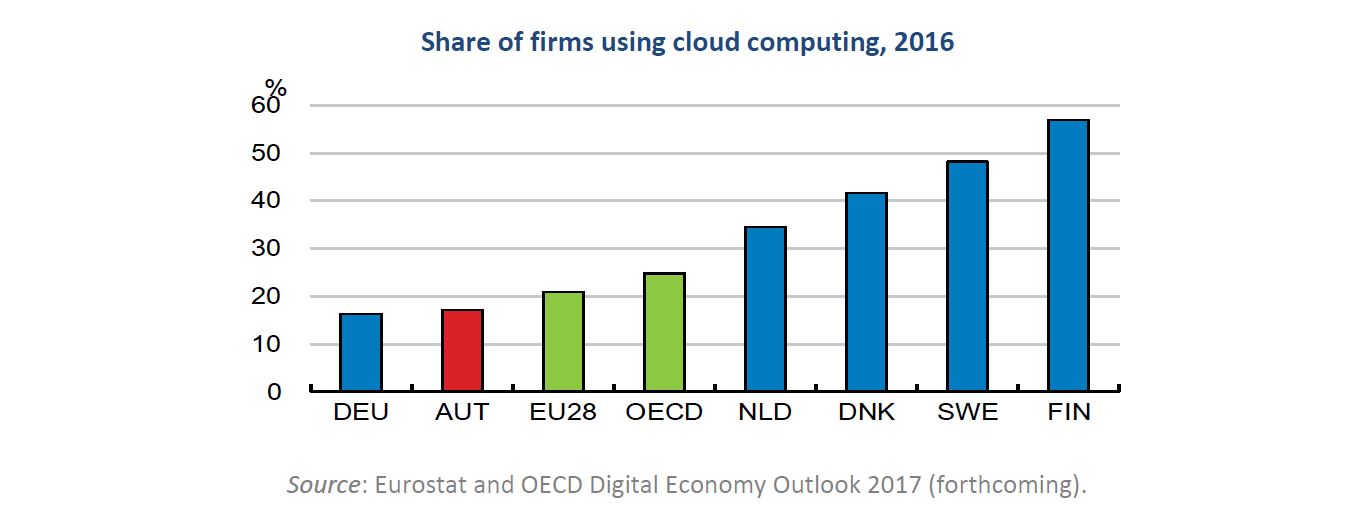
Austria’s business sector is adapting to the global digital revolution, albeit at a slower pace than in the most advanced countries, especially among smaller firms (see Figure below). The adoption of information and communication technology applications by households is also uneven: while the young and highly educated swiftly follow global trends, older generations, individuals with lower education and immigrants lag behind. The authorities recognise the importance of helping people and firms to embrace digitalisation and have designed a “Digital Roadmap” around 12 guiding principles. Achieving the set objectives will require a transparent monitoring system with clear timelines and quantitative targets.

Austria graphic

The ability of firm owners to fully embrace digitalisation and renew their business models should be further enhanced through awareness-raising and skills initiatives. On another front, stronger incentives, including financial ones, may be needed to encourage households to adopt e-government solutions. More generally, raising awareness for benefits arising from digitalisation and addressing potential challenges including by fostering trust and consumer protection are key ingredients for a successful and inclusive transition to the digital economy.

Many occupations may be automated in the near future. Others will see their tasks radically transformed. Researchers at the OECD and elsewhere have identified skills and tasks that are less likely to be affected and more likely to be complementary to digital technological change, notably activities requiring creative and social intelligence. Compared to the most digitised countries, such tasks seem to be less prevalent in Austria. Therefore, Austria should further develop basic digital skills and raise awareness of digital gaps. A wide-ranging education reform addresses these challenges and ought to be implemented swiftly. Finally, life-long learning solutions need to be developed further to upgrade skills of middle-aged and older workers.

Find out more:

OECD (2017), OECD Economic Surveys: Austria 2017, OECD Publishing, Paris.


Growth is picking up in Austria but fundamentals need to be strengthened

by Rauf Gonenc and Volker Ziemann,  Austria Desk, OECD Economics Department

After several years of subdued growth, economic output accelerated in 2016 supported by a tax reform that entered into force in 2015-16, and more recently a pick-up in international trade. The upturn has improved fiscal balances, and the public debt ratio, though still high, is on a downward path. The improvement in the macroeconomic situation has strengthened business and household confidence and the short-term outlook is favourable.

Nonetheless, the OECD 2017 Economic Survey of Austria suggests that Austria may be adapting too slowly in a rapidly changing environment, including with respect to digitalisation. Austria’s strong position in regional value chains has suffered somewhat since 2012 amid intense competition with catching-up Eastern European countries notably in supplying traditional key partners such as Germany or Italy. On the other hand, Austria has managed to gain export market shares in countries like the United States, China, India or Japan which, together with vibrant tourism, has kept the current account in positive territory.

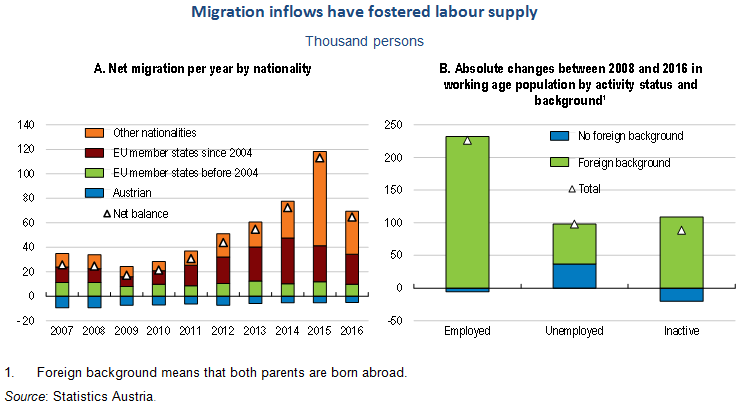
Austria’s labour force and employment have expanded strongly in recent years largely driven by migration from new EU member states and, especially in 2015, by refugee inflows (see Figure below). Pension reforms limiting pathways to early retirement have induced a strong increase in employment of older workers albeit from very low levels in international comparison. Labour participation of women has also improved, though mainly through part-time work reflecting prevailing gender-inequalities, which were analysed in detail in the OECD 2015 Economic Survey of Austria.

Austria 2017 macro

The resulting decline in average hours worked per person contributed to the decline in trend growth observed since the beginning of the 2000s, alongside the slowdown of both the capital stock and total factor productivity. While Austria shares these trends with most, if not all, other advanced OECD countries, some specific weaknesses emerge. Geographical mobility is low and the labour tax wedge remains high. OECD indicators further suggest that, despite some progress, retail and professional services are over-regulated. Enterprise churn rates are lower than in comparable countries which may be partly driven by restricted financing options. Austria has recently launched a crowd-financing initiative, but external financing of start-up and small firms remains overly reliant on bank credit and venture capital is scarce. The government’s January 2017 policy package will help reduce some of these bottlenecks provided that the political process surrounding the October 2017 snap elections does not undermine its implementation.

Find out more:

OECD (2015), OECD Economic Surveys: Austria 2015, OECD Publishing, Paris.

OECD (2017), OECD Economic Surveys: Austria 2017, OECD Publishing, Paris.