



By Filippo Gori and Álvaro Pina, OECD Economics Department
The COVID-19 pandemic precipitated Europe into a recession of unprecedented nature and magnitude. Owing to a rapid and effective policy response to the crisis, the recovery in Europe is now firming up, but there is no room for complacency. To achieve stronger growth than before the pandemic and weather well future shocks, the EU needs to enhance both its economic resilience and its territorial cohesion. To achieve this, the 2021 OECD Economic Surveys of the European Union and the Euro Area focus on two closely related aspects: (i) improving cyclical convergence among member states and (ii) spurring convergence in living standards across EU regions.
Increasing cyclical convergence in the euro area
In the aftermath of the global financial crisis, large differences in business cycles across euro area countries developed into diverging economic paths for hardest hit economies. Today, the COVID-19 pandemic is again affecting euro area economies differently and posing risks of diverging economic trajectories. Europe needs to ensure that no country is left behind during the recovery.
Cyclical divergence in the euro area has deep roots, including heterogeneous national economic structures that enhance the likelihood of asymmetric shocks. In the years following the introduction of the euro, the removal of trade and investment barriers led to spatial agglomeration of economic activities according to national or regional competitive advantages (Fontagné and Freudenberg, 1999; Mongelli et. al, 2016). Heightened competition and agglomeration economies favoured sectoral concentration, resulting in greater divergence in the productive structure of individual countries (Figure 1. B). Though industrial heterogeneity among euro area countries is still milder than across the United States (Figure 1.A), the dispersion in GDP growth among euro area members has tended to be higher than across US states, peaking during downturns (Figure 1. C).
This suggests that industrial polarisation alone cannot explain the relatively high cyclical divergence in the euro area. Much of this divergence is instead explained by policy and institutional frameworks.
Figure 1. Differences in industrial structures among euro area members have been rising


2. Gross value added by NACE activities, EA17.
3. Coefficient of variation for annual GDP growth across 50 US States and EA17 countries. EA17 include all other euro area members that are also part of the OECD.
Source: OECD (2020), OECD Economic Outlook: Statistics and Projections (database); Eurostat
To reduce cyclical divergence in the currency union, the 2021 OECD Economic Survey of the Euro Area suggests policy reforms in three directions:
- More resilient labour markets. In this regard, euro area countries should strengthen policies that preserve viable jobs during major downturns, such as job retention schemes (JRS), and ease workers’ transition to new jobs through skilling and activation.
- A more effective single market for capital and stronger banks. In the current context, this requires supporting European banks to deal with a possible new wave of non-performing loans (NPLs) by designing better insolvency and loan foreclosure procedures, improving regulatory policies, and developing secondary markets for distressed assets. To strengthen European banks it is also necessary to complete the banking union, notably by setting up a common deposit insurance scheme.
- The introduction of common fiscal capacity: Fiscal integration remains one of the most important missing features of the euro area. The euro area should consider setting up a common fiscal stabilisation capacity through an unemployment re-insurance scheme.
Enhancing the convergence between regions
Over the decades, the European Union gained the reputation of a “convergence machine” (Gill and Raiser, 2012), helping its poorest member states narrow the gap to their richer partners. Since the turn of the century, however, the convergence machine has become less well oiled. Central and Eastern European countries have been converging, but Southern Europe has lost ground (Figure 2). In addition, within countries, remote rural regions have fallen further behind large cities, and especially capitals. Growing territorial inequalities threaten social cohesion and weaken growth potential in Europe as a whole.
Figure 2. Southern and Eastern European countries have had a contrasting growth performance

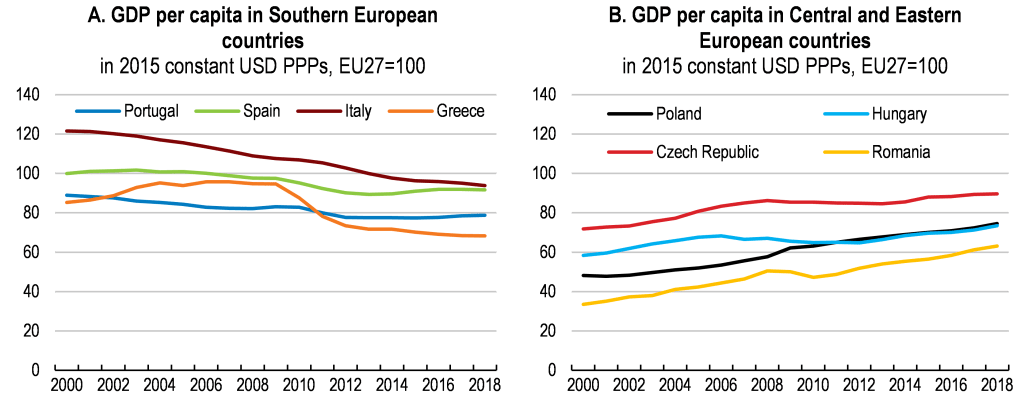
Why has convergence faltered? Part of the explanation lies in global trends, such as digitalisation, which has mainly benefitted large cities, and stronger competition from emerging economies, which has hurt some industrial regions. Indeed, a growing spatial concentration of manufacturing – Figure 1.B – has also taken place at regional level. But European-specific factors have also played against convergence. Incomplete financial integration and procyclical fiscal policies have led to the expansion of low-productivity non-tradable sectors, such as construction, in the run-up to the global financial crisis, and to abrupt adjustment and divergence in its aftermath. This cyclical divergence, discussed above, has particularly affected Southern Europe. Furthermore, growth and innovation in the EU as whole, including in many wealthy regions, has often been modest, limiting the ability to generate spillovers across the Union.
How can poor regions prosper? The above reforms to reduce cyclical divergence will help. In addition, the 2021 OECD Economic Survey of the European Union suggests policy recommendations in two main directions:
- Place-based policies, tailoring different sectoral policy interventions to region-specific circumstances, can help upgrading the productive specialisation of lagging regions. Cross-regional cooperation in innovation and transport can play an essential role on this count, by for instance fostering capacity building in poorer regions and helping them gain better access to markets and a shorter travel time to thriving large cities.
- The European Union should also use more effectively Cohesion Policy and the Common Agricultural Policy (CAP) to support regional convergence. A stronger focus on innovation is needed: more cohesion funds should be devoted to R&D projects, and the CAP needs to promote generational renewal in agriculture. At the same time, these policies should not end up propping up inefficient firms or activities, which may happen, for instance, due to weak competition in public procurement.
References
Fontagné, L., and Freudenberg, M. (1999), “Endogenous symmetry of shocks in a monetary union”, Open economies review, Vol. 10 Issues 3, p.p. 263-287.
Gill, I. S. and M. Raiser (2012), Golden growth: restoring the lustre of the European economic model: Overview (English). Europe and Central Asia Studies Washington, D.C.: World Bank Group. http://documents.worldbank.org/curated/en/723961468032339818/Overview
Mongelli, F. P., Reinhold, E., and Papadopoulos, G. (2016) “What’s so Special About Specialisation in the Euro Area?” ECB Occasional Paper, No. 168, European Central Bank, Frankfurt.
OECD (2021), OECD Economic Surveys: Euro Area 2021, OECD Publishing, Paris. https://doi.org/10.1787/214e9f0a-en
OECD (2021), OECD Economic Surveys: European Union 2021, OECD Publishing, Paris. https://doi.org/10.1787/a77ab220-en