

by Orsetta Causa and Jacob Pichelmann


Promoting residential mobility is not an end in itself, still it is an important policy challenge, especially in countries with large spatial disparities and labour market skills mismatches. Policies that remove disincentives to move are likely to bring efficiency and equity gains by lifting productivity growth and social mobility. Residential mobility is one way to encourage labour market adjustment and reallocation to encourage a smooth recovery from the Covid-19 crisis.
Recent work by Causa and Pichelmann (2020) presents new evidence on housing and residential mobility across OECD countries and on the role of individual factors and policies, in particular housing policies, in enhancing or hampering mobility. The evidence strongly supports the view that housing conditions and structural policies influence people’s decisions and possibilities to move.
To set the scene, there is a strong negative association between countries’ homeownership rates and their mobility rates, confirming previous evidence in this area. Mobility is particularly low in Eastern European countries exhibiting very high homeownership rates for historical reasons and also in large Southern European countries (e.g. Italy and Spain). The negative cross-country association between homeownership and residential mobility arises because across all countries, homeowners, whether outright owners or owners paying back mortgage debt, are much less mobile than renters, controlling for an extensive array of individual and household drivers of mobility.

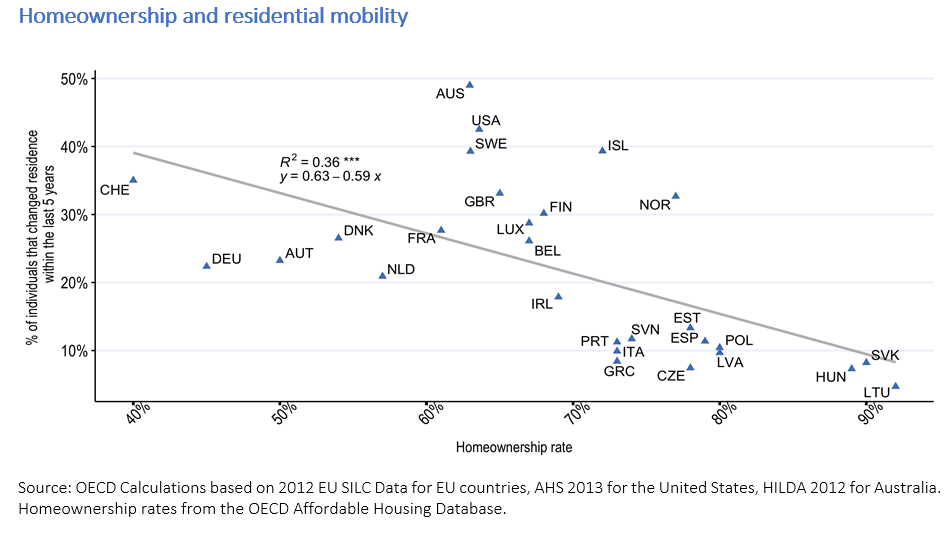
By influencing mobility, the housing market can give rise to externalities, in particular on the labour market. The implication is that housing conditions and policies that magnify the cost of moving are likely to affect economic efficiency and equality of opportunities. Analyzing the policy drivers of residential mobility yields the following findings:
- A more responsive housing supply is associated with higher residential mobility. Reducing policy-driven barriers in this area, for example reforming poorly designed land-use and planning policies, may facilitate moving by reducing house price differences across locations.
- Stricter rental regulations are associated with lower residential mobility, particularly for low-educated and low-income households. Rental regulations need to strike a balance between tenants’ and landlords’ interests, create security of tenure and encourage the supply of rental housing for all socio-economic groups.
- Social cash and in-kind spending on housing are positively correlated with residential mobility. While housing allowances are in principle more favorable to mobility than direct provision of social housing, the latter can be designed to avoid lock-in effects, for example, by waiving residency or queuing requirements in the case of unemployed workers taking up a job in the region.
- Higher transaction costs in buying and selling a home, in particular from transfer taxes and notary fees, are associated with lower residential mobility, especially among younger households, which are more likely to be first time-buyers.
- Tax reforms shifting housing taxation from non-recurrent (e.g. transfer) to recurrent taxes would help reducing barriers to mobility, on top of making the tax system more efficient with positive aggregate growth effects.
- Beyond housing policies, more generous cash income support to low-wage jobseekers and minimum income schemes embedded in social transfers are positively associated with residential mobility. By contrast, excessive job protection on regular contracts is negatively associated with mobility, particularly for youth, low-income and low-educated individuals. This suggests that shifting protection from jobs to individuals coupled with job counselling and training may help removing barriers to mobility.


This study highlights the importance of removing policy-driven obstacles to mobility and offers insights enabling policy makers to balance between encouraging people to move from less to more productive areas and avoiding the emergence of left-behind areas. It poses the question whether tax-favoring of owner-occupied housing is in need of rethinking and makes a case for reducing tax-driven barriers to mobility, such as housing transfer takes, while taking resilience implications into consideration. The findings underline the importance of housing-related policies that support affordability, especially for households at the bottom of the distribution: well-designed housing allowances and social housing, balanced rental market regulations, and a responsive housing supply.
Further reading:
Causa, O. and J. Pichelmann (2020), “Should I stay or should I go? Housing and residential mobility across OECD countries”, OECD Economics Department Working Papers, No. 1626, OECD Publishing, Paris, https://doi.org/10.1787/d91329c2-en