Overcoming persistent obstacles to growth in South Africa

By Nikki Kergozou and Lilas Demmou, OECD.

South Africa, under the Presidency’s Operation Vulindlela, has embarked on bold reforms to address key obstacles to economic growth. Keeping this reform momentum is critical: GDP growth has averaged only 0.7% per year over the past decade. The persistently sluggish pace of GDP growth has failed to significantly raise GDP per capita, expand labour market participation, or improve living standards for the majority of South Africans. The economy’s high emissions intensity presents an additional challenge, as renewed growth may amplify environmental pressures.

In this context, the new 2025 OECD Economic Survey of South Africa (OECD, 2025) contains four main messages:

  1. The macro-economic policy framework needs to be strengthened to make the economy more resilient.
  2. Transforming the electricity sector to ensure energy security is vital for economic growth and would, in addition, facilitate the green transition.
  3. Greater inclusion of South Africans in the labour market is essential for social cohesion and poverty reduction.
  4. The prospect of higher growth requires speeding up reforms to reduce emissions.

An enhanced macro-economic framework is a prerequisite for stronger sustainable growth. South Africa’s 3-6% inflation target is high and its mid-point is well-above that of other major trading partners. Lowering the inflation target and considering reducing the band around it would help achieve lower inflation and support competitiveness. Public debt has surged from 31.5% of GDP in 2010 to a projected 77% in 2025 (National Treasury, 2025) and rising debt-servicing costs of around 5% are squeezing fiscal space, limiting the government’s capacity to finance social programmes and public investment. Stricter spending controls through reinforced spending rules, and improved governance would help improve the fiscal position and eventually reduce debt. Enhancing the efficiency of tax services, while raising value-added and property taxes, would also contribute to increase revenue collection.

A key structural reform to ensure that growth can be higher in a sustainable way is to ensure that electricity provision is sufficient for businesses to operate. Power outages, or “loadshedding” were estimated to have reduced economic growth by 1.5 percentage points in 2023 (SARB 2024). In addition to directly reducing efficiency, a loss of confidence in the electricity system weakens incentives to invest and deters new market entrants. Significant progress has been made but a lot remains to be done to put electricity outages behind us. Priority should be given to establishing a competitive wholesale electricity market, expanding the transmission grid, and improving municipality’s capacities to deliver electricity effectively. Reforms to municipal management and financing should prioritise earmarking electricity revenues to reduce cross-subsidisation, enhancing property tax collection and exploring distribution concessions.

Many South Africans struggle to find work: the country has the lowest employment rate and the highest unemployment rate among G20 economies. Reforms are needed to help firms create more jobs and to also help workers better connect with job opportunities. Restrictive regulations constrain firms’ ability to enter the market and expand, limiting job creation. Urban sprawl and insufficient public transport lead to lengthy, expensive commutes that pose challenges for workers to connect with employment. Promoting densification, and prioritising housing near public transport and development corridors would help.

As reforms leading to higher growth would put upward pressure on greenhouse gas emissions, South Africa will face additional challenges in meeting its climate goals. In addition, the country is highly vulnerable to the changing climate. A greener economy requires higher carbon prices, an enhanced policy framework for faster implementation of policies, and improved public transport so that people use their cars less often. In parallel, adaptation to climate change needs to be accelerated, notably by reducing the severe under resourcing of municipalities, who have a key role to play in climate policies.

References


Addressing labour market challenges for sustainable and inclusive growth in Israel

By Michael Koelle, OECD Economics Department

Strong employment growth in Israel has accounted for about two-thirds of GDP growth in the last three decades. The population has doubled since 1990 due to high fertility and immigration. Migrants, many from the former Soviet Union, were successfully integrated into the labour market. Women’s labour force participation rose strongly and is now significantly above the OECD average (Figure 1). These gains are even more impressive considering the still high fertility rate of three children per woman, almost double the OECD average. The COVID-19 pandemic did not leave a lasting trace in the labour market thanks to decisive policy support and the strength of Israel’s high-tech sector.

Figure 1. Women’s labour force participation increased strongly

Source: OECD Labour Statistics database.

Demographic change will imply a rising share of population groups with weaker labour market outcomes. Some groups, such as Arab-Israeli women and Haredi (Ultra-Orthodox) men, still have significantly lower employment rates (Figure 2). Moreover, women as well as Arab-Israelis and Haredim of both genders often work in lower productivity sectors and face sizeable wage gaps. If these disparities are unaddressed, future productivity growth, progress in living standards and fiscal sustainability will be at risk.

Figure 2. Labour market and wage disparities are high

Source: OECD (2023), OECD Economic Surveys: Israel 2023.

To sustain broad-based progress in living standards, Israel needs to find ways to improve labour market outcomes along both participation and quality of employment. The 2023 OECD Economic Survey of Israel suggests reforms in three broad areas:

  1. Improving skills. Employment and wage gaps are partly a reflection of skills gaps. The fragmentation of the education system is reflected in learning outcomes. The school a student attends matters more for test scores than in most other OECD countries. As a result, some young Israelis have outstanding skills, while the majority lag behind their peers in other OECD countries. At the level of secondary schools, better aligning public funding with teaching needs and core subject instruction would help those with the weakest learning outcomes to catch up. At the post-secondary level, work-based vocational education and training (VET) could be strengthened. A national qualifications framework that maps and relates the skills content of different VET, college, and university degrees, would help improve modular learning and pathways for educational mobility at different stages in life.
  2. Fostering labour market participation. The tax and benefit system plays an important role in incentivising or – if it is poorly designed – disincentivising labour market participation. The Israeli tax and benefit system in general sets strong pro-work incentives. Some elements, however, could be strengthened to improve its effectiveness in encouraging labour force participation. For example, the successful Earned Income Tax Credit (EITC) scheme could provide greater support for second earners, to lift low-income families out of poverty. Women’s opportunities to participate in all parts of the economy could be improved. More childcare offers are needed in Arab towns and villages. Introducing paid paternity leave, like most other OECD countries have done by now, would encourage fathers to take on a more equal share of care tasks at home.
  3. Increasing job mobility. Pay differences may be also the result of the lack of mobility into high-paying jobs and firms. Wage differences across sectors are larger in Israel than in other countries, reflecting limited labour mobility and reallocation into higher productivity sectors. Despite progress in education, some population groups are still massively underrepresented in the well-paying high-tech sector. For example, Arab men are 80% less likely to work in high-tech than the general population, despite majoring in STEM at similar rates. A comprehensive strategy to broaden the high-tech talent pool could include expanding foundational skills in middle school, coding bootcamps, and internship and mentoring programmes. This would expand opportunities to Israelis from all backgrounds. Reforms to ease housing and transport infrastructure development would increase geographical mobility. Better broadband coverage would ease remote working even in rural areas.

Reference:

OECD (2023), OECD Economic Surveys: Israel 2023, https://doi.org/10.1787/901365a6-en.


Updating the Polish economy: how to digitalise and boost productivity

By Srdan Tatomir, OECD Economics Department

Poland experienced remarkable economic progress over the last three decades. Living standards have risen from around half the EU average in 1995 to close to 80% in 2021. Poland has substantially increased educational attainment and boosted skills, and Polish firms have successfully integrated into European and global markets. Digitalisation can help to sustain this success as our recent Economic Survey suggests.

While most firms in Poland already employ digital technologies, their use could be more extensive. Total investment in ICT and R&D is well below the OECD average and this is reflected in comparatively lower adoption of individual digital technologies (Figure 1). Most firms have a website, but e-commerce is not widespread. The use of software for managing customer relationships and enterprise resources is average by OECD standards and the adoption of more advanced technologies, such as cloud computing and big data, lags behind most OECD countries. In particular, the use of robots is low compared to other European countries, such as the Czech Republic and Slovakia (Leśniewicz and Święcicki, 2021). Small and medium-size enterprises (SMEs) are less digitalised than larger firms and, given that they account for two thirds of all employment and half of all output, this is where policy should focus.

Figure 1 – Digital technology adoption is relatively low in Poland

Diffusion of selected ICT tools and activities in enterprises, 2021 or latest
As a percentage of enterprises with ten or more persons employed

Note: CRM = customer-relationship management. Enterprise resource planning (ERP) systems are software-based tools that can integrate the management of internal and external information flows, from material and human resources to finance, accounting and customer relations. Here, only sharing of information within the firm is considered. Cloud computing refers to ICT services used over the Internet as a set of computing resources to access software, computing power, storage capacity and so on. Supply chain management refers to the use of automated data exchange applications. Big data analysis refers to the use of techniques, technologies and software tools for analysing big data. This, in turn, relates to the huge amount of data generated from activities that are carried out electronically and from machine-to-machine communications. Social media refer to applications based on Internet technology or communication platforms for connecting, creating and exchanging content online with customers, suppliers or partners, or within the enterprise. Radio frequency identification (RFID) is a technology that enables contactless transmission of information via radio waves.
Source: OECD ICT Access and Usage by Businesses Database.

Digital investment in firms is relatively low for a number of reasons. Firms in Poland tend to overestimate their own technological sophistication (World Bank, 2022). When they consider digital investments, they often undervalue the benefits and overestimate the costs. A lack of time and adequate skills are also cited as obstacles.

The government is already taking action. The ‘Future Industry Platform’ foundation was set up to accelerate the digital transformation of industry through promotion of and technical support for new technology adoption. The Polish Agency for Enterprise Development, known in Poland as PARP, is currently running several pilot programmes to support digitalisation.

To facilitate digital investment in firms, the authorities should consider expanding targeted technical and advisory support. Many ICT investments can be profitable, but SMEs often lack the knowledge and skills to choose the appropriate ICT tools, which results in low investment demand. Thus, there is a need for proactive consultancy and advisory services. For example, Denmark and Austria operate programmes for SMEs that help them to identify digital opportunities and then to implement the new technologies.

Digital technologies require skilled people to use them. Skilled managers are important in identifying new technologies and implementing them (Zadura-Lichota, 2015). Management skill levels are broadly average in Poland, relative to other European countries, but could be increased. Managers also need workers with digital skills to install and operate new digital technologies. However, adults’ digital skills, particularly among older adults, are relatively low (Figure 2). People in Poland tend to use ICT for simple tasks, such as searching for information and using social media, while the use of ICT for work purposes is less widespread.

Figure 2 – Digital skills lag behind most European countries

% of individuals who have basic or above basic overall digital skills, by age group, 2021

Source: Eurostat.

Lifelong learning is key to developing digital skills. Adults need to continue to learn digital skills, but participation in formal adult learning is low as firms tend to underinvest in training (Figure 3). This is mainly due to little perceived need for further training, as well as family responsibilities and scheduling issues. Better awareness of the benefits of adult learning, coupled with more extensive and detailed counselling, could encourage adults to develop their digital skills. Adult learning also needs to be made more flexible and modular so that it fits around work and personal duties. Many Polish people learn in less formal ways, such as from colleagues or by themselves. Recognising prior learning and making more use of short learning training certifications, such as micro-credentials, could help identify digital skill gaps, but also encourage workers to profit from their skills in the labour market. Individual training accounts, such as those introduced in France in 2015, can facilitate adult learning.

Figure 3 – Participation in formal adult learning is low

% of the 15-54 population, 2021

Source: Eurostat.

Poland needs more ICT specialists. The ICT sector has some of the highest vacancy rates. To increase the number of ICT specialists, it is essential that schools have adequate ICT equipment and that teachers are appropriately trained to teach digital skills. As young people progress with their schooling, they should be able to specialise in ICT. Within vocational education, new ICT programmes have been introduced, which should partly address digital skill shortages in the economy. But universities can also boost the number of ICT graduates through more flexible programmes that allow students from other disciplines to also specialise in ICT. Moreover, Poland should encourage more women to study ICT by raising awareness and through scholarships.

Further digitalising the economy can boost productivity. Closing a quarter of the gap with best performing OECD countries in terms of more ICT adoption in firms and better managerial and digital skills could raise the long-run level of GDP by around 6% (Sorbe et al., 2019). Public policies can support and facilitate this transition but they need to be comprehensive and inclusive to ensure the benefits are shared by all.

References:

Leśniewicz, F. and I. Święcicki (2021), “Czy pandemia przyśpieszyła robotyzację?” [Has the pandemic accelerated robotisation?], Polish Institute of Economics, Warsaw.

OECD (2023), “OECD Economic Surveys: Poland 2023”, OECD Publishing, Paris.

Sorbe, S. et al. (2019), “Digital Dividend: Policies to Harness the Productivity Potential of Digital Technologies“, OECD Economic Policy Papers, No. 26, OECD Publishing, Paris.
Zadura-Lichota, P. (2015), “Innovative entrepreneurship: Revealed and hidden potential for innovation in Poland”, Polish Agency for Enterprise Development (PARP), Warsaw.

World Bank (2022), “Drivers of Productivity Growth in Poland: A Firm-Level Perspective on Technology Adoption and Firm Capabilities”, World Bank Group, Washington DC.


The United Kingdom: Stronger growth needs significant productivity improvements across regions

By Daniela Glocker, OECD Economics Department

On the heels of the COVID-19 pandemic, the UK economy is again facing major challenges. A combination of substantially higher energy prices, increasing global prices of tradable goods and services and heightened uncertainty is dampening the economic outlook. The September Interim Outlook foresees annual growth for the United Kingdom of 3.4% in 2022 before stagnating in 2023. Inflation is expected to peak at just over 10% towards the end of 2022, driven by supply shortages and high global energy prices. Private consumption, a main driver of the recovery in 2021, is expected to slow as rising costs of living erode households’ income.

In this complex context, the Economic Survey of the United Kingdom 2022 argues that productivity must be strengthened to support growth and increase the country’s fiscal space. Already before the pandemic, productivity growth was lower than in many other advanced economies and has almost stagnated since the Global Financial Crisis (Figure 1). Productivity growth has stalled on the back of skill mismatches, low innovation and knowledge diffusion, as well as low investment. Regional disparities in productivity, income, work, education and health are high across UK regions and are weighing on aggregate productivity.

Raising productivity and living standards in lagging regions is at the heart of the government’s “Levelling Up” agenda and will require significant investment. The government plans for large scale investments in infrastructure, skills and innovations through its “Plan for Growth”. Public investment has increased in recent years and will remain close to a significant 2.5% of GDP over the coming years, however, large investments will be needed to compensate for years of underinvestment and to address long-term challenges such as the net zero transition. The Survey therefore recommends the government to continue its ambitious public investment as planned, and implement the Levelling Up White Paper proposals such as infrastructure investments and targeted spending in poorer areas outside London and the South East. The government should ensure funding is well targeted, better streamlined, and with a special focus on improving productivity in lagging regions.

A substantial rise in business investment, including in physical capital, innovation or new processes that would make labour more productive, is needed. Business investment has been slow on the back of Brexit and pandemic related uncertainty, contributing to low productivity growth. A policy environment that reduces uncertainty and provides a transparent and credible longer-term strategy could support business confidence and investment.

Figure 1. Productivity growth has almost stagnated

Average annual productivity growth rates, in percent

Note: Labour productivity is measured as GDP per hour worked in constant prices, USD purchasing power parities.
Source: OECD (2021), productivity database.

Raising skills across the population is the key to support productivity growth. On-going efforts to up-skill and re-skill are already significant, but digitalisation, automation and the transition to net zero will add to quickly rising demand for skills in an already tight labour market. The Survey welcomes the government’s focus on lifelong learning programmes, but stresses that it should be ensured that training opportunities for adults are of high quality and respond to identified skills need. It is equally important to make use of already existing skills. Women in the United Kingdom are highly educated, but many women reduce their working hours after they have children to take over care work. Reducing the high cost for good quality childcare, in particular for under 2-year-olds, could incentivise more women to work full-time and would be one way to grow the economy and reduce the gender gap in earnings.

As the United Kingdom readies itself to tackle the challenges ahead, it is not the time to repeat the old ways. It is the time to set the foundation for a new future. A future that is better and that is more productive.

Reference

OECD (2022), OECD Economic Surveys: United Kingdom 2022, OECD Publishing, Paris, https://doi.org/10.1787/7c0f1268-en.


Continuing the reform process in France to improve job and income prospects

by Nicola Brandt and Pierre Guérin, France Desk, Country Studies Branch, OECD Economics Department

Economic growth is strengthening in France, supported by consumption and investment, and the labour market is gradually recovering, as past reductions of comparatively high labour and business taxes are starting to take effect. However, GDP and employment growth are still lagging relative to the euro-area average (Figure 1). As in many other OECD countries, a weakening of productivity gains is limiting the government’s ability to continue providing its citizens with a high level of social protection and good prospects for high-quality jobs and rising incomes. The new government is passing a major labour market reform. It is also reducing business and labour taxes on low wages and plans to strengthen workers’ rights to unemployment benefits, while tightening obligations to accept job offers. It intends to make the pension system more universal by aligning rights across different regimes, and ease access to high-quality vocational training and adult learning. This ambitious reform agenda can make an important contribution to securing stronger and more inclusive growth and job creation.

France2017ref1

High levels of public spending, while contributing to low poverty and good health care, requires burdensome taxes that limit firms’ ability to invest and create jobs. The new government has set an ambitious target to reduce public expenditures by three points of GDP by 2022. The recently released OECD Economic Survey of France proposes structural reforms that would help cut inefficient and non-essential spending, while better targeting public money where it is most needed. This includes lowering the relatively high public payroll, by not replacing every public servant who retires, reducing overlap in sub-central governments’ competencies and merging France’s often particularly small municipalities, aligning different pension regimes to increase transparency and reduce administrative costs, and gradually raising the minimum retirement age. In health care, improving prevention, while limiting unnecessary prescriptions and treatments would go a long way in containing spending growth, while preserving and further improving overall good health outcomes. Education spending needs to be better targeted at schools with many struggling pupils and public infrastructure spending should focus on poor neighbourhoods that suffer from poor connection to public transport.

Unemployment is still high, and spells are long, particularly for young people; too many of them are not in employment, education nor training. Those who do work often find it difficult to  begin their careers, as most new hires are on temporary contracts few of whom are transformed into permanent jobs. The ongoing labour market reform aims at facilitating negotiations in small firms and simplifies the governance of firm-level institutions representing employees. Also, the needs of small and medium-sized enterprises (SMEs) will be better taken into account as sector-level agreements will have to include explicit provisions for them. This will allow firms and workers to better adapt their working conditions to their specific needs and makes it easier for small and innovative firms to enter the market and grow, promoting productivity growth. Moreover, labour courts setting indemnities for unfair dismissals will now be constrained by a binding range.  Compared to other countries, indemnities in France are indeed particularly variable, and limiting their range will reduce uncertainty for employers regarding dismissal costs, reducing hurdles to hiring on open-ended contracts. However, the Survey also points out that the quality of France’s labour court procedures needs to improve. They  are unusually lengthy, and judgements are appealed in roughly 70% of the cases. One solution would be to introduce professional judges to support the lay assessors who currently handle the process. France is indeed the only OECD country besides Mexico where such legal actions are reviewed by lay assessors alone.

Too many French adults have weak basic skills (Figure 2). Access to training is hampered by a complex training system that is characterised by a large number of training and financing schemes.  The recently introduced personal training account (compte personel de formation, CPF) is difficult to use and provides access only to a limited number of training offers that differ by sector. The government intends to  implement a national vocational training plan of 15 billion euros.  To maximize the impact of that investment the Survey recommends improving information about providers  by strengthening  the quality label system so that workers become fully aware of the label and can understand it. The CPF should be simplified and give access to all training measures that have obtained a quality label. The number of competing schemes should be reduced to concentrate financing on one measure that works.

Fra2017ref2

Further reading

OECD (2017), OECD Economic Surveys: France 2017, OECD Publishing, Paris.


Retraining can enable ageing Slovenians to keep pace with new technologies

by Rory O’Farrell, Slovenia Desk, OECD Economics Department

While workers in many OECD countries are worried whether robots will take their jobs, the inhabitants of the Slovenian town of Kočevje are less concerned. In 2016 Japanese robotics firm, Yaskawa, announced plans to produce robots in Kočevje, which could create up to 200 jobs. This is a continuation of a pattern seen since independence whereby Slovenia has continued to shift from traditional manufacturing to business services and high-tech production. However, not all Slovenians have been included in this progress.

Modernisation has mainly been achieved by training young Slovenians to fill new occupations. In contrast, those with obsolete skills tend to retire or become unemployed rather than retrain, leaving Slovenia with persistent long-term unemployment, and amongst the lowest employment rates of older workers in the OECD. An ageing population means this is no longer sustainable, and labour shortages are already emerging. To meet the need for skills that complement investment in knowledge-based capital, and the new technologies brought by foreign firms, more responsive education and training solutions are needed.

Slovenia2017blog1

Slovenia performs poorly in terms of providing workers the opportunity to retrain later in life. While it has an effective system of vocational education, workers lack some basic skills that enable them to retrain later in life. Also, although tertiary attainment has increased rapidly, high fees for part-time students make it unattractive for older Slovenians to pursue tertiary education. There is also a lack of incentives to retrain, as wages rise automatically with age and thus do not reflect the relative demand for different occupations, and unemployment and disability insurance have served as pathways to early retirement.

The just-released OECD Economic Survey of  Slovenia outlines how a more flexible education and training system can help create a more flexible labour market. Policies such as greater problem-based learning for vocational students, more adult training, and equalising fees for part-time and full-time students can help workers adapt to future changes in the labour market. This can help ensure all Slovenians benefit from future economic growth.

Find out more:

OECD (2017), OECD Economic Surveys: Slovenia 2017, OECD Publishing, Paris.


Raising skills holds the key to higher living standards and well-being in Portugal

by Sonia Araujo, Country Studies Branch, OECD Economics Department

For each hour worked Portugal produces about half of the output produced in the United States. A historic legacy of very low education attainment is partly to blame for Portugal’s lower productivity. However, education attainment remains low even for those who have left the education system not so long ago. At 65%, the share of young adults (aged 25-34 years old) who have completed upper secondary education is still the third lowest in the OECD (Figure 1).

Portugal skills 1

Low levels of skills are not only an obstacle to higher material living standards, but also affect the well-being of Portugal’s citizens and stand in the way of reducing income inequality, one of  Europe’s highest, as education is often a pre-requisite for higher job quality and learning opportunities.

What are the priorities to enhance skills in Portugal?

As discussed in the 2017 OECD Survey of Portugal, the top priority is to raise the skills of the adult population that has left the education system but will stay in the labour market for long. The challenge for Portugal is to find strategies to engage the low skilled, which are much less likely to receive training than the highly qualified young adults. Although this is not a problem unique to Portugal, other countries have managed to attract more low-skilled workers into training by raising awareness of existing training opportunities and by offering opportunities of recognition of skills acquired beyond formal education. Another area for further improvement is to define clear labour market performance indicators against which to check the success of training programs. Monitoring performance and policy evaluation is underdeveloped in Portugal and improvement in these areas would allow focusing resources on those programmes that really make a difference for labour market outcomes of low skilled adults.

Second, the education system needs to do more to reduce Portugal’s early school leaving rate, one of the highest in Europe (Figure 2), and a major reason behind the low qualifications of young adults. One of the drivers of early school leaving is grade repetition, an ingrained practice in the Portuguese education system to resolve student learning difficulties. By age 15, around one third of Portuguese students have repeated a year at least once. International experience shows that grade repetition is an ineffective way of supporting underperforming students. In Portugal, grade repetition is a stronger predictor of additional repetitions along the education system. It also exacerbates inequalities, as half of the students coming from disadvantaged backgrounds are likely to repeat a grade, in stark contrast with the OECD average of 20%. Finding alternatives to grade repetition and strengthening learning opportunities of students from disadvantaged backgrounds is a priority to improve the overall level of skills. The economic survey of Portugal recommends re-focusing resources on primary and pre-primary education, detecting and providing early individualised support of students at risk, strengthening teacher training and exposure to best working practices, creating incentives to attract the most experienced teachers and principals to disadvantaged schools and taking account of students’ profiles and specific needs when allocating resources across schools.

Portugal student 2

Third, the vocational education and training (VET) system needs a comprehensive evaluation. The VET system has developed quite fast in the past decade, putting an end to Portugal’s strong bias towards academically-orientated programmes. However, two systems co-exist in parallel, and the courses run by the Ministry of Labour have a stronger dual nature than the VET courses organised by the Ministry of Education. The government should unify the different VET systems by establishing a single dual VET system with strong work-based learning in companies. VET is also provided by several private training entities, risking overlaps and inefficiencies in the use of resources. The capacity to monitor training quality and labour market outcomes of VET students also needs to be strengthened. The authorities should regularly compile performance indicators and use them to streamline the VET offer and improve training quality.

References

OECD (2017), OECD Economic Surveys: Portugal 2017, OECD Publishing, Paris. http://dx.doi.org/10.1787/eco_surveys-prt-2017-en

OECD (2015), OECD Skills Strategy Diagnostic Report: Portugal 2015, OECD Publishing, Paris. http://www.oecd.org/skills/nationalskillsstrategies/Diagnostic-report-Portugal.pdf


Structural reforms in a difficult time

By Naomitsu Yashiro,
Structural Surveillance Division, OECD Economics Department

The pace of structural reforms is slowing just when the world economy needs decisive policy actions to strengthen fundamentals and restore healthy growth (the 2016 Going for Growth report). Policy makers may be concerned that introducing structural reforms in the current context involve trade-offs between the mid- to long-run gains in employment and productivity and short-run losses.

In our recent paper (Caldera Sánchez, de Serres and Yashiro, 2016), we note that when the economy is near its potential, and confidence among consumers and investors is high, gains from growth-enhancing reforms have been found to exceed potential losses even in the short run, as demand increases on the anticipation of the future benefits. However, the short-term impact of reforms may be less favourable when they are introduced in difficult macroeconomic conditions, as several factors may prevent a pick-up in demand. In some circumstances, specific reforms may even entail short-term reductions in demand.

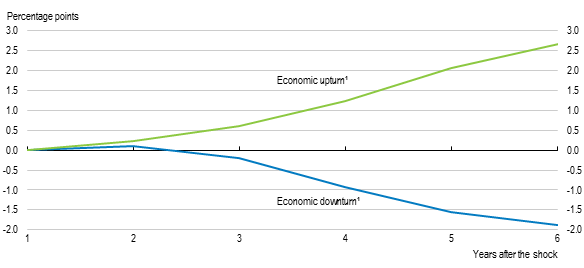
There are several conflicting channels through which reforms affect the real economy. The strength of the channel can change under different macroeconomic conditions. Take reforms of unemployment benefits that aim to improve work incentives by strengthening the conditionality of income support in the case of a lay-off on intensive job-search efforts. By facilitating the return to work, such reforms raise employment, household income and thus consumption. However, uncertainty regarding disposable income also increases, potentially discouraging consumption. In good times, employment gains can be quick, so that output increases within 2-3 years after reforms. But during recessions when the unemployed are less likely to find jobs the gains in employment can even turn negative (See figure).

The gains in employment of an unemployment benefit reform
can turn negative during a downturn

Reforming in a difficult macro context

Note: The lower (upper) line corresponds to the impact of the reduction in the initial unemployment benefit replacement rate during economic downturn (upturn), where the economic cycle is measured through the level of the pre-reform unemployment gap (i.e. the difference between the structural unemployment rate and the unemployment rate). The economic downturn (upturn) corresponds to the case where unemployment gap is set to the minimum (maximum) value within the sample.
Source: Bouis et al. (2012).

Other reforms that seek to restore competitiveness through lower relative costs and prices can also depress demand if conducted during downturns. This is because in bad times labour and goods demand respond little to the lower wages and product prices resulting from reforms, while workers or firms see their income and profit eroded in the short term. Ideally, governments can deploy expansionary fiscal policies or monetary policies to support demand. But, in some cases, macro policies may also be constrained, as has been the case for several countries in the past few years. Strong external demand can help to bring forward the benefits of reforms as well. For instance, our review of case studies suggests that Canada’s labour market reforms around the mid-1990s benefited from strong demand from the United States. This supported the gains in employment following the reforms.

Even under limited supports from fiscal and monetary policies or external demand, a smart packaging or sequencing of reforms can alleviate the negative short-run impacts on demand: (1) reforms of labour and product markets can be conducted in tandem, so that the lower prices from stronger competition limit the impact of labour market reforms on real wages; (2) addressing dysfunctions in the financial sector as early as possible can improve access to credit and allow households and firms to capitalise on the future benefits of reforms and expand consumption and investment today; (3) reducing policy uncertainty through well-communicated, credible reform strategies can prevent the deterioration of confidence among business and consumers.

Many reforms can boost demand by themselves even during difficult macroeconomic conditions. For instance, measures aimed at raising investment in knowledge-based capital, including through infrastructure spending, as well as tax structure reforms can bring short benefits. Also, reducing regulatory barriers to entry in services sectors with large pent-up demand and relatively low entry costs (like professional services or taxis) can boost business expansion and employment relatively quickly. Similarly, reducing barriers to geographic or jobs mobility can increase the speed of employment gains in difficult times. Strengthening active labour market policies and to alleviate skill shortages and mismatch can unleash business activities that were previously constrained by skills bottlenecks. Reforms that contribute to the long-term sustainability of public finance and to the cost-effectiveness of healthcare or pension systems can reduce uncertainties on household’s future income, thereby boosting consumption today.

References:

Caldera Sánchez, A., A. de Serres and N. Yashiro (2016), “Reforming in a difficult macroeconomic context: A review of the issues and recent literature”, OECD Economics Department Working Papers, No. 1297, OECD Publishing, Paris.

OECD.  (2016), Economic Policy Reforms 2016: Going for Growth Interim Report, OECD Publishing, Paris.


Vocational education after transition in Poland

by Nicola Brandt, Head of Poland Desk,
OECD Economics Department

Adapting vocational education to the needs of a market economy has been a challenge in Poland as in other transition countries of Central and Eastern Europe. Average educational attainment and literacy rates were relatively high and vocational education was strong in Poland, when the economic transformation set in. Yet, competencies taught in vocational schools were often specific to enterprises to which they were attached, many of which disappeared.

Meanwhile, it took vocational schools time to establish links to newly created firms, and the process of developing high-quality training in management, IT and other advanced technologies is still ongoing.  Rote learning was widespread, and skills that help people adapt to new circumstances, such as critical thinking, creativity and leadership, were long neglected. Programmes on offer have not always been adapted to labour market needs, leading to shortages of workers in some areas and a surplus in others. As a result, the reputation of vocational education suffered. During the transition young people abandoned basic vocational education in large numbers (Panel A), while a tertiary education boom set in.

Vocational education lost ground during the transition

poland1

1. The data are based solely on Flanders for Belgium and on England and Northern Ireland for the United Kingdom.
2. Mean reading score for 16 year-old students of Polish technical schools (Panel A) from an optional national study for the first grade of upper secondary  school (16 year-olds) complementing PISA and mean PIAAC literacy proficiency score for Polish adults having attended technical schools (Panel B).
3. Mean reading score for 16 year-old students of Polish basic vocational education (Panel A) from an optional national study for the first grade of upper secondary school (16 year-olds) complementing PISA and mean PIAAC literacy proficiency score for Polish adults having attended basic vocational education (Panel B).
4. Mean PIAAC literacy proficiency score for adults with less than upper secondary education.
Source: GUS (2014), Education in the 2013/2014 School Year; OECD (2013), OECD Skills Outlook 2013 Database and OECD calculations.

The government has done much to adapt vocational schools to the needs of the market economy. Since 2012 curricula have been based on learning outcomes rather than on a narrow description of subject content. This has given schools more autonomy to adapt their programmes, including in collaboration with employers.  There is now more emphasis on general competencies, such as basic skills, reasoning, problem-solving and teamwork, and the programmes also include training on setting up a business. The government launched an image campaign recently, and vocational education has started to re-gain some ground as shortages of workers with intermediate skills have become apparent.

But challenges remain. Many weak students are concentrated in basic vocational schools as evidenced by their low literacy scores in the OECD’s PISA test (Panels B and C). Helping them level their skills requires particularly qualified teachers. Offering interesting pay and career opportunities at basic vocational schools would be one option to attract such teachers. While around 65% of students now combine study and work in firms – a considerable increase from earlier years –  the rest still receive their practical training in workshops set up for training purposes. The challenge is to engage Poland’s many small firms to offer work placements and contribute to the development of programmes to ensure that they are relevant for their needs.

Find out more:

OECD (2016), OECD Economic Surveys: Poland 2016”, OECD Publishing.

Mertaugh, M. and E. Hanushek (2005), “ Education and training”, in Nicholas Barr (ed.), Labor Markets and Social Policy in Central and Eastern Europe: The Accession and Beyond, The World Bank, Washington, DC, pp. 207-51.

Nešperová, A. (2000), Employment and labour market policies in transition economies, International Labour Organization, Geneva.


Ireland…trading in the global talent pool.


by David Haugh, Head of the Ireland Desk,
OECD Economics Department

Passing through Dublin airport’s sparkling, spacious Terminal 2, sprinkled with bi-lingual English, Irish signs is a fine experience – it’s a modern, global emporium but with a very Irish flavour as anyone partial to a Guinness in departures can attest to. On arrival before you know it, a phalanx of escalators and travellators have whooshed you to the immigration hall. Standing in the non-EU citizens line gazing across at the streaming mobs of EU passport holders, strangely you can feel almost a little exclusive with your own little gateway to Ireland. The other thing you notice is that a good chunk of the non-EU citizens line are young tertiary students, coming to Ireland to further build their educational achievements. Many others in-line are already experienced professionals. This is migration, a phenomena Ireland has experienced for hundreds of years, 21st century style.

Following the severe banking and fiscal crisis 2008-2011, the Irish economy is again growing at a blistering pace. At 7.8% per annum in 2015 it was the fastest growing economy in the OECD for the second year running. By historical norms rapid growth after a banking-crisis-related recession is unusual. As I argue in the January 2016 OECD Observer, the swift expansion is thanks to Ireland’s huge pool of foreign investment and success in the third great globalisation wave. A key ingredient of this success is Ireland’s capacity to attract and integrate skilled migrants and so far it’s doing quite nicely. It may be a cliché but the Irish people really are loquacious and welcoming. That may be one of the reasons why Google brings staff to Ireland, not just to work in Dublin, but also to train for its offices worldwide.

It is true that in the wake of the crisis, mass immigration turned into a mass exodus. The economic recovery has seen this start to turn around but at the trough in 2012 net migration reached -34000 per annum (0.75% of the population). A good chunk of those leaving were prime age workers. The big concern with this is that Ireland is suffering a “brain drain”. However the data presented in the latest OECD Economic Survey of Ireland suggest that rather than “brain drain” Ireland exhibits “brains exchange”, a large proportion of emigrants and immigrants are well qualified. Skilled immigrants complement Ireland’s well-qualified workforce with “hard-to-classroom-learn” capabilities, such as native speaker-level ability in foreign languages. Migrants also allow Ireland to draw on a wider range of education and experiences than a small economy, even with high quality educational institutions, can be expected to provide. Ireland’s large stock of foreign investment is not just there for low corporate tax rates. The ready availability of a global talent mix is an important part of the attractiveness of Ireland to the world’s most innovative multinationals.

More than half of immigrants are tertiary qualified

Educational Attainment, 2014

Imm daveSource: Central Statistics Office (CSO)

Large migration flows can have important implications for trends across the economy and vice versa: large migrant flows can push around housing markets, or fast rising rents and houses prices, as have been occurring recently in Dublin, could discourage them. The system of work permits and qualifications must recognise that to succeed in a global market Irish firms need to be able to draw on a global talent pool. The policy framework should be fine-tuned to deal with these realities and foster an economy and institutions flexible enough to cope with sizeable migration flows.

Ireland is a high-home-ownership country for many reasons but one of them is that rental accommodation has traditionally often been of poor quality. What is required is a more developed rental market and high quality apartments in city centres where many young, educated migrants want to live and work. Government should carry through on plans to densify city centres and height restrictions should be eased from three or four stories as part of this…think the seven stories of Paris…hardly ugly is it?

The government has improved work permit processing but could do more on qualifications recognition. It could also give non-EU student graduates more time to find a job. This is a rich potential talent pool, combining education and skills from Ireland and their own home countries. And training in Ireland is a perfect platform to integrate successfully from. Ireland has invested in these people, why let that handsome return walk out the door?

References:

OECD (2015). OECD Economic Survey of Ireland , OECD Publishing, Paris

O’Connor, B., T. Hynes, D. Haugh and P. Lenain (2015), “Searching for the inclusive growth tax grail”, OECD Economics Department Working Papers, No. 1270, OECD Publishing, Paris.

Kennedy, S., Y. Jin, D. Haugh and P. Lenain (2015), “Taxes, income and economic mobility in Ireland”, OECD Economics Department Working Papers, No. 1269, OECD Publishing, Paris.