Energy expenditures have surged, posing challenges for policymakers

By Geoff Barnard and Patrice Ollivaud, OECD Economics Department

The estimated ratio of energy expenditures to GDP in OECD economies surged in 2022. The prices of oil, natural gas, electricity and coal had already risen strongly during 2021, and soared further after Russia’s invasion of Ukraine in February 2022. Even though by the end of 2022 prices had fallen well below their intra-year highs, for the year as a whole all four energy components contributed to the estimated increase in the OECD-wide expenditure-to-GDP ratio relative to 2021: 2½ percentage points of GDP for electricity, 2¼ for crude oil and oil products, 2 for natural gas and 1 for coal.

It is possible that the 2022 energy-expenditure estimates are somewhat overstated. First, full-year volumes are not yet known and are assumed to be equal to the average of 2019 and 2021 (leaving out the COVID-affected year of 2020). However, in some cases, such as gas and electricity consumption in Europe, high prices have been curtailing consumption in recent months. Moreover, end-user prices for 2022 are not yet available and have therefore been proxied by wholesale prices. To the extent that retail prices have been held down by government policies and/or that industrial users buy energy under long-term price contracts, actual end-user prices and expenditure may have risen by less than suggested by wholesale prices. Nonetheless, it is clear that expenditures on energy as a proportion of GDP will have risen rapidly, and to a high level, in 2022, both in the OECD as a whole and in the typical economy.

Experience suggests that this represents a warning about the potential risk of recession in OECD economies in 2023. Over the past 50 years, the share of incomes in OECD economies taken up by energy expenditures has been closely related to the incidence of economic downturns (Figure 1). As shown in the latest OECD Economic Outlook (OECD, 2022), end-use expenditures on energy in the OECD have been high and rising whenever an OECD-wide recession has occurred since 1970, with the sole exception of the pandemic-affected year of 2020. There were surges in energy expenditures during the first (1973-74) and second (1979-80) oil crises in many countries, both of which preceded an OECD-wide recession, while the global financial crisis occurred at the culmination of an upward trend in energy expenditures that began in the early-2000s, reaching 13% in 2008. The surge in energy expenditures seen in 2022 is thus a cause for concern.

The association between energy expenditures and the economic cycle is readily explicable: with energy an important input for firms, a rise in energy prices may represent an adverse supply shock, lowering output and raising the price level. At the same time, higher energy prices erode the purchasing power of households. While there are winners from higher energy prices, their propensity to spend their windfalls is typically low (Cookson et al., 2022), so that the net effect on aggregate demand is negative.

Figure 1. Periods of high energy expenditures are often associated with a recession

Estimated energy end-use expenditures for the OECD economies

Note: Recessions (shaded areas) correspond to years in which there were at least two quarters of negative GDP growth for the OECD aggregate. Estimates of the level of energy expenditure, computed as end-use prices in local currency multiplied by volumes consumed, are produced at the country level for 29 OECD countries. GDP shares are aggregated using moving GDP weights in PPP terms. End-use prices include taxes. Prices, which start in 1978 in the IEA database, were backcast to 1971 using the Brent price for oil, prices for coal products and natural gas and the rate of increase of the electricity price in the US CPI for electricity. Prices are extended to 2022 using the growth rate of reference prices converted in local currency (average of observed 2022 data compared to 2021): Brent for oil, ICE Newcastle futures for coal, and wholesale prices for electricity and natural gas (available for 25 and 27 OECD countries, respectively).
Source: International Energy Agency; OECD Economic Outlook 112 database; US Energy Information Administration; Japanese Power; German Federal Network Agency (SMARD); Korea Electric Power Statistics Information System; Canada Independent Electricity System Operator; and OECD calculations.

There are, however, some differences with previous episodes of sharp increases in energy expenditure. First, past surges in the expenditure-to-GDP ratio were mostly driven by oil, while this time the contributions are more evenly spread across energy sources. If the link to economic activity is stronger for oil than for the other energy components, this might mean that the negative growth impact is smaller than for past energy expenditure shocks of similar size. The impact on particular countries will also differ from the past depending on their endowments of the various energy components: for example, net exporters of natural gas, including the United States, are likely to suffer less of a negative impact from the current energy price spike than in the past.

Second, because the market for oil (as well as coal) is much more global than those for electricity and gas, the incidence of the OECD-wide energy price increase is more regionally focussed than in the past, with most European economies particularly severely affected. The recession signal may therefore turn out to be more regional than global on this occasion.

Finally, the energy intensity of OECD economies (defined as energy consumed per unit of GDP) has trended down over the past five decades (Figure 2), reflecting rising energy efficiency. A large part of this downtrend is driven by oil and coal; the use of natural gas intensified until the end of the 1990s, when it stabilised, while electricity intensity has remained relatively constant. The downtrend in energy intensity is often masked by swings in the relative price of energy. For example, energy intensity fell by nearly 15% from the mid-1990s to the early 2000s, but energy expenditures remained roughly stable in relation to GDP because of an offsetting increase in the relative (weighted) price of energy. And the spike in the expenditure-to-GDP ratio in 2022, reflecting the unprecedented rises in some energy prices, obscures the ongoing decline in energy intensity. To the extent that OECD economies have become less energy intensive, the impact of an energy price shock on output may be expected to be smaller than in the past.

Bearing these differences in mind, the latest OECD Economic Outlook projections do not show a global or OECD-wide recession in 2023. A sharp slowdown is, however, expected in Europe – GDP growth for the euro area is projected to decline from 3.3% in 2022 to 0.5% in 2023, with quarterly output declines projected in several European countries. In addition, the Economic Outlook points to a range of downside risks, including the risk that the impact of lower energy imports to Europe from Russia is more severe than expected.

Figure 2. Energy intensity has declined, especially for oil and coal

Energy volume consumed per unit of real GDP, index, 2015=100

Note: OECD aggregate computed using energy intensity for 33 OECD countries weighted by GDP (PPP).
Source: OECD Economic Outlook 112 database; International Energy Agency.

References:

OECD (2022), OECD Economic Outlook, Volume 2022 Issue 2, OECD Publishing, Paris.

Cookson, J., E. Gilje and R. Heimer (2022), “Shake Shocked: Cash Windfalls and Household Debt Repayment”, Journal of Financial Economics, Vol. 146, Issue 3.



The US COVID-19 recession – Will this time be different?

By D. Azzopardi, M. Hermansen, P. Lenain and D. Sutherland, OECD Economics Department

As COVID-19 hit the United States, non-essential businesses had to shut down and large numbers of workers lost their jobs. The unemployment rate went from a low point of 3.5% in early 2020 to a post-war record high of 14.7% in just two months. With the easing of confinement and the reopening of businesses, many workers were recalled and the unemployment rate fell back to 11.1% in June 2020. After this initial rapid improvement, however, further declines are likely to be slower. The OECD projects that unemployment will still be in the range of 8-10% at the end of 2021, depending on how fast the coronavirus epidemics is controlled, leaving millions of workers without a job (OECD, 2020a).

Business cycle regularities

A striking regularity of business cycles is that unemployment always rises much faster than it falls. The US economy has a remarkable capacity to create jobs after recessions, bringing unemployment back down to a low range of 3-5%. However, this takes time. Many workers lose their link to a previous employer during recessions and need to go through a time-consuming process of job search, retraining, relocation, and temporary contracts before securing stable employment (Gregory et al., 2020). As a consequence, after a recession, the unemployment rate typically declines at the slow average pace of about 0.55 percentage point per year (Hall and Kudlyak, 2020). After the 1981-82 recession, unemployment did not reach 5% until 1989. After the 2008 financial crisis, it took 10 years for the economy to return to full employment (Figure 1). If this historical regularity still applies, the United States may not return to full employment until the early 2030s. Adopting policy reforms to hasten the return to work would mitigate the impact on job seekers in terms of earning losses and well-being (Davis et al., 2011).

A large reallocation shock has hit workers providing in-person services

The COVID-19 crisis is not a typical recession. Instead of coming from the accumulation of imbalances (inflation in early 1980s, credit bubble in 2008), it results from government lockdown orders to protect the population from the pandemic. Once businesses reopen, some workers are quickly reemployed. Judging from the experience of New Orleans after Hurricane Katrina, unemployment can decrease fast as sectors such as retail trade, education and social services restart their activity (Figure 1). However, the COVID-19 pandemic is likely to have a longer-lasting impact: sectors such as air transport, leisure, entertainment, accommodation and food services may remain depressed for a long time if distancing and customer anxiety continue to prevail. In June 2020, despite progress in reopening, 10 million jobs had still been lost in shutdown sectors, and the unemployment rate was still close to 30 percent in the leisure and hospitality industry (Figure 2).

The coronavirus crisis has been characterized as a “reallocation shock” (Barrero et al, 2020) because many workers providing in-person services will have to find work in other parts of the economy. Past sector-specific shocks show that such a reallocation can be difficult. After the China shock of early-2000s (Autor, 2016), which hit the manufacturing industry hard in the Midwest, it took 15 years to return to earlier levels of employment in this region.

The new Job-to-Job dataset of the Census Bureau shows that many manufacturing workers were able to move to other industries or to other parts of the country after the China shock, but low skilled and seniors faced greater difficulties (Azzopardi et al, 2020). The same dataset suggests many construction workers struggled to return to work after the 2008 burst of the housing bubble. This is worrying because the sectors presently locked down employ a large share of workers who will have difficulties moving to new industries, and these jobs are often entry points for workers joining or re-joining the labour force. If previous patterns once again emerge, the sluggish reallocation of workers may prevent the United States from returning quickly to full employment.

Lessons from the past also suggest that a set of regulatory easing measures and support to dismissed workers could help. Regulations introduced in past decades at the state level – especially mandatory occupational licenses, non-compete contracts, and housing regulations ¬– hinder the fluidity of the worker-job matching process and slow down the reallocation of workers across industries (Hermansen, 2019). Easing these restrictions, for instance by eliminating these requirements when not clearly justified or through interstate reciprocity agreements, would quicken the return to full employment. Similarly, a reform of unemployment benefits from passive support to active policies favouring labour-market reintegration, reskilling and geographic mobility — would help the return to work of job seekers and avoid long spells of unemployment and their scarring effects. These policy options are detailed in the new OECD Economic Survey of the United States (OECD, 2020b).

References

Autor, D., D. Dorn and G. Hanson (2016), “The China Shock: Learning from Labor-Market Adjustment to Large Changes in Trade”, Annual Review of Economics,

Azzopardi, D. et al. (2020), ”Why has labour mobility declined in the United States? Insights from a new dataset”, Technical Background Paper, forthcoming.

Barrero, J. M., N. Bloom and S.J. Davis (2020), “COVID-19 Is Also a Reallocation Shock”, Brookings Papers on Economic Activity, Summer 2020.

Davis, Steven J. and Till Von Wachter (2011), “Recessions and the Costs of Job Loss”, Brookings Papers on Economic Activity, Fall.

Gregory, Victoria, Guido Menzio and David G. Wiczer (2020), “Pandemic Recession: L or V-Shaped?”, NBER Working Paper No. 27105

Hall, Robert E. and Marianna Kudlyak (2020), Why Has the US Economy Recovered So Consistently from Every Recession in the Past 70 Years?, NBER Working Paper No. 27234 May.

Hermansen, Mikkel, 2019. “Occupational Licensing and Job Mobility in the United States,” OECD Economics Department Working Paper No. 1585.

OECD (2020a), OECD (2020), OECD Economic Outlook, Volume 2020 Issue 1: Preliminary version, No. 107, OECD Publishing, Paris,

OECD (2020b), Economic Survey of the United States, OECD Publishing, Paris


Reviving Italy’s Growth

by Mauro Pisu and Tim Bulman, Italy Desk, OECD Economics Department

In Curno, 50 km north east of Milan, is the headquarters of Brembo, the Italian company supplying brakes for Teslas and Ferraris as well as for mass market cars and motorcycles. Founded in 1961, its 255 employees generate over USD 3 billion of revenue from production facilities across 15 countries.

1500 km away,
in Sicily’s south-east, Gaetana Jacono runs the Valle dell’Acate winery. She is
bringing to six generations of wine making tradition new production
technologies and distribution approaches that are developing exports to large
new markets.

Enterprises like Brembo and Valle dell’Acate have helped
Italy in recent years gradually recover from its extended recession. These are
mostly medium sized enterprises that are highly productive and have grown
activity and created jobs though investment and exports, supported by
government policies such as the Industry 4.0 programme or labour market and
education reforms.

But Italy’s recovery stalled in late 2018, before
Italy could reverse the deep losses in incomes and well-being suffered during
the extended recession. Overall, income per capita today is near its level in
2000, and economy-wide productivity has been stagnant. This lack of progress
has seen poverty rates rise, especially among the young and families. The
OECD’s latest projections are for GDP to contract by 0.2% in 2019 and to expand
by 0.5% in 2020.

What will it take to restart and extend Italy’s
recovery?

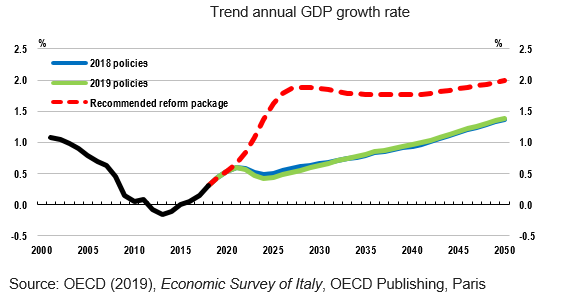
A clear multi-year reform programme to boost employment and productivity, while reducing steadily public debt, would lift average annual growth rates and improve inclusiveness. This is among the key policy insights of the OECD’s 2019 Economic Survey of Italy, launched on 1 April 2019 by the OECD Secretary General and Italy’s Minister of Finance. Compared current polices, this reform programme would raise growth rates by about 1.5 percentage points by 2030, expand employment and reduce inequalities.

Increasing productivity growth is key. Boosting productivity
will require enhancing competition in markets that are still protected, such as
professional services and local public services; raising innovation and
business dynamics, including through strengthening targeted incentives connected
to the Industry 4.0 plan; removing incentives for SMEs to stay small and
obstacles hampering their growth; and completing the reform of insolvency
regime.

Among the reforms proposed in the Survey, those concerning the efficiency of public administration
and justice system would have the largest impact on GDP growth by strengthening
the rule of law, thus supporting investment and productivity growth. The
expansion of active labour market programmes and reducing social security
contributions would also generate large benefits by boosting employment and
social inclusion.

Reducing the public debt ratio by steadily raising the
primary budget surplus to above 2% is essential to address the risk to the
broader economy of the high public debt ratio. Lower interest rates have
reduced interest payments on the public debt to a record low of 3.5% of GDP in
2018, which is however near what Italy spends on education.

Italy can raise the primary budget surplus by incorporating in the annual budget through and effective spending reviews that help rationalise current spending by reducing waste and reallocating resources towards more effective programmes. Closing the early retirement scheme introduced in 2019 would free resources to boost employment and opportunities for young people in addition to improving inter-generational equity. Implementing this programme would help Italy’s successful enterprises develop and new enterprises to follow their path, generating opportunities for Italians across the country. A future blog will discuss how this reform programme can address the large disparities between the regions such as those around Brembo’s headquarters and those around Valle dell’Acate.

References
OECD (2019), OECD Economic Surveys: Italy 2019, OECD Publishing, Paris.