Addressing the challenges of high government debt and population ageing in Japan
Category: Japan
written by oecdecoscope | January 11, 2024
By Müge Adalet McGowan, OECD Economic Department
Japan has coped well with the pandemic and the energy crisis, but the fiscal support to help mitigate their impact has pushed up gross public debt to an unprecedented level of almost 245% of GDP in 2022. Demographic change will exacerbate these challenges. Japan’s population is projected to decline from 135 million to around 96 million in 2060, while the elderly population will reach 79% of working-age population, one of the highest in the OECD (Figure 1). The government projects that with ageing, social security spending will rise from 21.5% of GDP in 2018 to around 24% by 2040. Without corrective action, this would substantially worsen long-term fiscal sustainability.
The 2024 OECD Economic Survey of Japandiscusses fiscal and structural reforms to bring debt levels down. Japan lacks a credible medium-term fiscal consolidation strategy to put public debt on a downward path and build fiscal buffers to increase resilience to shocks, which should include both revenue and expenditure measures. Containing spending growth requires health and long-term care reforms. Lengthy hospital stays and a high number of medical consultations suggest room for efficiency gains in providing high-quality care to Japan’s ageing population. Gradually raising tax revenues, including by increasing the consumption tax rate further in small increments, should be another element of broad fiscal reforms. Raising productivity and employment, particularly among women and older people, is also key to limit the effects of demographic headwinds.
Figure 1. Japan’s elderly dependency ratio is high and will continue rising
Note: Ratio of population aged 65 and above to population aged 20-64. Projections are based on medium fertility variant. Source: OECD Demography and Population Statistics database.
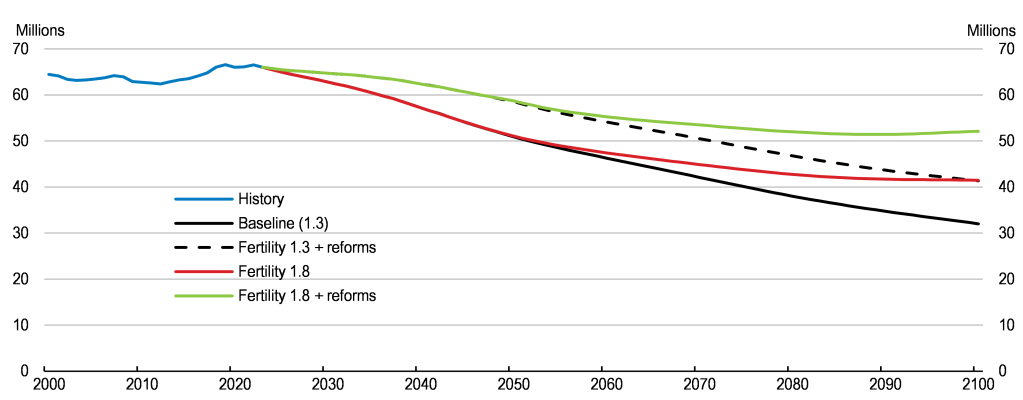
Under current fertility, employment and immigration rates, employment would fall by 52% by 2100 (Figure 2). The government aims to increase the fertility rate from 1.3 to 1.8, which would help mitigate the decline in employment. One priority is to strengthen the weak financial position of youth, which leads many to delay or forgo marriage and children. Making it easier to combine paid work and family is also critical so that women are not forced to choose between a career and children. Increasing the take-up and duration of parental leave by fathers can also boost fertility rates. Policies should also cut the cost of raising children, the key obstacle to couples achieving their desired number of children.
Given the difficulty of raising fertility, which partially reflects changing social norms, and the decades-long wait for a pay-off from higher fertility, it is essential to prepare for a low-fertility future, in part by raising labour force participation. Hence, Japan should also continue to remove obstacles to the employment of women and older persons and make greater use of foreign workers, which would have a more immediate impact on labour shortages. Breaking down labour market dualism, which disproportionately affects youth, women, and older people, is a priority. Abolishing the right of firms to set a mandatory retirement age (usually at 60) and raising the pension eligibility age would also promote employment. These reforms should be accompanied by measures to re-skill older workers, whose participation in lifelong learning is relatively low. Offering long-term residency to workers and their families and broad policies to increase the integration of foreign workers would boost foreign worker inflows.
Figure 2. Reforms to boost fertility, employment rates and foreign worker inflows would mitigate the decline in employment
Note: The reforms include; i) a doubling of inflows of foreigners to 200 000 per year; ii) a convergence of female employment rates to those of men by 2050; and iii) the employment rate for each five-year cohort from 60-64 to 70-74 converges to that of the preceding cohort (i.e., the rate for the 60-64 group would rise to the 2021 rate for the 55-59 age group, etc.) by 2050. Source: OECD calculations based on the OECD Long-term Model.
Population ageing and government revenue: It is not all bad news
Category: Ageing
written by oecdecoscope | January 11, 2024
By David Crowe, Jörg Haas, Valentine Millot, Łukasz Rawdanowicz and Sébastien Turban, OECD Economics Department
Population ageing is one of the biggest challenges to public finances (Rawdanowicz et al., 2021). It is expected to necessitate a sizeable increase in public spending on pensions and health care. Such spending pressures could be mitigated by structural reforms or cost reductions, but in their absence large increases in tax revenue would be needed to stabilise public debt (Rouzet et al., 2019; Guillemette and Turner, 2021).
In contrast to the existing literature which focuses on government spending, in our latest paper (Crowe et al., 2022), we shed light on the consequences of population ageing for government revenue in OECD countries. We do this in a framework consistent with the OECD long‑term model (LTM) (Chalaux and Guillemette, 2019; Guillemette and Turner, 2021). We show that if the labour and capital income shares in GDP remain constant and pension income increases in relation to GDP, the tax revenue-to-GDP ratio is likely to increase slightly via higher revenues derived from the taxation of pension income and of associated consumption. However, this will not be enough to cover the total increase in government spending due to population ageing.
In view of these results, countries still would have to reduce spending or raise taxes and implement structural reforms to boost labour force participation and growth, if they do not want public debt to increase. Policy options will be constrained by countries’ current levels of overall taxes and debt, and political economy considerations. Countries with high tax revenue and debt may need to favour spending reductions. In contrast, countries with low taxation and debt may envisage raising taxes and increasing borrowing. In practice, a combination of these strategies, which reflects a country’s social preferences, could be desirable to limit negative effects associated with each option.
The modelling framework
Building on the recent analysis of the consequences of ageing populations on government spending and long‑term GDP in the LTM (Guillemette and Turner, 2021), we analyse implications for government revenue. In the baseline scenario, the labour share in GDP remains constant, consistent with the Cobb‑Douglas production function employed in the LTM.
Our model’s general approach is to project shares of the main income components in GDP, which constitute the main income tax bases, and apply calibrated effective tax rates (ETRs), which are assumed to remain constant, to obtain projected government revenue from income taxes and social security contributions (SSCs). The resulting disposable income of households is used to project household consumption (based on constant calibrated saving rates) and then consumption taxes, again based on a constant calibrated ETR.
The proposed framework, while admittedly stylised, has the advantage of ensuring accounting consistency between the assumed split of nominal GDP into labour and capital income shares (the primary allocation of income), taxes and social benefits – including pensions (which are part of the secondary distribution of income) – and household consumption (uses of disposable income). Thus, the model can indicate the orders of magnitude of the impact of selected aspects of population ageing on budget balances.
Given the model’s assumptions, population ageing affects tax revenue mainly via income taxes and SSCs on pensions and via taxes on consumption out of pension income.
The results
The increase in government tax revenues resulting from higher aggregate pension income projected in the model is significant in relation to the size of the pension spending pressures, but by far not enough to solve the fiscal challenge. On average, the additional revenue covers around a quarter of the expected increase in government spending on public pensions; the latter accounts for less than 40% of the total increase in public spending due to population ageing (see figure).
In most countries, more than half of the extra tax revenue is generated from indirect taxes due to growing consumption out of pension income and thus growing consumption tax revenue. In these countries, the coverage ratio correlates positively with the ETR for consumption taxes.
The general smaller importance of direct taxes stems from the fact that ETRs for current taxes and SSCs on pensions are usually low and below the respective ETRs on labour income. Lower ETRs on pensions are due to favourable treatment, exemptions from taxation, and the progressivity of personal income taxation (as average pension income is usually below average wage income). Still, the coverage ratio is large in several countries where ETRs related to current taxes paid by households on social benefits are particularly high (e.g. Denmark, Finland, Luxembourg, the Netherlands, Sweden and Switzerland).
Tax revenue from growing aggregate pension income will likely increase
Per cent of GDP, change between 2023 and 2060
Note: Changes in indirect taxes are mainly driven by taxes related to household consumption as payroll and other indirect taxes do not change in relation to GDP in this exercise. Changes in other revenue refer primarily to changes in current taxes on household income and wealth. They include also changes in social security contributions received by government but, in most countries, this change is rather small. Spending on public pensions is consistent with the long-term model projections. Source: Crowe et al. (2022), “Population ageing and government revenue: Expected trends and policy considerations to boost revenue”, OECD Economics Department Working Papers, No 1737, OECD Publishing, Paris.
Robustness checks
Given the stylised nature of the model, the results should be treated as indicative of potential magnitudes rather than precise projections. While the results are robust to alternative constant ETRs calibrations, there are other aspects of the model that could affect the results. They are discussed in the paper. Here we mention only two:
First, the alternative assumption of a modest decline in labour income shares does not change net fiscal pressures significantly. Lower labour shares reduce labour-related revenue but increase tax revenue from gross profits of companies and self-employed income (all relative to GDP). The net effect on the tax‑to‑GDP ratio is expected to be negative since the taxation of capital income tends to be lower than that of labour income. However, as the LTM specifies pensions relative to the average wage, a fall in the labour share also reduces the increase in public spending on pensions relative to GDP. On net, fiscal pressures are expected to be slightly higher in the scenario with a modest decline in the labour share compared with the baseline scenario in two‑thirds of the analysed countries, and marginally lower in the remaining countries.
Second, while saving rates in the model are assumed to be constant over time, they are likely to differ across age cohorts (which can be related to income level and type) and result in a time-varying aggregate saving rate given expected changes in population and income structures. For instance, the saving rate can fall for people transitioning from employment to retirement if they maintain similar consumption level and their pension income is lower than previous wage income. However, savings may not be affected if older people receive higher capital income. Similarly, if the consumption of older people declines proportionally or more than income during retirement, their saving rate could remain unchanged or increase. Available Eurostat household surveys suggest that saving rates tend to decrease with age in several EU countries, but the opposite is true in other countries. Other studies show that on average, the elderly does not decumulate wealth in the United States (Auclert et al., 2021) and in Europe (Horioka and Ventura, 2022). Maintaining wealth could be explained by precautionary or bequest motives, but reasons for cross-country differences in age-specific saving rates are not clear. Thus, although assuming the same saving rate for all age cohorts may not be a realistic assumption, the alternative is not obvious. If the saving rate for the older population would be lower than for the working‑age population, consumption tax revenue would be somewhat larger than in the case of a uniform saving rate. However, sensitivity tests indicate that this assumption does not affect the model simulation results significantly.
References:
Auclert, A. et al. (2021), Demographics, Wealth, and Global Imbalances in the Twenty-First Century, National Bureau of Economic Research, Cambridge, MA, https://doi.org/10.3386/w29161.
Chalaux, T. and Y. Guillemette (2019), “The OECD potential output estimation methodology”, OECD Economics Department Working Papers, No. 1563, OECD Publishing, Paris, https://dx.doi.org/10.1787/4357c723-en.
Crowe et al. (2022), “Population ageing and government revenue: Expected trends and policy considerations to boost revenue”, OECD Economics Department Working Papers, No 1737, OECD Publishing, Paris, https://doi.org/10.1787/9ce9e8e3-en.
Guillemette, Y. and D. Turner (2021), “The Long Game: Fiscal Outlooks to 2060 Underline Need for Structural Reforms”, OECD Economics Department Policy Papers, https://doi.org/10.1787/a112307e-en.
Horioka, C. and L. Ventura (2022), Do the Retired Elderly in Europe Decumulate Their Wealth? The Importance of Bequest Motives, Precautionary Saving, Public Pensions, and Homeownership, National Bureau of Economic Research, Cambridge, MA, https://doi.org/10.3386/w30470.
Rawdanowicz, Ł. et al. (2021), “Constraints and demands on public finances: Considerations of resilient fiscal policy”, OECD Economics Department Working Papers, No. 1694, OECD Publishing, Paris, https://dx.doi.org/10.1787/602500be-en.
Rouzet, D. et al. (2019), “Fiscal challenges and inclusive growth in ageing societies”, OECD Economic Policy Papers, No. 27, OECD Publishing, Paris, https://dx.doi.org/10.1787/c553d8d2-en.
Reforming Brazil’s old-age pension system to ensure its sustainability
Category: Brazil,Uncategorized
written by oecdecoscope | January 11, 2024
By Jens Arnold, Head of Brazil Desk at the OECD Economics Department and Hervé Boulhol, Head of Pensions and Population Ageing at the OECD’s Directorate for Employment, Labour and Social Affairs
Pensions have been successful in reducing old-age poverty well below the population-wide average, and below the OECD average (Figure 1). At present, all pension recipients – and this includes around 90% of those aged 65 and above – receive at least the minimum wage, which is more than 5 times as much as the poverty line of BRL 170 (equivalent to USD 55).
However, Brazil’s old-age pension system already costs more than 10% of GDP, despite the country’s young – but rapidly ageing – population. The combined annual shortfall of the pension schemes is close to 4.5% of GDP, contributing substantially to the budget deficit. If the current parameters of the system remain unchanged, spending on pensions for private-sector workers alone would increase by almost 3% of GDP by 2030, and by almost 5% of GDP by 2040. Taking into account the public sector amplifies imbalances, which will make the system financially unsustainable. An in-depth reform is necessary and inevitable.
Several policy measures could contribute to containing pension expenditures. Raising Brazil’s low average retirement ages of 56 years for men and 53 years for women appears urgent, by introducing a binding minimum retirement age. Many OECD countries are now gradually moving their normal retirement ages beyond 65 years for men and women. In contrast to Brazil’s pension system, all public pension schemes in OECD countries include a minimum retirement age.
Brazil also stands out for high pension benefits relative to working-age incomes, in particular for low-wage earners, paid at low retirement ages (Figure 2). In the OECD, an average-wage full-career worker will get a pension paying 53% of pre-retirement earnings at the age of 65.5 years, compared to 70% for men and 53% for women in Brazil at age 55 and 50, respectively. Moreover, the minimum pension benefit is equal to the minimum wage, which has led to real increases in the minimum pension of almost 90% over the last 10 years. The minimum pension is available after 35 years of contribution or from age 65 after only 15 years of contribution.