Restoring high growth and securing the pension system for future generations in Luxembourg

Photo outside the European Convention Centre

Read the blog in French l Lire le blog en français

By Cyrille Schwellnus and Simone Romano

Despite several major shocks and the recent slowdown, Luxembourg has grown vigorously over recent decades. Living standards are among the highest in the OECD. The stable institutional framework, responsive regulation and a relatively favourable tax regime have attracted foreign investment and foreign workers.

Yet, the growth model based on rapid labour force expansion has reached its limits. Productivity has stagnated over the past 15 years, congestion has increased and housing has become less affordable for many residents. Moreover, Luxembourg faces rapidly rising pension expenditure over the next decades, as the number of pensioners will more than triple over 2024-2070.

Policies fostering the transition to a more sustainable growth model based on skills and innovation need to be prioritised, while ensuring the sustainability of the pension system and addressing climate change.

In this context, the new 2025 OECD Economic Survey of Luxembourg contains three main messages:

•             A comprehensive reform to curb pension expenditure and raise revenue is needed in the near term to secure the system for future generations and prevent more disruptive changes at a later stage.

•             Boosting skills by upgrading training, refocusing public support for innovation and strengthening competition, especially in services, would help to reinvigorate stagnating productivity.

•             Continuing to develop public transport and alternative mobility options, while bringing fuel prices more in line with neighbouring countries and making the tax regime less advantageous for cars with internal combustion engines, would help Luxembourg reach its climate targets.

Balancing the pension system in the long term while safeguarding inter-generational fairness and competitiveness requires a multipronged approach and fast implementation. The horizon over which periodic reviews assess the balance of the system needs to be extended from 10 to 50 years. Setting a steady-state contribution rate that balances the system over 50 years and phasing it in early would ease the burden on future generations by allowing larger working-age cohorts to contribute more, while the pension reserve fund would grow through financial returns.

Raising the effective retirement age, which is the lowest in the OECD, would further help to put the system on a sustainable footing. Eligibility for early retirement should be tightened by removing educational years from the calculation of contributory years, aligning benefits with actual work history. At the same time, early and statutory retirement ages should be raised to match gains in life expectancy.

Pension benefits need to be brought more in line with other OECD countries, as the relative income of older people is the highest in the OECD. Shortening the transition to the lower replacement rates of the 2012 reform from 40 to 25 years would contribute to a slower depletion of assets in the pension reserve fund. Switching from nominal wage indexation of pensions in payment to inflation indexation – as is common in OECD countries – would ensure that current pensioners contribute to the reform effort.

Transitioning from a growth model based on rapid labour force growth to a model based on skills and innovation requires reforms to innovation, skills and competition policies. Establishing a coordination mechanism between the main actors providing public innovation support, shifting more from institution to project-oriented support and strengthening the role of public-private partnerships would crowd-in more business R&D investment.

Quality standards for training providers could be strengthened through the creation of a national accreditation agency, as well as the tightening of quality control on training providers. Enhancing the targeting of financial incentives for adult learning and more proactive guidance would increase the participation of low skilled and older workers. Requiring full disclosure of the identity of interest groups and public officials that were involved in lobbying activities and introducing sanctions for lobbyists who do not enrol in the dedicated public register would limit the scope for incumbents and larger firms to shape regulation in their favour at the expense of smaller firms. The quality of regulation could be further improved by introducing ex-ante and ex-post evaluations of the impact of regulation on competition and requiring the use of plain language in drafting new laws.

Luxembourg has made substantial progress in reducing emissions, but further efforts are needed to reduce emissions in sectors not covered by the EU Emissions Trading System by 55% by 2030 and to reach net zero emissions by 2050. Continuing to expand the public transport infrastructure and increasing the frequency and capacity of trains would help to ease congestion and boost overall system capacity. Measures are also needed to limit congestion during peak hours, including by better linking land planning and public transport development.

The reliance on combustion engine cars is high, supported by low taxes on cars and fuel. Setting a clear, forward-looking trajectory for the taxes on motor fuels that goes well beyond 2027 and brings the final fuel price more in line with that of neighbouring countries would reduce fuel tourism and the use of private cars. Increasing the registration tax on new cars and making it dependent on emissions, while introducing road tolls and reserving road lanes for buses and carpooling would encourage the transition to more sustainable commuting options.

For more information, visit the Luxembourg snapshot page.

References

OECD (2025), OECD Economic Surveys: Luxembourg 2025, OECD Publishing, Paris,
https://doi.org/10.1787/d01c660f-en.


Population ageing and government revenue: It is not all bad news

By David Crowe, Jörg Haas, Valentine Millot, Łukasz Rawdanowicz and Sébastien Turban, OECD Economics Department

Population ageing is one of the biggest challenges to public finances (Rawdanowicz et al., 2021). It is expected to necessitate a sizeable increase in public spending on pensions and health care. Such spending pressures could be mitigated by structural reforms or cost reductions, but in their absence large increases in tax revenue would be needed to stabilise public debt (Rouzet et al., 2019; Guillemette and Turner, 2021).

In contrast to the existing literature which focuses on government spending, in our latest paper (Crowe et al., 2022), we shed light on the consequences of population ageing for government revenue in OECD countries. We do this in a framework consistent with the OECD long‑term model (LTM) (Chalaux and Guillemette, 2019; Guillemette and Turner, 2021). We show that if the labour and capital income shares in GDP remain constant and pension income increases in relation to GDP, the tax revenue-to-GDP ratio is likely to increase slightly via higher revenues derived from the taxation of pension income and of associated consumption. However, this will not be enough to cover the total increase in government spending due to population ageing.

In view of these results, countries still would have to reduce spending or raise taxes and implement structural reforms to boost labour force participation and growth, if they do not want public debt to increase. Policy options will be constrained by countries’ current levels of overall taxes and debt, and political economy considerations. Countries with high tax revenue and debt may need to favour spending reductions. In contrast, countries with low taxation and debt may envisage raising taxes and increasing borrowing. In practice, a combination of these strategies, which reflects a country’s social preferences, could be desirable to limit negative effects associated with each option.

The modelling framework

Building on the recent analysis of the consequences of ageing populations on government spending and long‑term GDP in the LTM (Guillemette and Turner, 2021), we analyse implications for government revenue. In the baseline scenario, the labour share in GDP remains constant, consistent with the Cobb‑Douglas production function employed in the LTM.

Our model’s general approach is to project shares of the main income components in GDP, which constitute the main income tax bases, and apply calibrated effective tax rates (ETRs), which are assumed to remain constant, to obtain projected government revenue from income taxes and social security contributions (SSCs). The resulting disposable income of households is used to project household consumption (based on constant calibrated saving rates) and then consumption taxes, again based on a constant calibrated ETR.

The proposed framework, while admittedly stylised, has the advantage of ensuring accounting consistency between the assumed split of nominal GDP into labour and capital income shares (the primary allocation of income), taxes and social benefits – including pensions (which are part of the secondary distribution of income) – and household consumption (uses of disposable income). Thus, the model can indicate the orders of magnitude of the impact of selected aspects of population ageing on budget balances.

Given the model’s assumptions, population ageing affects tax revenue mainly via income taxes and SSCs on pensions and via taxes on consumption out of pension income.

The results

The increase in government tax revenues resulting from higher aggregate pension income projected in the model is significant in relation to the size of the pension spending pressures, but by far not enough to solve the fiscal challenge. On average, the additional revenue covers around a quarter of the expected increase in government spending on public pensions; the latter accounts for less than 40% of the total increase in public spending due to population ageing (see figure).

In most countries, more than half of the extra tax revenue is generated from indirect taxes due to growing consumption out of pension income and thus growing consumption tax revenue. In these countries, the coverage ratio correlates positively with the ETR for consumption taxes.

The general smaller importance of direct taxes stems from the fact that ETRs for current taxes and SSCs on pensions are usually low and below the respective ETRs on labour income. Lower ETRs on pensions are due to favourable treatment, exemptions from taxation, and the progressivity of personal income taxation (as average pension income is usually below average wage income). Still, the coverage ratio is large in several countries where ETRs related to current taxes paid by households on social benefits are particularly high (e.g. Denmark, Finland, Luxembourg, the Netherlands, Sweden and Switzerland).

Tax revenue from growing aggregate pension income will likely increase

Per cent of GDP, change between 2023 and 2060

Note: Changes in indirect taxes are mainly driven by taxes related to household consumption as payroll and other indirect taxes do not change in relation to GDP in this exercise. Changes in other revenue refer primarily to changes in current taxes on household income and wealth. They include also changes in social security contributions received by government but, in most countries, this change is rather small. Spending on public pensions is consistent with the long-term model projections.
Source: Crowe et al. (2022), “Population ageing and government revenue: Expected trends and policy considerations to boost revenue”, OECD Economics Department Working Papers, No 1737, OECD Publishing, Paris.

Robustness checks

Given the stylised nature of the model, the results should be treated as indicative of potential magnitudes rather than precise projections. While the results are robust to alternative constant ETRs calibrations, there are other aspects of the model that could affect the results. They are discussed in the paper. Here we mention only two:

  • First, the alternative assumption of a modest decline in labour income shares does not change net fiscal pressures significantly. Lower labour shares reduce labour-related revenue but increase tax revenue from gross profits of companies and self-employed income (all relative to GDP). The net effect on the tax‑to‑GDP ratio is expected to be negative since the taxation of capital income tends to be lower than that of labour income. However, as the LTM specifies pensions relative to the average wage, a fall in the labour share also reduces the increase in public spending on pensions relative to GDP. On net, fiscal pressures are expected to be slightly higher in the scenario with a modest decline in the labour share compared with the baseline scenario in two‑thirds of the analysed countries, and marginally lower in the remaining countries.
  • Second, while saving rates in the model are assumed to be constant over time, they are likely to differ across age cohorts (which can be related to income level and type) and result in a time-varying aggregate saving rate given expected changes in population and income structures. For instance, the saving rate can fall for people transitioning from employment to retirement if they maintain similar consumption level and their pension income is lower than previous wage income. However, savings may not be affected if older people receive higher capital income. Similarly, if the consumption of older people declines proportionally or more than income during retirement, their saving rate could remain unchanged or increase. Available Eurostat household surveys suggest that saving rates tend to decrease with age in several EU countries, but the opposite is true in other countries. Other studies show that on average, the elderly does not decumulate wealth in the United States (Auclert et al., 2021) and in Europe (Horioka and Ventura, 2022). Maintaining wealth could be explained by precautionary or bequest motives, but reasons for cross-country differences in age-specific saving rates are not clear. Thus, although assuming the same saving rate for all age cohorts may not be a realistic assumption, the alternative is not obvious. If the saving rate for the older population would be lower than for the working‑age population, consumption tax revenue would be somewhat larger than in the case of a uniform saving rate. However, sensitivity tests indicate that this assumption does not affect the model simulation results significantly.

References:

Auclert, A. et al. (2021), Demographics, Wealth, and Global Imbalances in the Twenty-First Century, National Bureau of Economic Research, Cambridge, MA, https://doi.org/10.3386/w29161.

Chalaux, T. and Y. Guillemette (2019), “The OECD potential output estimation methodology”, OECD Economics Department Working Papers, No. 1563, OECD Publishing, Paris, https://dx.doi.org/10.1787/4357c723-en.

Crowe et al. (2022), “Population ageing and government revenue: Expected trends and policy considerations to boost revenue”, OECD Economics Department Working Papers, No 1737, OECD Publishing, Paris, https://doi.org/10.1787/9ce9e8e3-en.

Guillemette, Y. and D. Turner (2021), “The Long Game: Fiscal Outlooks to 2060 Underline Need for Structural Reforms”, OECD Economics Department Policy Papers, https://doi.org/10.1787/a112307e-en.

Horioka, C. and L. Ventura (2022), Do the Retired Elderly in Europe Decumulate Their Wealth? The Importance of Bequest Motives, Precautionary Saving, Public Pensions, and Homeownership, National Bureau of Economic Research, Cambridge, MA, https://doi.org/10.3386/w30470.

Rawdanowicz, Ł. et al. (2021), “Constraints and demands on public finances: Considerations of resilient fiscal policy”, OECD Economics Department Working Papers, No. 1694, OECD Publishing, Paris, https://dx.doi.org/10.1787/602500be-en.

Rouzet, D. et al. (2019), “Fiscal challenges and inclusive growth in ageing societies”, OECD Economic Policy Papers, No. 27, OECD Publishing, Paris, https://dx.doi.org/10.1787/c553d8d2-en.


The pension system in Hungary is under pressure from demographic changes

by Ania Thiemann, Hungary Desk, OECD Economics Department

Over the next 50 years, the old-age dependency ratio will double, and public spending on pensions and health-care is set to increase. People will also spend more time in retirement. The 2019 Economic Survey of Hungary is assessing the demands on public finances arising from this population-ageing challenge.

https://doi.org/10.1787/888933897190

At present, public spending on public pensions is among the
lowest in the OECD, but it is expected to increase by some 3 percentage points
of GDP by 2070. This estimate may be on the low side. OECD work suggests that
ageing-related costs could rise by as much as 4 percentage points more of
GDP, for instance, if expected economic growth fails to materialise, or if
people live longer than projected.

An additional concern is a high risk of old-age poverty. Already today, some 20% of pensioners receive pensions below the poverty line. Looking ahead, the earnings-related pension system will secure good pensions for individuals with full careers. Improved employment prospects will therefore address a part of the poverty issues. For others, with interruptions in their careers, for instance because of unemployment, there is a risk of low pensions, or even old-age poverty. This because the impact of career breaks on pension entitlements is larger than elsewhere in the OECD.

https://doi.org/10.1787/888933897057

OECD work suggests that the way forward to address these problems
includes a longer working life, improved predictability of pension outcomes,
and the introduction of a basic safety-net pension for all. Reforms in this area also have to
take into account the need for securing more actuarial neutrality and fairness
in the Hungarian pension system.

Hungary spends relatively little on its public health-care system and outcomes are below the OECD average. Mortality rates are high and Hungarians spend less time in good health in old age.

https://doi.org/10.1787/888933897361

The system is not efficient, but problems are also related to life-style factors, such as smoking and high alcohol consumption. Additional concerns include uneven access to health care, particularly in rural areas. The 2019 Economic Survey of Hungary points out that addressing these problems is likely to require a significant increase in public spending. That said, there is also scope to improve the use of current resources to achieve better outcomes. This includes a larger role for the family doctor (GPs) as a gate-keeper to provide guidance for patients in the system. In addition, larger, more specialised and more independents hospitals can lead to a better use of resources and better quality treatments.

Selected References:
Becker, U. (ed.) (2018), Long Term Care in Hungary, Springer, Cham., https://doi.org/10.1007/978-3-319-70081-6.

Blöndal, S. and S. Scarpetta (1999), “The Retirement Decision in OECD Countries”, OECD Economics Department Working Papers No. 202.
https://doi.org/10.1787/18151973

Fall, F. and D. Bloch (2014), “Overcoming Vulnerabilities of Pension Systems”, OECD Economics Department Working Papers No. 1133, http://dx.doi.org/10.1787.5jz1591prxth-en.

Freudenberg, C., T. Berki and A. Reiff (2016), “A Long-Term Evaluation of Recent Hungarian Pension Reforms”, MNB Working Papers 2.

Gaál, P. (2004), Health Care Systems in Transition: Hungary, WHO Regional Office for Europe on behalf of the European Observatory on Health Systems and Policies.


Ambitious retirement age indexation ensures sustainable public finances in Denmark

By Mikkel Hermansen, Denmark desk, OECD Economics Department

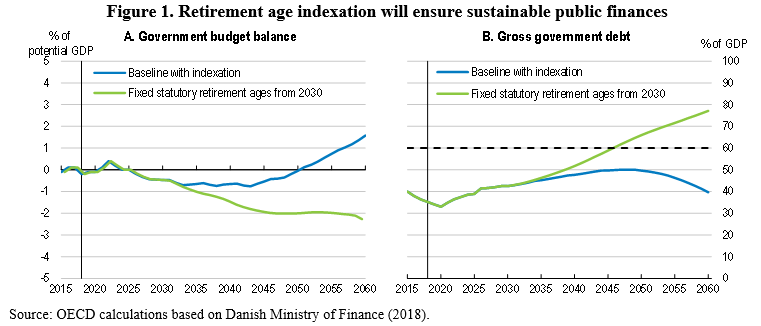
Denmark has a long tradition of reforms delivering sound public finances and strengthening economic growth. One foundation of long-term fiscal sustainability was the decision taken in 2006 to index statutory and early retirement ages to life expectancy. Projections of public finances suggest that in this case (the baseline scenario) the government budget will remain close to balance and debt stay well below 60% of GDP (Figure 1). However, if indexation where to be stopped from 2030, persistent deficits and fast rising debt are projected. 

The indexation mechanism works by raising the statutory retirement
age by up to one year every five years to keep the expected number of years in
retirement constant (Figure 2, Panel A). Experience from the first adjustment
of the early retirement age starting in 2014 has been encouraging. Many seniors
have chosen to stay in their job, which has supported a significant rise in the
employment rate among 55-64 year olds (Figure 2, Panel B). There is still scope
for improvement as the senior employment rate in Denmark remains below those of
Norway and Sweden. 

In the coming years the statutory retirement age will be
increased from 65 to 67 years. Assessing whether the affected workers remain
active will provide another indication of whether the long-term fiscal strategy
is on track. Current projections indicate that the statutory retirement age
will reach 73 by 2060. This is an ambitious path and the highest planned
retirement age across OECD countries. Still, since additional years lived are
generally in good health such a rise is achievable, but requires policies to
retain seniors in the labour market. 

The recent OECD Economic Survey of Denmark commends Denmark for its impressive reform track record and sound public finances. The indexation of retirement ages to life expectancy should become a pillar of the economic policy framework and useful guide for other countries undertaking their own reforms. Nonetheless, successful reform requires full implementation and more could be done to ensure the functioning of the labour market does not discriminate against seniors as well as helping those with reduced work capacities to remain in employment (OECD, 2015).  


References

Danish Government (2018), Denmark’s Convergence Programme
2018
, Copenhagen.

Danish Ministry of Finance (2018), Opdateret 2025-forløb:
Grundlag for udgiftslofter 2022 (Updated 2025 projection: Basis for expenditure
ceilings 2022)
, Copenhagen.

OECD (2019), OECD Economic Surveys: Denmark 2019, OECD Publishing, Paris, http://dx.doi.org/10.1787/eco_surveys-dnk-2019-en.

OECD (2015), Ageing and Employment Policies: Denmark 2015:
Working Better with Age, OECD Publishing, Paris, http://dx.doi.org/10.1787/9789264235335-en


Sustainably financing pensions and healthcare in Thailand

By Adam Bogiatzis, Economist, South East Asia Desk, Economics Department.

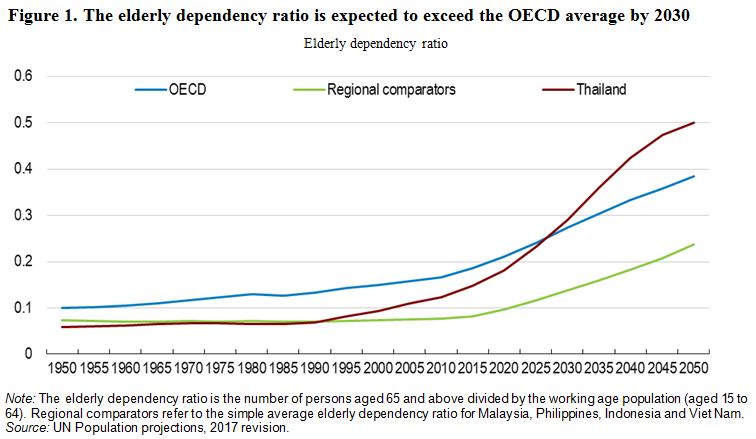
Thailand has made remarkable socio-economic progress over the past several decades. Poverty has plummeted and access to education and health services has become near universal. As is commonly the case, improved health outcomes and expanded opportunities – particularly for women – have led to higher life expectancy, a declining fertility rate and ultimately an ageing population. However, the rate of Thailand’s ageing is exceptional, particularly given its stage of development. Indeed, Thailand’s elderly dependency ratio far exceeds that of other emerging economies in the region (including Indonesia, the Philippines, Malaysia and Viet Nam) and is expected to surpass the OECD average by 2030 (Figure 1).

Thailand 3.JPGWith a rapidly ageing population, the public burden to provide social pensions (which will need to increase to improve very low replacement ratios and safeguard against elderly poverty) and healthcare will grow considerably. Indeed, the Initial Assessment Report of the Multi-dimensional Review of Thailand notes that although Thailand’s current fiscal position is healthy, structural reforms to the pension and healthcare systems are needed to ensure fiscal sustainability (OECD, 2018).
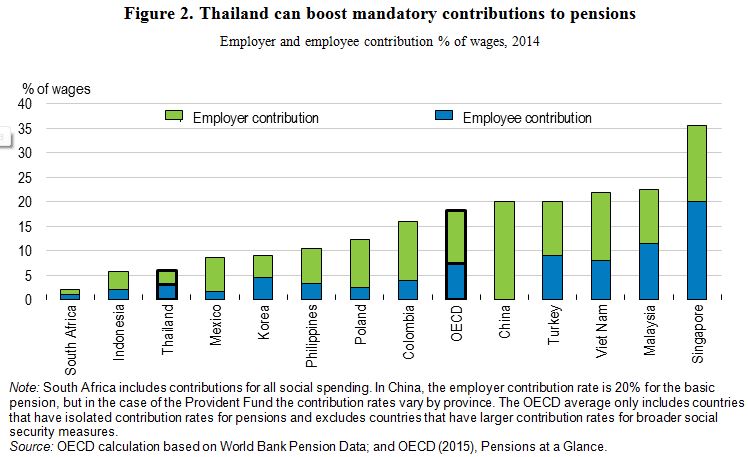
On pensions, Thailand’s shrinking labour force and longer retirements mean there are fewer work years available to support the burgeoning number of retirees. As a first step, the pensionable age of the private pension scheme (55 years and over) should be aligned with the public sector and the social pension scheme (60 years and over), with transitional arrangements put in place for current or imminent retirees. Moreover, consideration should be given to progressively raising the official retirement age in line with life expectancy. Indeed postponing retirement is an efficient way to both raise retirement income and improve financial sustainability (OECD, 2017). Thailand should also gradually increase the mandated private sector contribution rate (i.e. the share of wages mandatorily contributed to a pension fund). Under the national private pension fund, employers and employees combined contribute 6% of wages. This is below the contribution rates for comparator countries and the OECD average (Figure 2).

Thailand 3 bis.JPGIn healthcare, Thailand should avoid near-term regressive and often ineffective blanket cuts to the health budget and instead implement targeted structural reforms that will be beneficial over the longer run. For example, to prevent overburdening of hospitals, Thailand should increase health provision through preventive and primary care by boosting the number of family physicians and general practitioners, particularly in rural areas. Healthcare financing should also be reformed by reducing the exemptions on co-payments and allowing greater private contributions from those able to afford it.

Tax revenues are, and will continue to be, the dominant source of finance for Thailand’s pension and healthcare systems. The government provides an old-age allowance to 82% of people aged over 60 and accounts for 78% of total healthcare expenditure – a share higher than the OECD average and regional comparator countries including Indonesia, Malaysia, the Philippines and Viet Nam. Therefore, a complementary set of reforms that boost revenue is needed. In this regard, Thailand needs to broaden the tax base whilst improving efficiency by relying more heavily on less distortive taxes such as those on consumption, property and inheritances. Moreover, the government should continue its efforts to improve collection efficiency by easing compliance through technological innovation, providing incentives that discourage tax avoidance and informality, and strengthening enforcement on tax evasion.

References

OECD (2018), Multi-dimensional Review of Thailand: Volume 1. Initial Assessment, OECD Development Pathways, OECD Publishing, Paris.
OECD (2017a), Pensions at a Glance 2017: OECD and G20 Indicators, OECD Publishing, Paris.
OECD (2015), Pensions at a Glance 2015: OECD and G20 Indicators, OECD Publishing, Paris.


Reforming Brazil’s old-age pension system to ensure its sustainability

By Jens Arnold, Head of Brazil Desk at the OECD Economics Department and Hervé Boulhol, Head of Pensions and Population Ageing at the OECD’s Directorate for Employment, Labour and Social Affairs

Pensions have been successful in reducing old-age poverty well below the population-wide average, and below the OECD average (Figure 1). At present, all pension recipients – and this includes around 90% of those aged 65 and above – receive at least the minimum wage, which is more than 5 times as much as the poverty line of BRL 170 (equivalent to USD 55).

However, Brazil’s old-age pension system already costs more than 10% of GDP, despite the country’s young – but rapidly ageing – population.  The combined annual shortfall of the pension schemes is close to 4.5% of GDP, contributing substantially to the budget deficit. If the current parameters of the system remain unchanged, spending on pensions for private-sector workers alone would increase by almost 3% of GDP by 2030, and by almost 5% of GDP by 2040. Taking into account the public sector amplifies imbalances, which will make the system financially unsustainable.  An in-depth reform is necessary and inevitable.

Brazil pov by age

Several policy measures could contribute to containing pension expenditures. Raising Brazil’s low average retirement ages of 56 years for men and 53 years for women appears urgent, by introducing a binding minimum retirement age. Many OECD countries are now gradually moving their normal retirement ages beyond 65 years for men and women. In contrast to Brazil’s pension system, all public pension schemes in OECD countries include a minimum retirement age.

Brazil also stands out for high pension benefits relative to working-age incomes, in particular for low-wage earners, paid at low retirement ages (Figure 2). In the OECD, an average-wage full-career worker will get a pension paying 53% of pre-retirement earnings at the age of 65.5 years, compared to 70% for men and 53% for women in Brazil at age 55 and 50, respectively. Moreover, the minimum pension benefit is equal to the minimum wage, which has led to real increases in the minimum pension of almost 90% over the last 10 years. The minimum pension is available after 35 years of contribution or from age 65 after only 15 years of contribution.

Brazil net repla

References

OECD (2017). Pension Reform in Brazil. OECD Policy Memo, Paris: OECD, available at http://www.oecd.org/eco/surveys/reforming-brazil-pension-system-april-2017-oecd-policy-memo.pdf