Going for Growth: Shaping a vibrant recovery

by Laurence Boone, OECD Chief Economist and G20 Finance Deputy

A unique opportunity to shape a vibrant recovery

After a devastating 2020, prospects are improving. The rollout of vaccines is giving us hope while extraordinary monetary and fiscal buffers continue to support firms, jobs and incomes, limiting the social and economic fallout of the pandemic. Importantly, COVID-19 has exposed how structural weaknesses can weigh on economic resilience. How we respond will shape the recovery and the future of our economies. Governments need to act now to address the structural obstacles to growth, build resilience and sustainability; boost productivity and facilitate reallocation; and help people adapt to change.

The cost of unpreparedness to COVID-19 is counted in lives lost, livelihoods damaged and in long-lasting social and economic scars. Most healthcare systems struggled with a global outbreak on such an unprecedented scale. Social safety nets were unevenly prepared for dealing with the consequences of lockdowns. Jobs and incomes were lost with the most vulnerable people often the hardest hit. As large parts of economic, social and educational activity moved on-line, the opportunity costs of limited digital skills and insufficient infrastructure became real. Governments reacted with emergency measures, unprecedented in size and scope, to cushion the shock. Yet the measures will not fix the underlying structural problems, which left us vulnerable in the first place.

The crisis has only added to pre-existing challenges. Before the pandemic, many economies were struggling with sluggish productivity growth amid declining business dynamics. Structural problems in many labour markets included stubbornly high long-term unemployment, informality and poor job quality and security. Moreover, environmental sustainability alongside more general resilience concerns were often absent from growth strategies. As economies reopen in a world of rising digitalisation, changes to workplace practices, corporate restructuring and job transformation, reforms to enhance business dynamism and productivity growth also need to help people and firms adjust and reallocate in order to seize new opportunities.

Going for Growth 2021 provides first-hand advice to governments of OECD and major non-OECD economies on the structural policy priorities needed for a vibrant recovery. It is the OECD’s contribution to the debate on what governments need to do to break away from unsustainable past practices and achieve stronger, more resilient, more equitable and sustainable growth.

The pandemic has also underlined the importance of international cooperation, which can make policy action more effective and less costly. This is why, for the first time, we are putting forward priorities for international policy cooperation: in healthcare, on climate change, on global trade and on the taxation of multinational enterprises. By acting together can help to achieve more.

Laurence Boone
OECD Chief Economist and G20 Finance Deputy

Further reading:
OECD (2021), Economic Policy Reforms 2021: Going for Growth, OECD Publishing, Paris, https://doi.org/10.1787/3c796721-en.


Reducing regional gaps in Bulgaria would support a more inclusive recovery

© Shutterstock.com/RossHelen

By Mikkel Hermansen, Bulgaria desk, OECD Economics Department

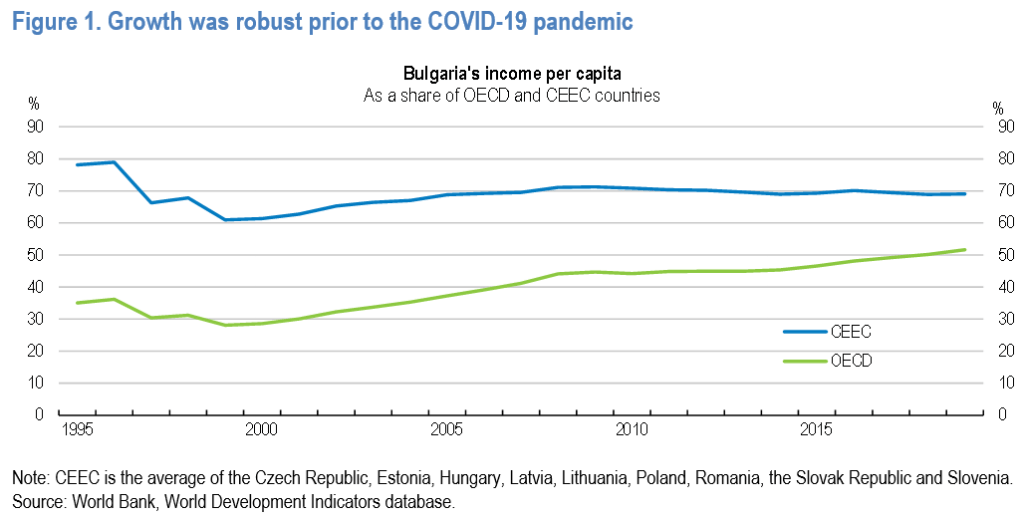
Bulgaria had several years of robust economic growth prior to the COVID-19 pandemic. Income per capita reached half of the OECD average (Figure 1), but did not catch up on faster-growing Central and Eastern European peers. The structural reform agenda has been substantial in recent years. Even so, the 2021 Economic Assessment of Bulgaria (OECD, 2021) calls for continued efforts to modernise the economy and enhance inclusion. This is all the more important as vaccinations accelerate and a recovery looms ahead.

A key challenge for Bulgaria is a fast-shrinking and ageing population (Figure 2). This has increased regional income differences that are now larger than in most OECD countries. Regions without larger cities are lagging behind and are facing multiple challenges from depopulation, high unemployment and widespread poverty. Increasing investments in infrastructure and housing reform would help to boost mobility and strengthen regional linkages to national and international supply chains. Many rural regions are strongly dependent on agriculture, while tourism plays a big role in coastal regions by the Black Sea. Bulgaria has taken several measures to cushion workers, notably in tourism, from the pandemic shock. This is welcome and should be followed by policies to facilitate sustainable local economic development in the longer term. For instance, from upgrading tourism and agricultural activities and products.

Improving living standards across all regions will require better coverage and access to public services. Health and long-term care needs to be strengthened in particular. Hospital capacity is high and helped to mitigate the ongoing pandemic crisis. Nonetheless, access to health care is restricted in many regions due to low numbers of general practitioners, and gaps in health insurance coverage remain significant. To address the pandemic, the government made treatment of COVID-19 available to all. Going forward, priorities should be given to increase effectiveness of public healthcare spending by gradually consolidating the hospital sector and reducing out-of-pocket payments for low-income groups.

References

OECD (2021), OECD Economic Surveys: Bulgaria 2021: Economic Assessment, OECD Publishing, Paris, https://doi.org/10.1787/1fe2940d-en.


Global policy co-operation would strengthen the recovery from the pandemic

by Nigel Pain and Véronique Salins, OECD Economics Department

The COVID-19 pandemic saw governments throughout the world impose stringent containment measures to contain the spread of the virus, including the partial or total shutdown of the activity in many sectors. These necessary measures succeeded in slowing the spread of infections and reducing the death toll, but have severely impacted economic activity, with GDP declines of more than 20% in many countries during shutdowns and a surge in unemployment.

Governments reacted quickly, with substantial fiscal measures being used to help preserve the incomes of workers and companies despite the collapse of activity. In addition, monetary policy has been eased and financial policy relaxed to support credit provision by financial institutions. While such measures have helped to limit the short-term costs of the crisis, the path to recovery remains exceptionally uncertain in the absence of a vaccine or adequate treatment of the disease,.

The OECD Economic Outlook, released on June 10, presented two possible scenarios: one in which the virus recedes slowly and remains under control (the single-hit scenario), and one in which a second wave of contagion is assumed to erupt later in 2020 (the double-hit scenario). In both cases, the G20 economies are projected to experience a severe output decline in 2020, followed by a slow and gradual recovery in 2021 with output and incomes remaining well below the levels expected prior to the pandemic.

Policymakers face exceptional challenges as the recovery gets underway. Government budget deficits are elevated, public debt is set to rise to exceptionally high levels in many countries, monetary policy space is limited, and there are strong risks that a fragile recovery will leave lasting scars.

Should another virus outbreak occur, as assumed in the double-hit scenario, or the recovery proves unexpectedly weak, additional stimulus will need to be supplied mainly by fiscal policy, with monetary policy helping to ensure adequate liquidity and low interest rates along the yield curve. In either scenario, supportive macroeconomic policies will be required for some time to foster a durable recovery. Debt-financed public spending will need to be well targeted on support for the most vulnerable and on public investment in the health, education, digital and environmental infrastructures that are necessary for a sustainable recovery and which lift demand in the near term.

Potential scars in labour and product markets, the necessary reallocation of workers and capital across sectors in the aftermath of the pandemic, and the significant adverse impact of the crisis on living standards also emphasise the urgent need for renewed and well-targeted structural policy reforms in all economies.

Global policy co-operation would enhance the benefits of these actions. Acting together creates confidence and positive spillovers on trade and investment that will be more effective for all countries than if they acted alone. Co-ordinated policy actions across all the major economies are needed to ensure effective healthcare provision around the world and provide the most effective stimulus to the global economy. They would help restore growth more efficiently than country specific actions, with larger effects on trade, consumer and investor confidence and uncertainty.

Illustrative policy simulations for the G20 economies highlight the benefits of economic policy co-operation. The particular set of co-ordinated fiscal, monetary and structural measures considered includes a debt-financed fiscal easing of 0.5% of GDP in all countries for three years, reductions in policy interest rates in economies with sufficient policy space, and additional competition-enhancing structural reforms that increase productivity slowly over time. In all of the G20 countries (or wider areas) central banks are also assumed to use forward guidance that helps interest rates to remain low and takes into account the longer-term output gains from the package of policies being undertaken. In addition, a temporary reduction in investment risk premia is incorporated when all countries act together to capture the favourable effects on investor confidence.

Taken together, these policy measures raise the level of GDP by around ¾ per cent in the first year in the median G20 economy (Figure below, Panel A) and by 1¼ per cent in the second year, with the level of output permanently higher in the longer term. The near-term boost to output primarily results from the collective gains from more supportive macroeconomic policies, but the structural reform measures also start to raise output in the short run, with their impact continuing to build over time. The near-term impact on GDP is a little higher in the G20 economies that have space to reduce policy interest rates, reflecting positive effects on demand and investment, but output gains nevertheless remain strong in the other economies.

In all G20 countries, there are clear gains from collective action relative to each country acting by itself (Figure below, Panel B). First, acting together enhances the spillovers through stronger trade growth and higher financial asset prices as firmer external demand boosts exports and incentives to invest. Second, there are additional gains for each country from the boost to global confidence and reduction in uncertainty that comes from acting together to tackle a common problem. Altogether, the gains from collective actions add nearly one-half and one-third respectively to the output gains in the median G20 economy in the first and second year of the scenario.

This suggests that co-ordinated policy action across countries remains the most effective response to the large economic disruptions caused by the Covid-19 outbreak and the challenges that result. In practice, it may either not be possible for all countries to undertake actions on all fronts or countries may simply choose to undertake a different mix of fiscal, monetary and structural responses. Nonetheless, it is important that all countries participate in a co-ordinated effort to support growth as this will increase the collective gains and the benefits for each country.