Monetary policy and productivity: Unpacking multifaceted links

By Guido Franco and Filiz Unsal, OECD.

Over the past decades, productivity growth has experienced a significant slowdown across most advanced economies. Existing studies point to a range of structural explanations contributing to this deceleration (André and Gal, 2024), but the recent swift tightening and subsequent easing of the monetary policy stance in many jurisdictions have also renewed interest in understanding whether, and through which mechanisms, monetary policy shifts can influence productivity dynamics.

Our new paper (Franco and Unsal, 2025) provides a comprehensive analysis of the impacts of monetary policy shocks on productivity through both (i) within firm productivity, via modified incentives and capabilities to innovate, adopt new technologies, and invest in capital and labour; and ii) variations in the reallocation of resources across firms with different productivity levels, via the heterogeneous transmission across sectors and firms. The analysis relies on the use of the local projection methodology and a large firm-level dataset, covering both manufacturing and services industries across 24 countries over the 1995-2019 period, matched to a newly published database on monetary policy shocks across countries (Choi, Willems and Yoo, 2024). This setting allows us to overcome the potential endogeneity arising from firms’ expectation of changes in policy rates.

Within firm productivity effects

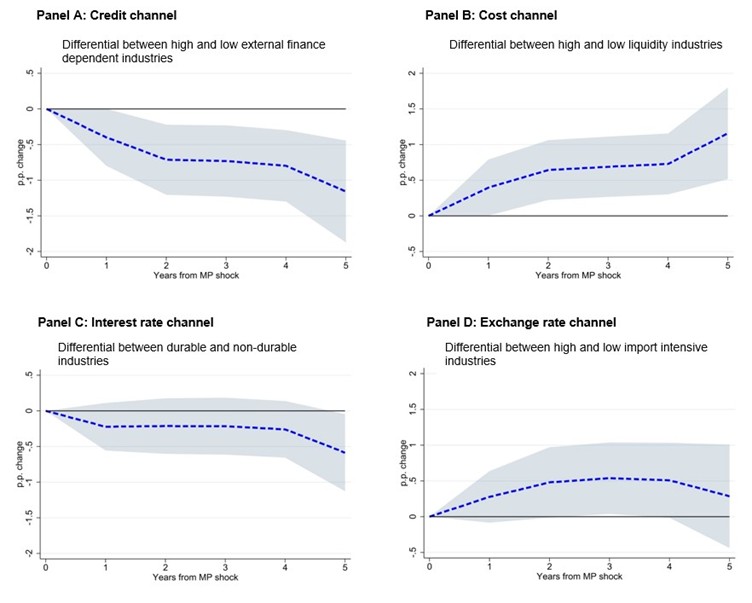
We find that, on average, firm-level productivity growth reacts significantly to changes in the monetary policy stance. A 25 basis points tightening (easing) monetary policy shock implies a cumulative decrease (increase) in productivity growth of 0.7 p.p. over a 5-year time span. Evaluating separately easing and tightening episodes, the former are found to entail slightly larger effects, but the estimates are not far from symmetry. Exploiting the differential effects across sectors and types of firms (Figure 1), we find that the credit and cost channels of the monetary transmission appear to play a relevant role in determining the dynamics of productivity after a monetary policy shock, while the interest-sensitive demand and the exchange rate channels seem to have a more limited and delayed impact.[1]

These effects are amplified or mitigated depending on the country-specific framework conditions and the counter-cyclical response of the policy to the state of the economy. Firms’ productivity is more sensitive to monetary policy shifts in countries with low financial development, in line with the relevance of the credit and cost channels of the monetary transmission. For instance, a developed financial system could allow firms to seek external capital from a variety of sources, attenuating the consequences of a tightening shock.  Moreover, firm-level productivity losses (gains) associated with monetary tightening (easing) are only observed when the economy is in a downturn, hinting that a “leaning against the wind” approach to monetary policy appears favourable not only for providing macroeconomic stability but also from a productivity perspective.

Figure 1. The credit and cost channels of monetary policy transmission appear the most relevant in determining productivity dynamics after monetary policy shocks.

Note: In each panel, the graph simulates the impact of a 25 basis points monetary policy shock. The dashed line reports the size of the effect, while the shaded area displays the 90% confidence intervals. Positive (negative) shocks stand for tightening (easing) shocks. Estimates on the interest-sensitive demand channel (Panel C) refer to industrial sectors only.
Source: OECD calculations based on Authors’ calculations based on Orbis, Choi et al. (2024), Demmou and Franco (2021), Durante et al. (2022) and OECD data.

Reallocation effects

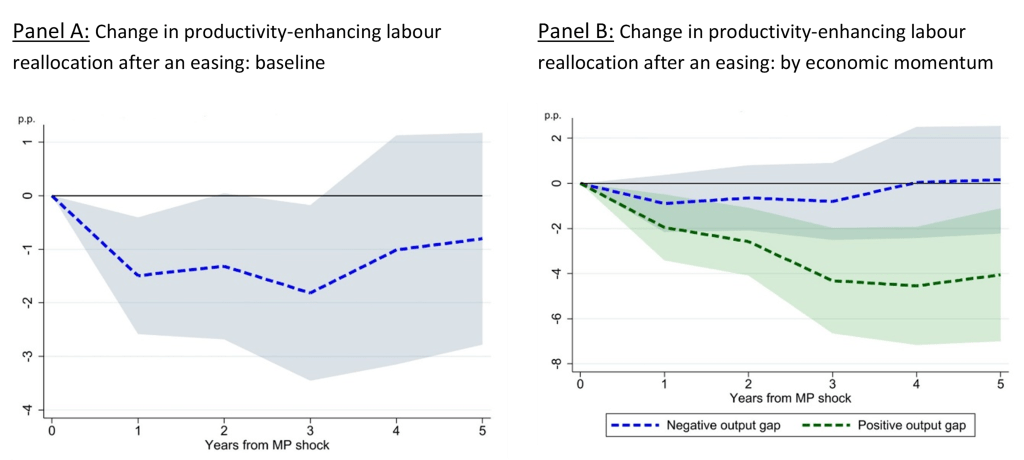
Changes in the monetary policy stance also affect the efficiency with which resources are allocated across firms. Easing episodes are associated with lower productivity-enhancing reallocation, as well as a higher share of labour and capital sunk in zombie firms.  The estimated impacts are not extensive but could imply up to a 7% reduction in the efficiency of resources reallocation over 3-years in the aftermath of a monetary easing episode (Figure 2, Panel A).

Critically, the impact is heterogeneous across countries, as it is the case with respect to within-firm productivity effects. Low barriers to competition and a deep and efficient financial system are essential to offset the misallocation effects that may follow a monetary easing episode, for instance by reducing the risk of credit flowing towards zombie firms and ensuring an effective allocation of the credit inflows arising from the relaxation of lending standards. Importantly, a monetary easing reduces the extent of productivity-enhancing reallocation only when it is pro-cyclical: increased misallocation of resources with easing shocks disappears during economic downturns, as the monetary easing may partially compensate for intensified frictions that productive firms may face when the economy is contracting (Figure 2, Panel B).

There is no significant evidence, instead, of the potentially cleansing effects of tightening episodes. Similarly, monetary policy shocks do not alter the productivity-enhancing nature of business dynamism through the extensive margin, as our estimates show that the strength of the (inverse) relationship between firm exit and productivity is unaffected. Still, when turning to business dynamism more broadly and using sector-level data, we find that the entry and exit margins adjust in opposite directions: a tightening (easing) implies higher (lower) bankruptcies and lower (higher) 1-year survival rate of newly born enterprises.

Figure 2. Monetary easing reduces the productivity-enhancing reallocation of labour, prevalently when it is pro-cyclical.

Note: Productivity-enhancing labour reallocation is measured as the strength of the relationship between firms lagged productivity and employment growth, and hence as the differential employment growth of higher productivity firms compared to lower productivity ones. The graphs simulate the impact of a 25 basis points monetary policy easing surprise.
Source: OECD calculations based on Orbis, Choi et al. (2024) and OECD data.

Conclusion

Productivity dynamics are significantly influenced by monetary policy shocks, but the impacts may depend on the transmission channels involved, country-specific framework conditions and cyclical alignment of the monetary policy responses.

Specifically, a monetary easing boosts firm-level productivity in the medium-term, mainly through investment, but also tends to slow down the productivity-enhancing nature of labour and capital reallocation across firms. On the other hand, tightening episodes are detrimental for firm-level productivity and neutral from a misallocation perspective. The productivity benefits are larger and the losses smaller when sound policies are implemented. Developing a deep and stable financial system, ensuring competitive product markets, while avoiding pro-cyclical changes in the monetary policy stance, helps leverage the advantages and minimise the productivity damages associated with policy rates shifts.

References

André, C. and P. Gal (2024), “Reviving productivity growth: A review of policies”, OECD Economics Department Working Papers No. 1822, OECD Publishing, Paris, https://doi.org/10.1787/61244acd-en.

Choi, S., T. Willems and S. Y. Yoo (2024), “Revisiting the monetary transmission mechanism through an industry-level differential approach”, Journal of Monetary Economics, Vol. 145, 103556, https://doi.org/10.1016/j.jmoneco.2024.103556.

Demmou, L. and G. Franco (2021), “Mind the financing gap: Enhancing the contribution of intangible assets to productivity”, OECD Economics Department Working Papers No. 1681, OECD Publishing, Paris, https://doi.org/10.1787/7aefd0d9-en.

Durante, E., A. Ferrando and P. Vermeulen (2022), “Monetary policy, investment and firm heterogeneity”, European Economic Review, Vol. 148, 104251, https://doi.org/10.1016/j.euroecorev.2022.104251.

Franco, G. and F. Unsal (2025), “Monetary policy and productivity: Unpacking multifaceted links”, OECD Economics Department Working Papers No. 1843, OECD Publishing, Paris, https://doi.org/10.1787/e1d617b2-en.


[1] The credit channel relates to the sensitivity of the external financing premium to changes in policy rates. The interest rate channel is the driven by the impact of changes in interest rates on the interest-sensitive component of demand. The exchange rate channel concerns the negative impact that a tightening (easing) could have on exporting (importing) industries through the appreciation (depreciation) of the domestic currency. The cost channel is instead related to firms’ need to pay factors of production before receiving sale revenues, and thus to borrow some working capital; a change in the cost of borrowing would then be alike to a change in inputs prices.


What explains the ongoing credit slowdown in advanced economies?

Monetary policy image

by Lucia Quaglietti, Economist, Macroeconomic Policy Division, OECD Economics Department

Credit conditions across OECD countries have tightened sharply in recent quarters, with rising policy rates quickly reflected in bank lending rates and bank lending standards becoming more restrictive. Credit growth has slowed, especially to households. New mortgage lending to households has fallen by around 30% year-on-year in the euro area and in the United Kingdom in 2023. A key question is whether this reflects the impact of more restrictive lending conditions or whether demand for borrowing has just declined sharply.

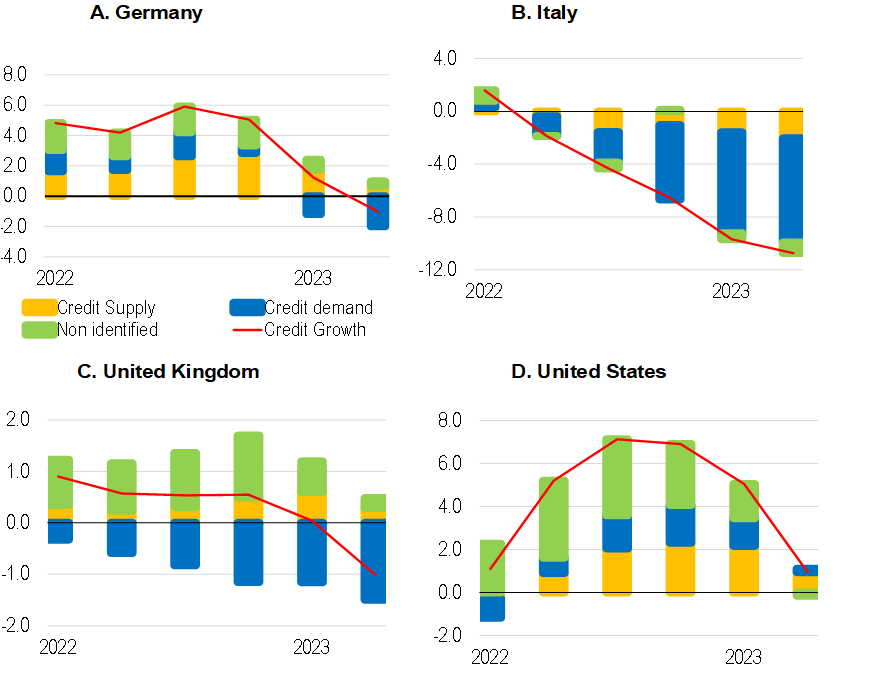
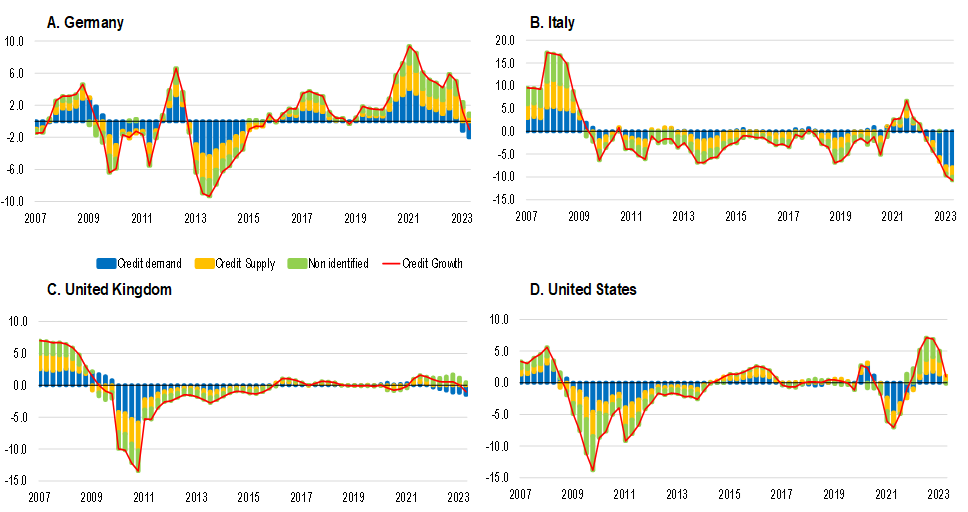
Credit growth is shaped by a range of factors that affect credit demand and supply conditions. Estimates of the impact of these factors on total credit growth to households and non-financial corporations have been obtained for Germany, France, Italy, the United Kingdom and the United States (Quaglietti, 2023). The technique used (structural VARs) permits four types of shocks to be identified: aggregate demand shocks, aggregate supply shocks, monetary policy shocks and credit supply shocks. The contribution of these different shocks to the annual rate of credit growth in 2022 and 2023 is shown in Figure 1, with a longer-term perspective provided in Figure 2. For simplicity, shocks to credit demand are shown as the combined impact of all identified shocks other than credit supply shocks.

  • The results suggest that the recent sharp slowdown in credit reflects a combination of tighter credit supply and falling demand, with the balance of these factors differing across economies (Figure 1).
  • Tighter credit supply has been a more important driver of recent credit dynamics in the United States than weaker credit demand, although other (non-identified) factors have also contributed to credit growth developments (Figure 1).
  • Weaker credit demand accounts for the bulk of the slowdown in Germany, Italy and the United Kingdom. The impact of deteriorating demand conditions appears to be particularly sizeable in Italy, reducing average annual credit growth by 7 percentage points in 2023 (Figure 1). Over the same period, in Germany and the United Kingdom credit demand shocks appear to have lowered average annual credit growth by 1.5 percentage points.
  • The current slowdown in credit growth is comparatively mild relative to that seen during the global financial crisis in many countries, with the exception of Italy (Figure 2). In 2009-10, credit supply and credit demand both contracted sharply. This also occurred in Germany and Italy during the subsequent euro area crisis.

Bank lending surveys broadly corroborate these findings. Banks overwhelmingly report a tightening of credit standards (a supply shock) in the United States, especially for mortgage lending, and a sharp decline in credit demand in the euro area, especially for house purchase.

Higher interest rates, low consumer confidence and falling real disposable income have weakened credit demand by households and firms. The banking sector now is better capitalised than prior to the global financial crisis, and credit supply shocks were still marginally boosting credit growth in most countries as of mid-2023. Even so, banks have tightened credit standards due to rising risk aversion, higher funding costs and balance sheet constraints. In the euro area, the decrease in liquidity following TLTRO (targeted longer-term refinancing operations) repayments may also have contributed to weaker credit supply (Lane, 2023).

So far, there are few signs of a severe and widespread credit shortage of the type seen in the global financial crisis. Ample capital and liquidity buffers and low levels of non-performing loans currently allow banks to continue supplying credit to households and firms, enabling an orderly transmission of monetary policy. But risks remain, especially if the current economic slowdown were to deepen. As banks continue to pass through past increases in policy rates to households and corporates, delinquency rates and non-performing loans could rise, potentially generating credit losses that would weigh on the supply of new credit to the economy. Credit demand could also weaken further in the event of a sharp economic downturn or a swift repricing in asset prices.

Figure 1. Contributions of demand and supply shocks to recent developments of credit growth

Decomposition of the year-on-year percentage change of credit growth relative to its long-term trend

Note: The decomposition is based on the moving average representation of the estimated VARs, and shows in each quarter the contribution of contemporaneous and past structural shocks to credit growth expressed as a deviation from its long-term trend over the period 2000Q1-2023Q2. This trend broadly corresponds to the sample average. Credit demand shocks are obtained as the sum of aggregate demand, aggregate supply and monetary policy shocks. The green bars correspond to unidentified factors [1}.

Source: Bank of England, European Central Bank, Federal Open Market Committee and OECD calculations.

[1] The VAR for each country is estimated by Bayesian techniques, with shocks identified by sign restrictions based on standard theoretical models (Gambetti and Musso, 2017). Aggregate supply shocks are assumed to drive real GDP and inflation in opposite directions; aggregate demand shocks move real GDP, inflation, policy rates, bank lending rates and credit growth in the same direction; positive (i.e., rate-increasing) monetary policy shocks negatively affect both GDP and inflation; and expansionary credit supply shocks are assumed to lead to an increase in output, inflation and (due to the central bank policy reaction) policy rates but make bank lending rates and credit growth move in opposite directions. The VARs are estimated with one lag and sign restrictions are imposed on impact only (first quarter).


Figure 2. Contributions of demand and supply shocks to credit growth in the period 2007-2023

Decomposition of year-on-year percentage change of credit growth relative to its long-term trend

Note: See note to figure 1.
Source: Bank of England; European Central Bank, Federal Open Market Committee; and OECD calculations.


References

Lane P. (2023) “The banking channel of monetary policy tightening in the euro area”, remarks at the Panel Discussion on Banking Solvency and Monetary Policy, NBER Summer Institute 2023 Macro, Money and Financial Frictions Workshop.

Musso, A. & L. Gambetti, (2017), “Loan supply shocks and the business cycle”, Journal of Applied Econometrics, Vol. 32, No. 4, pp. 764-782

Quaglietti, L. (2023), ‘’Drivers of credit growth across advanced economies’’, OECD Economics Department Working Paper, forthcoming.


Monetary policy and credit standards: this time it’s different

by Almira Enders and Dennis Dlugosch, OECD Economics Department

The current monetary policy tightening cycle observed in many countries stands out for several reasons. In particular, it is rapid, globally synchronised and accompanied by an equally rapid tightening of credit standards (OECD, 2022).

Since February 2022, the US Federal Funds Target Rate has risen by 500 basis points (Figure 1 Panel A). No tightening cycle since the mid-1980s has seen such a big increase in policy rates in such a short period of time. Central banks in other main advanced economies have acted comparably aggressively in their fight against high inflation. The European Central Bank, for example, has raised its policy rates by 400 basis points since June 2022. The increase of policy rates has been quickly transmitted to money market and bank lending rates over the past year (OECD, 2023).

Figure 1. Policy rates and credit standards have tightened in sync

Note: Starting on Dec 16, 2008, the fed funds target rate contains the average of the upper and lower limits of the target range of the fed funds rate. Prior to Dec 16, 2008 the fed funds target rate was a fixed rate. Credit standards refer to net percentage of US domestic banks reporting tightening of standards for commercial and industrial loans to small firms (in percent, not seasonally adjusted).
Source: Federal Reserve Board; OECD calculations.

While the tightening of credit conditions is a standard transmission channel of monetary policy, the synchronised increase in interest rates and tightening of credit standards is eye-catching in comparison to previous tightening cycles (Figure 1 Panel B).[1]  Credit standards are non-price measures that determine access to credit, such as collateral requirements, employment status or income situation. Credit standards can restrict access to credit in addition to sheer the changes in lending rates which affect the supply and demand for credit through their impact on cost of debt and banks’ and borrowers’ balance sheets.

The net share of banks reporting tightened credit standards in the current monetary policy tightening cycle has increased, in step with the increase in policy rates. In March and April 2023, the net share of banks tightening lending standards to small firms over the previous three months reached 47% in the US.[2] While this share is still below the peaks reached during the Covid-19 crisis (70%) and the Global Financial Crisis (about 75%), the current rapid tightening of credit standards is similar to the dynamics seen during the last two severe economic downturns. In the euro area, as well, the current monetary policy tightening was accompanied by the tightening of credit standards, although less rapidly than in the US. The corresponding net share of banks tightening credit standards  in the euro area increased to about 24% recently, only a fraction below the last peak reached during the euro area sovereign debt crisis at 28%. In the UK, the share of lenders reporting worsened availability of unsecured credit to households and small businesses widened rapidly to almost 40%, approaching the peak reached during the Covid-19 crisis of about 63%.[3]

Bank lending surveys also provide information on the reasons behind changes in lending standards. In the US, most banks have reported tighter lending standards because of a less favourable or more uncertain economic outlook and a reduced tolerance for risk. In the euro area, we observe similar patterns, as higher risk perception and a lower tolerance for risk of banks were the main reasons behind the recent tightening of credit standards.

Focussing on small firms and households is interesting because they are usually more exposed to tighter credit standards given that they rely more on bank loans as external source of finance. In the US and the euro area, the evolution of lending standards to small firms appears representative for the overall corporate sector. While in the US more banks have also reported tighter standards for credit card loans; in the euro area, the net share of banks reporting tighter credit standards for households, which includes but is not limited to credit card loans, has receded from their recent peaks over the past two quarters. In the UK, credit availability remains favourable for corporate sector and for secured lending for households.

In the past, banks rapidly tightened credit standards during severe economic downturns, mainly due to the expected deterioration of borrower’s balance sheets (Ciccarelli et al., 2015). In contrast to the current juncture, at that time monetary policy accommodated these economic downturns, by lowering interest rates in response to a slump in aggregate demand and declining inflation. The combined tightening of policy rates and credit standards has several implications for policy makers. First, it adds to the uncertainty over the impact of monetary policy on the real economy and thus makes the transmission channel for monetary policy difficult to gauge. Central banks will need to maintain restrictive monetary policy to curb inflation durably. However, monitoring financial stability and clear communication will be needed to minimise uncertainty about apparent conflicts between the pursuit of price stability and financial stability mandates. Finally, keeping an eye on competition in financial services will be critical to ensure that small business and households continue to benefit from a vibrant financial sector.

References

Ciccarelli, M., A. Maddaloni and J.-L. Peydró (2015),”Trusting the bankers: A new look at the credit channel of monetary policy”, Review of Economic Dynamics, Vol. 18 (4).

OECD (2022), OECD Economic Outlook, Volume 2022 Issue 2, OECD Publishing, Paris, https://doi.org/10.1787/16097408.

OECD (2023), OECD Economic Outlook, Volume 2023 Issue 1, OECD Publishing, Paris, https://doi.org/10.1787/ce188438-en.

Footnotes


[1] The figure shows the synchronized tightening of policy rates and credit standards in the US. The euro area bank lending survey was launched in 2003. This limits a comparison over several monetary policy tightening cycles.

[2] Based on a survey of lending practices of major US banks conducted by the Federal Reserve Board System. The number refers to the net percentage of banks that have tightened lending standards over the previous three months. The net percentage is equal to the difference between the sum of banks answering “tightened considerably” and “tightened somewhat” and the sum of banks answering “eased somewhat” and “eased considerably” in percentage of the total number of banks.

[3] Based on the Bank Lending Survey conducted by the Eurosystem of Central Banks for the euro area and based on the Credit Conditions Survey conducted by the Bank of England for the UK.


Do central bank losses matter?

coins with downward arrow

By Nobukazu Ono and Álvaro Pina, OECD Economics Department

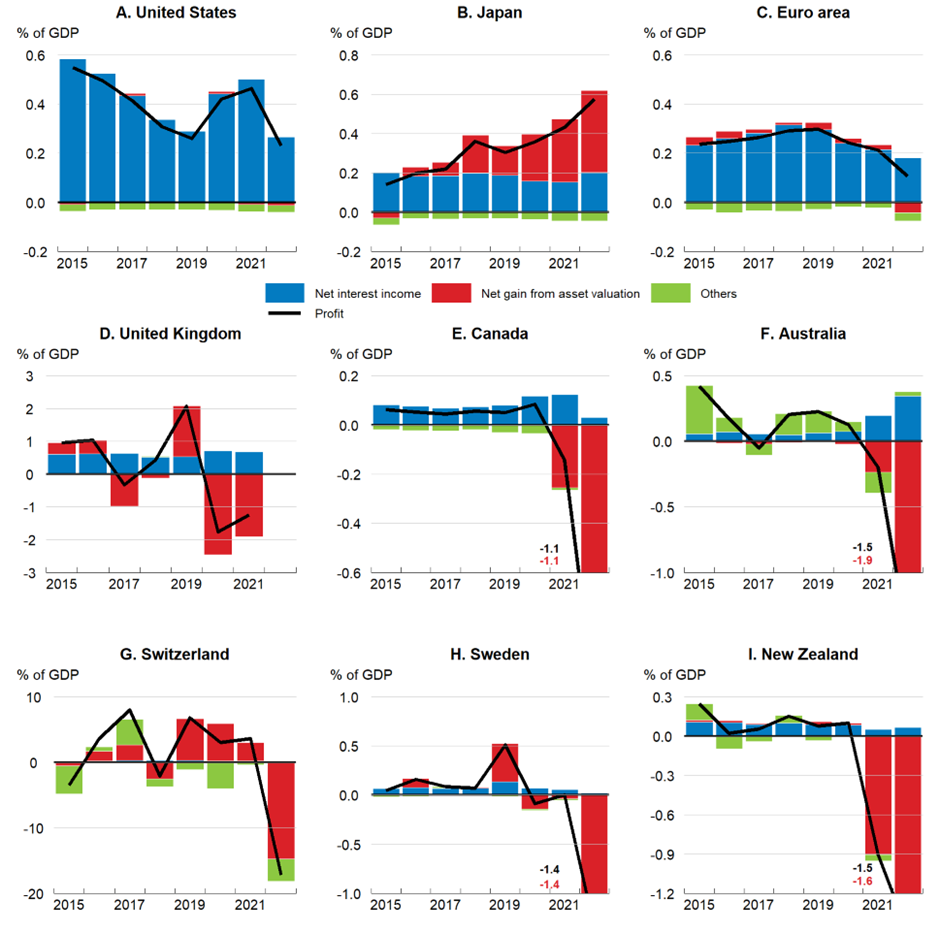
After recording sizeable gains from quantitative easing (QE) over most of the past decade, several central banks have recently reported financial losses. Further losses are likely in the coming years. As discussed in the latest OECD Economic Outlook (OECD, 2023), these losses have long been anticipated, as past gains and current losses are two sides of the same coin. This is also the case for the adverse impact of losses on the public finances, which comes after several years of significant central bank remittances to Treasuries. Nonetheless, losses and the potential need for recapitalisation from the government can still undermine the credibility and perceived independence of central banks. This calls for transparency and clear communication in the presentation of losses.

Why are central banks making losses?

Losses largely reflect the large balance sheets built up during an extended period of QE and the effects of the recent rises in policy interest rates. QE created a sizeable mismatch in the maturity of central bank assets and liabilities. On the liability side, central bank reserves (mainly commercial bank deposits) rose sharply. The remuneration on these is closely linked to policy interest rates, and has thus risen rapidly, to the benefit of commercial banks. In contrast, on the asset side, QE purchases were mostly long-term fixed-rate bonds that generate a relatively stable stream of income. When policy interest rates were at or close to the zero lower bound, the balance of these two sets of payments generated gains for central banks. Even as policy rates were raised through 2022, their impact on whole-year net interest income was still relatively mild (Figure 1), especially where most rate increases took place towards the end of the year, as in the euro area. However, larger impacts are likely in 2023 and 2024 (Anderson et al., 2022; De Nederlandsche Bank, 2022).  

Higher interest rates also reduce the market value of securities. Valuation losses may thus arise, though this depends on the accounting frameworks and asset sales decisions of central banks. For instance, the Federal Reserve and the Bank of Japan account for securities held for monetary policy purposes using amortised cost. This means that valuation changes do not affect profits unless securities are sold, which has not been the case so far. Eurosystem accounting guidelines, also followed by Sweden, allow central banks to value securities held for monetary policy purposes at either amortised cost or the current market price. While euro area national central banks have generally opted to use amortised cost, the Riksbank has adopted market pricing, making a significant loss apparent in 2022. Mark-to-market accounting brings forward loss recognition, as also illustrated by Australia, Canada, New Zealand, Switzerland and the United Kingdom. In Switzerland, the central bank loss was unusually large in 2022, at 17 per cent of GDP, but these losses stemmed largely from changes in the domestic currency value of foreign exchange reserves, including foreign securities.

 Do losses hamper fiscal or monetary policy?

Central bank losses affect the public finances by reducing or ending central bank payments to the Treasury in the form of income taxes or remittances. Moreover, reverse cash flows (i.e., payments from the Treasury) may occur if central banks are entitled to be compensated by the government for certain losses, such as QE-related losses. For instance, in the United Kingdom, the Bank of England Asset Purchase Facility (APF), through which QE asset purchases were conducted, is fully indemnified by the Treasury.

The annual impact on the general government fiscal balance should in general be modest: over 2015-21, revenues from the central banks considered in Figure 1 rarely exceeded, and were often far below, 0.5% of GDP per year. However, even if small, the negative effect on fiscal balances could be protracted, as losses may persist for several years. Even after the central bank returns to profit, some time may elapse before remittances to the Treasury resume.

Central bank losses are not an indication of a policy error and need not hamper the effectiveness of monetary and financial policies. The policy mandates of central banks include price stability and financial stability, but not profit maximisation. Their current losses, as well as their earlier gains from QE, are a by-product of policy actions designed to help achieve their mandates. Moreover, central banks are not subject to capital adequacy requirements or bankruptcy procedures and can operate effectively even with negative equity, as the central banks of Chile, the Czech Republic, Israel and Mexico have done over several years (Bell et al., 2023).

However, losses or negative equity can pose communication challenges. For instance, some policy decisions, such as retaining rather than selling government bonds, could be misinterpreted as being motivated by a desire to contain losses rather than as actions to pursue specific policy mandates. This would reduce central bank credibility. Likewise, financial flows from government, including actions to strengthen central bank capital positions, could be misperceived as being inconsistent with central bank independence. This underscores the importance of clear communication about the reasons for losses and of a transparent framework for financial flows between the central bank and the government.

Figure 1: Several central banks now report negative profits

Note: Accounting approaches and financial years differ across countries and data should therefore be compared with caution. ‘Net gain from asset valuation’ includes realised gains/losses and, in some countries, unrealised ones. For the euro area, the chart shows the consolidated result of national central banks. The euro area figure for 2022 is based on the 17 member banks who had published results by 29 June 2023. For the United Kingdom, the chart shows the consolidated result of the Bank of England and the Asset Purchase Facility. See Box 1.3 in OECD (2023) for further details.
Source: Board of Governors of the Federal Reserve System; Bank of Japan; national central banks in the euro area; Bank of England; Bank of Canada; Reserve Bank of Australia; Swiss National Bank; Sveriges Riksbank; Reserve Bank of New Zealand; OECD Quarterly National Accounts database; and OECD calculations.

References

Anderson, A., P. Marks, D. Na, B. Schlusche, and Z. Senyuz (2022), “An Analysis of the Interest Rate Risk of the Federal Reserve’s Balance Sheet, Part 2: Projections under Alternative Interest Rate Paths,” FEDS Notes, Washington; Board of Governors of the Federal Reserve System, 15 July, https://doi.org/10.17016/2380-7172.3174.

Bell, S., M. Chui, T. Gomes, P. Moser-Boehm, and A. P. Tejada (2023), “Why are Central Banks Reporting Losses? Does it Matter?,” BIS Bulletin No 68, February, https://www.bis.org/publ/bisbull68.pdf.

De Nederlandsche Bank (2022), “Letter regarding DNB’s capital position – September 2022,” 9 September, https://www.dnb.nl/media/p4igu5fc/letter-regarding-dnb-s-capital-position-september-2022.pdf.

OECD (2023), OECD Economic Outlook, Volume 2023 Issue 1, OECD Publishing, Paris, https://doi.org/10.1787/ce188438-en.


Monetary policy pass-through to bank credit conditions: progressing fast

Monetary policy image

Ane Kathrine Christensen and Lucia Quaglietti, OECD Economics Department

Policy interest rates have risen at an unusually rapid pace since the end of 2021 in many countries. Such policy changes affect economic activity through many different channels. One key channel is the speed and extent to which changes in policy rates are passed through to financing conditions and credit growth, and thus to private consumption and investment (Bernanke and Gertler 1995; Mishkin 1996).  Analysis in the June 2023 OECD Economic Outlook, suggests that changes in policy rates in OECD advanced economies are being quickly reflected in bank credit conditions faced by households and firms, with transmission occurring at a broadly similar pace to past tightening cycles.

One indicator is the extent to which increases in policy rates have been transmitted into the interest rates on new bank loans for households and firms. The evidence suggests that transmission in the current cycle is similar to that in past tightening cycles on average, but with significant variation across countries (Figure 1, Panels A and B). In particular, there have been strong increases in the cost of new bank loans for non-financial corporations, where bank lending rates have on average increased almost one‑to‑one with policy rates. The largest relative increases in new bank lending rates have been observed in Australia, Canada, New Zealand, Norway and Sweden, in some cases reflecting an earlier start to policy tightening. In the euro area, bank lending rates charged on short-term loans to non-financial corporations have generally increased faster than those on loans with longer maturities and lending rates on consumer loans to households have risen less than rates on loans for house purchases.

Figure 1: Bank credit is slowing down and swiftly becoming more expensive

Note: For the current tightening cycle, changes in policy rates, new lending rates and real credit growth are computed between the date of the first policy increase in each country and March 2023. Similarly, changes in bank lending rates across past tightening cycles are computed since the first rate increase and over a period matching the one elapsed since the first increase in the current cycle. Changes across past tightening cycles are computed as simple averages of individual country tightening cycles since 2000. “Average” is computed as a simple average across countries. Bank lending rates and credit growth to households are for house purchases. Real credit growth is obtained by deflating nominal credit growth by national consumer prices.
Source: Central bank statistics; and OECD calculations.


Banks generally base the lending rates they charge to firms and households on their own funding costs, plus a mark-up. Rising policy rates have been quickly transmitted to interbank lending rates, but transmission to deposit rates has been sometimes slower. However, deposit rates have started to rise more rapidly recently, with banks trying to counteract tighter liquidity conditions and an acceleration in deposit outflows by offering higher rates to their customers.

Fast-rising bank lending rates have been associated with a slowdown in the pace of real credit growth (Figure 1, Panels C and D). On average, the slowdown in real credit growth during the current tightening cycle has been somewhat larger for households than for companies, though credit to firms has contracted sharply in a number of countries in the euro area and in the United Kingdom, while it has remained comparatively resilient in the United States and Canada. In the majority of the countries considered, credit growth has been weaker than at similar points in previous tightening cycles, and also lower than on average over 2000-19, particularly for households.

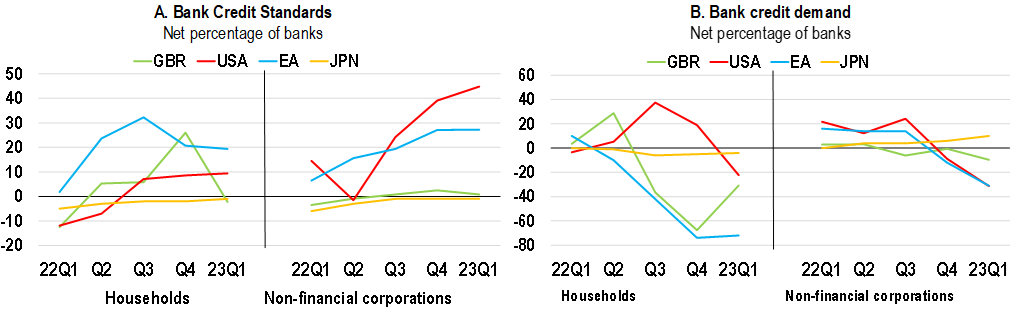
Monetary policy changes may also affect the willingness of banks to make credit available to potential borrowers. Bank lending surveys suggest that slowing credit growth and higher lending rates observed in the major advanced economies reflect a combination of tighter credit standards and falling credit demand (Figure 2). Credit standards have often tightened substantially in recent quarters, especially for mortgage lending in the euro area and for lending to non-financial corporations in the United States. Surveys point to a sharp decline in credit demand as well, especially for house purchase in the euro area and in the United Kingdom. In the euro area, the decline in credit demand for house purchases is similar to the fall seen during the global financial crisis. Japan is an exception, with credit standards and demand being little changed due to the continued accommodative monetary policy stance.

Figure 2: Credit standards have tightened and demand has declined sharply

Note: Net percentages are defined as the difference between the sum of the share of banks reporting a tightening in credit standards/rising credit demand and the sum of the share of banks reporting a loosening of credit standards/falling credit demand. Positive (negative) balances indicate tighter (easier) credit standards and rising (falling) credit demand. For the United Kingdom, credit standards are proxied by inverted loans approved. For the United States, the United Kingdom and Japan, credit standards to non-financial corporations are for large firms
Source: Central bank statistics; and OECD calculations.


The pace of policy rate increases has now begun to slow in many countries, but bank credit conditions could tighten further in the coming quarters, with banks continuing to pass through higher funding costs to households and corporates. As a result, the full impact of policy tightening on activity is likely to appear with a lag over the course of 2023 and early 2024.

References

Bernanke, B., and M. Gertler (1995). “Inside the Black Box: The Credit Channel of Monetary Policy Transmission.” Journal of Economic Perspectives, Vol. 9.

Mishkin F. (1996), “The Channels of Monetary Transmission: Lessons for Monetary Policy,” NBER Working Papers 5464.

OECD (2023), OECD Economic Outlook, Volume 2023 Issue 1, OECD Publishing, Paris.


Canada: five messages from the latest OECD Economic Survey

By Ben Conigrave and Philip Hemmings, OECD Economics Department

Canada’s economy has proved resilient to testing global conditions in the wake of Russia’s invasion of Ukraine. Amid a strong post-pandemic recovery in output and revenues, the federal government stepped up action to improve housing affordability and expand access to low-cost childcare. While Canada’s recent social policy progress is impressive, a major reform challenge remains – to lift tepid growth in productivity and average incomes while also eliminating net greenhouse gas emissions by 2050. Projected economic growth of 1.3% in 2023 and 1.5% in 2024, while avoiding recession, would not close gaps in living standards to better-performing economies. The latest Economic Survey of Canada sets out recommendations aimed at boosting Canada’s growth potential and driving down carbon emissions.

Inflation has fallen from peak levels but is still above target. The main drivers of last year’s surge in consumer prices have abated. Energy price falls and easing tensions in world supply chains have helped reduce headline inflation. Higher borrowing costs have also started to cool domestic demand after a series of large interest rate rises by the Bank of Canada. Still, underlying price pressures remain elevated. Labour market conditions are tight, with the jobless rate near record lows and workers demanding larger-than-usual wage increases. Policymakers face the tricky task of returning inflation to target without creating an economic downturn.

Figure 1. Inflation has passed its peak but remains high

Headline consumer prices, annual increase, %

Note: The Bank of Canada aims to keep inflation close to the 2% midpoint of a control range from 1 to 3% over the medium term.
Source: OECD (2022), Main Economic Indicators (database).

Living cost pressures have increased. High inflation has eroded real incomes and is weighing on consumer spending. Governments have stepped in to ease the cost of living. Some measures rightly target support to vulnerable households. For instance, the federal government has temporarily increased goods and services tax (GST) credit payments aimed at those on lower incomes. In contrast, provinces have in some cases introduced across-the-board subsidies to reduce utility bills or cut fuel taxes. Untargeted measures of this sort can be costly, fail to focus support on under-pressure households, and weaken incentives to save energy. A major federal-provincial initiative separately promises to improve access to cheap childcare. Properly implemented, the scheme should help lift employment, particularly among women, supporting higher living standards. At the same time, significant socio-economic gaps still separate Indigenous people and the rest of Canada’s population. Support for Indigenous self-determination needs to continue as part of efforts to close these gaps.

Budget repair has been faster than expected. Commodity export price rises contributed to revenue growth in a high-inflation environment just as pandemic support was ending. Deficits and debt burdens have shrunk despite the federal government extending living-cost relief and launching new programmes to improve the affordability of housing and childcare. But as multi-year spending commitments mount, and revenue tailwinds die down, governments will find it harder to sustain budget improvements. Better spending efficiency could reduce long-term fiscal challenges. Tax system reform will also be important, both for fiscal sustainability and unlocking higher potential output. Shifting the tax mix towards greater use of indirect taxes, and less use of distortive taxes on income, would reduce drags on Canada’s productive capacity. Windfall gains from high commodity prices in 2022 also serve as a fresh reminder of the need for provinces to make more use of stabilisation funds to mitigate boom and bust cycles in their budgets.

Figure 2. The public debt burden is decreasing

Public debt, % of GDP

Note: Data for 2022 are estimates. Gross debt includes general government liabilities in the form of currency and deposits; debt securities, loans; insurance, pensions and standardised guarantee schemes, and other accounts payable. Net debt subtracts financial assets from gross debt.
Source: OECD Economic Outlook 112 (database).

More policy focus is needed on productivity-enhancing reform. Population increase, underpinned by high levels of immigration, will continue to be an important driver of growth in Canada’s economy in the years ahead. But long-term improvement in living standards will require higher productivity. Lacklustre productivity growth since 2015 saw gaps in per capita GDP widen between Canada and better-performing economies, including the United States. Reversing this trend, which coincided with weak business investment after the 2014 oil price collapse, demands reform efforts equal to those behind recent social policy advances. Removing barriers to trade between provinces would improve the business environment. Regulations and technical standards impede flows of goods and services across Canada’s internal borders as well as the performance of regional labour markets. Separately, stringent foreign ownership limits in network sectors – including telecommunications – directly restrict foreign direct investment. The rules should be reviewed.

Figure 3. Canada’s investment performance can be improved

Real private non-residential investment

Source: OECD Economic Outlook database.

Strong incentives are needed to decarbonise production. Canada’s resource-intensive economy uses more energy and generates more greenhouse gas emissions per person than most other OECD countries. An ambitious federal government plan aims to change this. Deploying regulations, market-based tools and support for green investment, the government has committed to eliminate Canada’s net emissions by 2050. As well as energy saving in businesses and homes, achieving this goal will require replacement of fossil fuels with clean energy across the economy. For policymakers, the task will be to minimise drags on activity from sometimes overlapping mitigation tools. Higher carbon prices levied uniformly on a larger share of emissions will help ensure an efficient green transition. Canada’s federal and provincial governments must work together to strengthen incentives for low-cost mitigation across key sectors – including electricity, oil and gas, transport and buildings – and prepare communities for fast-changing climates.

Figure 4. Canada’s emission reduction challenge is large

GHG emissions

Note: The solid blue line shows historical GHG emissions. The dotted line shows the emissions reductions required to meet 2030 and 2050 targets along an indicative pathway. The green line shows emissions projections by Environment and Climate Change Canada.
Source: Calculations based on OECD (2022), Environment Statistics (database); Climate Action Tracker; and Environment and Climate Change Canada.

References:

OECD (2023), OECD Economic Surveys: Canada 2023, OECD Publishing, Paris. https://doi.org/10.1787/7eb16f83-en


Quantitative tightening: another driver of higher interest rates?

By Nobukazu Ono and Álvaro Pina, OECD Economics Department

Policy rate increases are not the only lever for monetary policy tightening. As discussed in the latest OECD Economic Outlook (OECD, 2022), some central banks have started to reduce the amount of bond holdings on their balance sheets, a policy action known as quantitative tightening (QT). In some respects, this is the opposite of quantitative easing (QE), the large-scale asset purchases undertaken by central banks on several occasions since the global financial crisis. However, QT is generally expected to take place at a slower and more predictable pace, leaving holdings of securities by end-2024 at a higher level than before the pandemic. While QE lowered long-term interest rates, QT is likely to increase them, but the impact over the next two years should be moderate in most countries. However, given scant previous experience with QT and the many different transmission channels involved, these estimates are uncertain.

QT: how and how fast

Central banks can reduce their balance sheets without selling securities (active QT). They can choose to not (or not fully) reinvest the proceeds of maturing bonds (passive QT), in which case the pace of decline in bond holdings depends on the maturity structure of the bond portfolio and on the extent of partial reinvestment. Based on announced central bank policy decisions, the maturity structure of bond holdings, and the projections for GDP in OECD (2022), declines in the range of 3 to 11 per cent of GDP are projected in balance sheets between November 2022 and the end of 2024 in six advanced economies (Figure 1; Japan and the euro area are not included as they have not yet announced plans for QT).

Approaches to QT vary among these countries, with Australia and Canada pursuing passive QT with no reinvestment throughout, Sweden and the United States making some partial reinvestment (at least initially) and New Zealand and the United Kingdom also resorting to active QT (for further details, see Box 1.3 in OECD, 2022). In all six cases, QT is expected to take place at a slower pace than the post-March 2020 QE programmes, leaving bond holdings by end-2024 still above pre-pandemic levels, both in nominal terms (OECD, 2022) and as a share of GDP.

Figure 1: Projections of central bank balance sheet reduction

Note: The charts show different definitions of central bank securities holdings divided by GDP (sum of the four latest quarters). Other aspects of central bank balance sheets are not included. A vertical dotted line indicates when the central bank started quantitative easing programmes in response to the COVID-19 shock. See Box 1.3 in OECD (2022) for further details.
Source: Board of Governors of the Federal Reserve System; Office for National Statistics; Bank of Canada; Reserve Bank of Australia; Reserve Bank of New Zealand; Sveriges Riksbank; OECD Economic Outlook 112 database; and OECD calculations.

QT is likely to raise long-term interest rates, but the size of the impact is uncertain

As QE helped to lower long-term interest rates, QT should increase them. But estimating the magnitude of the possible impact is difficult, given the different contexts in which the policies are being implemented and the various channels through which they operate. For both QE and QT, the absolute and relative importance of different transmission channels depends on specific circumstances (Bank of England, 2022). For instance, when policy interest rates were at their effective lower bound, QE episodes reduced interest rate expectations by signalling a commitment to maintain low policy rates for a longer period. This signalling effect is less important when policy can be tightened by raising interest rates and QT takes place in a gradual and predictable way (Bullard, 2019; Lane, 2022). Asset purchases or sales may also affect different components of the risk premium on long-term yields, by changing the average maturity and the duration risk of private portfolios (portfolio balance effects), impacting liquidity conditions, or mitigating market stress.

Given the scant past experience with QT, essentially limited to the US in 2017-19, the estimated effects on long-term yields from QE programmes may help to gauge the possible order of magnitude of the impact of QT. As a rule of thumb, bond purchases of 1% of GDP have been found to reduce long-term yields by about 5 to 10 basis points on average (Gagnon, 2016; Finlay et al., 2021; Bank of England, 2022; Crawley et al., 2022), with impacts tending to be stronger at times of market stress. Applying this simple rule to the amounts of QT projected to occur from the start of bond holdings reduction in each country to the end of 2024 tentatively suggests an impact on long-term interest rates ranging from 15-30 basis points in Australia to between ½ and 1 percentage point in the United States, with values for the other four countries in the 30-80 basis points interval. These impacts are several times smaller than those from recent and ongoing policy rate increases.

However, the impacts of QT and QE on longer-term interest rates could turn out to be asymmetric. With policy rates clearly above zero and balance sheet size being reduced gradually and predictably, signalling effects should be (much) smaller in QT than for QE. On the other hand, the liquidity effects from QT could prove stronger, leading to a substantial increase in liquidity premia. For instance, evidence for the United States suggests that QE made bank liabilities increase and become of shorter maturity, which 2017-19 QT did not reverse to a commensurate extent. Banks could thus become more sensitive to liquidity shocks now that QT is again underway (Acharya et al., 2022).

References:

Acharya, V. V., Chauhan, R. S., Rajan, R. G., and Steffen, S. (2022), “Liquidity Dependence: Why Shrinking Central Bank Balance Sheets is an Uphill Task”, presented at 45th Annual Jackson Hole Economic Symposium, August 2022.

Bank of England (2022), “QE at the Bank of England: a perspective on its functioning and effectiveness”, Bank of England Quarterly Bulletin 2022Q1.

Bullard, J. (2019), “When Quantitative Tightening Is Not Quantitative Tightening”, Federal Reserve Bank of St Louis, Economy Blog.

Crawley, E., Gagnon, E., Hebden, J., and Trevino, J. (2022), “Substitutability between Balance Sheet Reductions and Policy Rate Hikes: Some Illustrations and a Discussion,” FEDS Notes. Washington: Board of Governors of the Federal Reserve System, June 03, 2022.

Finlay, R. Titkov, D. and Xiang, M. (2021), “An Initial Assessment of the Reserve Bank’s Bond Purchase Program”, Reserve Bank of Australia Bulletin, June 2021.

Gagnon, J. E. (2016), “Quantitative Easing: An Underappreciated Success”, Peterson Institute for International Economics Policy Briefs 16-4, April 2016.

Lane, P. (2022), “The Transmission of Monetary Policy”, speech at the SUERF, CGEG|COLUMBIA|SIPA, EIB, SOCIÉTÉ GÉNÉRALE conference on “EU and US Perspectives: New Directions for Economic Policy”, 11 October.

OECD (2022), OECD Economic Outlook, Volume 2022 Issue 2, OECD Publishing.


Mortgage rates are rising: Should we be concerned?

By Damien Puy and Kimiaki Shinozaki, OECD Economics Department.

Mortgage interest rates are now rising in many OECD countries, reflecting the ongoing tightening of monetary policy by most central banks. This raises important questions about the impact on household finances and house prices, and the implications for financial stability. The latest OECD Economic Outlook (OECD, 2022) discusses these issues. Overall, financial stress among households should be contained in most OECD countries due to relatively strong balance sheets and the moderate use of adjustable-rate mortgages (ARM). However, pockets of risk do exist, and the outlook for house prices remains very uncertain. Many macroprudential authorities have already taken steps to limit over-indebtedness and reinforce banks’ capital buffers, but further preventive steps may be warranted. At the same time, structural reforms in housing markets are called for in most countries, often to increase supply responsiveness.

Mortgage rates are climbing, but fixed-rate loans dominate the mortgage landscape

Mortgage rates have started to increase in several OECD economies (Figure 1, Panel A). The rise has been particularly strong in the United States, where rates rose by almost 2 percentage points in a few months. This may deter prospective homebuyers, but the impact on existing homeowners should be small in most large OECD countries. As of 2020, the median share of adjustable-rate mortgages across OECD countries was around 45%, and, except for Japan, all G7 economies had much lower shares (Figure 1, Panel B). Notably, borrowers in France, Germany, the United Kingdom and the United States rely almost entirely on fixed-rate mortgage contracts, which come with fixed payments over the life of the loan. In contrast, ARM contracts account for over 80% of the total in the Baltics and in several Nordic and Eastern European countries.

Figure 1. Mortgage rates are rising, but most homeowners are shielded by fixed-rate contracts

Note: Rates in Panel A based on newly issued adjustable-rate mortgages. Latest data refer to July 2022 (for Canada, Japan and the USA), June 2022 (for New Zealand, Sweden and the United Kingdom) and May 2022 (for the remaining countries). In Panel B, the level of household credit is measured as of 2021 Q3, and the average share (in value) of ARM at issuance in 2020 is used to proxy for the importance of each type of mortgage in each country.
Source: National central banks, national statistics agencies, BIS, European Mortgage Federation, and OECD calculations.

Will households be able to cope with higher debt service burdens?

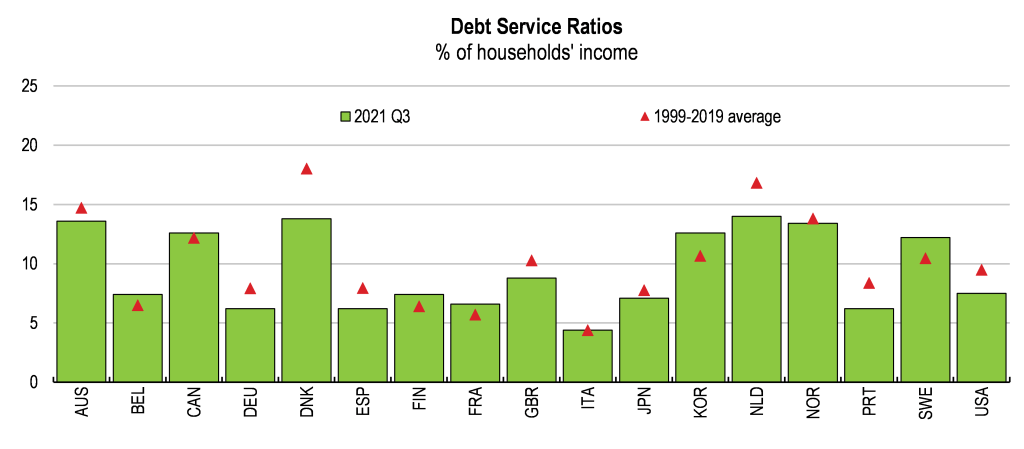
Household debt, which mainly consists of mortgage loans, has grown substantially over the past decade in most OECD countries. Nonetheless, the extended period of low interest rates since the global financial crisis (GFC) has left average debt service ratios in the household sector close to or even below their long-term norms (Figure 2), suggesting that some rise in debt service burdens should be manageable for most households. Moreover, the rise in household debt during the pandemic has been matched by a significant rise in household savings, which should support the repayment capacity of many households exposed to adjustable rates. However, aggregate numbers conceal important risks that the repayment capacity of low-income borrowers could deteriorate, given the withdrawal of pandemic income support measures and higher inflation. Financially fragile borrowers in countries with independent monetary policies and rising inflation pressures are particularly exposed to the risk of a substantial rise in debt servicing costs, especially in countries where the ratio of mortgage costs to disposable income is already high for the lowest income quintile, such as Australia (van Hoenselaar et al., 2021).

Figure 2. Moderate debt service ratios limit risks in housing markets

Source: BIS Credit Database; and OECD calculations.

Effective macroprudential policies are needed to limit risks from swings in house prices

House prices rose strongly and quickly in most OECD countries during the pandemic. Between the fourth quarter of 2019 and the fourth quarter of 2021, real house prices rose by 13% in the median OECD economy, leading to stretched valuations in many countries. For many reasons, the pandemic has exacerbated pre-existing tensions in real estate markets. Exceptionally accommodative monetary conditions, a surge in household savings and unprecedented fiscal support all boosted housing demand, with housing supply temporarily curtailed by mobility restrictions and logistical bottlenecks.

The future evolution of house prices is uncertain. Higher financing costs should moderate future housing demand, helping the rise in house prices to abate. However, in the short run, supply constraints could continue to sustain price increases. Although the supply of new construction slowed down only moderately during the pandemic, new housing permits and starts dropped significantly in many OECD countries. This gap, along with ongoing supply bottlenecks and labour shortages, is likely to amplify the structural housing shortages affecting many countries, helping to sustain prices.

Given the large uncertainty surrounding the outlook, it is critical that there are adequate buffers in the banking sector to ensure resilience to unexpected fluctuations in property markets. Stronger regulation in the aftermath of the GFC has limited risk-taking, helped to strengthen underwriting standards, and raised bank capital ratios. Most countries already have macroprudential policies in place to limit over-indebtedness and reinforce banks’ capital buffers, but the continued build-up of housing market vulnerabilities may merit further preventive measures to limit medium-term risks, such as additional steps to lower loan-to-value or debt service-to-income ratios.

Over time, in addition to macroprudential instruments, reforms in rental regulation and property taxation may also be effective tools to address more structural housing pressures. Those tools, along with stronger public investment in social housing and potential land use reforms, especially in job-rich urban areas, could ease the tensions that are still likely to prevail in the medium and long term (OECD, 2021).

References

OECD (2021), Brick by Brick: Building Better Housing Policies, OECD Publishing, Paris, https://doi.org/10.1787/b453b043-en.

OECD (2022), OECD Economic Outlook, Volume 2022 Issue 1, OECD Publishing, Paris, https://doi.org/10.1787/62d0ca31-en.

van Hoenselaar, F., et al. (2021), “Mortgage finance across OECD countries”, OECD Economics Department Working Papers, No. 1693, OECD Publishing, Paris, https://doi.org/10.1787/f97d7fe0-en.


Unsatisfactory global growth:  A call to policy action!

CLM with credit press conference Interim Eco Outlook Feb 2016


by Catherine L. Mann

OECD Chief Economist and Head of the Economics Department


Welcome to the OECD Economics Department’s new ECOSCOPE blog !

Our Interim Economic Outlook launched today shows a troubling picture—world growth stuck at 3% in 2016, and only 3.3% in 2017, with substantial volatility in financial markets raising new risks.  The OECD’s mantra is “better policies for better lives”  and that is central to our assessment that a stronger policy response is urgently needed to get global growth out of this low-growth equilibrium.  Monetary stimulus alone cannot reverse many of the worrying trends seen in the Interim including weak trade, low investment and an apparent slowing of trend productivity.  Given very low interest rates, now is an opportune time for collective fiscal action, focusing  on investment spending that will raise growth in the near term and underpin long-term output potential.  Greater ambition on structural reforms to provide an environment conducive to private investment goes hand-in-hand. ( On 26 February, we will launch our annual Going for Growth assessment of structural policy needs and the progress countries are making towards achieving more productive economies with better quality jobs (details to be posted on this site)).   Monetary, fiscal, and structural policy tools are synergistic and all need to be deployed at this time.

Does the call for more fiscal action by the OECD represent a change of view ?

In a well-known phrase, Keynes wrote “When my information changes, I alter my conclusions. What do you do, sir?”.   So, what is new?

First, OECD governments have more fiscal space than they did in the immediate post-crisis period. The sovereign debt crisis has faded and the most severe banking problems have been addressed. Budget deficits have fallen in many countries following budgetary consolidation and falling interest costs. The long-term interest rate is far lower than it was 3-years ago with negative interest rates on government borrowing of a few years and the ability to raise money at longer horizons at a minimal cost.

Second, the persistent downgrade of forecasts across the economics profession in recent years raises deep questions about how the economy is operating. Some key mechanisms that drive economic recoveries seem to be not working:  wage pressures are exceptionally weak even in countries where unemployment has fallen; inequality is rising; business investment is not responding to the extraordinarily low cost of capital;  currency depreciations are not leading to robust exports;  inflation pressures seem non-existent across many economies despite exceptional monetary policy action; productivity growth and diffusion innovation appear to have slowed. The thread that runs through these disconnects is weak demand, hence the need to use all policy tools to full effect.

A scenario exercise in the Interim shows the potential growth gains, and fiscal sustainability benefits of a collective action on fiscal spending.

1st year effects of a 1/2 percent of GDP public investment stimulus by all OECD countries
Change from baseline

IEO_Slide18_Fig1_E_P2CL

There are many open questions about what are the key issues facing policymakers, and how they should balance both immediate and longer-term objectives.  This blog is an opportunity to debate these topics!

We hope that windows into research by OECD economists posted on this blog will share new insights about the evidence and the ‘’better  policies” we need to ensure the ‘’better lives’’.   Please join the conversation!

Background

Achieving prudent debt targets using fiscal rules

Interim Economic Outlook

The Future of Productivity