Are there ways to protect economies against potential future housing busts?

by Boris Cournède, Maria Chiara Cavalleri, Volker Ziemann, OECD

Housing, a large and volatile sector, is often at the centre of economic crises, as a trigger or amplifier. The current situation, which is characterised by house prices approaching or exceeding pre-crisis levels in many countries, raises questions as to whether these price levels may be indicative of a possible impending correction and what can be done to reduce housing-related macroeconomic risks.

Figure 1. House price developments since the global financial crisis

The OECD has been developing models that allow assessing to which extent economic trends associated with housing booms, such as steep house price increases or strong debt expansion, can fuel the risk of a severe economic downturn (Turner, Chalaux and Morgavi, 2018). About half of the countries covered by the models are estimated to face real yet limited risks (above 20% but below 30%) of experiencing a severe downturn over the medium term, with housing trends playing a significant role.” Model results suggest that housing booms can fuel crisis risk domestically but also across borders as a consequence of international financial links (Cavalleri, Cournède and Ziemann, 2019).

Countries can reduce housing-related risks in particular by:

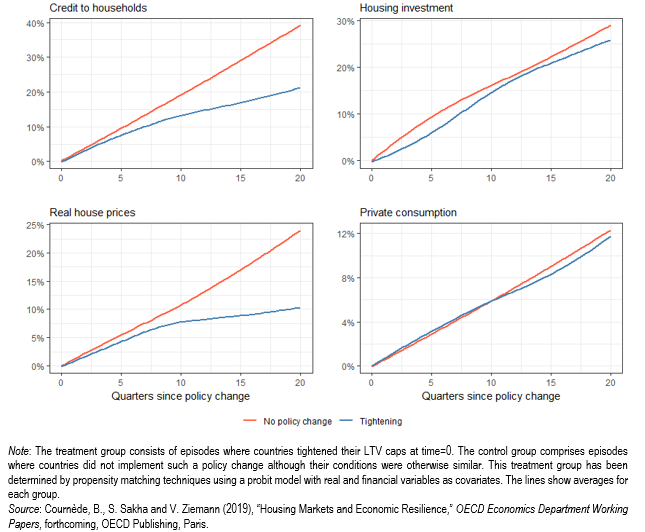
  • Capping the size of loans relative to house prices. New evidence suggests that such caps are capable of containing house prices and mortgage lending incurring limited economic cost (Figure 2): housing investment is only marginally reduced and there is very little effect on consumption. Tighter loan-to-value ratios are also linked with a lower risk of severe downturns.
  • Limiting the size of loans relative to income. This measure holds promising potential but has been seldom used so far, which means there is little scope yet to evaluate it ex post.
  • Tightening bank capital requirements for riskier housing loans. Measures of this nature are linked to more moderate output fluctuations and stronger recoveries after downturns.
  • Reducing the tax advantages given to housing assets. Higher effective taxation of housing assets (which can come from higher property taxes or lower income tax breaks for housing) favours smoother housing cycles.

Figure 2. Effect of tightening LTV caps
References:

Cavalleri, M. C., B. Cournède and V. Ziemann (2019), “Housing Markets and Macroeconomic Risks“, OECD Economics Department Working Papers, No. 1555, OECD Publishing, Paris.
Turner, D., T. Chalaux and H. Morgavi (2018), “Fan Charts around GDP Projections Based on Probit Models of Downturn Risk”, OECD Economics Department Working Papers, No. 1521, OECD Publishing, Paris.


New Zealand has recently enjoyed strong economic growth, but housing and population ageing pose challenges

by David Carey, New Zealand Desk, OECD Economics Department.

New Zealand enjoyed strong economic growth during 2016, driven by high net inward migration, solid construction activity, booming tourism and supportive monetary policy, although in per capita terms growth has been more in line with that in other advanced economies. The terms of trade have rebounded to near record levels, boosting income growth. Growth eased somewhat during the last quarter of 2016 and the first quarter of 2017, in part due to temporary factors including the impact of unfavourable weather conditions on agricultural output and disruption from the November 2016 Kaikōura earthquake. The OECD projects that growth will return to around 3% in 2017‑18, supported by export growth from strong tourism demand and increases in dairy exports. However, slower net immigration is likely to curtail both consumption and residential construction, and the wind-down in the Canterbury earthquake rebuild will curb construction expenditure, more than offsetting the boost from the Kaikōura rebuild and the recently announced increases in infrastructure spending. The unemployment rate is expected to edge down to 4 ½ per cent by the end of 2018 and wage growth to rise moderately. Consumer price inflation should rise sustainably to 2% by the end of 2018, as the effects of oil price falls pass and capacity constraints bite.

While appropriate on the basis of the Reserve Bank of New Zealand’s inflation projections, current monetary policy settings have the downside of fuelling increases in house prices and household debt. As discussed in the accompanying housing blog, both have reached high levels by historical standards and in comparison with most other countries. Further progress is needed to reduce housing supply restrictions, and macro-prudential policy may need to be tightened further, notably by the implementation of debt-to-income limits to reduce financial stability risks.

The government’s prudent approach to fiscal policy puts New Zealand in good stead to cope with future global shocks and natural disasters. Like other countries, New Zealand also faces large spending pressures from public pensions and health-care costs in the longer term. To this end, the government has announced its intention to increase the age of eligibility for the public pension by six months each year from 2037, reaching 67 by 2040. Budget savings would be larger and inter-generational equity greater if this increase were to be brought forward, the transition period lengthened and the pension age subsequently indexed to life expectancy. The planned focus on increasing public-sector productivity should help to contain long-term increases in health-care outlays.

NZmacroblog

References
OECD (2017), OECD Economic Surveys: New Zealand, OECD Publishing, Paris.