Developments in Artificial Intelligence markets: New evidence on model characteristics, prices and providers

By Christophe André, Manuel Bétin, Peter Gal and Paul Peltier.

The release of Deepseek’s R1 model on January 20th stunned the world. This “sputnik moment” in AI showed that an almost unknown Chinese company could develop an AI model at the very top of AI capabilities at a fraction of the development costs of other leading models, release its parameter set (“weights”) for open use and offer ten times cheaper access to users. 

Our recent OECD paper, “Developments in Artificial Intelligence markets: New indicators based on model characteristics, prices and providers” (André, Bétin, Gal and Peltier, 2025), shows that while important risks for competition in digital markets persist, the strong position of digital incumbents in the supply of AI has not curbed innovation and prevented potential AI-users from accessing better and cheaper AI models, which provides strong preconditions for adoption across many sectors of the economy.

New data and indicators to monitor AI markets

After the skyrocketing popularity of OpenAI’s GPT models in late 2022, concerns emerged that AI may further entrench dominant positions in digital markets, with incumbents gaining a definitive advantage by controlling the three key AI inputs to AI development: access to data, computing capacity and top AI talents (OECD, 2024). However, emerging empirical evidence offers some nuance regarding such concerns.

The paper relies on an extensive data collection on AI foundation models on the market and shows that, so far, there have been several signs indicating dynamism in three segments of the AI value chain (AI model development, AI model provision from the cloud and AI downstream applications). First, the number of available AI foundation models has been rising exponentially (Figure 1), developed by an increasing number of companies and offering several interaction modalities. 

Second, using common industry benchmarks to evaluate AI models’ performances and collecting prices of AIfrom cloud providers, we construct an AI Economic Frontier by identifying, each month, the best models in terms of the price-performance trade-off (Figure 2). Results suggest that in the last two years, the positions at this AI Economic Frontier have shifted continuously towards lower prices and higher quality. Moreover, the developers and models that make it to the frontier have been changing, with five to six players alternating at the frontier (OpenAI, Meta, DeepSeek, Anthropic, etc.) and around ten others following closely.

Figure 2. The AI Economic frontier shows the continuous improvements of AI 

Note: Performance is defined by a normalised weighted performance index on industry benchmarks. Each dot represents the model with the best available price-performance trade-off within Text-to-Text models.
Source: André, Betin, Gal and Peltier, 2025.

This variety of models at the frontier is important from an economic perspective. Many users may not always need the best available models and would rather pay an order of magnitude less to access “good enough” models specialised for specific tasks or preferences. In addition to the offer of closed models directly from the cloud, open-weight models offer an option for cheaper (with no license fee), transparent and easily customable (fine-tuned) models used outside of the public cloud environment. This option provides opportunities for better tailored performance and greater control in specific business applications and enhanced data privacy.

AI is getting better, cheaper and more accessible

Figure 2 illustrates the upward shift of the AI economic frontier, implying that AI has become more efficient and cheaper. Indeed, our quality-adjusted AI price index has fallen by on average 80% in two years (Figure 3) and, on average, 30% of models at the frontier have been replaced every month by cheaper and better models.

AI-adopting firms have benefited from greater access to AI models via a widespread offer accessible through several cloud providers (for business use) and an increasing number of AI-powered consumer services (consumer-facing applications). According to our data collection, around 60 cloud providers offer access to AI models, on average from five different AI developers. Downstream, in consumer facing applications, we recorded more than 12 000 AI tools ranging from chatbots to image editing software, customer support applications or domain specific services. While this offer is large and growing, only a few of them (like ChatGPT) attract most users.

 AI market developments have been favourable for AI users, but risks for competition exist

Dynamic AI markets are a necessary condition for the diffusion of AI across the economy via widespread AI adoption in various sectors, a central determinant of long-term productivity gains from AI (Filippucci et al., 2024). Our evidence so far suggests that the supply of AI has been more open than initially expected in various segments of the AI value chain, driving innovation and generating the optimal conditions for broad AI adoption (lower price, better quality, broader accessibility). If current trends persist, dynamic AI markets can foster adoption and boost innovation which in turn are preconditions for widespread economic and welfare benefits.

Nonetheless, several uncertainties and risks persist about the future dynamism of AI markets. For instance, the capacity of digital incumbents to leverage existing compute infrastructure and user base in adjacent markets is high. Furthermore, the high concentration of the necessary inputs for AI development — data, compute, and talent — creates additional risks for long-term competition.

References

André, C. et al. (2025), “Developments in Artificial Intelligence markets: New indicators based on model characteristics, prices and providers”, OECD Artificial Intelligence Papers, No. 37, OECD Publishing, Paris, https://doi.org/10.1787/9302bf46-en.

Filippucci, F., P. Gal and M. Schief (2024), “Miracle or Myth? Assessing the macroeconomic productivity gains from Artificial Intelligence”, OECD Artificial Intelligence Papers, No. 29, OECD Publishing, Paris, https://doi.org/10.1787/b524a072-en.

OECD (2024), “Artificial intelligence, data and competition”, OECD Artificial Intelligence Papers, No. 18, OECD Publishing, Paris, https://doi.org/10.1787/e7e88884-en.

Live data from OECD.AI


Greece: Boosting firm growth and innovation to raise living standards 

Cover of the greece economic survey 2024

By Antoine Goujard and Timo Leidecker

The Greek economy has weathered recent crises well and GDP growth has outpaced the euro area since early 2021. As headwinds are subsiding, the economy is emerging with significant gains in competitiveness, growing investment and more high-tech exports, and historically low levels of unemployment. Helped by solid growth, inflation and fiscal consolidation, public debt levels dropped significantly, and Greece regained the investment grade rating of its sovereign debt in 2023. GDP growth is expected to continue to outpace the Euro area over the next two years, with real incomes picking up and European funds supporting investment.  

While Greece’s performance has been strong, boosting firm growth and innovation remains a key challenge to support long-term gains in living standards. As highlighted in the  2024 OECD Economic Survey of Greece (OECD, 2024), despite recent improvements, productivity remained 40% below the OECD average in 2023, reflecting performance gaps that are visible in all sectors of the economy. Business investment has declined following the Great Financial Crisis and has just started to rebound in recent years (Figure 1). More than in most other OECD countries, the business sector is dominated by micro and small firms, which often struggle to seize the opportunities of new technologies, innovate and grow. Skill shortages are high and prevent firms from growing and implementing new technologies. This is despite the high -albeit declining- unemployment of 9.8% in October 2024, and reflects the fact that many workers do not have the skills needed by firms. The 2024 OECD Economic Survey of Greece identifies three policy areas where further action could help to strengthen firm growth and innovation.   

Figure 1. Business investment and innovation remains low despite recent progress 

Panel A. Data refer to the business sector excluding real estate activities, public administration and defence, compulsory social security, education and human health and social work activities. 
Source: Panel A: Eurostat (2024) National Accounts database ; Panel B: OECD (2024), Business enterprise R&D expenditure. 

One area with further scope for reforms is to continue removing regulatory burdens. Greece’s regulatory framework has become more business-friendly in recent years, recording the largest improvement in the OECD Product Market Regulation Indicator over 2018-23. However, restrictive regulations persist for professional services and hold back business innovation. Tools to identify and revise burdensome regulations are being applied but have yet to be used to their full potential. Improving the quality and scope of regulatory impact assessments and formalising the review of the stock of existing regulations together with stakeholders would be one way forward. Denmark, for example, does this well with its Business Forum for Better Regulation. In addition, Greece could also minimise regulatory burdens arising from new legislation by implementing its existing rules for quality control and consultations more systematically. Ensuring the effective and timely consultation of stakeholders on new draft legislation is key to continue to improve the business environment.  

Another important avenue will be to make more of the current labour force and improve skills. Better activating youths, women and foreign-born workers, would boost productivity and employment, as would equipping workers with the skills required by rapidly changing technologies. Vocational Education and Training (VET) should be developed further by increasing apprenticeships and the role of employers in the design of curricula. The roll-out of compulsory traineeships in 2024 and the more direct involvement of social partners in the design of vocational training are welcome steps, but there is space to devise a better combination of school and work-based programmes, an area where the success of Germany and Switzerland can provide useful lessons. Policies to support those already in the labour market, so-called “active labour market policies”, are still too much focused on low-effective direct-job creation programmes, and some of that spending could be redirected to training programmes for workers and the unemployed, while regularly assessing and certifying the quality of training providers. Barriers to labour market participation should also be removed, notably by continuing to expand childcare facilities and making it easier to recognise prior learning and skills gained abroad.  

Greek firms could grow stronger by boosting their access to finance. Low business investment, including in research, development and innovation, limits growth prospects, and there are only limited spillovers from foreign direct investment to domestic firms. Greece has made extensive use of loan-guarantee and subsidised lending programmes to improve access to finance, but these programmes should be regularly evaluated to avoid the risks of locking in resources in low-productivity firms and crowding out alternative financing sources. Bank health has improved greatly but non-performing loan exposures remain sizeable in the banking sector and among loan servicing companies. Reducing the length of court procedures, building on the recent bankruptcy law and the 2024 reform of the judicial system, would help restructure non-performing assets. With growing EU and national funding for business innovation and entrepreneurship, regular evaluations will also be key to enhance the effectiveness of public incentives for business innovation.  

Boosting productivity and innovation is not just a short-term priority for Greece—it is fundamental for achieving more sustainable and inclusive growth, especially as Greece’s population ages and the share of those in working age decreases.  

Reference: 
OECD (2024), OECD Economic Surveys: Greece 2024, OECD Publishing, Paris, https://doi.org/10.1787/a35a56b6-en


Laying the foundations for strong, sustainable growth in Finland

By David Carey, OECD Economics Department

After a large drop in the first half of 2020, Finland regained its pre-COVID-19 GDP level by mid-2021, which was faster than many other OECD countries (Figure 1). Policies to support incomes during and after the pandemic contributed to the powerful economic rebound. However, Russia’s war of aggression against Ukraine has boosted inflation, slashing household spending power and consumer confidence, and weakened Finland’s main export markets. Consequently, economic growth is set to stall in 2023 but to recover in 2024 when the adverse effects of the energy shock will have passed.

Figure 1. The economy recovered quickly from the COVID-19 shock but is set to slow

Source: OECD Economic Outlook database.

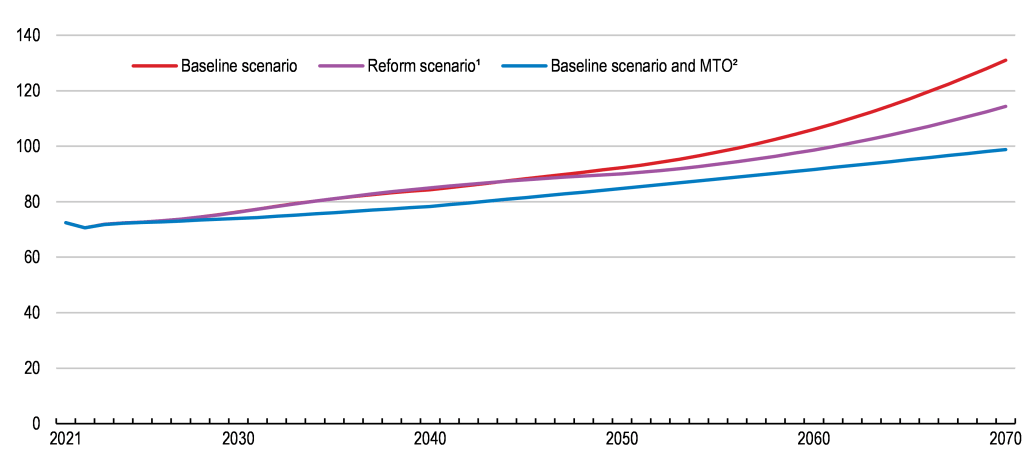
Russia’s war in Ukraine has also increased the government’s budget deficit. On current policies, the budget deficit adjusted for the business cycle is set to be around 2% of GDP in 2023-24. With increases in spending related to population ageing on the horizon, the OECD projects that gross government debt will rise to 130% of GDP by 2070 (Figure 2). This increase would be considerably smaller if the deficit were constantly limited to Finland’s medium-term target of 0.5% of GDP beyond 2030. To this end, comprehensive spending reviews should be undertaken to identify consolidation measures and the incentives in the healthcare reform for counties to increase efficiency reinforced, if necessary.

Figure 2. Government debt would increase substantially under unchanged policies

Gross general government debt, % of GDP

1. In the reform scenario, improvements in the innovation system increase the level of GDP by 3% over the baseline by 2050 and work-based immigration rises gradually from the current level (1 500 per annum) in 2030 to 7 500 per annum in 2050-70. In addition, fixed capital is assumed to grow faster (at 2% per year throughout the projection) than in the baseline scenario (0.9% per year from 2040 onwards). Higher growth in the fixed capital-to-labour ratio is the main factor increasing growth in labour productivity (to 1.4%) and output (to 1.1%) in the reform scenario.
2. In the MTO scenario, Finland continuously meets its medium-term budgetary objective of a structural financial balance of minus 0.5% of GDP from 2030.
Source: OECD.

Finland is on track to meet its gross greenhouse gas abatement targets for 2030 and 2035. However, the cost of reducing emissions is unnecessarily high. To lower these costs, the share of biofuels mandated in the transport sector should be reduced to the minimum level required by the European Union and, to compensate, the carbon price used to calculate carbon tax rates on heating fuels aligned with that used for transport fuels. Furthermore, heat production using peat, which is highly CO2 emissions intensive, should be subject to the same tax regime as other fossil fuels and policies to reverse car dependency in cities strengthened.

Finland is not on track to meet its forestry and other land-use targets. It needs to reduce forestry and land-use emissions from 2 CO2-eq. in 2021 to minus 17 and minus 21 Mt CO2-eq. by 2030 and 2035, respectively. To this end, instruments should be created to encourage the cultivation of wetted peatlands and forestry should be subject to carbon pricing.

Finland needs to reboot its innovation ecosystems, which comprise innovation partnerships between various public and private actors like universities, firms and research institutions, to lift weak productivity growth (0.5% on average over the past decade). The government’s legal commitment to boost R&D spending to 4% of GDP by 2030, from 2.9% currently, will help to strengthen innovation ecosystems. It will be important that additional spending and innovation support schemes be regularly assessed for their impact and improved continuously. Innovation support should also become more mission oriented, directing applied research toward solving the most pressing socio-economic challenges.

Another key challenge for Finland’s innovation ecosystems is the severe shortage of qualified workers with skills to develop advanced technologies or adopt successfully technologies developed elsewhere. The government has an ambitious goal of raising the tertiary attainment of young adults to 50% by 2030, from 40% today (Figure 3). To realise this goal, it should commit to a credible plan to increase tertiary study places, fund them and improve the allocation of study places across study fields to better reflect the skill needs of the labour market.

Figure 3. Tertiary educational attainment among young adults is relatively low

Percentage of 25-34-year-olds having completed tertiary education, 2021

Note: Data refer to 2020 for Chile.
Source: OECD (2022), Education at a Glance 2022.

Attracting more foreign talents is also important for alleviating skill shortages and better linking innovation activities with those in other countries. The government aims to increase annual work-based immigration by at least 50 000 by 2030. It will be important that these immigrants also find good jobs in Finland, which currently is not always the case.

References:

OECD (2022), OECD Economic Surveys: Finland 2022, OECD Publishing, Paris,
https://doi.org/10.1787/516252a7-en.


Boosting export performance in Chile

by Antoine Goujard, Chile Desk, Economics Department

Chile’s export growth has disappointed over the past two decades. In particular, exports of goods and services – in volume – have only grown at 1.1% annually over 2009-17 and at around 2.0% for non-copper products and services, compared to 4.2% in the average Latin American country (Panels A and B).

Chile’s weak export performance reveals structural weaknesses. Beyond copper and copper-related products that are highly dependent on external demand, export growth has been weak in manufacturing and services sectors. At the same time, with low investment in innovation and skills, productivity gains have stalled (Panel C). Exports remain mostly natural-resource based (Panel D) and highly concentrated across products, firms and destinations, with SMEs participating little in international trade.

To enhance inclusive growth potential decisive policy efforts are needed to improve productivity and competitiveness, and broaden the export base. The 2018 OECD Economic Survey shows that while the implementation of the 2014-18 Productivity Agenda and measures to raise the efficiency of electricity markets have been positive steps, more efforts are needed to raise productivity in four key areas:

  1. Strengthening competition. Perceived market dominance that tends to reduce efficiency and raise rents, is among the worst in the OECD. Competition is limited in key sectors, such as telecommunications, maritime services and railways. The recent strengthening of the competition framework is welcome, but systematic reviews of competitive pressures are needed. Moreover, the guidelines issued by the OECD (2016b) should be used to review existing regulations from a competition perspective according to a set schedule, and pro-competitive and streamlining measures should be implemented rapidly.
  2. Simplifying the business environment. Administrative procedures, such as licenses and permits, are burdensome, notably for smaller and younger firms complicating entry of new businesses. Streamlining unnecessary and complex regulations would allow substantial productivity gains. Improving the digital procedures for firms (Escritorio Empresa), and focusing on ex-post controls for businesses that have low associated sanitary and environmental risks, would ease firm creation and growth. On the trade side, simplifying regulations of preferential trade agreements would help SMEs to go global. Going forward, the regulatory process should build on all stakeholders and strengthened ex-ante and ex post evaluations such as the new productivity assessments (OECD, 2016a).
  3. Increasing innovation and skills. Business investment in R&D and innovation is particularly weak, while entrepreneurial and managing skills are low and unequal. Increasing public support for R&D and innovation, and strengthening its evaluation, would help develop public-private links and ease R&D financing for SMEs. Additional technical assistance and mentoring for young and smaller firms, building on the recent Centros de Desarrollo de Negocios, would also support firm growth, innovation and access to export markets.
  4. Improving logistic and digital infrastructure. Investment in intermodal connections, railways and digital networks is needed to bridge connectedness gaps (OECD, 2017b). Developing national and local infrastructure strategies, integrating the regulation of public and private ports and better accounting for environmental damages in transport taxes and road pricing would ensure money is well spent. Fully integrating the single window mechanism for exports and imports (SICEX) with the domestic logistic infrastructure and with regional partners would deliver significant synergies and gains for exports.

xports and chile 2018

Find out more:

OECD (2018), OECD Economic Surveys: Chile 2018, OECD Publishing.

OECD (2017a), OECD Economic Outlook (November 2017), OECD Publishing.

OECD (2017b), Infrastructure Governance Review: Chile – Gaps and governance standards of public infrastructure, OECD publishing.

OECD (2016a), OECD Reviews of Regulatory Reform – Regulatory Policy in Chile, Government Capacity to Ensure High –Quality Regulation, OECD Publishing.

OECD (2016b), Competition Assessment Toolkit – Volume I: Principles, OECD Publishing.

Goujard, A. (2018), “Boosting export performance in Chile”, OECD Economics Department Working Papers, forthcoming, OECD Publishing.


Getting the most out of Fintech in Estonia

By Caroline Klein, Estonia Desk, OECD Economics Department and Olena Havrylchyk, Professor of Economics at the University of Paris 1 Panthéon Sorbonne

Pioneers of the Estonian Fintech need a fair level playing field. Estonia, at the forefront of alternative finance should seize the moment to set framework conditions right.

Estonia is a frontrunner in alternative finance and a host to some of the most innovative Fintech start-ups in the OECD – i.e. start-ups using technology and technology-facilitated new business models in the provision of financial services. Some Fintech companies based or born in Estonia have a world-wide reach. These include one of the largest European peer-to-peer lending platforms for unsecured consumer loans, the first worldwide secondary market for venture capital and a platform that allows individuals and small businesses to transfer money between international accounts at much lower cost than traditional banks.

For some, Fintech will revolutionize the traditional banking industry as we know it today, but for the moment, the platforms finance mostly risky projects. At one end of the platform, there are retail investors who choose whom they would like to finance. On the other end, there are SMEs and start-ups that do not go to banks, often because they cannot provide standard guarantees. The platforms generate profits from the origination and servicing fees that they charge to funders and fundraisers. The investors bear all investment risks, providing a natural ‘bail-in’ mechanism. Equity crowdfunding platforms can complement angel- and venture-capital, by allowing individuals to invest in start-ups and buy shares which are not listed on the regulated stock market.

For the moment the scale of finance channelled through Fintech platforms remains limited (Figure 1) and peer-to-peer lending to SMEs lags far behind consumer lending. The 2017 Economic Survey of Estonia stresses that a sustainable development of this ‘alternative finance’ requires a creation of a level playing field between the traditional and the alternative sources of credit in terms of access to information, regulation, and taxation.

Estonia Fintech

To build confidence in these new financing forms, a necessary condition to their development, consumer protection of Fintech users should be reinforced.  The Estonian authorities should introduce licencing and transparency requirements and require the platforms to have resolution plans in place to ensure that repayments continue to be collected in case of bankruptcy. By establishing a well-designed credit information-sharing scheme covering all borrowers (firms and individuals) it could help to move the industry forward, by facilitating the use of big data and algorithms to screen and monitor borrowers. Finally, the level playing field should be established also when it comes to taxes. Taxation of investment via Fintech platforms should be harmonised with that of bond and equity securities, by allowing investors to deduct their losses from their income tax base.

References

OECD (2017), OECD Economic Survey of Estonia, OECD Publishing, Paris.


Retraining can enable ageing Slovenians to keep pace with new technologies

by Rory O’Farrell, Slovenia Desk, OECD Economics Department

While workers in many OECD countries are worried whether robots will take their jobs, the inhabitants of the Slovenian town of Kočevje are less concerned. In 2016 Japanese robotics firm, Yaskawa, announced plans to produce robots in Kočevje, which could create up to 200 jobs. This is a continuation of a pattern seen since independence whereby Slovenia has continued to shift from traditional manufacturing to business services and high-tech production. However, not all Slovenians have been included in this progress.

Modernisation has mainly been achieved by training young Slovenians to fill new occupations. In contrast, those with obsolete skills tend to retire or become unemployed rather than retrain, leaving Slovenia with persistent long-term unemployment, and amongst the lowest employment rates of older workers in the OECD. An ageing population means this is no longer sustainable, and labour shortages are already emerging. To meet the need for skills that complement investment in knowledge-based capital, and the new technologies brought by foreign firms, more responsive education and training solutions are needed.

Slovenia2017blog1

Slovenia performs poorly in terms of providing workers the opportunity to retrain later in life. While it has an effective system of vocational education, workers lack some basic skills that enable them to retrain later in life. Also, although tertiary attainment has increased rapidly, high fees for part-time students make it unattractive for older Slovenians to pursue tertiary education. There is also a lack of incentives to retrain, as wages rise automatically with age and thus do not reflect the relative demand for different occupations, and unemployment and disability insurance have served as pathways to early retirement.

The just-released OECD Economic Survey of  Slovenia outlines how a more flexible education and training system can help create a more flexible labour market. Policies such as greater problem-based learning for vocational students, more adult training, and equalising fees for part-time and full-time students can help workers adapt to future changes in the labour market. This can help ensure all Slovenians benefit from future economic growth.

Find out more:

OECD (2017), OECD Economic Surveys: Slovenia 2017, OECD Publishing, Paris.