Boosting efforts to improve health in Estonia

Picture of a woman putting together a puzzle of an outline of a human head, with one piece missing

By Srdan Tatomir, OECD

This week is European Mental Health Awareness week, which aims to raise understanding of mental health. In Estonia, mental health problems are significant. Adult suicide rates are high and above most OECD countries (Figure 1). The first Estonian National Mental Health Survey in 2022 found that a quarter of adults was at risk of anxiety and depression. Lower income groups, particularly men, were more likely to be affected (OECD, 2024). Among adolescent children, almost 30% report feeling depressed every week, and this has risen over time (TAI, 2025). Ill mental health carries a high human toll and is estimated to cost Estonia 2.8% of GDP each year (OECD, 2021).

Estonia has recognised this and expanded its efforts to improve mental health. The 2021 Green Paper on Mental Health developed the foundations and is being implemented through the Mental Health Action Plan for 2023-26. A new mental health department has been established within the Ministry of Social Affairs and funding for mental healthcare services has more than tripled to EUR 7 million in 2023. New surveys to monitor and better understand the issues have been put in place. This year, Estonia adopted its first Suicide Prevention Action Plan for 2025–2028.

These policies aim to create a comprehensive, intersectoral and multi-level mental health system and broaden access to both community-based and specialist healthcare services.

Better health of Estonia’s people, highlighted by the OECD’s 2024 Economic Survey, can be achieved in other areas as well. Life expectancy at birth has risen by around 8 years over the past two decades to 78.8 years by 2023. This is higher than in neighbouring Baltic countries but below most European and OECD countries. Around a third of the deaths can be avoided through faster treatment and more prevention. For example, with more than half of adults obese, physical activity levels need to increase and nutrition could be healthier. To address this, Estonia should introduce a tax on sugar-sweetened beverages and could tax unhealthy foods more broadly as done in Hungary.

Furthermore, alcohol consumption is among the highest in the OECD. Reducing affordability by raising alcohol excise duties and linking them to inflation as well as reducing availability through restricting opening hours and density of alcohol sales outlets can help lower consumption. To maximise their effectiveness, policies on alcohol need to be coordinated with other Baltic countries.

The number of healthcare staff, crucial to improving health outcomes, should increase. The number of health workers relative to the population is low compared to other OECD countries. In 2022, there were 6.6 practising nurses per 1 000 people, well below most OECD and EU countries. The ratio of practising doctors was 3.5 per
1 000 people, slightly below the OECD average and lower than in most EU countries. More nurses, school and clinical psychologists, and psychiatrists are needed in particular to deliver more mental health services (Sisask, 2023). Given that the workforce is ageing quickly, raising nurse and doctor training levels is paramount. This should be complemented by better remuneration and working conditions to make the healthcare profession more attractive, as discussed in the 2024 OECD Economic Survey of Estonia.

Estonia’s total spending on healthcare is among the lowest in the OECD (Figure 2). Population ageing is driving up demand for more healthcare and new services will ultimately require additional resources. Better use of technology, improved administration and enhanced financial incentives can free up more resources. This year’s increase in user charges for specialised care is a step in the right direction as it will help both raise revenues and lead to more efficient use of specialist services. Nevertheless, more revenues will be needed to fund public healthcare services and to ensure out-of-pocket spending does not cause financial difficulties for vulnerable households.

Better healthcare will improve the quality of life in Estonia, allow people to stay active longer and contribute to a stronger economy with higher tax revenues.

For further information, please visit the Estonia Economic Snapshot page.

Learn more about Mental Health Awareness Week.

References

OECD (2021), A New Benchmark for Mental Health Systems: Tackling the social and economic costs of mental ill-health, OECD Health Policy Studies, OECD Publishing, Paris; https://doi.org/10.1787/4ed890f6-en.

OECD (2024), OECD Economic Surveys: Estonia 2024, OECD Publishing, Paris; https://doi.org/10.1787/33e6beee-en.

Sisask, M. (ed.) (2023), Estonian Human Development Report 2023: Mental Health and Well-Being, Estonian Cooperation Assembly, Tallinn.

TAI (2025), Andmebaas – Health Statistics and Research Database, accessed on 28 April, 2025.


Living longer and living better: an OECD perspective on Polish healthcare

By Srdan Tatomir

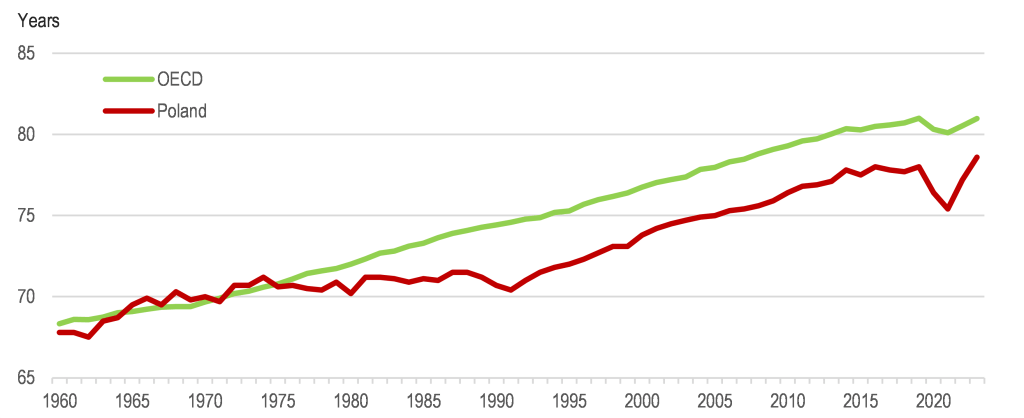
On today’s World Health Day Poland can celebrate the highest level of life expectancy in its history, after it bounced back from the COVID-19 pandemic (Figure 1). It is now 74.8 years for men and 82.4 years for women, longer than in many Central and Eastern European and Baltic countries. But Poland still lags behind the majority of OECD countries. Circulatory system diseases, such as heart disease, hypertension and stroke, account for nearly half of all deaths, while cancer contributes to around a further fifth. As our latest Economic Survey discusses, Poland can do more to boost healthcare.

Figure 1 – Life expectancy in Poland is historically high but there is room to catch up with average OECD life expectancy
Note: The data shown is for average life expectancy at birth. The OECD average is weighted. The latest data point is 2023.
Source: OECD Health Statistics.

Poland has historically been among the lowest spenders on healthcare in the OECD. Before the pandemic, overall health spending accounted for 6.5% of GDP. Successive governments have recognised the need to improve healthcare and are implementing reforms. Current plans are to bring overall health spending closer to the OECD average of around 9% by 2027. Policy efforts should focus on key priorities to maximise the positive impact of additional spending on health outcomes. 

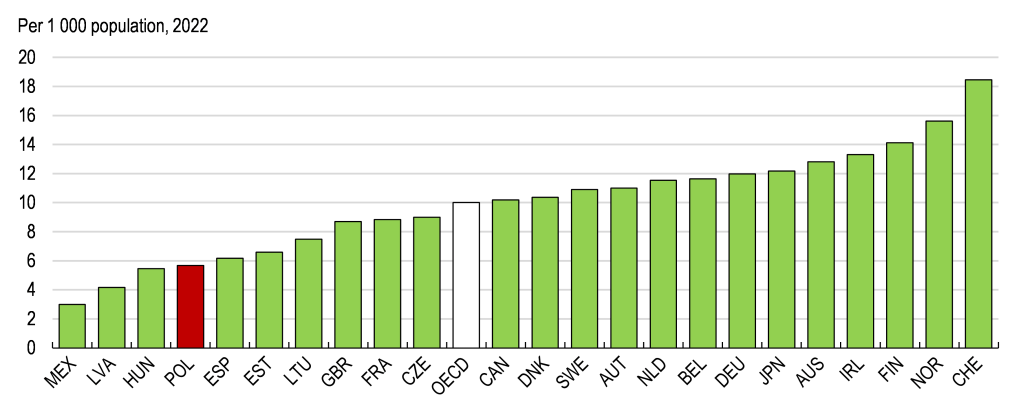
To deliver quality healthcare services an adequate healthcare workforce is essential. While the relative number of doctors in Poland is around the OECD average, the number of nurses is comparatively low (Figure 2). The number of training places for nurses has risen, but more are needed especially because many nurses are close to or over retirement age. Recent increases in salaries should help: in 2022 (the latest year for which the OECD has data), nurses’ salaries stood at 1.6 the national average wage, among the highest in the OECD in relative terms. When adjusted for purchasing power, salaries are now higher in Poland than in countries Polish nurses traditionally emigrated to, such as the UK and Ireland. However, working conditions matter as well. More explicit guidance on working practices, such as setting limits on the number of patient consultations and overtime hours, could improve working conditions and help attract more people to healthcare.

Figure 2 – The number nurses is relatively low compared to other OECD countries

2022, or latest available

The number of nurses in Poland is realtively low compared to other OECD countries.
Note: The OECD average is unweighted.
Source: OECD Health Statistics.

Improving health requires faster treatment. Poland has given cancer patients priority in the health system and there is no cap on treatment costs. Yet cancer is often detected too late. Despite free nationwide screening programmes available since the early 2000s, participation rates are below the EU average, particularly among less educated people. Targeted outreach would help raise participation.

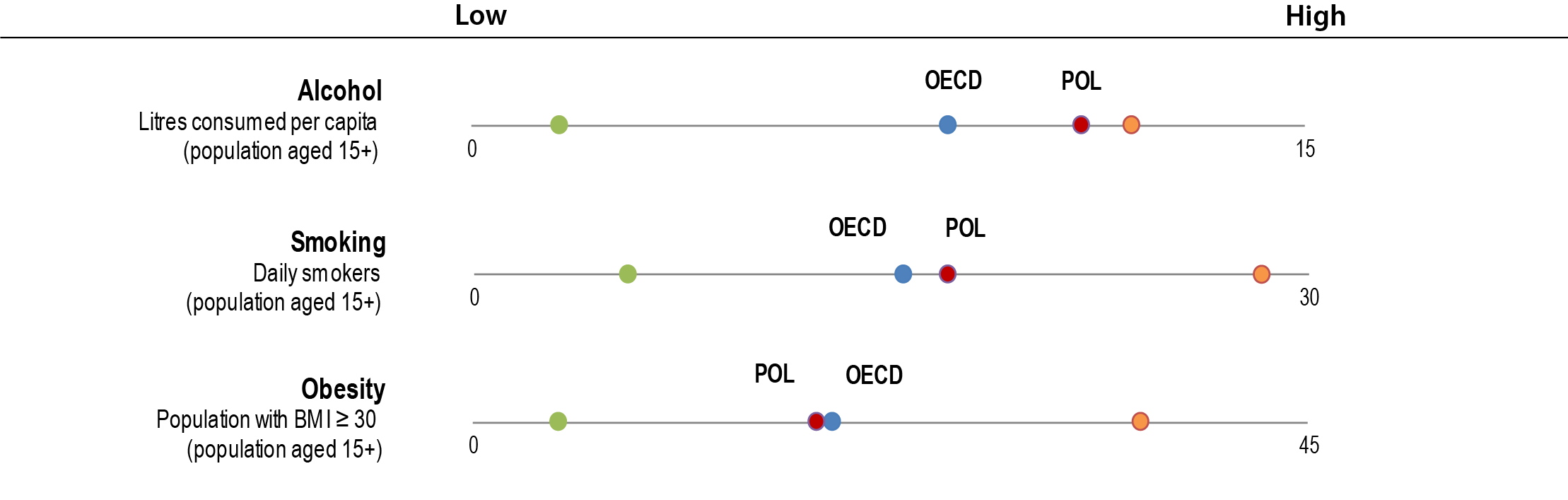
In the medium to long term, better prevention of key risky health behaviours could lead to better health. Alcohol consumption is among the highest in the OECD and smoking rates should be lowered further (Figure 3). Excise duties to make alcohol and tobacco less affordable are rising, and this could be complemented by restricting their availability to maximise the impact on consumption. Introducing taxes on unhealthy foods with high content of salt, sugar and fat could steer people towards healthier eating as has been done in Mexico and Hungary.

Figure 3 – Reducing alcohol and tobacco consumption would improve health outcomes

2022, or latest available

Note: The green circles represent the minimum and the orange circles the maximum observation in the OECD for each variable. Data for alcohol, smoking and obesity is for 2022.
Source: OECD Health Statistics 2023, OECD Environment Statistics 2020, WHO Global Health Observatory. 

Higher efficiency of the healthcare system can free up resources to fund better healthcare. Poland has made great progress in digitalising its healthcare services and the maturity of its e-health system has been ranked the fifth highest in the EU in 2022. User charges, with exemptions for children and those on low incomes, could be introduced to reduce the number of unnecessary consultations and improve the use of scarce resources. Consolidating the hospital network to reduce capacity, while better reflecting local health needs and improving hospital management quality, could reduce costs without compromising quality or access to care.

Learn more by visiting the OECD’s Poland Economic Snapshot page.

References:
OECD (2025), OECD Economic Surveys: Poland 2025, OECD Publishing, Paris, https://doi.org/10.1787/a35a56b6-en


Securing the health of Ireland’s future

By Douglas Sutherland, Patrizio Sicari and Müge Adalet McGowan, OECD Economics Department

In recent decades, Ireland made impressive strides in developing its economy and raising living standards. This progress has allowed it to weather the COVID-19 pandemic and cope effectively with the repercussions from Russia’s war of aggression against Ukraine. Exports from the multinational part of the economy, benefiting from strong demand for medical and information communication technology goods and services, continue to support growth (Figure 1). The domestic economy, while moderating, also remains relatively resilient, despite strong headwinds from high inflation.

Figure 1. Exports continue to support growth

Gross domestic product, volume

1. Excludes those large transactions of foreign corporations that do not have a big impact on the domestic economy.
Source: OECD, National Accounts database and Central Statistics Office.

The 2022 OECD Economic Survey shows that the current Irish fiscal situation is favourable, with budget balance expected in 2022, in contrast to many European countries. This is partly driven by high tax revenues, especially corporate tax receipts, which have provided room for government support to households and businesses in the face of rising energy prices. As part of these tax receipts are potentially transitory, there is a need to ensure that expenditure policy is decoupled from windfall tax revenues, rather than facilitating an upward creep of permanent spending.

Two recent measures have improved the fiscal framework. First, EUR 6 billion of the windfall corporate tax gains have been put in the National Reserve Fund in 2022-23. Upside revenue surprises should continue to be saved in this Fund to help prepare for future shocks and long-term fiscal challenges, such as ageing. Second, a spending rule setting an annual cap of 5% on increases in the value of permanent spending (broadly the sum of trend growth of an underlying measure of economic activity assumed to be 3% and the 2% inflation target) over the medium term was introduced in 2021. However, the planned increase in spending to cushion households from high inflation is temporarily pushing outlays above the new rule. Ensuring adherence to the 5% rule as soon as possible will be important to move fiscal policy onto a more stable spending path and enable greater resilience to future shocks.

Ireland faces a number of challenges to sustain growth, improve well-being and ensure fiscal sustainability over the longer term. The 2022 OECD Economic Survey assesses the government’s plans to reform the pension system, overhaul the health system to improve quality of care and value for money, ensure affordable housing and achieve a just carbon transition. As various spending pressures materialise, reforms are needed to ensure debt sustainability. For example, the Irish population is expected to age more rapidly than in most OECD member countries. OECD simulations suggest that public health, including long-term care, and pension costs could rise by 5.7 percentage points of potential GDP by 2060 (Figure 2).

Figure 2. Population ageing will increase pressures on the government budget

Projected change in expenditures from 2021 to 2060

Source: Simulations based on the OECD Economics Department Long-term Model.

The government is investing to boost housing supply and reduce greenhouse gas emissions, but regulatory and legal hurdles should also be tackled to reduce uncertainty and high transaction costs. Planning and permitting delays coupled with judicial review concerning major investments constrain housing supply and slow the development of renewable energy capacity. Increased uncertainty deters investment and raises prices. The availability of construction workers may present an additional constraint on progress, given competing demands from residential construction, including for retrofitting the existing housing stock, and infrastructure projects. In this regard, working to lift supply by increasing the inflow of workers will be important.

The government has initiated a far-reaching overhaul of the health sector, which suffers from legacy issues, such as past underinvestment, centralised decision-making and long waiting lists. The latter, in particular, contributed to a de facto two-tier system, in which buyers of voluntary private health insurance enjoy a faster access to several public hospital services than low-income patients eligible for free care. In this context, Sláintecare reforms will reconfigure the sector by moving away from an expensive largely hospital-based system, which does not offer universal coverage of primary care, towards a better integrated primary, community and long-term care system to enhance access and efficiency. The plans to increase decentralisation, with the creation of Regional Health Areas, and improve data availability and governance as well as financial reporting and management should be prioritised. Effective implementation should remove the burden on expensive hospital care and create the conditions for streamlining the complex interactions between the private and public elements of the system.

References

OECD (2022), OECD Economic Surveys: Ireland 2022, OECD Publishing, Paris, https://doi.org/10.1787/19990324.


“Every breath you take”: Reducing exposure to environmental health risks in Poland

by Paula Adamczyk, Priscilla Fialho, Antoine Goujard, OECD Economics Department

The COVID-19 crisis has spotlighted Poland’s environmental challenges, notably the heavy air pollution at which the Polish population is exposed, as it makes individuals more vulnerable to acute respiratory illnesses and to the ongoing sanitary crisis. As the government prepares its recovery plan to revive the economy in the aftermath of COVID-19, there is a unique opportunity to bring forward needed public investments into clean energy projects. “Green” investment projects would not only stimulate employment and aggregate demand, but also make growth more sustainable in the longer-term. The newly agreed “Next Generation EU” recovery plan will have dedicated funds to support the transition to climate neutrality and Poland should grasp the opportunity to enhance the resilience of its economy and society. The newly published 2020 OECD Economic Survey of Poland provides some advice on policies that could help supporting the transition to a greener and fairer economy.

Poland has made little progress to improve air quality. In many cities and regions, the level of atmospheric pollution remains well above the limits established in the European Union Air Quality Directive: an alarming 36 out of 50 most polluted European cities are located in Poland. The population exposure to fine particles is among the highest in the OECD (Figure 1), which causes a variety of adverse health outcomes and premature deaths (WHO, 2019).

  1. CEEC is the average of Hungary and the Czech and Slovak Republics.
    Source: OECD (2020), OECD Green Growth Indicators (database).

The residential sector is responsible for high air pollution and levels of energy consumption. The burning of poor-quality coal, wood, or even waste, in old boilers used to heat individual houses is the main contributor for the high level of particulate matter in the air. The incomplete combustion of solid fuel in low-efficiency stoves and lamps used for cooking and lighting also releases a significant amount of fine particles. Moreover, a large share of the existing residential and commercial buildings date back from before 1990 and have poor thermal insulation. As a result, space heating requires a significant amount of energy and there is a lot of heat loss through the building envelope. In fact, the energy intensity of space heating in Poland is one of the highest among European Union (EU) countries.

The transport sector is another key driver of air pollution. In 2018, the average vehicle age in Poland was 14 years, compared to 11 years in the European Union. That same year, 80% of passenger cars in Poland’s roads were more than 10 years old (European Commission, 2019). The average CO2 emissions from new passenger cars sold in Poland are among the highest in Europe. In 2019, only 0.5% of newly registered passenger cars were electric vehicles, compared to an average of 3.6% in the European Union (International Council on Clean Transportation, 2020). Polish authorities have set welcome and ambitious targets to increase the fleet of electric vehicles in the coming years. These targets should be met. In June this year, the government made efforts in that sense and introduced Poland’s first fiscal incentive programme for the purchase of cleaner cars.

Progress to decarbonise electricity production in Poland has also stalled over the past few years. Coal still accounts for around 78% of gross electricity generation, compared to about 25%, on average, in other Visegrád countries and the OECD. Furthermore, most Polish coal-fired power plants are over 25 years old. The industry lags behind in terms of production efficiency and in the adoption of new technologies that could reduce the emission of pollutants.Coal mining is another source of air pollution as it releases fine particles in the air, such as dust, soot and smoke, which can be carried to nearby towns by the wind. Despite all the environmental challenges implied, Poland is still one of the largest coal producer in the world. The authorities have recently agreed to phase out coal mining by 2049, but plan to continue subsidising coal production until then (European Council for an Energy Efficient Economy, 2020).

Polish authorities need to step-up their efforts to improve air quality and reduce the health risks associated with ambient air pollution. The latest OECD Economic Survey of Poland establishes three policy priorities that can boost Poland’s transition to a greener economy and, in particular, bring the country on the path to meeting higher air quality standards:

  1. Support building renovation to improve energy performance in the residential sector.

Two years ago, the government introduced a programme to offer means-tested financial grants and loans for the replacement of obsolete stoves and for thermal retrofits to single-family houses. However, the take-up rate has been far much lower than anticipated. Complex application procedures and low income-threshold for the highest grants have been pointed as possible reasons for the low take-up.

Polish authorities could consider extending nationwide the recently introduced anti-smog regulations in some regions (“voivodeships”) that aim at limiting the burning of fossil fuels in furnaces, as well as introducing fines for noncompliance. Continuing to simplify the administrative procedures associated with the loans and grants for replacing old heating and cooking equipment as well as easing access for low-income households would help to increase take-up. Expanding the use of smart meters would also contribute to reduce the energy consumption of the residential sector. Finally, improving the energy standards for new buildings (e.g. more stringent building energy codes, additional performance-based requirements or more demanding energy performance certificates) and imposing minimum requirements for the creation of reserve funds in multi-flat buildings dedicated to building renovation and thermal insulation, could significantly improve buildings’ energy efficiency.

  1. Increase the effective tax carbon rate and the pricing of environmental externalities.

Tax rates on energy use in the residential sector and the electricity excise tax are low for international standards. Furthermore, there are several exemptions from energy taxes, such as from the tax on coal in the agricultural sector, from the tax on coal for households’ consumption, and from the coal and gas excise duties in some energy-intensive industries. Poland is also one of the very few OECD countries without a specific CO2-related vehicle tax and diesel is still taxed at a lower rate than petrol. Overall, this results in low carbon prices on road and non-road GHG emissions (Figure 2).

To encourage the takeup of greener technologies, the government should progressively phase out exemptions to energy taxes and gradually increase explicit carbon taxes, while using the generated revenues to support the transition of low-income households towards greener technologies and increase social adhesion.

  1. Improve the regulatory environment surrounding the production and distribution of renewable energy.

Stringent regulation prevents the use of larger and more efficient turbines to generate electricity from onshore wind. The development of offshore wind, on the other hand, is held back by low energy transmission capacity, especially in the northern part of Poland. Frequent changes in regulations create a lot of uncertainty and reduce incentives for private investment in renewable energies.

A stable regulatory environment and further incentives to develop alternative sources of energy would help to reduce the reliance on coal for energy production. The renewable energy sector can quickly absorb capital investments and generate employment in both construction and manufacturing.

Further reading:

European Commission (2019), The Environmental Implementation Review 2019, Country Report – Poland, April 2019.

European Council for an Energy Efficient Economy (2020), Poland Agrees to shut coal mines by 2049, EurActiv News, 26 September 2020.

European Environmental Agency (2019), Tax breaks and incentives make Europeans buy cleaner cars, 12 April 2018, Last modified 10 December 2019.

International Council on Clean Transportation (2020), Emerging electric passenger car markets in Europe: Can Poland lead the way? Working Paper 2020-19.

OECD (2020), OECD Economic Surveys: Poland 2020, OECD Publishing, Paris, https://doi.org/10.1787/1999060x

World Health Organization (2019), Health consequences of air pollution on populations, 15 November 2019.


Improving the Czech health care system

by Falilou Fall, Czech Republic desk, OECD Economics Department

czech rep 2018

Health outcomes in the Czech Republic have improved considerably over the last decade. Life expectancy rose by 2.6 years to 78.7 years between 2005 and 2015 towards the OECD average of 80.6 years. This was achieved with relatively low expenditures on health care of about 7% of GDP. However, the population is ageing challenging the financial sustainability of the health care system. As the old-age dependency ratio deteriorates, so do revenues of the health care system as they rely heavily on social security contributions of the working population. Ageing is expected to account for roughly half of the future rise in health care spending, which would reach about to 40% of the government budget by 2060 (OECD 2018).

healthcareCzecrep2018

To maintain and  improve health outcomes and to set a basis for healthy ageing, healthier lifestyles need to be promoted. Risky behaviour, such as smoking, alcohol consumption and obesity are close or above the OECD average. Excise taxes on alcohol are among the lowest in the OECD, contributing to the relatively high alcohol consumption that reached 11.5 litres per capita in 2015 – compared to an OECD average of 9 litres per capita. Price incentives through higher taxation of tobacco, alocohol and unhealthy food and beverages could reduce consumption. Policy measures to promote healthier lifestyles should however follow an integrated approach beyond tax incentives and include further development of health education, disease prevention and screening programmes.

Alcoholczechrep2018

A well functioning primary care sector can bring both efficiency gains through reducing avoidable use of hospital facilities, and better quality of care through better management of patients’ pathways. However, in the Czech Republic, the efficiency of delivery of primary care is suffering from lack of co-ordination. Patients’ ability to access specialist care without a prior general practitioner (GP) consultation, poorly defined mutual responsibilities of outpatient specialists and GPs and current payment systems mean that primary care’s potential to lead for instance chronic disease management is not being fulfilled. GPs should be entrusted with a greater gate-keeping and co-ordination role to ensure that patients are better directed to the most appropriate place for their treatment. User fees for specialist visits without referral could be introduced to strengthen GP’s gate-keeping role.

As the economy is doing well, reforms to the health care system and its financing should be adressed now. The Czech health system is heavily regulated by the government through the Reimbursement Decree. Through this decree, most prices and volume limitations of activities of health providers are set. Having a genuine negotiation process between health care providers and insurance funds would help reduce some of the inefficiencies in service delivery. Overall, there is a need to rebalance the system towards more competition between health providers and insurance funds and private funding to improve quality, efficiency and reduce the reliance on public funding.

References:

OECD (2018), OECD Economic Surveys: CZECH REPUBLIC 2018, OECD Publishing

OECD (2017), Health at a Glance 2017: OECD Indicators, OECD Publishing, Paris