Polska w drodze do silnej i zdrowej gospodarki

Autor: Zuzana Smidova

Link to this blog in English

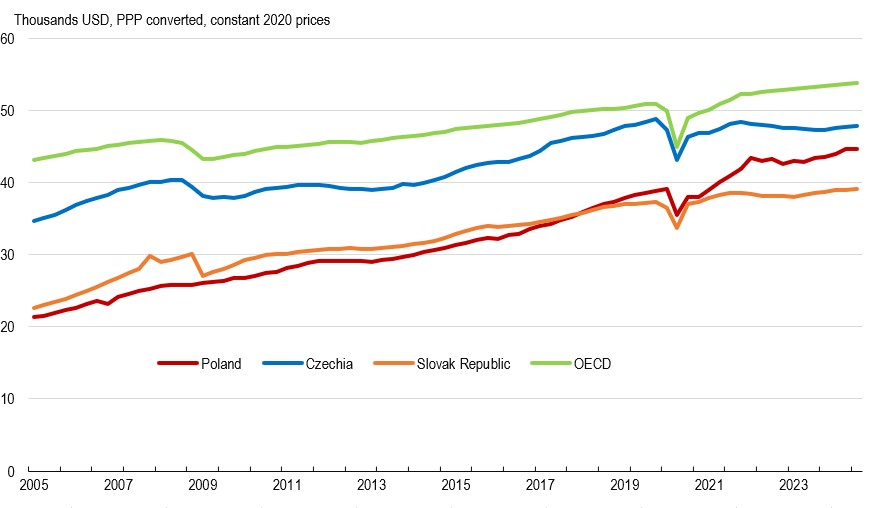
Standard życia w Polsce znacznie wzrósł w ciągu ostatnich dwóch dekad. PKB na mieszkańca podwoił się, zmniejszając dystans do Czech i Słowacji (Rysunek 1), a średnia długość życia wzrosła do 78,6 lat.

Postęp gospodarczy w ostatnich latach spowolnił z powodu dwóch zewnętrznych wstrząsów: pandemii COVID‑19 i reperkusji rosyjskiej wojny w Ukrainie. Niemniej jednak w zeszłym roku gospodarka odnotowała solidny wzrost o prawie 3%, i podobna dynamika wzrostu ma się utrzymać w tym i przyszłym roku. Silna kondycja gospodarcza znajduje odzwierciedlenie na rynku pracy, gdzie stopa bezrobocia osiągnęła historycznie niski poziom, a liczba osób pracujących przekroczyła poziom sprzed pandemii.

Rysunek 1. Silny wzrost doprowadził do znacznego zmniejszenia różnic w rozwoju gospodarczym
Note: Seasonally and calendar adjusted data.
Source: OECD Economic Outlook database.

Opublikowany dziś przegląd gospodarczy Polski podsumowuje osiągnięty postęp i analizuje główne krótko i długoterminowe wyzwania stojące przed polską gospodarką. Najbardziej pilnym wyzwaniem jest obniżenie inflacji. Chociaż stopa inflacji spadła znacznie z 18% w lutym 2023 r., nadal jest wyższa od celu inflacyjnego banku centralnego. Inflacja bazowa również pozostaje wysoka i przekracza 4%. W tym kontekście polityka pieniężna powinna pozostać restrykcyjna, a stopy procentowe powinny być obniżane stopniowo jeśli wzrost płac spowolni i presja inflacyjna trwale się obniży.

Deficyt budżetowy Polski pogorszył się w ostatnich latach z powodu szybkiego wzrostu wydatków socjalnych, zdrowotnych oraz obronnych. Polska potrzebuje trwale obniżyć deficyt budżetowy zgodnie z planem rządowym aby sfinansować bieżące priorytety rządu i przygotować się na przyszłe presje wydatkowe. Po stronie wydatków pewne powszechne świadczenia rodzinne mogłyby zostać odebrane osobom o wyższych dochodach. Dochody można by zwiększyć dzięki zmianą w tak zwanych wydatkach podatkowych a także podatkach środowiskowych oraz od majątku. Na przykład pomocna byłaby zmiana opodatkowania nieruchomości, obecnie opartego na ich powierzchni, na system oparty na ich wartości (który istnieje w większości krajów OECD).

Sprzyjające środowisko biznesowe w połączeniu z dobrze wykształconą populacją przyciągnęło do Polski zagraniczne inwestycje oraz innowacyjne firmy. Jednak polskie firmy stoją przed wyzwaniami związanymi z awansem w łańcuchu wartości, starzeniem się społeczeństwa i niedoborem wykfalifikowanych pracowników. Ten ostatni problem należy rozwiązać poprzez zwiększenie szkoleń oraz podnoszenie kwalifikacji, zwłaszcza wśród małych i średnich firm, a także poprzez ukierunkowane kampanie informacyjne i kompleksową strategię migracji.

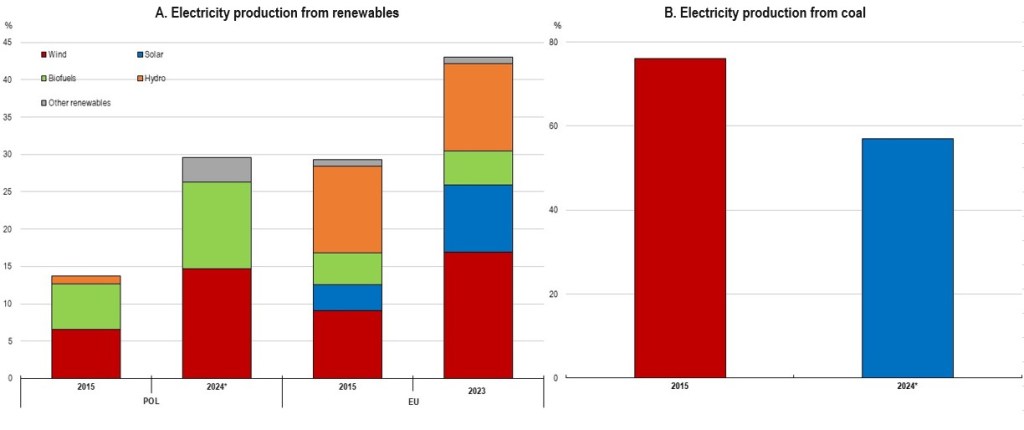
Biorąc pod uwagę ciągłe uzależnienie Polski od węgla, obniżenie emisji netto gazów cieplarnianych do zera do 2050 r. będzie niezwykle trudne (Rysunek 2). Cel ten wymaga przyspieszenia wdrażania polityk określonych w projekcie Krajowego planu na rzecz energii i klimatu na lata, wzmocnienia zachęt cenowych i szeregu form wsparcia dla najbardziej dotkniętych transformacją energetyczną. Bardziej ambitne wycofywanie węgla i skrócenie okresu wydawania pozwoleń na energię odnawialną pomogłyby osiągnąć niezbędne długoterminowe inwestycje sektora prywatnego. Emisje z sektora transportu podwoiły się w ciągu ostatnich trzydziestu lat. Aby odwrócić ten trend, potrzebne jest kompleksowe opodatkowanie pojazdów mechanicznych, obejmujące wszystkie samochody, co wzmocniłoby sygnały cenowe, a także utrzymanie inwestycji w transport publiczny.

Rysunek 2: Produkcja energii elektrycznej ze źródeł odnawialnych wzrosła, ale rola węgla pozostaje istotna
Note: * Preliminary estimates for 2024.
Source: Forum Energii (2025), OECD Green Growth Indicators database, International Energy Agency.

Chociaż oczekiwana długość życia w Polsce wzrosła, utrzymuje się ona poniżej poziomu w wielu krajach OECD (Rysunek 3). Poza tym istnieje pole do poprawy wyników zdrowotnych. Finansowanie systemu opieki zdrowotnej zwiększyło się. Niemniej jednak racjonalizacja nadwyżki łóżek w szpitalach i większe wykorzystanie zachęt w opiece podstawowej pozwoliłoby na zwiększenie efektywności i poprawę opieki. Ulepszenia w leczeniu i większy nacisk na profilaktykę, szczególnie w odniesieniu do ryzykownych zachowań takich jak picie alkoholu i palenie tytoniu, mogą znacznie poprawić wyniki zdrowotne. W obliczu presji budżetowej wynikającej z starzejącego się społeczeństwa, rząd powinien w zrównoważony sposób rozszerzyć opiekę długoterminową.

Rysunek 3: Średnia długość życia znacznie się poprawiła, ale nadal pozostaje poniżej średniej OECD
Note: The OECD average is weighted.
Source: OECD Health Statistics.

Reference:
OECD (2025), OECD Economic Surveys: Poland 2025, OECD Publishing, Paris, https://doi.org/10.1787/a35a56b6-en


Boosting health spending efficiency in Ireland

By Patrizio Sicari and Douglas Sutherland, OECD Economics Department

Overall, the quality of healthcare is generally good in Ireland, with life expectancy and the (self-assessed) health status of its population now among the best in the OECD. Even so, the country’s health system struggles in providing effective access to quality care for all, as it copes with rising demand due to rapid population growth and ageing.

Indeed, Ireland’s health system entered 2023 on the backdrop of nationwide bottlenecks in the flow of hospital admissions, particularly within emergency departments, with more than 900 patients waiting for a bed on trolleys – a historical high. More broadly, the number of patients waiting for over six months for outpatient, inpatient and day case appointments, after first referral, made up 46% of the total and accounted for 6% of the population (Figure 1).

These pressures, as highlighted in the 2022 OECD Economic Survey of Ireland, partly stem from a highly centralised health system, largely based on costly hospital services. Moreover, unique among European OECD peers, Ireland only provides a proxy for universal coverage of primary care to about 30-40% of the population, through a complex scheme of age-based and means-tested medical cards. Hence, the bulk of the remaining population purchases voluntary private insurance to finance private or semi-private care performed also in public hospitals. This has resulted in a de facto two-tier health system, in which better-off holders of private insurance gain quicker access to specialist consultations or diagnostics, while poorer patients remain stuck in waiting lists for longer, even if formally eligible for free care.

Figure 1. Waiting times for key healthcare services are substantial

Number of persons waiting for a scheduled date for outpatient, inpatient and day case appointments by waiting time, % of population¹

1. After first referral.
Source: National Treatment Purchase Fund.

At the same time, past underinvestment following the global financial crisis, has weighed on the efficiency of healthcare delivery. The legacy of relatively outdated hospital infrastructure, low numbers of hospital beds, associated with markedly high bed occupancy rates (Figure 2), and weak intensive care units facilities put pressure on the health system at the outset of the pandemic. Increased resources and swift reorganisation of processes, coupled with strong containment measures and a successful vaccination campaign helped avoid the worse. Nevertheless, the COVID-19 crisis strained waiting lists for “regular” care services further and pushed public health spending up to about 1/5 of total public expenditure in 2020 (Figure 3). In this context, enhancing public spending efficiency will be paramount to the financial sustainability of Ireland’s health system.

Figure 2. Hospital capacity constraints were significant at the onset of the pandemic

2019 or latest year available

1. Occupancy rate of curative (acute) care beds.
2. Unweighted average across 27 countries with available data.
Sources: OECD, Health Statistics database.

The government’s wide-ranging reform agenda, termed Sláintecare, aims to broaden the coverage of universal care and enhance the cost-efficiency of health services. The current system is overly centralized, complex and biased towards expensive hospital-based treatments. Hence, the goal to implement an effective integration across primary, community, long-term and social care services to move away from expensive hospital care is welcome. Accelerating the implementation of the Single Assessment Tool, a key IT-based needs assessment to support enhanced operational integration across all health and social long-term care providers, would enable large efficiency gains and the provision of more effective person-centred care services. Integrated services should reduce the number of visits to emergency departments as well as of hospital admissions, which can help address the challenge of long waiting lists.

Figure 3. Government health spending is high

Percent of total government spending, 2020 or latest

Source: OECD, Health Expenditure and Financing database; and OECD, National Accounts database.

The creation of six new regional health areas, which will be responsible for the planning, management and delivery of integrated and patient-centric care based on local population needs, is an important step towards more decentralised integrated care. Their success will depend on a suitable funding system and data availability. The funding system is currently fragmented across care settings and lacks transparency, limiting the traceability of healthcare spending. The planned adoption of a population-based resource allocation funding model to ensure regional health areas’ annual budgets reflect the specificities of local care needs, should be prioritised. This can improve financial reporting and management via higher transparency, spending traceability and accountability, while strengthening incentives to improve corporate governance and equity in health outcomes.

Monitoring the health system and achieving efficiency gains will also require greater use of digitalisation and an improved digital infrastructure. Tracking of patients across care services is currently hampered by the lack of national electronic records, as key available healthcare datasets are not interlinked. The information potential of anonymised patients’ data is largely unexploited, partly because of insufficient institutional resources and technical skills. Accelerating the process towards the adoption of a unique health identifier could enhance the monitoring of cost-effective health service utilisation and enable better-informed decision making at all levels. Centralising the national governance data framework in a single independent body may be of further help. By taking on the responsibility to link available health-related data collections, protect data confidentiality and ensure its secured sharing, the new body would be key in fostering the general trust in digital solutions needed for patients to agree with the treatment of their personal data.

References

Sicari P. and D. Sutherland (2023), “Health sector performance and efficiency in Ireland”, OECD Economics Department Working Papers, No. 1750, OECD Publishing, Paris, https://doi.org/10.1787/6a000bf1-en.

OECD (2022), OECD Economic Surveys: Ireland 2022, OECD Publishing, Paris, https://doi.org/10.1787/46a6ea85-en.