The output cost of the global financial crisis

By David Turner and Patrice Ollivaud, OECD Economics Department

Assessing the damage from the Global Financial Crisis (GFC) is not straightforward, even with the benefit of hindsight provided by ten years of history, because the counter-factual of what might have happened in its absence is unknowable. However, a simplistic, but commonly adopted approach, of comparing the post-crisis path of GDP with the pre-crisis trend exaggerates the cost and can lead to misleading policy conclusions. Such an approach is akin to treating the GFC as a meteorite from outer space which is completely unrelated or ‘exogenous’ to preceding macroeconomic developments. This is implausible because the pre-crisis trend in GDP involved unsustainable trends in asset prices, most obviously house prices, driven by a long period of rapid excessive credit growth across most of the advanced economies. Similarly ageing has started to progressively reduce the contribution from labour in many economies, so reducing their growth capacity. Hence, the counter-factual represented by the extrapolation of the past trends in GDP was never realistically attainable. A more plausible basis for a counter-factual is an extrapolation of pre-crisis trends of potential output, where potential output is an estimate of a sustainable measure of GDP [1]. The difference between these two approaches is first illustrated by considering the OECD countries as a group and using aggregated measures of potential output that are regularly published in the OECD Economic Outlook. A simple-minded extrapolation of OECD-wide GDP per capita implies an ever-widening loss, which is currently more than 10% of GDP, whereas compared to a pre-crisis extrapolation of potential output per capita implies a smaller loss of around 2-3 percentage points of GDP (Figure 1).

eoturnerdec2018

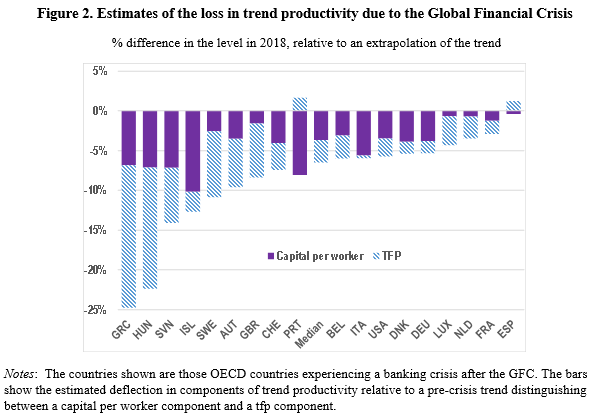
However, the estimated cost of 3% of GDP for the OECD as a whole hides large variations across countries. Among the 19 OECD countries that experienced a banking crisis, following the same approach, the median loss in output is more than double that, at around 6%.

The estimates of potential output also provide an estimate of how the loss was incurred and some clues as to some policy lessons that might be drawn. Perhaps surprisingly, in nearly all OECD countries, aggregate employment rates have recovered and are close to, or have even surpassed, the pre-crisis levels, although some groups (for example young workers) have suffered more permanent losses than these aggregate calculations suggest.  A notable exception is the United States, where the aggregate employment rate is still more than 3% below the pre-crisis level, which may be partly explained by the effects of opioid addiction [2].

Instead, the main lasting macroeconomic damage from the GFC is accounted for by lost productivity. OECD estimates suggest that for a majority of OECD countries experiencing a banking crisis, most of this lost productivity is accounted for by lower growth in capital per worker, rather than lower total factor productivity (tfp) (Figure 2). The loss in capital per worker illustrates how a severe adverse demand shock can be transformed into an adverse supply shock via an accelerator effect on investment that then reduces the capital stock [3]. In addition, increasing evidence, including from firm level studies, suggests that many countries where interest rates were particularly low in the pre-crisis period, especially in Southern Europe, experienced a substantial misallocation of capital. These countries are also among those that experienced a more abrupt post-crisis adjustment in capital stock growth. The fall in capital stock growth was also exacerbated in some countries by cutbacks in public investment after the crisis.
eoturnerdec2018fig2

Conversely, much of the loss in tfp can be traced back to weakening trend tfp growth that pre-dates the Global Financial Crisis. This in turn would suggest that policy may be better directed to addressing more long-standing causes, such as the increasing divergence between productivity performance of frontier and laggard firms, which may be symptomatic of rising entry barriers and reduced contestability [4].

References:

[1]  The approach described here represents an update of the calculations presented in:

Ollivaud, P., and D. Turner (2015),”The effect of the global financial crisis on OECD potential output“, OECD Journal: Economic Studies, OECD Publishing, vol. 2014(1), pages 41-60.

[2]  A more in-depth analysis of post-crisis trends in employment and labour force participation in the United States, including the effect of the opioid crisis, is provided by:

OECD (2018), OECD Economic Surveys: United States 2018, OECD Publishing, Paris, https://doi.org/10.1787/eco_surveys-usa-2018-en.

[3]  A more detailed analysis of the effect of the crisis on productivity in OECD countries, in terms of its effects on capital per worker and tfp, is provided by:

Ollivaud, P., Y. Guillemette and D. Turner (2018), “Investment as a transmission mechanism from weak demand to weak supply and the post-crisis productivity slowdown“, OECD Economics Department Working Papers, No. 1466, OECD Publishing, Paris, https://doi.org/10.1787/0c62cc26-en.

[4]  Evidence on the difference between the productivity performance of firms at the global frontier and laggard firms, as well as possible causes and policy responses, is provided by:

Andrews, D., C. Criscuolo and P. Gal (2016), “The Best versus the Rest: The Global Productivity Slowdown, Divergence across Firms and the Role of Public Policy“, OECD Productivity Working Papers, No. 5, OECD Publishing, Paris, https://doi.org/10.1787/63629cc9-en.


Maintaining Switzerland’s enviable living standards into the future

by Christine Lewis, Switzerland Desk, Economics Department

Switzerland’s high living standards and quality of life are renowned. It has the third-highest level of GDP per capita in the OECD. Likewise, survey data show Swiss have the OECD’s second-highest rate of life satisfaction. Unemployment is low, including for young people. And income inequality (after taxes and transfers) is around the OECD average.

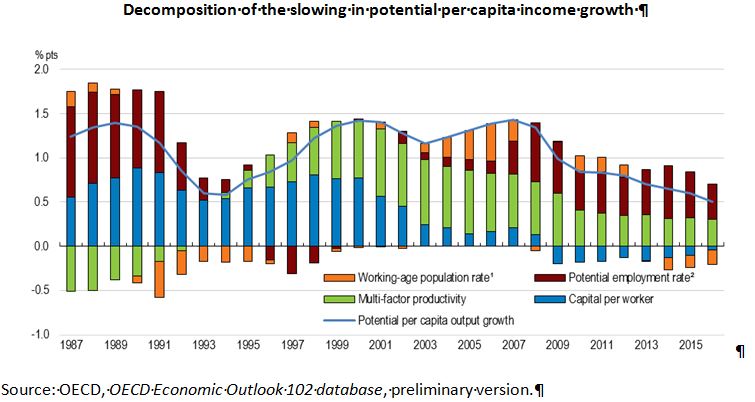
But Switzerland cannot take these enviable outcomes for granted. Indeed, trends are slowly eroding this favourable position. The rate of potential growth in per capita income has slowed to just 0.5%. While Swiss GDP per hour worked was one of was of the highest 40 years ago, growth has stalled due to slow increases in investment and in multi-factor productivity (Figure). Demographics are also playing a role by reducing the share of the population that is of working-age. And immigration, which had helped offset this effect and ease skills shortages, is slowing too. Ageing will add to the fiscal burden: spending on pensions, health and long-term care is projected to increase by 3.5 percentage points of GDP in the next three decades, which risks crowding out other spending and pushing up debt (Federal Department of Finance, 2016).

Switz

The OECD’s latest Economic Survey of Switzerland highlights several win-win policies that can counter these trends by raising labour supply and skills while contributing to the inclusiveness of growth (OECD, 2017):

  • Increasing affordability of childcare would allow mothers to increase their hours if they so choose and help them to maintain a career path. By better allocating women’s skills it would also raise productivity. Likewise, the disincentives in the tax system to take on more hours should be removed by shifting to taxation of individual incomes or undertaking some equivalent measure.
  • Participation in life-long learning should be promoted more actively to ensure that workers continue to maintain and adapt their skills as the economy changes at an ever-faster pace. Swiss workers have high levels of participation in continuing education and training overall, but it is not broad-based with a heavy concentration on those with strong educational attainment. To ensure that other workers are not left behind, subsidies should be offered to workers from groups with low participation rates.
  • Incentivising and assisting workers to delay retirement will help combat the effects of ageing on growth as well as alleviating fiscal pressures. Pension reform is urgently needed to ensure the financial sustainability of the system; reform should raise retirement ages and index them to life expectancy and also include stronger incentives to work longer. Promoting take-up of preventative health programmes, as well as career planning and tailored job-search assistance would lengthen healthy working lives.

[

References

Federal Department of Finance (2016), Report on the Long-term Sustainability of Public Finances in Switzerland, Federal Department of Finance, Bern.

OECD (2017), OECD Economic Survey of Switzerland, OECD Publishing, Paris.


What is the scope for public investment to lift long-term growth ?

by  Annabelle Mourougane, Jarmila Botev, Jean-Marc Fournier, Nigel Pain and Elena Rusticelli, OECD Economics Department

Long-term rates are low in OECD countries, particularly in Japan, France and Germany. This opens up fiscal space and can justify any public investment projects with a positive rate of return. At the same time, infrastructure needs are sizeable, especially as fiscal consolidation in recent years has pushed down public capital spending to very low levels in many countries. In such a situation, additional public investment is likely to benefit from high rates of return (Fournier, forthcoming).

New estimates in the June OECD Economic Outlook show long-term output gains of a budget neutral sustained investment stimulus of 0.5% of GDP could amount to between 0.5% and 2% (figure below).

Collective action among the major advanced economies to raise good-quality public investment is estimated to bring additional GDP gains. This would represent a gain of around one-half on average after the first year compared to a scenario where countries acts individually in the large advanced economies but Japan, where the gains are uncertain (Auerbach and Gorodnichenko, 2014). Amongst the major advanced economies, Germany would benefit the most from collective action to boost public investment.
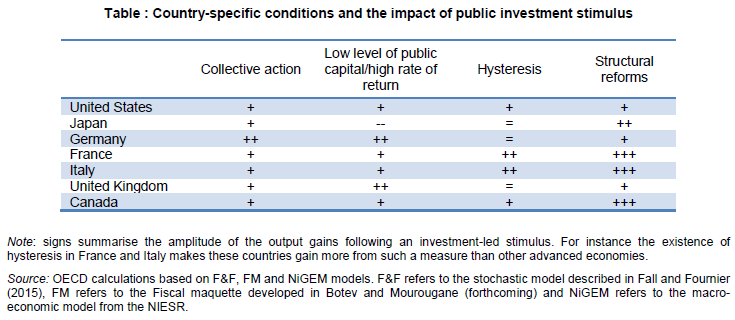
What factors affect the gains to such a stimulus (see table below)? OECD analysis points to the following country-specific factors:

  • the initial level of public capital stock and the rate of returns of these investments: Lowering returns to public capital by one standard deviation could significantly reduce the long-term effect on output, by cutting it by around 3/4. Amongst the large advanced economies, the effect on output would be above average in Germany and the United Kingdom, while the output gains can be negative for Japan.
  • the country’s initial position in the economic cycle and the extent of labour-market rigidities, which determine how far persistent demand weakness undermines the productive capacity of the economy (“hysteresis”). In Italy and France, where this hysteresis effect is stronger, the effect of public investment stimulus is stronger.
  • the additional gains structural reforms can bring to the economy: Reforms targeted at frictions that hold back demand for investment, such as increasing product market competition, can lower the opportunity costs of investing, and hence raise the catalytic impact of public investment on private capital spending. Lowering product market regulations by the average improvement over two years in a typical OECD country could add around 0.1-0.3 percentage point to the growth impact after the first year. Such gains would be sizeable in France, Italy and Canada.

Investm2.png


Investment1

References

Auerbach, A.J. and Y.Gorodnichenko (2014), “Fiscal Multiplier in Japan”, NBER Working Papers, No. 19911.

Botev, J. and A. Mourougane (forthcoming), “Fiscal Consolidation: What are the Breakeven Fiscal Multipliers?”, OECD Economics Department Working paper, OECD Publishing, Paris.

Fall, F. and J.M. Fournier  (2015), “Macroeconomic Uncertainties, Prudent Debt Targets and Fiscal Rules”,OECD Economics Department Working Papers, No. 1230, OECD Publishing, Paris.

Fournier, J.M. (forthcoming), “The Positive Effect of Public Investment on Potential Growth”, OECD Economics Department Working Paper, OECD Publishing, Paris.

Mourougane, A., J. Botev, J.M. Fournier, N. Pain and E. Rusticelli (forthcoming), “Can an Increase in Public Investment Sustainably Lift Growth?”, OECD Economics Department Working Papers, OECD Publishing, Paris.