Boosting health spending efficiency in Ireland

By Patrizio Sicari and Douglas Sutherland, OECD Economics Department

Overall, the quality of healthcare is generally good in Ireland, with life expectancy and the (self-assessed) health status of its population now among the best in the OECD. Even so, the country’s health system struggles in providing effective access to quality care for all, as it copes with rising demand due to rapid population growth and ageing.

Indeed, Ireland’s health system entered 2023 on the backdrop of nationwide bottlenecks in the flow of hospital admissions, particularly within emergency departments, with more than 900 patients waiting for a bed on trolleys – a historical high. More broadly, the number of patients waiting for over six months for outpatient, inpatient and day case appointments, after first referral, made up 46% of the total and accounted for 6% of the population (Figure 1).

These pressures, as highlighted in the 2022 OECD Economic Survey of Ireland, partly stem from a highly centralised health system, largely based on costly hospital services. Moreover, unique among European OECD peers, Ireland only provides a proxy for universal coverage of primary care to about 30-40% of the population, through a complex scheme of age-based and means-tested medical cards. Hence, the bulk of the remaining population purchases voluntary private insurance to finance private or semi-private care performed also in public hospitals. This has resulted in a de facto two-tier health system, in which better-off holders of private insurance gain quicker access to specialist consultations or diagnostics, while poorer patients remain stuck in waiting lists for longer, even if formally eligible for free care.

Figure 1. Waiting times for key healthcare services are substantial

Number of persons waiting for a scheduled date for outpatient, inpatient and day case appointments by waiting time, % of population¹

1. After first referral.
Source: National Treatment Purchase Fund.

At the same time, past underinvestment following the global financial crisis, has weighed on the efficiency of healthcare delivery. The legacy of relatively outdated hospital infrastructure, low numbers of hospital beds, associated with markedly high bed occupancy rates (Figure 2), and weak intensive care units facilities put pressure on the health system at the outset of the pandemic. Increased resources and swift reorganisation of processes, coupled with strong containment measures and a successful vaccination campaign helped avoid the worse. Nevertheless, the COVID-19 crisis strained waiting lists for “regular” care services further and pushed public health spending up to about 1/5 of total public expenditure in 2020 (Figure 3). In this context, enhancing public spending efficiency will be paramount to the financial sustainability of Ireland’s health system.

Figure 2. Hospital capacity constraints were significant at the onset of the pandemic

2019 or latest year available

1. Occupancy rate of curative (acute) care beds.
2. Unweighted average across 27 countries with available data.
Sources: OECD, Health Statistics database.

The government’s wide-ranging reform agenda, termed Sláintecare, aims to broaden the coverage of universal care and enhance the cost-efficiency of health services. The current system is overly centralized, complex and biased towards expensive hospital-based treatments. Hence, the goal to implement an effective integration across primary, community, long-term and social care services to move away from expensive hospital care is welcome. Accelerating the implementation of the Single Assessment Tool, a key IT-based needs assessment to support enhanced operational integration across all health and social long-term care providers, would enable large efficiency gains and the provision of more effective person-centred care services. Integrated services should reduce the number of visits to emergency departments as well as of hospital admissions, which can help address the challenge of long waiting lists.

Figure 3. Government health spending is high

Percent of total government spending, 2020 or latest

Source: OECD, Health Expenditure and Financing database; and OECD, National Accounts database.

The creation of six new regional health areas, which will be responsible for the planning, management and delivery of integrated and patient-centric care based on local population needs, is an important step towards more decentralised integrated care. Their success will depend on a suitable funding system and data availability. The funding system is currently fragmented across care settings and lacks transparency, limiting the traceability of healthcare spending. The planned adoption of a population-based resource allocation funding model to ensure regional health areas’ annual budgets reflect the specificities of local care needs, should be prioritised. This can improve financial reporting and management via higher transparency, spending traceability and accountability, while strengthening incentives to improve corporate governance and equity in health outcomes.

Monitoring the health system and achieving efficiency gains will also require greater use of digitalisation and an improved digital infrastructure. Tracking of patients across care services is currently hampered by the lack of national electronic records, as key available healthcare datasets are not interlinked. The information potential of anonymised patients’ data is largely unexploited, partly because of insufficient institutional resources and technical skills. Accelerating the process towards the adoption of a unique health identifier could enhance the monitoring of cost-effective health service utilisation and enable better-informed decision making at all levels. Centralising the national governance data framework in a single independent body may be of further help. By taking on the responsibility to link available health-related data collections, protect data confidentiality and ensure its secured sharing, the new body would be key in fostering the general trust in digital solutions needed for patients to agree with the treatment of their personal data.

References

Sicari P. and D. Sutherland (2023), “Health sector performance and efficiency in Ireland”, OECD Economics Department Working Papers, No. 1750, OECD Publishing, Paris, https://doi.org/10.1787/6a000bf1-en.

OECD (2022), OECD Economic Surveys: Ireland 2022, OECD Publishing, Paris, https://doi.org/10.1787/46a6ea85-en.



Laying the foundations for strong, sustainable growth in Finland

By David Carey, OECD Economics Department

After a large drop in the first half of 2020, Finland regained its pre-COVID-19 GDP level by mid-2021, which was faster than many other OECD countries (Figure 1). Policies to support incomes during and after the pandemic contributed to the powerful economic rebound. However, Russia’s war of aggression against Ukraine has boosted inflation, slashing household spending power and consumer confidence, and weakened Finland’s main export markets. Consequently, economic growth is set to stall in 2023 but to recover in 2024 when the adverse effects of the energy shock will have passed.

Figure 1. The economy recovered quickly from the COVID-19 shock but is set to slow

Source: OECD Economic Outlook database.

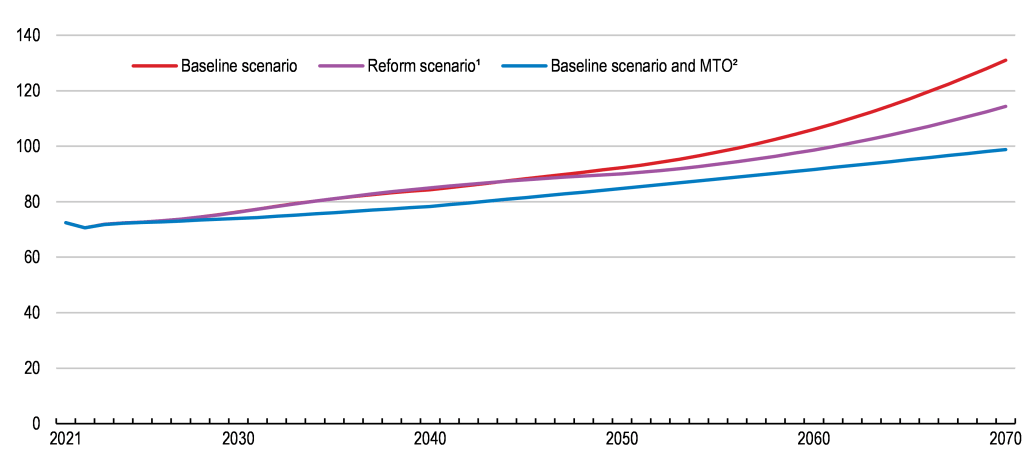
Russia’s war in Ukraine has also increased the government’s budget deficit. On current policies, the budget deficit adjusted for the business cycle is set to be around 2% of GDP in 2023-24. With increases in spending related to population ageing on the horizon, the OECD projects that gross government debt will rise to 130% of GDP by 2070 (Figure 2). This increase would be considerably smaller if the deficit were constantly limited to Finland’s medium-term target of 0.5% of GDP beyond 2030. To this end, comprehensive spending reviews should be undertaken to identify consolidation measures and the incentives in the healthcare reform for counties to increase efficiency reinforced, if necessary.

Figure 2. Government debt would increase substantially under unchanged policies

Gross general government debt, % of GDP

1. In the reform scenario, improvements in the innovation system increase the level of GDP by 3% over the baseline by 2050 and work-based immigration rises gradually from the current level (1 500 per annum) in 2030 to 7 500 per annum in 2050-70. In addition, fixed capital is assumed to grow faster (at 2% per year throughout the projection) than in the baseline scenario (0.9% per year from 2040 onwards). Higher growth in the fixed capital-to-labour ratio is the main factor increasing growth in labour productivity (to 1.4%) and output (to 1.1%) in the reform scenario.
2. In the MTO scenario, Finland continuously meets its medium-term budgetary objective of a structural financial balance of minus 0.5% of GDP from 2030.
Source: OECD.

Finland is on track to meet its gross greenhouse gas abatement targets for 2030 and 2035. However, the cost of reducing emissions is unnecessarily high. To lower these costs, the share of biofuels mandated in the transport sector should be reduced to the minimum level required by the European Union and, to compensate, the carbon price used to calculate carbon tax rates on heating fuels aligned with that used for transport fuels. Furthermore, heat production using peat, which is highly CO2 emissions intensive, should be subject to the same tax regime as other fossil fuels and policies to reverse car dependency in cities strengthened.

Finland is not on track to meet its forestry and other land-use targets. It needs to reduce forestry and land-use emissions from 2 CO2-eq. in 2021 to minus 17 and minus 21 Mt CO2-eq. by 2030 and 2035, respectively. To this end, instruments should be created to encourage the cultivation of wetted peatlands and forestry should be subject to carbon pricing.

Finland needs to reboot its innovation ecosystems, which comprise innovation partnerships between various public and private actors like universities, firms and research institutions, to lift weak productivity growth (0.5% on average over the past decade). The government’s legal commitment to boost R&D spending to 4% of GDP by 2030, from 2.9% currently, will help to strengthen innovation ecosystems. It will be important that additional spending and innovation support schemes be regularly assessed for their impact and improved continuously. Innovation support should also become more mission oriented, directing applied research toward solving the most pressing socio-economic challenges.

Another key challenge for Finland’s innovation ecosystems is the severe shortage of qualified workers with skills to develop advanced technologies or adopt successfully technologies developed elsewhere. The government has an ambitious goal of raising the tertiary attainment of young adults to 50% by 2030, from 40% today (Figure 3). To realise this goal, it should commit to a credible plan to increase tertiary study places, fund them and improve the allocation of study places across study fields to better reflect the skill needs of the labour market.

Figure 3. Tertiary educational attainment among young adults is relatively low

Percentage of 25-34-year-olds having completed tertiary education, 2021

Note: Data refer to 2020 for Chile.
Source: OECD (2022), Education at a Glance 2022.

Attracting more foreign talents is also important for alleviating skill shortages and better linking innovation activities with those in other countries. The government aims to increase annual work-based immigration by at least 50 000 by 2030. It will be important that these immigrants also find good jobs in Finland, which currently is not always the case.

References:

OECD (2022), OECD Economic Surveys: Finland 2022, OECD Publishing, Paris,
https://doi.org/10.1787/516252a7-en.


The Slovenian economy is bouncing back

by Rory O’Farrell, Slovenia Desk, OECD Economics Department

Slovenia would do well if its economy performed as well as its ski-jumpers. In 2015, Slovenian Peter Prevc became the first ski-jumper in history to jump 250 metres. As impressive has been his ability to land successfully, being among the few jumpers to receive a perfect 20 points for style. While the Slovenian economy has been successful in bounding forward, it has taken hard falls in the past, and a lack of resilience means it has taken a long time to recover.

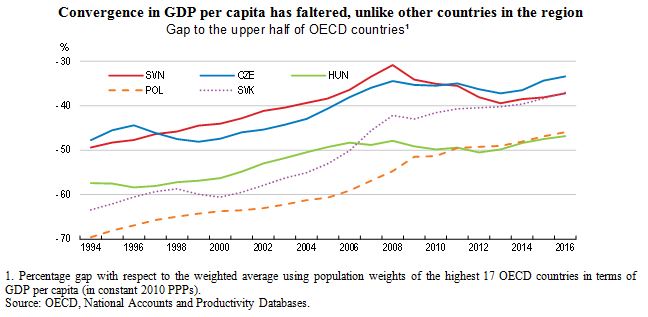
Prior to the international crisis, the bounding Slovenian economy converged with advanced OECD economies, before suffering a double hard landing with the onset of the international financial crisis and a subsequent domestic banking crisis. However, thanks to recent structural reforms, business restructuring, supportive monetary conditions and improved export markets, Slovenia is leaping forward again. GDP growth is accelerating and broadening, unemployment is down, and both consumer confidence and the trade balance are reaching record highs. The government may need to step in early with tighter fiscal policy to ensure a controlled landing.

Slovenia

However, unlike its agile youthful ski-jumpers, Slovenia is not breaking any records in terms of productivity. Indeed, its growth has lagged that of regional peers. Labour productivity is low compared to the OECD average, in part due to large numbers of workers employed in relatively low-productivity small firms, and this has yet to show a strong improvement. Productivity gains were also held back by low investment, as the crisis-afflicted banking sector was unable to lend to domestic firms, and Slovenia has been less succcesful in attracting foreign direct investment than other countries in the region. In addition, a lack of competitive pressure, due to heavy regulation and ineffective competition policies and enforcement, has inhibited Slovenian firms from developing the efficiency needed to drive productivity forward.

The nimbleness of the Slovenian economy is also being reduced by a rapidly ageing population. Older workers with obsolete skills have tended to take early retirement rather than retrain, and a poor reallocation of labour is leading to labour shortages. In the past such shortages were filled by training young Slovenians, but a shrinking youth population means this is no longer possible. In addition, public spending pressures due to ageing (in terms of health and pensions) are mounting.

However,  with an improving economy Slovenia is in a good position to move ahead with reforms that will boost long-term growth. As with any ambitious endeavour, occasional mishaps are inevitable. The just released OECD Economic Survey of Slovenia highlights the need to maintain a fiscal cushion to soften future landings as well as the reforms needed to create a more agile economy to sustain incomes and well-being.

Find out more:

OECD (2017), OECD Economic Surveys: Slovenia 2017, OECD Publishing, Paris.


Time to deploy the fiscal levers actively and wisely

by Catherine L. Mann, OECD Chief Economist, OECD Economics Department

The role of fiscal policy has been at the heart of the policy debate since the financial crisis. With the global economy stuck in a low-growth trap and monetary policy overburdened, it is time to re-assess the use of fiscal policy levers.

Government interest payments have fallen sharply as interest rates have declined to very low levels, freeing up cash. In addition, new OECD estimates show that “fiscal space” – the gap between current government debt and levels at which market access would be compromised – have widened since 2014, as lower interest rates have more than offset headwinds from lower potential growth. This creates a window of opportunity.

fiscal-levers-two

Most OECD governments have space to pursue a ½ percent of GDP deficit-financed “fiscal initiative” to support productivity-enhancing measures for 3-4 years without increasing public debt in the medium term. The withdrawal of deficit financing after the initial fiscal initiative and the outcome of higher growth from the initiative are enough to ensure that debt sustainability does not deteriorate, while the low interest rate environment means that stimulus is not crowded out.  The benefits are greater if boosting short-term activity helps to avoid high and persistent unemployment, if countries reduce regulatory burdens, and if countries undertake these efforts collectively.

fiscal-matrix

While it may be easy to relax the fiscal stance, the success of the fiscal initiative to promote growth, enhance long-run potential output, and improve debt sustainability depends on an effective strategy of additional spending or tax reductions to achieve more inclusive and higher growth.

Several major economies are now using the fiscal levers more actively, following the consolidation of the years following the crisis. But, some countries – notably in Europe – have yet to seize the opportunity.

However, are countries using the fiscal levers more wisely? The evidence of recent years is that many countries have cut the share of spending on investment and education, while increasing the share of taxes that are most harmful to growth and equality. A shift toward a more effective mix is needed.

The OECD is today releasing new research on the mix, size and quality of public investment, including a new dataset on the composition of public spending. Soft investment, such as skills and R&D, together with well-governed public investment in infrastructure, can yield large growth gains. Good institutions enhance the effectiveness of government spending and tax policy.

The policy debate will continue, but now is the time to deploy the fiscal levers actively and wisely !

References:

OECD (2016), “Using the fiscal levers to escape the low growth trap“, in OECD Economic Outlook, Volume 2016 Issue 2, OECD Publishing, Paris.

Mourougane, A., J. Botev, J-M. Fournier, N. Pain and E. Rusticelli (2016), “Can an increase in public investment sustainably lift economic growth?” OECD Economics Department Working Papers, No. 1351, OECD Publishing, Paris.

Botev, J., J-M. Fournier and A. Mourougane (2016), “A reassessment of fiscal space in OECD countries“, OECD Economics Department Working Papers, No. 1352, OECD Publishing, Paris.