Addressing Korea’s Fertility Crisis

by HyunJeong Hwang, OECD Economics Department
In 2023, Korea’s fertility rate fell to a world-record low of 0.7. Its sharp decline implies a faster increase in the old-age dependency ratio than in any other OECD country. As the proportion of retirees grows, labour shortages will intensify, and the costs of health care, long-term care, and pensions are expected to more than double to 17.4% of GDP by 2060. The government has declared the situation a national emergency and announced plans to establish a new ministry focused on population strategy, alongside a range of policy initiatives. These demographic challenges are the main topic of the 2024 Economic Survey of Korea. It emphasises the importance of addressing obstacles preventing young adults from having the number of children they desire and implementing policies to mitigate the economic impact of an ageing population.
Fertility rates in Korea have declined reaching the lowest in the world
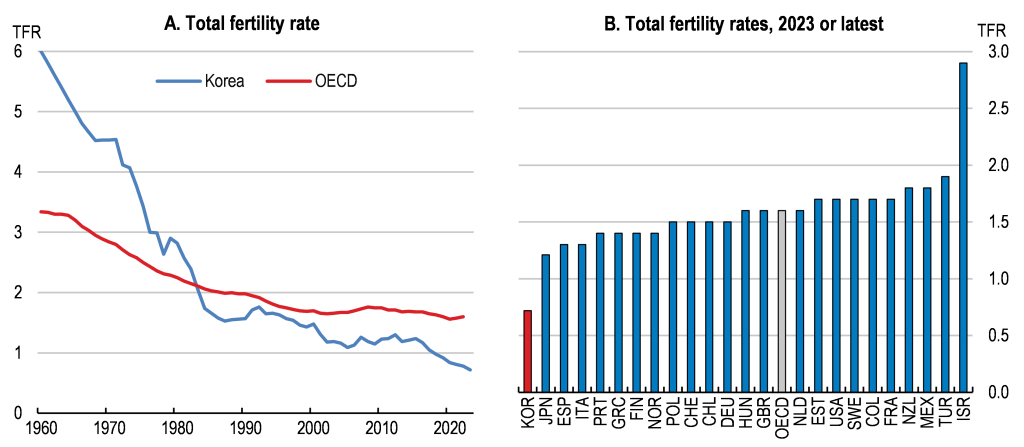
A key cause of ultra-low fertility is the high opportunity cost of having children in Korea. Rapid economic development and higher access to education have enabled women to pursue increasingly rewarding careers. But long hours, insufficient protections against workplace discrimination, and a work culture where work is expected to take priority over family make it very challenging to combine work and motherhood. This leads to a large career cost for women who become mothers and underpins the widest gender pay gap in the OECD.
Improving the work-life balance must be a top priority to reverse the decline in fertility rates. While policies have made childcare nearly free, there is still room to expand access to popular childcare services, ensure consistent quality across all types, and align childcare opening hours with work hours. Raising the take-up of paid parental leave, which is currently very low, especially for fathers, is also essential. This can be achieved by relaxing strict eligibility, raising the benefit ceiling, and strengthening sanctions for workplace discrimination.
The weak financial position of youth holds back family formation. Labour market duality with large differences in pay, job quality and social protection weaken the economic position of young adults. Many young people either postpone their careers to land high-quality jobs in large firms, or start at smaller companies with non-regular contracts. Duality also spurs a race for credentials, which leads to high spending on private education. Addressing labour market dualism by relaxing employment protection for regular workers and expanding social insurance would help strengthen the financial prospects of young people and encourage family formation.
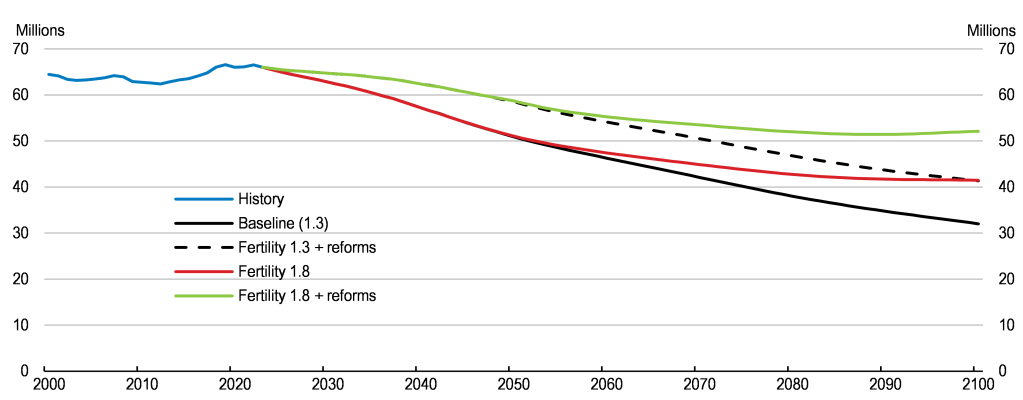
However, boosting fertility alone will not suffice to offset the rapid decline in the workforce. Even tripling fertility to 2.1 children per woman by 2040, the level associated with a stable population in the long term, would not prevent the workforce from declining. Korea must therefore prepare for and adapt to the challenges of an ageing and shrinking population.
Lengthening working lives is essential to counteract inevitable population ageing. Careers are shortened by the seniority-based wage system which renders older workers less appealing to firms when their wage rises above their productivity. Company-specific mandatory retirement ages below the legal pension age and the practice to encourage older employees to voluntarily leave before reaching the mandatory retirement age also contribute to premature retirements from their main job. Reforming these systems, raising the statutory retirement age, and offering upskilling opportunities for older workers can help keep them in the workforce longer.
Increasing the supply of foreign labour is another vital strategy. Although Korea has significant potential to boost immigration, various visa hurdles for skilled immigration as well as poor working conditions for low-skilled immigrants hold back immigration. Korea’s immigration policies need reform to enhance opportunities for both low-skilled and skilled immigrants. Removing entry barriers for qualified foreign talent and integrating low-skilled immigrants better will help increase the foreign labour force.
Further reading:
OECD (2024), OECD Economic Surveys: Korea 2024, OECD Publishing, Paris.
Yang, Y., H. Hwang and J. Pareliussen (2024), “Korea’s unborn future: lessons from OECD experience”, OECD Economics Department Working Papers, No. 1824, OECD Publishing, Paris.
Choi, S., S. Ham., Y. Yang, and J. Pareliussen (2024), “Women’s employment and fertility in South Korea: A literature review”, OECD Economics Department Working Papers, No. 1825, OECD Publishing, Paris.