Greece: Achieving the green economy transition

By Tim Bulman, Timo Leidecker and Ilai Levin, OECD Economics Department

More intense and more frequent wildfires and floods, hotter and drier summers, and disrupted seasons are among the striking signs that the climate in Greece and globally is changing. Like other OECD countries, Greece is contributing to the global effort to mitigate climate change by becoming a net zero emission economy.

Reducing emissions from energy use to transition towards a net-zero economy

The green economy transition poses a particular challenge for Greece. The economic crisis of the last decade has limited public and private financial capacity to invest in renewable energy production, make infrastructure more resilient, improve energy efficiency, upgrade heating systems, and replace fossil-fueled with zero emission cars. Using public funds effectively, mobilising private capital, and raising additional revenues will be key for Greece. The just-released OECD Economics Working Paper on “Transitioning to a green economy in Greece“, drawn from the OECD Economic Survey of Greece (2023) presents a mix of the policies required to limit the financial and social coss of the transition. Achieving the transition is feasible with little long-term cost to incomes and employment, especially if continued reforms to improve the business environment and raise investment accompany the transition (discussed in this ECOSCOPE post).

The Paper identifies three policy priorities that would make substantial cuts to the more than two-thirds of Greece’s emissions that come from energy use:

1. Pricing greenhouse gas emissions consistently to encourage investment, innovation and savings. Average CO2 prices from using fossil fuels are high in Greece but vary substantially across uses. For example, charges on CO2 emissions from using gasoline are effectively double those from diesel; in turn, charges for using fossil fuels for heating or producing electricity are much lower than average charges for using fossil fuels for road transport. Introducing a minimum price floor to harmonise prices would encourage low-cost ways to cut emissions. Higher and more consistent prices for emissions would also generate more than enough revenues to compensate low-income households for rising living costs.

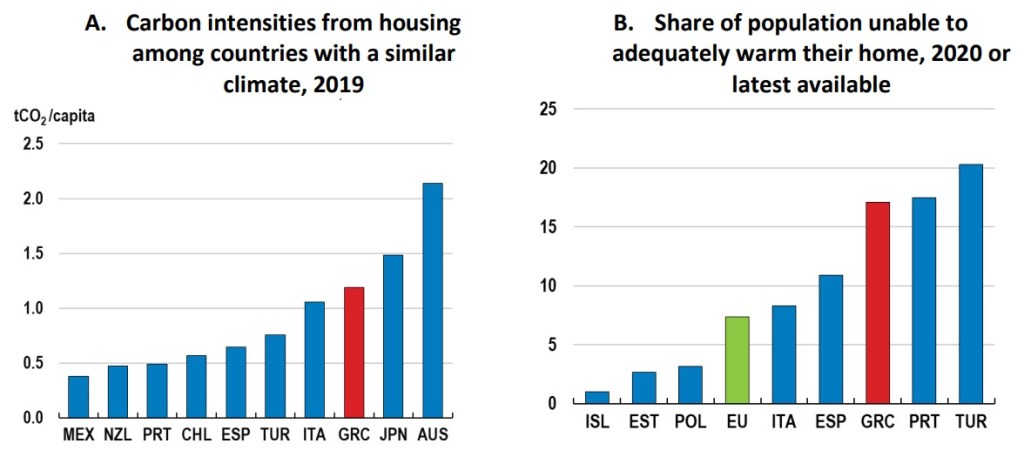
2. Giving a push to renovate buildings. Greece has an old housing stock with low energy efficiency. This harms residents’ well-being, especially when energy prices are rising, as experienced over the past year. It also contributes to high greenhouse gas emissions in Greece compared to countries with similar climates (Figure 1). Housing renovations can cut emissions, improve residents’ comfort, and usually pay for themselves through energy savings. The up-front costs of renovations, however, can be a major barrier to realising these savings. Substantially expanding the current financial support programmes and – to leverage more private financing – encouraging loans that are repaid through energy savings would boost renovations. Setting out a clear timeline of increasing minimum energy-efficiency standards to cover both new and existing buildings would provide certainty for investors and builders, bringing more resources to renovations and create green jobs.

Figure 1. Improving housing energy efficiency would reduce emissions and energy poverty
3. Moving transport onto low-emission modes. Cutting emissions from transport is costly and complex but, as it generates one-fifth of Greece’s total emissions, is central to Greece’s goals. More passengers and freight are carried on roads than in the EU on average. The car fleet is large and old, with Greeks spending less on buying cars than in most other OECD countries (Figure 2). Renewing the car fleet, especially with more expensive low-emission cars, is likely to be very slow, even if purchase subsidies were used more extensively. At the same time, modelling by the International Transport Forum and the OECD finds that improving public transport could cut transport emissions in Greece by 19% in 2030 relative to 2019 levels with an additional investment of about 0.2% of GDP annually.

Figure 2. Alternatives to road transport could cut emissions from transport cost effectively

Helping people and businesses adapt to the changing climate

Transforming the economy to net-zero emissions will affect how firms operate and which skills are needed. As some jobs bound to fossil fuels disappear, for example in lignite mining, new and potentially higher productivity job opportunities will be created, for example in housing renovations or greener technologies. Workers may need to up-skill for these new jobs, especially in regions highly dependent on fossil fuel industries such as Western Macedonia. Focused interventions such as those underway in Greece’s lignite mining areas are increasing access to quality training. and help hasten this transition and support incomes.

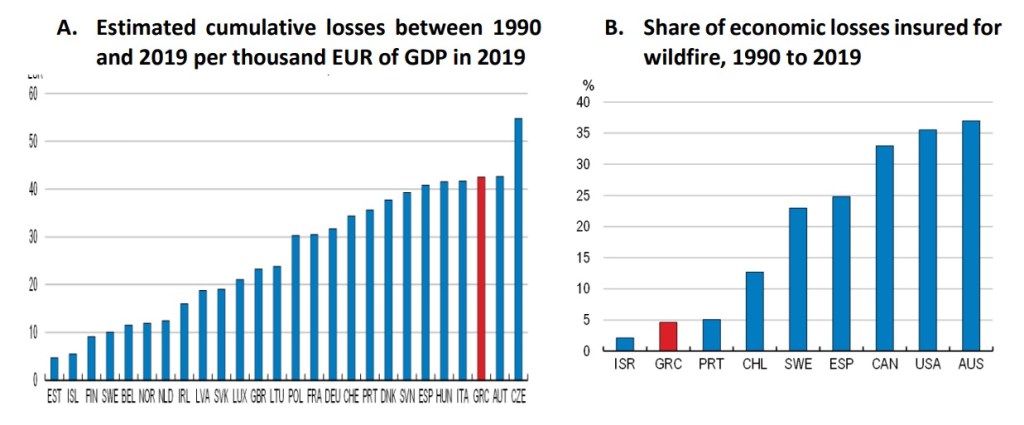
Damages from extreme weather events, such as wildfires or floods, are already mounting in Greece and are likely to further aggravate. Encouraging households and firms to anticipate these risks when they decide where and what to build will help reduce the disruption from a changing climate. Private insurance can help make the costs of climate-related risks clearer. Yet, insurance coverage in Greece is among the lowest in OECD countries (Figure 3). After past natural disasters the government has partly compensated damages, but this leaves people uncertain about how much and when they will receive compensation and weighs on public finances. Making insurance coverage compulsory could encourage people to take protective measures upfront, would leverage the skills of the private sector to assess reconstruction costs, and provide greater certainty to those afflicted. Public re-insurance, and ensuring that insurance markets remain competitive, can improve the accessibility of insurance.

Figure 3. Expanding insurance coverage would improve compensation for damages and encourage households and firms to minimise their exposure to a changing climate
Reference:

OECD (2023), OECD Economic Surveys: Greece 2023, OECD Publishing, Paris, https://doi.org/10.1787/c5f11cd5-en.

Leidecker, T., et al. (2023), “Transitioning to a green economy in Greece”, OECD Economics Department Working Papers, No. 1757, OECD Publishing, Paris, https://doi.org/10.1787/77cd54d8-en.


Confronting the energy crisis: changing behaviours to reduce energy consumption

By Francesca Papa and Filippo Cavassini, OECD Economics Department

Russia’s war of aggression against Ukraine is strongly impacting energy prices worldwide. While relatively mild weather avoided rationing over the 2022-23 winter in European countries, challenges remain in securing sufficient storage levels for the 2023-24 winter (OECD, 2023). In some countries, high prices have already incentivised some demand reductions from firms and households. However, as argued in our recent paper (Cavassini and Papa, 2023), the crisis calls for additional changes in behaviour to accompany long-term technical and structural solutions to lower gas and electricity demand.

The current energy crisis calls for significant changes in behaviour

Diversifying energy sources and reducing energy demand will be critical. Some of these changes will take time to be implemented, such as improving buildings’ energy efficiency. However, the current crisis also calls for policies leading to more immediate demand reduction (Haas, Kozluk and Sarcina, 2022) (Figure 1).

Figure 1. Without demand reductions, Europe may risk gas supply interruptions

Note: For all scenarios, assuming 90% storage levels at the end of November; no imports from Russia from November 2022 and domestic production at average 2019-2021 levels. In the baseline, we assume “10% reduction” in gas demand relative to the 2017-21 average consumption, imports from other sources at 28 bcm/month, of which 13.5bcm/month from LNG imports. “Cold winter” assumes consumption at the maximum 2017-21 levels, a 10% reduction in gas demand relative to the maximum 2017-2021 levels and imports from other sources, incl. LNG imports, as the baseline. Low LNG imports assumes 12bcm/month of LNG imports starting from 2023 and a 10% reduction in gas demand relative to the 2017-21 average consumption.
Source: Update of OECD Ecoscope Blog (Haas, Kozluk and Sarcina, 2022[2]) .

Some of these actions will need to come from changes in the behaviour of households, which account for almost 24% of energy consumption in the EU, with an even higher share in winter (OECD, 2022) (Figure 2).

Figure 2. Households account for a large share of electricity consumption

Electricity total final consumption by sector
1971-2018 (Mtoe)

Notes: Other includes agriculture, fishing and non-specified sectors.
Source: (IEA, 2021).

Reducing households’ energy use can not only help curb the current crisis, but, if sustained over time, it can also support the transition to net zero. Identifying the psychological factors that influence energy conservation behaviour is particularly important, because changing behaviour is the result not only of responses to prices but also of expectations, habits, and biases (Carrus, 2021).

How to facilitate a behavioural response to energy savings?

A range of structural and psychological barriers make it hard for consumers to change their energy consumption. For example, inattention, sheer habit or emulation can create a gap between the intention to reduce energy consumption – I will turn off the light when I exit the room – and the actual action – but in fact I leave it on. The capacity of individuals to process information can also be a barrier. Information campaigns that are not sufficiently clear on what can be done can be difficult to act upon.

There are, however, ways of counteracting these behavioural barriers.

Successful information campaigns tend to provide a set of clear and actionable guidelines, which can be important for emergency situations (Cornago, 2022). For example, after the 2011 earthquake and tsunami hit the Fukushima nuclear power plant in Japan, the government launched an information campaign to encourage households to save energy. Government and energy utilities disseminated checklists of energy saving tips with simple actionable steps, complemented by technical support to commercial and industrial consumers (Institute of Energy Economics, Japan, 2021). Overall, the campaign led to 15% less electricity being used in 2011 relative to the previous year in the most affected regions. This was achieved without price increases (Kimura and Nishio, 2016).

Social norms are strong determinants of action and can influence the effectiveness of information campaigns. For example, a study on the role of beliefs in energy conservation found that the belief that neighbours were reducing energy consumption correlated highly with energy saving efforts, a finding which has often replicated in real-life applications (e.g. Figure 3) (Jachimowicz, 2018).

Figure 3. Sample of redesigned energy bill emphasising social comparison

Source: (Jachimowicz, 2018[9])

Behavioural change can also be promoted through a combination of price mechanisms (time of the day pricing) and user-centric technologies. A study conducted by the OECD in 2018 showed that smart meters providing real-time feedback on electricity consumption, price and expenditures induced households to reduce electricity demand by an average of about 3%, with results increasing to around 4% over a five-month period (OECD, 2019).

Table 1 presents possible responses that build on behavioural sciences and can be used to counteract different behavioural barriers affecting energy consumption.

Table 1. Examples of behavioural barriers that can affect energy consumption in the short and long term and possible responses

Source: OECD elaboration from (Andor and Fels, 2018), (Feygina, 2010), (Gifford, 2011), (Mol, Jantsje M., et al., 2020), and (OECD, 2019b).

Conclusions

Governments should already concentrate on energy saving measures that will prepare us for the next winter. The choice of message that policymakers send to consumers, how and when the information is provided to households and through which channels can make a difference in changing consumption behaviours. The effectiveness of these campaigns and actions should be monitored to gauge evolutions in behaviours and identify solutions to behavioural barriers.

References:

Andor, M. (2018), Behavioral economics and energy conservation–a systematic review of non-price interventions and their causal effects, Ecological economics 148 (2018): 178-210. https://www.researchgate.net/publication/331999076_Behavioral_Economics_and_Energy_Conservation_-_A_Systematic_Review_of_Non-price_Interventions_and_Their_Causal_Effects.

Carrus, G. (2021), Psychological predictors of energy saving behavior: A meta-analytic approach., Frontiers in Psychology, 12, 648221. https://www.frontiersin.org/articles/10.3389/fpsyg.2021.648221/full.

Cavassini F. and Papa F. (2023), “Confronting the energy crisis: changing behaviours to reduce energy consumption“, OECD Policy Responses on the Impacts of the War in Ukraine. Available at: https://www.oecd.org/ukraine-hub/policy-responses/confronting-the-energy-crisis-changing-behaviours-to-reduce-energy-consumption-5664e8a9/#back-note-d1e350.

Cornago, E. (2022), HOW TO SAVE ENERGY IN A SMARTER WAY, Center for European Reform. https://www.cer.eu/insights/how-save-energy-smarter-way.

Feygina, I. (2010), System justification, the denial of global warming, and the possibility of “system-sanctioned change”., Personality and social psychology bulletin, 36(3), 326-338. https://journals.sagepub.com/doi/abs/10.1177/0146167209351435.

Gifford, R. (2011), The dragons of inaction: psychological barriers that limit climate change mitigation and adaptation., American psychologist, 66(4), 290. https://psycnet.apa.org/doiLanding?doi=10.1037%2Fa0023566.

Haas, Kozluk and Sarcina (2022), Emergency plans and solidarity: Protecting Europe against a natural gas shortage, OECD Ecoscope. https://oecdecoscope.blog/2022/10/21/emergency-plans-and-solidarity-protecting-europe-against-a-natural-gas-shortage/.

IEA (2021), Electricity total final consumption by sector, 1971-2019, IEA, Paris https://www.iea.org/data-and-statistics/charts/electricity-total-final-consumption-by-sector-1971-2018, IEA. Licence: CC BY 4.0.

Institute of Energy Economics, Japan (2021), CERT Thematic Discussions: The role of ʻbehavioural aspectsʼ for reaching net zero emissions by 2050, https://iea.blob.core.windows.net/assets/d65c0edb-50fc-46e4-90db-d7df8933af4d/1.Naoko_DOI_ImpactofSetsuden.pdf.

Jachimowicz, J. (2018), The critical role of second-order normative beliefs in predicting energy conservation., Nat Hum Behav 2, 757–764 (2018). https://doi.org/10.1038/s41562-018-0434-0.

Kimura, O. and K. Nishio (2016), Responding to electricity shortfalls: Electricity-saving activities of households and firms in Japan after Fukushima., Economics of Energy & Environmental Policy, 5(1), 51–72. https://www.jstor.org/stable/26189398.

Mol, Jantsje M., et al. (2020), Insights into flood risk misperceptions of homeowners in the Dutch River Delta., Risk analysis 40.7 (2020): 1450-1468. https://onlinelibrary.wiley.com/doi/full/10.1111/risa.13479.

OECD (2023), OECD Economic Outlook, Interim Report March 2023: A Fragile Recovery,, OECD Publishing, Paris, https://doi.org/10.1787/d14d49eb-en.

OECD (2022), Emergency plans and solidarity: Protecting Europe against a natural gas shortage, OECD, Paris. https://www.oecd.org/economy/outlook/Briefing-Note-Gas-Emergency-Plans-and-Solidarity.pdf.

OECD (2019), Delivering Better Policies Through Behavioural Insights: New Approaches,, OECD Publishing, Paris, https://doi.org/10.1787/6c9291e2-en.

OECD (2019b), Tools and Ethics for Applied Behavioural Insights: The BASIC Toolkit, OECD Publishing, Paris, https://doi.org/10.1787/9ea76a8f-en.

Acknowledgments

Valuable comments, inputs and support were received from colleagues across the OECD Economics Department: special thanks go to Tomasz Kozluk; Mauro Pisu; Enes Sunel; Filippo Maria D’Arcangelo; Tobias Kruse; Jonas Teusch; Fátima Talidi and Jesús Calderón Argüello. The authors gratefully acknowledge Cassandra Castle for her important contributions. Isabell Koske, Acting Director, Country Studies, Economics Department, provided guidance and inputs to the policy brief. Antonia Vanzini prepared the blog for publication.


Energy expenditures have surged, posing challenges for policymakers

By Geoff Barnard and Patrice Ollivaud, OECD Economics Department

The estimated ratio of energy expenditures to GDP in OECD economies surged in 2022. The prices of oil, natural gas, electricity and coal had already risen strongly during 2021, and soared further after Russia’s invasion of Ukraine in February 2022. Even though by the end of 2022 prices had fallen well below their intra-year highs, for the year as a whole all four energy components contributed to the estimated increase in the OECD-wide expenditure-to-GDP ratio relative to 2021: 2½ percentage points of GDP for electricity, 2¼ for crude oil and oil products, 2 for natural gas and 1 for coal.

It is possible that the 2022 energy-expenditure estimates are somewhat overstated. First, full-year volumes are not yet known and are assumed to be equal to the average of 2019 and 2021 (leaving out the COVID-affected year of 2020). However, in some cases, such as gas and electricity consumption in Europe, high prices have been curtailing consumption in recent months. Moreover, end-user prices for 2022 are not yet available and have therefore been proxied by wholesale prices. To the extent that retail prices have been held down by government policies and/or that industrial users buy energy under long-term price contracts, actual end-user prices and expenditure may have risen by less than suggested by wholesale prices. Nonetheless, it is clear that expenditures on energy as a proportion of GDP will have risen rapidly, and to a high level, in 2022, both in the OECD as a whole and in the typical economy.

Experience suggests that this represents a warning about the potential risk of recession in OECD economies in 2023. Over the past 50 years, the share of incomes in OECD economies taken up by energy expenditures has been closely related to the incidence of economic downturns (Figure 1). As shown in the latest OECD Economic Outlook (OECD, 2022), end-use expenditures on energy in the OECD have been high and rising whenever an OECD-wide recession has occurred since 1970, with the sole exception of the pandemic-affected year of 2020. There were surges in energy expenditures during the first (1973-74) and second (1979-80) oil crises in many countries, both of which preceded an OECD-wide recession, while the global financial crisis occurred at the culmination of an upward trend in energy expenditures that began in the early-2000s, reaching 13% in 2008. The surge in energy expenditures seen in 2022 is thus a cause for concern.

The association between energy expenditures and the economic cycle is readily explicable: with energy an important input for firms, a rise in energy prices may represent an adverse supply shock, lowering output and raising the price level. At the same time, higher energy prices erode the purchasing power of households. While there are winners from higher energy prices, their propensity to spend their windfalls is typically low (Cookson et al., 2022), so that the net effect on aggregate demand is negative.

Figure 1. Periods of high energy expenditures are often associated with a recession

Estimated energy end-use expenditures for the OECD economies

Note: Recessions (shaded areas) correspond to years in which there were at least two quarters of negative GDP growth for the OECD aggregate. Estimates of the level of energy expenditure, computed as end-use prices in local currency multiplied by volumes consumed, are produced at the country level for 29 OECD countries. GDP shares are aggregated using moving GDP weights in PPP terms. End-use prices include taxes. Prices, which start in 1978 in the IEA database, were backcast to 1971 using the Brent price for oil, prices for coal products and natural gas and the rate of increase of the electricity price in the US CPI for electricity. Prices are extended to 2022 using the growth rate of reference prices converted in local currency (average of observed 2022 data compared to 2021): Brent for oil, ICE Newcastle futures for coal, and wholesale prices for electricity and natural gas (available for 25 and 27 OECD countries, respectively).
Source: International Energy Agency; OECD Economic Outlook 112 database; US Energy Information Administration; Japanese Power; German Federal Network Agency (SMARD); Korea Electric Power Statistics Information System; Canada Independent Electricity System Operator; and OECD calculations.

There are, however, some differences with previous episodes of sharp increases in energy expenditure. First, past surges in the expenditure-to-GDP ratio were mostly driven by oil, while this time the contributions are more evenly spread across energy sources. If the link to economic activity is stronger for oil than for the other energy components, this might mean that the negative growth impact is smaller than for past energy expenditure shocks of similar size. The impact on particular countries will also differ from the past depending on their endowments of the various energy components: for example, net exporters of natural gas, including the United States, are likely to suffer less of a negative impact from the current energy price spike than in the past.

Second, because the market for oil (as well as coal) is much more global than those for electricity and gas, the incidence of the OECD-wide energy price increase is more regionally focussed than in the past, with most European economies particularly severely affected. The recession signal may therefore turn out to be more regional than global on this occasion.

Finally, the energy intensity of OECD economies (defined as energy consumed per unit of GDP) has trended down over the past five decades (Figure 2), reflecting rising energy efficiency. A large part of this downtrend is driven by oil and coal; the use of natural gas intensified until the end of the 1990s, when it stabilised, while electricity intensity has remained relatively constant. The downtrend in energy intensity is often masked by swings in the relative price of energy. For example, energy intensity fell by nearly 15% from the mid-1990s to the early 2000s, but energy expenditures remained roughly stable in relation to GDP because of an offsetting increase in the relative (weighted) price of energy. And the spike in the expenditure-to-GDP ratio in 2022, reflecting the unprecedented rises in some energy prices, obscures the ongoing decline in energy intensity. To the extent that OECD economies have become less energy intensive, the impact of an energy price shock on output may be expected to be smaller than in the past.

Bearing these differences in mind, the latest OECD Economic Outlook projections do not show a global or OECD-wide recession in 2023. A sharp slowdown is, however, expected in Europe – GDP growth for the euro area is projected to decline from 3.3% in 2022 to 0.5% in 2023, with quarterly output declines projected in several European countries. In addition, the Economic Outlook points to a range of downside risks, including the risk that the impact of lower energy imports to Europe from Russia is more severe than expected.

Figure 2. Energy intensity has declined, especially for oil and coal

Energy volume consumed per unit of real GDP, index, 2015=100

Note: OECD aggregate computed using energy intensity for 33 OECD countries weighted by GDP (PPP).
Source: OECD Economic Outlook 112 database; International Energy Agency.

References:

OECD (2022), OECD Economic Outlook, Volume 2022 Issue 2, OECD Publishing, Paris.

Cookson, J., E. Gilje and R. Heimer (2022), “Shake Shocked: Cash Windfalls and Household Debt Repayment”, Journal of Financial Economics, Vol. 146, Issue 3.


Emergency plans and solidarity: Protecting Europe against a natural gas shortage

By Jörg Haas, Tomasz Kozluk, Giuliana Sarcina, OECD Economics Department

The dramatic decline in Russian gas exports to Europe threatens to create a natural gas shortage this coming winter (Birol, 2022; European Commission, 2022a). In a recent paper (Haas, Kozluk and Sarcina, 2022), we argue that filling storage will be insufficient to eliminate that risk. Unless European countries reduce demand now, they might have to ration gas this winter. The emergency plans and solidarity provisions in place in case of a shortage offer strong protection for households and social services but would leave firms bearing the brunt of the burden of adjustment. The economic and employment costs could be severe, which underlines the need to reduce demand across all sectors of the economy now in order to prevent the risk of rationing during the winter. Moreover, solidarity between EU members is well-established on paper but may prove challenging to implement. It needs to be made operational by putting the necessary bilateral agreements in place or agreeing on EU legislation to this effect.

Storage and supply are limited

Replenishing gas storage levels to prevent a shortage in winter is a salient approach in the public debate, but it offers only a partial solution. EU gas storage levels currently stand at above 90%, with most member states well in excess of the 80% target set by the European Commission for November 2022 (GIE, 2022). This equals about 100 billion cubic meters (bcm) of gas, while the European Union typically consumes about 290 bcm between November and April. In most countries, gas reserves are seasonal rather than strategic: they decline in winter amid continued imports. If imports from Russia cease completely and the European Union does not reduce its gas consumption, it risks a shortage in early 2023. Consumption would have to shrink by between 10 and 20%, depending on gas flows from Russia, deliveries from alternative suppliers, and winter temperatures (Figure 1) (Kennedy, 2022; McWilliams and Zachman, 2022). A further consideration is the fact that the United Kingdom typically imports substantial amounts of gas throughout winter and may need to rely on EU storage due to its very limited own storage capacities. Finally, even if consumption is reduced sufficiently at the aggregate EU level, individual countries could still face shortfalls as the EU internal gas grid has limited transmission capacity between member states.

Figure 1. Without demand reductions, Europe risks gas supply interruptions

Stylised scenarios of EU and UK gas storage level developments, %

Note: Assuming 90% storage levels at the end of September 2022, no imports from Russia, imports from other sources at 30 bcm/month, and domestic production at average 2019-21 levels. “No change” assumes consumption at the average 2017-21 levels. “Cold winter” assumes consumption at the maximum 2017-21 levels. “10% reduction” is relative to the 2017-21 average consumption.
Source: Bruegel; Eurostat; GIE; IEA; ONS; and OECD calculations.

National emergency plans

What happens if demand reduction turns out to be insufficient and gas must be rationed? National emergency plans define which consumers will lose access (European Commission, 2022b). As a last resort, the gas supply to certain customer groups can be reduced, while “protected customers” should still be supplied in full. EU countries typically protect households, social services, essential infrastructure, and district heating systems from cuts (Figure 2) (European Commission, 2019). By contrast, firms would have to bear the brunt of the adjustment. The order in which unprotected customers are supplied is not specified in emergency plans, although the European Commission suggests prioritising customers that provide socially critical products like food or medicine, as well as those that could have large downstream effects on value chains (European Commission, 2022c).

Figure 2. Households are protected against gas cuts, but most firms are not

Share of EU member states with regulation that protects customer groups against gas cuts, %

Source: OECD calculations based on national gas emergency plans.

EU solidarity

EU solidarity provisions aim to provide additional protection across borders. They oblige EU members to ensure that households, social services, infrastructure and heating systems everywhere in the European Union are able to access gas, even in the worst-case scenario of a severe shortage (EU Council Regulation 2017/1938). If an EU member state requests solidarity, connected member states are obliged to reduce gas supply to non-protected customers and pump the gas that has been saved to a member state in need. In return, natural gas providers are entitled to financial compensation. Flows must be ensured until the demand of protected customers in the requesting member state is satisfied (Fleming, 2019).

The details of gas-sharing under the solidarity mechanism have to be specified in bilateral agreements between neighbouring countries. However, as of now, only six such agreements have been concluded. The list includes Germany and Denmark; Germany and Austria; Estonia and Latvia; Lithuania and Latvia; Italy and Slovenia; as well as Finland and Estonia (European Commission, 2022b). The European Commission has therefore proposed harmonised clauses that would be directly applicable in the absence of bilateral agreements, but these have not yet been signed into law.

As long as the coverage of bilateral agreements is sparse and there is no additional European legislation to fill that gap, solidarity may face practical and political challenges. An agreement on and enforcement of common standards (e.g. minimum acceptable interior temperature standards) across the European Union may help alleviate this problem. Solidarity could be crucial not just to avoid major disruptions in individual countries, but also to help limit the severity of disruptions in the extreme scenario of widespread shortages.

What can governments do?

While emergency plans and solidarity provisions are crucial in ensuring that citizens and critical infrastructure will not lose access to energy, they can only serve as measures of last resort. Rationing the gas consumption of firms would imply large economic costs and unpredictable cascading effects along supply chains. Governments should thus aim to ensure energy savings now and spread them across all sectors of the economy, rather than risk burdening firms with the costs of a sudden emergency adjustment in early 2023. High prices will and already are incentivising demand reductions. However, some government support policies blur or weaken the price signal. To this extent, they merit a review as they may discourage energy savings and can be fiscally costly. In addition, governments have a wide range of measures at their disposal, including appeals for voluntary reductions and restrictions on certain uses of gas or electricity, as well as investment in energy efficiency.

References

Birol, F. (2022b). Coordinated actions across Europe are essential to prevent a major gas crunch: Here are 5 immediate measures. Available at: https://www.iea.org/commentaries/coordinated-actions-across-europe-are-essential-to-prevent-a-major-gas-crunch-here-are-5-immediate-measures.

EU Regulation 2017/1938 of the European Parliament and of the Council of 25 October 2017 concerning measures to safeguard the security of gas supply. Available at: https://eur-lex.europa.eu/legal-content/EN/TXT/?uri=CELEX%3A02017R1938-20220701.

European Commission (2019). Commission’s opinions on the preventive action plans and emergency plans submitted by EU countries in 2019. Available at: https://energy.ec.europa.eu/topics/energy-security/secure-gas-supplies/commissions-opinions-preventive-action-plans-and-emergency-plans-submitted-eu-countries-2019_en.

European Commission (2022a). Opening remarks of Commissioner Simson at the press conference of the Extraordinary Energy Council of 26 July 2022. Available at: https://ec.europa.eu/commission/presscorner/detail/en/SPEECH_22_4727.

European Commission (2022b) Secure Gas supplies. Available at: https://energy.ec.europa.eu/topics/energy-security/secure-gas-supplies_en.

European Commission (2022c). A European gas demand reduction plan. Available at: https://ec.europa.eu/commission/presscorner/detail/en/fs_22_4611.

Fleming R. (2019). A legal perspective on gas solidarity. Energy Policy 124, pp.102-110. Available at: https://doi.org/10.1016/j.enpol.2018.09.037.

GIE (2022). Aggregated Gas Storage Inventory. Available at: https://agsi.gie.eu/.

Haas, J., Kozluk, T., and Sarcina, G. (2022). Emergency plans and solidarity: Protecting Europe against a natural gas shortage. OECD Policy Spotlight, October 2022. Available at: https://read.oecd-ilibrary.org/view/?ref=1160_1160374-3tkm8gj0xp&title=Briefing-Note-Gas-Emergency-Plans-and-Solidarity.

Kennedy, C. (2022). IEA chief: Europe must cut gas usage 20% to survive winter. Oilprice.com, 21 July 2022. https://oilprice.com/Latest-Energy-News/World-News/IEA-Chief-Europe-Must-Cut-Gas-Usage-20-To-Survive-Winter.html.

McWilliams, B., and Zachmann, G. (2022). European Union demand reduction needs to cope with Russian gas cuts. Bruegel Blog Post, July 2022. Available at: https://www.bruegel.org/2022/07/european-union-demand-reduction-needs-to-cope-with-russian-gas-cuts.


Clean energy investment could be a key driver of economic recovery in Europe

by Laszlo Varro, Chief Economist, International Energy Agency

The IEA Chief Economist on energy investment in the COVID-19 recovery:

The economy is in a deep recession. Weak demand and excess capacity weigh down corporate investment; skyrocketing unemployment cuts consumption and threatens social stability. Policymakers respond by debt-funded public investment into clean energy projects that not only successfully stimulates the economy but furthers long-term strategic objectives for an energy transition. The year is not 2020 but 1935, the clean energy projects are the large hydro plants in the Tennessee Valley and the French Alps, and the energy transition is moving the countryside from the petroleum lamp to electric light.

It is interesting to note in the context of the discussions on a Green New Deal that are unfolding in several countries today, that the most iconic achievements of the original New Deal era were actually clean energy projects. This was decades before the emergence of climate concerns, but the energy sector can absorb capital investment rapidly and trigger spillovers into both construction and manufacturing, two sectors that were both hard hit then and today.

Europe has a chance to repeat this historic progress with the implementation of the recently-announced increase in climate ambition. Previous policies under implementation and technology change already put Europe on a declining CO2 emissions path. However, the recently enhanced target of “at least 55% reduction by 2030” represents a step change in ambition. Compared to the trajectory determined by previously-stated policies and national emission plans, the new ambition that puts Europe on track for full decarbonisation requires an additional over 400 million tons emission reduction. In a single decade, Europe will need to eliminate the equivalent of the combined fossil fuel use of France and Belgium, on top of the already meaningful clean energy policies under implementation.

The pandemic reduced emissions, but mostly for the wrong reason, of depressing economic activity. The social and behaviour changes it brought have only a minor energy impact: some people work from home instead of commuting, others drive instead of using public transport. Faster and larger emission reductions will require an unprecedented investment effort. But, the potential rewards are sizeable: as the recent IEA Special Report on a Sustainable Recovery pointed out, a three-year focused clean energy investment push at a global level can lead to 4.5% higher GDP level and create an additional 9 million jobs by the end of the investment drive. This would represent a substantial contribution to the post virus recovery. Europe would represent around 10% of the global green job creation with around 900 thousand additional jobs. Due to labour costs and technology characteristics, clean energy development in Europe tends to be capital intensive and relies on skilled, well compensated jobs. There are significant differences in the labour intensity of various low carbon options, with building retrofits and rooftop solar having a higher than average employment effect. It is appropriate to integrate considerations on labour market impacts into clean energy investment policy design.

For a timely deep decarbonisation, investment in the energy system does not simply need to recover to the 2019 level, as that investment was insufficient for the energy transition objective, but to go significantly beyond. In the IEA Sustainable Development Scenario which is broadly consistent with the new, stringent climate ambition, average energy investment in the 2020s in the European energy system will have to more than double. The increase – from the current depressed level – is around 1% of EU GDP. One reason why this could have a measurable positive macroeconomic impact is that Europe is a very large oil and gas importer. In a high carbon trajectory the oil and gas industry would invest over 60 billion USD annually into projects outside Europe that serve European demand. If this is replaced by wind turbines or building retrofit projects domestically, Europe will need to move to a structurally higher energy investment/GDP ratio.

Investment would have to be transformative. It is not possible to have a “copy–paste” replacement of fossil fuels. A credible decarbonisation pathway will have to involve a step change improving energy efficiency, into renewable energies and investment for new infrastructures. The efficiency ambition is equivalent to retrofitting a Berlin in every three months.

Moreover, as the most successful clean energy technologies like wind and solar generate electricity, massive investments are needed to electrify transport and other energy use. This includes households spending to buy electric cars as well as utility and public investment in charging infrastructures. This will need to be managed carefully: Europe is a powerhouse of internal combustion engine manufacturing but there is currently no European company among the top 5 battery manufacturers. Overall benefits would improve further if a viable and competitive battery manufacturing value chain can be developed in Europe.

For renewables to reach the required volumes, investment in the most mature and scaleable wind and solar will have to increase by 60%, but other technologies like bioenergy and nuclear power will also need to play a role. While there will be imported solar panels, Europe has strong industrial capabilities in most clean energy technologies. Recent technological progress allow renewables to provide energy on a larger scale and they are more technology intensive. They require specialized technical skills Europe can provide, especially in the case of wind turbines and modern grid solutions, Europe is a significant exporter. Retrofitting buildings also require better skills to be efficient, and can be a sizeable source of emission reductions.

The current macro financial environment is a major opportunity for both private and public investment. Most low carbon technologies like wind turbines or electric cars demand a significant initial investment but are then cheaper or even free to operate and save fuel costs. As a result, the ultralow interest rate environment improves their competitiveness. IEA analysis suggests the majority of the investment can be mobilized from the private sector. A wind park with a credible long-term contract is to a certain extent a financial substitute of a long-term bond and is made attractive by negative bond yields. Direct government investment could complement, investing in new infrastructure like hydrogen pipelines and technologies with unusual risk profiles like nuclear. The EU Recovery Fund and national budget funding can thereby appropriately complement private investment.

However to reap the full benefits of the macro-economic environment, non-market barriers to clean energy investment need to be lifted. Despite improving technology and falling costs, the growth of clean energy in Europe flattened in recent years below its historical peak. Complicated and lengthy licencing procedures are a constant complaint from investors. Scale and speed matters. In the Sustainable Development Scenario trajectory, by 2030 Europe will have to build 140 GW more renewable capacity than what the current renewable policies would deliver. This is 20000 wind turbines and the equivalent of a 100000 football fields covered by solar panels. As the current electricity network is not suited to integrate this new energy inflow, and additional 400 billion euros of network investment will be needed over the decade, both to a physical backbone and also into digitalization to the grid. The experience with priority interconnection projects is that even if the money is in the bank, it is not easy to spend it on the electricity network. What is needed is a bottom-up effort to streamline and accelerate such investment regulatory framework.

During the Great Depression, Keynes famously recommended for governments to pay people to dig holes and pay other people to fill them up. We can do even better, by paying people to put the foundations of wind turbines and electric car chargers into those holes. In order to put the energy system on a low-carbon trajectory consistent with the scientific consensus, clean energy investment has to scale up. With an appropriate policy design, this can lead to substantial positive macroeconomic spillovers, helping the recovery of the European economy. The time is now.

Further reading: Global Energy Review 2020: The impacts of the Covid-19 crisis on global energy demand and CO2 emissions