Addressing the challenges of high government debt and population ageing in Japan

By Müge Adalet McGowan, OECD Economic Department

Japan has coped well with the pandemic and the energy crisis, but the fiscal support to help mitigate their impact has pushed up gross public debt to an unprecedented level of almost 245% of GDP in 2022. Demographic change will exacerbate these challenges. Japan’s population is projected to decline from 135 million to around 96 million in 2060, while the elderly population will reach 79% of working-age population, one of the highest in the OECD (Figure 1). The government projects that with ageing, social security spending will rise from 21.5% of GDP in 2018 to around 24% by 2040. Without corrective action, this would substantially worsen long-term fiscal sustainability.

The 2024 OECD Economic Survey of Japan discusses fiscal and structural reforms to bring debt levels down. Japan lacks a credible medium-term fiscal consolidation strategy to put public debt on a downward path and build fiscal buffers to increase resilience to shocks, which should include both revenue and expenditure measures. Containing spending growth requires health and long-term care reforms. Lengthy hospital stays and a high number of medical consultations suggest room for efficiency gains in providing high-quality care to Japan’s ageing population. Gradually raising tax revenues, including by increasing the consumption tax rate further in small increments, should be another element of broad fiscal reforms. Raising productivity and employment, particularly among women and older people, is also key to limit the effects of demographic headwinds.

Figure 1. Japan’s elderly dependency ratio is high and will continue rising

Note: Ratio of population aged 65 and above to population aged 20-64. Projections are based on medium fertility variant.
Source: OECD Demography and Population Statistics database.

Under current fertility, employment and immigration rates, employment would fall by 52% by 2100 (Figure 2). The government aims to increase the fertility rate from 1.3 to 1.8, which would help mitigate the decline in employment. One priority is to strengthen the weak financial position of youth, which leads many to delay or forgo marriage and children. Making it easier to combine paid work and family is also critical so that women are not forced to choose between a career and children. Increasing the take-up and duration of parental leave by fathers can also boost fertility rates. Policies should also cut the cost of raising children, the key obstacle to couples achieving their desired number of children.

Given the difficulty of raising fertility, which partially reflects changing social norms, and the decades-long wait for a pay-off from higher fertility, it is essential to prepare for a low-fertility future, in part by raising labour force participation. Hence, Japan should also continue to remove obstacles to the employment of women and older persons and make greater use of foreign workers, which would have a more immediate impact on labour shortages. Breaking down labour market dualism, which disproportionately affects youth, women, and older people, is a priority. Abolishing the right of firms to set a mandatory retirement age (usually at 60) and raising the pension eligibility age would also promote employment. These reforms should be accompanied by measures to re-skill older workers, whose participation in lifelong learning is relatively low. Offering long-term residency to workers and their families and broad policies to increase the integration of foreign workers would boost foreign worker inflows.

Figure 2. Reforms to boost fertility, employment rates and foreign worker inflows would mitigate the decline in employment
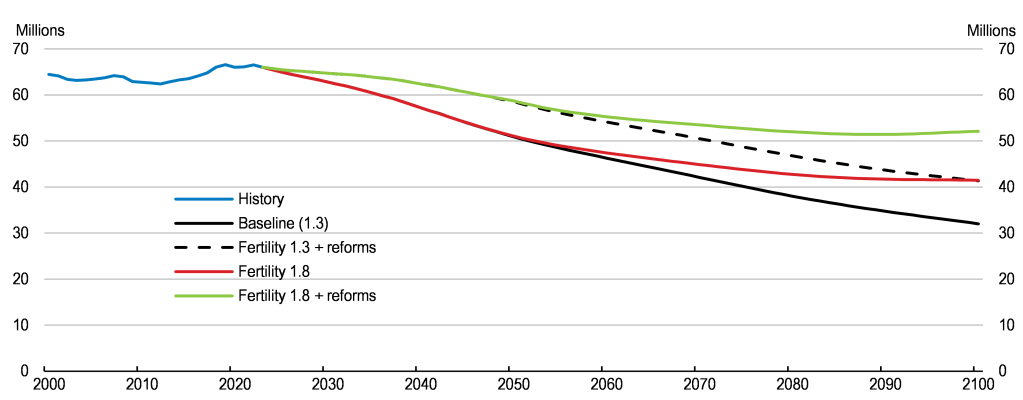
Note: The reforms include; i) a doubling of inflows of foreigners to 200 000 per year; ii) a convergence of female employment rates to those of men by 2050; and iii) the employment rate for each five-year cohort from 60-64 to 70-74 converges to that of the preceding cohort (i.e., the rate for the 60-64 group would rise to the 2021 rate for the 55-59 age group, etc.) by 2050. 
Source: OECD calculations based on the OECD Long-term Model.

References

OECD (2024), OECD Economic Surveys: Japan 2024, OECD Publishing, Paris. https://doi.org/10.1787/41e807f9-en


Boosting employment in post-COVID Finland

by Naomitsu Yashiro, OECD Economics Department

In the context of the large economic contraction and debt build-up in the wake of the COVID-19 pandemic, the government of Finland is formulating reforms to raise employment by 80 000 persons by 2029. Achieving this would raise the employment rate from the estimated 70.8% in 2020 to 73.7% in 2029, reversing the labour market damage caused by COVID-19 and reducing, but not eliminating the structural budget deficit.

Before the pandemic, Finland’s employment rate was 73% in 2019, lagging behind the average of Scandinavian Nordics (76%).The largest contribution to the employment rate gap was made by the 60-64 year-old age group. Finland grants to older workers with sufficiently long working period unemployment benefit entitlements that are not only longer than those for younger workers but can also be extended from the age of 61 up to the statutory retirement age. This extension, often dubbed the unemployment tunnel, provides strong disincentives to continue working. It also induces employers to target older workers in redundancies, even though large employers are obliged to finance a part of the unemployment benefits claimed by their former employees who entered the tunnel. The risk of unemployment increases markedly as workers near the age at which they become eligible to the unemployment tunnel (Figure 1). Past reforms that raised the eligibility age in steps from 59 to 61 have pushed back the timing of the sharp rise in unemployment risks each time, effectively lengthening the working lives of older workers (Figure 1). The 2020 Economic Survey of Finland, published in 10 December 2020, recommended abolishing the unemployment tunnel. A week later, the government announced its decision to abolish the tunnel by 2025.

In Finland, inflow into disability benefits has often increased when access to other early retirement pathways was tightened by policy changes. Early retirement via disability benefits is facilitated by more lenient eligibility criteria for awarding disability benefits applied to individuals aged 60 and over, which include non-medical factors. The Survey recommends aligning the criteria between older and younger individuals, namely by not taking into account non-medical factors. This is important for avoiding the surge of inflow into disability benefits as the unemployment tunnel is being phased out.

In order to ensure that these supply-side reforms result in higher employment, additional policy efforts to place older workers in jobs are needed. Activation requirements for the older unemployed should be applied with the same vigour as for other unemployed persons. The capacity of the public employment service needs to be strengthened by focusing resources on providing essential services like face-to-face counselling while making more use of private providers expertise and digital technologies. Ample upskilling opportunities should be provided to workers with higher risks of jobs loss at old age, such as those with jobs exposed to automation risks (Yashiro et al., 2021). Although the participation in adult education in Finland is relatively high, old and unskilled workers participate much less, as in other OECD countries. Finland’s adult education is biased toward formal education at higher education institutions, making it less attractive to the low skilled. The government should bolster targeted trainings, referencing successful examples in other OECD countries, such as the Unionlearn scheme in the United Kingdom where Union Learning Representatives help workers identify their training needs and arrange learning opportunities within their companies.

Another population group contributing to Finland’s relatively low employment rate vis-à-vis its Scandinavian peers is young women (30 to 34). However, the lower employment rate among this group is mainly due to differences in the statistical treatment of maternity leave between Finland and Sweden. The work attendance rates, which measure the share of persons who were at work during the surveyed week, are about the same between the two countries. However, the attendance rates are still considerably lower in Finland among mothers of children aged up to three years old, owing to the generous social benefit granted for taking care of children at home instead of using childcare services provided by municipalities. Removing this financial disincentive would encourage return to work by young mothers, thereby avoiding their career development being hampered by a long absence from work, which would help reduce the large gender pay gap.

Further reading:

OECD (2020), OECD Economic Surveys: Finland 2020, OECD Publishing, Paris.  

REFERENCE

Yashiro et al. (2021), “Technology, labour market institutions and early retirement: evidence from Finland”, OECD Economics Department Working Papers, Forthcoming, OECD Publishing, Paris.


The output cost of the global financial crisis

By David Turner and Patrice Ollivaud, OECD Economics Department

Assessing the damage from the Global Financial Crisis (GFC) is not straightforward, even with the benefit of hindsight provided by ten years of history, because the counter-factual of what might have happened in its absence is unknowable. However, a simplistic, but commonly adopted approach, of comparing the post-crisis path of GDP with the pre-crisis trend exaggerates the cost and can lead to misleading policy conclusions. Such an approach is akin to treating the GFC as a meteorite from outer space which is completely unrelated or ‘exogenous’ to preceding macroeconomic developments. This is implausible because the pre-crisis trend in GDP involved unsustainable trends in asset prices, most obviously house prices, driven by a long period of rapid excessive credit growth across most of the advanced economies. Similarly ageing has started to progressively reduce the contribution from labour in many economies, so reducing their growth capacity. Hence, the counter-factual represented by the extrapolation of the past trends in GDP was never realistically attainable. A more plausible basis for a counter-factual is an extrapolation of pre-crisis trends of potential output, where potential output is an estimate of a sustainable measure of GDP [1]. The difference between these two approaches is first illustrated by considering the OECD countries as a group and using aggregated measures of potential output that are regularly published in the OECD Economic Outlook. A simple-minded extrapolation of OECD-wide GDP per capita implies an ever-widening loss, which is currently more than 10% of GDP, whereas compared to a pre-crisis extrapolation of potential output per capita implies a smaller loss of around 2-3 percentage points of GDP (Figure 1).

eoturnerdec2018

However, the estimated cost of 3% of GDP for the OECD as a whole hides large variations across countries. Among the 19 OECD countries that experienced a banking crisis, following the same approach, the median loss in output is more than double that, at around 6%.

The estimates of potential output also provide an estimate of how the loss was incurred and some clues as to some policy lessons that might be drawn. Perhaps surprisingly, in nearly all OECD countries, aggregate employment rates have recovered and are close to, or have even surpassed, the pre-crisis levels, although some groups (for example young workers) have suffered more permanent losses than these aggregate calculations suggest.  A notable exception is the United States, where the aggregate employment rate is still more than 3% below the pre-crisis level, which may be partly explained by the effects of opioid addiction [2].

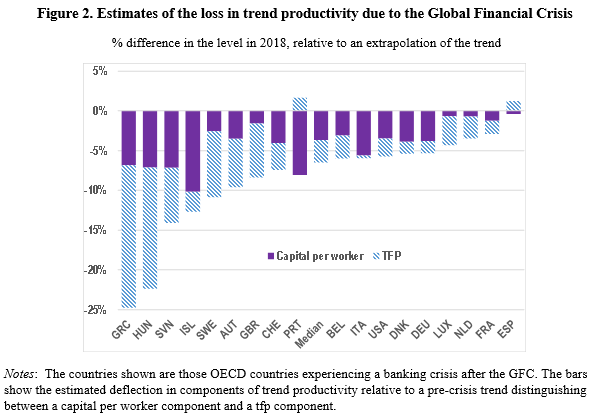
Instead, the main lasting macroeconomic damage from the GFC is accounted for by lost productivity. OECD estimates suggest that for a majority of OECD countries experiencing a banking crisis, most of this lost productivity is accounted for by lower growth in capital per worker, rather than lower total factor productivity (tfp) (Figure 2). The loss in capital per worker illustrates how a severe adverse demand shock can be transformed into an adverse supply shock via an accelerator effect on investment that then reduces the capital stock [3]. In addition, increasing evidence, including from firm level studies, suggests that many countries where interest rates were particularly low in the pre-crisis period, especially in Southern Europe, experienced a substantial misallocation of capital. These countries are also among those that experienced a more abrupt post-crisis adjustment in capital stock growth. The fall in capital stock growth was also exacerbated in some countries by cutbacks in public investment after the crisis.

eoturnerdec2018fig2

Conversely, much of the loss in tfp can be traced back to weakening trend tfp growth that pre-dates the Global Financial Crisis. This in turn would suggest that policy may be better directed to addressing more long-standing causes, such as the increasing divergence between productivity performance of frontier and laggard firms, which may be symptomatic of rising entry barriers and reduced contestability [4].

References:

[1]  The approach described here represents an update of the calculations presented in:

Ollivaud, P., and D. Turner (2015),”The effect of the global financial crisis on OECD potential output“, OECD Journal: Economic Studies, OECD Publishing, vol. 2014(1), pages 41-60.

[2]  A more in-depth analysis of post-crisis trends in employment and labour force participation in the United States, including the effect of the opioid crisis, is provided by:

OECD (2018), OECD Economic Surveys: United States 2018, OECD Publishing, Paris, https://doi.org/10.1787/eco_surveys-usa-2018-en.

[3]  A more detailed analysis of the effect of the crisis on productivity in OECD countries, in terms of its effects on capital per worker and tfp, is provided by:

Ollivaud, P., Y. Guillemette and D. Turner (2018), “Investment as a transmission mechanism from weak demand to weak supply and the post-crisis productivity slowdown“, OECD Economics Department Working Papers, No. 1466, OECD Publishing, Paris, https://doi.org/10.1787/0c62cc26-en.

[4]  Evidence on the difference between the productivity performance of firms at the global frontier and laggard firms, as well as possible causes and policy responses, is provided by:

Andrews, D., C. Criscuolo and P. Gal (2016), “The Best versus the Rest: The Global Productivity Slowdown, Divergence across Firms and the Role of Public Policy“, OECD Productivity Working Papers, No. 5, OECD Publishing, Paris, https://doi.org/10.1787/63629cc9-en.


Achieving an inclusive and sustainable recovery in Greece

by Mauro Pisu and Tim Bulman, Greece Desk, Economics Department

Greece is finally recovering from a deep depression. In 2017 GDP expanded by 1.3%, according to initial estimates, and is projected to accelerate to 2% in 2018 and 2.3% in 2019 (Figure 1). Labour market reforms have improved competitiveness and exports are leading the expansion. Overall the economy is becoming more open. Exports rose from 24% of GDP in 2008 to 34% in 2017. Employment is rising strongly while the external and fiscal imbalances are being addressed. Public finances are outperforming European Stability Mechanism (ESM) Stability Support programme’s targets, helping to restore fiscal credibility. Financial markets are taking notice, with bond spreads falling and agencies upgrading their ratings of Greece’s public debt.

Greece1.JPG

Despite these positive developments, the long crisis has left deep scars in the society that have yet to heal. GDP per capita is still 25% below its pre-crisis level. The public debt is still high. Wages are low. Though poverty has stabilised, it remains near a record high, especially among the young and families.

The OECD’s 2018 Economic Survey of Greece suggests that maintaining the reform momentum and strengthening reform ownership will be essential to sustaining the recovery and moving towards a more inclusive and prosperous society. Keeping the reform momentum is crucial to tackle the three key challenges highlighted in the 2018 Survey: Improving debt sustainability, sustaining job growth and reducing poverty, boosting investment.

The public debt has stabilised but at about 175% of GDP is still one of the largest in the world. A three-pronged strategy would place this on a downward path for the long-term (Figure 2). This includes: additional pro-growth reforms; large but realistic primary surpluses; and additional debt restructuring, as needed:

  • Pro-growth reforms, focusing on improving the functioning of public administration and product markets as well as boosting labour force participation, will do most to bolster long term GDP growth.
  • Maintaining the primary surplus above 2% of GDP into the long-term will be challenging but can be achieved through further broadening the tax base – by improving tax collection and reducing the informal economy – and improving spending effectiveness – by using spending reviews regularly and continuing the ambitious public administration reform.
  • As concerns debt restructuring, locking-in the currently low interest rates on concessional loans would reduce public debt below 80% of GDP by the 2050s, under prudent assumptions, if combined with additional pro-growth reforms.

Greece2.JPG

For Greece’s recovery to be inclusive, it must be rich in jobs. Greece’s recent labour market reforms have improved flexibility and supported job creation. However, over 1 million people are still unemployed, three-quarters for over a year. New jobs often pay the minimum wage, and are part-time or temporary. Reintroducing sectoral collective wage agreements should aim at maintaining the flexibility of the current system, ensuring wages align with productivity and better protecting individuals from labour market risks. They should cover broad working conditions and have no automatic extensions. Since small firms employ most workers, wage agreements need also to be flexible enough to take into account their specific circumstances.

The number of Greeks suffering from poverty doubled between 2010 and 2016, to almost 2.4 million on some measures, harming families with children the most. Recent reforms have already started to address this problem by better targeting social programmes. However, the many small and poorly targeted programmes and cumbersome administrative processes lower the effectiveness of and access to the welfare system. Progress towards better targeting social programmes and simplifying administrative processes should continue so as to create a fairer and more effective welfare system.

Investment has dropped by 60% since the onset of the crisis and has yet to recover, because of a mixture of weak demand, tight financial conditions and structural problems. The productive stock capital is now falling, dragging down GDP growth.

Recent reforms have already improved important areas of the investment climate, but Greece’s business environment still lags other countries. Further addressing product market restrictions, improving regulatory quality and transparency through Regulatory Impact Assessments, completing the land registry, and fully implementing the legislated insolvency reforms are priorities the OECD survey highlights.

Greece also needs to continue tackling the challenges facing its banking sector. Governance standards have improved drastically but these still need to become entrenched practices. Addressing the large stock of non-performing loans will require fully implementing out-of-court workout procedures and e-auctions, and strengthening temporary tax incentives to encourage the disposal of banks’ non-performing loans. Carefully phasing out capital controls, while preserving financial stability, will also be needed to restore access to finance.

References:

OCDE (2018) OECD Economic Surveys: Greece 2018 OECD Publishing.


A balancing act: Why inequality increased in the Nordics

Mr. Jon Pareliussen, Economist, Sweden/Finland desk, Economics Department

The Nordics are rightly renowned for being inclusive societies with low inequality compared to other OECD countries. However, some of the largest inequality increases over the past few decades took place in Sweden, Finland and Denmark. A newly released article  building on previous OECD work discusses how market forces, demographic trends and redistribution together shaped the income distribution of the Nordics.

It may seem like a paradox that the Nordics, which are very open economies, heavily integrated in global value chains and front-runners in the use of new technologies, have not seen even more widening distributions of market incomes. However, the extent to which skill-biased technological change and other forces widening the earnings distribution of workers will actually drive up inequality depends on a number of factors, and key policies and institutions in the Nordics play a dampening role. First, institutions such as unions and collective bargaining, employment protection legislation and minimum wages dampen the direct effect of market trends on earnings. Second, higher demand for skills are met by publicly-funded higher education, increasing the supply of skilled workers and thus holding back skills premiums. Third, a widening earnings distribution among workers coincided with increasing employment, limiting the overall effect on inequality.

Nordic1.JPG

With a relatively modest overall impact from market forces, explanations for increasing inequality must be sought elsewhere:

  • Demographic trends have been relatively strong drivers of inequality in the Nordics. Household structure, with more single-headed households has widened income dispersion in Denmark, Finland, Norway and Sweden. Ageing has increased inequality significantly in Finland, and immigration has increased inequality in Norway, Denmark and Sweden.
  • Redistribution through taxes and transfers has weakened significantly in Denmark, Finland and Sweden, notably due to less insurance transfers (i.e. unemployment, sickness, disability insurance) and only partially offset by more assistance (i.e. means-tested) transfers. Income taxes have played a less important and more heroegneous role, as progressivity increased in Sweden while it decreased in Denmark and Iceland.

Technological and demographic pressures are set to continue going forward, and these challenges need to be embraced. Continued flexibility and constructiveness of the social dialogue and improvements to education are essential to seize opportunities from technological change and avoid a widening wage distribution. Making social insurance and welfare transfers more flexible and agile would improve workers’ protection in a rapidly changing world of work. Improving benefit system design so that work always pays, notably in Denmark and Finland, and linking benefits to real-time income registries are important steps to this end.

The Nordics demonstrate that equity and efficiency can be compatible if incentives are right. Low inequality and strong safety nets can even be an advantage in today’s globalised world, which requires constant adaptation. Reaping the full benefits from globalisation and technological progress requires broad support, which is easier to muster when the social dialogue is constructive and representative, when everyone is given opportunities to fulfil their potential, risks are shared and losers compensated.

References:
Pareliussen, J. K., Hermansen, M., André, C. and Causa, O. (2018), Income Inequality in the Nordics from an OECD perspective, Nordic Economic Policy Review 2018.


What do pro-competitive policies imply for workers?

By Boris Cournede, Senior Economist, Public Economics Division, OECD Economics Department

Reforms that make economies more competitive have become a polarising subject. On one side, they are well established as a core staple of reform programmes: they are known to boost growth. On the opposite side, they often come up as lightning rods for criticism, as some perceive that such reforms make life more difficult for workers. And some people may lose from such reforms.

What do the data say? And what can economic policy makers do to achieve better results? The OECD has gathered, harmonised and probed micro-level data covering individual households in 26 countries over the past two decades to answer these questions.

A key conclusion is that reforms that improve competition in goods and services markets generally boost job-finding chances for people out of work (Figure 1). At the same time, they do not increase job-loss rates much, so that overall they have a small but positive net effect on employment. This micro-level finding that pro-competition reforms boost employment corroborates previous OECD and other research identified at the macro level: such confluence of different studies using different methods is reassuring about the robustness of the conclusion.

cournede-the-chances-to-become-employed

Effects differ a lot across different people. The job-finding benefits of more competitive markets accrue primarily to young workers and women. More competitive markets leave jobless men’s chances to find jobs essentially unchanged.

More competitive markets imply a greater number of job exits for workers who are less qualified or more generally have low earnings capacity (Figure 2). This effect adds to a starting point where, in the absence of reform, low-income workers already face a much higher risk than others to become unemployed or quit the labour market altogether. However, job-finding probabilities also rise, leaving employment unchanged for low-income workers. In other words, more competitive markets imply that low-income workers face higher labour market rotation, with more frequent but shorter spells out of employment, for unchanged average employment prospects over time.

pmr-reforms-cournede

The greater labour market instability that pro-competition reforms generate for low-income workers calls for ensuring that employment assistance programmes reach them and are effective. These programmes are particularly helpful when they develop vulnerable workers’ employability in all situations: this can be done by allowing vulnerable programmes to tap active employment assistance programmes not only when they are unemployed but also when they work or are out of the labour force.

The OECD inquiry into the effects of flexibility-enhancing reforms on workers also delved into labour market reforms, the influence of other policies and specific impacts on workers employed in reformed sectors. These areas have important policy implications that forthcoming blog posts will outline.

References

Cournède, B., O. Denk, P. Garda and P. Hoeller (2016), “Enhancing Economic Flexibility: What is in it for Workers?”, OECD Economic Policy Papers, No. 19, OECD Publishing.

Cournède, B., O. Denk and P. Garda (2016), “Effects of Flexibility-Enhancing Reforms on Employment Transitions”, OECD Economics Department Working Papers, No. 1348, OECD Publishing.

Denk, O. (2016), “How Do Product Market Regulations Affect Workers? Evidence from the Network Industries”, OECD Economics Department Working Papers, No. 1349, OECD Publishing.

Garda, P. (2016), “The Ins and Outs of Employment in 25 OECD Countries”, OECD Economics Department Working Papers, No. 1350, OECD Publishing.

Boeri, T., P. Cahuc and A. Zylberberg (2015), “The Costs of Flexibility-Enhancing Structural Reforms: A Literature Review”, OECD Economics Department Working Papers, No. 1227, OECD Publishing.


Revisiting policy options for more jobs

by Alain De Serres, Head of Division, and Peter Gal, Economist
Structural Surveillance Division, Policy Studies Branch, OECD Economics Department

In many OECD countries, the labour market has yet to recover the lost ground suffered in the aftermath of the financial crisis. In some of them, unemployment has been persistently high, resulting in a very high incidence of long-term unemployment. In part, this reflects the weakness of demand but given that a slow recovery has been a reality for many countries, a number of structural factors also contribute to the situation in the hardest-hit countries.

Lifting employment requires a combination of measures that will boost job creation, encourage labour force participation and facilitate the matching of jobs and job seekers. A recent OECD study reassesses the effectiveness of a wide range of structural labour market policies for spurring employment, building on insights from a vast volume of economic literature and new empirical analyses. Besides the overall labour market, it also considers a number of specific labour market groups, along the demographic dimension (youth, elderly, women, men) and the skill dimension (low-, middle and high educated), as well as a large number of potentially beneficial policies.

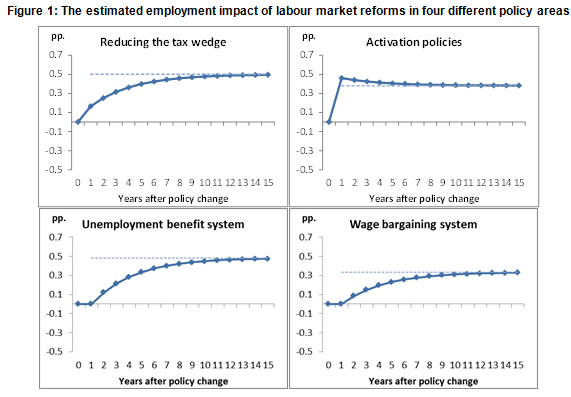
Four policy areas stand out as the key labour market policy levers, showing strong potential for lifting employment rates (See Figure 1 below).

  • First, a reduction in the so-called tax wedge, that is the part of labour costs that governments collect through income taxes and social security contributions boost overall employment. It does so not only by making it more attractive for companies to hire workers (job creation channel), but also by making it more attractive for employees to accept job offers, as they receive a higher take-home pay.
  • Second, spending more on activation policies, in particular job training, facilitates finding a good match between the skills that employers search and what employees can offer.
  • Third, reforms of unemployment insurance systems to provide more effective re-employment assistance and services to jobseekers, while conditioning benefits more strongly on job-search intensity, raise incentives to accept job offers, contributing thereby to stronger employment growth.
  • Finally, striving for a wage bargaining system that raises the responsiveness of wage adjustments to labour market conditions, including by giving firms more leeway in the applications of collective agreements negotiated at the sector level, also raises employment.

AdeS and PGal Structural

Source: Gal, P. and A. Theising (2015), “The macroeconomic impact of structural policies on labour market outcomes in OECD countries: A reassessment”, OECD Economics Department Working Papers, No. 1271, OECD Publishing, Paris.Figure 5.

Note: In these simulations, the magnitude of reforms is chosen to be of a typical size that was observed in the past. More specifically it is the average improvement of the policy indicators over 5 consecutive years, across all the 25 OECD countries and years (1985-2011) included in the study.

Outside the realm of labour market policies, easing regulations of product markets – most importantly, liberalizing entry to markets and thus increasing competition – have an extra potential to create jobs over the medium- to long run.

Importantly in the context of subdued growth, all these findings are valid even under the assumption that the overall government budget remains unchanged, thus making sure that public finances would not be strained further by putting in place these reforms.

Finally, note that the OECD is currently revising the OECD Jobs Strategy, which will delve into more details on the design and the mechanism of labour market policies.

References

Gal, P. and A. Theising (2015), “The macroeconomic impact of structural policies on labour market outcomes in OECD countries: A reassessment”, OECD Economics Department Working Papers, No. 1271, OECD Publishing, Paris.