How widespread has the rise in unit profits been?

Compass pointing to profits

By Geoff Barnard and Patrice OllivaudOECD Economics Department

In an earlier post on this blog, the decomposition of GDP inflation (year-on-year increases in the GDP deflator) into contributions from unit profits, unit labour costs and unit net taxes across a range of OECD economies was discussed, drawing on an exercise described in the most recent OECD Economic Outlook (OECD, 2023). While informative, the economy-wide picture of unit profits leaves open the policy-relevant question of whether the increase in profits has been widespread across the economy or concentrated in only a few industries.

To get insights about where and by how much profit margins may have increased as inflation rose, information is needed on how an economy-wide increase in profits is distributed across firms. One approach is to use firm-level data. The evidence from this work is mixed. Colonna et al. (2023) find that margins rose in the United States and in non-tradeable sectors in Germany, and returned to pre-pandemic levels in Italy after an earlier decline. Weber and Wasner (2023), using US firm-level data, argue that rising prices after the first phase of the COVID-19 pandemic were mainly the result of market power and implicit agreements between large firms. In contrast, Glover et al. (2023) suggest that the rise of mark-ups in the United States during 2021-22 was due to firms anticipating future cost increases rather than an increase in monopoly power or higher demand. And Bijnens et al. (2023) find no evidence of a widespread opportunistic raising of profit margins in 2022 among firms in Belgium.

Another possible angle is to look at profits by sector. Doing this for the 13 OECD commodity-importing economies that produce timely data on a comparable basis, and computing unit profit as value added minus labour compensation, suggests that a disproportionate part of the observed increase of unit profits in 2022 came from mining and utilities: that is, mining and quarrying together with electricity, gas and water supply (Figure 1, Panel A). This sector accounts for only about 4% of the average economy but more than 40% of the rise of unit profits in 2022 as a whole in this group of commodity-importing countries. For these countries, this likely corresponds mainly to electricity and gas supply, including renewable electricity producers, who did not suffer from higher costs as fossil fuel prices soared, but benefited from higher retail prices. On the other hand, this effect was far from uniform across countries. Neither Germany nor France (Panels C and D of Figure 1) had a large increase in mining and utilities unit profits until late in 2022 or early 2023, when fossil fuel prices were turning down. In the case of the United Kingdom (Panel F), most of the increase in unit profits’ contribution to GDP inflation from negative values in early 2021 to above 5% in the fourth quarter of 2022 corresponded to a swing in unit profits in services, although other sectors, including mining and utilities, also contributed.

Figure 1. Mining and utilities account for a substantial share in the increase in unit profits

Contribution of unit profits to year-on-year GDP inflation

Note: Unit profits based on estimated sectoral gross operating surplus in current values. The latter is computed as sectoral output minus sectoral compensation and an estimate of unit taxes (based on the value at the macroeconomic level in percent of GDP applied to sectoral GDP) and reconciled so that the sum across sectors equals the macroeconomic level. OECD commodity importers correspond to a simple average of Austria, Belgium, Denmark, Finland, France, Germany, Greece, Ireland, Italy, the Netherlands, Spain, Sweden and the United Kingdom.

Source: OECD Quarterly National Accounts database; and OECD calculations.


On a quarterly basis, the contribution of other sectors to the rise of unit profits in the group of commodity-importing countries as a whole gradually increased through 2022 and into the first quarter of 2023, with stronger effects from both services and (through end-2022) manufacturing. Considering the small share of agriculture in the economy (less than 2% for the euro area), the contribution of unit profits in this sector to the overall unit profit contribution to GDP inflation is also notable. Thus, while the increase in unit profits (and thus the contribution to inflation) has been widespread across sectors in commodity-importing OECD economies, and while the details vary significantly across individual countries, the disproportionate rises in mining, utilities and  agriculture suggest some strong sector-specific effects.

Among OECD commodity exporters, there is only one country, Norway, with the necessary sector data on a comparable basis, so this is the only source of information on sectoral developments of unit profits for this group of countries. As expected, the bulk of the large increase in unit profits in Norway in 2022 came from mining and utilities (Figure 1, Panel B), with the contribution of unit profits to GDP inflation plummeting from 2022Q4 because of the global fall in energy prices.

Overall, there is evidence from available cross-country sectoral profit data that the surge in energy prices and the associated increase in the profits of energy and utility providers over 2021-22 played an important role in the widespread rise in the aggregate contribution of unit profits to GDP inflation. The strong rise in international food commodity prices also appears to have helped push up unit profits in agriculture in many countries, although the small size of that sector means that the impact on economy-wide profits was generally limited. The sectoral data indicate, however, that the size, timing and distribution of the increase in unit profits, and thus of their contribution to GDP inflation, varied quite widely across OECD economies – no single story fits all countries.

References

Bijnens, G., C. Duprez and J. Jonckheere (2023), “Are price hikes in Belgium being driven by greed?”, National Bank of Belgium blog, 26 June 2023.

Colonna, F., R. Torrini and E. Viviano (2023), “The Profit Share and Firm Mark-up: How to Interpret Them?”, Occasional Papers, Banca d’Italia, No. 770.

Glover, A., J. Mustre-del-Rìo and A. von Ende-Becker (2023), “How Much Have Record Corporate Profits Contributed to Recent Inflation?”, Economic Review, Federal Reserve Bank of Kansas City.

OECD (2023), OECD Economic Outlook, Volume 2023 Issue 1, OECD Publishing, Paris.

Weber, I. and E. Wasner (2023), “Sellers’ Inflation, Profits and Conflict: Why can Large Firms Hike Prices in an Emergency?”, Economics Department Working Paper Series, University of Massachusetts Amherst.


Shifting sands: trade partner patterns since 2018

by Seung-Hee Koh, Catherine MacLeod and Elena Rusticelli

Global trade policy is undergoing a sea-change. The share of global merchandise imports subject to trade restrictions has risen particularly rapidly since 2018, initially due to a sharp increase in tariffs on bilateral trade between the United States and China. Since then, trade policy choices have steadily become more harmful to global trade in goods (Figure 1, Panel A). Trade policy uncertainty has also increased, alongside policy discussions about the re-location of value chains and ongoing changes in the design of national industrial policies. The latest OECD Economic Outlook (OECD, 2023) analyses trends in imports of manufactured goods across major OECD economies to understand what impact this has had on trade patterns.

So far, the increasing use of trade policies has coincided with a period of subdued world trade growth, but has not reduced global merchandise trade intensity (the ratio of trade in manufactures and commodities to GDP in volume terms). Nonetheless, since the global financial crisis, global trade intensity has risen only marginally, following a period of very sharp rises in the 1990s and early 2000s. The COVID crisis saw a shallower decline and faster rebound in merchandise trade intensity than the global financial crisis (Figure 1, Panel B). In 2022, global trade in goods was 22% of global GDP in volume terms, marginally higher than 2018.

The recent resilience of trade in volume terms may be linked to the huge increase in demand for goods during the COVID pandemic, as well as strong policy support during the pandemic and energy crises. Merchandise trade as a share of GDP generally rose in OECD countries between 2018 and 2022, including in Europe and Japan, offsetting a decline in Chinese merchandise trade intensity. However, merchandise trade intensity was relatively unchanged in the United States, where weak export growth offset a rise in import intensity.

Underneath the general rise in the value and volume of trade, imported manufactured goods at a country-level reveal important and differing shifts in the composition of manufactured goods imports since 2018 in the major economies (Figure 2). A particular issue of policy interest is the evolution of trade with geographically distant partners for key inputs (far-shoring) compared to trade with geographically closer trade partners (near-shoring).   

  • Shifting far-shoring: In the US, there have been sharp declines in China’s share of manufactured imports since 2018 – which have typically coincided with rising import shares from dynamic Asian economies. This includes goods where the 2018 tariffs are still applied. Evidence of near-shoring is limited, with Mexico and Canada’s share of imports rarely rising in the same categories where China’s share has fallen.
  • Expanding far-shoring: in the EU, China’s weight in manufactured imports has continued to grow steadily. In contrast to the US, this has been alongside rising import shares for dynamic Asian economies. As for the US, there is limited evidence of near-shoring: the share of imports from other OECD countries in Europe has fallen, largely driven by changes in import shares from the United Kingdom.
  • Changes at the margin: In Japan, the shifts in import shares have been much smaller than in the US or Europe. Its trade with the wider Asian region has increased steadily, although increases have been larger for dynamic Asia than China. As in Europe, this has been accompanied by a decline in the share of imports from other advanced economies.

So far, these shifts in trade patterns have occurred whilst aggregate trade has continued to expand broadly in line with global activity. However, in a global economy with slowing long-term growth prospects the economic costs of more harmful trade policies may become more evident over time.


References:

OECD (2023), OECD Economic Outlook, Volume 2023 Issue 1, OECD Publishing, Paris, https://doi.org/10.1787/ce188438-en.


A Long Unwinding Road

By Clare Lombardelli, OECD Chief Economist

The global economy is turning a corner but faces a long road ahead to attain strong and sustainable growth. Global GDP growth slowed substantially throughout 2022, but several of the factors weighing negatively are now unwinding. Falling energy prices and headline inflation, easing supply bottlenecks and the reopening of China’s economy, coupled with strong employment and relatively resilient household finances, all contribute to a projected recovery. Nevertheless, the recovery will be weak by past standards. We project global growth to be 2.7% in 2023, with a modest pick-up to 2.9% in 2024 – both well below the average growth rate in the decade preceding the COVID-19 pandemic.

Policymakers need to act decisively on macroeconomic and structural policy to deliver stronger and more sustainable growth. This is hard. Core inflation remains too persistent. Debt levels are too high. And potential output is too low.

Monetary policymakers need to navigate a difficult road. Although headline inflation is declining thanks to lower energy prices, core inflation remains stubbornly high, more so than previously expected. Central banks need to maintain restrictive monetary policies until there are clear signs that underlying inflationary pressures are abating. Some economies grappling with stubbornly high core inflation may require additional interest rate increases. However, policymakers must keep a watchful eye, given the uncertainties around the exact impact of the rapid and globally synchronised monetary policy tightening following an extended period of low interest rates. The tightening has already revealed some vulnerabilities in financial markets. Should further financial market stress arise, central banks should deploy financial policy instruments to enhance liquidity and minimise contagion risks. Clear communication will be crucial to avoid confusion about the potential conflict between pursuing price stability and financial stability mandates.

The choices for fiscal policymakers are clearer but no easier to implement given the inherent political sensitivity of policy choices with direct redistributive effects. Fiscal policy played a vital role in supporting the global economy through the shocks of the COVID-19 pandemic and Russia’s war in Ukraine. However, in the aftermath, most countries are grappling with higher budget deficits and higher public debt. The burden of debt servicing is increasing and spending pressures related to ageing and the climate transition are building.

As the recovery takes hold, fiscal support should be scaled back and better targeted. Energy price support should be withdrawn as energy prices fall. Vulnerable households inadequately covered by existing social protection systems, will continue to need support, as still high food and energy prices particularly burden the most disadvantaged. Limited resources should be targeted only to those who really need it and to high-priority productivity-enhancing investments, including those driving the green transition and improving labour supply and skills. Gradually unwinding fiscal support will help reduce the burden on monetary policy, strengthen buffers against future crises and prepare for longer-term challenges

Emerging-market economies face challenges from tight global financial conditions: higher debt servicing costs, capital outflows, and reduced credit availability from foreign lenders. Moreover, rising geopolitical tensions and concerns about supply chain security have prompted several countries to implement trade and investment restrictions. Increasingly restrictive trade policies risk curtailing the gains from global trade and harming the development prospects of low-income countries.

Ultimately only ambitious structural policy reforms can sustainably raise long-term economic growth and people’s quality of life around the world. Revitalising labour and product markets; removing barriers to cross-border trade; promoting competition and adapting competition policies to the digital era; and enhancing skill development are essential elements of the structural reform agenda.

Private and public investment is needed in human, tangible and intangible capital to enable people to make the most of their skills and capabilities, and to harness the ever-increasing opportunities from technological transformation. Investment in education and skills is critical to enable people to flourish in the future economy and reap the benefits of increased productivity.

Policymakers need to unwind the impact of a sequence of negative shocks to the global economy and face a complex set of challenges in doing so. They need to calibrate monetary and fiscal policies to curtail inflation and rebuild fiscal buffers without overly reducing growth. Delivering sustainably higher rates of growth will need bold and forward-thinking structural policy reforms allowing us to harness the opportunities of rapid technological advances, demographic shifts, and the climate transition.

More information:

Editorial from the OECD Economic Outlook, June 2023

Clare Lombardelli’s Twitter
Clare Lombardelli’s LinkedIn


La route est encore longue

Clare Lombardelli, Cheffe économiste de l’OCDE

L’économie mondiale a amorcé un tournant, mais la route est encore longue pour parvenir à une croissance forte et durable. La croissance du PIB mondial a sensiblement ralenti tout au long de 2022, mais plusieurs des facteurs qui la brident encore commencent à s’estomper. Le recul des prix de l’énergie et de l’inflation globale, l’atténuation des perturbations de l’offre et la réouverture de l’économie chinoise sont autant de facteurs qui, conjugués à la vigueur de l’emploi et à la relative résilience des finances des ménages, contribuent à la reprise prévue. Celle-ci sera néanmoins timide par rapport aux rebonds observés dans le passé. D’après nos projections, la croissance mondiale s’établira à 2.7 % en 2023, avant de se redresser légèrement pour atteindre 2.9 % en 2024, soit bien en deçà du taux de croissance moyen enregistré durant la décennie qui a précédé la pandémie de COVID-19.

Les décideurs publics doivent agir avec détermination sur les leviers macroéconomiques et structurels pour asseoir une croissance plus forte et plus durable. La tâche est ardue : l’inflation sous-jacente est trop persistante, les niveaux d’endettement sont trop élevés et la production potentielle est trop faible.

Les autorités monétaires doivent négocier un virage délicat. Malgré la décrue de l’inflation globale due au recul des prix de l’énergie, l’inflation sous-jacente reste obstinément forte, en tout cas plus élevée qu’on ne l’avait anticipé. Les politiques monétaires doivent rester restrictives tant qu’aucun signe d’atténuation des tensions inflationnistes sous-jacentes ne sera clairement confirmé. De nouveaux relèvements des taux d’intérêt pourraient être nécessaires dans certaines économies en proie à une inflation sous-jacente résolument élevée. Les autorités doivent toutefois rester vigilantes compte tenu des conséquences incertaines du resserrement monétaire rapide et synchronisé opéré à l’échelle mondiale après une longue période de faibles taux d’intérêt. Ce changement de cap a déjà mis au jour certaines vulnérabilités sur les marchés financiers. Si les tensions devaient s’accentuer, les banques centrales devraient mobiliser divers instruments de politique financière pour accroître la liquidité et réduire autant que possible les risques de contagion. Elles devront à tout prix communiquer clairement pour éviter toute confusion quant au conflit potentiel entre le double mandat de stabilité des prix et de stabilité financière.

Les choix qui s’imposent aux autorités budgétaires sont plus évidents, mais pas plus faciles à mettre en œuvre, les décisions qui ont des effets redistributifs directs étant toujours politiquement sensibles. La politique budgétaire a joué un rôle essentiel en soutenant l’économie mondiale face aux chocs provoqués par la pandémie de COVID-19 et la guerre menée par la Russie en Ukraine. Cependant, la plupart des pays sont aujourd’hui aux prises avec des déficits budgétaires plus amples et un endettement public en hausse. La charge du service de la dette s’alourdit tandis que les tensions sur les dépenses liées au vieillissement démographique et à la transition climatique s’accentuent.

Alors que la reprise va s’installer, il faudra réduire et mieux cibler les mesures de soutien budgétaire. Les aides liées aux prix de l’énergie devraient être démantelées à mesure que ceux-ci diminueront. Les ménages vulnérables, dont la protection sociale est actuellement insuffisante, continueront d’avoir besoin d’aide, le niveau toujours élevé des prix de l’alimentation et de l’énergie pesant particulièrement sur les plus défavorisés. Les ressources disponibles, limitées, devraient être consacrées à celles et ceux qui en ont réellement besoin, ainsi qu’aux investissements hautement prioritaires propices aux gains de productivité, notamment ceux qui favorisent la transition écologique et améliorent l’offre de main-d’œuvre et les compétences. La suppression progressive des aides budgétaires permettra de moins solliciter les instruments de politique monétaire, de renforcer les marges de manœuvre pour affronter les crises futures, et de se préparer à faire face aux enjeux à plus long terme.

En raison du durcissement des conditions financières à l’échelle mondiale, les économies de marché émergentes traversent des difficultés, notamment un alourdissement du service de la dette, des sorties de capitaux ou une réduction de l’offre de crédit des prêteurs étrangers. Par ailleurs, la montée des tensions géopolitiques et les préoccupations grandissantes concernant la sécurité des chaînes d’approvisionnement ont incité plusieurs pays à prendre des mesures limitant les échanges et l’investissement. Des politiques commerciales de plus en plus restrictives risquent de réduire les gains tirés du commerce mondial et de compromettre les perspectives de développement des pays à faible revenu.

En définitive, seules des réformes structurelles ambitieuses peuvent améliorer durablement la croissance économique à long terme et la qualité de vie des populations partout dans le monde. Tout train de réformes structurelles doit impérativement viser à redynamiser les marchés du travail et des produits, à lever les obstacles aux échanges internationaux, à favoriser la concurrence et à adapter les politiques en la matière à l’ère numérique, ainsi qu’à renforcer les compétences.

Des investissements privés et publics dans le capital humain et les actifs matériels et immatériels seront indispensables pour permettre aux individus d’utiliser au mieux leurs compétences et aptitudes, et tirer parti des perspectives toujours plus nombreuses offertes par la transformation technologique. Il est primordial d’investir dans l’éducation et les compétences afin que chacun puisse s’épanouir dans l’économie future et récolter les fruits d’une productivité accrue.

Les décideurs publics vont devoir estomper les effets induits par une succession de chocs négatifs sur l’économie mondiale, et affronter pour cela une série de défis complexes. Il leur faut notamment ajuster les politiques monétaires et budgétaires de façon à réduire l’inflation et à reconstituer des marges de manœuvre budgétaires sans trop freiner la croissance. Pour améliorer durablement les taux de croissance, ils ne pourront se dispenser de mener des réformes structurelles audacieuses et novatrices qui nous permettront de mettre à profit les perspectives ouvertes par les progrès technologiques rapides, les évolutions démographiques et la transition climatique.

Editorial des Perspectives économiques de l’OCDE


Die Krise bewältigen

Álvaro Santos Pereira, Interim-Chefvolkswirt der OECD

Die Weltwirtschaft wird momentan durch die schwerste Energiekrise seit den 1970er Jahren erschüttert. Dieser Schock hat die Inflation in Höhen getrieben, die wir seit vielen Jahrzehnten nicht mehr gesehen haben, und das Wirtschaftswachstum weltweit gebremst. In ihrem neuen Wirtschaftsausblick geht die OECD davon aus, dass das Wachstum der Weltwirtschaft 2023 auf 2,2 % zurückgehen und 2024 wieder auf relativ bescheidene 2,7 % steigen wird. Asien wird 2023 und 2024 der größte Wachstumsmotor sein. In Europa, Nordamerika und Südamerika dagegen wird das Wachstum sehr verhalten bleiben.

Höhere Inflation und niedrigeres Wachstum sind der Preis, den die Weltwirtschaft für Russlands Angriffs-krieg gegen die Ukraine bezahlt. Bereits der rasche Aufschwung nach der Pandemie und die damit einher-gehenden Lieferengpässe hatten für Preissteigerungen gesorgt. Nach der russischen Invasion in der Ukraine ist die Inflation dann sprunghaft angestiegen und hat weltweit deutlich stärker um sich gegriffen.

Der unerwartete Preisauftrieb führt dazu, dass die Reallöhne in vielen Ländern fallen und die Kaufkraft sinkt. Dies trifft die Menschen überall hart. Wenn die Inflation nicht eingedämmt wird, werden sich diese Probleme weiter verschärfen. Daher muss die Inflationsbekämpfung im Moment unsere oberste Priorität sein.

Weltweit erhöhen Zentralbanken die Zinsen, um in ihren Volkswirtschaften die Inflation einzuhegen und die Inflationserwartungen zu verankern. Diese Strategie zahlt sich allmählich aus. In Brasilien beispiels-weise, wo die Zentralbank rasch handelte, hat die Inflation in den letzten Monaten abgenommen. Auch in den Vereinigten Staaten deuten die neuesten Daten auf Fortschritte bei der Inflationsbekämpfung hin. Dennoch sollte die Geldpolitik in den Ländern, in denen die Inflation nach wie vor hoch und breit basiert ist, weiter gestrafft werden.

Im Kampf gegen die Teuerung ist zudem eine enge Abstimmung zwischen Geld- und Fiskalpolitik erforderlich. Wenn fiskalpolitische Entscheidungen den Inflationsdruck verstärken, müssen die Leitzinsen noch stärker angehoben werden, um die Inflation unter Kontrolle zu halten. Daher sollten Maßnahmen, mit denen Familien und Unternehmen bei der Bewältigung des Energiepreisschocks unterstützt werden, ziel-genau und befristet sein. Sie sollten gefährdete Haushalte und Unternehmen schützen, ohne den Inflationsdruck und die öffentliche Schuldenlast zu erhöhen. Die Regierungen haben bereits zahlreiche Maßnahmen ergriffen, um die wirtschaftlichen Auswirkungen der hohen Energie- und Nahrungsmittel-preise abzufedern, wie z. B. Preisdeckel, Preissubventionen und Einkommensbeihilfen sowie Steuer-senkungen. Da aber die Energiepreise noch eine ganze Weile hoch und volatil bleiben dürften, werden pauschale Maßnahmen zur Eindämmung der Preise zunehmend unfinanzierbar. Sie könnten zudem die Anreize für die notwendigen Energieeinsparungen schwächen.

Die Energiemärkte zählen nach wie vor zu den wesentlichen Abwärtsrisiken für diesen Ausblick. Europa hat bei der Aufstockung seiner Erdgasreserven und der Verringerung der Nachfrage bereits große Fortschritte erzielt. Dennoch wird dieser Winter in der nördlichen Hemisphäre zweifellos eine Heraus-forderung. Im Winter 2023/2024 könnte sich die Situation noch verschärfen, da die Wiederaufstockung der Gasreserven im nächsten Jahr schwieriger werden könnte. Höhere Gaspreise oder tatsächliche Unter-brechungen der Gasversorgung würden 2023 und 2024 in Europa und auf der ganzen Welt für deutlich schwächeres Wachstum und höhere Inflation sorgen.

Auch die steigenden Zinssätze bringen zahlreiche Herausforderungen und Risiken mit sich. Für Unter-nehmen, Staaten und private Haushalte, die variabel verzinste Kredite bedienen oder neue Kredite auf-nehmen müssen, wird der Schuldendienst teurer. Besondere Sorge bereiten uns Niedrigeinkommens-länder, da mehr als die Hälfte dieser Länder bereits überschuldet sind (oder ein hohes Überschuldungs-risiko aufweisen) und nun mit restriktiveren Finanzierungsbedingungen konfrontiert sind. Die Abwertung der Landeswährungen gegenüber dem US-Dollar in vielen dieser Länder, ebenso wie in aufstrebenden Volkswirtschaften, verschärft diese Risiken zusätzlich.

Russlands Krieg gegen die Ukraine verschlimmert zudem die globale Ernährungsunsicherheit, da er die Preise in die Höhe treibt und die Nahrungsmittelversorgung wie auch die Bezahlbarkeit von Nahrungs-mitteln gefährdet. Vulnerable Bevölkerungsgruppen sind weltweit besonders von Ernährungsunsicherheit bedroht, und viele Regierungen haben nicht die nötigen Mittel, um diese Krise zu bewältigen. Oberste Priorität sollte daher sein, die Märkte offen zu halten, einen funktionierenden Handel mit Agrargütern sicherzustellen und zielgerichtete Hilfe zu leisten, um weitere Störungen der Nahrungsmittelversorgung und Hunger in vielen dieser Länder zu verhindern.

Politikmaßnahmen für einen stärkeren Aufschwung

Die Politikverantwortlichen müssen diesen großen Herausforderungen entschlossen begegnen. Neben der Geld- und Fiskalpolitik sollte auch die Strukturpolitik wieder in den Blick genommen werden, um einige der momentan drängendsten Probleme zu überwinden.

Erstens muss unbedingt in die Energieversorgungssicherheit und die Diversifizierung der Energie-versorgung investiert werden. Um Versorgungsstörungen zu verhindern, greifen viele Länder vorüber-gehend wieder auf umweltschädlichere und CO2-intensivere Energieträger zurück. Die hohen Energie-preise und die Sorge über die Versorgungssicherheit veranlassen Regierungen und Unternehmen aber auch dazu, ihre Energiequellen zu diversifizieren und mehr in erneuerbare Energien zu investieren. Um das Ziel der Treibhausgasneutralität zu erreichen, müssen die Stärkung der Energienetze sowie Investitionen in Energieeffizienz und grüne Technologien ganz oben auf der politischen Tagesordnung stehen. Die OECD unterstützt diese Anstrengungen durch ihr Inclusive Forum on Carbon Mitigation Approaches (IFCMA). Dieses Forum fördert den Dialog zwischen Ländern, die sich in unterschiedlichen Stadien der Entwicklung befinden, und ermöglicht es, unterschiedliche Politikansätze bei der CO2-Minderung sowie deren Effekte besser zu verstehen und zu analysieren.

Zweitens müssen die Regierungen dafür sorgen, dass die Märkte offen bleiben und der internationale Handel weiter funktioniert. Dies wird den Wettbewerbsdruck erhöhen und Lieferengpässe verringern. Protektionistische Politikmaßnahmen hingegen wären ein bedeutender Rückschlag für viele Länder, insbesondere für die ärmsten Länder der Welt, und würden der Weltwirtschaft schweren Schaden zufügen.

Drittens muss die Beschäftigung gefördert werden, um das Potenzialwachstum zu steigern und einen stärkeren Aufschwung mit größerer Breitenwirkung zu erzielen. In Ländern beispielsweise, in denen nach wie vor ein großes Gefälle zwischen den Beschäftigungsquoten von Männern und Frauen besteht, sollten sich die Regierungen bemühen, diese Beschäftigungslücke zu reduzieren. Wichtig sind auch Investitionen in Kompetenzen, um dem Humankapitalschwund insbesondere in vulnerablen Bevölkerungsgruppen entgegenzuwirken, zu dem es während der Pandemie gekommen ist, und die seit Längerem bestehenden und zunehmenden Kompetenzengpässe in vielen Ländern zu adressieren.

Fazit

Wir sehen uns aktuell mit einem sehr schwierigen wirtschaftlichen Umfeld konfrontiert. In unserem Basis-szenario gehen wir zwar nicht von einer globalen Rezession aus, wir rechnen aber damit, dass sich das Wachstum der Weltwirtschaft 2023 erheblich verlangsamen wird. Zudem dürften viele Länder nach wie vor eine hohe – wenn auch nachlassende – Inflation verzeichnen. Die Risiken bleiben beträchtlich. In diesen schwierigen und unsicheren Zeiten spielt die Politik, wie so oft, eine entscheidende Rolle: Die Geld-politik muss weiter gestrafft werden, um die Inflation zu bekämpfen, und die fiskalpolitische Unterstützung sollte zielgenauer gestaltet und befristet werden. Investitionen in die Nutzung und Entwicklung sauberer Energieträger und Technologien müssen beschleunigt werden, um die Energieversorgung zu diversifizie-ren und Versorgungssicherheit zu gewährleisten. Strukturpolitische Maßnahmen können helfen, die Be-schäftigung und Produktivität anzukurbeln, und dafür sorgen, dass das Wachstum allen zugutekommt. Anders ausgedrückt: Wir haben es in der Hand, diese Krise zu bewältigen. Und wir können unsere Erfolgs-chancen durch die richtigen politischen Weichenstellungen verbessern.

Editorial from the OECD Economic Outlook, November 2022


Faire face à la crise

Par Álvaro Santos Pereira, Chef économiste par intérim de l’OCDE

L’économie mondiale est confrontée à la pire crise énergétique depuis les années 1970. Le choc énergétique a porté l’inflation à des niveaux qu’elle n’avait plus atteints depuis des décennies et pèse sur la croissance dans le monde entier. Dans la présente édition des Perspectives économiques de l’OCDE, nous estimons aujourd’hui que la croissance mondiale refluera à 2.2 % en 2023, avant de rebondir très modestement pour atteindre 2.7 % en 2024. L’Asie sera le principal moteur de la croissance en 2023 et 2024, tandis qu’en Europe, en Amérique du Nord et en Amérique du Sud, les taux de croissance seront très faibles.

Sur fond de hausse de l’inflation et de recul de la croissance, l’économie mondiale paie au prix fort la guerre d’agression menée par la Russie contre l’Ukraine. Si les prix avaient déjà commencé à augmenter sous l’effet du rapide rebond économique, survenu après la pandémie et des difficultés d’approvisionnement qui ont suivi, l’inflation s’est emballée et s’est propagée dans le monde entier après l’invasion russe en Ukraine.

En raison de cette envolée inattendue des prix, les salaires réels chutent dans de nombreux pays, amputant fortement le pouvoir d’achat. Nul n’est épargné. Si l’inflation n’est pas jugulée, ces problèmes ne feront que s’aggraver. La lutte contre la hausse des prix doit donc être aujourd’hui la première priorité des décideurs publics.

À travers le monde, les banques centrales relèvent les taux d’intérêt dans le but de contenir l’inflation et d’ancrer les anticipations d’inflation dans leurs économies respectives. Cette stratégie commence à porter ses fruits. Au Brésil par exemple, la banque centrale a réagi rapidement et l’inflation a commencé à régresser ces derniers mois. Aux États-Unis, les dernières données laissent aussi entrevoir quelques progrès dans la lutte contre l’inflation. Néanmoins, les pays où l’inflation demeure élevée et généralisée doivent poursuivre le resserrement de leur politique monétaire.

Pour combattre la hausse des prix, il est également essentiel que les autorités budgétaire et monétaire travaillent main dans la main. En effet, toute décision budgétaire ayant pour effet d’accentuer les tensions inflationnistes nécessitera des relèvements encore plus marqués des taux directeurs en vue de maîtriser l’inflation. C’est pourquoi les aides publiques instaurées pour protéger les familles et les entreprises contre le choc énergétique devraient être temporaires et ciblées sur les ménages et les entreprises les plus vulnérables, sans pour autant accroître les tensions inflationnistes ni alourdir le poids de la dette publique. Les gouvernements ont déjà fait beaucoup pour atténuer le coup porté à l’économie par l’envolée des prix de l’énergie et des denrées alimentaires, notamment au moyen de plafonnements des prix, d’aides aux revenus, de prix subventionnés et de baisses d’impôts. Cependant, comme les prix de l’énergie resteront sans doute élevés et volatils pendant un certain temps, les mesures non ciblées visant à contenir les prix deviendront de plus en plus difficiles à financer, et risquent en outre d’affaiblir les incitations aux économies d’énergie, pourtant nécessaires.

Les marchés de l’énergie demeurent l’un des principaux risques à la baisse par rapport à nos perspectives. L’Europe a beaucoup fait pour reconstituer ses réserves de gaz naturel et réduire la demande, mais il reste des risques pour cet hiver dans l’hémisphère nord. La situation pourrait être encore plus tendue à l’hiver 2023-24, le remplissage des réserves de gaz risquant de s’avérer plus problématique l’année prochaine. Un renchérissement du gaz, ou un arrêt pur et simple de l’approvisionnement, pèserait nettement sur la croissance et accélèrerait l’inflation en Europe et dans le reste du monde en 2023 et 2024.

La hausse des taux d’intérêt va elle aussi entraîner de nombreux risques et difficultés. Le remboursement des dettes deviendra plus coûteux pour les entreprises, les États et les ménages ayant emprunté à taux variables ou contractant de nouvelles dettes. Nous sommes particulièrement préoccupés par la situation des pays à faible revenu, car plus de la moitié d’entre eux sont déjà en surendettement critique (ou risquent de le devenir) et doivent à présent faire face à un durcissement des conditions financières. Pour beaucoup d’entre eux et pour les éçonomies de marché émergentes, la dépréciation de la monnaie par rapport au dollar des États Unis accroît encore ces risques.

La guerre menée par la Russie contre l’Ukraine aggrave par ailleurs l’insécurité alimentaire mondiale en faisant monter les prix, en perturbant les approvisionnements et en limitant l’accès à des produits alimentaires abordables. Certaines des populations les plus vulnérables du monde courent des risques d’insécurité alimentaire extrêmes, et de nombreux États n’ont pas les moyens d’y remédier. La première des priorités doit donc être de préserver l’ouverture des marchés et la circulation des produits agricoles et d’apporter des aides dûment ciblées, afin d’éviter d’autres perturbations des approvisionnements alimentaires, voire des famines, dans nombre d’entre eux.

Quelles mesures pour une reprise plus forte ?

En ces temps difficiles, les décideurs doivent prendre des mesures audacieuses. Au-delà des décisions monétaire et budgétaire, l’heure est venue pour les États de renouer avec les politiques structurelles pour résoudre certains des problèmes actuels les plus impérieux.

Premièrement, il est impératif d’investir dans la sécurité énergétique et la diversification des sources d’approvisionnement en énergie. Pour prévenir les problèmes liés à l’énergie, de nombreux pays ont décidé de revenir provisoirement à des sources plus polluantes et émettrices de carbone. Cependant, l’explosion des prix et les inquiétudes quant à la sécurité énergétique encouragent aussi États et entreprises à diversifier leurs sources d’énergie et à investir davantage dans les renouvelables. Les gouvernements devront en priorité renforcer les réseaux et investir dans l’efficacité énergétique et les technologies vertes afin d’atteindre les objectifs de neutralité carbone. L’OCDE entend soutenir ces efforts via son Forum inclusif sur les approches d’atténuation des émissions de carbone, qui promeut le dialogue entre pays à différents stades de développement et qui permettra de mieux comprendre et analyser les différentes approches d’atténuation du changement climatique ainsi que leurs effets.

Deuxièmement, les gouvernements doivent veiller à préserver l’ouverture des marchés et les flux d’échanges internationaux. Les pressions concurrentielles en seront renforcées et les difficultés d’approvisionnement atténuées. En revanche, la mise en œuvre de politiques protectionnistes constituerait un grave recul pour de nombreux pays, notamment les plus pauvres, et nuirait fortement à l’économie mondiale.

Troisièmement, il est indispensable de promouvoir l’emploi pour dynamiser la croissance potentielle et asseoir une reprise plus solide et plus inclusive. Ainsi, les gouvernements devraient s’employer à réduire les écarts de taux d’emploi entre les femmes et les hommes dans les pays où ils restent élevés. Il est également essentiel d’investir dans les compétences pour contrebalancer les pertes en capital humain causées par la pandémie, notamment au sein des populations les plus vulnérables, et pour remédier aux pénuries de compétences persistantes ou nouvelles que connaissent de nombreux pays.

En résumé

Nous sommes aujourd’hui face à des perspectives économiques très difficiles. Notre scénario central ne prévoit pas de récession mondiale, mais un net ralentissement de la croissance mondiale en 2023 et une inflation encore élevée, bien qu’en recul, dans de nombreux pays. Les risques demeurent importants. En ces temps difficiles et incertains, les politiques publiques ont encore une fois un rôle crucial à jouer : la poursuite du resserrement monétaire est nécessaire pour lutter contre l’inflation, tandis que les mesures de soutien budgétaire devront être plus ciblées et temporaires. Il sera impératif d’accélérer l’investissement dans l’adoption et le développement de sources et de technologies d’énergie propre pour diversifier les approvisionnements et assurer la sécurité énergétique. Mettre de nouveau l’accent sur les politiques structurelles permettra aux décideurs de stimuler l’emploi et la productivité, et de faire en sorte que la croissance profite à tous. En d’autres termes, c’est à nous d’agir pour surmonter cette crise. À nous de mettre en œuvre les bonnes politiques pour améliorer nos chances d’y parvenir.

Editorial des Perspectives économiques de l’OCDE, novembre 2022


Confronting the Crisis

By Álvaro Santos Pereira, OECD Chief Economist ad interim

The global economy is reeling from the largest energy crisis since the 1970s. The energy shock has pushed up inflation to levels not seen for many decades and is lowering economic growth all around the world. In the new OECD Economic Outlook, we are now forecasting that world growth will decline to 2.2% in 2023 and bounce back to a relatively modest 2.7% in 2024. Asia will be the main engine of growth in 2023 and 2024, whereas Europe, North America and South America will see very low growth.

Higher inflation and lower growth are the hefty price that the global economy is paying for Russia’s war of aggression against Ukraine. Although prices were already creeping up due to the rapid rebound from the pandemic and related supply chain constraints, inflation soared and became much more pervasive around the world following Russia’s invasion.

As a consequence of the unexpected surge in prices, real wages are falling in many countries, slashing purchasing power. This is hurting people everywhere. If inflation is not contained, these problems will only become worse. Thus, fighting inflation has to be our top policy priority right now.

Central banks around the world are increasing interest rates to curb inflation and anchor inflation expectations in their respective economies. This strategy is starting to pay off. For example, in Brazil, the central bank moved swiftly, and inflation has started to come down in recent months. In the United States, the latest data also seem to suggest some progress in the fight against inflation. Nevertheless, monetary policy should continue to tighten in the countries where inflation remains high and broad-based.

In the fight against rising prices, it is also essential that fiscal policy works hand-in-hand with monetary policy. Fiscal choices that add to inflationary pressures will result in even higher policy rates to control inflation. This means that policy support to shield families and firms from the energy shock should be targeted and temporary, protecting vulnerable households and firms without adding to inflationary pressures and increasing public debt burdens. Governments have already done a lot to ease the economic pain from high energy and food prices, including price caps, price and income subsidies and reduced taxes. However, since energy prices are likely to remain high and volatile for some time, untargeted measures to keep prices down will become increasingly unaffordable, and could discourage the needed energy savings.

Energy markets remain among the significant downside risks around this outlook. Europe has gone a long way to replenish its natural gas reserves and curb demand, but this winter in the Northern Hemisphere will certainly be challenging. The situation might be even more complicated in the winter of 2023-2024, as replenishing gas reserves might prove more difficult next year. Higher gas prices, or outright gas supply disruptions, would entail significantly weaker growth and higher inflation in Europe and the world in 2023 and 2024.

Rising interest rates will also pose many challenges and risks. Debt repayment will be more expensive for firms, governments and households who have variable rate debt obligations or when taking on new debt. We are particularly concerned about low-income countries, over half of which are already in (or at high risk of) debt distress and now face tightening financial conditions. Currency depreciation vis-à-vis the US dollar in many of these countries, and in emerging markets, adds to these risks.

Russia’s war against Ukraine is also aggravating global food insecurity by putting pressure on prices, supplies, and food affordability. Some of the most vulnerable people around the globe face the highest risk of food insecurity, and many governments lack the means to address this problem. Keeping markets open and agricultural goods flowing, as well as providing well-targeted aid, should be the utmost priority to avoid further food disruptions and hunger in many of these countries.

Policies for a stronger recovery

Policymakers must take bold policy actions to confront these challenging times. In addition to monetary and fiscal policies, it is time for governments to go back to structural policies to tackle some of the most pressing current issues.

First, investing in energy security and diversifying energy supplies is imperative. To prevent energy disruptions, many countries are reverting temporarily to more polluting and carbon-emitting energy sources. However, high energy prices and concerns about energy security are also encouraging governments and firms to diversify energy sources and boost investment in renewables. Strengthening energy grids and investing in energy efficiency and green technologies will need to be high on political agendas to ensure that we reach our net zero emissions goals. The OECD aims to support this effort through its Inclusive Forum on Carbon Mitigation Approaches (IFCMA), a forum of dialogue between countries at different stages of development that will allow us to better understand and analyse diverse policy approaches to carbon mitigation and their effects.

Second, governments need to keep markets open and international trade flowing. This will strengthen competitive pressures and will help alleviate supply constraints. In contrast, pursuing protectionist policies would be a serious setback for many countries, in particular the world’s poorest, and would significantly damage the global economy.

Third, fostering employment is essential to boost potential growth and achieve a stronger and more inclusive recovery. For example, governments should work to decrease the gaps in employment rates between men and women in countries where these gaps remain high. Investing in skills is also essential, to counteract the human capital losses that occurred during the pandemic, especially for the most vulnerable, and address the persistent and emerging skill shortages that many countries are facing.

Summing up

We are currently facing a very difficult economic outlook. Our central scenario is not a global recession, but a significant growth slowdown for the world economy in 2023, as well as still high, albeit declining, inflation in many countries. Risks remain significant. In these difficult and uncertain times, policy has once again a crucial role to play: further tightening of monetary policy is essential to fight inflation, and fiscal policy support should become more targeted and temporary. Accelerating investment in the adoption and development of clean energy sources and technologies will be crucial to diversifying energy supplies and ensuring energy security. A renewed focus on structural policies will allow policymakers to foster employment and productivity, as well as to make growth work for all. In other words, it is in our hands to overcome this crisis. And if we choose to undertake the right set of policies, we will certainly increase our chances of success.

Editorial from the OECD Economic Outlook, November 2022


Un entorno internacional desafiante: ¿Qué oportunidades y desafíos para América Latina?

Por Jens Arnold, Aida Caldera, Priscilla Fialho, Paula Garda, Alberto González Pandiella and Alessandro Maravalle, Departamento de Economía, OCDE

Tras un fuerte repunte en 2021, la recuperación económica de América Latina se ralentizará. La propagación de Omicron, los prolongados cuellos de botella en las cadenas de suministro mundiales, la inflación más alta y generalizada, el endurecimiento de las condiciones financieras en la región y en el extranjero, junto con una demanda mundial más débil, contribuyeron a debilitar la demanda interna en los primeros meses del año. La recuperación parcial de los mercados de trabajo, con salarios, empleo y niveles de participación que se mantienen por debajo de los niveles pre-pandemia en muchos países, no ha sido suficiente para compensar la retirada de las medidas extraordinarias de apoyo en algunas economías latinoamericanas y el aumento de los precios.

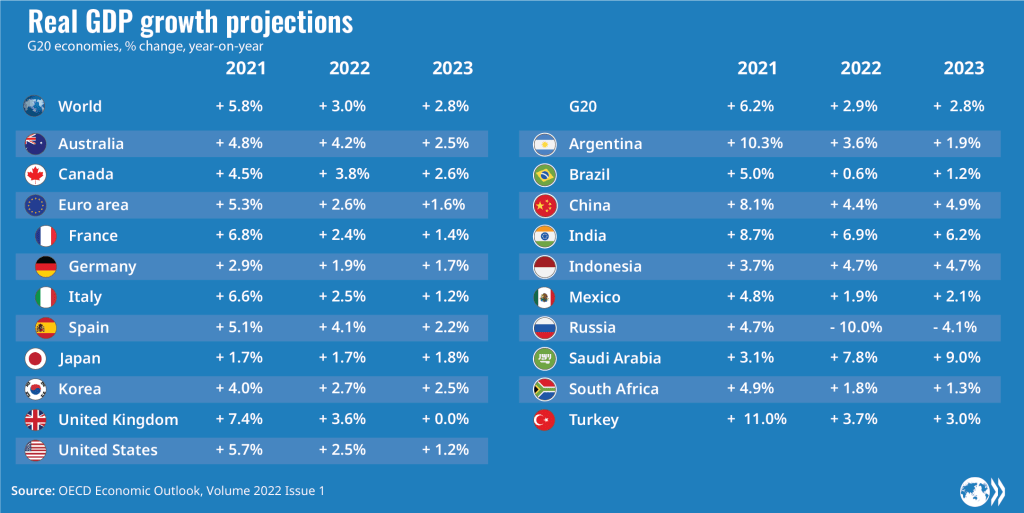
La invasión de Ucrania está desacelerando la economía mundial y contribuyendo a agravar las presiones inflacionarias, aumentando la incertidumbre para la región. Ahora se prevé que el crecimiento del PIB mundial se ralentice bruscamente hasta el 3% en 2022 (desde un 4.5% que se preveía en diciembre 2021) y 2.75% en 2023. Las cuarentanas en China, junto con la guerra, está prolongando las interrupciones en las cadenas de valor y el comercio mundiales. Los precios de las materias primas han subido considerablemente, lo que ha aumentado la inflación en todas partes. Las proyecciones para la inflación se encuentran ahora en torno al 9%, el doble de lo que pronosticábamos en diciembre del año pasado. La inflación subyacente se moderará un poco, pero se mantendrá por encima de los objetivos en la mayoría de las principales economías a finales de 2023, a pesar de la normalización de la política monetaria.

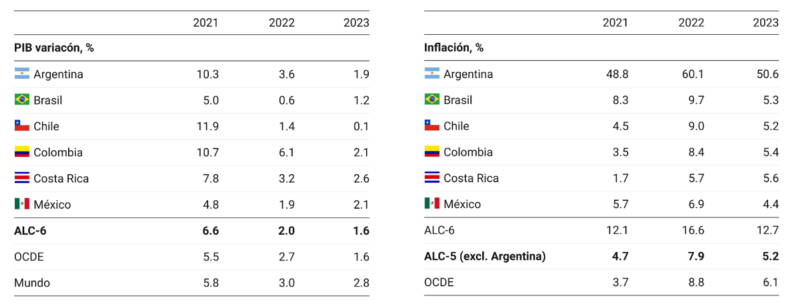
En comparación con el resto del mundo y las economías avanzadas de la OCDE, el crecimiento de América Latina corre el riesgo de quedarse atrás en los próximos años (Cuadro 1), comprometiendo la convergencia hacia niveles de vida más altos. En relación a nuestras proyecciones de diciembre de 2021, para las seis principales economías de América Latina, el crecimiento del PIB se ha revisado a la baja en 0,7 puntos porcentuales en 2022 y 0,6 puntos porcentuales en 2023, mientras que, excluyendo Argentina, la inflación se ha revisado significativamente al alza en 3,5 puntos porcentuales en 2022 y 2 puntos porcentuales en 2023. No obstante, existen algunas diferencias entre países. En Argentina y Colombia, el crecimiento del primer trimestre de 2022 resultó más fuerte de lo previsto, lo que llevó a una revisión al alza de las proyecciones.

Cuadro 1. Perspectivas económicas de los países de América Latina

Nota: América Latina (ALC) es la media ponderada por PIB a paridad de poderes de compra de los 6 países en la tabla para el PIB; y la media simple de los países incluidos en el cuadro para la inflación.
Fuente:  OCDE Perspectivas Económicas No. 111, junio de 2022. 

Se han exacerbado desafíos ya existentes y han surgido otros nuevos

Las economías latinoamericanas salieron de la crisis de COVID-19 con una mayor deuda pública como porcentaje del PIB y un espacio fiscal muy limitado. A medida que la inflación alcanza niveles altos en todo el mundo y los bancos centrales endurecen la política monetaria, sobre todo en Estados Unidos, esto supone una amenaza no despreciable para la estabilidad financiera de la región. El aumento de los costes de financiación a nivel mundial y nacional dificultará a los países latinoamericanos la refinanciación de la deuda, el cumplimiento de las obligaciones de la deuda externa y la financiación de las tan necesarias inversiones en infraestructuras y otras reformas pro-crecimiento, aunque la proporción de la deuda en moneda extranjera en las nuevas emisiones haya disminuido considerablemente. Los cambios bruscos en la orientación de la política monetaria de las economías avanzadas también podrían dar lugar a importantes salidas de capital y a la depreciación de la moneda, exacerbando las presiones inflacionistas internas. Una desaceleración significativa del crecimiento en China también podría repercutir en el comercio y el crecimiento de la región.

Los hogares de bajos ingresos, que todavía están luchando por el impacto económico de la pandemia, se están viendo muy afectados por el aumento de los precios de los alimentos y la energía. En una región con niveles históricamente altos de desigualdad, y donde muchos todavía están luchando por recuperarse de la pandemia, esto está añadiendo presión a los gobiernos para que refuercen el apoyo social y aumenten el gasto público para reducir el riesgo de malestar social. La mayoría de los países han respondido al aumento de la inflación intentando influir directamente en los precios: reducción de los aranceles a la importación de productos agrícolas y otros bienes básicos (Brasil, Colombia, México), medidas de reducción de impuestos (Argentina, Brasil, México, Perú), aumento de las subvenciones a la energía (Argentina, Chile, Perú) o medidas para aumentar la producción de granos básicos (México). La reducción de los aranceles de importación es bienvenida y podría incluso hacerse permanente. Los gobiernos deberían tratar de ampliar temporalmente los programas de transferencias monetarias específicas para apoyar a los hogares más vulnerables, como ha hecho Chile.

Algunas señales de esperanza

En el caso de los exportadores netos de materias primas, como Brasil y Colombia, el aumento de los precios del petróleo, los minerales y la agricultura ha mejorado los resultados fiscales, aliviando temporalmente las presiones fiscales. La relación de intercambio también ha mejorado para estos países, apoyando a los sectores exportadores, lo que ha impulsado las entradas de capital. Sin embargo, para los importadores netos de materias primas, como Costa Rica, la relación de intercambio se ha deteriorado, perjudicando las perspectivas de crecimiento a corto plazo. La guerra en Ucrania también ha llevado a los inversores a reequilibrar sus carteras a expensas de Rusia y de los países de Europa Central altamente expuestos a Rusia, en beneficio de algunas economías latinoamericanas, como Brasil. Estas entradas de capital han servido de apoyo a la moneda local y han contenido la inflación importada hasta ahora, aunque no se puede descartar una posible reversión a medida que las economías avanzadas endurezcan su política monetaria.

La guerra en Ucrania también está afectando a la dinámica del comercio mundial, sobre todo cuando las exportaciones rusas tenían una cuota de mercado considerable. En el caso de algunos productos, como los cereales y los minerales, algunos países latinoamericanos están bien situados para mitigar el choque de la oferta, como Argentina, Brasil o Colombia. Esto podría ser una oportunidad para mejorar los resultados de las exportaciones y establecer vínculos comerciales duraderos con nuevos socios comerciales. Al mismo tiempo, los últimos acontecimientos han aumentado el apetito por la deslocalización, lo que podría jugar a favor de la región dada su proximidad al mercado norteamericano. El comercio podría convertirse en un importante pilar para la recuperación económica de la región y sus futuras perspectivas de crecimiento.

Conseguir el equilibrio de políticas adecuado

Los gobiernos latinoamericanos deberían responder a este entorno especialmente desafiante y aprovechar las oportunidades existentes. El apoyo fiscal para compensar a los hogares vulnerables por el aumento de los precios de la energía y los alimentos debería ser temporal y específico, para evitar poner en peligro los esfuerzos de consolidación fiscal. Rompiendo con el pasado, esta vez los ingresos adicionales de las materias primas deberían utilizarse con prudencia, por ejemplo para reducir la deuda pública, ya que las perspectivas de crecimiento son inciertas y también lo es la evolución futura de los precios de las materias primas. Los bancos centrales deben seguir vigilando la situación y estar dispuestos a seguir subiendo las tasas de interés oficiales para evitar un desanclaje de las expectativas de inflación. Por último, los gobiernos deben abordar los obstáculos que desde hace tiempo se oponen a la integración comercial, como las deficiencias de las infraestructuras, las barreras arancelarias y no arancelarias que aún existen o la falta de mano de obra cualificada. Esto será clave para un crecimiento económico y de las exportaciones amplio e inclusivo. Debe prestarse mayor atención a las políticas medioambientales para garantizar una reducción progresiva de las emisiones de carbono.

Más información:


The Price of War

By Laurence Boone, OECD Chief Economist and Deputy Secretary-General.

The world is set to pay a hefty price for Russia’s war against Ukraine. A humanitarian crisis is unfolding before our eyes, leaving thousands dead, forcing millions of refugees to flee their homes and threatening an economic recovery that was underway after two years of the pandemic. As Russia and Ukraine are large commodity exporters, the war has sent energy and food prices soaring, making life much harder for many people across the world.

The extent to which growth will be lower and inflation higher will depend on how the war evolves, but it is clear the poorest will be hit hardest. The price of this war is high and will need to be shared.

The global economy is set to weaken sharply in our projections. We estimate world growth to be 3% in 2022 – down from the 4½ per cent we projected last December – and 2¾ per cent in 2023. Inflation projections now stand at nearly 9% in OECD countries in 2022, twice what we were previously projecting. Elevated inflation across the globe is eroding households’ real disposable income and living standards, and in turn lowering consumption. Uncertainty is deterring business investment and threatening to curb supply for years to come. At the same time, China’s zero-Covid policy continues to weigh on the global outlook, lowering domestic growth and disrupting global supply chains.

With risks biased to the downside, the price of war could be even higher. The conflict is disrupting the distribution of basic food and energy, fuelling higher inflation everywhere and threatening low-income countries in particular. European economies are struggling to wean themselves off Russian fuel. But because alternative energy sources may not be easy to ramp up quickly, there is a risk of higher prices or even shortages. If the war escalates or becomes more protracted, the outlook would worsen, particularly for low-income countries and Europe.

Limiting Russia’s ability to finance the war, as is intended by an embargo on Russian oil exports, is essential for speeding up an end to this devastating conflict.

Meanwhile, we must minimise the humanitarian, economic and social consequences.

The first urgency is to avoid a food crisis. Today, the world is producing enough cereals to feed everyone, but prices are very high and the risk is that this production will not reach those who need it most. Global cooperation is needed to ensure that food reaches consumers at affordable prices, in particular in low-income and emerging-market economies. This may require more international aid as well as cooperation in the logistics of shipping and distributing to countries in need. The flaws of global vaccine distribution are still fresh in our memory. Let’s not repeat them.

Second, inflation has strong distributional effects. It will help drive down debt, including public debt, but it is also eroding real income, savings and purchasing power. At the same time, it may affect firms’ profits and capacity to invest and create jobs. Inflation is a burden, which must be shared fairly among people and firms, between profit and wages. Governments also have to play a role through support targeted to those most vulnerable to rising food and energy inflation.

Next, monetary and fiscal policy need to adjust to these extraordinary circumstances.

Globally, the elevated levels of inflation and employment today suggest there is no longer a need for monetary policy accommodation. However, in many regions inflation is driven by food and energy. If monetary policy cannot address such supply shocks, it can send signals that it will not allow inflation to rise or spread further. Removing accommodation is therefore warranted across the globe, but with particular caution in Europe where supply-driven inflation dominates. Conversely, wherever inflation is driven by over-buoyant demand, as in the United States, monetary policy can tighten faster to reduce such excess.

Fiscal policy management is particularly complex. Because of the current levels of growth, employment and inflation, the need for economy-wide income support has disappeared and should be replaced by better targeted measures. The war in Ukraine has raised the need for higher public investment in defence and for greater urgency in the transition to greener energy. This comes on top of other investment needs like health, digitalisation, ageing and education, and as public debts remain high. This conundrum can only be resolved with a stronger focus on prioritisation from governments. In Europe, the integration of the region and high exposure to the war calls for more solidarity in defence and energy spending.

The war has exposed how energy security and climate mitigation are intertwined. Governments need to shift gear to accelerate the energy transition. The emergency response to an energy crisis has turned out to be a stark scramble for alternative sources of fossil fuels and an increase in coal use. This can only be temporary as it is the opposite of what the world needs, which is a rapid increase in investment in, and consumption of, cleaner energy. But clean energy requires inputs, minerals and intermediate materials which come from all over the planet. Put simply, the cleaner the energy, the larger and the more geographically diverse the value chains will have to be. There will be no climate mitigation without open trade and resilient global value chains.

The world is already paying the price for Russia’s aggression. The choices made by policymakers and citizens will be crucial to determining how that price will be distributed across people and countries.

Editorial from the OECD Economic Outlook, June 2022


El Precio de la Guerra

Por Laurence Boone, Economista Jefe y Secretaria General Adjunta de la OCDE.

El mundo va a pagar un alto precio por la guerra entablada por Rusia contra Ucrania. Ante nuestros ojos se agrava una crisis humanitaria que está dejando miles de muertos, obligando a millones de refugiados a huir de sus hogares y amenazando una recuperación económica que arrancaba tras dos años de pandemia. Rusia y Ucrania son grandes exportadores de materias primas, por lo que la guerra ha disparado los precios de la energía y los alimentos, haciendo la vida mucho más difícil para un gran número de personas en todo el mundo.

Hasta qué punto el crecimiento se frenará y la inflación aumentará dependerá de cómo evolucione la guerra, pero no cabe duda de que los más pobres serán los más castigados. El precio de esta guerra es alto y tendrá que ser compartido por todos.

Según nuestras previsiones, la economía mundial se va a debilitar considerablemente. Estimamos que el crecimiento mundial será del 3% en 2022 –frente al 4½% que proyectamos el pasado mes de diciembre– y del 2¾% en 2023. La previsión de inflación para 2022 ahora se sitúa prácticamente en el 9% en los países de la OCDE, duplicando la proyección anterior. La elevada inflación en todo el mundo está erosionando los ingresos reales disponibles de los hogares y su nivel de vida, con la consiguiente contracción del consumo. El clima de incertidumbre está desalentando la inversión de las empresas y amenaza con retraer la oferta en los próximos años. Asimismo, la política de “COVID cero” de China sigue ensombreciendo las perspectivas mundiales, frenando el crecimiento del país y perturbando las cadenas de suministro internacionales.

El sesgo del riesgo en nuestras proyecciones es de sobreestimación, por lo que el precio de la guerra podría ser aún mayor. El conflicto está trastocando la distribución de alimentos básicos y de energía, lo que aviva aún más la inflación en el mundo entero, amenazando sobre todo a los países de bajos ingresos. Las economías europeas están haciendo todo lo posible para prescindir del combustible ruso, pero ampliar rápidamente las fuentes de energía alternativas podría no resultar sencillo, de modo que no se pueden descartar subidas de precios o incluso escasez. En caso de escalada o prolongación del conflicto, las perspectivas serían aún más sombrías, especialmente para los países de bajos ingresos y Europa.

Para acabar cuanto antes con este devastador conflicto, resulta esencial limitar la capacidad de Rusia para financiarlo, que es precisamente lo que pretende el embargo de sus exportaciones de petróleo.

Entretanto, debemos minimizar las consecuencias humanitarias, económicas y sociales.

Lo más apremiante es evitar una crisis alimentaria. En la actualidad, el mundo produce suficientes cereales para alimentar a toda su población, pero los precios son muy elevados y cabe el riesgo de que los productos no lleguen a quienes más lo necesitan. La cooperación mundial es necesaria para hacer llegar los alimentos a precios asequibles a los consumidores, especialmente en las economías de bajos ingresos y en mercados emergentes. Esto podría precisar una mayor ayuda internacional, así como cooperación en materia de logística de transporte y distribución en los países necesitados. Los errores cometidos en la distribución mundial de vacunas están aún frescos en la mente de todos. No los repitamos.

Además, la inflación tiene fuertes efectos distributivos. Ayudará a reducir la deuda, incluida la pública, pero también está erosionando la renta real, el ahorro y el poder adquisitivo. Asimismo, podría afectar a los beneficios de las empresas y a su capacidad para invertir y crear empleo. La inflación es una carga que debe repartirse equitativamente entre los ciudadanos y las empresas, entre los beneficios y los salarios. Las administraciones públicas también han de contribuir mediante ayudas dirigidas a quienes son más vulnerables al aumento de la inflación de los alimentos y la energía.

Finalmente, las políticas monetarias y fiscales deben ajustarse a estas circunstancias extraordinarias.

En todo el mundo, los elevados niveles de inflación y empleo actuales sugieren que ha dejado de ser necesario que la política monetaria sea acomodaticia. Sin embargo, en muchas regiones la inflación está impulsada por los precios de los alimentos y la energía. La política monetaria no puede hacer frente a esas perturbaciones del lado de la oferta, pero puede enviar señales que indiquen que no permitirá que la inflación aumente o se propague en mayor medida. Por lo tanto, la retirada del sesgo acomodaticio de las políticas monetarias está justificada en todo el mundo, pero debe hacerse con especial prudencia en Europa, donde, entre las causas de la inflación, predominan factores del lado de la oferta. Por el contrario, allí donde la inflación esté impulsada por una demanda muy elevada, como en Estados Unidos, la política monetaria puede endurecerse más rápidamente para reducir ese exceso de demanda.

La gestión de la política fiscal es especialmente compleja. Debido a los actuales niveles de crecimiento, empleo e inflación, el apoyo a los ingresos del conjunto de la economía ya no está justificado y debería sustituirse por medidas más específicas. La guerra de Ucrania ha aumentado la necesidad de inversión pública en defensa y ha hecho más urgente la transición a una energía más ecológica. Esto se suma a otras necesidades de inversión en ámbitos como la sanidad, la digitalización, el envejecimiento y la educación, todo ello al tiempo que la deuda pública sigue siendo elevada. Para salir de esta encrucijada, los poderes públicos tendrán que esforzarse más en establecer prioridades. En Europa, la integración de la región y la alta exposición a la guerra exigen una mayor solidaridad en el gasto en defensa y energía.

La guerra ha puesto de manifiesto hasta qué punto la seguridad energética y la mitigación del cambio climático están conectadas. Los gobiernos deben considerar nuevas estrategias para acelerar la transición energética. La respuesta de emergencia ante una posible crisis energética ha desembocado en una carrera desesperada en busca de fuentes alternativas de combustibles fósiles y en un aumento del uso del carbón. Esto sólo puede tener carácter temporal, ya que es precisamente lo contrario de lo que el mundo necesita: un rápido avance en la inversión y el consumo de energías más limpias. Sin embargo, la energía limpia requiere insumos, minerales y productos intermedios que provienen de todo el planeta. En otras palabras, cuanto más limpia sea la energía, más amplias y diversas desde el punto de vista geográfico tendrán que ser las cadenas de valor. No habrá mitigación del cambio climático sin libre comercio y cadenas de valor resilientes a nivel mundial.

El mundo ya está pagando el precio de la agresión rusa. Las decisiones que tomen las autoridades y los ciudadanos jugarán un papel esencial en cómo se distribuya ese precio entre las personas y los países.

Editorial de las Perspectivas económicas de la OCDE, junio 2022