How large should central bank balance sheets be?

Since the global financial crisis, the size of central bank balance sheets has varied widely, both over time and across countries. Balance sheet size has major implications in many domains, including the operation of the payments system, the transmission of monetary policy and the cost of public debt.

by Masatoshi Ando and Álvaro Pina, OECD Economics Department


The value of total assets and liabilities of many central banks in advanced economies has varied widely since the global financial crisis (see Figure 1). Following the global financial crisis quantitative easing (QE), with the large-scale purchase of securities (mainly government bonds), led to a significant increase in the size of the balance sheets of the Federal Reserve and the Bank of England from 2009, and of other central banks, such as the European Central Bank (ECB), in subsequent years. During the pandemic, these and other central banks resorted again to QE to address strains in financial markets and provide support to economic activity. At their post-pandemic peaks, balance sheets were (relative to GDP) 3 to 9 times larger than in 2007 and displayed substantial cross-country variation, ranging from 25% of GDP in Canada to around 130% in Japan.

Central banks began quantitative tightening (QT), the downsizing of bond holdings, in 2022-23 (the Federal Reserve had previously done this in 2017-19). In several economies the size of balance sheets relative to GDP has now returned to or is close to pre-pandemic levels. Against this background, some central banks have brought QT to a halt while others are still pursuing it, and a lively debate has emerged about the appropriate size and composition of central bank balance sheets in the longer run (Bailey, 2024; Schnabel, 2025; Logan et al., 2026).

The balance sheet of the central banks which conducted QE is mainly composed of government bonds on the asset side and reserves on the liability side. Thus, as discussed in the latest OECD Economic Outlook (OECD, 2026a), the decision about the appropriate balance sheet size essentially depends on an assessment of the trade-offs that arise as bond holdings and reserves increase or decrease. These trade-offs can evolve over time, depending on the wider economic situation and on financial market conditions.

Figure 1. Quantitative easing and quantitative tightening have been the main drivers of changes in central bank balance sheet size
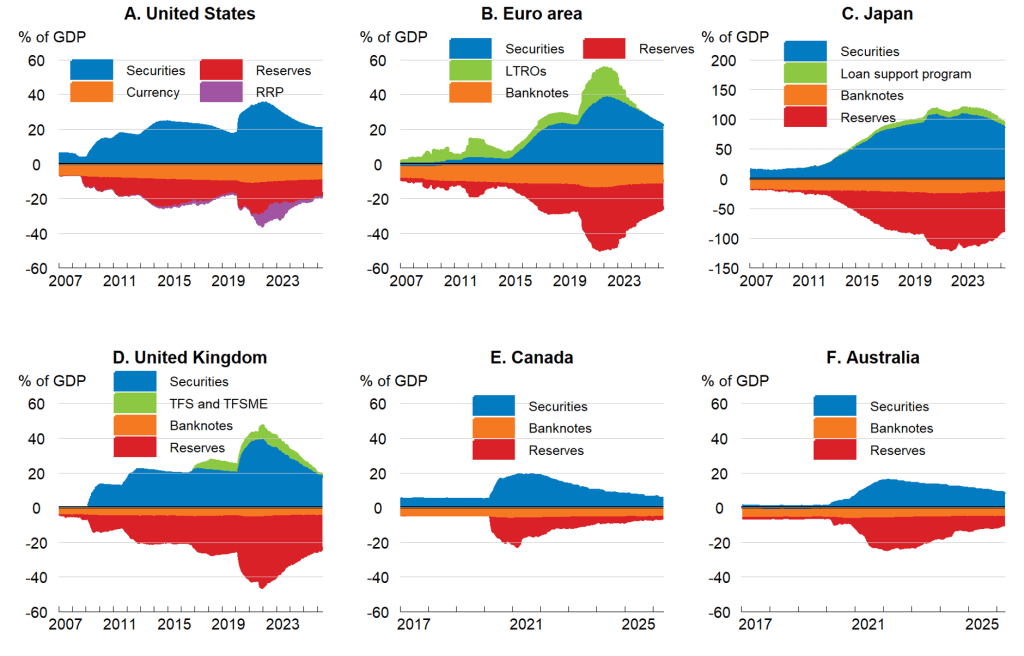
Bar graphs comparing the percentage of GDP attributed to various financial assets for the United States, Euro area, Japan, United Kingdom, Canada, and Australia from 2007 to 2025.

Note: Only major components of the central bank balance sheets are shown. Assets are displayed as positive and liabilities as negative. For the United States, RRP stands for Reverse Repurchase Agreements. For the euro area, data refer to the actual membership at each point in time, reserves include the amount of deposit facility, and longer-term refinancing operations (LTROs) include targeted longer-term refinancing operations (TLTROs) and pandemic emergency longer-term refinancing operations (PELTROs). For the United Kingdom, securities are proxied by loans from the Bank of England to the Asset Purchase Facility (APF), net of Term Funding Scheme (TFS) drawings.
Source: OECD Economic Outlook 119 database; Bank of Canada; Bank of England; Bank of Japan; Board of Governors of the Federal Reserve System; European Central Bank; Eurostat; Reserve Bank of Australia; Office for National Statistics; and OECD calculations.

Larger or smaller? Trade-offs arise for both bond holdings and reserves

One argument for smaller balance sheets and lower central bank government bond holdings is that this would reduce price distortions in sovereign debt markets, leading to a more efficient allocation of resources. Furthermore, large holdings of government bonds can complicate central bank communication, particularly if they are perceived to constrain monetary policy due to the risk of fiscal dominance. Returning to lower bond holdings also preserves policy space to reintroduce QE as a response to future crises, if needed (Anderson et al., 2026).

However, it is uncertain that central banks can reduce their holdings of government bonds significantly at a time of large budget deficits and substantial debt issuance. Any reduction in central bank holdings requires greater public debt absorption by private sector investors, who tend to be more price‑sensitive and are sometimes highly leveraged. This entails the risk of higher yields and greater volatility in sovereign bond markets at times of stress (Ando et al., 2026; OECD, 2026b). In the event of serious bond market volatility, central banks could need to temporarily resume or enhance securities purchases to help preserve financial stability, as in the United Kingdom in September-October 2022. In a currency union, tensions in sovereign debt markets could also lead to financial fragmentation. This would threaten the smooth and effective transmission of monetary policy across the whole area and potentially require central bank intervention (Cipollone, 2025).

Important policy trade-offs also apply to the liability side of central bank balance sheets. From the perspective of the private sector, reserves held at the central bank are safe, and liquid assets which serve as an essential means of settlement. Although a reduction in the amount of reserves could lead to better functioning of money markets, with a pickup in trading volumes, there is a risk that liquidity shortages in money markets could raise interest rate volatility at certain junctures, forcing the central bank to intervene. Events in September 2019 in the United States are an example, when the repo rate spiked sharply amid ongoing QT at the same time as high tax payments and Treasury settlements.

Ensuring that balance sheet reductions do not lead to liquidity stress is difficult given uncertainty about the demand for reserves. There is a broad consensus that demand for reserves has increased over the past two decades, partly due to changes in financial regulation (Anderson et al., 2026; BIS, 2025). For instance, reserves have come to be regarded as the prime asset for compliance with liquidity requirements. In addition, financial institutions may hold more reserves as a buffer to avoid the reputational risks from using a central bank liquidity backstop (Anderson et al., 2026; Logan et al., 2026). More broadly, the demand for reserves varies according to the reserves regime. Demand is higher when central banks seek to control short-term interest rates by remunerating reserves while supplying ample liquidity to the market (an ample reserves regime), in contrast to the regime of scarce reserves prior to the global financial crisis (Borio et al. 2024).

Balance sheet size also matters for the cost of public debt

Bond holdings and reserves both affect central bank profits and thus the costs of public debt. QE effectively shortened the average maturity of public debt in the consolidated balance sheet of the general government and the central bank, replacing long-term fixed-rate bonds by short-term floating-rate reserves (OECD, 2023). This increased the speed of transmission of changes in policy rates to public debt costs, making the latter more volatile. Very low policy rates in QE years reduced effective debt costs via higher central bank profits, transferred to governments as dividends. Conversely, higher policy rates in recent years have increased reserve remuneration costs, inducing central bank losses. A smaller balance sheet would reduce the volatility of public debt costs, although such an objective could also be achieved by tilting central bank bond holdings towards shorter-term securities (Schnabel, 2025).

References

Anderson, A.G., A. Barbarino, A.M. Diercks, and S. Miran (2026), “A user’s guide to reducing the Federal Reserve’s balance sheet”, Finance and Economics Discussion Series 2026-019, Board of Governors of the Federal Reserve System, Washington, March.

Ando, M., B. Conigrave, Á. Pina and C. Roulet (2026), “The investor base for sovereign debt: recent developments and potential implications”, OECD Ecoscope blog, February.

Bailey, A. (2024), “The importance of central bank reserves”, Lecture in honour of Charles Goodhart, London School of Economics, May.

BIS (2025), BIS Quarterly Review, September, Bank for International Settlements.

Borio, C., P. Disyatat and A. Schrimpf (2024), “The double-faced demand for bank reserves and its implications”, VOXEU CEPR Column, Centre for Economic Policy Research, February.

Cipollone, P. (2025), “Striking the right balance: the ECB’s balance sheet and its implications for monetary policy”, Speech at an MNI Connect webcast, February.

Logan, L. and S. Schulhofer-Wohl (2026), “Options for reducing the size of the Fed’s balance sheet”, Dallas Fed Economics in Depth, Federal Reserve Bank of Dallas, Texas, April.

OECD (2026a), OECD Economic Outlook, Volume 2026 Issue 1: Under Pressure, OECD Publishing, Paris.

OECD (2026b), Global Debt Report 2026: Sustaining Debt Market Resilience Under Growing Pressure, OECD Publishing, Paris.

OECD (2023), OECD Economic Outlook, Volume 2023 Issue 1: A long unwinding road, OECD Publishing, Paris.

Schnabel, I. (2025), “Towards a new Eurosystem balance sheet”, Speech at the ECB Conference on Money Markets 2025, November.


Stablecoins on the rise: A risk for financial stability? 

By Caroline Roulet, OECD Economics Department.

Stablecoins are a type of crypto-asset designed to maintain a stable value by anchoring to a reference asset (often US Treasury bills). They offer convertibility on demand at par, and fee-free, immediate and pseudonymous transactions, making them an attractive means of payment, especially across borders. The market value of stablecoins has risen rapidly, with two issuers that mainly rely on USD-denominated collateral accounting for almost 90% of the global market capitalisation (Figure 1). Stablecoins are still only a small part of financial markets, but as they expand and become more intertwined with traditional finance they pose non-negligible risks to financial stability and important challenges for financial regulation and monetary policy.

As discussed in the latest OECD Economic Outlook the total value of payments using stablecoins surpassed that of major traditional digital payment providers in 2024-25 (Figure 2, Panel A). Currently, stablecoins are mainly used to settle trades in other crypto-assets, and now account for around 80% of all trades on crypto-asset platforms (ECB, 2025), although usage for other payments by corporates and households has begun to rise.

Though less risky than crypto-assets as a whole, some stablecoins have experienced significant price volatility, particularly those that are not fiat-collateralised (i.e. not fully backed by assets denominated in currency terms, such as US Treasury bills or bank deposits). Fiat-collateralised stablecoins have been much more stable, but still often deviate from par in secondary markets (Aldasoro et al, 2025). In contrast to the majority of bank deposits, stablecoins are typically uninsured. Variation in the value of their backing assets (and subsequent deviations of stablecoins’ market value from their original face value) can therefore prompt holders to request redemptions, with ensuing risks of liquidity shortages and fire sales of collateral.

The expansion of stablecoins raises financial stability risks. One concern is the potential effects on the pricing and operation of segments of critical funding markets, such as sovereign debt markets (Aldasoro et al., 2025), as stablecoin issuers are now major holders of US Treasury bills (Figure 2, Panel B). Investor inflows into stablecoins and asset sales to meet redemptions could thus affect short-term bond yields and hence monetary policy transmission. Stablecoin issuers’ generation of additional income through reverse repos (lending securities to traditional financial intermediaries who then pledge them as collateral) may also add to potential strains on repo market liquidity at times of stress.

Figure 2. Stablecoin transactions are expanding and holdings of US Treasury bills are sizeable

Note: In Panel A, Visa and Mastercard payments primarily reflect settlements for goods and services, while stablecoins have been primarily used so far to settle trades in other crypto-assets. Payments data (Gross Dollar Volume, GVD) for Mastercard in 2025 is available through Q3, with Q4 estimated using the average GDV from the first three quarters. Panel B reports holdings of US T-bills by selected domestic and foreign holders and major stablecoins issuers (Tether and USD Coin) as of 2025 Q3.
Source: Artemis Analytics; Tether and USD Coin transparency reports; US Federal Reserve; US Department of the Treasury; Visa and Mastercard annual reports; and OECD calculations.

The expansion of stablecoins may also pose risks to banks. Companies with crypto-related business models, including stablecoin issuers, also hold bank deposits (as required by regulation in some jurisdictions). This could prove an unstable deposit base if stablecoin issuers suddenly withdraw funds to meet liquidity needs (ECB 2025), potentially disrupting bank credit availability.

The growing adoption and use of stablecoins, alongside their ability to circulate freely across borders, poses economic policy challenges. In emerging-market economies, the use of foreign‑currency denominated stablecoins could raise exchange rate volatility at times of stress and enable foreign exchange regulations to be bypassed. This would make standard indicators of capital outflows harder to interpret. More broadly, usage of foreign currency denominated stablecoins could weaken the control of monetary conditions by domestic central banks (BIS, 2025; Rey, 2025). The potential use of stablecoins for illicit activities is a further concern, raising challenges for the enforcement of anti‑money laundering and financing of terrorism regulations.

Many countries have begun to develop tailored regulations relating to stablecoins, and crypto-assets more generally. Prominent recent examples include the GENIUS Act in the United States (Guiding and Establishing National Innovation for U.S. Stablecoins Act, enacted in July 2025) and the MiCA (Markets in Crypto-Assets) Regulation in the European Union, which became effective from December 2024. However, regulatory approaches differ across countries and significant gaps and inconsistencies remain (FSB, 2025). The limited oversight of cross-border transactions is a key challenge, potentially hampering responses to systemic risks and encouraging regulatory arbitrage. The rapid growth of the stablecoin market, and the impact stablecoin usage may have on other asset markets, highlights the need for enhanced international cooperation to ensure effective regulation, supervision, and oversight of stablecoins in all jurisdictions.

REFERENCES

ECB (2025), “Just another crypto boom? Mind the blind spots”, Financial Stability Review, May, European Central Bank.

Aldasoro, I., M. Aquilina, U. Lewrick, and S. Lim (2025), “Stablecoin growth – policy challenges and approaches,” BIS Bulletins 108, Bank for International Settlements.

BIS (2025), Annual Economic Report, Chapter 3 “The next-generation monetary and financial system”, June, Bank for International Settlements.

FSB (2025), Thematic Review on FSB Global Regulatory Framework for Crypto-asset Activities, Financial Stability Board, Geneva. Rey, H. (2025), “Stablecoins, tokens, and global dominance”, IMF Finance and Development magazine, September.

Rey, H. (2025), “Stablecoins, tokens, and global dominance”, IMF Finance and Development magazine, September.


Time for a regulatory reset? Clearing the path for productivity and dynamism

By Dan Andrews, Joana Duran-Franch and Sébastien Turban, OECD Economics Department.

Over recent years, governments across the OECD have expressed concerns that “red tape” is hampering economic activity. Concerns that have been supported by the recent OECD Simplifying for Success survey, in which business organisations report that regulatory requirements and compliance now stand as the most significant challenge for firms, ahead of difficulties in finding workers with the right skills, tax pressures, or geopolitical instability. And crucially, firms perceive that the regulatory burden is mounting over time.

The latest OECD Economic Outlook, in its thematic chapter Time for a Regulatory Reset? (OECD, 2025a), confirms that this is more than a feeling – and that it matters for growth. Labour productivity growth has slowed across most OECD countries since the late 1990s, due to weak business investment (OECD, 2025b) and diminished economic dynamism, which reflects the declining likelihood of new firms to enter and scale-up, workers to change jobs and scarce resources to be reallocated towards more productive firms (Figure 1). Some of this is due to benign forces such as ageing populations or the rise of firm-specific human capital in an intangible-driven economy. But growing regulatory frictions are also part of the story.

Figure 1. Productivity and economic dynamism have slowed down in the last 20 years

Note: In Panel B, the figure reports the average of within-country–industry cumulative changes in percentage points relative to 2004. Estimates are based on data for 12 countries (Austria, Belgium, Finland, France, Germany, Italy, Hungary, Portugal, Slovenia, Spain, Türkiye and the United Kingdom) over the period 2004–2022.
Source: OECD Economic Outlook 118 database; Calvino, F., C. Criscuolo and R. Verlhac (2020); Cho, W. et al. (2024); and OECD calculations.

While regulation is essential, the way we regulate matters for growth and dynamism

Regulations are indispensable for correcting market failures, protecting health and safety, safeguarding the environment and addressing distributional concerns. The question is whether these objectives can be met with fewer distortions and lower compliance costs – freeing up talent and capital for innovation and growth. And there is good reason to believe they can.

The growing regulatory environment has absorbed scarce labour resources

A central contribution of the chapter is to develop a new task-based measure of the real resources used to comply with regulation, as in Trebbi and Zhang (2022) and Trebbi, Zhang and Simkovic (2023). The idea is simple: most jobs include some tasks that are linked to regulation compliance – completing forms, reporting, audits, inspections, ensuring legal or standards compliance, and so on. By identifying these tasks across occupations, we estimate the share of wages and employment devoted to regulatory compliance in OECD countries for which data are available.

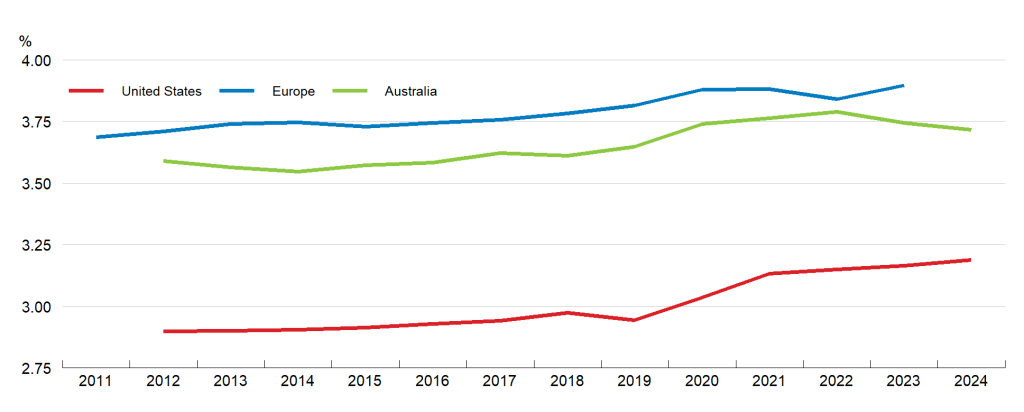
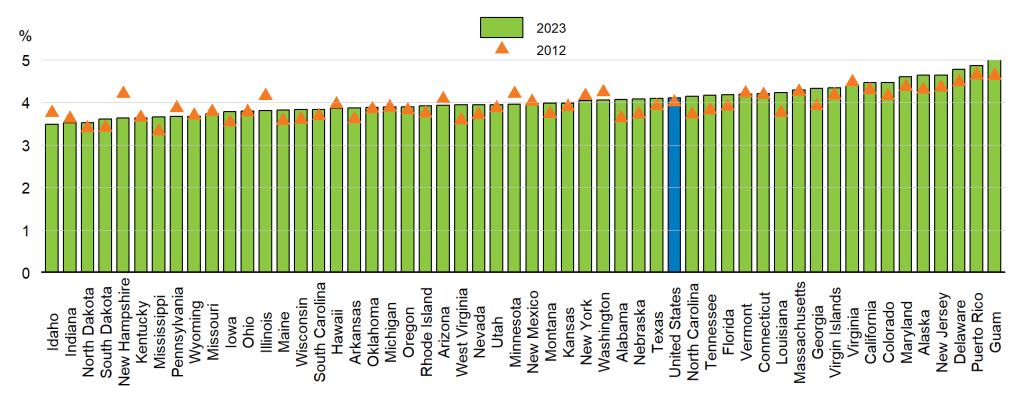
These new measures show that resources devoted to regulatory compliance are significant and growing (Figure 2): In Europe, regulatory tasks accounted for an average of 3.9% of total employment in 2023, up from 3.7% in 2011. This share is higher than in Australia – where the increase has also been smaller over the same period – and notably higher than in the United States, where regulatory tasks account for 3.2% of total employment. In 2024, an estimated 4.2% of the US wage bill was spent on regulation-related tasks (up from 4.0% in 2012), equivalent to around USD 521 billion or 1.8% of GDP. But there is considerable variation across US states, ranging from 3.5% in Idaho to closer to 5% in some states such as New Jersey.   

Figure 2. The share of employment devoted to regulatory tasks has risen in selected OECD countries

A. Share of employment

B. Share of US state and territories’ wages spent on regulatory tasks in 2012 and 2023

Note: In Panel A, the index represents the employment-weighted sum of occupations’ regulation task intensity scores in the three regions. “Europe” refers to the average score of EU countries except Bulgaria, Malta, and Slovenia, and includes the United Kingdom (data available up to 2019), Iceland, Norway, and Switzerland. In Panel B, the index represents a similar, wage-weighted sum. The US unweighted average is in blue. The values for the District of Columbia are not displayed, for readability: the numbers were 7.8% in 2012 and 7.5% in 2023.
Source: Andrews, Turban and Tyros (forthcoming).

When more rules mean less dynamism

Using variation within US states over time, we find that higher regulatory compliance costs are linked to workers producing less per hour and to new businesses making up a smaller share of employment. In detail, long-difference regressions for US states over 2012–2023 show that the average increase in compliance costs is associated with roughly 0.5% lower labour productivity and a 0.4 percentage point drop in the employment share of young firms. The estimates also suggest the effects build up gradually over time. These results are consistent with a growing body of evidence linking regulatory accumulation to slower GDP and productivity growth in the United States, Europe and Australia (Coffey, McLaughlin and Peretto, 2020; Dawson and Seater, 2013; McLaughlin and Wong, 2024; Pellegrino and Zheng, 2023).

Calling for a regulatory reset: Smarter rules for stronger growth

Against this backdrop, the chapter outlines a plan for a “regulatory reset”. While the specific recommendations vary by country – as highlighted by Chapter 3 of the Economic Outlook and explained in a recent blogpost –  a clear common message emerges: this is not about deregulating across the board, but about regulating in a smarter, more dynamic way. The chapter identifies five priorities that governments can act on today:

  1. Simplify and manage regulations systematically. Use non-regulatory tools where appropriate and make regulatory governance more agile and evidence-based. A key step includes managing the stock of regulations through systematic reviews, which currently occur in fewer than one-third of OECD countries (OECD, 2020; OECD, 2025d). Increasing legal certainty and predictability is necessary too: frequent changes, complex drafting, and inconsistent enforcement remain among the top complaints from businesses in the OECD Simplifying for Success surveys.
  2. Make product and labour market regulations more dynamism-friendly. Pro-competitive product market regulation remains a powerful lever for growth, especially in services. Recent OECD evidence suggests that the slowdown in deregulation in network sectors – like energy, transport, and communications – explains up to one-sixth of the post-2005 productivity slowdown. At the same time, easing product market regulations in retail trade and professional services could boost labour productivity significantly. That said, not all regulation harms dynamism and targeted rules can actually enhance it, for example, by addressing the excessive use of non-compete clauses or tightening safeguards against excessive lobbying.
  3. Redesign housing regulation to promote affordability and mobility. Restrictive planning and rental regulations can depress residential construction, push up rents and house prices over time, and reduce labour mobility by locking in tenants. The chapter argues for simpler, more flexible land-use and spatial planning, with fewer barriers to densification and better co-ordination across levels of government, and a gradual phasing-out of strict rent controls.
  4. Regulatory frameworks should harness the productivity benefits of digitalisation and AI. Large-scale AI adoption relies on tangible infrastructure and intangible assets, both shaped by regulation – from data protection and consumer rules to competition and trade policy. The key regulatory challenge is striking the right balance: protecting data without stifling innovation, avoiding fragmented or overlapping rules that raise uncertainty and compliance costs, and ensuring competition and openness in AI markets.
  5. Confront regulatory barriers to energy abundance. As electrification accelerates and AI and data centres push up power demand, renewables have become some of the cheapest sources of new generation. Yet regulatory barriers are slowing investment and deployment (OECD, 2025c). Where these bottlenecks have been tackled – for example through emergency permitting reforms in parts of Europe – renewable deployment has accelerated markedly. The chapter argues for modernising energy regulation to align with decentralised, flexible systems and to make permitting, grid access and remuneration more transparent and predictable.

The bottom line: done well, a regulatory reset can revive economic dynamism and unlock productivity growth, while still delivering on societies’ environmental, social and safety objectives. We should not always regulate less, but we must regulate better.

References

Andrews, D., S. Turban and S. Tyros (forthcoming), “Regulatory compliance costs and productivity: new task-based evidence”, OECD Working Papers.

Calvino, F., C. Criscuolo and R. Verlhac (2020), “Declining business dynamism: Structural and policy determinants”, OECD Science, Technology and Industry Policy Papers, No. 94, OECD Publishing, Paris, https://doi.org/10.1787/77b92072-en

Cho, W. et al. (2024), “Diagnosis and policy action for sustainable and inclusive productivity growth”, OECD Science, Technology and Industry Working Papers, No. 2024/7, OECD Publishing, Paris, https://doi.org/10.1787/1668f250-en.

Coffey, B., P. McLaughlin and P. Peretto (2020), “The cumulative cost of regulations”, Review of Economic Dynamics, Vol. 38, pp. 1-21, https://doi.org/10.1016/j.red.2020.03.004.

Dawson, J. and J. Seater (2013), “Federal regulation and aggregate economic growth”, Journal of Economic Growth, Vol. 18/2, pp. 137-177, https://doi.org/10.1007/s10887-013-9088-y.

McLaughlin, P. and J. Wong (2024), “The Causal Effect of Regulations on Economic Growth: Evidence from the US States”, Mercatus Center Working Paper, https://www.mercatus.org/research/working-papers/causal-effect-regulations-economic-growth-evidence-us-states

OECD (2025), “Simplifying for success: Insights from OECD surveys”, Prepared for the OECD High-level Symposium: 17-18 November 2025, OECD%20S4S%20Symposium%20Brief_Simplifying%20for%20success_Insights%20from%20OECD%20surveys.pdf.

OECD (2025a), OECD Economic Outlook, Volume 2025 Issue 2: Resilient Growth but with Increasing Fragilities, OECD Publishing, Paris, https://doi.org/10.1787/9f653ca1-en.

OECD (2025b), OECD Economic Outlook, Volume 2025 Issue 1: Tackling Uncertainty, Reviving Growth, OECD Publishing, Paris, https://doi.org/10.1787/83363382-en.

OECD (2025c), Diagnostic Toolkit for Reducing Regulatory Barriers to Solar, Wind and Pumped Hydro Storage in European Union: Empowering Policymakers at National, Regional and Local Levels, OECD Publishing, Paris, https://doi.org/10.1787/15f4aed4-en.

OECD (2025d), OECD Regulatory Policy Outlook 2025, OECD Publishing, Paris, https://doi.org/10.1787/56b60e39-en

OECD (2020), Reviewing the Stock of Regulation, OECD Best Practice Principles for Regulatory Policy, OECD Publishing, Paris, https://doi.org/10.1787/1a8f33bc-en.

Pellegrino, B. and G. Zheng (2023), “Quantifying the Impact of Red Tape on Investment: A Survey Date Approach”, SSRN Electronic Journal, https://doi.org/10.2139/ssrn.4593370.

Trebbi, F. and M. Zhang (2022), The Cost of Regulatory Compliance in the United States, National Bureau of Economic Research, Cambridge, MA, https://doi.org/10.3386/w30691.

Trebbi, F., M. Zhang and M. Simkovic (2023), “The Cost of Regulatory Compliance in the United States”, SSRN Electronic Journal, https://doi.org/10.2139/ssrn.4331146


Regulating smarter: OECD Economic Outlook recommendations on regulatory policy reforms

By Young-Hyun Shin, Nivetha Sivakumar and Ben Westmore, OECD Economics Department.

Regulatory policy is critical in shaping the incentives and ability for businesses to innovate and expand and supporting workers to move to the parts of the economy where their skills are needed the most. Assessing regulatory policy settings is thus important in identifying the reasons for the slowdown in labour productivity growth (Figure 1) and business dynamism in OECD economies over the past two decades, as discussed in a special chapter in the December OECD Economic Outlook. This is reinforced by new OECD estimates that highlight that the resources devoted to servicing regulatory compliance have been rising in the United States, the euro area and Australia (Andrews, Turban and Tyros, forthcoming).

But what aspects of regulatory policy need to be addressed? Regulatory environments are multi-faceted and reform priorities will vary across economies. Chapter 3 of the recent OECD Economic Outlook contains country-specific regulatory policy reform priorities. These can be aggregated to give a snapshot by reform category (Figure 2) and highlight two broad types of policy priorities: firstly, the need to reassess the existing stock of regulations and make changes to the methods used to design and implement regulations and, secondly, reducing regulatory impediments in particular markets, especially product markets.

There are also some notable differences between the reform recommendations for advanced and emerging-market economies. For instance, lowering regulatory barriers to firm entry in services sectors, as well as measures that reduce the stringency of housing regulations, are most relevant in advanced economies, while lowering regulatory barriers to foreign direct investment are judged to be particularly necessary in emerging markets (Figure 3).

Delving into the identified country-specific reform recommendations in more detail:

  • The need for reforms to simplify regulatory processes is widely recommended, including for most OECD countries. Efforts to streamline regulatory processes for business registration are judged to be necessary in many countries, including in Argentina, Brazil, Bulgaria, China, Colombia, Estonia, Hungary, Iceland, Ireland, Israel, Japan, Mexico, Norway, Poland, Peru, Romania, the Slovak Republic and Slovenia. In addition, harmonising regulations across levels of government would simplify the regulatory framework in Australia, Germany, India and Switzerland.
  • Institutional arrangements for regulatory design and oversight need to be improved in several countries, including through more rigorous use of evaluations of regulations in the euro area, China, Czechia and Denmark. In China, greater consumer protection is also needed along with better institutional oversight of regulations. Initiatives to improve regulatory enforcement are also recommended in some other emerging-market economies, including Argentina and Thailand.
  • Lowering regulatory barriers to product market entry is commonly needed. This is particularly the case in services sectors, such as in France where there are high barriers to entry for architects and accountants and stringent practice controls for lawyers and real estate agents. Reforms that reduce restrictions on entry to professional services would also be beneficial for growth in Austria, Belgium, Brazil, Czechia, Estonia, Ireland, Israel, Luxembourg and the Slovak Republic. There is also scope for rationalising such barriers in network sectors in some countries, including in Canada, Korea, Lithuania and the United States. Regulatory barriers to inward foreign direct investments could also be eased, including in Costa Rica, Iceland, Indonesia, Korea, Thailand and Viet Nam.
  • To help facilitate firm exit and improve business dynamism, improved insolvency regulations are recommended for several European economies, including Belgium, Hungary, Iceland, the Netherlands and Romania, as well as in South Africa and Türkiye.
  • Reforms to housing regulations are identified as a priority for several advanced economies, such as changes to spatial planning policies in Australia, the United Kingdom and the United States. However, such policies are not identified as a key priority for emerging-market economies.
  • Reducing regulatory barriers to trade, such as those arising from strict local content requirements in Brazil, unwarranted technical requirements on imports in Argentina and slow customs procedures in India, are essential to improving productivity growth. Implementing trade facilitation measures is also highlighted as a priority in other economies, including Iceland and Switzerland.

The summary highlights that smarter regulatory policy, such as reforms that simplify existing regulatory procedures and adjust regulatory design systems and enforcement, are the priority for future growth prospects. While reducing regulatory stringency is also relevant, deregulation should not be the sole focus of policymakers. Indeed, the importance of having regulations in place that effectively target market failures and social objectives, such as safety, environmental and equity concerns, should not be overlooked. Reforms should aim for regulations that serve their objectives and are administered in the most efficient way possible. In the context of an uncertain macroeconomic environment, such an approach can promote the resilience and adaptability of economies to future shocks and long-term economic growth.

References

OECD (2025), OECD Economic Outlook, Volume 2025 Issue 2: Resilient Growth but with Increasing Fragilities, OECD Publishing, Paris, https://doi.org/10.1787/9f653ca1-en

Andrews, D., S. Turban and S. Tyros (forthcoming), “Death by a thousand cuts? New evidence on regulatory compliance costs and productivity”, OECD Economics Department Working Papers.


Convertir la incertidumbre global en oportunidad: Una agenda de competitividad para América Latina

Por Jens Arnold, Aida Caldera, Priscilla Fialho, Paula Garda, Alberto González Pandiella, Michael Koelle, Alessandro Maravalle, Dimitris Mavridis, Claudia Ramírez y Adolfo Rodriguez-Vargas, OCDE.

El contexto global, marcado por una alta incertidumbre política y fragmentación, plantea nuevos desafíos para América Latina, pero también abre nuevas oportunidades para fortalecer su competitividad y reducir vulnerabilidades.

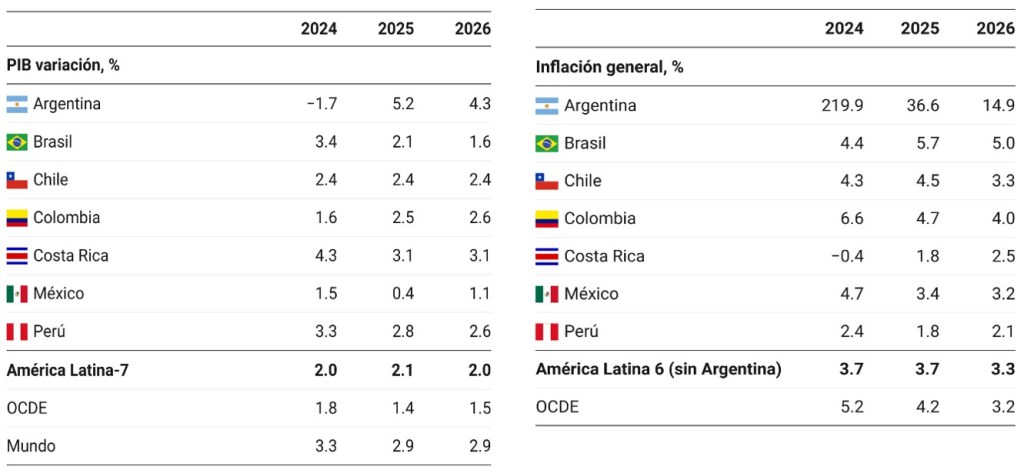
Se espera que el PIB en América Latina crecerá 2.1% en 2025 y 2% en 2026, lo que refleja una desaceleración generalizada en la región. Estas cifras son más bajas que las previstas a fines del año pasado y se sitúan por debajo del promedio de otras economías emergentes. Aunque se espera una fuerte recuperación en Argentina, el crecimiento se mantiene débil en la mayoría de los países, con revisiones a la baja para Brasil, México y Colombia (Tabla), en un contexto generalizado de una débil demanda externa y la alta incertidumbre.

Cuadro. Perspectivas económicas para los países de América Latina

Nota: América Latina 7 es la media ponderada por el PIB a valores de paridad del poder de compra de los 7 países en la tabla para el PIB. América Latina 6 es la media simple de los países incluidos en el cuadro para la inflación excluyendo a Argentina.
Fuente: OCDE Perspectivas Económicas No. 117, junio de 2025.

La desinflación avanza, pero persisten las presiones inflacionarias. La inflación se mantiene por encima del objetivo en muchos países. En cambio, Argentina ha logrado avances significativos gracias a una combinación de consolidación fiscal y una política monetaria más restrictiva. Con la excepción de Argentina y Brasil, los bancos centrales de la región deberían continuar con su flexibilización monetaria prudente y gradual para asegurarse que la inflación se acerque al objetivo, manteniéndose alerta ante riesgos de salidas de capitales y nuevas presiones inflacionarias.

Los riesgos para las perspectivas son a la baja. Un aumento de los aranceles comerciales y menor dinamismo al previsto en socios comerciales clave podría debilitar aún más las exportaciones y presionar a la baja los precios de las materias primas. Los costos comerciales podrían ralentizar más de lo esperado la desinflación en las economías avanzadas y prolongar tasas de interés globales más altas. Una elevada deuda pública y unas condiciones financieras globales más restrictivas de lo previsto, podrían retrasar la tan necesaria inversión. Si se intensifican las salidas de capital, los bancos centrales podrían tener menos margen de maniobra para flexibilizar la política monetaria.

Una agenda de competitividad para tiempos inciertos

En este complejo entorno global, la región necesita más que nunca mejorar sus políticas domésticas. Un área donde es posible avanzar, y urgentemente necesario, es en competitividad, comercio e inversión. Estas no son prioridades nuevas, pero los cambios globales en el comercio, las cadenas de suministro y la transición hacia economías más sostenibles aumentan su relevancia estratégica. Los países que ofrezcan estabilidad institucional, apertura y baja carga administrativa estarán mejor posicionados para atraer inversión y expandir sus mercados.

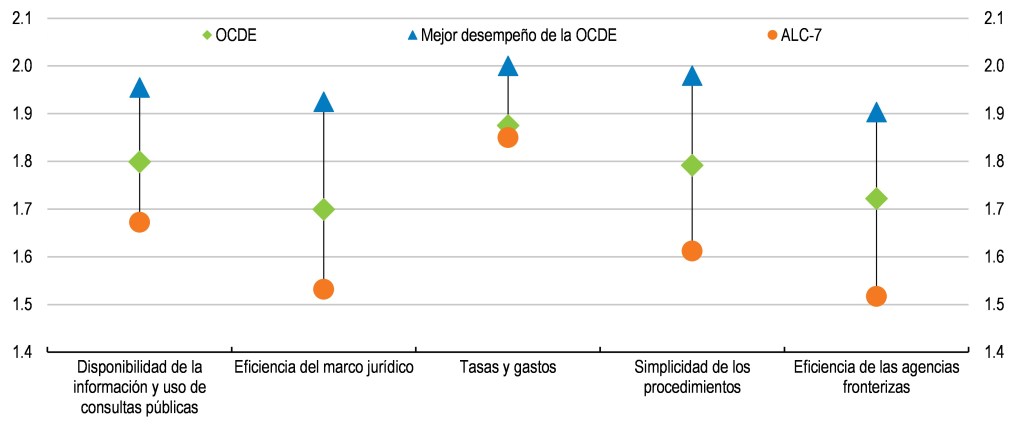
Mejorar los procedimientos aduaneros representa una oportunidad clara. Según los Indicadores de Facilitación del Comercio de la OCDE, América Latina aún enfrenta altos costos comerciales debido a procedimientos aduaneros complejos, inspecciones redundantes y poca coordinación entre agencias fronterizas (Figura). Hay amplio margen para mejorar el procesamiento, levante y despacho de mercancías, en particular mediante una mayor automatización y una mejor coordinación entre las agencias aduaneras, sanitarias, tributarias y otras agencias fronterizas. Medidas prácticas como la cooperación entre agencias de distintos países en la frontera, la agilización de los procesos judiciales y una mayor digitalización pueden beneficiar a los exportadores, especialmente a las pequeñas empresas, y atraer inversión. Además, estas medidas reducen los costos de operar formalmente, lo que incentiva a más empresas a salir de la informalidad.

Figura. Las políticas de facilitación del comercio pueden mejorarse en América Latina

2 = Mejor desempeño

Nota: Disponibilidad de la información y uso de consultas públicas es la media de los indicadores de la facilitación del comercio (TFI, por sus siglas en inglés) A y B. Eficiencia del marco jurídico es la media de los indicadores TFI C y D. Simplicidad de los procedimientos es la media de los indicadores TFI F, G y H. Eficacia de las agencias fronterizas es la media de los indicadores TFI I, J y K. ALC-7 es la media de Argentina, Brasil, Chile, Colombia, Costa Rica, México y Perú.
Fuente: Estadísticas sobre los Indicadores de Facilitación del Comercio de la OCDE (TFI, por sus siglas en inglés).

La facilitación del comercio debe ir acompañada de reformas más amplias que fomenten la productividad. Impulsar la competitividad de las exportaciones y la productividad empresarial también requiere un entorno empresarial más dinámico, una mayor competencia doméstica, un mejor acceso a la financiación, más capacitación y capacidad de innovación. Estas reformas se refuerzan mutuamente: las empresas más productivas tienen mayor probabilidad de exportar, invertir y formalizarse.

El fortalecimiento de la integración regional sigue siendo relevante en América Latina, especialmente en un mundo donde las cadenas de valor están cambiando y los centros regionales cobran mayor importancia. El enfoque debe centrarse en la cooperación: mejorar la cooperación entre organismos fronterizos, el reconocimiento mutuo de normas, el intercambio de datos, los sistemas interoperables y el reconocimiento de estándares técnicos comunes. La región también cuenta con un potencial sin explotar en el comercio de servicios, gracias a idiomas compartidos y husos horarios similares; sin embargo, el comercio interregional de servicios sigue siendo bajo en comparación con los estándares mundiales.

América Latina debe adoptar una visión más orientada hacia el exterior. Acuerdos comerciales como el de la UE-Mercosur, y la participación en marcos plurilaterales como la Alianza del Pacífico o el CPTPP pueden ayudar a diversificar mercados de exportación, atraer inversión, fortalecer la participación en las cadenas globales de valor y aprovechar nuevas tecnologías. Sin embargo, para aprovechar al máximo los beneficios de estas iniciativas, los países deben mejorar su capacidad de implementación y garantizar la coherencia entre las políticas comerciales, de inversión y regulatorias.

América Latina cuenta con ventajas reales: vastas reservas de minerales críticos, abundante energía renovable, una fuerza laboral joven y cada vez más cualificada, y proximidad a mercados clave. Al impulsar reformas concretas que mejoren la competitividad, reduzcan las barreras comerciales y atraigan inversión de calidad, la región puede convertir los desafíos actuales en oportunidades y sentar las bases para un crecimiento más sólido y resiliente.

Referencias:

OECD (2025), OECD Economic Outlook, Volume 2025 Issue 1, OECD Publishing, Paris, doi – Reporte completo en inglés con las proyecciones macroeconómicas, los principales desafíos estructurales e información detallada por país.

Perspectivas económicas de la OCDE para países de América Latina, Junio 2025.

Información detallada por país: Argentina | Brasil | Chile | Colombia | Costa Rica | México | Perú


Extending trade benefits to more firms and workers

By Aida Caldera, Alberto Gonzalez Pandiella and Alessandro Maravalle

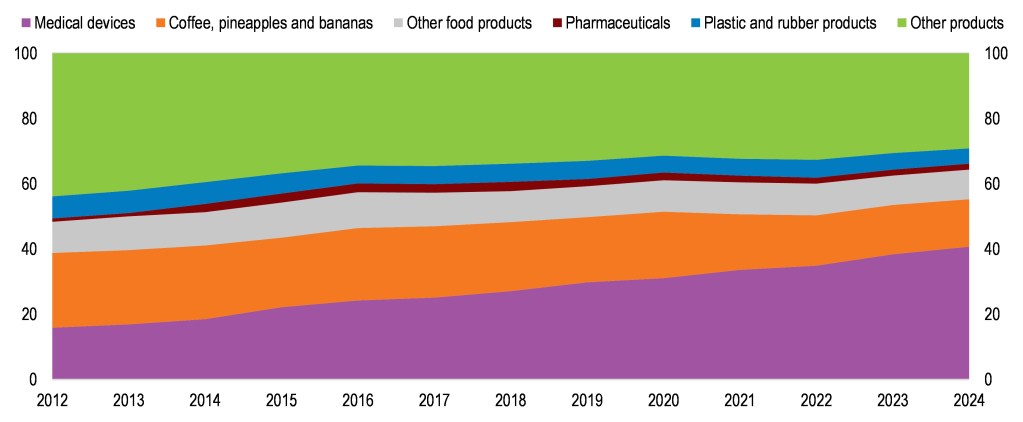
At the beginning of the 1990s, Costa Rica was primarily known for exporting agricultural products like bananas and coffee, along with its thriving tourism sector. Today, places like Alajuela have become global hubs for advanced manufacturing, particularly in the medical devices sector. A strong and sustained commitment with open trade explains this remarkable transformation.  Thanks to a more diversified export basket and a shift towards higher value-added goods and services (Figure 1), Costa Rica’s economy has grown more than other OECD countries and regional peers over the last three years and was more resilient to recent shocks. This success story is not without clouds or challenges, as detailed in the 2025 OECD Economic Survey. A long-standing challenge is that not all workers, companies and regions have so far benefited from trade.

Figure 1. High-tech products are a growing share of Costa Rica’s exports

Exports by type of product, % of total good exports

Source: Banco Central de Costa Rica.

Maximising trade benefits

There remain ample opportunities for Costa Rica to capitalize on its trade openness and FDI attractiveness. With Costa Rica’s exports remaining concentrated in a few destinations ongoing efforts to diversity trade agreements and enhance trade facilitation, which have regained considerable impetus since 2022, will facilitate stronger integration into global and regional value chains. Nearshoring offers new opportunities for Costa Rica to extend trade benefits to more workers, firms and regions. However, several barriers might prevent these opportunities from materializing. Continuing the path of reform to enhance education, foster innovation, improve infrastructure and promote stronger competition would help Costa Rica seize maximise trade benefits.

Costa Rica’s well-educated workforce has been traditionally key to attract FDI and develop value added exports. However, now large skills shortages pose a critical threat to Costa Rica’s FDI attractiveness. A comprehensive education reform is underway, but key timelines and milestones are still unclear. The ongoing efforts to reform education should prioritise the increase in the number of technicians and graduates in STEM areas and ensure that university education is better aligned with labour market demands.

Boosting innovation is crucial for Costa Rican firms to access international markets. However, interactions between public universities and businesses are weak, and most innovation funding goes directly to universities without impact evaluations. Competitive performance-based funding is limited, compared to other OECD countries. Strengthening interaction between public universities and businesses, and introducing  impact evaluations to innovation funding, would help boost firms’ innovation.

Infrastructure bottlenecks are large, driving up trade costs and limiting the participation of remote regions and SMEs in international trade. Key issues include poor-quality roads and overcrowded ports. The low quality of transport infrastructure can be attributed to underspending, deficient strategic planning and inefficient capital project execution, with only 30% of budgeted capital spending getting executed. Strengthening planning and design of transport projects and enhancing budget management  would reduce delays and cost overruns and contribute solve Costa Rica’s large infrastructure gaps.

Finally, boosting competition in domestic markets would help Costa Rican firms access better inputs at lower costs. Despite ongoing efforts to improve competition in some areas, , such as removing anticompetitive practices in professional services and reducing the large and complex stock of regulations, Costa Rica still has some of the strictest regulations in the OECD. Continuing to increase the Competition Authority’s budget is crucial for identifying and addressing anticompetitive practices.

References

OECD (2025), OECD Economic Surveys: Costa Rica 2025, OECD Publishing, Paris, https://doi.org/10.1787/048cf07b-en


Resilience in uncertain times

By Laura Betschka, Natalia García Soto and Max Glanville.

This blog is based on the editorial and Chapters 1 and 2 of the OECD Economic Outlook released in December 2024.

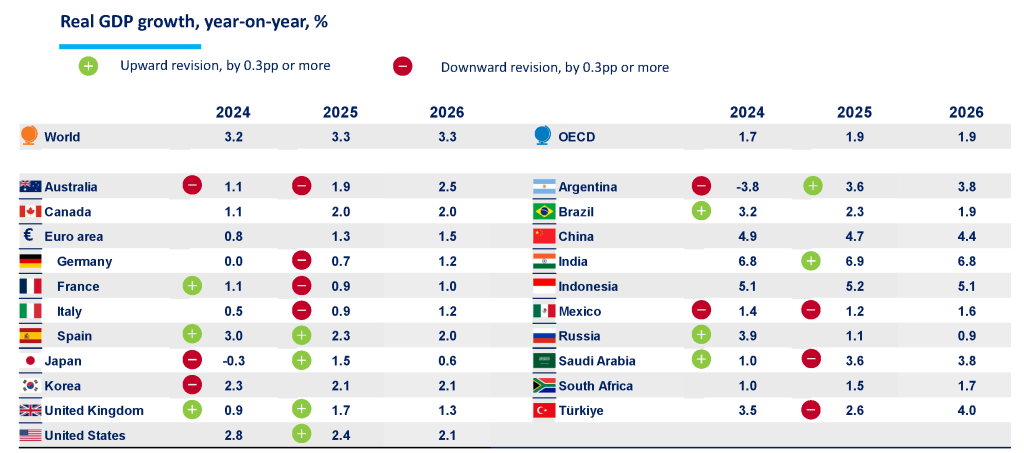
In the past few years, the global economy has demonstrated remarkable resilience despite being subject to major shocks, such as the pandemic and an energy crisis. Outcomes have varied significantly across countries. In the United States, growth remained particularly solid, fuelled by private consumption and real wage gains. On the contrary, many other advanced countries, especially in Europe, experienced more sluggish growth or even contractions. Indonesia and India have continued to grow strongly. In our recently published OECD Economic Outlook we project world GDP growth at 3.2% before edging up slightly to 3.3% in 2025 and 2026 (Figure 1).

Figure 1. GDP projections from the OECD Economic Outlook November 2024

Note: Revisions relative to the latest estimates from the May 2024 Economic Outlook. India projections are based on fiscal years, starting in April. World and OECD aggregates use moving nominal GDP weights at purchasing power parities.
Source: OECD Economic Outlook 116 databases; and OECD Economic Outlook 115 database.

Inflation has returned to central bank targets in the majority of the advanced and emerging-market economies covered by the OECD Economic Outlook. At the same time, labour markets are easing but remain generally tight, with unemployment rates still near historical lows in many countries. This labour market tightness, along with falling inflation, has led to solid real wage growth in many countries. Yet, in many advanced economies consumption growth remains subdued. A contributing factor is that consumer confidence on average remains low in both advanced and emerging market economies. Research in the OECD Economic Outlook indicates that elevated food and energy prices weigh particularly on consumer sentiment, as households are particularly sensitive to these essential expenses. In many countries, the costs of food and energy have increased more than household incomes since before the COVID-19 pandemic, leading to a higher cost of living.

 The relatively benign baseline outlook masks significant downside risks:

  • Rising trade tensions: Trade has been a fundamental driver of global growth, job creation and declining poverty in the past decades.  Rising trade tensions and an increase in protectionism might disrupt supply chains, raise consumer prices, and negatively impact growth.
  • A renewed escalation of geopolitical tensions and conflicts could disrupt trade and energy markets, potentially fuelling  inflation and constraining economic growth.
  • High levels of public debt: Some emerging market economies and low-income countries are now in debt distress or are at high risk of it. Public debt is also a pressing concern for advanced economies. Ageing populations, increased spending on defence and the investments needed for the green transition amplify these challenges.
  • Financial market volatility: Downside surprises may prompt sharp equity and bond market corrections, heightening volatility and systemic risks, particularly in the increasingly interconnected network of non-bank financial institutions.

Policy has a pivotal role to play in managing risks and unlocking prospects for strong, resilient and sustainable growth. This requires concerted action on monetary, fiscal, and structural policies.

As inflation pressures decline further, central banks should continue to ease monetary policy. Still, central banks need to act cautiously, considering incoming data and thoroughly assessing policy actions. Failing to durably contain inflation would increase the risks to growth and real incomes. 

Governments need to put in place credible fiscal consolidation strategies. Fiscal prudence is crucial amid high public debt levels and rising spending pressures. Governments must balance easing fiscal strains with sustaining economic growth.  

A Special Chapter of the recent OECD Economic Outlook focuses on labour shortages – an important challenge in many economies. Labour and skill shortages have risen over the past decade and intensified during the pandemic. Although labour markets are easing, shortages persist in many sectors, especially health and long-term care and information technology. On average, one out of four firms in OECD countries report severe labour shortages, defined as difficulties filling all or most vacancies. Such shortages, particularly in technology-intensive firms, hinder business expansion and adoption of productivity-enhancing innovations. Population ageing, which leads to a shrinking labour force, risks further exacerbating the labour shortage problem.

To reduce growth bottlenecks from labour shortages, key policy priorities include up-skilling and re-skilling of the workforce, with a focus on lifelong learning and digital skills training to improve skills supply and address mismatches. In addition, policies to increase the participation of women, such as the provision of quality and affordable childcare facilities and the promotion of a gender balance in occupations. Targeted migration and integration policies could also increase the labour supply, including easing restrictions on residence permits and speeding up the recognition of foreign diplomas. Ensuring tax and benefit systems are designed to encourage work, including through well-targeted in-work benefits and the removal of implicit biases against second earners, can further boost labour force participation. Other policy areas to be considered include promoting youth participation by stimulating vocational training and retaining older workers by promoting healthy ageing and pension reforms. 

In sum, while the global economy is expected to remain resilient, uncertainties around the central growth scenario are high. In the short term, it is essential for policymakers to ensure macroeconomic stability by ensuring that inflation is durably realigned with central bank target and ensuring sustainable public finances. In the medium term, efforts should focus on lifting growth potential through fostering multilateral dialogue and ambitious structural reforms, for example by investing in infrastructure, reform migration policies and creating a pro-competitive regulatory environment.

Reference

OECD (2024), OECD Economic Outlook, Volume 2024 Issue 2: Resilience in uncertain times, OECD Publishing, Paris, https://doi.org/10.1787/d8814e8b-en.


An unfolding recovery

By Clare Lombardelli, OECD Chief Economist

Available in French

Cautious optimism has begun to take hold in the global economy, despite modest growth and the persistent shadow of geopolitical risks. Inflation is easing faster than expected, labour markets remain strong with unemployment at or near record lows.  Private-sector confidence is improving.  Yet the impacts of tighter monetary conditions are being felt, especially in housing and credit markets.

This recovery is unfolding differently across regions. The United States and a number of large emerging markets continue to exhibit strong growth, in contrast to European economies.  The mixed macroeconomic landscape is expected to persist, with inflation and interest rates declining at differing paces, and differing needs for fiscal consolidation.  

Despite a more balanced risk outlook, substantial concerns remain.  High geopolitical tensions, particularly in the Middle East, could disrupt energy and financial markets, causing inflation to spike and growth to falter.  Debt service burdens are already significant, and could rise further as low-yielding debt is rolled over or fixed-term borrowing rates are renegotiated. Expectations that inflation will continue to decline steadily might also prove misplaced.

In the medium and longer term, the fiscal position is worrying.  Governments must address mounting debt and rising expenditure demands due to ageing populations, climate change mitigation, and defence needs.  Increasing debt-service costs further worsen fiscal sustainability.  There is never an attractive time to do this, but conditions enable this rebuilding to begin now.   A robust medium-term approach to containing spending, building revenues, and focusing policy efforts on growth enhancing structural reforms are all needed.

Disappointing growth underscores the case for strengthening global trade and productivity.   Trade and industrial policies should aim for resilient global value chains through diversification without undermining the benefits of open trade. At the same time, accelerating decarbonisation requires bold policy measures, such as investing in green and digital infrastructure, enhancing carbon pricing, and promoting technology transfer.  The developments in Artificial Intelligence (AI) provide a welcome and much needed opportunity to raise productivity.  Ensuring the benefits materialise and are broadly shared requires investments in education and training and strong and internationally consistent competition policy.

Access the digital report.

Reference:

OECD (2024), OECD Economic Outlook, May 2024: An unfolding recovery, OECD Publishing, Paris, https://doi.org/10.1787/69a0c310-en.


L’amorce d’une reprise

Clare Lombardelli, Cheffe économiste de l’OCDE

Un optimisme prudent a commencé à gagner l’économie mondiale, malgré une croissance modeste et l’ombre persistante des risques géopolitiques. Le recul de l’inflation est plus rapide que prévu, et les marchés du travail restent vigoureux, avec un taux de chômage à son plus bas niveau ou proche de l’être. Dans le secteur privé, la confiance s’améliore. Pour autant, les effets du durcissement des politiques monétaires sont perceptibles, notamment sur les marchés du logement et du crédit.

Cette reprise qui s’amorce diffère dans ses modalités selon les régions du monde. Les États-Unis et un certain nombre de grands marchés émergents continuent d’afficher une forte croissance, contrairement aux économies européennes. Le paysage macroéconomique devrait rester contrasté, le repli de l’inflation et des taux d’intérêt étant plus ou moins rapide et les besoins d’assainissement budgétaire plus ou moins importants.

Malgré des perspectives plus équilibrées sur le plan des risques, des préoccupations majeures subsistent. Les fortes tensions géopolitiques, notamment au Moyen-Orient, pourraient venir perturber les marchés de l’énergie et les marchés financiers, provoquant une envolée de l’inflation et un ralentissement de la croissance. Le service de la dette représente déjà une charge importante, qui pourrait s’alourdir davantage au fur et à mesure du refinancement des emprunts à faible rendement ou de la renégociation des taux des emprunts à terme fixe. Les attentes d’une poursuite de la baisse régulière de l’inflation pourraient également s’avérer inappropriées.

À moyen comme à long terme, la situation budgétaire est préoccupante. Les pouvoirs publics doivent faire face à un endettement croissant, ainsi qu’à la hausse des dépenses requise par le vieillissement démographique, l’atténuation du changement climatique et les besoins en matière de défense. La hausse du coût du service de la dette amplifie la dégradation de la viabilité budgétaire. Il n’y a jamais un moment idéal, mais les conditions actuelles permettent d’engager dès à présent le redressement des finances publiques. Une approche à moyen terme et ferme s’impose pour maîtriser les dépenses, accroître les recettes et centrer les efforts des pouvoirs publics sur des réformes structurelles favorisant la croissance.

La croissance étant décevante, cela appelle à renforcer les échanges mondiaux et la productivité. Les politiques commerciales et industrielles devraient viser à assurer la résilience des chaînes de valeur mondiales, en favorisant leur diversification sans compromettre les avantages de l’ouverture des échanges. Dans le même temps, l’accélération de la décarbonation exige de la part des pouvoirs publics des mesures ambitieuses, par exemple investir dans les infrastructures vertes et numériques, relever la tarification du carbone et promouvoir les transferts de technologies. Les progrès de l’intelligence artificielle (IA) offrent des perspectives de gains de productivité aussi bienvenues qu’indispensables. Pour que ces avantages puissent se concrétiser et être largement partagés, des investissements dans l’éducation et la formation, et une politique de la concurrence solide, cohérente au niveau international, seront essentiels.2 mai 2024.

Editorial des Perspectives économiques de l’OCDE

Référence:

OECD (2024), Perspectives économiques de l’OCDE, Volume 2024 Numéro 1, OECD Publishing, Paris, https://doi.org/10.1787/bd18c5ae-fr


Rétablir la croissance

Economic Outlook November 2023 cover image

Clare Lombardelli, Cheffe économiste de l’OCDE

L’inflation s’atténue, mais la croissance ralentit. Le resserrement des politiques monétaires nécessaire pour lutter contre l’inflation produit ses effets. Malgré une croissance du PIB plus forte que prévu en 2023, le durcissement des conditions financières, la faiblesse des échanges et la confiance en berne pèsent sur l’activité. Les marchés du logement et les économies tributaires des banques, notamment en Europe, en ressentent les effets.

Le rythme de la croissance est inégal. Les économies de marché émergentes connaissent globalement une situation plus favorable que les économies avancées. La croissance est moins rapide en Europe qu’en Amérique du Nord et dans les grandes économies d’Asie. L’inflation, bien qu’en recul, reste préoccupante.

Nous prévoyons un atterrissage en douceur pour les économies avancées, mais cette issue est loin d’être garantie. La relation entre l’inflation, l’activité et les marchés du travail a changé, si bien qu’il est difficile d’évaluer pleinement l’impact du resserrement des politiques monétaires. Aux États-Unis, l’économie se révèle plus dynamique que prévu, et il existe un risque que l’inflation s’avère persistante. Dans la zone euro, les effets du durcissement de la politique monétaire ne se sont pas encore pleinement matérialisés, et l’activité pourrait être plus fortement touchée qu’on ne l’anticipe.

Nombre d’économies de marché émergentes ont fait preuve d’une résilience considérable au cours de l’année écoulée, mais les pays présentant des vulnérabilités liées à leur endettement structurel sont maintenant surveillés de près par les marchés.

Les échanges mondiaux manquent de dynamisme. Des facteurs non seulement conjoncturels, mais aussi structurels entraînent un ralentissement de l’intégration des chaînes de valeur entre pays. Des opportunités de croissance, liées en particulier à une augmentation des échanges de services, sont inexploitées. Nous devons relancer le commerce mondial. Pour développer la résilience des chaînes de valeur mondiales, il s’agit de promouvoir plutôt la diversification que le protectionnisme ou des politiques de repli sur soi.

Graph showing trade growth has stalled

Les tensions budgétaires s’accentuent dans de nombreux pays. Compte tenu des évolutions démographiques, de la décarbonation ainsi que de la combinaison d’un alourdissement des charges d’intérêts et d’une croissance lente, les pays sont confrontés à des perspectives budgétaires difficiles. Les gouvernements doivent prendre des mesures audacieuses pour réduire ces pressions et mettre l’accent davantage sur la croissance dans l’élaboration de leurs politiques. Cela signifie qu’il faut réformer les politiques du marché du travail et les systèmes de retraite, intensifier la concurrence et actionner les leviers budgétaires pour accroître les investissements susceptibles de renforcer le capital humain et la productivité, notamment les investissements nécessaires à la transition écologique.

En résumé, l’économie mondiale est aux prises avec l’inflation, le ralentissement de la croissance et la montée des tensions budgétaires. Les décideurs publics doivent donner la priorité à la stabilité macroéconomique, aux réformes structurelles, aux politiques budgétaires intelligentes et à la coopération internationale, pour favoriser une croissance durable et inclusive.

Pour plus d’infos et de données: https://oe.cd/PE-nov23

References

OECD (2023), Perspectives économiques de l’OCDE, Volume 2023 Numéro 2, OECD Publishing, Paris,OECD