From Playgrounds to Growth: Bolstering early education in Mexico

by Alberto González Pandiella and Alessandro Maravalle, OECD Economics Department, Mexico Desk

Thanks to sound macroeconomic policies, the Mexican economy has been stable and resilient over the last decades.  Yet, growth has been elusive, despite Mexico’s large growth potential. Over the last two decades, Mexico’s GDP grew by around 9% while Chile grew by 68% or Dynamic Asian economies grew by 110%[1]. The ongoing redrawing of global value chains makes Mexico an attractive nearshoring destination and opens new growth opportunities. Grasping these opportunities requires several reforms, such as advancing digitalization, reducing regulatory burden or shifting to renewable energies, as detailed in the recently published 2024 Economic Survey of Mexico (OECD, 2024).  But there is one reform that will have a particularly large growth pay-off: setting a comprehensive early childhood and education network. This reform would simultaneously and cost-effectively renew two growth engines: female labour participation and skills.

Early childhood education and care is key to facilitate that Mexican women can pursue employment opportunities, as domestic and care responsibilities fall disproportionally on them, hampering their prospects to complete education or be in the labour force. At a moment when Mexican firms report difficulties to retain and find workers with the appropriate skills, taping on Mexico’s female talent would significantly boost Mexico’s growth. Female labour market participation has recently increased to 50%, its historical high, but is still the second lowest participation rate in the OECD (Figure).

Figure: Female labour force participation is low
% of female population aged 15-64, 2022

Note: LAC is a simple average of Chile, Colombia, Costa Rica, Argentina, and Brazil. Data for Argentina refer to the year 2021.
Source: OECD Labour Force Statistics.

Enhancing early childhood education and care coverage would also improve education outcomes at a moment when skills availability is becoming more central in firms’ decisions about where to invest. Mexico has a relatively young population, with significant potential to adapt to global trends that are reshaping skill needs, such as digitalization or decarbonization. But it also has two substantial challenges. First, still too many students leave the education system without completing secondary education. Second, there is room to increase education quality.  Boosting early childhood education would help with both challenges by mitigating the impact of socioeconomic disparities on educational outcomes.  Positive results will materialise in the medium-term, facilitating that more Mexicans gain the necessary skills to access formal jobs, widening the talent pool from which domestic and foreign firms can draw.

An early education network that would cover all children under 6 years old throughout Mexico would only cost 1.2% of GDP annually, a bit more than double what Mexico spends today (0.5% of GDP).  Mexico will need to find extra revenues to finance this reform, but the 2024 OECD Economic Survey (OECD, 2024) suggests that there are viable options, such as enhancing the collection of taxes on immovable property and of those related to the purchase, ownership and use of vehicles.

References:

OECD (2024), OECD Economic Surveys: Mexico 2024, OECD Publishing, Paris https://doi.org/10.1787/19990723


[1] Growth in real PPP-adjusted GDP per capita from 2000 to 2022. Source: World Bank World Development Indicators. Dynamic Asia includes India, Indonesia, Malaysia, Philippines, Thailand, and Viet Nam.



Reducing regional gaps in Bulgaria would support a more inclusive recovery

© Shutterstock.com/RossHelen

By Mikkel Hermansen, Bulgaria desk, OECD Economics Department

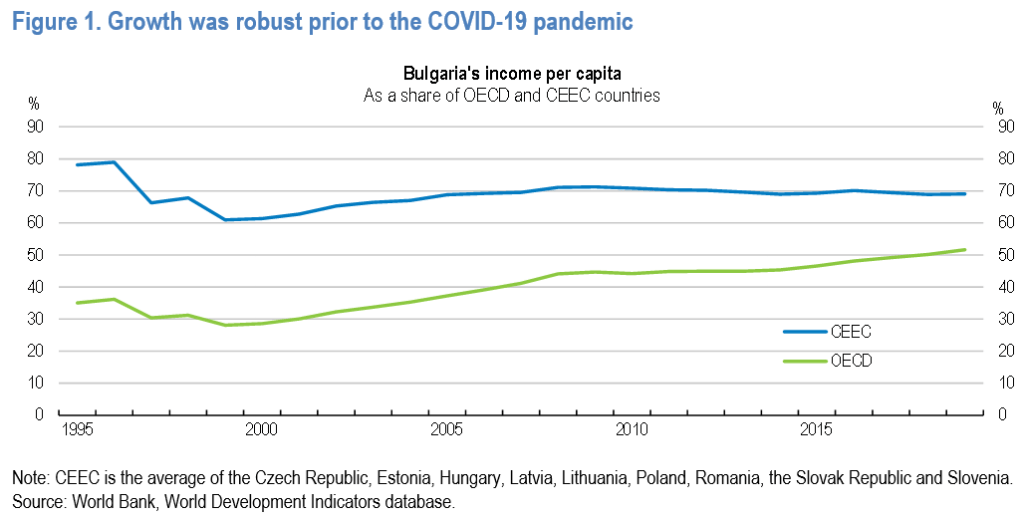
Bulgaria had several years of robust economic growth prior to the COVID-19 pandemic. Income per capita reached half of the OECD average (Figure 1), but did not catch up on faster-growing Central and Eastern European peers. The structural reform agenda has been substantial in recent years. Even so, the 2021 Economic Assessment of Bulgaria (OECD, 2021) calls for continued efforts to modernise the economy and enhance inclusion. This is all the more important as vaccinations accelerate and a recovery looms ahead.

A key challenge for Bulgaria is a fast-shrinking and ageing population (Figure 2). This has increased regional income differences that are now larger than in most OECD countries. Regions without larger cities are lagging behind and are facing multiple challenges from depopulation, high unemployment and widespread poverty. Increasing investments in infrastructure and housing reform would help to boost mobility and strengthen regional linkages to national and international supply chains. Many rural regions are strongly dependent on agriculture, while tourism plays a big role in coastal regions by the Black Sea. Bulgaria has taken several measures to cushion workers, notably in tourism, from the pandemic shock. This is welcome and should be followed by policies to facilitate sustainable local economic development in the longer term. For instance, from upgrading tourism and agricultural activities and products.

Improving living standards across all regions will require better coverage and access to public services. Health and long-term care needs to be strengthened in particular. Hospital capacity is high and helped to mitigate the ongoing pandemic crisis. Nonetheless, access to health care is restricted in many regions due to low numbers of general practitioners, and gaps in health insurance coverage remain significant. To address the pandemic, the government made treatment of COVID-19 available to all. Going forward, priorities should be given to increase effectiveness of public healthcare spending by gradually consolidating the hospital sector and reducing out-of-pocket payments for low-income groups.

References

OECD (2021), OECD Economic Surveys: Bulgaria 2021: Economic Assessment, OECD Publishing, Paris, https://doi.org/10.1787/1fe2940d-en.


If potential output estimates are too cyclical, then OECD estimates have an edge

by Yvan Guillemette and Thomas Chalaux, OECD Economics Department

To assess the cyclical position of an economy, macroeconomists use a concept called potential output, which measures the economy’s production rate that is consistent with stable inflation at the target. When actual output is below potential, the ‘output gap’ is negative, the economy is depressed and, without prompt intervention by the central bank, inflation would tend to sag below target. Conversely, a positive output gap indicates an overheating economy and portends price and wage pressures, signalling the need for tighter monetary policy.

A country’s output gap is also a crucial ingredient in the estimation of the structural budget balance, which serves to assess the impulse that fiscal policy is imparting on the economy. Since the 2005 reform to the European Union’s fiscal framework, the Stability and Growth Pact, the structural budget balance has been at the centre of assessments by the European Commission of member countries’ adherence to the Union’s fiscal rules.

The difficulty is that potential output, and measures derived from it, such as the output gap and the structural budget balance, are not directly observable but must be estimated. The objective is for potential output to capture structural changes in the economy, such as a declining working-age population associated with ageing, while letting cyclical fluctuations, which are expected to be temporary, flow through to the output gap measure. Potential output estimation is therefore largely a matter of separating out cyclical fluctuations from structural changes. Three international organisations routinely produce such estimates for their member countries: the European Commission (EC), the International Monetary Fund (IMF) and the OECD. Despite using broadly similar methods, differences arise from a number of methodological and judgemental choices.

It is difficult to assess the quality of potential output estimates because there are no ‘true’ observed values to compare them to. Nevertheless, one criticism increasingly levelled against such estimates is that they treat too much of regular economic fluctuations as being structural. Estimated potential growth tends to be too weak when the economy is weak and vice-versa. In other words, potential output estimates are excessively ‘pro-cyclical’. One consequence is that governments will tend to have a pessimistic view of the structural budget balance in bad times and, conversely, an optimistic view in good times. Too much procyclicality in potential output therefore encourages procyclicality in fiscal policy, whereas economists generally agree that fiscal policy should be countercyclical.

For instance, the economists Antonio Fatás and Lawrence Summers have argued that the financial and economic crisis of 2008 created an overly pessimistic view of potential output among policy makers, which led them to support contractionary fiscal policy (i.e. cuts in spending or increase in taxes). Fiscal austerity affected economies negatively by subtracting a vital source of demand and, via hysteresis effects, caused a reduction in potential output that not only validated the original pessimistic assessment, but also led to a second round of fiscal consolidation. As Fatás says, this succession of contractionary fiscal policies was likely self-defeating for many European countries in the sense that their public debt-to-GDP ratios are barely better today than when austerity measures started.

A simple measure of the cyclicality of potential output series can be obtained by regressing the annual change in estimated potential growth on a constant and the annual change in actual growth. The estimated coefficient on actual growth then measures the sensitivity of potential growth to actual growth. Intuitively, this measure should be positive but small.

The chart below reports the result of this exercise for potential output estimates published by the three aforementioned institutions as part of their spring 2018 forecasting rounds, using a common panel of 24 countries over the 1980-to-2017 period. Each regression uses 682 observations, so an average of 28 years per country.

OECD estimates yvan

The results show clearly that the spring 2018 European Commission potential output series were the most cyclical. On average in the Commission estimates, a one-percentage point change in actual real GDP growth is associated with a 0.18 percentage point change in potential growth. The coefficient on the IMF estimates is only slightly smaller. On the other hand, the OECD coefficient is less than half of the two others. One reason the OECD potential output measure may be less cyclical is that before smoothing them with a filter, the component series used to construct potential output are first cyclically adjusted by making use of other variables – such as survey measures of capacity utilisation or the investment rate – which are known to be correlated with the cycle (see Turner et al., 2016).

The above exercise does not use ‘real-time’ estimates of potential output so, for instance, the 2010 potential growth estimate for France is different now than it was back in 2010. The 2010 estimate was of course the relevant one for the conduct of policy at the time. Rather, the test assesses the amount of cyclicality inherent in current methodologies, which may also have evolved since 2010. And if current estimates for past years are considered too sensitive to actual growth, then it is likely that the real-time estimates being produced now with a given methodology are too sensitive as well.

The sensitivity of changes to potential growth to changes in actual growth rates is neither a perfect nor a comprehensive measure of the quality and reliability of potential output estimates. After all, simply using a fixed number for a country’s potential growth would show a zero correlation but would obviously be problematic. However, in the absence of other obvious flaws, the OECD potential output estimates appear less exposed to the procyclicality criticism than those of the EC or IMF.

References

Coibion, O., Y. Gorodnichenko and M. Ulate (2017), “The Cyclical Sensitivity in Estimates of Potential Output”, NBER Working Papers, No. 23580, National Bureau of Economic Research.

Fatás, A. (2018). “Fiscal Policy, Potential Output and the Shifting Goalposts”, CEPR Discussion Papers, No. 13149, Centre for Economic Policy Research.

Fatás, A. and L.H. Summers (2018), “The permanent effects of fiscal consolidations”, Journal of International Economics, Vol. 112, pp. 238–250.

Turner, D. et al. (2016), “An investigation into improving the real-time reliability of OECD output gap estimates”, OECD Economics Department Working Papers, No. 1294, OECD Publishing, Paris.