Un sector público más digital para una América Latina más productiva

Jens Arnold, Aida Caldera, Priscilla Fialho, Paula Garda, Alberto González Pandiella, Michael Koelle, Alessandro Maravalle, Dimitris Mavridis, Claudia Ramírez y Adolfo Rodriguez-Vargas, Departamento de Economía, OCDE

La última edición de las Perspectivas Económicas de la OCDE ofrece un diagnóstico realista pero esperanzador sobre las economías latinoamericanas. Aunque el entorno global sigue siendo complejo, marcado por tensiones comerciales y geopolíticas, la región tiene oportunidades claras para fortalecer el crecimiento económico a través de las reformas estructurales. Una de las más prometedoras: la transformación digital del sector público para simplificar trámites, reducir costos y mejorar la eficiencia regulatoria.

América Latina muestra resiliencia pero con desafíos persistentes

En línea con la evolución de la economía global, tras un crecimiento proyectado del 2.3% en 2025, se prevé una ligera desaceleración al 1.9% en 2026, antes de repuntar al 2.4% en 2027 en las  siete principales economías de la región. Factores como la consolidación fiscal en muchos países de la región, necesaria pero restrictiva, y una elevada incertidumbre política y económica seguirán afectando la demanda interna, la inversión y las exportaciones, principalmente en 2026.

Cuadro. Perspectivas económicas para los países de América Latina
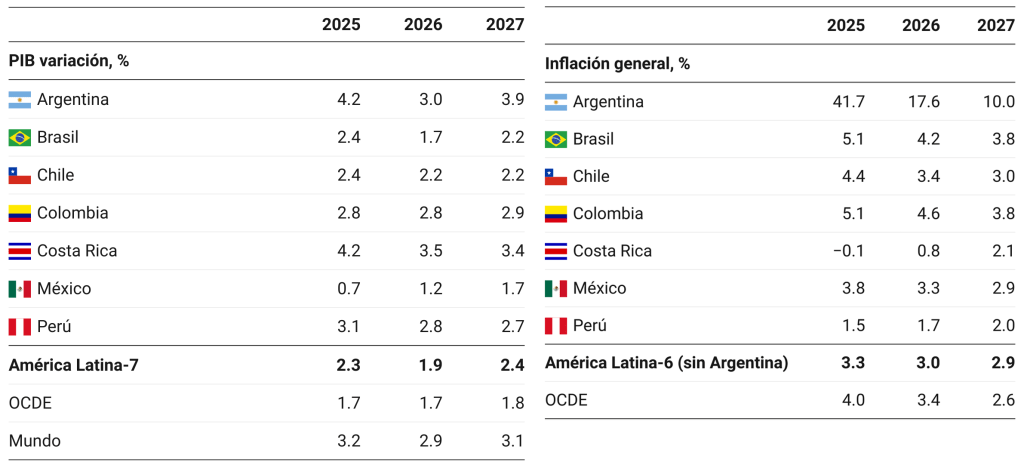
Nota: América Latina 7 es la media ponderada por el PIB a valores de paridad del poder de compra de los 7 países en la tabla para el PIB. América Latina 6 es la media simple de los países incluidos en el cuadro para la inflación excluyendo a Argentina.
Fuente: OCDE Perspectivas Económicas No. 118, diciembre de 2025.

La inflación en los últimos meses ha sido más persistente de lo esperado. En la mayoría de los países se prevé que en 2025 la inflación se mantenga por encima de las metas de los bancos centrales, convergiendo gradualmente hacia las metas en 2026 y 2027. Excepciones son Perú, donde la inflación está controlada hace un año, Costa Rica, que mantiene una inflación negativa en 2025, y Argentina, en donde la elevada inflación seguirá reduciéndose gracias a una combinación de consolidación fiscal y política monetaria restrictiva. La mayoría de los países tendría que mantener una política monetaria prudente basada en datos y orientada a devolver la inflación a sus metas sin generar presiones innecesarias sobre la actividad. En este contexto, los bancos centrales deben mantenerse atentos a la evolución del comercio global, las condiciones financieras, las expectativas de inflación y la orientación de la política fiscal. Al mismo tiempo, será clave que la consolidación fiscal siga avanzando con medidas concretas y más ambiciosas, dada la elevada deuda pública y la necesidad de asegurar su sustentabilidad en un entorno externo incierto y con elevados costos de financiamiento.

Los riesgos económicos están sesgados a la baja:

  • Incertidumbre global derivada de tensiones comerciales y geopolíticas, junto con la incertidumbre política en algunos países de la región asociada al ciclo electoral u otros factores internos, podría afectar negativamente a la inversión y las exportaciones, con repercusiones adversas sobre el crecimiento económico.
  • Desviaciones fiscales podrían subir el coste del servicio de la deuda, socavar la confianza, frenar la inversión y generar presiones inflacionarias.
  • Persistencias inflacionarias limitarían el espacio para reducir las tasas de interés, afectando las condiciones financieras y desincentivando el consumo y la inversión.

Sin embargo, también hay riesgos al alza: una reducción de las barreras comerciales o redirección del comercio hacia la región y una menor incertidumbre geopolítica podrían fortalecer el consumo, la inversión y el consumo.

Aprovechar la revolución digital para avanzar hacia marcos regulatorios más simples y eficientes

El capítulo especial de las perspectivas económicas subraya la necesidad de avanzar hacia marcos regulatorios más simples y eficientes. En este contexto, la transformación digital del sector público emerge como una herramienta clave para facilitar esta simplificación regulatoria, reduciendo la carga administrativa y modernizando procesos normativos. Una implementación eficiente de la gobernanza digital representa una gran oportunidad para América Latina, tanto para mejorar la eficiencia del gasto público y la transparencia, como mejorar el crecimiento económico al impulsar la productividad de las empresas, históricamente baja. Un gobierno digital bien implementado permite:

  • Ofrecer servicios públicos más rápidos, sencillos e inclusivos.
  • Reducir costos administrativos y simplificar trámites gubernamentales, mejorando el entorno de negocios, lo que cual se puede traducir en ganancias significativas de eficiencia al reducir costos y tiempos de espera, ampliar la cobertura y fomentar la competitividad de las empresas. 
  • Fortalecer la transparencia y rendición de cuentas facilitando el acceso ciudadano a la información, la detección de irregularidades, contribuyendo a prevenir el fraude.

Los indicadores de la OCDE muestran que países como Colombia y Brasil lideran el gobierno digital en la región. Colombia ha avanzado significativamente con la puesta en marcha de plataformas en línea, aplicaciones móviles para trámites gubernamentales y datos abiertos, mientras que Brasil ha sido pionero en servicios como el voto electrónico, las declaraciones de impuestos digitales, y más recientemente la centralización del acceso a cientos de servicios y la identificación digital. No obstante, muchos otros países siguen rezagados (Figure 1).

¿Qué se necesita para una transformación digital exitosa del sector público?

Para lograr una transformación digital exitosa en el sector público, los gobiernos de América Latina aún enfrentan retos importantes y requieren redoblar esfuerzos para lograr:

  • Infraestructura digital robusta con cobertura suficiente y sistemas interoperables entre niveles de gobierno para garantizar que todos puedan acceder a los servicios digitales.
  • Coordinación efectiva entre gobiernos centrales y locales. En muchos países de la región, existe una gran brecha en el uso de herramientas digitales entre las instituciones públicas centrales y las locales.
  • Autoridad política clara para liderar la transformación.  El reciente impulso a la agenda digital en México, incluida la creación de la Agencia de Transformación Digital y Tecnológica, es un ejemplo destacado de cómo dotar de liderazgo institucional a estos procesos
  • Regulación ágil y flexible para tecnologías emergentes como la inteligencia artificial.
  • Confianza ciudadana. Garantizar la privacidad y la seguridad de los datos es esencial para que los ciudadanos confíen y utilicen los servicios públicos digitales, aprovechando así al máximo el potencial de la digitalización. Además, publicar datos en formatos reutilizables facilitaría el acceso a información pública completa y confiable, mientras que impulsar la colaboración entre gobiernos, sociedad civil, universidades y empresas, aceleraría la experimentación y mejoraría el impacto de la gobernanza digital.

Casos exitosos como el de Estonia demuestran que una gobernanza digital bien implementada puede generar ahorros al gobierno equivalentes al 2 % del PIB anual.

Digitalizar para transformar

La digitalización del sector público no solo mejora la eficiencia del gasto público. También genera beneficios que se extienden a toda la economía, al elevar la productividad, reducir cargas administrativas para ciudadanos y empresas, facilitar la formalización y mejorar el acceso a servicios esenciales, todos desafíos de larga data en la región. Pero para que la gobernanza digital tenga legitimidad y pueda realmente desplegar todo su potencial, es necesario que todos se conviertan en “ciudadanos digitales”. Esto implica centrarse en las necesidades reales de la población y crear las condiciones para que todos tengan acceso a conexión a internet, dispositivos adecuados y las habilidades necesarias para navegar con seguridad. La transformación digital debe ser ambiciosa. Solo así la región podrá aprovechar todo su potencial y construir un futuro más próspero.

Para más información:

OECD (2025), OECD Economic Outlook, Volume 2025 Issue 2, OECD Publishing, Paris, https://doi.org/10.1787/9f653ca1-en – Reporte completo en inglés con las proyecciones macroeconómicas, los principales desafíos estructurales e información detallada por país.

Perspectivas económicas de la OCDE para países de América Latina

Información detallada por país: Argentina Brasil Chile Colombia Costa Rica | México Perú


Updating the Polish economy: how to digitalise and boost productivity

By Srdan Tatomir, OECD Economics Department

Poland experienced remarkable economic progress over the last three decades. Living standards have risen from around half the EU average in 1995 to close to 80% in 2021. Poland has substantially increased educational attainment and boosted skills, and Polish firms have successfully integrated into European and global markets. Digitalisation can help to sustain this success as our recent Economic Survey suggests.

While most firms in Poland already employ digital technologies, their use could be more extensive. Total investment in ICT and R&D is well below the OECD average and this is reflected in comparatively lower adoption of individual digital technologies (Figure 1). Most firms have a website, but e-commerce is not widespread. The use of software for managing customer relationships and enterprise resources is average by OECD standards and the adoption of more advanced technologies, such as cloud computing and big data, lags behind most OECD countries. In particular, the use of robots is low compared to other European countries, such as the Czech Republic and Slovakia (Leśniewicz and Święcicki, 2021). Small and medium-size enterprises (SMEs) are less digitalised than larger firms and, given that they account for two thirds of all employment and half of all output, this is where policy should focus.

Figure 1 – Digital technology adoption is relatively low in Poland

Diffusion of selected ICT tools and activities in enterprises, 2021 or latest
As a percentage of enterprises with ten or more persons employed

Note: CRM = customer-relationship management. Enterprise resource planning (ERP) systems are software-based tools that can integrate the management of internal and external information flows, from material and human resources to finance, accounting and customer relations. Here, only sharing of information within the firm is considered. Cloud computing refers to ICT services used over the Internet as a set of computing resources to access software, computing power, storage capacity and so on. Supply chain management refers to the use of automated data exchange applications. Big data analysis refers to the use of techniques, technologies and software tools for analysing big data. This, in turn, relates to the huge amount of data generated from activities that are carried out electronically and from machine-to-machine communications. Social media refer to applications based on Internet technology or communication platforms for connecting, creating and exchanging content online with customers, suppliers or partners, or within the enterprise. Radio frequency identification (RFID) is a technology that enables contactless transmission of information via radio waves.
Source: OECD ICT Access and Usage by Businesses Database.

Digital investment in firms is relatively low for a number of reasons. Firms in Poland tend to overestimate their own technological sophistication (World Bank, 2022). When they consider digital investments, they often undervalue the benefits and overestimate the costs. A lack of time and adequate skills are also cited as obstacles.

The government is already taking action. The ‘Future Industry Platform’ foundation was set up to accelerate the digital transformation of industry through promotion of and technical support for new technology adoption. The Polish Agency for Enterprise Development, known in Poland as PARP, is currently running several pilot programmes to support digitalisation.

To facilitate digital investment in firms, the authorities should consider expanding targeted technical and advisory support. Many ICT investments can be profitable, but SMEs often lack the knowledge and skills to choose the appropriate ICT tools, which results in low investment demand. Thus, there is a need for proactive consultancy and advisory services. For example, Denmark and Austria operate programmes for SMEs that help them to identify digital opportunities and then to implement the new technologies.

Digital technologies require skilled people to use them. Skilled managers are important in identifying new technologies and implementing them (Zadura-Lichota, 2015). Management skill levels are broadly average in Poland, relative to other European countries, but could be increased. Managers also need workers with digital skills to install and operate new digital technologies. However, adults’ digital skills, particularly among older adults, are relatively low (Figure 2). People in Poland tend to use ICT for simple tasks, such as searching for information and using social media, while the use of ICT for work purposes is less widespread.

Figure 2 – Digital skills lag behind most European countries

% of individuals who have basic or above basic overall digital skills, by age group, 2021

Source: Eurostat.

Lifelong learning is key to developing digital skills. Adults need to continue to learn digital skills, but participation in formal adult learning is low as firms tend to underinvest in training (Figure 3). This is mainly due to little perceived need for further training, as well as family responsibilities and scheduling issues. Better awareness of the benefits of adult learning, coupled with more extensive and detailed counselling, could encourage adults to develop their digital skills. Adult learning also needs to be made more flexible and modular so that it fits around work and personal duties. Many Polish people learn in less formal ways, such as from colleagues or by themselves. Recognising prior learning and making more use of short learning training certifications, such as micro-credentials, could help identify digital skill gaps, but also encourage workers to profit from their skills in the labour market. Individual training accounts, such as those introduced in France in 2015, can facilitate adult learning.

Figure 3 – Participation in formal adult learning is low

% of the 15-54 population, 2021

Source: Eurostat.

Poland needs more ICT specialists. The ICT sector has some of the highest vacancy rates. To increase the number of ICT specialists, it is essential that schools have adequate ICT equipment and that teachers are appropriately trained to teach digital skills. As young people progress with their schooling, they should be able to specialise in ICT. Within vocational education, new ICT programmes have been introduced, which should partly address digital skill shortages in the economy. But universities can also boost the number of ICT graduates through more flexible programmes that allow students from other disciplines to also specialise in ICT. Moreover, Poland should encourage more women to study ICT by raising awareness and through scholarships.

Further digitalising the economy can boost productivity. Closing a quarter of the gap with best performing OECD countries in terms of more ICT adoption in firms and better managerial and digital skills could raise the long-run level of GDP by around 6% (Sorbe et al., 2019). Public policies can support and facilitate this transition but they need to be comprehensive and inclusive to ensure the benefits are shared by all.

References:

Leśniewicz, F. and I. Święcicki (2021), “Czy pandemia przyśpieszyła robotyzację?” [Has the pandemic accelerated robotisation?], Polish Institute of Economics, Warsaw.

OECD (2023), “OECD Economic Surveys: Poland 2023”, OECD Publishing, Paris.

Sorbe, S. et al. (2019), “Digital Dividend: Policies to Harness the Productivity Potential of Digital Technologies“, OECD Economic Policy Papers, No. 26, OECD Publishing, Paris.

Zadura-Lichota, P. (2015), “Innovative entrepreneurship: Revealed and hidden potential for innovation in Poland”, Polish Agency for Enterprise Development (PARP), Warsaw.

World Bank (2022), “Drivers of Productivity Growth in Poland: A Firm-Level Perspective on Technology Adoption and Firm Capabilities”, World Bank Group, Washington DC.


Korea: Roadmap to narrow digital gaps

By Mathilde Pak, OECD Economics Department

When it comes to emerging digital technologies, Korea is a top player, with an outstanding digital infrastructure and a dynamic ICT sector. 5G has been introduced nationwide earlier than in any other country in the world and has spurred numerous projects supported by the governement to enhance competitiveness, innovation and the quality of life: smart factories, smart grids, smart healthcare, smart cities, smart roads. Korea also stands out for its swift and effective use of advanced digital tools to contain COVID-19 without shutting down the economy. For instance, artificial intelligence enables fast testing, mobile apps provide real-time information on locations visited by patients diagnosed with COVID-19 (Figure 1) and untact (contactless) lifestyle limits the spread of the virus. The recent New Digital Deal further supports the use of digitalisation with projects exploiting synergies between the government and the business sector, including strengthening data infrastructures, expanding data collection and usage, establishing 5G network infrastructure early, promoting untact industries and developing artificial intelligence.

However, the diffusion of digital technologies among firms and workers is slow. The digital gap between SMEs and large enterprises is wide because SMEs face obstacles to the adoption of advanced technologies, like cloud computing and big data: lack of innovation, lack of information and funds, lack of skilled workers and low access to training. This digital gap creates wide productivity gaps, weighing on economy-wide productivity, which is far below the OECD average. Moreover, the digital gap between generations is the highest among OECD countries (Figure 2). In an ageing and increasingly digitalised society, this exacerbates well-being inequalities, as part of the population is left behind.

Digital opportunities to boost productivity and well-being are numerous but are not used to their full potential. To promote the diffusion of technology, the 2020 OECD Economic Survey of Korea highlights recommendations focussing on three main areas.

First, regulations for product and service markets remain stringent, holding back innovation and new business models, as well as competition and productivity growth. The government has introduced regulatory sandboxes allowing firms in new technologies and new industries to test their products and business models without being subject to all existing legal requirements. The temporary lifting of the ban on telemedicine during the COVID-19 outbreak illustrates the potential benefits of a timely review of regulations. After four years at most, if a regulatory sandbox is considered effective and safe, it can lead to the permanent suppression of the regulation that was temporarily waived, its amendment, or the extension of the trial period. It can also lead to the creation of licences with a narrower scope, for example for FinTech companies, which could be allowed to provide some banking services without needing a full banking licence. Follow up on this strategy should allow identifying excessive regulation and revise or abolish it, notably in the case of telemedicine.

Second, subsidies to SMEs should better target innovative and productive companies. Extensive government R&D support still largely props up low-productivity companies and scale-up success is limited. Innovation vouchers in the form of a one-off payment should be provided to SMEs in manufacturing and services to commission R&D and studies on potential for new technology introduction from universities and research institutions. They would help develop innovation networks, which are still limited in Korea, and facilitate the diffusion of digital technology. In addition to promoting collaboration between SMEs and academia, collaboration between SMEs and large enterprises should be further strengthened to enhance innovation diffusion, for instance through open collaborative platforms to exchange new products, services and big data. Financial support for technology R&D should also be reallocated to commercialisation for SMEs that successfully developed new technology.

Third, addressing the lack of adequate skills and awareness of digital benefits or dangers is crucial. SMEs face a lack of skilled workers in digital fields, limited access to ICT training and insufficient awareness of managers of the potential of digital technologies. Older generations often lack digital and basic skills to participate in online activities like e-commerce. Most teachers feel they are not sufficiently prepared to use ICT for teaching, which has been a hurdle during the COVID-19 school closures. A relatively high share of individuals experience privacy violation and youth are at higher risk of cyber-bullying and addiction to ICT technologies. More specialists and high-level researchers are needed in fourth industrial revolution core technologies like artificial intelligence and big data, as well as next-generation security technologies like blockchains and quantum cryptography communication. Higher-quality ICT education and training should be provided to enable students, teachers, SME workers and older people to thrive in a digital society.

The COVID-19 outbreak is strengthening the existing trend towards digitalisation, with a growing use of artificial intelligence and remote services like telework, telemedicine and e-commerce by firms and households. Narrowing the digital gap between firms and between workers is key to bring about a more rapid diffusion of technology and to make the most of digital opportunities to raise productivity and well-being.

References:

OECD (2020), OECD Economic Surveys: Korea 2020, OECD Publishing, Paris.
https://doi.org/10.1787/2dde9480-en

Pak, M. (2020), “Promoting the diffusion of technology to boost productivity and well-being in Korea”, OECD Economics Department Working Papers, OECD Publishing, Paris, forthcoming.


Policy changes to turn the tide

by Laurence Boone, OECD Chief Economist

For the past two years, global growth outcomes and prospects have steadily deteriorated, amidst persistent policy uncertainty and weak trade and investment flows. We now estimate global GDP growth to have been 2.9% this year and project it to remain around 3% for 2020-21, down from the 3.5% rate projected a year ago and the weakest since the global financial crisis. Short-term country prospects vary with the importance of trade for each economy though. GDP growth in the United States is expected to slow to 2% by 2021, while growth in Japan and the euro area is expected to be around 0.7 and 1.2% respectively. China’s growth will continue to edge down, to around 5.5% by 2021. Other emerging market economies are expected to recover only modestly, amidst imbalances in many of them. Overall, growth rates are below potential.

The mix between monetary and fiscal policies is unbalanced. Central banks have been easing decisively and timely, partly offsetting the negative impacts of trade tensions and helping to prevent a further rapid worsening of the economic outlook. Thereby, they have also paved the way for structural reforms and bold public investment to raise long-term growth, such as spending on infrastructure to support digitalisation and climate change. However, to date, other than a few countries, fiscal policy has been only marginally supportive, and not especially of investment, while asset prices have been buoyant.

The biggest concern, however, is that the deterioration of the outlook continues unabated, reflecting unaddressed structural changes more than any cyclical shock. Climate change and digitalisation are ongoing structural changes for our economies. In addition, trade and geopolitics are moving away from the multilateral order of the 1990s. It would be a policy mistake to consider these shifts as temporary factors that can be addressed with monetary or fiscal policy: they are structural. In the absence of clear policy directions on these four topics, uncertainty will continue to loom high, damaging growth prospects.

The lack of policy direction to address climate change issues weighs down investment. The number of extreme weather events is on the rise and insufficient policy action could increase their frequency. They may lead to significant disruptions to economic activity in the short term, and long-lasting damage to capital and land, as well as to disorderly migration flows. Adaptation plans are in their infancy, while mitigation, moving away from fossil fuels, through measures such as carbon taxes, has proved technically and politically challenging. Governments must act quickly: without a clear sense of direction on carbon prices, standards and regulation, and without the necessary public investment, businesses will put off investment decisions, with dire consequences for growth and employment.

Digitalisation is transforming finance, business models and value chains, through three main channels: investment, skills and trade. So far, only a small fraction of businesses appear to have successfully harnessed the strong productivity potential of digital technologies, which partly explains why digitalisation has been unable to offset other headwinds on aggregate productivity. Reaping the full benefits of digital technologies requires complementary investments in computer software and databases, R&D, management skills and training, which remains a challenge for too many firms. Digitalisation is also affecting people and work, because it confers a huge advantage to people whose main tasks require cognitive and creative skills, and penalises those whose work has a large routine element, and at the same time generates new forms of contractual arrangements that escape traditional social protection. But the policy environment to harness new technology – concerning skill upgrading, social protection, access to communication infrastructure, digital platform development, competition in digital markets and regulation of cross-border data flows – lags behind, making it difficult to reap the benefits of digitalisation in full.

The Chinese economy is structurally changing, rebalancing away from exports and manufacturing towards more consumption and services. Increasing self-sufficiency in core inputs for certain manufacturing sectors is reflecting a desire to move away from importing technology towards national production. A shift in energy utilisation to address pollution, and the rise in services also induce additional changes in Chinese demand for imports. China’s traditional contribution to global trade growth is set to slow and change in nature. While India is set to grow rapidly, its growth model is different and its contribution to global trade growth will not be enough to substitute for China as a global engine for traditional manufacturing.

Trade and investment are also structurally changing, with digitalisation and the rise of services, but also with geopolitical risks. The rise in trade restrictions is nothing new. About 1500 new trade restrictions have been implemented by G20 economies since the global financial crisis in 2008. Yet, the past two years have seen a surge in trade-restricting measures and an erosion of the rules-based global trading system, which is deep-rooted. Coupled with rising government support across a range of sectors, this induces disruptions in supply chains and reallocations of activities across countries that both exert a drag on current demand by reducing incentives to invest and undermine medium-term growth.
Against this backdrop, there is scope and an urgent need for much bolder policy action to revive growth. Reducing policy uncertainty, rethinking fiscal policy, and acting vigorously to address challenges raised by digitalisation and climate change, all have the potential to reverse the current slippery trend and lift future growth and living standards.

First, a clear policy direction for transitioning towards sustainable growth amidst digitalisation and climate challenges would trigger a marked acceleration of investment. Governments should focus not only on the short-term benefits of fiscal stimulus, but primarily on the long-term gains and to this end they should review their investment policy frameworks. The creation of national investment funds, focused on investing in the future, could help governments design investment plans to address market failures and take account of positive externalities for society as a whole. A number of governments already have dedicated funds of the sort, but their governance could be improved to ensure higher economic and social returns on investment.

Second, greater trade policy predictability and transparency could go a long way to reduce uncertainty and revive growth. For instance, there is a need to bring more transparency to the numerous forms of government support that distort international markets and to agree global rules on the transparency, predictability, reduction and prevention of such support.

Third, fiscal and monetary policies can be better activated, and to powerful effect if coordination prevails. There is scope to strengthen automatic stabilisers to preserve household income and consumption. Active coordination across the euro area would contribute to lift growth now. Moreover, should the outlook deteriorate more than we project, coordinated fiscal and monetary action across the G20, even allowing for the limited policy space some central banks have, could efficiently avert a recession, not least because coordination would bolster confidence.

The current stabilisation at low levels of economic growth, inflation and interest rates does not warrant policy complacency. The situation remains inherently fragile, and structural challenges – digitalisation, trade, climate change, persistent inequalities – are daunting. Rather, there is a unique window of opportunity to avoid a stagnation that would harm most people: restore certainty and invest for the benefit of all.

http://oecd.org/economic-outlook/


Are digital technologies the new Holy Grail ?

By Stéphane Sorbe, Peter Gal, Giuseppe Nicoletti and Christina Timiliotis

Digital innovations are everywhere, in our pockets, cars and homes. However, while digital technologies seem to offer great potential to enhance firm productivity, productivity growth has slowed sharply in most OECD countries over the past two decades (Figure 1).

Source: OECD Productivity Statistics

One explanation to this puzzle is that digital
technologies are spreading out across firms less rapidly than we think.
Moreover, digital adoption has not been equally effective across all types of
firms.

As more productive firms have tended to adopt
digital technologies faster and more efficiently, their performance has improved
relative to less-digitalised, less-productive firms, contributing to a widening
gap in productivity performance. This has far-reaching implications, as it
contributes to widening wage dispersion and income inequalities.

Recent
OECD work
focusing on EU countries suggests that
policies have a key role to play to enable efficient adoption of digital
technologies across firms, industries and countries, potentially yielding substantial
productivity gains and helping less productive firms to catch up.

A first paper (Andrews et al., 2018)
suggests that a set of structural and policy factors can affect firms’
capabilities and incentives to adopt a selection of digital technologies (e.g.
cloud computing, back and front-office integration software). These factors
include the availability of enabling infrastructures (such as high-speed
broadband internet), managerial quality and workers skills, and product,
labour and financial market settings that enable an efficient reallocation of
ressources across firms. Importantly, there are strong complementarities between
these factors.

A second paper (Gal et al., 2019) confirms that the adoption of digital technologies supports firm productivity. The benefits tend to be higher among more productive firms, presumably because they have more access to the technical and organisational skills that are crucial to adopt and use digital technologies efficiently. Indeed, the presence of skill shortages in an industry is found to reduce the benefits of digitalisation, mainly among the least productive firms. As a result, digitalisation may explain about half of the rising gap between best performing firms and the rest of firms observed over recent years.

The main findings of these two papers are combined and summarised in Sorbe et al. (2019). The analysis confirms that improving policies in a range of areas can support digital adoption and thereby substantially lift firm productivity (Figure 2). Thus, if widely adopted and well used, digital technologies could indeed help overcoming the headwinds that drive the global productivity slowdown.

Source: Sorbe et al. (2019)

While policies to make the best of digital technologies should be tailored to country specificities, the following priorities emerge across the OECD:

  • Implementing regulatory frameworks that support investment in
    broadband and pro-competition reforms in telecommunication sectors to enable
    broader and cheaper access to high-speed internet;
  • Increasing participation in training – especially of low-skilled
    workers – and its quality, as well as promoting good cognitive, organisational
    and managerial skills;
  • Enabling the efficient reallocation of labour and capital across
    firms and industries by reducing administrative burdens on start-ups,
    facilitating job transitions and improving the efficiency of insolvency
    regimes;

In addition to stimulating productivity, some of these policies can support inclusiveness to the extent that they help lagging firms to catch up, displaced workers to find other jobs and support wage growth. Upgrading skills is particularly important in this respect.

References:

Andrews, D., G. Nicoletti and C. Timiliotis (2018), “Digital
technology diffusion: A matter of capabilities, incentives or both?
”,
OECD Economics Department Working Papers, No. 1476, OECD Publishing, Paris

Gal, P., G. Nicoletti, T. Renault, S. Sorbe and C. Timiliotis (2019), “Digitalisation and productivity: In search of the holy grail – Firm-level empirical evidence from EU countries”, OECD Economics Department Working Papers, No. 1533, OECD Publishing, Paris.

Sorbe, S., P. Gal, G. Nicoletti and C. Timiliotis (2019), “Digital dividend: Policies to harness the productivity potential of digital technologies”, OECD Economic Policy Paper No. 26, OECD Publishing, Paris.


Making trade and digitalisation work for all

by Laurence Boone, OECD Chief Economist

IncgrowthblogLB12-11-2018For some, the financial crisis was an eye-opener exposing the inequalities in life chances between those with the right skills and those without, between those born and educated in the right places and those who were not.  But for many others the growing gap in well-being has been a reality for decades.

Widening inequalities threaten economic growth, undermine trust in government and democracy, and fuel discontent with the multilateral rules-based system of market economies.

Governments can and should seek to reverse the trend towards growing inequality and ensure that  economic growth benefits everyone. Making trade and digitalisation work for all is not about idealism: it is about improving people’s standard of living, boosting opportunities for inter-generational mobility and ensuring a brighter future for all.

The OECD has developed a whole-of-government approach, built around analysis of policies and strategies to ensure that the fruits of economic growth are better shared across society. We identify comprehensive policy packages that optimise gains in GDP and households incomes, including among the less well off.

There are no one-size-fits-all reform packages, but key principles can guide policy-making for inclusive growth by targeting three broad areas for action: firms, skills and workers.

  • Firms: to promote business dynamism and the diffusion of knowledge by, for instance, lowering barriers to market entry or improving the efficiency of the corporate tax system.
  • Skills: by fostering higher quality education and greater innovation and through better-adapted R&D policies so that innovation fosters productivity gains across all types of activities.
  • Workers: with policies that ensure workers benefit from a fast-evolving labour market, including those who are most vulnerable to the changing demand for skills and automation, or who have less bargaining power.

The principles build on extensive OECD empirical research into the effects of pro-growth structural policy reforms on household disposable incomes. This research highlights the trade-offs between productivity gains and inequality when they appear, as well as possible synergies between efficiency and equity.

The policies needed to raise equality of opportunity are clear. It is striking that a child whose parents did not graduate from secondary school has only a 15% chance of doing so himself or herself, compared to a 65% chance for more well-off children.  Equality of opportunities can foster social mobility: an equal access to education, finance, jobs, health, transport and other public services helps compensate for the environment in which people were born. Good quality education is primordial throughout life – especially early childhood education, but also training at work, which too often benefits those already well educated.

Other reforms have more ambiguous effects on efficiency and equity. Policies which reduce labour costs by lowering unemployment benefits increase employment, but also make the vulnerable more fragile when there is an economic downturn. Meeting the twin objectives of raising employment while mitigating the negative consequences on poor households requires well-targeted active labour market policies to enhance the employability of low-skilled workers, the long-term unemployed and discouraged job seekers.

Some policies have more ambiguous effects: raising the minimum wage reduces inequality, just as stronger unions may strengthen workers’ bargaining position.  When firms have the option of investing in automation technology,  striking the right balance between bargaining power and the economic environment is  crucial to preserving employment with appropriate wage gains.

Spurring productivity, by easing barriers to firm entry and competition in product markets, supports GDP growth gains without exacerbating inequality, but only to the extent that the associated job gains are fairly equally shared across households. This requires the distributional effects of higher employment – which tends to benefit the less affluent households disproportionately – to more than offset those of higher labour productivity, which tends to benefit  the wealthiest households.

Inclusive growth also requires devoting careful attention to transition. Opening markets to trade or progress in technology inevitably leads to the decline of certain companies and obsolescence of particular skills. Accompanying measures – building on an active partnership between employers and governments, often at the regional level – can help workers and strengthen trust in the protective capacity of governments. Safety net packages and trampoline policies for keeping workers in the labour markets are all relevant. For example, in Sweden, job security councils, founded by employers, assist workers whose employment is put at risk when firms restructure. The programmes have enabled  85% of displaced workers to find a new job within a year, a higher rate than any other OECD country. Conversely, the US Trade Adjustment Assistance and the EU Globalisation Adjustment Fund, which lack such partnerships, have barely benefitted those affected by the displacement of economic activities.

It is important to acknowledge that transitional policy responses have limits. This is especially the case for persistent shocks concentrated in specific regions, sectors or skills. When distributional effects are persistent, direct fiscal policy measures may be needed to restore equity and opportunity. These may include well-designed wealth and inheritance taxation, paying particular attention to the progressivity of the tax system, and better targeting social benefits towards those who need those most. Separately at the global level, the international  programme to tackle Base Erosion and Profit Shifting (BEPS) and increase information transparency of the tax system will help strengthen the level-playing field and ensure a fair share of firms’ revenues is allocated to where value added is produced. This will help stabilise government revenues and ensure redistribution  benefits to those who need it most, but perhaps more importantly may help increase trust in multilateral cooperation.

Sustained growth is a pre-condition for improving living standards and job creation, but sustainability depends on an effective and perceived broad sharing of the growth dividends. The OECD has been promoting an inclusive growth framework based on three pillars: equal opportunities, business dynamism and inclusive labour markets, efficient and responsive governments. Implementation needs to start today.

References: