Lithuania: Addressing demographic challenges 

Vilnius, Lithuania overview

By Pierre-Alain Pionnier

Lithuania’s population is expected to decline by 20% and its working-age population by 30% over the next 25 years (Figure 1). Few countries will face such a large demographic shock. This calls for policy responses across different areas, including fiscal and labour market policies, as explained in the 2025 Economic Survey of Lithuania

Figure 1. Lithuania will face a large demographic shock

Change in the working-age population (20-64 years old), %, 2022-2050
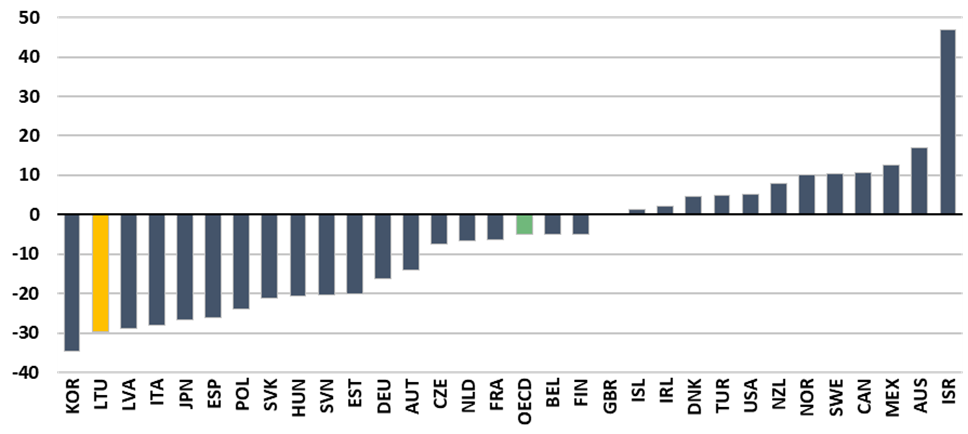
Figure showing Lithuania will face a large demographic shock
Source: UN World Population Prospects 2022 (Medium scenario)

Ageing-related expenditure is set to increase by 3.6% of GDP by 2045, most of it related to the financing of public pensions. At 37% of GDP in 2023 Lithuania’s public debt is one of the lowest in the OECD, but simulations show that it could increase rapidly due to ageing-related costs.

Unfortunately, there is not much that Lithuania can do to contain the expected increase in pension spending, at least in the short term.

The statutory retirement age is currently around 64, similar to the OECD average, and will increase to 65 in 2026 for both men and women. Significant disparities in life expectancy between men and women and across socio-economic groups make further increases in the retirement age difficult. Lithuanian men have one of the lowest life expectancies in the OECD and enjoy relatively short retirement periods. Even in an optimistic scenario, fiscal savings that could be obtained from linking the retirement age to life expectancy would be limited in Lithuania.

Adjusting pension benefits could in principle provide a way to improve the financial sustainability of the pension system. But pension replacement rates, which measure pension benefits relative to pre-retirement wages, are already the lowest in the OECD and old-age poverty is high (25%). This severely limits the scope for savings through benefit adjustments.

Ensuring fiscal sustainability will therefore require creating additional fiscal space outside of the pension system. Better spending efficiency can help to improve fiscal outcomes. For example, Lithuania has a larger public sector than other OECD countries and available estimates suggest that wages in the public sector are around 10% higher than in the private sector. Moreover, Lithuania’s fiscal revenues are comparatively low (Figure 2). This provides scope to increase taxes to contribute to the financing of ageing-related expenditure. One case in point is property taxes, which are among the taxes that are least detrimental to economic growth but also largely underused in Lithuania. A large shadow economy is another unexploited source of fiscal revenues. This shadow economy reduces revenues from value-added taxes. Further reducing the use of cash in the economy and reducing the tax wedge for low-income earners to make formal work more attractive could help, and the resulting revenue losses could be compensated by increasing income taxes for higher incomes.

Figure 2. Property tax revenues could be increased to strengthen fiscal sustainability

Structure of tax revenues, % of GDP, 2023
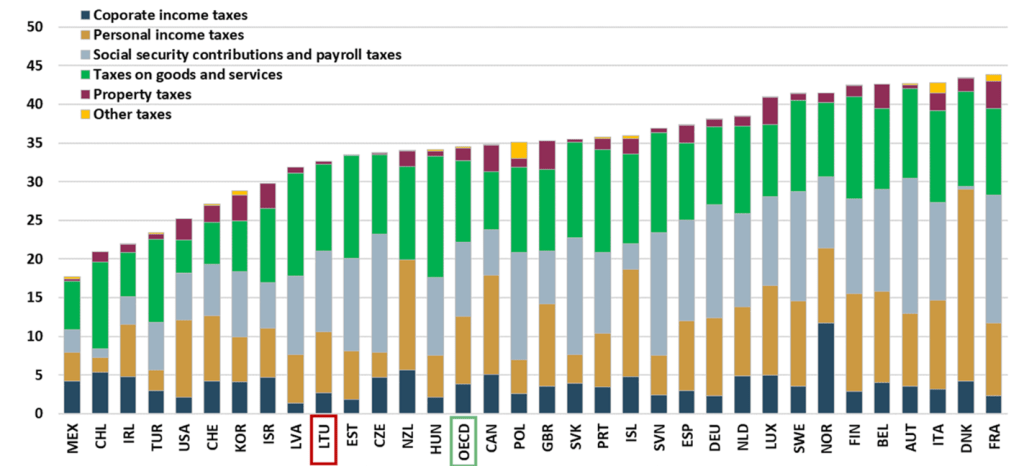
Increasing property tax revenues for fiscal sustainability in Lithuania
Note: OECD is an unweighted cross-country average
Source: OECD Revenue statistics

Bringing more people into the labour force would attenuate the impact of the demographic shock on the labour market.

Despite existing labour shortages in many sectors, the employment gap between higher- and lower-skilled workers is high in Lithuania. The creation of learning accounts for training courses in 2024 is a step in the right direction. If it turned out that current funding is insufficient to make a significant difference, targeting could be increased towards the groups that are most in need of training.

Increasing the employment prospects of older-age workers will also require improving their health. Poor health conditions are partly related to preventable diseases and behavioural factors such as poor diets, high alcohol consumption and low physical activity. Regulations and taxes have a key role to play by limiting the affordability of harmful substances.

Immigration is another way to mitigate labour shortages. Simulations presented in this Survey show that extending the positive net migration inflows that were observed just before the outbreak of the war in Ukraine would halve the impact of the demographic shock on the Lithuanian economy. Residence permits for non-EU workers could be made more attractive. With 1.3 million persons of Lithuanian descent living abroad, return migration also has a significant potential. Since migrants of Lithuanian origin may be easier to integrate, outreach towards the diaspora could be strengthened.

Visit the OECD’s Lithuania Economic Snapshot page for further information.

References:

OECD (2025), OECD Economic Surveys: Lithuania 2025, https://doi.org/10.1787/4abf1ea5-en, OECD Publishing, Paris.



Addressing Korea’s Fertility Crisis

Asian,Boy,Is,Playing,In,Playground,With,Happy,Face,In

by HyunJeong Hwang, OECD Economics Department

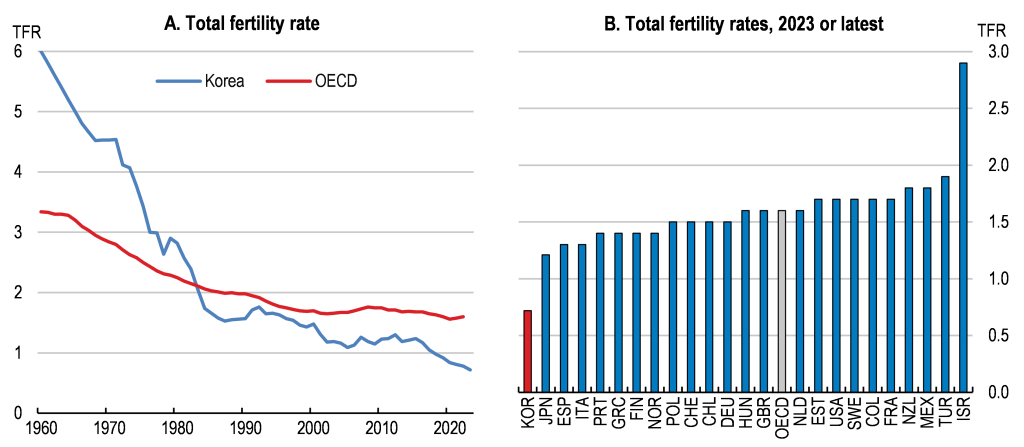
In 2023, Korea’s fertility rate fell to a world-record low of 0.7. Its sharp decline implies a faster increase in the old-age dependency ratio than in any other OECD country. As the proportion of retirees grows, labour shortages will intensify, and the costs of health care, long-term care, and pensions are expected to more than double to 17.4% of GDP by 2060.  The government has declared the situation a national emergency and announced plans to establish a new ministry focused on population strategy, alongside a range of policy initiatives. These demographic challenges are the main topic of the 2024 Economic Survey of Korea. It emphasises the importance of addressing obstacles preventing young adults from having the number of children they desire and implementing policies to mitigate the economic impact of an ageing population.  

Fertility rates in Korea have declined reaching the lowest in the world 

Source: Statistics Korea; OECD (2024), Fertility rates (indicator). doi: 10.1787/8272fb01-en; OECD Pensions at a Glance (2023).

A key cause of ultra-low fertility is the high opportunity cost of having children in Korea. Rapid economic development and higher access to education have enabled women to pursue increasingly rewarding careers. But long hours, insufficient protections against workplace discrimination, and a work culture where work is expected to take priority over family make it very challenging to combine work and motherhood. This leads to a large career cost for women who become mothers and underpins the widest gender pay gap in the OECD.

Improving the work-life balance must be a top priority to reverse the decline in fertility rates. While policies have made childcare nearly free, there is still room to expand access to popular childcare services, ensure consistent quality across all types, and align childcare opening hours with work hours. Raising the take-up of paid parental leave, which is currently very low, especially for fathers, is also essential. This can be achieved by relaxing strict eligibility, raising the benefit ceiling, and strengthening sanctions for workplace discrimination.

The weak financial position of youth holds back family formation. Labour market duality with large differences in pay, job quality and social protection weaken the economic position of young adults. Many young people either postpone their careers to land high-quality jobs in large firms, or start at smaller companies with non-regular contracts. Duality also spurs a race for credentials, which leads to high spending on private education. Addressing labour market dualism by relaxing employment protection for regular workers and expanding social insurance would help strengthen the financial prospects of young people and encourage family formation.

However, boosting fertility alone will not suffice to offset the rapid decline in the workforce. Even tripling fertility to 2.1 children per woman by 2040, the level associated with a stable population in the long term, would not prevent the workforce from declining. Korea must therefore prepare for and adapt to the challenges of an ageing and shrinking population.

Lengthening working lives is essential to counteract inevitable population ageing. Careers are shortened by the seniority-based wage system which renders older workers less appealing to firms when their wage rises above their productivity. Company-specific mandatory retirement ages below the legal pension age and the practice to encourage older employees to voluntarily leave before reaching the mandatory retirement age also contribute to premature retirements from their main job. Reforming these systems, raising the statutory retirement age, and offering upskilling opportunities for older workers can help keep them in the workforce longer.

Increasing the supply of foreign labour is another vital strategy. Although Korea has significant potential to boost immigration, various visa hurdles for skilled immigration as well as poor working conditions for low-skilled immigrants hold back immigration. Korea’s immigration policies need reform to enhance opportunities for both low-skilled and skilled immigrants. Removing entry barriers for qualified foreign talent and integrating low-skilled immigrants better will help increase the foreign labour force.

Further reading:          

OECD (2024), OECD Economic Surveys: Korea 2024, OECD Publishing, Paris. 

Yang, Y., H. Hwang and J. Pareliussen (2024), “Korea’s unborn future: lessons from OECD experience”, OECD Economics Department Working Papers, No. 1824, OECD Publishing, Paris. 

Choi, S., S. Ham., Y. Yang, and J. Pareliussen (2024), “Women’s employment and fertility in South Korea: A literature review”, OECD Economics Department Working Papers, No. 1825, OECD Publishing, Paris.