Extending trade benefits to more firms and workers

By Aida Caldera, Alberto Gonzalez Pandiella and Alessandro Maravalle

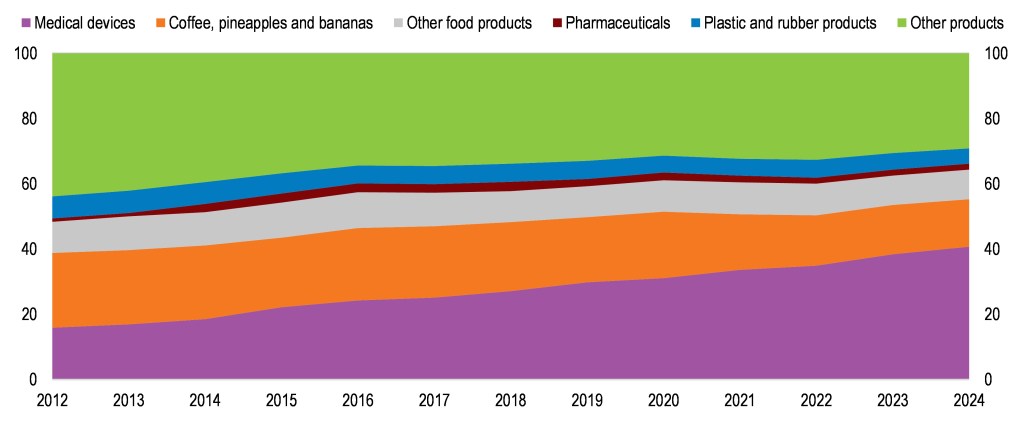
At the beginning of the 1990s, Costa Rica was primarily known for exporting agricultural products like bananas and coffee, along with its thriving tourism sector. Today, places like Alajuela have become global hubs for advanced manufacturing, particularly in the medical devices sector. A strong and sustained commitment with open trade explains this remarkable transformation.  Thanks to a more diversified export basket and a shift towards higher value-added goods and services (Figure 1), Costa Rica’s economy has grown more than other OECD countries and regional peers over the last three years and was more resilient to recent shocks. This success story is not without clouds or challenges, as detailed in the 2025 OECD Economic Survey. A long-standing challenge is that not all workers, companies and regions have so far benefited from trade.

Figure 1. High-tech products are a growing share of Costa Rica’s exports

Exports by type of product, % of total good exports
Source: Banco Central de Costa Rica.

Maximising trade benefits

There remain ample opportunities for Costa Rica to capitalize on its trade openness and FDI attractiveness. With Costa Rica’s exports remaining concentrated in a few destinations ongoing efforts to diversity trade agreements and enhance trade facilitation, which have regained considerable impetus since 2022, will facilitate stronger integration into global and regional value chains. Nearshoring offers new opportunities for Costa Rica to extend trade benefits to more workers, firms and regions. However, several barriers might prevent these opportunities from materializing. Continuing the path of reform to enhance education, foster innovation, improve infrastructure and promote stronger competition would help Costa Rica seize maximise trade benefits.

Costa Rica’s well-educated workforce has been traditionally key to attract FDI and develop value added exports. However, now large skills shortages pose a critical threat to Costa Rica’s FDI attractiveness. A comprehensive education reform is underway, but key timelines and milestones are still unclear. The ongoing efforts to reform education should prioritise the increase in the number of technicians and graduates in STEM areas and ensure that university education is better aligned with labour market demands.

Boosting innovation is crucial for Costa Rican firms to access international markets. However, interactions between public universities and businesses are weak, and most innovation funding goes directly to universities without impact evaluations. Competitive performance-based funding is limited, compared to other OECD countries. Strengthening interaction between public universities and businesses, and introducing  impact evaluations to innovation funding, would help boost firms’ innovation.

Infrastructure bottlenecks are large, driving up trade costs and limiting the participation of remote regions and SMEs in international trade. Key issues include poor-quality roads and overcrowded ports. The low quality of transport infrastructure can be attributed to underspending, deficient strategic planning and inefficient capital project execution, with only 30% of budgeted capital spending getting executed. Strengthening planning and design of transport projects and enhancing budget management  would reduce delays and cost overruns and contribute solve Costa Rica’s large infrastructure gaps.

Finally, boosting competition in domestic markets would help Costa Rican firms access better inputs at lower costs. Despite ongoing efforts to improve competition in some areas, , such as removing anticompetitive practices in professional services and reducing the large and complex stock of regulations, Costa Rica still has some of the strictest regulations in the OECD. Continuing to increase the Competition Authority’s budget is crucial for identifying and addressing anticompetitive practices.

References

OECD (2025), OECD Economic Surveys: Costa Rica 2025, OECD Publishing, Paris, https://doi.org/10.1787/048cf07b-en


Maintaining and reinforcing achievements in Costa Rica

By Alberto Gonzalez Pandiella and Alessandro Maravalle, OECD Economics Department

Costa Rica has made remarkable economic progress over the past two decades, such as achieving life expectancy at par with the OECD average. Thanks to a strong commitment to trade, it has succeeded in attracting foreign direct investment and in increasing the level of sophistication of its export basket. However, the challenges to safeguard these achievements and further improve living standards are substantial. Growth prospects were deteriorating before the pandemic and going forward population ageing will take an additional toll (Figure). Unemployment is high, at a two-digit rate since 2018, as well as informality, affecting nearly half of the labour force. The fiscal situation improved in 2021 and 2022, thanks to the 2018 fiscal reform, but with public debt at around 70% of GDP, public finances remain a critical vulnerability requiring sustained efforts to contain spending and boost public sector efficiency. Nearshoring trends, by which companies seek reducing supply chain disruption risks by locating closer to their final markets, are providing new investment opportunities. Costa Rica is a front runner in environmental protection and renewables generation, and the global transition to net zero greenhouse gas emissions can further increase the country’s competitiveness.

The latest OECD Economic Survey (OECD, 2023) argues that continuing and stepping up structural reform efforts would be the best way for Costa Rica to respond to these challenges and seize new opportunities. Reforms to boost productivity are particularly critical to uphold growth in GDP and living standards. Strengthening competition is especially a promising avenue to boost productivity. Weak competition tends to translate into relatively high prices of goods and services for consumers and firms. Valuable and bold steps have been recently taken to boost competition in key markets, such as rice or professional services. Steps are also being taken in cooperation with the private sector to reduce regulatory burden, by identifying regulations and procedures susceptible to be phased out, including also specific deadlines for their elimination. Providing the national competition authority with the budget granted by law is a pending challenge that would be particularly beneficial at the current juncture when measures to improve regulations and open up key sectors of the economy are being taken. Effective competition authorities, by promoting stronger economic growth, can also have a positive fiscal impact by supporting higher tax revenues.

Informality, at around 45% of total employment, remains high and is both a cause and a consequence of low productivity. A comprehensive strategy is required to reduce it, with actions needed in several policy areas, such as reducing non-wage labour costs, facilitating the creation of formal firms, including by reducing the bureaucratic and economic cost of establishing a formal firm, helping more Costa Rican to acquire the skills needed to access formal jobs, simplifying taxes and enhancing enforcement mechanisms. Experience in some OECD countries, such as Colombia, indicates that reducing non-wage costs, by cutting employer payroll charges, can help to reduce informality. Employer payroll charges in Costa Rica are high in comparison with the OECD average, indicating that there is ample room to move in this direction.

Virtually universal health care and primary education and one of the highest pension coverage in the region have led to remarkable social outcomes. However, Costa Rica faces substantial social challenges, such pas poverty remaining largely unchanged at around 20% over the last 25 years and increasing income inequality. There is room to improve social programmes targeting, as in some cases more than 40% of the beneficiaries are middle and high-income households. There is also room to reduce fragmentation, as 21 institutions are in charge of delivering more than 35 schemes. Better targeting and lower fragmentation would facilitate reinforcing social protection in key areas and reduce inequality.

Improving the quality and efficiency of education and training is also key to support growth and equity in Costa Rica. Even if spending on education is high in Costa Rica, where it amounts to more than 6.5% of GDP, one of the highest shares across OECD countries, educational outcomes remain poor and educational exclusion is still high, with too many Costa Ricans leaving school without an upper-secondary education. A more targeted support to students with learning gaps, improving teachers’ selection and training and expanding access to education to children below four years would help increase equity of opportunities and help more Costa Ricans access better paid formal jobs and firms fill easier their vacancies.

Figure. Without reforms the economy’s growth potential will fall as the demographic bonus fades

Contributions to potential growth, % pts

References:

OECD (2023), OECD Economic Surveys: Costa Rica 2023, OECD Publishing, Paris.


Mantener y reforzar los logros en Costa Rica

Por Alberto González Pandiella y Alessandro Maravalle, Departamento de Economía de la OCDE

Costa Rica ha hecho un notable progreso económico en las dos últimas décadas, como tener una esperanza de vida equiparable a la media de la OCDE. Gracias a un fuerte compromiso con el comercio, ha logrado atraer inversión extranjera directa y aumentar el nivel de sofisticación de su cesta de exportaciones. Sin embargo, los retos para salvaguardar estos logros y seguir mejorando el nivel de vida son considerables. Las perspectivas de crecimiento se estaban deteriorando antes de la pandemia y, en el futuro, el envejecimiento de la población se cobrará un peaje adicional (gráfico). El desempleo es elevado, con una tasa de dos dígitos desde 2018, así como la informalidad, que afecta a casi la mitad de la población activa. La situación fiscal mejoró en 2021 y 2022, gracias a la reforma fiscal de 2018, pero con una deuda pública en torno al 70% del PIB, las finanzas públicas siguen siendo una vulnerabilidad crítica que requiere esfuerzos sostenidos para contener el gasto e impulsar la eficiencia del sector público. Las tendencias de nearshoring, por las que las empresas buscan reducir los riesgos de interrupción de la cadena de suministro localizándose más cerca de sus mercados finales, están proporcionando nuevas oportunidades de inversión. Costa Rica está a la vanguardia de la protección del medio ambiente y la generación de energías renovables, y la transición mundial hacia la emisión neta cero de gases de efecto invernadero puede aumentar aún más la competitividad del país.

El último Estudio Económico de la OCDE (OCDE, 2023) sostiene que continuar e intensificar los esfuerzos de reforma estructural sería la mejor manera de que Costa Rica respondiera a estos retos y aprovechara las nuevas oportunidades. Las reformas para impulsar la productividad son especialmente críticas para mantener el crecimiento del PIB y del nivel de vida. El fortalecimiento de la competencia es una vía especialmente prometedora para impulsar la productividad. Una competencia débil tiende a traducirse en precios relativamente altos de bienes y servicios para consumidores y empresas. Recientemente se han dado pasos valiosos y audaces para impulsar la competencia en mercados clave, como el del arroz o los servicios profesionales. También se están tomando medidas, en cooperación con el sector privado, para reducir la carga regulatoria, mediante la identificación de reglamentos y procedimientos susceptibles de ser eliminados progresivamente, incluyendo también plazos concretos para su supresión. Dotar a la autoridad nacional de competencia del presupuesto que le otorga la ley es un reto pendiente, que sería especialmente beneficioso en la coyuntura actual, en la que se están tomando medidas para mejorar las regulaciones y abrir sectores clave de la economía. Una autoridad de competencia eficaz, al promover un crecimiento económico más fuerte, también pueden tener un impacto fiscal positivo al apoyar una mayor recaudación de impuestos.

La informalidad, en torno al 45% del empleo total, sigue siendo elevada y es a la vez causa y consecuencia de la baja productividad. Se requiere una estrategia global para reducirla, con acciones necesarias en varias áreas, como reducir los costes laborales no salariales, facilitar la creación de empresas formales, incluso reduciendo el coste burocrático y económico de establecer una empresa formal, ayudar a más costarricenses a adquirir las cualificaciones necesarias para acceder a empleos formales, simplificar los impuestos y mejorar los mecanismos de aplicación. La experiencia de algunos países de la OCDE, como Colombia, indica que la reducción de los costes no salariales, mediante la reducción de las cargas salariales de los empleadores, puede ayudar a reducir la informalidad. Las cargas salariales de los empleadores en Costa Rica son elevadas en comparación con la media de la OCDE, lo que indica que hay un amplio margen para avanzar en esta dirección.

La asistencia sanitaria y la educación primaria prácticamente universales y una de las coberturas de pensiones más altas de la región han dado lugar a resultados sociales notables. Sin embargo, Costa Rica se enfrenta a importantes retos sociales, como el mantenimiento de la pobreza en torno al 20% en los últimos 25 años y el aumento de la desigualdad de ingresos. Hay margen para mejorar la focalización de los programas sociales, ya que en algunos casos más del 40% de los beneficiarios son hogares de ingresos medios y altos. También hay margen para reducir la fragmentación, ya que 21 instituciones se encargan de ejecutar más de 35 programas. Una mejor focalización y una menor fragmentación facilitarían el refuerzo de la protección social en áreas clave y reducirían la desigualdad.

Mejorar la calidad y la eficiencia de la educación y la formación también es clave para apoyar el crecimiento y la equidad en Costa Rica. Aunque el gasto en educación en Costa Rica es elevado, ascendiendo a más del 6,5% del PIB, uno de los porcentajes más altos de los países de la OCDE, los resultados educativos siguen siendo pobres y la exclusión educativa sigue siendo alta, con demasiados costarricenses que abandonan la escuela sin haber cursado la educación secundaria superior. Un apoyo más localizado a los alumnos con dificultades de aprendizaje, la mejora de la selección y la formación de los profesores y la ampliación del acceso a la educación a los niños menores de cuatro años contribuirían a aumentar la igualdad de oportunidades y ayudarían a que más costarricenses accedieran a empleos formales mejor remunerados y a que las empresas cubrieran más fácilmente sus vacantes.

Gráfico. Sin reformas el potencial de crecimiento de la economía caerá al desvanecerse el bono demográfico

Contribuciones al crecimiento potencial, % puntos

Referencias:

OCDE (2023), OCDE Estudios Económicos: Costa Rica 2023, OECD Publishing, Paris.