Decarbonising the Housing Sector: Pathways to Net-Zero Emissions by 2050 

By Volker Ziemann, OECD Economics Department

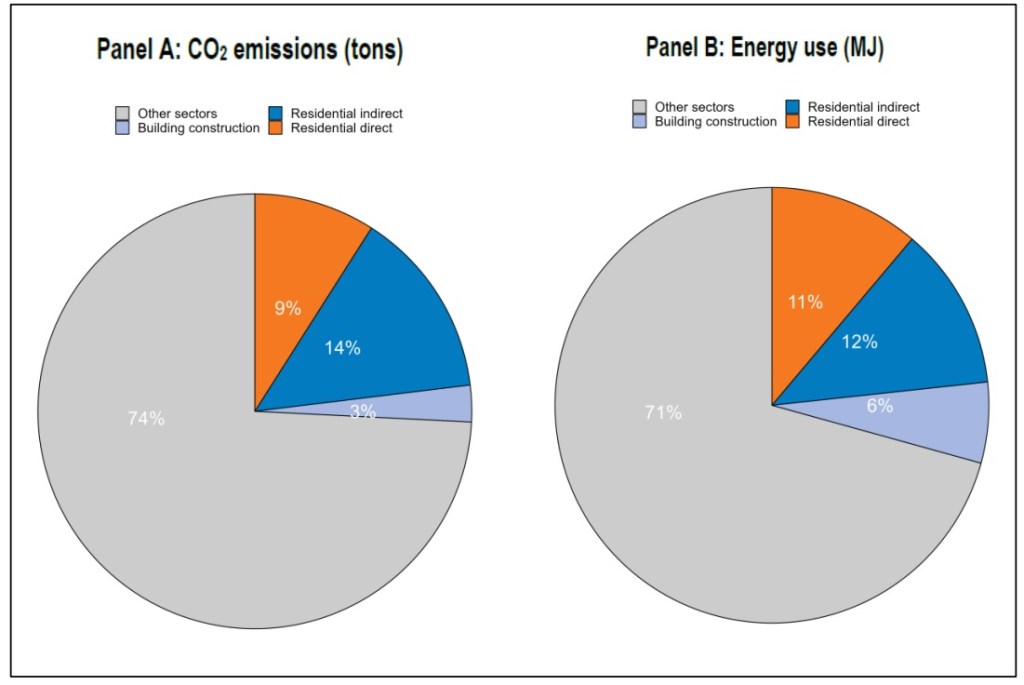
In 2020, over a quarter of total CO2 emissions in the OECD originated in the housing sector. These emissions are generated through space and water heating, cooling, ventilation, lighting, and the use of appliances and other electrical plug loads. Homebuilding is also emission-intensive, accounting for 6% of total CO2 emissions.

Figure 1. Housing accounts for a large share of CO2 emissions

Sectoral decomposition of OECD CO2 emissions and energy use, 2020
Source: Energy Efficiency Indicators (IEA, 2021[7]), Emission Factors database (IEA, 2021[8]), and OECD calculations.

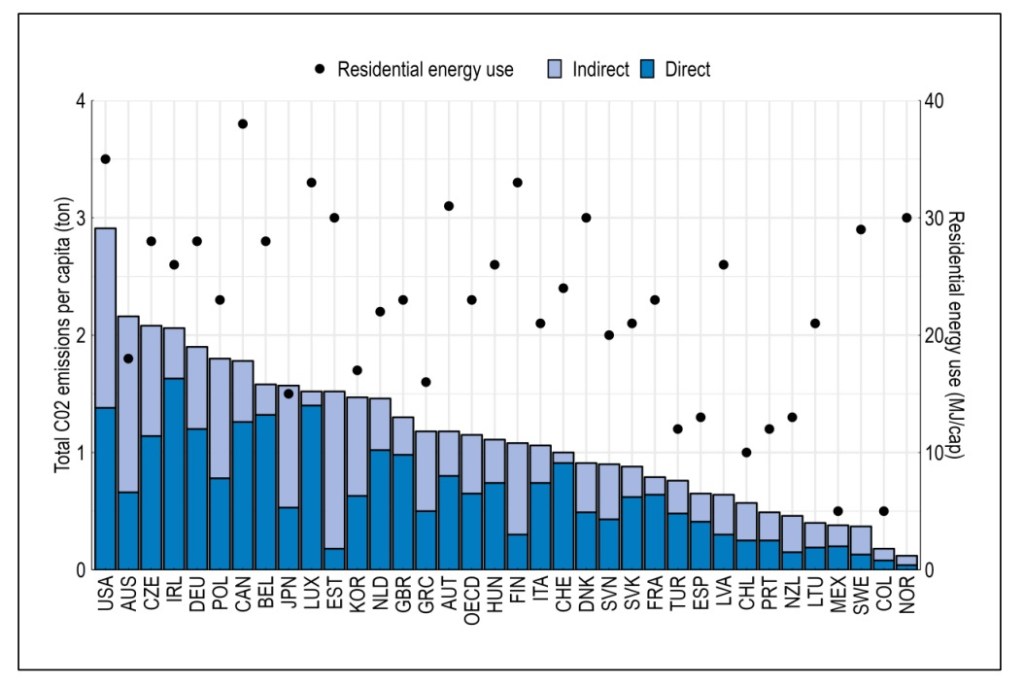
CO2 emission levels vary considerably across countries ranging from nearly three tonnes per capita in the United States to almost zero in Norway. These vast differences indicate that even countries with harsh climates can achieve low emission levels. One of the keys to decarbonising the housing sector is to reduce direct emissions from on-site combustion of fossil fuels such as oil and natural gas for heating and cooking. Electrification and energy efficiency improvements are the primary vehicles to get there. Reducing indirect emissions, those originating from electricity use, then hinges on decarbonising electricity production.

Figure 2. Several countries have high home energy needs, but low CO2 emissions

Total CO2 emissions and energy use of the residential sector, 2020
Source: Energy Efficiency Indicators (IEA, 2021[7]), Emission Factors database (IEA, 2021[8]), and OECD calculations.

Most OECD countries have pledged to reach net-zero emissions by 2050, and some have set even more ambitious targets to achieve this goal earlier. Bringing the housing sector on track to meet these targets requires stepping up efforts and going beyond environmental regulation and encompassing economic, social, innovation, tax, and spending policies.

The recent OECD working paper, “Home, Green Home: Policies to Decarbonise Housing“, delves into the various policy options for rapidly decarbonising the housing sector and recommends to:

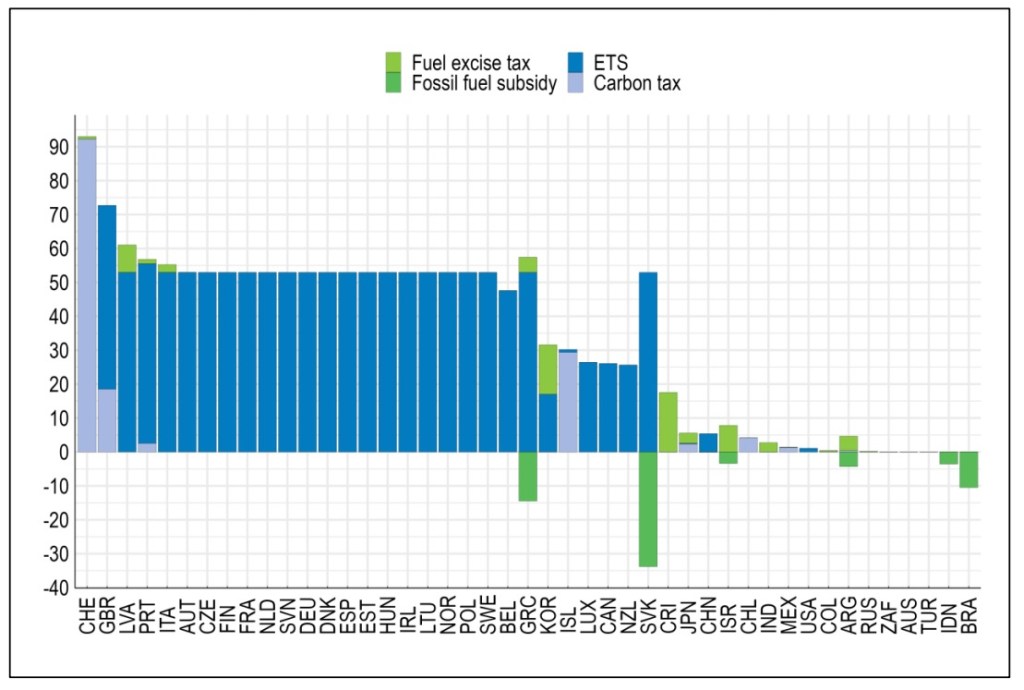
  • Align carbon prices of energy used in homes with those that apply to other sectors. This can be achieved by explicitly taxing the carbon content of energy sources or by emission trading (applied to energy suppliers).

Figure 3. Effective carbon rates are a long way from being similar across sectors and countries

EUR per tonne of CO2

Panel A: Building use

Source: OECD (2022), Pricing Greenhouse Gas Emissions: Turning Targets into Climate Action, OECD Publishing, https://www.oecd-ilibrary.org/deliver/cbda8bad-en.pdf?itemId=%2Fcontent%2Fpaper%2Fcbda8bad-en&mimeType=pdf.

Panel B: Electricity sector

Source: OECD (2022), Pricing Greenhouse Gas Emissions: Turning Targets into Climate Action, OECD Publishing, https://www.oecd-ilibrary.org/deliver/cbda8bad-en.pdf?itemId=%2Fcontent%2Fpaper%2Fcbda8bad-en&mimeType=pdf.

  • Ensure carbon-free electricity generation, as a lot of the decarbonisation of homes will have to come from their electrification.

  • Overcome the split incentive problem between landlords and renters by allowing landlords to recover part of the energy bill saving from energy-efficiency improvements when rent levels are updated.

  • Extend energy performance certification to all properties, not only those for sale.

  • Strengthen energy efficiency standards on appliances and new buildings to align with the net-zero emission target.

  • Offset adverse effects of mitigation measures on vulnerable social groups without blunting incentives to save energy.

  • Focus on retrofitting the worst existing housing units.

  • Abolish remaining subsidies for fossil fuel boilers.

  • Lead the way by building new and retrofitting existing social housing units according to high environmental standards.

  • Promote greater international comparability and transparency of green building standards to facilitate alignment of green real estate assets with the net-zero target.

  • Ensure local-level regulations, spending power, and resources are consistent with national decarbonisation goals.

Implemented together, these policy instruments can decarbonise housing at a pace compatible with climate targets and in a way that is consistent with social-inclusion objectives while avoiding unnecessary economic costs.

References:

Hoeller, P. Ziemann, V. , Cournède, B. and M Bétin (2023), “Home, green home: Policies to decarbonise housing “, OECD Economics Department Working Papers, No. 1751, OECD Publishing, Paris, https://doi.org/10.1787/cbda8bad-en.


What role for carbon pricing in reducing emissions and generating revenues?

By Filippo Maria D’Arcangelo, Mauro Pisu (OECD Economics Department), and Anasuya Raj, Kurt Van Dender (OECD Centre for Tax Policy and Administration)

Limiting global warming and avoiding its potentially catastrophic damages hinges on reaching net-zero emissions by mid-century (IPCC, 2022). Achieving this ambitious global target requires a wide range of mitigation policies to overcome market failures, path dependencies and coordination problems (D’Arcangelo et al., 2022).

Carbon pricing can play an important role in a well-coordinated mitigation policy mix for two main reasons. First, in many instances, carbon pricing can induce lower emissions at lower economic costs than alternative mitigation policies. Second, it can generate additional government revenues, at least until emissions start falling appreciably.

Available evidence on the responsiveness of CO2 emissions and government revenues to carbon pricing is fragmented and difficult to compare across countries and sectors. Thus, tracking and comparing countries’ progress towards emission reduction targets and assessing the contribution of carbon pricing to emission reductions is challenging. We tackle this challenge in our recent paper, Estimating the CO2 emission and revenue effects of carbon pricing: new evidence from a cross-country dataset.

The paper provides fresh evidence on the long-run responsiveness of CO2 emissions and government revenues to carbon pricing within a unified framework across countries, sectors and fuels. The analysis relies on the OECD Effective Carbon Rates (ECR) database, containing comprehensive and detailed information on instruments pricing carbon emissions from energy use in 44 OECD and G20 countries. The ECR database contains data on carbon taxes, permit prices resulting from emissions trading systems, and fuel excise taxes and covers about 80% of global CO2 emissions from energy use.

Broad-based carbon pricing is an effective measure to reduce emissions in most sectors and will accelerate coal phase-out

Baseline estimates suggest that a EUR 10 per tonne of CO2 increase in carbon prices decreases CO2 emissions from fossil fuels by 3.7% on average in the long term. Policy simulations indicate that introducing a EUR 60 per tonne of CO2 global carbon price floor (about three times the 2018 average effective carbon rate) would lower total CO2 emissions from fossil fuels by about 17% compared to 2018 levels, after firms and people have fully adjusted to the increase in ECRs. This is a sizeable reduction in emissions but far from what is required to reach net-zero.

Estimates of the responsiveness of CO2 emissions to carbon pricing vary across sectors and fuels. For example, emissions in the buildings sector are about three times less responsive to carbon pricing than those in the agriculture and fisheries sector. Increasing carbon prices can be expected to have the largest effects on emissions from the Electricity and Industry sectors (Figure 1) due to a confluence of factors: the low carbon prices these sectors still face in most countries; their high emission responsiveness compared to other sectors; and their large share in total emissions. A high price floor in the Road transport sector, where effective carbon rates are already elevated due to excise taxes, would also contribute substantially to reducing emissions.

Emissions from coal are more responsive to carbon pricing than those from all other types of fossil fuels. Even mild, broad-based carbon prices would contribute significantly to coal phase-out, given its high responsiveness to carbon pricing: a floor of EUR 60 per tonne of CO2 can be expected to reduce global emissions from coal by half.

Figure 1: Effect of different ECR floors on emissions by sector

Note: Simulations of the effect on CO2 emissions (y-axis) of a global ECR floor applied to all emissions priced in 2018, by EUR 5 increments (x-axis)

Broadening carbon pricing to unpriced emissions has large effects on emissions and revenues in some countries

Moderate increases in carbon pricing would initially translate into large government revenue increases, as carbon prices are still generally low. Globally, carbon-related revenues could triple, relative to 2018 levels, with a EUR 60 global carbon price floor. Over time, if carbon price floors keep on increasing, these carbon-related revenues would dwindle in tandem with the reduction of emissions.

The broadened coverage of carbon pricing to currently unpriced emissions would contribute to around two thirds of the total estimated effects on emissions and revenues. Emission-intensive countries that do not yet price a large share of their emissions would observe a larger reduction in emissions and greatly contribute to the increase in fiscal revenues.

Figure 2: Impacts of a EUR 60 ECR floor on carbon-related revenues

Note: Red bars: Carbon-related government revenues observed in 2018; Green bars: effect of a EUR 60 carbon price floor on revenues through emissions already priced in 2018; Blue bars: effect of a EUR 60 carbon price floor on revenues through emissions not priced in 2018.

Easing the substitution of clean energy sources for fossil fuels requires policies complementary to carbon pricing

The estimated responsiveness of emissions to carbon pricing suggests that even large carbon prices (about EUR 1000 per tonne by late 2030s) will not suffice to meet net-zero emission targets.

Complementing steady but moderate increases in ECRs with policies that markedly increase the emission responsiveness to carbon pricing is crucial to put emissions on a downward path towards net-zero targets. In this respect, innovation and reallocation-friendly policies have a major role to play, as they can ease the substitution of clean energy sources for fossil fuels, thus reducing emission abatement costs and making carbon price more effective. For instance, policy simulations show that an emission responsiveness twice as large as the baseline estimate, combined with an ECR floor of EUR 40 on priced and unpriced emissions, would result in the same emission reduction as the baseline responsiveness estimates combined with an ECR floor of EUR 175 on priced emissions and EUR 60 on unpriced emissions.

References

D’Arcangelo, F.M., Ilai Levin, Alessia Pagani, Mauro Pisu, and Åsa Johansson (2022), “A framework to decarbonise the economy”, OECD Economic Policy Papers, No. 31, OECD Publishing, Paris, https://doi.org/10.1787/4e4d973d-en.

IPCC, 2022: Climate Change 2022: Mitigation of Climate Change. Contribution of Working Group III to the Sixth Assessment Report of the Intergovernmental Panel on Climate Change. Cambridge University Press, Cambridge, UK and New York, NY, USA. doi: 10.1017/9781009157926.