After the Covid-19 crisis, Slovenia needs to focus on population ageing challenges

by Jens Høj, Slovenia Desk, OECD Economics Department

Slovenia was one of the best preforming OECD economies until the Covid-19 outbreak. The health crisis was smaller than in most other counties, helped by early implementation of containment measures.

Extensive fiscal measures were implemented to support jobs and incomes. Nonetheless, the ensuing economic crisis will be as severe as in other countries, reflecting the openness of the small Slovenian economy. The economic recovery should pick up unless a new outbreak materialise, which could lead to higher long-term unemployment and lower growth.

Once the Covid-19 economic crisis is under control, the government needs to start addressing population ageing challenges as this will lead to a higher number of pensioners and as the labour force becomes smaller and older. These developments are creating two main long-term challenges. The first is to contain ageing-related spending increases in pensions and health and long-term care. Longer working lives is key to secure the pension system’s fiscal sustainability, while better use of economic signals is needed to improve the efficiency and effectiveness of the health and long-term care systems. The second challenge is to sustain growth with a changing workforce. In the near-term, underutilised labour resources, such as older and low-skilled workers, need to be mobilised. Thereafter, maintaining growth and income convergence requires faster productivity growth, pointing to a need for continuously improving labour allocation. For this to be realised, labour market institutions have to adjust to ensure that workers’ reward reflects to a higher degree individual productivity and efforts. In addition, more geographical labour mobility is needed, pointing to a need to develop further the housing market.

Reference:
OECD (2020), OECD Economic Surveys: Slovenia 2020, OECD Publishing, Paris, https://doi.org/10.1787/a4209041-en.


Ambitious retirement age indexation ensures sustainable public finances in Denmark

By Mikkel Hermansen, Denmark desk, OECD Economics Department

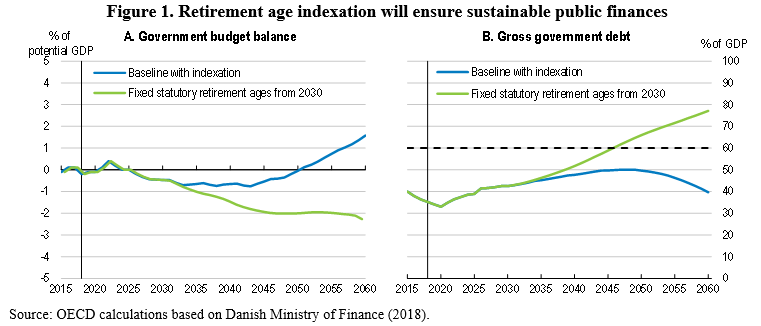
Denmark has a long tradition of reforms delivering sound public finances and strengthening economic growth. One foundation of long-term fiscal sustainability was the decision taken in 2006 to index statutory and early retirement ages to life expectancy. Projections of public finances suggest that in this case (the baseline scenario) the government budget will remain close to balance and debt stay well below 60% of GDP (Figure 1). However, if indexation where to be stopped from 2030, persistent deficits and fast rising debt are projected. 

The indexation mechanism works by raising the statutory retirement
age by up to one year every five years to keep the expected number of years in
retirement constant (Figure 2, Panel A). Experience from the first adjustment
of the early retirement age starting in 2014 has been encouraging. Many seniors
have chosen to stay in their job, which has supported a significant rise in the
employment rate among 55-64 year olds (Figure 2, Panel B). There is still scope
for improvement as the senior employment rate in Denmark remains below those of
Norway and Sweden. 

In the coming years the statutory retirement age will be
increased from 65 to 67 years. Assessing whether the affected workers remain
active will provide another indication of whether the long-term fiscal strategy
is on track. Current projections indicate that the statutory retirement age
will reach 73 by 2060. This is an ambitious path and the highest planned
retirement age across OECD countries. Still, since additional years lived are
generally in good health such a rise is achievable, but requires policies to
retain seniors in the labour market. 

The recent OECD Economic Survey of Denmark commends Denmark for its impressive reform track record and sound public finances. The indexation of retirement ages to life expectancy should become a pillar of the economic policy framework and useful guide for other countries undertaking their own reforms. Nonetheless, successful reform requires full implementation and more could be done to ensure the functioning of the labour market does not discriminate against seniors as well as helping those with reduced work capacities to remain in employment (OECD, 2015).  


References

Danish Government (2018), Denmark’s Convergence Programme
2018
, Copenhagen.

Danish Ministry of Finance (2018), Opdateret 2025-forløb:
Grundlag for udgiftslofter 2022 (Updated 2025 projection: Basis for expenditure
ceilings 2022)
, Copenhagen.

OECD (2019), OECD Economic Surveys: Denmark 2019, OECD Publishing, Paris, http://dx.doi.org/10.1787/eco_surveys-dnk-2019-en.

OECD (2015), Ageing and Employment Policies: Denmark 2015:
Working Better with Age, OECD Publishing, Paris, http://dx.doi.org/10.1787/9789264235335-en


How does ageing affect income redistribution?

By Mikkel Hermansen, Economist, OECD Economics Department

In many advanced countries, the share of citiziens having reached post-retirement age is growing fast. Since elderly rely for a good part on a public pension scheme for income support, population ageing tends to result in more income redistribution, in particular in the form cash transfers. However, insofar as ageing also means a growing share of population in groups that are close to retirement age, but still considered as part of the working-age population, a more interesting question is how this facet of ageing affects redistribution. As we show in a recent paper on “Income redistribution through taxes and transfers across OECD countries” ageing actually tends to reduce income redistribution when the latter is measured as the reallocation of resources between people in working-age to limit the influence of redistribution across lifetime. This is primarily a result of ageing being associated with higher employment rates among seniors.

The purpose of redistribution is to reduce income inequality. Therefore it is natural to measure redistribution as the difference between the Gini coefficients of households incomes before and after personal income taxes and cash transfers.[1] This is done only for the working-age population (age 18-65)  to avoid the influence of public pensions, mostly reflecting that people pay taxes in working-age they then receive back as benefits in retirement age.

But how does ageing then affect redistribution? As Figure 1 shows, the working-age population has been ageing over the last two decades in the sense that the composition has changed towards relatively more seniors and fewer people below age 40.

ageinghh1

Such ageing of the working-age population tends to produce two counteracting effects on redistribution. It may drive redistribution:

  • upwards since seniors (age 55-64) approaching retirement are more likely to receive transfers than younger age groups and such transfers are likely to be sizeable, e.g. from early retirement, pension benefits available before age 65 or disability insurance.
  • downwards since more seniors tend to work longer than in the past. Rising life expectancy has generally been associated with more years in good health, which, combined with widespread policy reforms to reduce early withdrawal from the labour market, has implied substantive increases in employment rates among seniors.

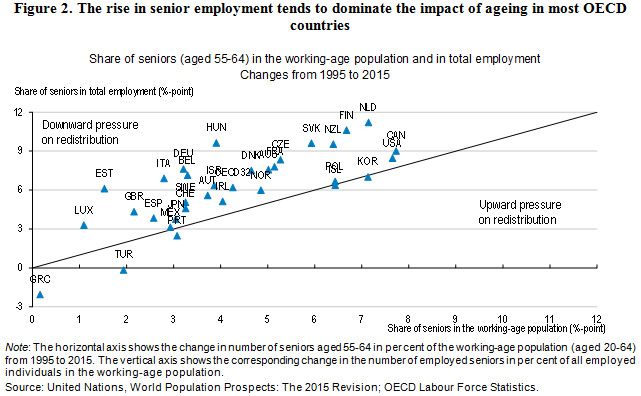
A simple empirical exercise shows that the share of seniors in total employment has risen more than the share of seniors in the working-age population in most OECD countries (Figure 2). This suggests that the employment effect has tended to dominate and ageing has thus exerted a downward pressure on redistribution in most OECD countries. We confirm this by computing the change in redistribution with and without the senior group and find for most countries a larger decline in redistribution when including seniors. Nevertheless, for most countries the impact on measured redistribution is limited and is therefore not the main factor driving the overall  decline in redistribution observed  in most OECD countries since the mid-1990s.

ageinghh2

[1] The difference is scaled by the Gini coefficient for households incomes before taxes and transfers to account for cross-country differences in the initial level of market income inequality. See Section 3.4 in Causa and Hermansen (2017) for details.

References

Causa, O. and M. Hermansen (2017), “Income redistribution through taxes and transfers across OECD countries”, OECD Economics Department Working Papers, No. 1453, OECD Publishing, Paris, http://dx.doi.org/10.1787/bc7569c6-en.


Retraining can enable ageing Slovenians to keep pace with new technologies

by Rory O’Farrell, Slovenia Desk, OECD Economics Department

While workers in many OECD countries are worried whether robots will take their jobs, the inhabitants of the Slovenian town of Kočevje are less concerned. In 2016 Japanese robotics firm, Yaskawa, announced plans to produce robots in Kočevje, which could create up to 200 jobs. This is a continuation of a pattern seen since independence whereby Slovenia has continued to shift from traditional manufacturing to business services and high-tech production. However, not all Slovenians have been included in this progress.

Modernisation has mainly been achieved by training young Slovenians to fill new occupations. In contrast, those with obsolete skills tend to retire or become unemployed rather than retrain, leaving Slovenia with persistent long-term unemployment, and amongst the lowest employment rates of older workers in the OECD. An ageing population means this is no longer sustainable, and labour shortages are already emerging. To meet the need for skills that complement investment in knowledge-based capital, and the new technologies brought by foreign firms, more responsive education and training solutions are needed.

Slovenia

Slovenia performs poorly in terms of providing workers the opportunity to retrain later in life. While it has an effective system of vocational education, workers lack some basic skills that enable them to retrain later in life. Also, although tertiary attainment has increased rapidly, high fees for part-time students make it unattractive for older Slovenians to pursue tertiary education. There is also a lack of incentives to retrain, as wages rise automatically with age and thus do not reflect the relative demand for different occupations, and unemployment and disability insurance have served as pathways to early retirement.

The just-released OECD Economic Survey of  Slovenia outlines how a more flexible education and training system can help create a more flexible labour market. Policies such as greater problem-based learning for vocational students, more adult training, and equalising fees for part-time and full-time students can help workers adapt to future changes in the labour market. This can help ensure all Slovenians benefit from future economic growth.

Find out more:

OECD (2017), OECD Economic Surveys: Slovenia 2017, OECD Publishing, Paris.