Helping Americans Work Again

Douglas Sutherland, Senior Economist, US Desk, Economics Department.

The economic expansion in the United States is now one of the longest on record, although it has been sluggish in comparison with previous recoveries. While job growth has reduced the unemployment rate to historically-low levels, many people still remain on the sidelines of the labour market, as shown by the low participation rates of prime age workers.
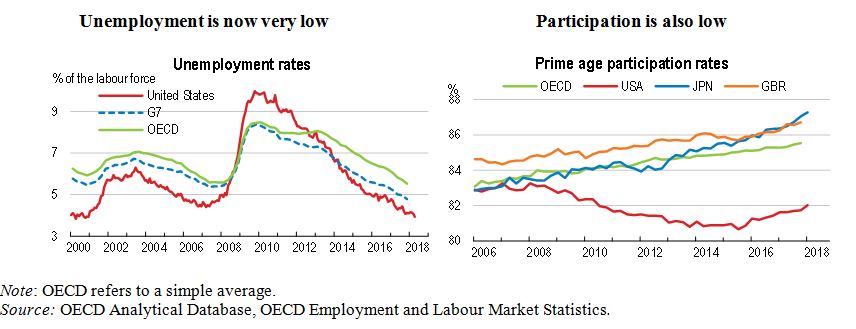
US1

The participation of women has increased, but many men remain out of the labour force. This is especially the case for young men with no college education and in states hit particularly hard by economic shocks, such as West Virginia where only 53% of working-age individuals participate (Varghese and Sutherland, 2018). Globalisation and automation have displaced workers, especially in the industrial heartland, and many of these workers have experienced difficulties in finding new employment. As they adjust only slowly to these shocks, these locations are characterized by high unemployment, low participation and poverty. This is partly explained by the limited amount of support provided to workers in the United States to find new jobs, compared to other OECD countries.

The interstate migration response to employment shocks, which contributed to the reallocation of workers to places with strong job growth, appears to have diminished during the past decade. Furthermore, these migration patterns show less of a population shift to urban agglomerations than elsewhere in the OECD. One factor contributing to this is that changing jobs has become more difficult over time. One of the constraints of interstate migration has been the availability of affordable housing, particularly in booming areas (Guichard, 2018). Restrictive zoning policies appear to be hindering the provision of more affordable housing, limiting employment opportunities and ultimately undermining growth. Sprawling cities can also make accessing jobs by public transport very difficult. Improving mass transit systems where appropriate would help improve accessibility and federal spending could be used to encourage States and localities to move towards mixed-use planning permissions to address housing affordability concerns.

US2.JPG

References:

Guichard, S. (2018), “The Decline in US Labour Force Participation: Some Insights from Regional Divergence”, OECD Economics Department Working Papers, Forthcoming.

OECD (2018), Economic Surveys: United States, OECD Publishing, Paris.

Varghese, N. and D. Sutherland (2018), “The Impact of Individual Characteristics on Labour Market Transitions: A Pseudo Panel Approach”, OECD Economics Department Working Papers, Forthcoming.


Unleashing private sector productivity in the United States

By Douglas Sutherland, Head of the United States Desk, OECD Economics Department

With the global economy mired in low- growth and no signs of strong acceleration, a lot of attention has been paid to the meagre pace of productivity growth in OECD countries. In the United States, the most watched indicator of productivity (nonfarm business productivity growth) decelerated about ¾ percentage point from 2009 to 2014 relative to the preceding 5-year period. This is not just the result of the crisis holding back investment. Productivity growth had already been slowing from the early 2000s.

Economic research reveals competitive markets stimulate productivity: faced with competitors, firms survive by becoming more efficient and bringing new products to the market. Competitive markets see a lot of firm entry and exit. However, this dynamism has declined: new firms are not being created as frequently as in the past (See figure, top panel) and the most productive of these firms are not growing as fast as they once did. This matters because advances in productivity typically result from the rapid growth of young dynamic firms. Instead, start-ups appear to be failing more often and the remaining firms are getting older with larger firms increasingly dominating markets (See figure, bottom panels).

sutehrland-prod-and-us

When this happens, markets become more concentrated, with large incumbent firms gaining market power. This has many disadvantages because gains in productivity are not being passed onto consumers in lower prices or to workers in higher wages. Faced with these worrying trends, competition/antitrust policy needs to adapt. This is particularly the case in markets transformed by digitalisation, financial innovation and globalisation – such as e-commerce and those dependent on access to information. The decline in business dynamism sometimes comes from barriers to competition being erected by the States. For example, state-level prohibitions on municipalities creating their own fixed broadband networks have hindered the development of stronger competition in this sector. In other cases, States have blunted competitive pressure through imposing state-specific occupational licensing requirements.

Amongst other factors, changes to bankruptcy laws have also contributed to more sluggish business formation. Reforms in 2005 increased the cost of bankruptcy for failed entrepreneurs and made it more difficult for them to try again (see the recent Ecoscope blog on the importance of this for productivity growth). The reforms appear to have stymied the creation of sole proprietorships and partnership, particularly in States that do not exempt some of the entrepreneur’s assets from bankruptcy proceedings. Given the importance of bankruptcy for long-run prospects, a better balance needs to be stuck between supporting entrepreneurship and creditor rights.

References:

Millar, Jonathan and Douglas Sutherland (2016), “Unleashing private sector productivity in the United States”, OECD Economics Department Working Paper no. 1328.

OECD (2016), Economic Surveys: United States 2016, OECD Publishing, Paris.


Unleashing private sector productivity in the United States

By Douglas Sutherland, Head of US Desk, OECD Economics Department

With the global economy mired in low-growth and no signs of strong acceleration, a lot of attention has been paid to the meagre pace of productivity growth in OECD countries. In the United States, the most watched indicator of productivity (nonfarm business productivity growth) decelerated about ¾ percentage point from 2009 to 2014 relative to the preceding 5-year period. This is not just the result of the crisis holding back investment. Productivity growth had already been slowing from the early 2000s.

Economic research reveals competitive markets stimulate productivity: faced with competitors, firms survive by becoming more efficient and bringing new products to the market. Competitive markets see a lot of firm entry and exit. However, this dynamism has declined: new firms are not being created as frequently as in the past (See figure, top panel) and the most productive of these firms are not growing as fast as they once did. This matters because advances in productivity typically result from the rapid growth of young dynamic firms. Instead, start-ups appear to be failing more often and the remaining firms are getting older with larger firms increasingly dominating markets (See figure, bottom panels).

sutehrland-prod-and-us

When this happens, markets become more concentrated, with large incumbent firms gaining market power. This has many disadvantages because gains in productivity are not being passed onto consumers in lower prices or to workers in higher wages. The US is often considered as a very competitive and dynamic marketplace – and it is to a large extent – but it has become less so for some time because of developments such as digitalilisation facilitating “winners take all” and anti-trust becoming less stringent than it used to be. Faced with these worrying trends, competition/anti-trust policy needs to adapt. This is particularly the case in markets transformed by digitalisation, financial innovation and globalisation – such as e-commerce and those dependent on access to information. The decline in business dynamism sometimes comes from barriers to competition being erected by the States. For example, state-level prohibitions on municipalities creating their own fixed broadband networks have hindered the development of stronger competition in this sector. In other cases, States have blunted competitive pressure through imposing state-specific occupational licensing requirements. As a result dynamism and competition can vary across states because of the importance of local administration in regulating markets with some states being very dynamic whereas others are not.

Amongst other factors, changes to bankruptcy laws have also contributed to more sluggish business formation. Reforms in 2005 increased the cost of bankruptcy for failed entrepreneurs and made it more difficult for them to try again (see the recent Ecoscope blog on the importance of this for productivity growth). The reforms appear to have stymied the creation of sole proprietorships and partnerships, particularly in States that do not exempt some of the entrepreneur’s assets from bankruptcy proceedings. Given the importance of bankruptcy for long-run prospects, a better balance needs to be struck between supporting entrepreneurship and creditor rights.

References:

Millar, Jonathan and Douglas Sutherland (2016), “Unleashing private sector productivity in the United States”, OECD Economics Department Working Paper no. 1328.

OECD (2016), Economic Surveys: United States 2016, OECD Publishing, Paris.