United Kingdom: Rebuilding fiscal space amid rising spending pressures

Rising spending demands from population ageing, healthcare, the climate transition and defence are placing growing pressure on the UK’s public finances. Rebuilding fiscal space will require a combination of fiscal discipline and structural reforms that strengthen growth and support fiscal sustainability.

Nicolas Gonne and Daniela Glocker, OECD Economics Department


Fiscal pressures are rising despite a more stable economy

The UK economy has shown resilience in the face of successive shocks. Inflation has fallen markedly from its peak, real incomes are recovering and activity has stabilised. Yet growth remains modest and fiscal pressures are mounting. Renewed geopolitical tensions, higher energy prices and persistent global uncertainty continue to weigh on growth prospects, while weak productivity growth remains a longstanding constraint on living standards (Figure 1).

Stronger growth is essential not only for raising living standards but also for supporting the public finances. Public debt exceeds 100% of GDP, interest payments remain elevated and long-term spending pressures are set to increase. Recognising these challenges, the government’s Growth Mission seeks to tackle long-standing barriers to productivity through reforms to investment, planning, infrastructure, skills and labour supply. As demands on public resources grow, strengthening the economy’s underlying growth potential has become more important than ever.

Rebuilding fiscal space through more efficient taxation and spending

However, higher GDP growth alone will not be enough to rebuild fiscal space. Fiscal discipline and reform need to go hand in hand. Restoring fiscal buffers requires maintaining sound public finances while strengthening the economy’s growth potential.

On the spending side, rebuilding fiscal space will require careful prioritisation. With taxes already at historically high levels, fiscal consolidation will need to rely primarily on expenditure measures. However, this should not come at the expense of productive public investment, which remains essential for long-term growth. Rather than relying on across-the-board spending cuts, efforts to improve efficiency should be targeted to areas where there is genuine scope for productivity gains, taking account of past efficiency savings and changes in departmental responsibilities. As spending pressures rise, ensuring that public resources deliver value for money will become increasingly important.

Recent experience with energy support measures illustrates the importance of policy design. Across many OECD countries, broad-based support measures helped cushion the 2022-2023 energy shock, but often came at a high fiscal cost and were not always well targeted. The United Kingdom has since shifted towards more targeted measures that better protect vulnerable households while containing fiscal costs. This approach helps preserve fiscal space and strengthens the capacity to respond to future shocks.

There is also scope to improve the efficiency of the tax system. Tax expenditures, including exemptions, reliefs and preferential treatments, are relatively large (Figure 2) and can narrow the tax base while creating economic distortions. While many pursue legitimate policy objectives and can play an important role in supporting households, businesses or specific activities, they are often subject to less regular scrutiny than direct spending programmes despite carrying similar fiscal costs. A systematic review of these provisions, combined with continued efforts to strengthen tax administration and compliance, could help ensure that they remain well targeted and deliver value for money. Where tax expenditures no longer achieve their intended objectives, reforming or phasing them out could broaden the tax base, reduce distortions and support fiscal sustainability.

From stabilisation to sustainability

The UK economy has regained stability after a series of shocks. The next challenge is to rebuild fiscal space to cope with rising pressures from ageing, healthcare, the climate transition and defence spending.

This will require more than fiscal discipline alone. The 2026 OECD Economic Survey of the United Kingdom argues that fiscal and structural reforms need to go hand in hand. Reforms that strengthen productivity, investment and labour supply can support growth and broaden the tax base, while better targeting of spending and tax provisions can improve fiscal sustainability. Together, these reforms can help rebuild fiscal space, strengthen the resilience of the public finances and ensure that the UK is better prepared for future economic and fiscal challenges.

References

OECD (2026), OECD Economic Surveys: United Kingdom 2026, OECD Publishing, Paris, https://doi.org/10.1787/aa997c6e-en.


The United Kingdom: Stronger growth needs significant productivity improvements across regions

By Daniela Glocker, OECD Economics Department

On the heels of the COVID-19 pandemic, the UK economy is again facing major challenges. A combination of substantially higher energy prices, increasing global prices of tradable goods and services and heightened uncertainty is dampening the economic outlook. The September Interim Outlook foresees annual growth for the United Kingdom of 3.4% in 2022 before stagnating in 2023. Inflation is expected to peak at just over 10% towards the end of 2022, driven by supply shortages and high global energy prices. Private consumption, a main driver of the recovery in 2021, is expected to slow as rising costs of living erode households’ income.

In this complex context, the Economic Survey of the United Kingdom 2022 argues that productivity must be strengthened to support growth and increase the country’s fiscal space. Already before the pandemic, productivity growth was lower than in many other advanced economies and has almost stagnated since the Global Financial Crisis (Figure 1). Productivity growth has stalled on the back of skill mismatches, low innovation and knowledge diffusion, as well as low investment. Regional disparities in productivity, income, work, education and health are high across UK regions and are weighing on aggregate productivity.

Raising productivity and living standards in lagging regions is at the heart of the government’s “Levelling Up” agenda and will require significant investment. The government plans for large scale investments in infrastructure, skills and innovations through its “Plan for Growth”. Public investment has increased in recent years and will remain close to a significant 2.5% of GDP over the coming years, however, large investments will be needed to compensate for years of underinvestment and to address long-term challenges such as the net zero transition. The Survey therefore recommends the government to continue its ambitious public investment as planned, and implement the Levelling Up White Paper proposals such as infrastructure investments and targeted spending in poorer areas outside London and the South East. The government should ensure funding is well targeted, better streamlined, and with a special focus on improving productivity in lagging regions.

A substantial rise in business investment, including in physical capital, innovation or new processes that would make labour more productive, is needed. Business investment has been slow on the back of Brexit and pandemic related uncertainty, contributing to low productivity growth. A policy environment that reduces uncertainty and provides a transparent and credible longer-term strategy could support business confidence and investment.

Figure 1. Productivity growth has almost stagnated

Average annual productivity growth rates, in percent

Note: Labour productivity is measured as GDP per hour worked in constant prices, USD purchasing power parities.
Source: OECD (2021), productivity database.

Raising skills across the population is the key to support productivity growth. On-going efforts to up-skill and re-skill are already significant, but digitalisation, automation and the transition to net zero will add to quickly rising demand for skills in an already tight labour market. The Survey welcomes the government’s focus on lifelong learning programmes, but stresses that it should be ensured that training opportunities for adults are of high quality and respond to identified skills need. It is equally important to make use of already existing skills. Women in the United Kingdom are highly educated, but many women reduce their working hours after they have children to take over care work. Reducing the high cost for good quality childcare, in particular for under 2-year-olds, could incentivise more women to work full-time and would be one way to grow the economy and reduce the gender gap in earnings.

As the United Kingdom readies itself to tackle the challenges ahead, it is not the time to repeat the old ways. It is the time to set the foundation for a new future. A future that is better and that is more productive.

Reference

OECD (2022), OECD Economic Surveys: United Kingdom 2022, OECD Publishing, Paris, https://doi.org/10.1787/7c0f1268-en.


How businesses are surviving the Covid-19 shock

By Sebastian Barnes, OECD Economics Department, and Robert Hillman, Neuron Capital.

As the economy locked down in March 2020, there were big concerns about how businesses would survive being unable to open normally with retail premises, offices, factories and construction sites closed. There was a fear that these pressures could trigger a “domino effect” that would ripple through the business sector, leading to widespread job losses and bankruptcies.

The Corporate Sector Agent-Based (CAB) Model was developed to look at these questions, taking into account the differences across firms in their activities and financial strength, how firms interact with each other through customer-supplier networks, the rule-of-thumb adjustments firms make and the risk of bankruptcy. Agent-based models are simulation models that build up the behaviour of the aggregate economy from the interaction of individual units. This can lead to insights on aggregate and microeconomic behaviour.

The CAB takes a data-rich approach to building a model of the United Kingdom business sector based on the Input-Output connections between sectors, firm characteristics from ORBIS data and evidence on network connections between firms. In the real world, many firms are heavily reliant on a small number of suppliers and customers. Matching final demand to the downturn in UK output during the Covid-19, the model sheds light on the mechanisms at work and alternative policy scenarios.

In the absence of any policy response, the Covid-19 shock would have led to a large and lasting fall in output: over 15% of firms would have failed in the first two years, far above the normal rate and similar to during the Global Finanicial Crisis. Almost a quarter of firms in the Accommodation and Food sector would have failed. The reasons for individual firm failure are multi-factored and simple “domino effects” are rare.

The UK rapidly mobilised a large-scale firm-level support programmes from spring 2020, including the Coronavirus Job Retention Scheme (CJRS) “furlough” program and a credit guarantee that helped businesses to borrow.

The massive policy response has been highly effective in supporting output and avoiding firm failure. The initial fall in output was reduced and the policy support allows activity to recover after two years to close to what it would have been without Covid-19.

Figure 1. With massive policy support, the depth and persistence of the Covid-19 loss of output has been reduced

Source: Authors’ calculations based on CAB model.

The model predicts that the rate of firm failures with this policy support should be lower than in normal times, as has been observed in the UK bankruptcy statistics to date. As the Table shows, this counterintuitive outcome reflects the fact that policy has protected almost all the previously profitable firms that would have failed as result of the Covid-19 shock, but also allowed more than half of firms that would have failed in normal times to survive.

Table 1. Policy supports have protected firms hard hit by Covid-19 and also supported firms that were already vulnerable
% share of firms

The survival of less productive firms raises the risks in the years ahead of unproductive “zombie firms” weighing on productivity. They may be joined by other firms that were previously successful, but whose business models have been permanently disrupted by Covid-19 and its effects. These firms may be able to survive financially for a long time, but have little prospect of contributing to the growth of the economy.

Could policy have been better targeted?  An approach, for example, of only helping previously profitable firms or those in severely affected sectors would have led to fewer inherently weak firms surviving, but at the cost of lowering incomes for workers and slowing the recovery.  Given the many challenges of targeting, the use of broad supports during the Covid-19 crisis appears justified.

Further reading

Barnes, S., R. Hillman, R., G. Wharf and D. McDonald et al. (2021). “The impact of Covid-19 on Corporate Fragility in the United Kingdom: Insights from a new calibrated firm-level Corporate Sector Agent-Based (CAB) Model”, OECD Economics Department Working Papers, No. 1674, Paris, OECD Publishing

Demmou, L. et al (2021), “Insolvency and Debt Overhang Following the Covid-19 Outbreak: Assessment of Risks and Policy Response”, I OECD Economics Working Paper,  No. 1651, Paris, OECD Publishing

Hillman, R., S. Barnes, G. Wharf and D. McDonald et al. (2021). “A new firm-level model of corporate sector interactions and fragility: the Corporate Agent-Based (CAB) Model”, OECD Economics Department Working Papers, No. 1675, Paris, OECD Publishing.


Navigating the United Kingdom towards fairer weather

By Annabelle Mourougane, Trade and Agriculture Directorate

The United Kingdom is sailing through troubled waters. Like other economies, the country is experiencing one of the most severe downturns in decades since the outbreak of the COVID-19 crisis. In addition, it has to manage its exit from the European Union, following almost 50 years of deep integration, and address its long-standing productivity gap. The country is at a critical juncture. Decisions made now about management of the COVID-19 crisis and future trade relationships will have a lasting impact on the country’s economic trajectory for the years to come. The latest OECD Economic Survey of the United Kindgom investigates these three inter-related issues in depth and puts forward recommendations to steer towards fairer weather.

Moving from emergency to a new phase of targeted support is essential to chart a course to a sustainable recovery. The United Kingdom has been hit hard by the COVID-19 crisis. Policy reaction to limit long-term scarring of the economy has been massive. A large majority of firms applied to the Coronavirus Job Retention Scheme. Since July, the Government has moved to a new phase of support by phasing out some emergency measures, and extending and introducing others, including programmes to help people get back to work.

A key challenge will be ensuring that people in activities that are lastingly impacted by the COVID-19 crisis are able to move to new activities and do not become detached from the labour market. It will be important to ensure support remains available as needed given epidemiological and economic developments, and to consider introducing more targeted measures. Further increasing active labour market spending to support displaced and low-skilled workers will also help to get people back to work in good-quality jobs and to support low-income households. The crisis also provides an opportunity to move toward a greener economy and to meet the UK’s ambitious target of zero net emissions by 2050 by investments that will help to lower emissions in the transport sectors.

A smooth exit from the EU Single Market and Customs Union and maintaining close trade relationships with the UK’s largest trading partners will be essential to maintain on course toward a sustainable recovery. Estimates from the OECD METRO model suggest that the trade impact of entering a Free Trade Agreement with the European Union with zero tariffs and without quotas would be much less costly than an exit without a deal (Arriola et al., 2020). Firms will nevertheless have to adapt to new trading relations and the overall output loss could amount to 3.5% in the medium term compared to the present situation. About two-thirds of the cost would come from rising trade costs on goods and the remaining third stems from rising regulations on services. Keeping low barriers to trade and investment vis-à-vis EU and non EU countries and seeking high market access for services, including financial services, would help key sectors to continue to flourish.

Fostering productivity in the service sector is key to ensuring recovery and sustained growth. Productivity growth in the United Kingdom has consistently underperformed relative to expectations and has been disappointed more than in most other OECD economies since at least the global financial crisis (Figure 1). Sluggish productivity growth in the service sectors was the main factor behind this weak performance. Raising productivity will help to sustain employment and wages, but there is no silver-bullet: it will require a broad range of policies.

Data: https://stat.link/3vd4tl

Keeping low barriers to trade and competition will create a supportive environment for strong productivity performance for the UK service sectors. Prioritising digital infrastructure in the allocation of the planned increase in public investment would bring large productivity dividends. Further increasing public spending on training to develop the digital skills of low-qualified workers, who have been particularly affected by the COVID-19 crisis, will be a double-dividend policy, boosting productivity and lowering inequality.

Navigating through the current waves will be challenging, but there, policy can steer a course to a fairer, greener and more resilient economy.

References

OECD (2020), OECD Economic Surveys: United Kingdom 2020, OECD Publishing, Paris, https://doi.org/10.1787/2f684241-en.

Arriola, C., S. Benz, A. Mourougane and F. Van Tongeren (forthcoming), “The Trade Impact of the UK’s Leaving the EU Single Market”, OECD Economics Department Working Papers, OECD Publishing, Paris.


The UK productivity puzzle through the magnifying glass: A sectoral perspective

Rafał Kierzenkowski, Gabriel Machlica and Gabor Fulop, Economics Department.

Labour productivity has flatlined since the global financial crisis, which contrasts with its recovery profiles from past recessions over the last decades (Figure 1).  The productivity shortfall, defined as the gap between actual productivity and the level implied by its pre-crisis trend growth rate, reached nearly 20% at the end of 2016. This unprecedented levelling off represents the so-called productivity puzzle, with the level of output being surprisingly weak relative to high total hours worked in the economy. At the aggregate level, the weakness in productivity is driven by subdued investment developments and total factor productivity, and this underperformance appears to be mainly structural rather than cyclical.

Fig1.JPG

Using disaggregated data at the sectoral level provides additional insights about the determinants of the productivity puzzle, as shown in a recent OECD Economics Department Working Paper (Kierzenkowski et al., 2018). There has been a marked increase in the dispersion of productivity performance across UK sectors since the crisis, with sectors lagging behind becoming even more disconnected from the best-performing sectors (at a given point in time). Moreover, the aggregate productivity slowdown appears to be mainly driven by the weakness in productivity within each sector, which suggests sector-specific determinants of the productivity shortfall.

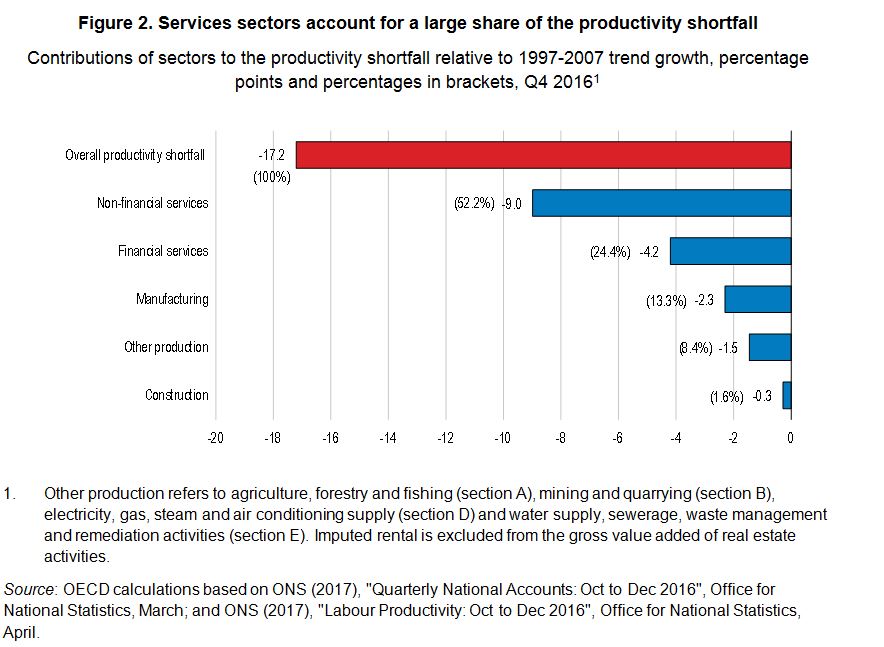
To investigate the issue further, it is possible to calculate the contribution of each sector to the aggregate productivity shortfall since 2007. Such calculation shows that half of the gap is explained by non-financial services (with information and communication being the largest contributor), a fourth by financial services, and another fourth by manufacturing, other production and construction (Figure 2). All but non-financial services and the construction sectors contribute disproportionately to the productivity shortfall compared to their shares in overall output and hours worked of the UK economy.

Fig2.JPG

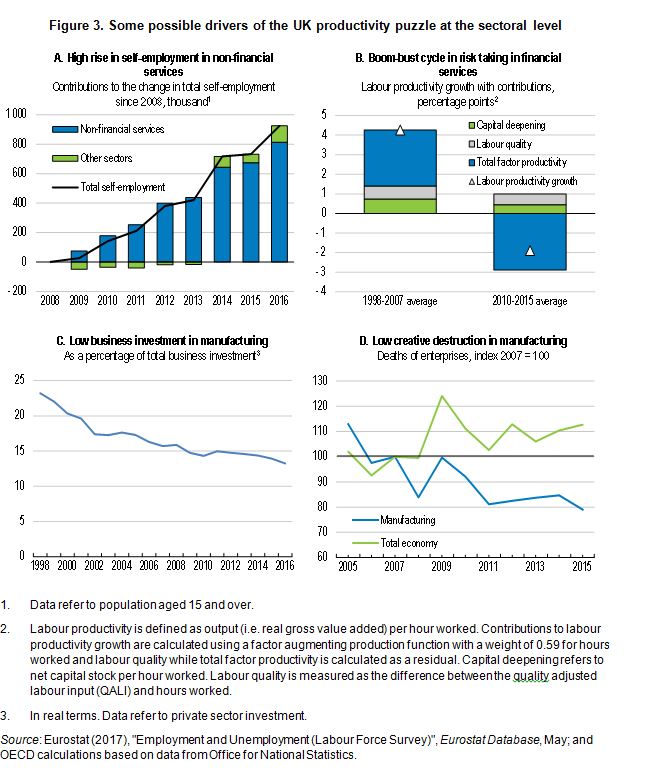
In non-financial services, large increases in self-employed with no employees may have reduced the economies of scale and scope of organised work (Figure 3, Panel A), while the production of the sector has become less capital-intensive at the same time. Greater mismatches between changing skills and created jobs may have also curbed productivity growth, in particular in the information and communication sector where many high-skilled occupations have been created but where increases in labour quality have been comparatively weak.

In financial services, stagnant labour productivity is mainly linked to reduced risk-taking and leverage, as reflected by the decline in total factor productivity following its steep increases in the run-up to the crisis (Figure 3, Panel B).  Although the measurement of output of the financial sector is difficult, this finding is corroborated by the relative size of the financial sector, which was expanding quickly to become significantly larger than in the rest of the G7 in the run-up to the crisis. Looking ahead, the key issue is the extent to which the financial sector can add to productivity growth of the UK economy without undermining financial stability.

In manufacturing, low accumulation of the capital stock (Figure 3, Panel C), suggests a greater substitution from capital towards labour in the production process and a drag on the productivity of the sector. Also, there are indications that weak corporate restructuring may have been another driver, with company exits being smaller than in the overall economy (Figure 3, Panel D). Particularly, in low-tech manufacturing , the percentage of capital and labour that is held up by zombie firms (defined as firms which persistently fail to cover their interest payments from current profits) is estimated to be respectively at around 18% and 13% (OECD, 2017).

The UK productivity puzzle is also partly explained by pre-crisis developments, which include a low tangible investment in comparison with other OECD countries, a too rapid expansion of the financial sector despite the comparative advantage of the City, productivity gains in the manufacturing sector that were insufficiently “offensive” (driven by innovation), and a secular decline of the oil and gas sectors with dwindling resources in the North Sea.

Fig3.JPG

References:

Kierzenkowski R., G. Machlica and G. Fulop (2018), “The UK productivity puzzle through the magnifying glass: A sectoral perspective”, OECD Economics Department Working Papers, No 1496, OECD Publishing.

OECD (2017), OECD Economic Surveys: United Kingdom 2017, OECD Publishing.


Where to get the best bang for the buck in the United Kingdom? Industrial strategy, investment and lagging regions

by Rafal Kierzenkowski, Head of UK Desk, Peter Gal, Economist, Productivity Workstream, and Gabor Fulop, Analyst at the UK Desk, OECD Economics Department

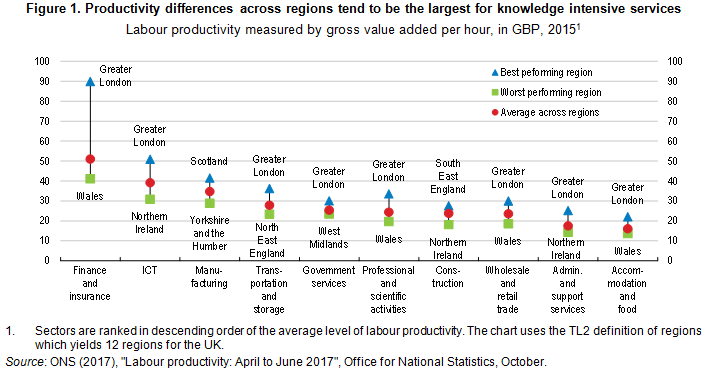
The United Kingdom has large regional disparities in productivity which contribute to differences in living standards across the country, while its less productive regions also hold back overall economic performance (OECD, 2017). High levels of productivity in London are widespread across nearly all sectors, especially among knowledge intensive services such as finance and insurance and information and communication technologies (ICT) (Figure 1).

UKbest bang 11-2017

To narrow these gaps in productivity, the government is preparing a modern industrial strategy to boost labour productivity across the whole country (HM Government, 2017). The strategy has a broad sectoral focus, going beyond manufacturing industries, and aims to improve the local and regional business environment so that both successful businesses and potential new ones can thrive. Devising the optimal strategy raises the question of the optimal allocation of scarce resources in meeting these targets. Our recent study (Kierzenkowksi et al. 2017) aims to contribute to the policy choices linked to the strategy and finds that the catch up of firms with the national best performers in services sectors can give large productivity benefits for most lagging regions, in particular knowledge intensive services such as ICT and business services, but also wholesale and retail trade.

Our study also identifies the sectoral strengths of each region and shows that while each region has productivity leaders, the concentration of such firms is the highest in the south of England, surrounding London, especially in ICT and business services. In turn, differences in the representation of the most productive firms in regions are strongly related to differences in regional productivity.

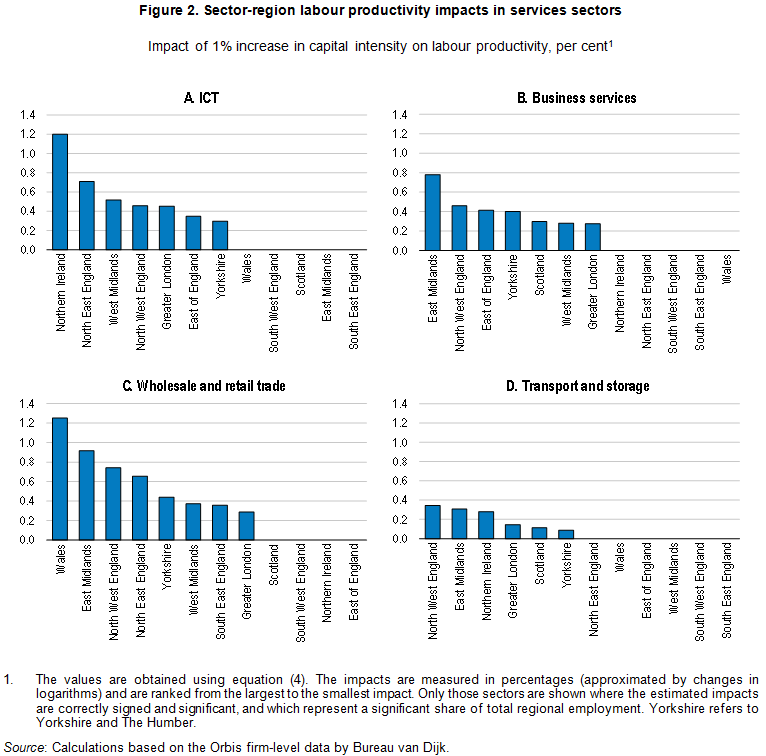
Given low levels of investments in the UK economy and the role new capital goods can play in adopting the latest technologies, our study quantifies the amount of regional and sectoral productivity increases that can be achieved by raising capital intensity. The greatest potential to increase productivity in most regions is by raising the capital intensity of services sectors, which are more responsive to capital intensity increases, in particular in many lagging regions (e.g. northern parts of England, Northern Ireland)  (Figure 2).

UKsectorregion11-2017

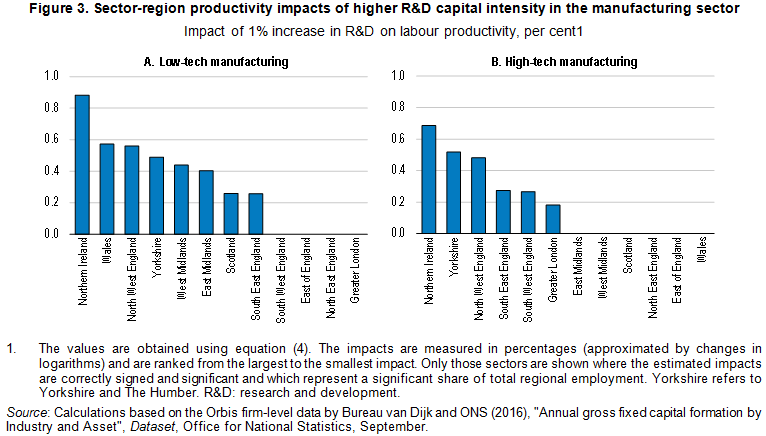
A strong focus on services would also be consistent with the position of UK sectors in global value chains (Criscuolo and Timmis, 2017). However, more granular analysis regarding the type of investment used to raise capital intensity suggests that R&D spending could be effective in raising the productivity of the manufacturing sector in some regions (Figure 3).

UKprod11-2017

Of course, there are several complementary factors to capital intensity that are likely to play a key role in boosting productivity of lagging regions but which can be harder to take into account in a systematic, quantitative manner. Key among them is the availability of skills and their matching to jobs, especially given that regional job-to-job mobility is likely to be held back by a low price elasticity of housing supply. In addition, the ecosystem of companies including the role of infrastructure as well as the density of consumers and suppliers are also likely to play a crucial role.

Bibliography

Criscuolo, C. and J. Timmis (2017), “GVCs and centrality: mapping key hubs, spokes and the periphery”, OECD Productivity Working Papers, forthcoming.

Cohen, W. M. and D. A. Levinthal (1989), “Innovation and Learning: The Two Faces of R & D”, The Economic Journal, Vol. 99, No. 397.

HM Government (2017), Building our Industrial Strategy, Green Paper.

Kierzenkowski, R., P. Gal and G. Fulop (2017), “Where to get the best bang for the buck in the United Kingdom? Industrial strategy, investment and lagging regions”, OECD Economics Department Working Papers No. 1426

OECD (2017), Economic Suvey of the United Kingdom, OECD Publishing, Paris


Mitigating the negative economic impact of Brexit

by Rafal Kierzendowski, Mark Baker, Pierre Beynet and Gabor Fulop, UK Desk, OECD Economics Department

Ahead of the referendum on Brexit, the OECD had been anticipating a significant decrease in economic growth if the decision to leave the EU were taken (Kierzenkowski et al., 2016). As the UK economy has started to slow down, OECD simulations remain remarkably valid so far (Figure 1).

UK

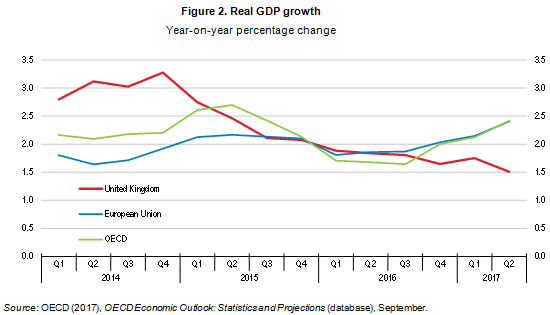
British growth was ahead of G7 economies one year ago, but has now fallen behind as other advanced economies have continued to recover (Figure 2). The recent OECD economic survey on the UK (OECD, 2017) analyses which channels Brexit prospects are currently hurting the economy and what could be done to mitigate this impact.

Fig2UKlaunch

The sterling’s depreciation has been a major drag on growth. It has pushed consumer prices up and hurt household consumption by reducing purchasing power. As real incomes have fallen, households have for a while supported their consumption by reducing their savings. However, the saving ratio increased in the second quarter and consumer credit growth may have peaked. Car registrations are subdued since April.

The sterling’s depreciation has also cut corporate margins of domestic producers, reducing the ability of non-exporting firms to finance investment. In addition, business investment growth has weakened as economic policy uncertainty is high. Weak demand should also negatively weigh on investment of domestically-oriented firms: this is the second-highest risk cited by around half of businesses, with the effects of Brexit being the top risk for nearly 60% of them (Deloitte, 2017).

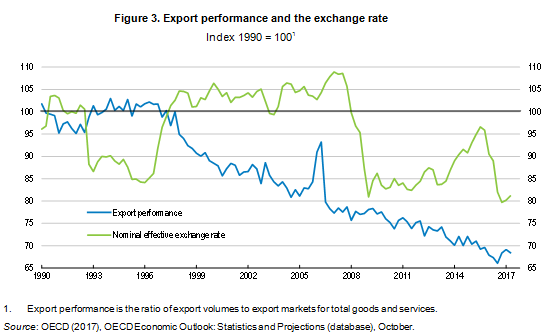
The depreciation of the pound should support export-oriented firms, but this might not be sufficient to offset the negative factors mentioned above. History indicates that British exports have had a low responsiveness to exchange rate movements and the UK’s export performance has been in fact falling over the last two decades (Figure 3). This could be due to increased participation in global value chains, implying a high import content in exports, reducing scope for exporters to win market share following currency depreciation. Moreover, exporters who rely less on imports tend to increase their margins following a depreciation, preventing them from gaining market shares.

Fig3UKlaunch

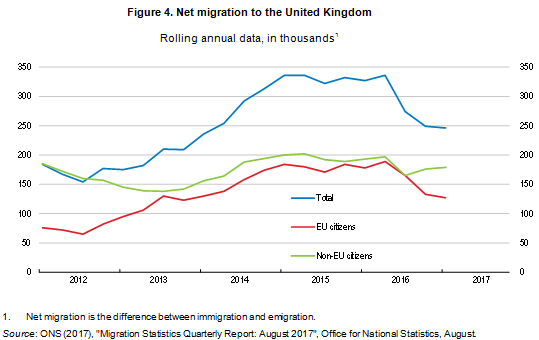
Immigration has enhanced living standards by expanding the labour market and by having a positive impact on labour productivity. Following the EU membership referendum in mid-2016, there has been an important fall in net migration, mainly of EU citizens, explained by increased emigration and reduced immigration (Figure 4). Declines in net migration could tighten the labour market if labour supply falls faster than labour demand. It will significantly reduce growth eventually.

Fig4UKlaunch

In this context, the recent OECD economic survey recommends that the UK authorities secure the closest possible economic relationship with the European Union in its future trading arrangement. Rapidly concluding negotiations to guarantee the rights of EU citizens is a priority to sustain labour supply and ensure further progress in living standards. The United Kingdom should adopt simple criteria to deal with EU citizens living and/or working in the United Kingdom, which would minimise administrative burdens and avoid that some categories of EU citizens fall into the cracks, such as cross-border workers. The government should also identify in advance productivity-enhancing fiscal initiatives on investment that can be implemented swiftly should growth weaken significantly ahead of Brexit. A detailed evaluation of polices to offset the possible loss of European structural funds to poorer UK regions will also be necessary to avoid exacerbating existing regional economic disparities.

Bibliography

Deloitte (2017), Deloitte CFO Survey: 2017 Q2, July.

Kierzenkowski, R., et al.  (2016), “The Economic Consequences of Brexit: A Taxing Decision“, OECD Economic Policy Papers, No. 16, OECD Publishing, Paris.
http://dx.doi.org/10.1787/5jm0lsvdkf6k-en

OECD (2017), OECD Economic Surveys: United Kingdom 2017, OECD Publishing, Paris. http://dx.doi.org/10.1787/eco_surveys-gbr-2017-en


The UK’s heart is wobbling but there are good reasons to Remain in the Union

By Rafal Kierzenkowski and Nigel Pain, OECD Economics Department

Membership of the European Union contributes to the economic prosperity of the United Kingdom. Real GDP per capita has doubled since the United Kingdom joined the European Union in 1973, to almost 40.000 pounds now. The United Kingdom has outperformed other English-speaking countries that are not EU members over time, but also most other longstanding EU members (EU15) (Figure 1). EU membership has played an important role in this, reinforcing the gains from sound domestic policy settings. Membership expands the markets available to UK businesses, enhances the wellbeing of its citizens and strengthens the influence of the United Kingdom in the global economy.

Brexit fig Since EU membership

The United Kingdom is a trading nation, with nearly 45% of its exports destined for the EU market and 3 million of its jobs associated with trade with the European Union. Development of the EU single market has benefitted UK exporters, and there is more to come as the European Union undertakes new initiatives to reduce remaining internal barriers to services, benefitting the large UK services sector. Membership has also helped to develop UK trade relationships beyond the EU market. The United Kingdom gains from a large network of EU trade treaties with 53 non-member countries. Another 67 new free trade agreements are being negotiated, including with the United States, India and Japan. Collectively, the EU economies account for 12.5% of global trade, enhancing the bargaining power and influence of the United Kingdom, which accounts for only 2% of world trade. This ensures that new trade deals favourable for the UK economy can be struck.

EU membership has also added to the attractiveness of the United Kingdom as a location for foreign companies and investors. Access to the EU Single Market is a key consideration for many of these investors. The United Kingdom receives far more foreign direct investment than other EU member states, gaining over one-fifth of all new investments in the European Union over the past decade. These investments originate from not only from the United States and Japan, but half of them also from other EU countries. Such investment boosts UK exports and ensures strong integration with value chains in Europe and beyond, for instance in the car sector. Foreign-owned firms support jobs, with around 3.5 million people employed in foreign multinationals in the United Kingdom in 2012. They also support productivity and wages by undertaking a substantial share of research and development and other capital investments, and by introducing cutting edge managerial practices. These in turn diffuse to other UK companies.

The UK economy benefits from one of the lowest regulatory burdens in the major economies, both on businesses and labour markets, suggesting that EU membership is not a significant constraint to growth and job creation. Indeed, the UK employment rate is now at almost 75%, a record high. Further reforms are possible of course, but the remaining obstacles are largely home grown, for instance in the post and road sectors. Greater regulatory convergence in the rest of the EU, championed by the UK, would also generate positive spillovers to the UK economy.

The survey of the British Chamber of Commerce released in May shows that businesses of all sizes continue to support EU membership, even those where the burden of regulations is often the most challenging. The Small Business Act for Europe, launched in 2008, is the EU’s key policy initiative to support SMEs. The UK government has implemented the vast majority of its recommendations to reduce administrative burdens, improve access to finance and strengthen the innovative potential of small businesses. Access to bank finance has been an important constraint for UK SMEs. EU financing programmes for SMEs are channelled indirectly through different government levels and financial intermediaries. The EU also introduced legislation to shorten payment delays, a key challenge for many SMEs.

A major policy challenge facing the UK is to upgrade infrastructure to lift productivity and to make society more inclusive. The European Investment Bank, the EU bank, is helping to support this. Between 2011 and 2015, the Bank provided over 20 billion pounds of support to the UK economy, with 50% on transport, water and telecommunications, 30% on energy, and 10% on education and health. Projects it supports include one of the largest UK infrastructure investments to raise transport capacity in London, Crossrail, the development of the port of Liverpool, the construction of energy-efficient social housing in the UK, the roll-out of more than 7 million smart meters in homes across Great Britain, and the expansion of research and teaching facilities at Oxford University.

EU competition and single market policies benefit UK consumers by raising their protection and their rights. There are EU rules on passenger rights in air travel. Last year, UK residents made over 65 million visits abroad and many benefited from EU initiatives to reduce international mobile roaming charges in Europe. Indeed, these will be eliminated from mid-2017. The EU also plans to end unjustified geo-blocking, enhancing the benefits of online commerce. The creation of the digital single market would yield further gains.

After 43 years of EU membership, the sizeable doubts that have emerged about staying in the EU suggest that the UK may be prone to a mid-life crisis. Yet there is strong evidence that EU membership has magnified the underlying strengths of the UK economy and that it can deliver more benefits in the future. Acting together, as part of the EU, makes the UK stronger than standing alone to confront global challenges, such as climate change and profit shifting.

See also: Blog: The Economic Consequences of Brexit: A Taxing Decision

References:

Kierzenkowski,R., et al.  (2016), “The Economic Consequences of Brexit: A Taxing Decision“, OECD Economic Policy Papers, No. 16, OECD Publishing, Paris.

OECD.  (2016), OECD Economic Surveys: Euro Area 2016, OECD Publishing, Paris.

OECD.  (2016), OECD Economic Surveys: European Union 2016, OECD Publishing, Paris.


The economic consequences of Brexit: A taxing decision

by Rafal Kierzenkowski,
Head of the UK Desk, OECD Economics Department

Membership of the European Union has contributed to the economic prosperity of the United Kingdom. Uncertainty about the outcome of the referendum has already started to weaken growth in the United Kingdom. A UK exit (Brexit) would be a major negative shock to the UK economy, with economic fallout in the rest of the OECD, particularly other European countries. In some respects, Brexit would be akin to a tax on GDP, imposing a persistent and rising cost on the economy that would not be incurred if the UK remained in the EU. The shock would be transmitted through several channels that would change depending on the time horizon.

In the near term, the UK economy would be hit by tighter financial conditions and weaker confidence and, after formal exit from the European Union, higher trade barriers and an early impact of restrictions on labour mobility. By 2020, GDP would be over 3% smaller than otherwise (with continued EU membership), equivalent to a cost per household of GBP 2200 (in today’s prices).

In the longer term, structural impacts would take hold through the channels of capital, immigration and lower technical progress. In particular, labour productivity would be held back by a drop in foreign direct investment and a smaller pool of skills. The extent of foregone GDP would increase over time.

Impact of Brexit on the United Kingdom through channels and over time

Difference in real GDP relative to the UK staying in the EU

brexit-overview-ECO

Source: OECD calculations.

By 2030, in a central scenario GDP would be over 5% lower than otherwise – with the cost of Brexit  equivalent to GBP 3200 per household (in today’s prices). The effects would be even larger in a more pessimistic scenario and remain negative even in the optimistic scenario. Brexit would also hold back GDP in other European economies, particularly in the near term resulting from heightened uncertainty would create about the future of Europe. In contrast, continued UK membership in the European Union and further reforms of the Single Market would enhance living standards on both sides of the Channel.

Related material

Read the full OECD report