The contribution of weak investment to the productivity slowdown

by Yvan Guillemette, OECD Economics Department

Concerns around weak productivity growth are everywhere these days. As the latest OECD Economic Outlook notes, since the mid-2000s, productivity growth has been markedly lower than at any other time since the 1950s. In response, the OECD has just launched the Global Forum on Productivity, an initiative to foster international co-operation between public bodies who promote productivity-enhancing policies. The goal is clear: to kick productivity growth out of the doldrums. In the long run, it drives all gains in living standards. Without it, many countries may not be able to keep the promises embedded in their social programs.

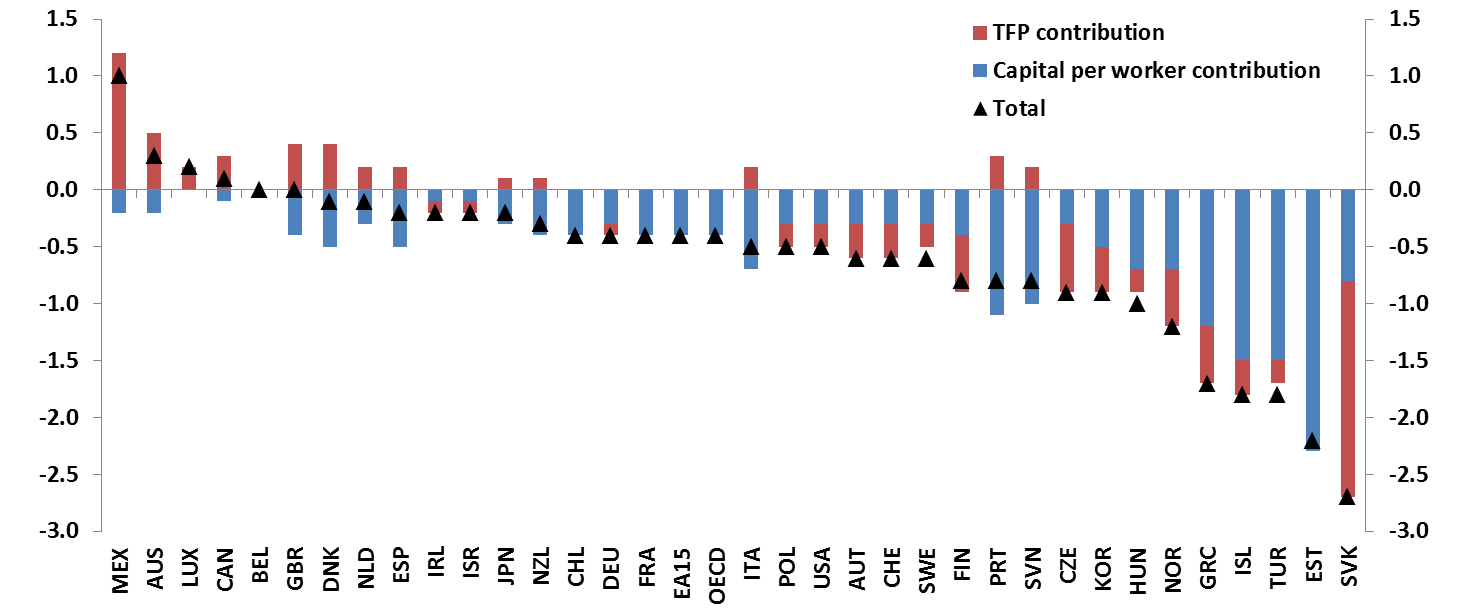
But if we are to boost productivity growth, it would help to understand why it has slowed. Recent OECD work disentangles two overlapping developments (Ollivaud, Guillemette and Turner, 2016). The first is a secular slowdown in total factor productivity growth (the efficiency with which labour and capital inputs are combined in production), which predates the crisis. This trend has continued since, but the reasons behind it are not yet well understood. The second is an abrupt slowdown in investment following the crisis. On average across the OECD and the euro area, trend productivity growth slowed by 0.4 pp per annum between 2007 and 2015, all of which is explained by slower growth in capital per worker. The same is true of most individual OECD countries (see figure).

Change in trend productivity growth between 2007 and 2015

Percentage points per year

cap sstock guilemette

Note: Because the decomposition uses an approximation, a small discrepancy sometimes occurs between the total and the sum of the two contributions.

Why has investment slowed down? A large part of the explanation is simply that weak demand and excess capacity give firms little incentive to invest. Falling investment reduces the amount of capital that workers have to work with, depressing their own productivity and the overall productive capacity of the economy, so-called potential output. The authors calculate that the demand shock associated with the financial crisis may have reduced the aggregate OECD capital stock by about 3¼ per cent and the level of potential output by more than 1% by 2015. The implied reduction in the average growth rate of the capital stock explains about half of the 0.4 pp decline in the contribution from capital deepening to trend productivity growth mentioned above for the OECD area.

Further to the demand effect, capital misallocation during the pre-crisis expansion explains why investment weakness is particularly acute in the countries that saw the biggest investment booms. In addition, many governments have cut public investment in response to deteriorating public finances. Uncertainty, lack of visibility and volatility have added to this unsavoury mix. And to cap it all, the pace of productivity-boosting structural reform has slowed.

High inertia in the capital stock means that the negative effects of the crisis on productivity could last for a while. This realisation adds to the urgency of using all available fiscal space to help stretched monetary policies boost demand, and to redouble efforts on structural reforms.

References:

Ollivaud, P., Y. Guillemette and D. Turner (2016), “Links between weak Investment and the slowdown in productivity and potential output growth across the OECD”, OECD Economics Department Working Papers, No. 1304.

OECD Economic Outlook, June 2016.


Central bank negative deposit rates and the banking sector

By Kei-Ichiro Inaba and Lukasz Rawdanowicz, Macroeconomic Policy Division, OECD Economics Department

The ECB, the Bank of Japan and five other central banks in Europe have applied negative interest rates on commercial banks’ reserves. This additional monetary policy stimulus, following large asset purchases by central banks in some of these areas, should boost the economy and thus raise inflation closer to target. However, its effectiveness may be reduced if negative interest rates undercut banks’ profits. As discussed in Box 1.2 in the latest Economic Outlook, so far these negative effects have been small but will increase in the euro area.

Negative interest rates applied to central bank reserves should lower short and longer-term market interest rates by signalling an easier monetary policy stance and encouraging banks and investors to rebalance their portfolios towards riskier assets. With unchanged monetary policy abroad, they should also weaken the domestic currency. All these effects should bolster the economy and thus banks.

However, negative interest rates may also imply direct losses for banks. The feasibility for banks to compensate these losses depends on their business models. It can be high when banks liabilities are largely in the form of inter-bank loans or bonds and stimulative monetary policy is effective in lowering market interest rates. In contrast, the feasibility will be particularly limited for banks with a large share of retail deposits. Passing negative interest rates to depositors risks widespread withdrawals when storing cash is not very costly. Thus, banks could be forced to compensate losses by raising fees and increasing, or not lowering, interest rates on loans. The chance of such an outcome, and an associated perverse impact on loan demand and growth, increases with the level and duration of negative interest rates.

So far, interest costs on banks’ funds at central banks have been limited and tiny compared to banks’ profits and the average interest rates on funds placed with the central banks are less negative than the central banks’ deposit rates (table below). This stems from various forms of exemptions (tiered reserve systems in Denmark, Japan, Norway and Switzerland; exemption for required reserves in the euro area and Japan). In Sweden, the costs are reduced as banks effectively do not use the deposit facility given that they can purchase Riksbank’s certificates or use overnight fine-tuning operations that are remunerated at less negative interest rates than the deposit rate. In Japan, banks as a whole continue to earn net positive interest income from excess reserves.

In the euro area, the cost of negative interest rates for banks is going to increase with the expansion of ECB total assets and the concomitant increase in reserves for banking sector as a whole. This will not be the case for Japan. Although the Bank of Japan intends to sustain asset purchases, the negative-interest tier has been capped at around 30 trillion yen.

EO99 Investment

References

OECD  (2016), OECD Economic Outlook, Volume 2016, Issue 1, OECD Publishing, Paris.
DOI: http://dx.doi.org/10.1787/eco_outlook-v2016-1-en


What is the scope for public investment to lift long-term growth ?

by  Annabelle Mourougane, Jarmila Botev, Jean-Marc Fournier, Nigel Pain and Elena Rusticelli, OECD Economics Department

Long-term rates are low in OECD countries, particularly in Japan, France and Germany. This opens up fiscal space and can justify any public investment projects with a positive rate of return. At the same time, infrastructure needs are sizeable, especially as fiscal consolidation in recent years has pushed down public capital spending to very low levels in many countries. In such a situation, additional public investment is likely to benefit from high rates of return (Fournier, forthcoming).

New estimates in the June OECD Economic Outlook show long-term output gains of a budget neutral sustained investment stimulus of 0.5% of GDP could amount to between 0.5% and 2% (figure below).

Collective action among the major advanced economies to raise good-quality public investment is estimated to bring additional GDP gains. This would represent a gain of around one-half on average after the first year compared to a scenario where countries acts individually in the large advanced economies but Japan, where the gains are uncertain (Auerbach and Gorodnichenko, 2014). Amongst the major advanced economies, Germany would benefit the most from collective action to boost public investment.
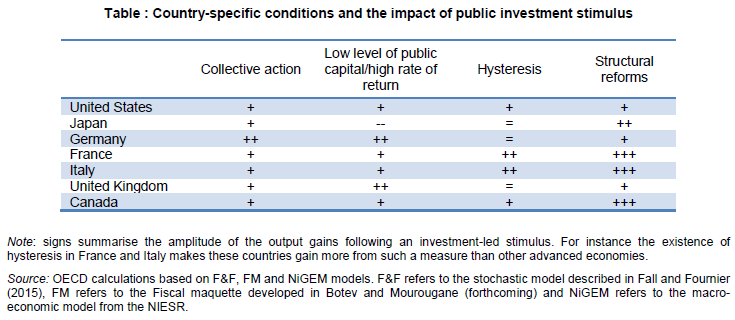
What factors affect the gains to such a stimulus (see table below)? OECD analysis points to the following country-specific factors:

  • the initial level of public capital stock and the rate of returns of these investments: Lowering returns to public capital by one standard deviation could significantly reduce the long-term effect on output, by cutting it by around 3/4. Amongst the large advanced economies, the effect on output would be above average in Germany and the United Kingdom, while the output gains can be negative for Japan.
  • the country’s initial position in the economic cycle and the extent of labour-market rigidities, which determine how far persistent demand weakness undermines the productive capacity of the economy (“hysteresis”). In Italy and France, where this hysteresis effect is stronger, the effect of public investment stimulus is stronger.
  • the additional gains structural reforms can bring to the economy: Reforms targeted at frictions that hold back demand for investment, such as increasing product market competition, can lower the opportunity costs of investing, and hence raise the catalytic impact of public investment on private capital spending. Lowering product market regulations by the average improvement over two years in a typical OECD country could add around 0.1-0.3 percentage point to the growth impact after the first year. Such gains would be sizeable in France, Italy and Canada.

Investm2.png


Investment1

References

Auerbach, A.J. and Y.Gorodnichenko (2014), “Fiscal Multiplier in Japan”, NBER Working Papers, No. 19911.

Botev, J. and A. Mourougane (forthcoming), “Fiscal Consolidation: What are the Breakeven Fiscal Multipliers?”, OECD Economics Department Working paper, OECD Publishing, Paris.

Fall, F. and J.M. Fournier  (2015), “Macroeconomic Uncertainties, Prudent Debt Targets and Fiscal Rules”,OECD Economics Department Working Papers, No. 1230, OECD Publishing, Paris.

Fournier, J.M. (forthcoming), “The Positive Effect of Public Investment on Potential Growth”, OECD Economics Department Working Paper, OECD Publishing, Paris.

Mourougane, A., J. Botev, J.M. Fournier, N. Pain and E. Rusticelli (forthcoming), “Can an Increase in Public Investment Sustainably Lift Growth?”, OECD Economics Department Working Papers, OECD Publishing, Paris.


Policymakers: Act now to break out of the low-growth trap and deliver on our promises

By Catherine L. Mann, OECD Chief Economist

Policymaking is at an important juncture. Without comprehensive, coherent and collective action, disappointing and sluggish growth will persist, making it increasingly difficult to make good on promises to current and future generations.

Global growth has languished over the past eight years as OECD economies have struggled to average only 2 per cent per year, and emerging markets have slowed, with some falling into deep recession. In this Economic Outlook the global economy is set to grow by only 3.3 per cent in 2017. Continuing the cycle of forecast optimism followed by disappointment, global growth has been marked down, by some 0.3 per cent, for 2016 and 2017 since the November Outlook.

The prolonged period of low growth has precipitated a self-fulfilling low-growth trap. Business has little incentive to invest given insufficient demand at home and in the global economy, continued uncertainties, and a slowed pace of structural reform. In addition, although the unemployment rate in the OECD is projected to fall to 6.2 per cent by 2017, 39 million people will still be out of work, almost 6.5 million more than before the crisis. Muted wage gains and rising inequality depress consumption growth. Global trade growth, at less than 3 per cent on average over the projection period, is well below historical rates, as value-chain intensive and commodity-based trade are being held back by factors ranging from spreading protectionism to China rebalancing toward consumption-oriented growth.

Negative feedback-loops are at work. Lack of investment erodes the capital stock and limits the diffusion of innovations. Skill mismatches and forbearance by banks capture labour and capital in low productivity firms. Sluggish trade prospects slow knowledge transfer. These malignant forces slow down productivity growth, constraining potential output, investment, and trade. In per capita terms, the potential of the OECD economies to grow has halved from just below 2 per cent 20 years ago to less than one per cent per year, and the drop across emerging markets is similarly dramatic. The sobering fact is that it will take 70 years, instead of 35, to double living standards.

The low-growth trap is not ordained by demographics or globalization and technological change. Rather, these can be harnessed to achieve a different global growth path – one with higher employment, faster wage growth, more robust consumption with greater equity. The high-growth path would reinvigorate trade and more innovation would diffuse from the frontier firms as businesses respond to economic signals and invest in new products, processes, and workplaces.

What configuration of fiscal, monetary, and structural policies can propel economies from the low-growth trap to the high-growth path, safeguarding living standards for both young and older generations?

Monetary policy has been the main tool, used alone for too long. In trying to revive economic growth alone, with little help from fiscal or structural policies, the balance of benefits-to-risks is tipping. Financial markets have been signalling that monetary policy is overburdened. Pricing of risks to maturity, credit, and liquidity are so sensitized that small changes in investor attitude have generated volatility spikes, such as in late 2015 and again in early 2016.

Fiscal policy must be deployed more extensively, and can take advantage of the environment created by monetary policy. Governments today can lock in very low interest rates for very long maturities to effectively open up fiscal space. Prioritized and high-quality spending generates the capacity to repay the obligations in the longer term while also supporting growth today. Countries have different needs and initial situations, but OECD research points to the kind of projects and activities that have high multipliers, including both hard infrastructure (such as digital, energy, and transport) and soft infrastructure (including early education and innovation). The right choices will catalyse business investment, which, as the Outlook of a year ago argued, is ultimately the key to propelling the economy from the low-growth trap to the high-growth path.

The high-growth path cannot be achieved without structural policies that enhance market competition, innovation, and dynamism; increase labour market skills and mobility; and strengthen financial market stability and functioning. As outlined in the special chapter in this Outlook, the OECD’s Going for Growth and the comprehensive Productivity for Inclusive Growth Nexus Report of the OECD Ministerial Summit, there is a coherent policy set for each country based on its own characteristics and objectives that can raise productivity, growth and equity.

The need is urgent. The longer the global economy remains in the low-growth trap, the more difficult it will be to break the negative feedback loops, revive market forces, and boost economies to the high-growth path. As it is, a negative shock could tip the world back into another deep downturn. Even now, the consequences of policy inaction have damaged prospects for today’s youth with 15 per cent of them in the OECD not in education, employment, or training; have drastically reduced the retirement incomes people are likely to get from pension funds compared to those who retired in 2000; and have left us on a carbon path that will leave us vulnerable to climatic disruption.

Citizens of the global economy deserve a better outcome. If policymakers act, they can deliver to raise the future path of output – which is the wherewithal for economies to make good on promises – to create jobs and develop career paths for young people, to pay for health and pension commitments to old people, to ensure that investors receive adequate returns on their assets, and to safeguard the planet.


OECD Economic Outlook urges policy action to promote productivity and equality

by Oliver Denk, OECD Economics Department

The Special Chapter of the OECD Economic Outlook published today shows why the global economy remains in the doldrums. Since the mid-2000s, productivity growth has been markedly lower than at any other time since the 1950s. This matters as rising productivity lies at the heart of economic progress.

The chapter also shows another unsettling trend. Income inequality has been on a steady upward rise over the past 30 years. Technological change and globalisation are likely to have put low- and medium-skilled workers at a disadvantage. On the other hand, income growth has been especially high for the top 1%.

The productivity slowdown and the rise in inequality have acted as a “double-whammy” for many workers and their families. On average across OECD countries, income of the bottom 40% in the income distribution has improved by a dismal ½ per cent per year over the past decades (adjusted for inflation). Income of the bottom 10% is effectively no higher than in 1990, a quarter-century ago.

Given these unsatisfying developments, it is no wonder that economic, social and political discontent has risen on both sides of the Atlantic. Worryingly, no fast turnaround is in sight. The global projections in our Economic Outlook, also released today, forecast only a small uptick in productivity growth for 2016-17.

How can policymakers reverse the two trends of slowing productivity and rising inequality? Many policy choices – on monetary, fiscal and structural policies – affect both productivity and inequality. They could thus tackle these twin challenges together. Ambitious, multifaceted and coherent policy actions are necessary.

Aggressive demand management will help economies return to trend productivity and employment. The downturn since 2007 has not only depressed productivity but also employment. Low-income, low-skilled workers have often been the first to lose their job. Accommodative monetary and fiscal policies work against this rise in poverty and income inequality.

Equally important, many countries have ample scope for structural policies to improve the education system, upgrade their infrastructure, facilitate the entry and exit of firms and support workers in transitioning to emerging, high-productivity jobs. Is there a one-size fits all? The chapter draws out the key general lessons, but country specificities matter as well. You can find the reform priorities tailored to each country’s circumstances in the country notes.

Background

Promoting Productivity and Equality: A Twin Challenge

OECD Economic Outlook

The Productivity-Inclusiveness Nexus

Global Forum on Productivity


Productivity, productivity, wherefore art thou?  (Romeo and Juliet: Act 2, Scene 2)

First published on OECD Insights http://wp.me/p2v6oD-2vJ.

By OECD Statistics Directorate

Four hundred years after the death of Shakespeare there remain many misconceptions on what he wrote. Perhaps the most common concerns the adulterated quote above, which is actually a reference to why Romeo was a Montague rather than where Romeo was. In the same spirit of confusion, recent years have seen considerable debate about the causes of the productivity slowdown seen across OECD countries.

This year’s Productivity Compendium includes a special chapter that casts a spotlight on some of the potential villains stalking the stage, together with insights from the OECD Productivity Database, and frames the discussion under the umbrella of the Productivity Paradox: a reference to the fact that productivity has slowed during a period of significant technological change, increasing participation of firms and countries in global value chains and rising education levels in the labour force.  Indeed, the advent of digital innovations such as Big Data was expected to have sparked off a new wave of productivity growth, similar to those seen in the past, for example, as a result of electrification in the early 1900s and the ICT wave in the 1990s.

However, this has not yet materialised, raising a number of still largely open questions, ranging from potential lagged effects of these new technologies, a thinning out of new ideas (Gordon, 2012) to a breakdown of the ‘diffusion’ machine (OECD, 2015), right through to measurement.  Indeed, against a backdrop of increases in income and wealth inequalities, concerns have emerged that this may reflect a structural, and not a cyclical, slowdown, with consequential impacts on well-being and long-term growth; hence the theme for this year’s OECD Ministerial meeting and OECD Forum : “Enhancing Productivity for Inclusive Growth” www.oecd.org/forum.

Double, double toil and trouble (Macbeth: Act 4, Scene 1)

But whilst all of these actors may in part explain the recent post-crisis productivity slowdown, often overlooked in the debate is that the slowdown in productivity is not a recent affair, a fact that even Macbeth’s witches may have struggled to foresee. The OECD Compendium of Productivity Indicators 2016 reveals that productivity growth began to slow well before the crisis; trending down since the early 2000s in Canada, the United Kingdom and the United States and since the 1970s in France, Germany, Italy and Japan (Figure 1).

Fig1-Productivity-G7.fw

Download graphs and data in Excel

Part of this downward trend in labour productivity can be explained by slower growth in multi-factor productivity (MFP), lending some weight to the arguments that technological spill-overs and diffusions from ICT, and other new technologies may be lower than from earlier technology breakthroughs. But lower MFP growth is not the only source.  In many countries the contribution of capital deepening has also declined significantly, particularly in recent years.

Nothing will come of nothing (King Lear: Act 1, Scene 1)

Although King Lear uttered the words above to his daughter Cordelia to solicit overt affection, his words are now typically used to illustrate that without investment, neither growth, nor indeed productivity, will follow. The Compendium shows, for example, that the direct contribution of information and communication technology (ICT) capital goods to productivity reached its peak in the late 1990s and has gradually waned since then, significantly so in most countries (Figure 2).

Fig2-contribution-ICT-capital.fw

Download graph and data in Excel

And although the shares of ICT investment have held up reasonably well compared with other forms of investment, ICT investment as a share of GDP also remains below previous highs in many countries (Figure 3). Moreover, when measured and included, although knowledge based capital has held up better, it too has slowed in recent years and makes little change to the overall picture.

Fig3a-3b-ICT-investment.fw

Download graphs and data in Excel

Truth is truth, to the end of reckoning (Measure for measure: Act V, Scene 1)

One suspect behind the slowdown, well versed in having to deal with the ‘slings and arrows of outrageous fortune’ is measurement.  Indeed so prevalent is the view that measurement is at fault, particularly relating to the measurement of new disruptive (digital) technologies, such as Big Data,  and business models, such as AirBnB and UberPop, it has been given its own acronym, MMH, the Mis-Measurement Hypothesis.  The spread of digitalised applications has brought with it the provision of free services such as internet search capacity and media content and new business models, many of which are dependent on greater participation (i.e. labour input) by consumers.  But the consumer’s activity remains (by and large) outside of the GDP production boundary, and the free services received are not captured as household consumption, raising questions about a missing ‘consumer surplus’ from GDP.

However, whilst it is clear that digitalisation may have compounded long standing measurement issues, in particular the measurement of price change and, so in turn, volume measures used in productivity measurement, and where efforts to improve measurement continue, the evidence increasingly suggests that the MMH is, at best, only partially true.  Syverson (2016) for example shows that US GDP would have been around 15% higher in the third quarter of 2015 if the recent slowdown (post 2004) hadn’t occurred, swamping any potential unmeasured productivity growth and estimates of the consumer surplus, while Byrne, Fernald, and Reinsdorf (2016) show similar results.  Ahmad and Schreyer (2016) further demonstrate that the GDP accounting framework is ‘up to the challenges posed by digitalisation’ and reinforce the distinction that needs to be made between GDP and welfare and indeed consumer surplus.

This is the short and the long of it (The Merry Wives of Windsor: Act II, Scene II)

In summary therefore the evidence suggests that the productivity slowdown is real and not a statistical phenomenon.  True as this may be, it is also true that attempts to identify the causes of the slowdown can be greatly facilitated by improved availability or use of firm-level statistics in analyses, in particular on intra-firm transactions, and improved data on investment by type of asset, occupations, and skills. So, although statistics are not at fault they continue to provide the best route for a solution to the paradox and the key for policies that can restart the productivity engine.


The OECD Productivity Database

The OECD Productivity Database contains a consistent set of internationally comparable data on levels and growth rates of labour productivity, hours worked, employment, capital services, multifactor productivity and unit labour costs for OECD countries and Key Partners. It also includes growth measures of labour productivity, hours worked, employment and unit labour costs by main economic activity. These series, available from 1970 onwards for some countries, are updated on a daily basis.

Get real-time data at OECD Productivity Statistics (Database)


References

Ahmad, N and P. Schreyer (2016), “Measuring GDP in a Digitalised Economy”, OECD Statistics Directorate Working Paper, forthcoming.

Byrne D., J. Fernald and M. Reinsdorf (2016), “Does the United States have a productivity slowdown or a measurement problem?”, Brookings Papers on Economic Activity, BPEA Conference Draft, March 10-11.

Gordon, R. (2012), “Is US Economic Growth Over? Faltering Innovation Confronts the Six Headwinds”, NBER Working Papers, No. 18315.

OECD (2015), The Future of Productivity, OECD Publishing, Paris, http://dx.doi.org/10.1787/9789264248533-en.

OECD (2016), OECD Compendium of Productivity Indicators 2016, OECD Publishing, Paris, http://www.oecd.org/std/productivity-stats/oecd-compendium-of-productivity-indicators-22252126.htm.

Syverson, C. (2016), “Challenges to mismeasurement explanations for the U.S. productivity slowdown”, NBER Working Paper No. 21974, http://www.nber.org/papers/w21974.


Structural reforms in a difficult time

By Naomitsu Yashiro,
Structural Surveillance Division, OECD Economics Department

The pace of structural reforms is slowing just when the world economy needs decisive policy actions to strengthen fundamentals and restore healthy growth (the 2016 Going for Growth report). Policy makers may be concerned that introducing structural reforms in the current context involve trade-offs between the mid- to long-run gains in employment and productivity and short-run losses.

In our recent paper (Caldera Sánchez, de Serres and Yashiro, 2016), we note that when the economy is near its potential, and confidence among consumers and investors is high, gains from growth-enhancing reforms have been found to exceed potential losses even in the short run, as demand increases on the anticipation of the future benefits. However, the short-term impact of reforms may be less favourable when they are introduced in difficult macroeconomic conditions, as several factors may prevent a pick-up in demand. In some circumstances, specific reforms may even entail short-term reductions in demand.

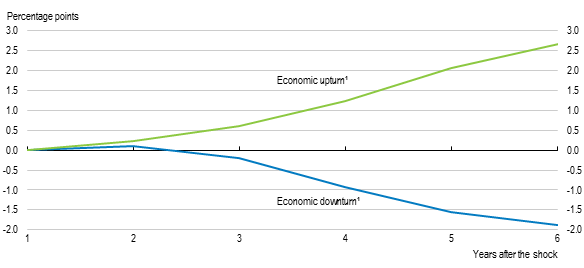
There are several conflicting channels through which reforms affect the real economy. The strength of the channel can change under different macroeconomic conditions. Take reforms of unemployment benefits that aim to improve work incentives by strengthening the conditionality of income support in the case of a lay-off on intensive job-search efforts. By facilitating the return to work, such reforms raise employment, household income and thus consumption. However, uncertainty regarding disposable income also increases, potentially discouraging consumption. In good times, employment gains can be quick, so that output increases within 2-3 years after reforms. But during recessions when the unemployed are less likely to find jobs the gains in employment can even turn negative (See figure).

The gains in employment of an unemployment benefit reform
can turn negative during a downturn

Reforming in a difficult macro context

Note: The lower (upper) line corresponds to the impact of the reduction in the initial unemployment benefit replacement rate during economic downturn (upturn), where the economic cycle is measured through the level of the pre-reform unemployment gap (i.e. the difference between the structural unemployment rate and the unemployment rate). The economic downturn (upturn) corresponds to the case where unemployment gap is set to the minimum (maximum) value within the sample.
Source: Bouis et al. (2012).

Other reforms that seek to restore competitiveness through lower relative costs and prices can also depress demand if conducted during downturns. This is because in bad times labour and goods demand respond little to the lower wages and product prices resulting from reforms, while workers or firms see their income and profit eroded in the short term. Ideally, governments can deploy expansionary fiscal policies or monetary policies to support demand. But, in some cases, macro policies may also be constrained, as has been the case for several countries in the past few years. Strong external demand can help to bring forward the benefits of reforms as well. For instance, our review of case studies suggests that Canada’s labour market reforms around the mid-1990s benefited from strong demand from the United States. This supported the gains in employment following the reforms.

Even under limited supports from fiscal and monetary policies or external demand, a smart packaging or sequencing of reforms can alleviate the negative short-run impacts on demand: (1) reforms of labour and product markets can be conducted in tandem, so that the lower prices from stronger competition limit the impact of labour market reforms on real wages; (2) addressing dysfunctions in the financial sector as early as possible can improve access to credit and allow households and firms to capitalise on the future benefits of reforms and expand consumption and investment today; (3) reducing policy uncertainty through well-communicated, credible reform strategies can prevent the deterioration of confidence among business and consumers.

Many reforms can boost demand by themselves even during difficult macroeconomic conditions. For instance, measures aimed at raising investment in knowledge-based capital, including through infrastructure spending, as well as tax structure reforms can bring short benefits. Also, reducing regulatory barriers to entry in services sectors with large pent-up demand and relatively low entry costs (like professional services or taxis) can boost business expansion and employment relatively quickly. Similarly, reducing barriers to geographic or jobs mobility can increase the speed of employment gains in difficult times. Strengthening active labour market policies and to alleviate skill shortages and mismatch can unleash business activities that were previously constrained by skills bottlenecks. Reforms that contribute to the long-term sustainability of public finance and to the cost-effectiveness of healthcare or pension systems can reduce uncertainties on household’s future income, thereby boosting consumption today.

References:

Caldera Sánchez, A., A. de Serres and N. Yashiro (2016), “Reforming in a difficult macroeconomic context: A review of the issues and recent literature”, OECD Economics Department Working Papers, No. 1297, OECD Publishing, Paris.

OECD.  (2016), Economic Policy Reforms 2016: Going for Growth Interim Report, OECD Publishing, Paris.


Can we improve real-time estimates of the output gap for policy purposes?

 
By David Turner, Yvan Guillemette & Maria Chiara Cavalleri,
Macroeconomic Analysis Division, OECD Economics Department

The output gap ought to be a key input in short-term policy-making because it provides a summary measure of economic slack, so allowing policy-makers to anticipate inflationary pressures. It can also be used to estimate cyclically-adjusted measures of the fiscal balance, to provide a better assessment of fiscal sustainability. Unfortunately, estimating output gaps is far from an exact science, and estimates are often revised leading some to question their usefulness.

Recent OECD work proposes a way of incorporating additional information into the existing OECD methodology that should better anchor output gap estimates so they are less prone to revision. Estimating the output gap essentially means trying to disentangle the sustainable trend component of output from its cyclical component. Large revisions to a key component of the output gap occur because simple statistical filtering techniques, such as the Hodrick-Prescott filter, cannot distinguish trend from cycle at cyclical turning points when they occur at the end of the sample. Indeed, revisions to OECD published estimates of the output gap for G7 countries over the immediate pre-crisis period have typically been 2–3 percentage points and sometimes larger.

To better distinguish trend from cycle, the paper proposes exploiting historical correlations between key components of the output gap and other macroeconomic variables which are available on a timely basis: particularly manufacturing capacity utilisation and the share of investment in GDP, and for some countries credit, house prices or the unemployment rate. How strongly each of these variables correlates to output gap components varies by country, but overall revisions to the output gap are reduced when a highly-correlated factor is considered in the estimation.

The additional adjustment substantially reduces revisions over the crisis period; the occurrence of revisions exceeding 2 percentage points is reduced from six of the G7 countries to a single country and the root mean square revision at turning points is reduced by one-third on average (Figure).

Root mean squared revisions to a key component of the output gap for 2007 and 2009

Percentage points of potential GDP

Output gap turner

Note: The chart shows revisions to the labour efficiency gap which is the main component of the output gap accounting for large historical revisions. Revisions are calculated both for a simple Hodrick-Prescott (HP) filter and an HP filter which is modified with the additional cyclical adjustment. Revisions for 2007 (2009) are calculated by applying the filtering procedure to data ending in 2007 (2009) to derive an initial estimate of the gap and then applying the same procedure over the full sample to 2014.

Useful though it is, this twist on the current methodology is not a panacea. Also, the size of eventual output gap revisions is only one of the yardsticks against which different methodologies should be evaluated. After all, a rule that the output gap was a fixed number would show no revision at all, but would be useless for policy. Good estimates should also pass the ‘smell test’ of credibility and be able to explain inflation developments. Research on these issues is ongoing at the OECD and elsewhere.

References:

Turner, D., M.C. Cavalleri, Y. Guillmette, A. Kopoin, P. Ollivaud and E. Rusticelli (2016), “An Investigation into Improving the Real-Time Reliability of OECD Output Gap Estimates”, OECD Working Papers, No. 1294, OECD Publishing, Paris.


Untying the knots strangling Brazil’s competitiveness

by Sónia Araújo
Economist, Brazil Desk, OECD Economics Department

There is strong international evidence that trade liberalisation and increased international integration are key elements of a successful growth strategy. Exposure to international competition, sourcing internationally and learning by exporting accelerates technological upgrading and fosters productivity growth. This column explains how three policy instruments are holding back competitiveness by limiting Brazil’s ability to tap into the global pool of knowledge.  

 Despite a constitutional amendment in 2003 intended to exempt exports from indirect taxes, Brazilian exporters face tremendous hurdles in claiming back indirect taxes paid on intermediate inputs. Poultry exporters, for instance, estimate that the government owes them around 7% of the value of their exports on account of the several indirect taxes paid on inputs. After attempting to claim these credits for years, companies simply prefer to write off these amounts.

The competitiveness of industrial exports is suffering even more than that of raw and semi-processed goods on two accounts: higher rates are applied to products requiring more transformation and indirect taxes are cumulative. Indirect taxes on inputs embodied in exports put Brazilian producers at a disadvantage vis-à-vis foreign competitors who do not pay such taxes.

Brazilian exporters are also penalised by Brazil’s high import tariffs, which are the highest among the BRICS countries for non-agricultural products (see previous post on Brazil: A tale of two industries or how openness to trade matters, March 22, 2016). Together with local content requirements that expand into an increasing number of sectors (oil, chemicals, motor vehicles, telecoms, health, etc.), they prevent Brazilian companies from sourcing at the lowest cost.

Advocates of trade protection often claim that protection raises the performance of domestic industry over time. Brazil’s own experience in this area is sobering. There is no evidence that high levels of protection have spurred Brazil’s exports, which have remained flat relative to GDP (Figure 1).

Figure 1. Brazil’s share of world trade is low relative to its GDP
Share of exports and imports on world’s total exports and imports, respectively
Brazil Sonia 1
Source: Secretaria de Comércio Exterior (SECEX) do Ministério do Desenvolvimento, Indústria e Comércio Exterior (MDIC), World Bank Development Indicators.

In fact, the share of manufacturing output in GDP has been declining for a decade and manufacturing productivity is low and stagnant (Figure 2).

Figure 2. Manufacturing productivity is low and stagnant
Labour productivity in thousands of constant 2005 USD per employee

Brazil Sonia fig2

Source: World Bank, ILO, IBGE.

By international comparison, Brazil’s industrial sector is small for a middle income country (Figure 3; OECD, 2015).

Figure 3. Brazil’s industrial sector is small for an upper middle income country
Share of industry in total value added in middle income countries, in per cent, 2012

Brazil Sonia fig3

Source: World Bank.

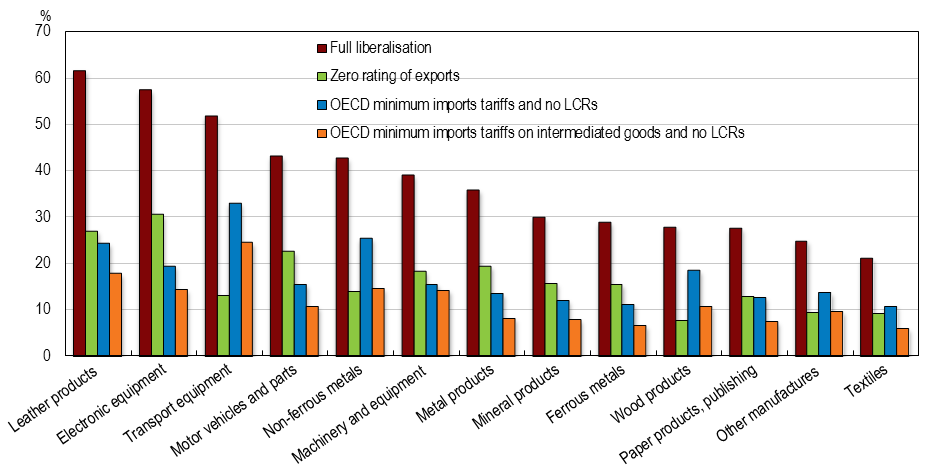
In a recent study we attempt to quantify the effects of lifting these barriers to trade using the OECD Metro model, a computable general equilibrium model of the world economy. The simulation results suggest that reducing import tariffs and local content rules, and effectively exempting intermediate inputs from indirect taxes would boost Brazilian exports, production and jobs substantially. The largest gains would accrue in manufacturing, where exports of leather products, electronic and transport equipment, motor vehicles and non-ferrous metals would all increase by more than 40% (Figure 4). Job creation would be higher in lower skilled occupations, benefiting those at the lower end of the income distribution.

Figure 4. Largest Gains in Exports
Sectors with an increase in exports of at least 20%

Brazil Sonia fig5

The simulation results also suggest that these tax and trade policy reforms would bring clear efficiency gains to the economy: firms would be able to use a higher share of foreign intermediate goods and final goods would in turn be sold at lower prices, enhancing export competitiveness and benefiting Brazilian households.

Another result from our simulations is that it pays to go for a big push. The benefits of a wide-ranging trade liberalisation would far exceed those of partial reforms. Overall, getting rid of these barriers would enable Brazil to develop a stronger manufacturing sector and become much more integrated into the global economy.

Find out more

Araújo, S. and D. Flaig (2016), “Quantifying the Effects of Trade Liberalisation in Brazil: A Computable General Equilibrium Model (CGE) Simulation”, OECD Economics Department Working Papers, No. 1295, OECD Publishing, Paris.

OECD (2015), OECD Economic Surveys: Brazil, OECD Publishing, Paris


Reforming benefits in Lithuania to generate a double dividend: Making work pay while better protecting the jobless

By Lilas Demmou, Head of Lithuania Desk, OECD Economics Department

Inequality measures in Lithuania (like in Estonia and Latvia) are high. To an important extent this is related to the high risk of poverty for non-working individuals and to the low rewards to work. Therefore, increasing the quality of jobs, ensuring that the most vulnerable have access to employment and providing adequate income support for those that have lost their job are key for making labour markets and the economy more inclusive. Lithuania provides an interesting example on how to reform out-of-work benefits to reconcile three major objectives i) providing adequate support for living, ii) improving labour market matching by allowing job seekers to devote enough resources to job search iii) maintaining financial incentives to search for a job and accept a vacancy.

In Lithuania less than 20% of unemployed are covered by the unemployment benefit system and the replacement rate is comparatively low. Social assistance benefits have been in practice the main income buffer in the case of job loss: the number of recipients increased from 1% of the total population before the crisis to around 7% at its peak (Panel A).

However, the social assistance system provides also only a very low level of income replacement (at maximum half the poverty line for single individuals) and insufficient incentives to work due to complete and immediate benefit withdrawal in case of accepting a formal job for the large majority of social assistance recipients. As a result of restrictive and low out-of-work benefits, losing a job goes often hand-in-hand with high risks of poverty, generating an inactivity trap and skills mismatch.

lithuania one

In line with OECD countries experience (Immervoll and Pearson, 2009), providing in-work benefits could strike a balance between labour market inclusiveness and maintaining incentives to work. Recent studies on Lithuania show that effective marginal taxation related to benefits withdrawal reaches almost 75% of additional income for low paid jobs (Panel A). The current in-work benefit scheme reduces effective taxes and increases work incentives by adding up to 25% of total income for those eligible with the lowest earnings. However, the macro effect on poverty remains limited due to the narrow population covered by the current system (2% of social assistance recipients) because high informality requires strict eligibility.

Against that background, reforming unemployment benefits might generate a double dividend: it would improve the functioning of the labour market by providing adequate support for job search and would reduce incentives for informal wage payments. Our simulations show that modifying the unemployment benefit system in line with the government’s proposed reforms under the “New Social Model” would roughly double the level of the average annual replacement rate and would increase the number of benefit recipients by 13%. The reform would be associated with a large increase in the disposable income of those at the bottom of the income distribution and a large increase in the replacement rate at the upper part of the income distribution, as the level of the benefit ceiling is increased (Panel B).

disponsable lithuania

Source: Navicke J., Avram S. and Demmou L., (2016)

This stronger link established with previous earnings would allow in a second step strengthening in-work benefits system by reducing incentives for underreporting wages.

Find out more:

Immervoll, H. and M. Pearson (2009), A good time for making work pay? Tacking stock of in-work benefits and related measures across the OECD, OECD DELSA working paper n.81 

OECD (2016), Economic Survey: Economic Assessment of Lithuania 2016, OECD Publishing

OECD (2015), Investing in Youth :Lithuania, OECD Publishing

Navicke J., Avram S. and Demmou L., (2016), The effects of Reform Scenarios for Benefits Systems on Work Incentives and Poverty in Lithuania, OECD Economics Department working paper forthcoming