The gig economy will not abolish working 9 to 5

by Rory O’Farrell, Economics, OECD Economics Department
Today’s post is also being published by the OECD Insights Blog

gig-economy2

There is little new about the ‘gig economy’. The word ‘gig’ originates from 1920s jazz musicians who played a small concert or ‘engagement’ at a venue. Dolly Parton may have sung about working 9 to 5, but her life was moving from one gig to another.  We have always had plumbers, electricians, and lawyers who do temporary work, and are not paid by clients when they are idle. However, do new apps such as Uber or Deliveroo mean the end of the 9 to 5 job, and do these platforms need to be regulated?

Similar to the introduction of the Yellow Pages phone directory, new smart phone apps lower the cost of collecting information and searching for a worker. Apps can show when people are available, their current location, and offer reviews of a worker’s reliability. Such ease of use may increase demand for gig services, and estimates of those working through such apps range from 0.5% to 3.5% of the workforce in advance economies. This, combined with scalability, allows new services to be provided such as food delivery from small restaurants, whereas before the market lacked the depth to be viable.

Though apps have been described as providing large scale efficient marketplaces, they may have market power. Certain aspects can lead apps to become a natural monopolies, and they may warrant regulation. As an app reduces search costs there is little point in having several apps providing related information. Apps benefit from ‘network externalities’, whereby the value of being connected with an app increases with the number of other users. Over time one app could become the access point for a gig service, similar to how supermarkets are for food.

There may also be high switching costs for gig workers, allowing app owners to extract rents. In an information age, reputation can be a worker’s most valuable asset. If a worker has established a reputation (via online reviews) with one platform, this reputation capital may be lost if the worker switches platforms. App owners can extract some of the value of the reputation. However, allowing the “portability” of workers’ existing good ratings from one platform to another would lessen the dependency of workers upon single platforms.

As much work happens in spurts, employers often value flexibility, and apps can help firms outsource tasks. Managers trade off the cost of having a worker on standby against the cost of disruption when a crucial worker is unavailable in a crisis. This is why factories often permanently employ electricians, and banks hire IT specialists. Though apps can lower the length of such disruptions, the effect is likely to be small. Having employees is like insurance, and is cheaper for lower paid workers.

Despite the advantages of flexibility, firms still hire staff. Search costs remain, especially for high-skill jobs. Reviews on apps do not provide the information that a standard job interview does. Once a firm finds a suitable worker, it may be cheaper to offer them a full-time job than pay the costs of constantly searching for staff, and giving firm-specific training. The cost of integrating a worker in a team is also likely to increase with the complexity of the job.

Also, whether someone does a good job can be difficult to monitor, and apps have not overcome this. This is especially the case for high-skill jobs and it can take a long time to discover whether the worker is doing a good job or not. This helps explain why people use legal firms rather than directly employ lawyers for complicated tasks (as the law firm itself has built up a reputation) but a local lawyer for conveyancing or drawing up a will. Self-employment works best when it is easier to assess the service provided than the effort a worker expends on providing it. This is why truck drivers were self-employed before on-board recorders were invented, but now tend to be employees.

Although the ‘gig economy’ refers to self-employed workers, in recent years firms have looked for more flexibility among employees, especially in the low-paid retail and hospitality sectors. There has been a move to an “on demand” or “just-in-time” workforce. While many of these long-term changes were likely driven by changes in regulation (such as for shop opening hours), technology has cut the cost of posting rosters, allowing them to be changed more frequently. Employers can now use software to notify staff of rosters, rather than phoning each member of staff, and it is now common for such workers to be texted their hours at the beginning of the week.

Maintaining a pool of idle workers so as to have such flexibility in the economy is not free, and firms will try to shift such costs on to the workforce and the social welfare system.  Ever since employers have had the obligation to pay social security contributions or give paid holidays, there has been a need to define whether a worker is self-employed or an employee. In a recent court case in London, it was found that Uber drivers were employees due to their lack of control over their work, such as the ability to set fares. Though some workers (such as students) may want flexible work, there is strong evidence that most low-pay, low-hours workers want more hours, or at very least certainty over weekly rosters. There is a paradox of flexibility. Irregular rosters can make it more difficult for workers to arrange childcare, take on a second job, or have a normal social life. Apps may help to reduce some of these frictions, but will not eliminate them.

Unfortunately research on the ‘gig’ economy has been hampered by the lack of data. Important questions remain, such as to what degree do consumers benefit from apps, who bears the costs of flexibility, and what level of flexibility is optimal. Such research will likely be an ongoing project, not a one-off gig.

References:

Eurofound, (2015), New forms of employment, Publications Office of the European Union, Luxembourg.

Katz, L. F. and A.B. Krueger (2016), “The Rise and Nature of Alternative Work Arrangements in the United States, 1995-2015”, National Bureau of Economic Research Working Paper Series, No. 22667. doi: 10.3386/w22667

Manyika, J., S. Lund, J. Bughin, K. Robinson, J. Mischke, and D. Mahajan (2016) Independent Work: Choice, Necessity, and the Gig Economy, McKinsey Global Institute.

OECD (2016), “Anticipating Change: Work, Skills and Job Quality”, Background Document: Meeting of the Council at Ministerial Level 1-2 June 2016, DELSA/ELSA(2016)8/REV1

Smith, R., and S. Leberstein (2015), Rights on Demand: Ensuring Workplace Standards and Worker Security In the On-Demand Economy, National Employment and Law Project.

STEFANO, V. D. (2016), “The rise of the ‘just-in-time workforce’: On-demand work, crowdwork and labour protection in the ‘gig-economy’”, Conditions of Work and Employment Series, No. 71 .



Boosting productivity is key for Malaysia to attain high-income-country status

By Hidekatsu Asada, Head of the Southeast Asia desk, Country Studies Branch, OECD Economics Department

Productivity growth is essential for living standards to durably improve. Malaysia has reached a development stage where growth needs to be driven more by productivity gains than the sheer accumulation of capital and labour inputs. The 11th Malaysia Plan (2016-20) sets an ambitious labour productivity growth target of 3.7% per year, well above than the 2% average growth recorded from 2011 to 2015 (Figure 1). The first OECD Economic Assessment of Malaysia calls for coordinated structural reforms to achieve the productivity improvements needed for Malaysia to attain high-income-country status.

malaysia-blog-2-fig-1

To boost productivity, three priority areas for further reform stand out.

First, enhancing the quality of education is critical to increase the availability of skilled workers and improve Malaysia’s attractiveness for investment in higher value-added activities. Improvement in teachers’ evaluation, training and upskilling is necessary to raise basic education outcomes. Enrolment in tertiary level education has expanded, but graduates often lack the skills required by industry. To narrow the skills mismatch in the labour market, more focus should be put on vocational education and training.

The second priority is improving the regulatory framework. Malaysia’s efforts to create a more business-friendly environment through regulatory reform resulted in the country ranking 18th in the World Bank’s Ease of Doing Business 2016. But observation of OECD best practice suggests Malaysia could do even better. Implementation of competition policy could be strengthened further by enhancing the independence and funding of the regulator. Productivity could be boosted by facilitating the entry of innovative firms and the exit of unproductive ones. With this in mind, a key recommendation is the reform of rigid bankruptcy laws in line with OECD standards.

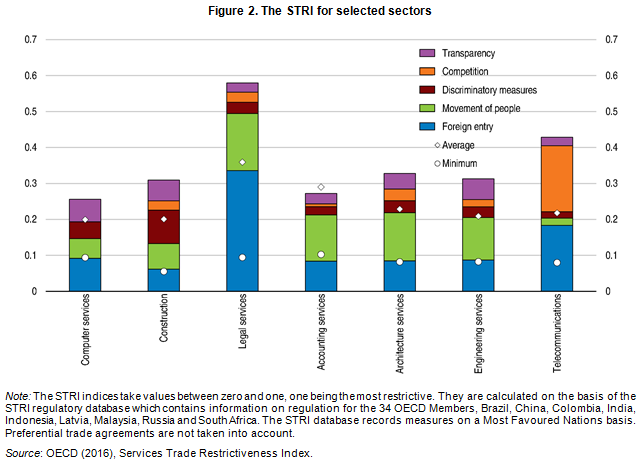
Thirdly, further investment liberalisation will also boost growth in the services sector and enhance competitiveness. Indeed, a set of indicators measuring restrictions to services sector trade (the OECD’s Services Trade Restrictiveness Index ‒ STRI) was computed for the first time for Malaysia, revealing that the country has more restrictive regulations than the average of OECD member countries and major emerging economies (Figure 2).

malaysia-blog-2-fig-2

Reference

OECD (2016), OECD Economic Surveys: Malaysia 2016: Economic Assessment, OECD Publishing, Paris.


Successful macro transformation in Malaysia, but challenges remain

By Mohamed Rizwan Habeeb Rahuman, Economist, Southeast Asia Desk, Country Studies Branch, OECD Economics Department

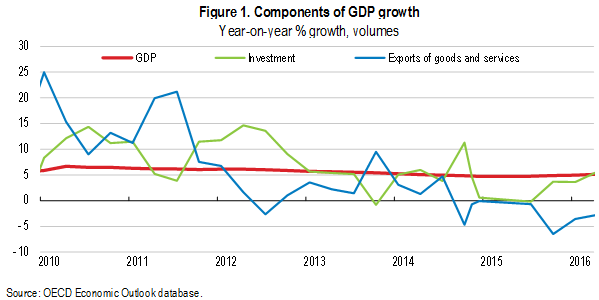
Malaysia has sustained rapid and inclusive economic growth for close to half a century, as documented in the OECD’s first Economic Assessment of Malaysia (OECD, 2016). Real GDP growth has averaged 6.4% per year since 1970, outperforming most of its regional peers (Figure 1). In the process, the Malaysian economy has undergone a dramatic transformation from dependence on agriculture and commodity exports to a more diversified and open economy with strong links to global value chains. Growth has been driven by a series of structural reforms that began in the 1970s. Malaysia harnessed its favourable geographical location on global trade routes to promote export-oriented industrialisation, encouraging regional integration through a relatively open environment to trade and investment. This has facilitated the development of manufacturing, boosting growth, employment and productivity by expanding access to global markets, capital, knowledge and technology. More recently, real GDP growth averaged 5.3% per year between 2011 and 2015, led mainly by domestic demand, with the services sector now representing more than half of GDP.

malaysia-blog-1-fig-1

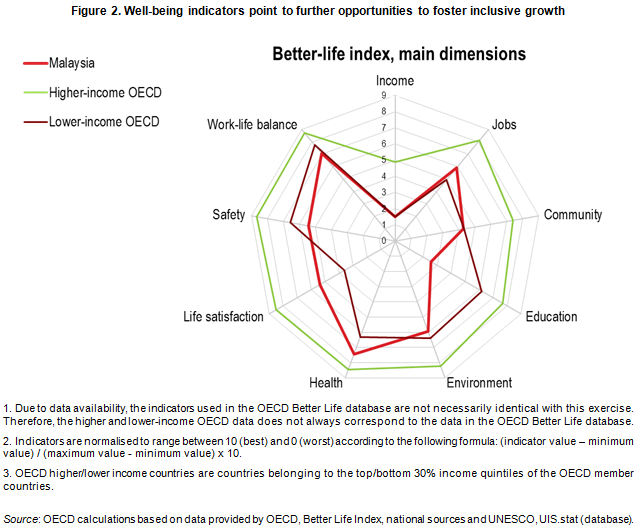
Malaysia’s aspiration to attain high-income country status involves striving for greater inclusiveness. It scores well on some indicators in the OECD Better Life Index, in particular long-term unemployment. However, the index illustrates relative weakness in areas such as educational attainment and skills, as well as personal earnings. It also highlights the need to further improve healthcare to increase healthy life expectancy (Figure 2).

malaysia-blog-1-fig-2

In the face of external headwinds, growth slowed down to just over 4% year-on-year in the first half of 2016 but is projected to remain resilient at around this pace in the remainder of 2016 and in 2017 thanks to the continuing strength of domestic demand, even though momentum will be held back by the subdued pace of the global economy and still low commodity prices. Trade will continue to grow at a slower rate than GDP in line with slowing global trade, which affects the growth potential of trade-exposed emerging market economies like Malaysia (134% of GDP in 2015).

The balance of risks to growth is tilted to the downside and stems mainly from external factors. A more rapid than foreseen normalisation of United States monetary policy would entail a downside risk to the projections, as open emerging market economies such as Malaysia are vulnerable to capital outflows. While Malaysia has diversified its economy and reduced its dependence on oil for government revenue, 19% of exports were agricultural and mining goods in 2015 and around 15% of government revenue is still oil-related in 2016. Thus, if commodity prices were to fall further, the trade balance, corporate profits and fiscal revenue would be negatively affected. On the upside, higher crude oil prices, accelerating inflows of tourists from Asia, or higher-than-forecast palm oil prices if unfavourable weather conditions continue to affect production, could see growth exceed projections.

Reference

OECD (2016), OECD Economic Surveys: Malaysia 2016: Economic Assessment, OECD Publishing, Paris.


Unleashing private sector productivity in the United States

By Douglas Sutherland, Head of US Desk, OECD Economics Department

With the global economy mired in low-growth and no signs of strong acceleration, a lot of attention has been paid to the meagre pace of productivity growth in OECD countries. In the United States, the most watched indicator of productivity (nonfarm business productivity growth) decelerated about ¾ percentage point from 2009 to 2014 relative to the preceding 5-year period. This is not just the result of the crisis holding back investment. Productivity growth had already been slowing from the early 2000s.

Economic research reveals competitive markets stimulate productivity: faced with competitors, firms survive by becoming more efficient and bringing new products to the market. Competitive markets see a lot of firm entry and exit. However, this dynamism has declined: new firms are not being created as frequently as in the past (See figure, top panel) and the most productive of these firms are not growing as fast as they once did. This matters because advances in productivity typically result from the rapid growth of young dynamic firms. Instead, start-ups appear to be failing more often and the remaining firms are getting older with larger firms increasingly dominating markets (See figure, bottom panels).

sutehrland-prod-and-us

When this happens, markets become more concentrated, with large incumbent firms gaining market power. This has many disadvantages because gains in productivity are not being passed onto consumers in lower prices or to workers in higher wages. The US is often considered as a very competitive and dynamic marketplace – and it is to a large extent – but it has become less so for some time because of developments such as digitalilisation facilitating “winners take all” and anti-trust becoming less stringent than it used to be. Faced with these worrying trends, competition/anti-trust policy needs to adapt. This is particularly the case in markets transformed by digitalisation, financial innovation and globalisation – such as e-commerce and those dependent on access to information. The decline in business dynamism sometimes comes from barriers to competition being erected by the States. For example, state-level prohibitions on municipalities creating their own fixed broadband networks have hindered the development of stronger competition in this sector. In other cases, States have blunted competitive pressure through imposing state-specific occupational licensing requirements. As a result dynamism and competition can vary across states because of the importance of local administration in regulating markets with some states being very dynamic whereas others are not.

Amongst other factors, changes to bankruptcy laws have also contributed to more sluggish business formation. Reforms in 2005 increased the cost of bankruptcy for failed entrepreneurs and made it more difficult for them to try again (see the recent Ecoscope blog on the importance of this for productivity growth). The reforms appear to have stymied the creation of sole proprietorships and partnerships, particularly in States that do not exempt some of the entrepreneur’s assets from bankruptcy proceedings. Given the importance of bankruptcy for long-run prospects, a better balance needs to be struck between supporting entrepreneurship and creditor rights.

References:

Millar, Jonathan and Douglas Sutherland (2016), “Unleashing private sector productivity in the United States”, OECD Economics Department Working Paper no. 1328.

OECD (2016), Economic Surveys: United States 2016, OECD Publishing, Paris.


Labour mobility in the European Union: a need for more recognition of foreign qualifications

by Jan Stráský, Economist, OECD Economics Department

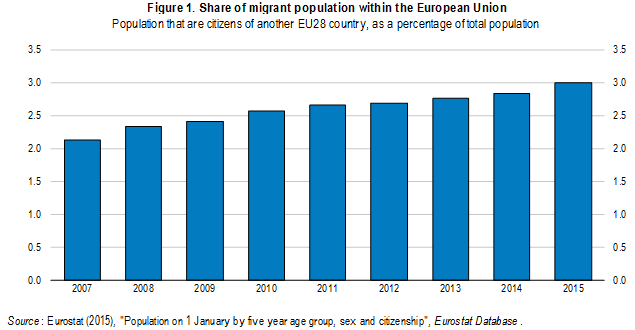
Labour market mobility in the European Union is increasing (Figure 1), but it remains too low to provide sufficient adjustment in the face of diverging labour market developments. This situation reflects non-policy factors, such as linguistic and cultural differences, but also policy barriers. In particular, difficulties in the recognition of professional qualifications are still a major hurdle.

eu-stratsky-1

Improvements in foreign language proficiency take time and require long-term policies. Publicly funded language courses aimed at cross-border workers are a useful tool, and should be provided. Even more important is to improve foreign language proficiency at an earlier stage, for example by considerably expanding the Erasmus student exchange programme that currently benefits only about 5% of European graduates.

Policy barriers to labour mobility in the EU have been reduced by a broader use of electronic procedures, such as the European Professional Card and the planned electronic passports for services. However, more is needed. The European Professional Card needs to be extended to other qualifications, such as engineers. Countries should be restricted in their ability to invoke “public interest” to discriminate against foreign suppliers of regulated professional services. Regulatory barriers arising from diverging legal form and other organisational requirements should be addressed. Most reforms in services between 2012 and 2014 took place in countries under financial assistance, while other countries did not act on their recommendations.

The differences in regulation across the EU remain high and affect also the number of recognitions of professional qualifications. Some countries have awarded a large number of recognitions, while others did not, despite being parties to the same mutual recognition directives (Figure 2, panel A). Moreover, countries with the lowest barriers to entry into professions may face the highest barriers to providing services abroad. For instance, when engineering is not a regulated profession, the barriers to entry are low for nationals and foreigners alike. Countries that regulate engineering through licensing, however, often create insurmountable obstacles to engineers from unregulated countries.

Although in the EU as a whole only some 5% of applications for recognition of qualifications eventually get rejected, there are considerable differences in rejection rates across the member states (Figure 2, panel B). Slow and overly heterogeneous procedures can still constitute a barrier to labour mobility, even if decisions are eventually positive. The EU should monitor improvements and best practice and develop further the possibility of partial recognition instead of rejection, complemented by shortened additional education. Bolder changes to the existing process would involve extending the scope of automatic recognition to other professions and making wider use of the European framework for comparison of national qualifications.

eu-stratsky-2

References:

OECD (2016), Economic Survey of the European Union 2016, OECD Publishing, Paris.

Stráský, Jan (2016), “Priorities for completing the European Union’s single market”, OECD Economics Department Working Paper no. 1315.


Funding priority spending will become increasingly challenging in Indonesia

By Patrice Ollivaud and Petar Vujanovic, Indonesia Desk, OECD Economics Department

As described in the 2016 OECD Economic Survey of Indonesia, economic growth is expected to pick up over the course of 2016 and into 2017. Despite persistently weak external conditions, confidence is returning, with inflation moderating, a stable rupiah and government investment in infrastructure gathering pace. Thanks to the stabilisation of the economy, BI has cut interest rates six times since January 2016, each time by 25 basis points. As recommended in the Survey, if growth disappoints, the authorities should continue to employ a prudent monetary policy to stabilise output without endangering financial stability.

indonesia-2016-ollivaud

Seizing the opportunity resulting from lower oil prices, the government substantially reduced fuel subsidies from about 19% of public expenditure in 2014 to 7% in 2015. The funds were mostly reallocated towards ambitious programmes to alleviate infrastructure gaps and poverty. However, the poverty rate is still relatively high compared to peer countries at a similar level of development. Moreover, a lack of infrastructure, especially in transportation (including maritime), logistics, water treatment and energy supply, is hampering Indonesia’s economic, business and social development.

The recent boost to confidence could be undermined if the government fails to deliver on its promises, notably in terms of infrastructure investment. With lacklustre revenues notably due to low tax compliance, the government’s programme is at risk. For several years, the fiscal deficit has been close to the 3% legal cap (Figure 2). In June and then in August, expenditure cuts (first by 1% and then 6.5% of government expenditure) were announced in the wake of lower revenues and a larger projected deficit. A tax amnesty was launched in July to boost tax collection. With the OECD’s Automatic Exchange of Information regime due to come into force over the next two years, the timing of the amnesty is good, as it provides taxpayers with an early opportunity to regularise past non-compliance. As of 30 September, over 400 000 Indonesians had declared about 3 500 trillion rupiah (USD 280 billion) in assets, generating about 90 trillion rupiah (USD 7 billion) in additional government revenues.

indonesia-2016-ollivaud2

In addition, improving the efficiency of public spending would allow getting the most out of existing resources. To that end, the Survey highlights in particular the need to boost the capacity and skills of civil servants, particularly in some sub-national governments. The “big-bang” decentralisation has proven to be popular and successfully brought government closer to the people. In order to complete it, more tax autonomy at the regional level would help to improve both tax collection and accountability.

References

OECD (2016), OECD Economic Surveys: Indonesia 2016, OECD Publishing, Paris.


Forecasting GDP during and after the Great Recession

by Patrice Ollivaud, Economist, OECD Economics Department,  Pierre-Alain Pionnier, Head of Unit, OECD Statistics Directorate and Cyrille Schwellnus, Senior Economist, OECD Economics Department

How was it possible not to see the Great Recession of 2008-09 coming? How could economic forecasters blindly ignore financial developments? These are typical questions asked by the media in the wake of the Great Recession.

The OECD has drawn a number of lessons from the failure to forecast the Great Recession for the monitoring and statistical modelling of near-term economic developments. Crucially, a broader range of information, including financial developments, is now accounted for in OECD forecasts (Lewis and Pain, 2014). In an attempt to systematise this approach, OECD economists have recently estimated state-of-the-art statistical models that allow extracting meaningful signals from a large set of economic indicators, including equity and credit market indicators, real estate and consumer prices, disaggregate industrial production, as well as business and consumer surveys. They compare these models’ ability to forecast quarterly GDP growth during and after the Great Recession with that of the smaller-scale traditional OECD forecasting models (Ollivaud et al., 2016).

The main lesson of this research is that relying on more data does not mechanically improve forecast performance. This is because some economic indicators are redundant and because more data also means more noise to filter out. Identifying which variables are most relevant for the GDP forecast is tremendously difficult in real time, even though with hindsight the relation appears obvious, as for instance with financial market developments during the Great Recession.

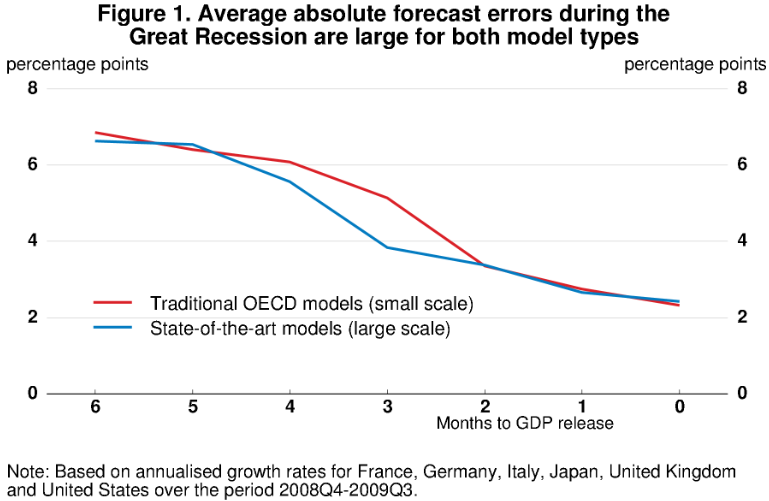
Ollivaud et al. (2016) show that traditional OECD forecasting models based on a reduced set of 5-6 economic indicators perform similarly to the state-of-the-art models that exploit up to 150 indicators. While forecasts become more precise as more up-to-date indicators become available, forecast errors during the Great Recession are large for both types of models even around the publication date of GDP (Figure 1).

ollivaud-et-companie

As was emphasised at a workshop on complexity and policy recently organised at the OECD, big data and models that include non-linear features can certainly help to better understand economic phenomena and are worth pursuing further. However, the results in Ollivaud et al. (2016) suggest that implementing this approach in practice will be a long endeavour. In the meantime, smaller and simpler models can play an important role in tracking short-term economic developments and also have the advantage that it is easier to understand what is behind any forecast revision.

References

Lewis C., Pain N. (2014): Lessons from OECD forecasts during and after the financial crisis. OECD Journal: Economic Studies

Ollivaud P., Pionnier P.-A., Rusticelli E., Schwellnus C., Koh S.-H. (2016): Forecasting GDP during and after the Great Recession. OECD Economics Department Working Paper No. 1313


Mind the gapS: boost early childcare education and care in Costa Rica

By Alberto González Pandiella, Economist, SDD, OECD Economics Department

Costa Rican well-being indicators are comparable or even above the OECD average in several dimensions (OECD, 2016a). Nevertheless, gaps with OECD countries are large in two dimensions:  labour market participation and education.  This hampers both long-term growth prospects and equity.  Boosting early childcare education and care would help to close both gaps (Gonzalez Pandiella, 2016).

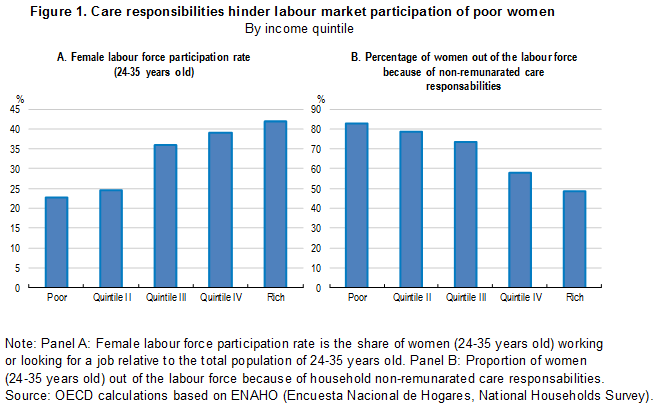
Only slightly over half of the Costa Rican working-age women participate in the labour market. Gaps in participation start at very early ages and remain large thereafter. Women from low socioeconomic background face difficulties to continue in education and tend to drop out of the labour force. Only one out of four women in low income households in the 24-35 age bracket participate in the labour market (Figure 1, Panel A). This low participation is predominantly due to the non-remunerated care responsibilities they have to assume (Figure 1, Panel B). This highlights the need to increase the supply of publicly-funded childcare services, and to target them at women in low income households.

costa-rica-fig-1

Costa Rica shows a strong commitment to invest in education. But the average education attainments remain low. Less than half of the 25-29 cohort has completed secondary education, which is well below graduation rates observed in other Latin American countries such as Colombia, Peru and Panama.  PISA scores are low in all disciplines, indicating that the quality of education is also comparatively low. Moreover, educational gaps depending on households’ income are widening.  These inequalities in education outcomes start early. At the end of primary education, the share of students coming from low income households lagging behind is high, and this is aggravated in lower secondary, when many drop out. Attendance to pre-primary education helps to decreases the likelihood of low performance in secondary education, even after controlling for socioeconomic factors (OECD, 2016b). Thus, boosting attendance to early childhood education and care, with an especial focus on children from low-income households, would also contribute to close educational inequalities and gaps in Costa Rica.

References:
Gonzalez Pandiella, Alberto (2016), “Making growth more inclusive in Costa Rica”, OECD Economics Department Working Paper no. 1300.

OECD (2016a), OECD Economic Surveys: Costa Rica 2016, OECD Publishing, Paris.

OECD (2016b),  Low-Performing Students: Why They Fall Behind and How to Help Them Succeed, PISA, OECD Publishing, Paris, http://dx.doi.org/10.1787/9789264250246-en


Inefficient insolvency regimes: a barrier to creative destruction?

by Müge Adalet McGowan and Dan Andrews, Structural Policy Analysis, OECD Economics Department

Productivity is the ultimate engine of growth in the global economy, but there has been an increasing concern about weak productivity growth in recent years. A key recent OECD work, the Future of Productivity implies that inefficient firms increasingly linger as opposed to exit the market, despite their inability to adopt new technologies. Joseph Schumpeter (1942) introduced the idea that economic progress can be partly attributed to the principle of “creative destruction”, the replacement of old and obsolete technologies, products, methods of production and markets with new ones; and the exit of existing firms that are unable to adopt new innovations.

The productivity costs of barriers to entry and competition are well known, but policy-induced barriers to exit of low productivity firms can also affect aggregate productivity. For example, personal insolvency regimes lacking a “fresh start” provision – i.e. the exemption of future earnings from obligations to repay past debt due to liquidation – increase the costs and the stigma of failure associated with insolvency: this can not only delay exit of failing firms, but also lower incentives for experimentation and entrepreneurs’ ability to start new businesses in the future. To better understand this kind of link between productivity and exit policies, Adalet McGowan and Andrews (2016) has developed an analytical framework to identify the channels through which exit policies affect aggregate productivity growth. Two main insights emerge from it (Figure 1):

  • Exit policies can directly affect aggregate productivity by: i) shaping the strength of market selection, which enables the exit of non-viable firms and the restructuring of viable ones (e.g. judicial efficiency); and ii) shaping the reallocation of resources from failing firms to more productive uses (e.g. via policies facilitating worker mobility).
  • Product market reforms that raise competitive pressures and efficient insolvency regimes will strengthen the contribution of exit to aggregate productivity via both tighter market selection and more effective reallocation, ultimately boosting the effects of other exit policies (e.g. regulations affecting product, labour and financial markets) on aggregate productivity growth.

policies-can-shape-prod

The OECD, which has been a leader in developing indicators on product market regulations, is currently building new cross-country indicators on insolvency regimes, which will be released in early 2017. This will make it possible to estimate the effects of these regimes on productivity and make relevant and specific policy recommendations on how to improve their different design features so as to boost productivity growth.

References:

Adalet McGowan, M. and D. Andrews (2016), “Insolvency Regimes and Productivity Growth: A Framework for Analysis”, OECD Economics Department Working Papers, No. 1309.

OECD (2015), The Future of Productivity, Paris.

Schumpeter, J. (1942), Capitalism, Socialism and Democracy, Harper and Brothers, New York.


Product market reforms under the microscope

by Alexander Hijzen, Senior Economist, Directorate for Employment, Labour and Social Affairs, OECD and  Peter N. Gal, Economist, Economics Department, OECD

Given the secular decline in productivity growth and the persistent weakness of the economic recovery in many advanced economies, increased attention is being paid to the potential role of structural reforms for restoring economic growth. While structural reforms concern many policy areas (e.g. banking supervision, property right laws and employment-protection rules), product market regulation (PMR) feature particularly prominently on the agenda of many advanced economies (OECD, 2015). Understanding the dynamics effects of reforms in this area may provide important insights with respect to the way such reforms are designed, the political economy of reforms and the potential need for complementary policies. In a recent paper (Gal and Hijzen, 2016), we attempt to open up the black box of pro-competition product market reforms by providing a comprehensive analysis of their short-term impacts across firms that differ in terms of the main sector in which they operate, the size of their operations and their financial health.

Our main findings on the impacts of major product market reforms are as follows:

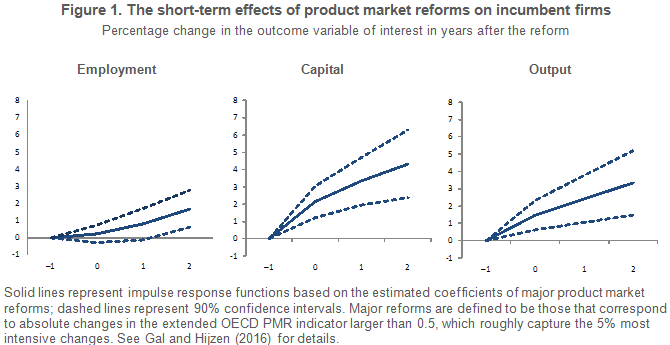
  • First, the short-term, firm-level effects of reducing regulatory barriers to product market competition are positive and strengthen over time (Figure 1). The effects are immediate for both output and investment, and increase further to 4% and 3% respectively after two years. The effects for employment are considerably smaller and only materialize after two years.

gal-on-pmr-1

  • Second, there are systematic and plausible differences in the effects of reforms across firms of different sizes across different industries (Figure 2). More specifically, in network industries, small firms tend to benefit most from pro-competitive product market reforms, while larger ones downsize to reduce costs and maintain market shares. By contrast, in retail trade, large and potentially more efficient firms tend to benefit more from such reforms.

gal-on-pmr-2

  • Third, financial difficulties faced by firms weaken the short-term impact of product market reforms on investment. These findings highlight the importance of addressing the problem of weak bank balance sheets when considering product market reforms, and points to the complementary role of financial sector reform more generally. This is particularly relevant in those countries where the flow of credit is still weak and the case for product market reform is relatively strong (e.g. some countries in Southern Europe).

 In sum, the present findings confirm the positive effects of pro-competitive product market reforms on economic performance in the medium to longer term, while also providing rich new insights on the way the effects of such reforms materialize over time across different types of firms. More specifically, these findings help to understand why it can be difficult to implement product market reforms in certain sectors, but less so in others. For example, the pace of product market reforms could be slowed down in network industries since large incumbent firms have a tendency to lose out in terms of jobs and profitability. The tendency of financial difficulties to mitigate the impact of product market reforms on investment may also suggest that the effects of product market reforms materialize more slowly in times when the economy is depressed and credit is hard to get by.

These insights can be used to enhance the design of product market reforms and to motivate the need for complementary measures to promote aggregate demand, restore bank balance sheets and to alleviate the social cost of adjustment (IMF, 2016; OECD, 2016).

References

Gal, P. N. and A. Hijzen (2016), “The Short-Term Impact of Product Market Reforms : A cross-country firm-level analysis”, OECD Economics Department Working Papers No. 1311.
Also appeared as IMF Working Paper No. 16/116.

IMF (2016), World Economic Outlook, Chapter 3, April, International Monetary Fund, Washington, D.C.

OECD (2015), Economic Policy Reforms: Going for Growth, Organization for Economic Cooperation and Development, Paris.

OECD (2016), “Short-term labour market effects of structural reforms: Pain before the gain?”, in OECD Employment Outlook 2016, OECD Publishing, Paris.