Does growth lead to inequality? It depends.

By Orsetta Causa, Mikkel Hermansen and Nicolas Ruiz, Structural Surveillance Division, OECD Economics Department

Widespread increases in inequality over the past three decades have raised the question of whether growth in itself is a driver of income inequality. Considering that correlation often tells little about causation, this question is less trivial than may appear at first glance. Indeed, the concomitant rise in GDP per capita and income inequality does not, per se, imply any causal relationship from the former to the latter. Research efforts have offered mixed conclusions so far and the growth and inequality question has been at the centre of a long-standing controversy among economists (Dollar et al. 2015). New OECD research by Hermansen et al. (2016) shows that in order to provide a convincing answer, the question needs to be framed more specifically.

First, the mechanisms that link growth and inequality are likely to differ depending on the location of inequality, i.e. at the bottom, in the middle, or at the top of the income distribution (Barro, 2000). Hence, a single inequality measure such as the Gini coefficient may end up capturing relatively unimportant average effects. Second, the mechanisms that link growth and inequality are likely to differ depending on the sources of growth, in particular whether growth in GDP per capita is driven by growth in productivity or growth in employment. Third, they are also likely to differ depending on whether one considers income inequality before or after government redistribution, that is, inequality in market incomes, i.e. income derived before taxes and transfers, or inequality in disposable income, that is, income after taxes and transfers.

Using a novel empirical framework, Hermansen et al. (2016) shed new light on the old growth and inequality nexus by assessing the impact of growth on household incomes across the distribution, that is, progressively encompassing poor, middle class and rich households. Their conclusion is that that there is no single answer to the growth and inequality question. Labour productivity growth is found to have contributed to rising market income inequality, while this was partly mitigated through government redistribution, on average across OECD countries over the past three decades (Chart 1, Panel A). By contrast, employment growth is found to have had an equalising impact, benefiting mostly and importantly households in the lower part of the income distribution (Chart 1, Panel B). Overall, these two forces have tended to offset each other and resulted in a broadly distribution-neutral impact of GDP per capita growth, on average across OECD countries over the last three decades. So, with reducing inequality remaining a defining challenge of the post-crisis era, promoting job creation is a key policy goal, in particular where employment rates still fall short of pre-crisis levels. But, perhaps more importantly, in looking for ways to revive productivity growth, governments need comprehensive policy strategies to ensure that the gains are more broadly shared across the population.

distribution-of-growth-dividends

References

Barro, R. J. (2000), “Inequality in a panel of countries”, Journal of Economic Growth, 5: 5-32 (March 2000).

Hermansen, M., N. Ruiz and O. Causa (2016), “The Distribution of the Growth Dividends”, OECD Economics Department Working Papers, No. 1343, OECD Publishing, Paris, http://dx.doi.org/10.1787/7c8c6cc1-en.

Dollar, D. T. Kleineberg and A. Kraay (2015), “Growth, Inequality and Social Welfare: Cross-Country Evidence”, Economic Policy, Vol. 30, pp. 335-377.


Mexico’s reforms are paying off, but there is much left to do

By Sean Dougherty, Mabel Gabriel, Patrick Lenain, and Julien Reynaud, OECD Economics Department

The overall economic and social situation has improved in recent years, but important challenges remain, such as high levels of poverty, extensive informality, low female participation rates, insufficient educational achievement, financial exclusion, weak rule of law, and persistent levels of corruption and crime. To address these problems, the government has rolled out major structural reforms since 2012 aimed at improving growth, well-being and income distribution. The initial wave of reforms, kicked-off by the multi-partisan political commitments in the Pacto por México, led to notable progress across a range of areas and put Mexico at the forefront of reformers among OECD countries. Key laws and constitutional amendments were approved, and secondary laws or regulations passed.

blog-reform-mexico

Reforms have already brought short-term benefits, especially on productivity growth, and helped to mitigate exteproductivityrnal headwinds such as lower oil prices and rising US interest rates. The OECD estimated in the last Economic Survey that a subset of the Pacto por México reforms could add one percentage point to GDP growth after five years. An additional set of selected reforms could add another percentage point to GDP. Strong progress has been made to open sectors such as energy and telecoms to more competition. Institutional designs have been improved with a new National Productivity Commission, a strengthened competition authority, and expanded sectoral regulators. Initial progress has been made with education and poverty alleviation, although parts of these plans ran into difficulties that are now being addressed.

growth-disparaties

Nonetheless, large differences prevail across sectors, states, and firms – a situation not unlike that in many OECD countries. Mexico’s most productive firms are performing well, such as in the sector of transportation equipment manufacturing, but the majority of firms are still struggling to perform better, leading to a growing dispersion in productivity,  with a few leading sectors pulling ahead. Inequalities continue to grow across states and sectors, emphasising the divergence of a modern Mexico – highly productive, competing globally, mostly located at the border with the United States, in the central corridor and in tourism areas; and a traditional Mexico, less productive, with small-scale informal firms, mostly located in the South. As a result, growth has not been inclusive enough to achieve better living conditions for many Mexican families.

Addressing this divergence is the main focus of the new Economic Survey (OECD, 2017).

References:

OECD (2017), Economic Surveys of Mexico, OECD Publishing, Paris.

OECD (2015), The Future of Productivity, OECD Publishing, Paris.


Structural reforms can be inclusive; it all depends on the details

By Orsetta Causa,  Mikkel Hermansen and Nicolas Ruiz, Structural Surveillance Division, OECD Economics Department

Structural reforms are regularly assessed based on their ability to boost GDP per capita. This emphasis relies on the assumption that higher GDP per capita is systematically associated with rising living standards for the vast majority of citizens. This view is increasingly being challenged. The worrying evolution of income inequality in many countries suggests that distributional considerations need to be more systematically taken into account in policy making. In a nutshell, what are the policy options for making pro-growth policies inclusive?

New research by Causa et al. (2016) sheds some light on this question by adopting a more granular approach to the evaluation of pro-growth policies. First, the analysis delivers the effect of reforms on household incomes at the bottom, the middle and the top of the distribution. This helps to better understand the distributional implications from pro-growth reforms. In particular, it allows for distinguishing reforms that boost incomes across the whole distribution but relatively more among the rich than among the poor from those that boost incomes in the middle class and among the rich but have no effect or depress incomes among the poor. Second, the analysis considers the channels of macroeconomic growth by decomposing the policy effect into growth in employment and growth in labour productivity. This provides a better understanding of the mechanisms through which policies benefit household incomes at different points of the income distribution.

This new research conveys policy relevant messages for the growth and inequality nexus:

  • Most pro-growth policies are good for the middle class inasmuch as they tend to lift all incomes around the middle of the distribution.
  • By contrast, a number of pro-growth policies that are good for the middle class can in fact hurt the poorest. This is mostly the case of reforms to social protection and labour market policies. In particular, reductions in the generosity of unemployment benefits and social assistance are found to leave poor households behind even when such reforms generate aggregate employment gains. Policy packages can in this case be designed to mitigate trade-offs between raising work incentives and ensuring income adequacy for vulnerable households, that is, through well-targeted job-search assistance and training programmes with a view to raising employability and pay prospects among those with low skills and the long-term unemployed.
  • Other reforms can also have the opposite effects, raising income for everybody but more so for the poor than for the middle class. Such is the case of increasing public spending on education (Chart 1, Panel A), in particular on childcare and early childhood education, as this boosts growth and at the same time enhances women labour market inclusion, resulting in a decline of income inequality.

causa-ssd

Whether pro-growth reforms act via boosting productivity, employment, or both matters: this shapes their distributional implications by compounding their final effects. For example, spurring productivity by easing barriers to firm entry and competition in product markets produces strong macroeconomic gains which accrue to households at large and are fairly equally shared. Yet this reflects two distributionally-offsetting effects: higher labour productivity, which tends to benefit the most affluent households disproportionately, and higher employment, which tends to benefit the less affluent households disproportionately (Chart 1, Panel B).

So, making reforms for inclusive growth is about exploiting synergies, and designing policy packages to mitigate trade-offs. It is thus all about details. At the current juncture there is a crucial need for more growth but also to make it more inclusive. This is not out of reach as countries exhibit large room for packaging structural reforms to target both growth and equity objectives.

References

Causa, O., M. Hermansen and N. Ruiz (2016), “The Distributional Impact of Structural Reforms”, OECD Economics Department Working Papers, No. 1342, OECD Publishing, Paris, http://dx.doi.org/10.1787/5jln041nkpwc-en .


Coping with Creative Destruction: Reducing the Costs of Firm Exit

By  Dan Andrews, Head of Productivity Workstream, OECD Economics Department

Creative destruction, the process through which a market economy replaces failing firms with successful ones, is a key driver of productivity growth. Reversing the current slowdown in productivity growth will therefore partly depend on structural reforms to recharge the engine of creative destruction. This will necessarily entail a more intense churning of jobs, which implies benefits for workers via improved job-worker matching but also costs through heightened job destruction. In this context, a key question is what happens to workers who lose their jobs due to firm exit – how quickly are they re-employed and what are the policies that can aid this process?

New research shows the probability that workers displaced by firm exit are re-employed one year later ranges from at least 70% in Denmark and Switzerland to around 50% in Greece and Spain. These estimates suggest that some countries are more effective at coping with creative destruction than others. What explains these differences?

As it turns out, public policy plays a key role. Higher spending on active labour market policies (ALMPs) – e.g. retraining and job placement services – tends to boost the re-employment probability of displaced workers, while the reverse is true for spending on passive measures (e.g. generous and long-lasting unemployment benefits). This implies that a (revenue-neutral) reform that partially switches the composition of labour market expenditures towards ALMPs could be desirable in countries where spending is overly tilted toward passive measures.

Crucially, ALMPs are more powerful at raising the re-employment prospects of workers displaced by firm exit than other displaced workers. This is significant given that the former are considerably older and have been tenured at the firm for longer – characteristics which ordinarily make transitioning to other jobs more difficult. Job loss due to firm exit is also politically salient since it is typically viewed as an exogenous event that is not specifically due to the actions of the worker. One implication is that for every worker who is laid out due to firm exit, many more may fear a similar fate, which may create political resistance to reforms that intensify job reallocation.

Thus, it is crucial that structural reforms which unleash the benefits of creative destruction are flanked by well-designed ALMPs. But labour market policies alone are insufficient to cope with creative destruction. Indeed, the effectiveness of ALMPs in returning displaced workers to work is significantly enhanced by reductions in administrative entry barriers in product markets (Figure 1), which tend to stimulate job creation, particularly by young firms.

creative-destruction-dec-2016

Andrews, D and A. Saia (2016), “Coping with Creative Destruction: Reducing the Costs of Firm Exit,” OECD Economics Department Working Paper No. 1353.


Making growth more inclusive by enhancing social protection: the case of Malaysia

By Abu Zeid Mohd Arif, Economist, Country Studies Branch, OECD Economics Department

Growth can be more inclusive by pursuing policies that enable improvements in a country’s living standards while sharing gains more equitably across the population. Inclusive growth incorporates a focus on relative – not just absolute – income and wealth inequality, and on well-being, which depends on both monetary and non-monetary conditions, such as access to quality education, employment, housing and healthcare.

Malaysia’s success in alleviating poverty has been achieved despite the absence of an integrated and comprehensive social protection system. Households benefit from near-universal access to electricity, clean water, healthcare and transport, but income support for disadvantaged persons (such as the unemployed, single parents, disabled and elderly) remains ad hoc, insufficiently targeted and inadequate in providing basic living standards (OECD, 2016a).

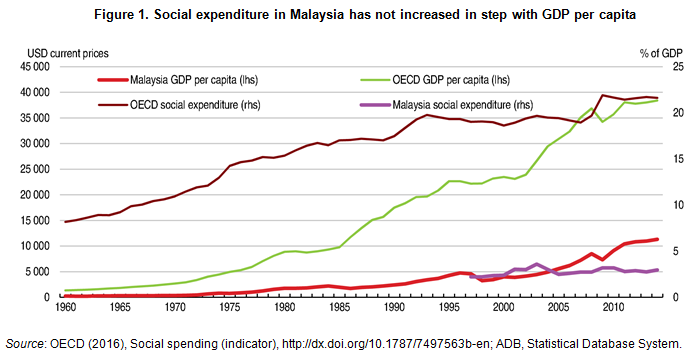
Malaysia’s social protection expenditure is lower than in all South East Asian countries for which data are available and than in all but a handful of countries in the Asia Pacific region. Public expenditure on social protection as a proportion of GDP typically rises in step with GDP per capita, as observed in OECD countries. Malaysia displays a different pattern (Figure 1). This would be the case even when adding in zakat, a compulsory Islamic charitable mechanism that in 2013 represented over one fifth of the level of government social spending excluding health.

malaysia-blog-3-fig-1

The low level of social protection expenditure is further reflected in the low redistributive power of the tax-and-transfer system: pre and post‑tax and transfer Gini coefficients for income barely differ, like in Turkey (Figure 2).

malaysia-blog-3-fig-2

Social expenditure is highly fragmented, being provided through a multitude of small-scale, specific-purpose programmes by a diverse range of ministries. It is essential that Malaysia develop a comprehensive social protection and income transfer system that provides targeted and timely support to those in need, while retaining strong incentives and facilitation mechanisms to maximise labour market participation. This calls for undertaking a comprehensive assessment of social protection needs and optimal strategies to meet them. Malaysia could utilise global best practice toolkits such as the Inter Agency Social Protection Assessments toolkit (ISPA, 2016) and draw lessons from the OECD Development Centre’s work to develop social protection systems in the region (OECD, 2016b).

A key priority is the introduction of an employment insurance scheme that integrates job‑matching services, reskilling and income smoothing to prevent a temporary setback from becoming an entrenched disadvantage. This scheme should also include temporary income smoothing payments to further reduce financial barriers to re-employment and overall income inequality.

References

ISPA (2016), Inter Agency Social Protection Assessments.

OECD (2016a), OECD Economic Surveys: Malaysia 2016: Economic Assessment, OECD Publishing, Paris.

OECD (2016b), The EU Social Protection Systems Programme, OECD Publishing, Paris.


Unleashing private sector productivity in the United States

By Douglas Sutherland, Head of the United States Desk, OECD Economics Department

With the global economy mired in low- growth and no signs of strong acceleration, a lot of attention has been paid to the meagre pace of productivity growth in OECD countries. In the United States, the most watched indicator of productivity (nonfarm business productivity growth) decelerated about ¾ percentage point from 2009 to 2014 relative to the preceding 5-year period. This is not just the result of the crisis holding back investment. Productivity growth had already been slowing from the early 2000s.

Economic research reveals competitive markets stimulate productivity: faced with competitors, firms survive by becoming more efficient and bringing new products to the market. Competitive markets see a lot of firm entry and exit. However, this dynamism has declined: new firms are not being created as frequently as in the past (See figure, top panel) and the most productive of these firms are not growing as fast as they once did. This matters because advances in productivity typically result from the rapid growth of young dynamic firms. Instead, start-ups appear to be failing more often and the remaining firms are getting older with larger firms increasingly dominating markets (See figure, bottom panels).

sutehrland-prod-and-us

When this happens, markets become more concentrated, with large incumbent firms gaining market power. This has many disadvantages because gains in productivity are not being passed onto consumers in lower prices or to workers in higher wages. Faced with these worrying trends, competition/antitrust policy needs to adapt. This is particularly the case in markets transformed by digitalisation, financial innovation and globalisation – such as e-commerce and those dependent on access to information. The decline in business dynamism sometimes comes from barriers to competition being erected by the States. For example, state-level prohibitions on municipalities creating their own fixed broadband networks have hindered the development of stronger competition in this sector. In other cases, States have blunted competitive pressure through imposing state-specific occupational licensing requirements.

Amongst other factors, changes to bankruptcy laws have also contributed to more sluggish business formation. Reforms in 2005 increased the cost of bankruptcy for failed entrepreneurs and made it more difficult for them to try again (see the recent Ecoscope blog on the importance of this for productivity growth). The reforms appear to have stymied the creation of sole proprietorships and partnership, particularly in States that do not exempt some of the entrepreneur’s assets from bankruptcy proceedings. Given the importance of bankruptcy for long-run prospects, a better balance needs to be stuck between supporting entrepreneurship and creditor rights.

References:

Millar, Jonathan and Douglas Sutherland (2016), “Unleashing private sector productivity in the United States”, OECD Economics Department Working Paper no. 1328.

OECD (2016), Economic Surveys: United States 2016, OECD Publishing, Paris.


What do pro-competitive policies imply for workers?

By Boris Cournede, Senior Economist, Public Economics Division, OECD Economics Department

Reforms that make economies more competitive have become a polarising subject. On one side, they are well established as a core staple of reform programmes: they are known to boost growth. On the opposite side, they often come up as lightning rods for criticism, as some perceive that such reforms make life more difficult for workers. And some people may lose from such reforms.

What do the data say? And what can economic policy makers do to achieve better results? The OECD has gathered, harmonised and probed micro-level data covering individual households in 26 countries over the past two decades to answer these questions.

A key conclusion is that reforms that improve competition in goods and services markets generally boost job-finding chances for people out of work (Figure 1). At the same time, they do not increase job-loss rates much, so that overall they have a small but positive net effect on employment. This micro-level finding that pro-competition reforms boost employment corroborates previous OECD and other research identified at the macro level: such confluence of different studies using different methods is reassuring about the robustness of the conclusion.

cournede-the-chances-to-become-employed

Effects differ a lot across different people. The job-finding benefits of more competitive markets accrue primarily to young workers and women. More competitive markets leave jobless men’s chances to find jobs essentially unchanged.

More competitive markets imply a greater number of job exits for workers who are less qualified or more generally have low earnings capacity (Figure 2). This effect adds to a starting point where, in the absence of reform, low-income workers already face a much higher risk than others to become unemployed or quit the labour market altogether. However, job-finding probabilities also rise, leaving employment unchanged for low-income workers. In other words, more competitive markets imply that low-income workers face higher labour market rotation, with more frequent but shorter spells out of employment, for unchanged average employment prospects over time.

pmr-reforms-cournede

The greater labour market instability that pro-competition reforms generate for low-income workers calls for ensuring that employment assistance programmes reach them and are effective. These programmes are particularly helpful when they develop vulnerable workers’ employability in all situations: this can be done by allowing vulnerable programmes to tap active employment assistance programmes not only when they are unemployed but also when they work or are out of the labour force.

The OECD inquiry into the effects of flexibility-enhancing reforms on workers also delved into labour market reforms, the influence of other policies and specific impacts on workers employed in reformed sectors. These areas have important policy implications that forthcoming blog posts will outline.

References

Cournède, B., O. Denk, P. Garda and P. Hoeller (2016), “Enhancing Economic Flexibility: What is in it for Workers?”, OECD Economic Policy Papers, No. 19, OECD Publishing.

Cournède, B., O. Denk and P. Garda (2016), “Effects of Flexibility-Enhancing Reforms on Employment Transitions”, OECD Economics Department Working Papers, No. 1348, OECD Publishing.

Denk, O. (2016), “How Do Product Market Regulations Affect Workers? Evidence from the Network Industries”, OECD Economics Department Working Papers, No. 1349, OECD Publishing.

Garda, P. (2016), “The Ins and Outs of Employment in 25 OECD Countries”, OECD Economics Department Working Papers, No. 1350, OECD Publishing.

Boeri, T., P. Cahuc and A. Zylberberg (2015), “The Costs of Flexibility-Enhancing Structural Reforms: A Literature Review”, OECD Economics Department Working Papers, No. 1227, OECD Publishing.


Deploy effective fiscal initiatives and promote inclusive trade policies to escape from the low-growth trap

by Catherine L Mann, OECD Chief Economist and Head of OECD Economics Department

For the last five years the global economy has been in a low-growth trap, with growth disappointingly low and stuck at around 3 per cent per year. Persistent growth shortfalls have weighed on future output expectations and thereby reduced current spending and potential output gains. Around the world, private investment has been weak, public investment has slowed, and global trade growth has collapsed, all of which have limited the improvements in employment, labour productivity and wages needed to support sustainable gains in living standards. Overall, a slowdown in structural policy ambition and policy incoherence have slowed business dynamism, trapped resources in unproductive firms, weakened financial institutions and undermined productivity growth. In the face of these limited prospects, the OECD has argued in previous Economic Outlooks that fiscal, monetary and structural policies need to be deployed comprehensively and collectively for economies to grow sufficiently to make good on promises to their citizens.

The projections in this Economic Outlook offer the prospect that fiscal initiatives could catalyse private economic activity and push the global economy to the modestly higher growth rate of around 3½ per cent by 2018. Durable exit from the low-growth tap depends on policy choices beyond those of the monetary authorities – that is, of fiscal and structural, including trade policies – as well as on concerted and effective implementation. Collective fiscal action undertaken by all countries, including a more expansionary stance than planned in many countries in Europe, would support domestic and global growth even for those economies, who by virtue of specific circumstances, need to consolidate their fiscal positions or pursue a more neutral stance.

Some might argue that there is no space for such fiscal initiatives, given the heavy public debt burden in many economies. In fact, following five years of intense fiscal consolidation, debt-to-GDP ratios in most advanced countries have flattened. It is past time to focus on expanding the denominator – GDP growth. This Economic Outlook argues that the current conjuncture of extraordinarily accommodative monetary policy with very low interest rates opens a window of opportunity to deploy fiscal initiatives. Fiscal space has been created by lower interest payments on rolled-over debt, which also increases gauges of market access and of debt sustainability. On average, OECD economies could deploy deficit financed fiscal initiatives for three to four years, while still leaving debt-to-GDP ratios unchanged in the long term. A front-loaded effort could allow deficit finance to taper sooner and put the debt-to-GDP ratio sustainably on a downward path.

The key is to deploy the right kind of fiscal initiatives that support demand in the short run and supply in the long run and address not just growth challenges but also inequality concerns. These include soft investments in education and R&D along with hard investment in public infrastructures. Such fiscal initiatives would improve outcomes for demand and supply potential even more for economies suffering from long-term unemployment, when undertaken collectively, and when fiscal initiatives are complemented by country-specific structural policies put together in a coherent package. The mix is different for different countries, as developed in Chapter 2, with further details in the Country Notes in Chapter 3 of this Economic Outlook.

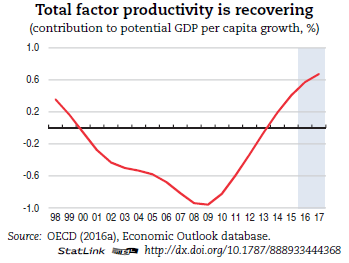
Against this backdrop of fiscal initiatives, reviving trade growth through better policies would help to push the global economy out of the low-growth trap, as well as support revived productivity growth. In this Economic Outlook trade growth is projected to increase from a dismal ratio of global trade-to-GDP growth of around 0.8 to be about on par with global output growth – remaining much less than the multiple of 2 enjoyed over the last few decades. This sluggish trade growth compared to historical experience shaves some 0.2 percentage point from total factor productivity growth – which may seem minor – but is meaningful given the slow productivity growth of some 0.5% per year during the postcrisis period.

Some argue that slowing globalization would temper the brunt of adjustments to workers and firms. This Economic Outlook suggests that protectionism and inevitable trade retaliation would offset much of the effects of the fiscal initiatives on domestic and global growth, raise prices, harm living standards, and leave countries in a worsened fiscal position. Trade protectionism shelters some jobs, but worsens prospects and lowers wellbeing for many others. In many OECD countries, more than 25% of jobs depend on foreign demand. Instead, policymakers need to implement the structural policy packages that create more job opportunities, increase business dynamism, promote successful reallocation and enhance policies to ensure that gains from trade are better shared. Fortunately, the country-specific policy packages that make fiscal initiatives more effective in promoting demand growth and supply potential also help to make growth more inclusive.

The transition path to a more balanced policy set and higher sustainable growth involves financial risks. But so too does the status quo dependence on extraordinary monetary policy. Pricing distortions in financial markets abound. Yield curves are still fairly flat, with negative interest rates. Pricing of credit risk has narrowed even as issuance of riskier bonds has increased. Real estate prices continue to advance in many markets, even in the face of attempted tempering by macro-prudential measures. Expectations in currency markets are on edge as evidenced by high measures of currency volatility. These financial distortions and risks expose vulnerable balance sheets of firms in emerging markets, and challenge bank profitability and the long-term stability of pension schemes in advanced economies.

The fiscal initiatives in conjunction with trade and structural policies, as outlined in the scenarios in this Economic Outlook, should revive expectations for faster and more inclusive growth, thus allowing monetary policy to move toward a more neutral stance in the United States at least, and possibly other countries as well. The risk of a growing divergence in monetary policy stances in the major economies over the next two years could be a new source of financial market tensions even as growth picks up, thus putting a premium on collective action by countries to revive growth in tandem.

In sum, policymakers should closely examine fiscal space; low interest rates enable many countries to boost hard and soft infrastructure and other growth-enhancing initiatives. Avoiding trade pitfalls, coupled with social measures to better share the gains from globalization and technological change, are key policy priorities. Using the window of opportunity created by monetary policy and following through on fiscal and structural measures should raise growth expectations and create the necessary momentum for the global economy to escape the low-growth trap.

Further reading:

OECD Economic Outlook

Using the fiscal levers to escape the low-growth trap

The effect of the size and mix of public spending on growth and inequality


Time to deploy the fiscal levers actively and wisely

by Catherine L. Mann, OECD Chief Economist, OECD Economics Department

The role of fiscal policy has been at the heart of the policy debate since the financial crisis. With the global economy stuck in a low-growth trap and monetary policy overburdened, it is time to re-assess the use of fiscal policy levers.

Government interest payments have fallen sharply as interest rates have declined to very low levels, freeing up cash. In addition, new OECD estimates show that “fiscal space” – the gap between current government debt and levels at which market access would be compromised – have widened since 2014, as lower interest rates have more than offset headwinds from lower potential growth. This creates a window of opportunity.

fiscal-levers-two

Most OECD governments have space to pursue a ½ percent of GDP deficit-financed “fiscal initiative” to support productivity-enhancing measures for 3-4 years without increasing public debt in the medium term. The withdrawal of deficit financing after the initial fiscal initiative and the outcome of higher growth from the initiative are enough to ensure that debt sustainability does not deteriorate, while the low interest rate environment means that stimulus is not crowded out.  The benefits are greater if boosting short-term activity helps to avoid high and persistent unemployment, if countries reduce regulatory burdens, and if countries undertake these efforts collectively.

fiscal-matrix

While it may be easy to relax the fiscal stance, the success of the fiscal initiative to promote growth, enhance long-run potential output, and improve debt sustainability depends on an effective strategy of additional spending or tax reductions to achieve more inclusive and higher growth.

Several major economies are now using the fiscal levers more actively, following the consolidation of the years following the crisis. But, some countries – notably in Europe – have yet to seize the opportunity.

However, are countries using the fiscal levers more wisely? The evidence of recent years is that many countries have cut the share of spending on investment and education, while increasing the share of taxes that are most harmful to growth and equality. A shift toward a more effective mix is needed.

The OECD is today releasing new research on the mix, size and quality of public investment, including a new dataset on the composition of public spending. Soft investment, such as skills and R&D, together with well-governed public investment in infrastructure, can yield large growth gains. Good institutions enhance the effectiveness of government spending and tax policy.

The policy debate will continue, but now is the time to deploy the fiscal levers actively and wisely !

References:

OECD (2016), “Using the fiscal levers to escape the low growth trap“, in OECD Economic Outlook, Volume 2016 Issue 2, OECD Publishing, Paris.

Mourougane, A., J. Botev, J-M. Fournier, N. Pain and E. Rusticelli (2016), “Can an increase in public investment sustainably lift economic growth?” OECD Economics Department Working Papers, No. 1351, OECD Publishing, Paris.

Botev, J., J-M. Fournier and A. Mourougane (2016), “A reassessment of fiscal space in OECD countries“, OECD Economics Department Working Papers, No. 1352, OECD Publishing, Paris.


Most countries have room to increase public investment

by Jean Marc Fournier, Economist, Public Economics Division, OECD Economics Department

Public investment benefits current as well as future generations. My research shows that public investment is a game changer, when it comes to boosting long-term growth. Increasing the share of public investment in primary government spending by one percentage point (offset by a reduction in other spending) would increase the long-term GDP level by about 5%. For countries that are catching-up to the productivity frontier, there is also evidence that public investment can substantially speed up the pace of convergence.

Public investment is good for economic activity because it stimulates private investment. Indeed, a recipe that mixes public and private investment produces a bigger economic pie. For instance, roads and railways connect firms. This suggests that the most relevant investment projects are those with the largest spill-overs. For instance, investment in health (hospitals and their equipment) is found to have a large effect as healthier workers are more productive. Investment in research and development also can have a particularly large effect as public research can spur private innovation.

The long-term effect of public investment depends on the initial level of the public capital stock, which includes, for instance, roads, schools or patents. In countries where this initial level is relatively low compared with the size of the economy, there is more scope for high-yielding investment projects. The analysis shows that virtually all countries have room to expand the public capital stock, with the exception of Japan, where it is already very large (Figure).

estimates-of-decreasing-returns-to-public-investment

The evidence that the public capital stock is below its optimal level means that public investment should rise above the pre-crisis level. However, the opposite has happened. In most countries, public investment has declined substantially during the recent fiscal consolidation period. In 2015, net investment was even negative in Germany, Italy, Portugal and Spain. This means that public investment does not suffice to compensate for the natural depreciation of the existing public capital stock in these countries. In the United States, net investment has reached an almost record low level of 0.5 per cent of GDP in 2015, so that the public capital stock grows much less than GDP.

Major challenges are to identify the right investment projects, and to implement them in an efficient way. For this, governments need sound public investment policies (provide the right incentives, carry out cost/benefit analysis underpinned by good data). Moreover, the focus should be on projects with high spill-overs.

References:

Source: Fournier, J.M. (2016), “The Positive Effect of Public Investment on Potential Growth”, OECD Economics Department Working Paper, No. 1347, OECD Publishing, Paris.

Related material see:

The effect of the size and mix of public spending on growth and inequality

Using the fiscal levers to escape the low-growth trap