Employment ins and outs in OECD countries

By Paula Garda, OECD Economics Department

Labour markets are in a continual state of flux. Workers get employed, leave a job and become unemployed, join the labour force or leave the labour force. The balance of these flows determines the overall employment rate. Analysing workers’ ins and outs of employment is critical to our understanding of labour market dynamics, especially from a welfare perspective. Transitions into unemployment hurt well-being that can be very strong and persistent, while transitions into employment boost life satisfaction. Not all job losses, however, involve financial loss or substantial hardship for individuals and their families. Indeed, high labour market transition rates could reflect the capacity for constant renewal, career development and productivity-enhancing reallocation of jobs.

The paper Garda (2016) “The Ins and Outs of employment in 25 OECD country” uses household surveys for 25 OECD countries to analyse cross-country differences in the transitions between employment, unemployment and economic inactivity for individuals. Between 2005 and 2012, the annual probability of leaving employment averaged 10% across OECD countries. Jobless people have an average 30% per year probability of finding a job. The variation in these flows across countries underlines the diversity of OECD labour markets (Figure 1). Every year, many workers in countries such as Austria, Finland, Portugal and Spain move from employment to joblessness and vice versa. On the other hand, labour market transitions are relatively infrequent in Belgium, the Czech Republic, France, Luxembourg, Poland, the Slovak Republic and Slovenia.

Employment ins and outs garda

Job-to-job flows are also very important for individual welfare and aggregate productivity. Many workers build their careers through moving to jobs with a higher pay or more generally trying to find better job-skill matches. These job-to-job flows typically translate into enhanced aggregate productivity and earnings gains. The job-to-job transition probability averages 7% across the 25 OECD countries in the sample. This average masks large cross-country differences: countries such as Norway, Sweden and the United Kingdom have high job-to-job flows of more than 12%.

From a welfare perspective it is also important to understand how these labour market flows differ across workers (Figure 2). Several common patterns emerge across countries. Young workers have a twice higher probability of leaving their job than older workers, but they also have a higher probability of finding a job when out of employment. This higher rotation rate is likely to be related to young workers trying to find the best match for their career development but also to a more intensive use of fixed-term contracts.

Female, low educated and low income workers face the highest risk of becoming jobless. Once jobless, these groups of workers experience lower probabilities of moving into a job. This means that labour market insecurity is particularly high for these groups of workers with consequent detrimental effects on individuals’ well-being. The size of the effects implies that lacking education, alone, can increase one’s labour market insecurity several times relative to their highly-educated peers.

National policies and institutions may shape the patterns of worker flows in OECD countries. Knowing more about how policies affect these flows can help us understand channels through which flexibity-enhancing reforms affect workers. This is the subject of other papers: have a look here or here.

Transition problems workers garda

Want to read more?

Cournède, B., O. Denk, P. Garda and P. Hoeller (2016), “Enhancing Economic Flexibility: What is in it for Workers?”, OECD Economic Policy Papers, No. 19, OECD Publishing.

Cournède, B., O. Denk and P. Garda (2016), “Effects of Flexibility-Enhancing Reforms on Employment Transitions”, OECD Economics Department Working Papers, No. 1348, OECD Publishing.

Denk, O. (2016), “How Do Product Market Regulations Affect Workers? Evidence from the Network Industries”, OECD Economics Department Working Papers, No. 1349, OECD Publishing.

Garda, P. (2016), “The Ins and Outs of Employment in 25 OECD Countries”, OECD Economics Department Working Papers, No. 1350, OECD Publishing.

Boeri, T., P. Cahuc and A. Zylberberg (2015), “The Costs of Flexibility-Enhancing Structural Reforms: A Literature Review”, OECD Economics Department Working Papers, No. 1227, OECD Publishing.


Raising skills holds the key to higher living standards and well-being in Portugal

by Sonia Araujo, Country Studies Branch, OECD Economics Department

For each hour worked Portugal produces about half of the output produced in the United States. A historic legacy of very low education attainment is partly to blame for Portugal’s lower productivity. However, education attainment remains low even for those who have left the education system not so long ago. At 65%, the share of young adults (aged 25-34 years old) who have completed upper secondary education is still the third lowest in the OECD (Figure 1).

Portugal skills 1

Low levels of skills are not only an obstacle to higher material living standards, but also affect the well-being of Portugal’s citizens and stand in the way of reducing income inequality, one of  Europe’s highest, as education is often a pre-requisite for higher job quality and learning opportunities.

What are the priorities to enhance skills in Portugal?

As discussed in the 2017 OECD Survey of Portugal, the top priority is to raise the skills of the adult population that has left the education system but will stay in the labour market for long. The challenge for Portugal is to find strategies to engage the low skilled, which are much less likely to receive training than the highly qualified young adults. Although this is not a problem unique to Portugal, other countries have managed to attract more low-skilled workers into training by raising awareness of existing training opportunities and by offering opportunities of recognition of skills acquired beyond formal education. Another area for further improvement is to define clear labour market performance indicators against which to check the success of training programs. Monitoring performance and policy evaluation is underdeveloped in Portugal and improvement in these areas would allow focusing resources on those programmes that really make a difference for labour market outcomes of low skilled adults.

Second, the education system needs to do more to reduce Portugal’s early school leaving rate, one of the highest in Europe (Figure 2), and a major reason behind the low qualifications of young adults. One of the drivers of early school leaving is grade repetition, an ingrained practice in the Portuguese education system to resolve student learning difficulties. By age 15, around one third of Portuguese students have repeated a year at least once. International experience shows that grade repetition is an ineffective way of supporting underperforming students. In Portugal, grade repetition is a stronger predictor of additional repetitions along the education system. It also exacerbates inequalities, as half of the students coming from disadvantaged backgrounds are likely to repeat a grade, in stark contrast with the OECD average of 20%. Finding alternatives to grade repetition and strengthening learning opportunities of students from disadvantaged backgrounds is a priority to improve the overall level of skills. The economic survey of Portugal recommends re-focusing resources on primary and pre-primary education, detecting and providing early individualised support of students at risk, strengthening teacher training and exposure to best working practices, creating incentives to attract the most experienced teachers and principals to disadvantaged schools and taking account of students’ profiles and specific needs when allocating resources across schools.

Portugal student 2

Third, the vocational education and training (VET) system needs a comprehensive evaluation. The VET system has developed quite fast in the past decade, putting an end to Portugal’s strong bias towards academically-orientated programmes. However, two systems co-exist in parallel, and the courses run by the Ministry of Labour have a stronger dual nature than the VET courses organised by the Ministry of Education. The government should unify the different VET systems by establishing a single dual VET system with strong work-based learning in companies. VET is also provided by several private training entities, risking overlaps and inefficiencies in the use of resources. The capacity to monitor training quality and labour market outcomes of VET students also needs to be strengthened. The authorities should regularly compile performance indicators and use them to streamline the VET offer and improve training quality.

References

OECD (2017), OECD Economic Surveys: Portugal 2017, OECD Publishing, Paris. http://dx.doi.org/10.1787/eco_surveys-prt-2017-en

OECD (2015), OECD Skills Strategy Diagnostic Report: Portugal 2015, OECD Publishing, Paris. http://www.oecd.org/skills/nationalskillsstrategies/Diagnostic-report-Portugal.pdf


An immediate Chinese challenge: further addressing vast income inequality

by Ben Westmore, China Desk, OECD Economics Department

The goal of the Chinese government to achieve a “moderately prosperous society in all respects” by 2020 is centred around improving social welfare throughout the population. One of the essential ingredients to doing this is a further reduction in economic inequality.

As underlined in the OECD 2017 China Economic Survey, China’s income inequality as measured by the Gini coefficient has been on a declining trend since 2008 after having climbed to a very high level (Figure 1, Panel A). This reflects some regional income convergence, as the central, western and northeastern parts of the country have made progress catching up with the east, and a narrowing of the urban-rural income gap. Across the income distribution, incomes of those in the middle have risen particularly strongly.

Nevertheless, there are signs that many of the poorest are being left behind. The gap between the richest and poorest urban households in terms of disposable income has barely narrowed. In rural areas, it has even widened (Figure 1, Panel B).

China inequality blog 1

The large and persistent income gap is partly the fault of China’s tax and transfer system (Figure 2). In particular, the redistributive influence of the personal income tax regime is stifled by a very generous personal income tax allowance and exemptions that favour high-income individuals. Rules around social security contributions are also regressive. For example, all workers need to make a minimum contribution irrespective of actual income earned and there is a cap on payments.

China redistribution blog2

On the transfer side, there has been a big increase in the coverage of the main social assistance scheme (the dibao) since 2000, especially in rural areas. However, there are massive discrepancies in benefits between locations depending on the financing capacity of local governments. While the coverage of unemployment insurance has picked up in recent years, it remains low. Moreover, for the unemployed that do receive benefits, the replacement rate is meagre by OECD standards.

There is also the need to enhance the opportunities of poorer households through reforms outside those relating to the tax and transfer system.  Access to good quality education must be broadened, as educational performance is influenced more by socioeconomic factors than in OECD countries. Gaping disparities also exist in access to health resources, especially between urban and rural areas, which translate into inequities in overall wellbeing. Fortunately, the government is prioritising these areas, as there is much work to do over the next few years so that China can be confidently classified a “moderately prosperous society in all respects”.

References

OECD (2017), OECD Economic Surveys: China 2017, OECD Publishing, Paris.

OECD (2015), In It Together: Why Less Inequality Benefits All, OECD Publishing, Paris.


Going for Growth 2017: Policies for growth to benefit all

by Alain De Serres and Nicolas Ruiz, Structural Surveillance Division, OECD Economics Department

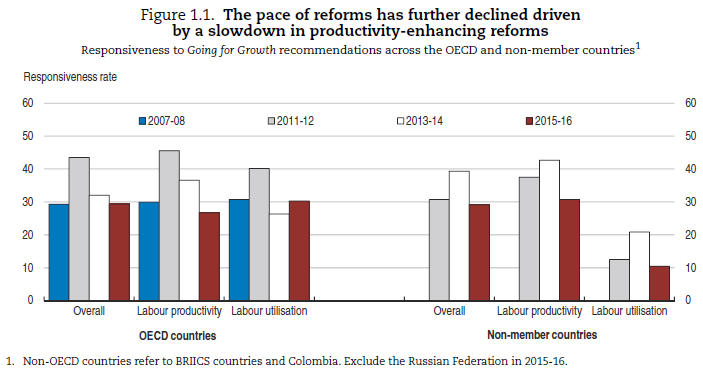
The support for governments’ pro-growth structural reform agenda is being undermined by the prolonged period of stagnating living standards that has affected a large share of the population in many countries.  Growing political headwinds are clearly one factor contributing to the steady slowdown in the pace of reforms observed since the immediate post-crisis years, (see first chart). Yet, the reforms are needed, both to escape the low-growth trap and to prepare for rapid technological changes.

GfG the pace of reforms

The annual Going for Growth report just released by the OECD helps government to pursue an ambitious reform agenda, one that seeks to make the most of the potential synergies between product, labour and financial market reforms. It proposes country-specific policy packages to boost productivity and employment, and to ensure that the gains reach a vast majority of workers and households. The report also reviews progress in structural reforms in areas related to Going for Growth recommendations.

In looking back at reform achievements over the past two years, one encouraging development highlighted has been the increase in the number of actions taken over the past two years to lift employment (see first chart). These efforts are paying off.  Employment rates among youth have risen well over 10 per cent on average across the OECD in the past 2-3 years, despite subdued growth.  In other countries such as Germany, Japan and Korea, access to childcare and early childhood education has been expanded, and this is helping women to join and stay in the labour market. These are clear indications of the greater attention that governments have paid to promoting inclusiveness. And, they have done so in a way that is also good for growth.

Achieving greater inclusiveness and reducing inequalities are important for the well-being of citizens. They are necessary for safeguarding social cohesion and sustaining growth in the longer run. But achieving inclusive growth on a sustained basis also requires addressing the productivity slowdown. The report emphasises the importance of creating an environment that encourages firms to innovate, but also that promotes the entry of new firms and the redeployment of resources from poorly performing firms to high-productivity ones.

This is how successful ideas and products can be tested and developed. For this to happen, poorly performing firms should either improve or be allowed to exit the market.  Since the crisis, the share of non-viable – or so-called zombie – firms has risen from 4% to nearly 6% of total businesses across OECD countries. And since they are trapping valuable resources this is lowering productivity, by close to 1% in countries where zombie firms are most prevalent.

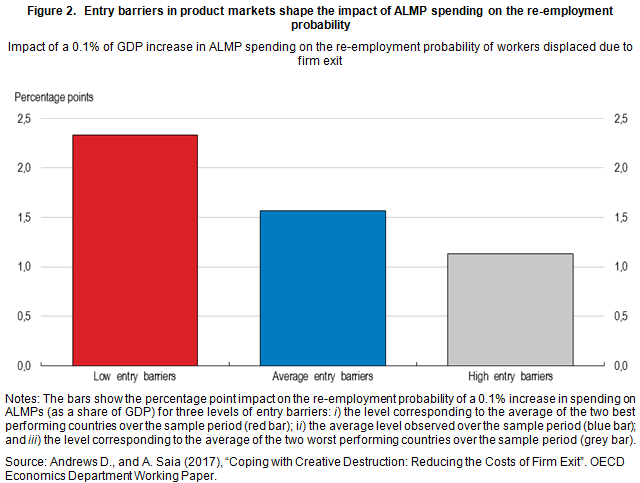
Reducing barriers to firm entry and exit is needed to revive business dynamism and productivity.  But to ensure that all can benefit, additional measures are needed to help workers coping with jobs turnover. This is one reason why reform packages are so important for growth to be more inclusive.  To give one example, OECD analysis has shown that spending more public money to help laid-off workers to find a new job is far more effective in countries where regulatory barriers to firm entry are low (see second Chart). This is because job opportunities are more abundant in places where new firms can enter the market more easily.

GfG creative destr

The report points out that by concentrating reform efforts in specific policy areas, governments run the risk of missing potential gains from policy synergies and reform complementarities. Improved packaging of reforms would make them easier to implement, maximise the impact on growth and job creation and help reduce income inequality.

References:

Adalet-McGowan M., D. Andrews and V. Millot (2016) “The Walking Dead? Zombie Firms and Productivity Performance”, in OECD countries, OECD Economics Department Working Paper No. 1372, OECD Publishing.

Andrews D., and A. Saia (2017), “Coping with Creative Destruction: Reducing the Costs of Firm Exit”. OECD Economics Department Working Paper No 1353, OECD Publishing.


Reducing poverty durably is a key challenge in Spain

By Yosuke Jin, Spain Desk, Country Studies Branch, OECD Economics Department

Poverty has risen in Spain in the wake of the crisis (Figure 1), mainly due to lack of quality jobs that provide enough hours of paid work to support decent incomes (OECD, 2017). The risk of poverty is concentrated on jobless households and households with only temporary workers (OECD, 2015). As employment has grown strongly over the past three years, poverty is likely to have declined. However, the level of poverty is also likely to remain high as the unemployment rate still stands at around 19% and a quarter of those who are employed are on temporary jobs. The risk of poverty is particularly intensified among jobless households with children.

pov incr during crisis esp

The tax and transfer system could do more to relieve poverty. Total social spending as a percentage of GDP is higher in Spain than the OECD average. However, social benefits are poorly targeted with relatively well-off households benefiting more than the poor. Cash transfers are particularly low at the bottom 20% of the income distribution (Figure 2), as less than half of the unemployed are covered by unemployment benefits and minimum-income safety nets are weak (OECD, 2017).

esp 2 transfers for poor

A substantial number of unemployed people have exhausted their unemployment benefits as their unemployment spell gets longer or are not entitled to them at all. This is particularly the case for those who separate from temporary contracts due to very short contribution periods in the social security system. The 2017 OECD Economic Survey on Spain recommends extending the coverage of the standard unemployment benefit by reducing its minimum required contribution period, in line with many other EU countries (OECD, 2017).

The minimum income support provided by safety nets is weak and its coverage is very limited. Social protection in Spain consists not only of the unemployment insurance system managed by the central government, but also of minimum income support schemes run by the central and regional authorities. Only 1.5% of households received minimum income support in 2014 from the regional schemes. The Renta Minima de Insercion (RMI) is the most common income support scheme for those who are not eligible for unemployment benefits, aimed at alleviating poverty by means of cash benefits for basic living needs. For those who do receive the RMI, the benefit amount is low compared with similar social assistance in other OECD countries, in particular for those with children due to weak top-ups for children. The Economic Survey recommends increasing the amount and coverage of the regional minimum income support programmes, in particular, for families with children (OECD, 2017).

While improving the coverage of social protection, the benefits should be strictly conditional on active job search. This would not only provide immediate income support but also allow benefit recipients to stay connected to the labour market, as long as relevant employment support measures are put in place. From this perspective, the Economic Survey also discusses the importance of improving the efficiency of public employment services by: employing profiling tools and specialisation of counsellors; increasing resources and staff-to-job seeker ratios; and improving co-ordination to provide integrated support for jobseekers via a single point of contact for social and employment services and assistance (OECD, 2017).

References

OECD (2015), In It Together: Why Less Inequality Benefits All, OECD Publishing, Paris.

OECD (2017), OECD Economic Surveys: Spain 2017, OECD Publishing, Paris.


Will risks and financial vulnerabilities derail the modest recovery?

By Catherine L. Mann, OECD Chief Economist and Head of Economics Department

Global growth is projected to pick up to around 3½ per cent in 2018, from just under 3% in 2016 in our latest Interim Economic Outlook. The forecast modest recovery is supported by fiscal initiatives in major economies and broadly unchanged from the November Economic Outlook. While the pick-up is welcome, it would still leave global growth below the historical average of around 4% for the two decades prior to the crisis.

This comes against the background of a five-year period where the global economy has been stuck in a low-growth trap. Consumption, investment, trade and productivity are far from strong and inequality is rising. Productivity gaps between frontier firms and laggard firms have widened, contributing to a growing income gap as wages have stagnated at less productive firms.

Moreover, financial vulnerabilities and policy risks could derail the modest recovery. There are apparent disconnects between the positive assessment reflected in financial market valuations and forecasts for the real economy. For example, equity prices have increased significantly over the past six months, despite the large rise in nominal interest rates and with long-term real GDP growth and inflation expectations barely changed.

The global interest-rate cycle turned in mid-2016. Some normalisation of interest rates as a result of rebalancing demand support from monetary to fiscal policy is welcome. However, the market response to higher rates, following a prolonged period of exceptional monetary stimulus and low yields, may not be smooth. Market expectations imply a rising divergence in short-term rates between the major advanced economies in the coming years. This creates risk of exchange rate volatility, which could lead to wider instability in financial markets.

Risks to emerging market economies are high, including from high and rapid growth in private credit, notably in China, and rising non-performing loans, particularly for India and Russia. Many emerging market economies are also vulnerable to external shocks and currency mismatches, particularly those with high levels of overseas borrowing or those with a mismatch between foreign currency denominated debts and export revenues.

IEO March 2017

Policy uncertainty and low trust in government cloud the policy environment. Global policy uncertainty increased significantly in 2016 according to news-based measures. Many countries have new governments, face elections this year, or rely on coalition or minority governments. More generally, falling public trust in governments makes it more difficult to pursue reforms needed to achieve strong and inclusive growth.

There is now significant uncertainty about the future direction of trade policy globally, in part because of falling public support for trade linked to disparities in outcomes across industries, workers and regions. But as I have written previously, trade matters for productivity, living standards and inclusive growth. More efforts are needed to strengthen domestic social protections, invest in human capital, promote skills and provide support for workers in transition which supports trade openness, and helps to maximise the gains from trade and ensure the benefits are shared. A roll-back of trade openness, on the other hand, would be costly for global GDP and the large number of jobs linked to global value chains.

Policy needs to manage these risks, strengthen growth and ensure it is more inclusive. Countries should use increased fiscal space to implement effective fiscal initiatives that boost demand and make government taxes and spending more supportive of long-term growth and equity. Most countries have room for additional fiscal initiatives to boost growth and employment and enhance inclusiveness without compromising debt sustainability.

A durable exit from the low-growth trap also requires greater political commitment to implement policy packages to boost inclusive growth. However, as shown in our forthcoming OECD Going for Growth 2017 (to be released on 17 March), the pace of reform has continued to decline in recent years. Reforms can be more effective and draw greater political support if implemented together, for example with actions to develop skills, remove barriers to competition and trade, and improve labour markets to raise incomes and share the gains widely.

References

OECD Interim Economic Outlook, March 2017.

See also: www.oecd.org/economy/growth/economic-resilience.htm


Australia’s economy, good track record but challenges ahead

by Philip Hemmings and Vassiliki Koutosgeorgopoulou

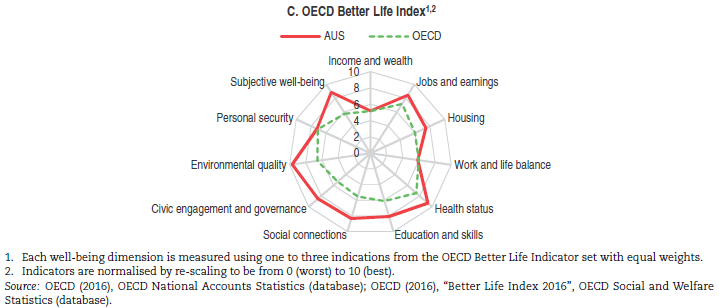
Australia’s economy has enjoyed considerable success in recent decades, gross domestic product per capita is high and the country generally ranks favourably in well-being. Despite the end of the global commodity super-cycle, the economy continues to perform well. The rebalancing of economic activity from commodity investment to other activities is well advanced, facilitated by monetary and fiscal policies, currency depreciation, and flexible labour and product markets.

blog-bli

However, Australia risks falling into a “low-growth trap”. Along with many OECD countries, productivity growth has slowed since its peak in the 1990s. The country’s future growth prospects depend on strong productivity growth which, in turn, requires greater capacity for absorbing and generating new innovations. This is the subject of this Survey’s in‑depth examination of innovation and related policies and the focus of a recent government initiative, the National Innovation and Science Agenda.

Furthermore, inclusiveness has been eroded. Households in upper income brackets have benefited more than others from Australia’s long period of economic growth. Real incomes for the top quintile of households grew by more than 40% between 2004 and 2014 while those for the lowest quintile only grew by about 25%. Strong growth has pulled the incomes of households with wage earners further ahead of households reliant on transfers or pensions. Also, scale effects have amplified returns to some already high-paid segments of the labour market ─ widening the income distribution. In addition, large socioeconomic gaps between Australia’s indigenous population  and the rest of the population remain and there is room to reduce gender imbalance.

The main messages of this Survey are:

  • Strong macroeconomic and financial-sector institutions and policies have supported strong economic growth and high living standards.
  • Merely maintaining long-run average productivity growth jeopardises this success; a renewed emphasis on structural reforms in particular those that help boost Australia’s capacity to absorb and generate innovation is required.
  • Widening income inequalities and longstanding issues of inclusion (notably Australia’s indigenous population) call for an ongoing emphasis on policies to ensure equitable opportunities for engaging in the labour market through skills acquisition and active labour market policies, especially policies that address these concerns while also enhancing productivity.

References

OECD (2017), OECD Economic Surveys: Australia 2017, OECD Publishing, Paris.


Efficient, Equitable and Enforceable: three “Es” for reforming India’s tax system and better finance public services

By Isabelle Joumard, Head of the India desk, OECD Economics Department

Promoting inclusive growth in India requires improving social and physical infrastructure. Public spending needs are large: only 40% of the population had access to sanitation facilities in 2015; public spending on health is just above 1% of GDP, compared to 7% on average in OECD countries and 3% in the other key emerging economies; only a small fraction of the population contributes to a retirement scheme. More than 20% of the population (almost 270 million persons) lived with less than USD 1.9 a day in 2011.

India needs to raise more tax revenue to finance access to better quality public services for all while putting the relatively high public debt-to-GDP ratio onto a declining path. Implementing the landmark Goods and Services Tax (GST) – a national value added tax – will promote the competitiveness and productivity of Indian companies. While the GST has been designed to be revenue-neutral, at least in the short- and medium-run, it should be complemented by a comprehensive reform of income and property taxes to raise additional revenue and make the overall tax system more efficient, equitable and enforceable.

Efficiency of taxes could be increased through lower rates and a broader base. Although the statutory tax rate on companies is high (Figure 1), various special rates, exemptions, deductions, rebates, deferrals and credits result in much lower effective tax rates and create a bias against labour-intensive activities. The government’s plan to reduce the corporate income tax rate from 30% to 25% while removing most exemptions is most welcome. That said, different tax regimes for small enterprises and social security contribution requirements – only companies with more than 20 permanent employees have to pay- continue to generate disincentives for firms to grow and create quality jobs.

blog-the-corporate-1

Equity is an issue. Less than 6% of the population pay the personal income tax, which is a very low share by international standards. An individual does not pay any income tax until income is around 2½ times the average wage in the organised/formal sector, a much high level than most other emerging economies and OECD countries (Figure 2). Personal income tax is also reduced by generous tax concessions (e.g. mortgage payments) which benefit the rich more. There is no tax on agricultural income of large-scale farmers. Estimates presented in the 2017 OECD Economic Survey of India suggest that bringing the personal income tax schedule in line with other emerging economies and scrapping tax concessions would increase personal income tax revenue by about 50%. Property taxes could also raise more revenue. Inheritance taxes are virtually absent, despite the extreme concentration of wealth in the hands of a few, while revenue from real estate taxes stands at about 0.2% of GDP which is well below the level in OECD and other BRIICS countries.

blog-personal-income-tax-india

Enforceability could be improved to enhance public perceptions of the tax system fairness. The government has taken several measures to reduce tax evasion, such as penalties for not filing returns or filing with inadequate asset and income disclosure. India has also taken steps to prevent base erosion and profit shifting. In particular, the treaty with Mauritius – more than 20% of FDI position – was renegotiated in 2016, giving India a right to tax capital gains channelled through Mauritius from April 2017. However, proliferation of tax concessions and lack of clarity of tax regulations raise compliance and collection costs. Ensuring clarity and certainty in tax legislation and employing more skilled tax officers would strengthen the tax administration and make the system fairer and more effective.

References:

OECD (2017), OECD Economic Surveys: India 2017, OECD Publishing, Paris.


Sweden is a champion of gender equality, but parity is not reached yet

by Christophe André, Swedish Desk, Country Studies Branch, OECD Economics Department

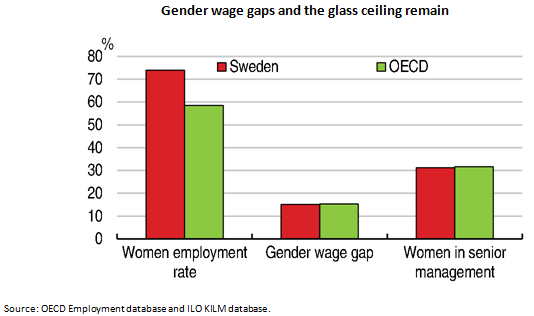
As shown in the Economic Survey, Sweden ranks among the OECD’s frontrunners in terms of gender equality. Women have a high employment rate, outperform men in education and are well represented in government and parliament. These achievements were made possible by policies which for decades have been promoting equality, notably through childcare and parental leave arrangements, individual taxation and mainstreaming gender issues.

Nevertheless, without further policy measures, achieving parity is still a distant prospect in several areas. Wage differences between genders persist, even though a large part of the gap results from differences in age, education, occupation, sector of employment and hours worked. Women are under-represented on private company boards, in senior management positions, in many well-paid and influential professions and among entrepreneurs.

blog-gender-wage-gaps

Hence, there is scope for further progress on gender equality. Paid parental leave has facilitated the rise in women’s employment rate, which is now close to that of men. However, 75% of the leave is still taken by women, which has a detrimental impact on their careers. Last year’s extension of the share of the parental leave reserved for each parent to three months is a move in the right direction, as it sends a signal which will contribute to shift social norms. Nevertheless, it would be desirable to move further in that direction to reduce the stigma associated with long leaves, even though there is a trade-off with the benefits of free choice.

The women’s share of board members of listed companies is still below one third. The recent government proposal to impose quotas, as Norway did more than a decade ago, has not received the necessary support from other parties. Notwithstanding, firms should continue to increase their share of female board members, and perhaps even more importantly, to increase the representation of women in senior management, which research shows to generally enhance economic performance. Gender inequalities can also be reduced through the fight against stereotypes in education and further promotion of women’s entrepreneurship.

Last but not least, special attention should also be paid to the integration of foreign-born women, whose employment rate is much lower than for their male counterparts. Helping foreign-born women to strengthen their contribution to the economy and society has to be a key ingredient of a more inclusive Sweden.

References:

OECD (2012), Closing the Gender Gap: Act Now, OECD Publishing. http://dx.doi.org/10.1787/9789264179370-en

OECD (2015), The ABC of Gender Equality in Education: Aptitude, Behaviour, Confidence, PISA, OECD Publishing. http://dx.doi.org/10.1787/9789264229945-en

OECD (2016), Working Together: Skills and Labour Market Integration of Immigrants and their Children in Sweden, OECD Publishing. http://dx.doi.org/10.1787/9789264257382-en

OECD (2017), OECD Economic Surveys: Sweden 2017, OECD Publishing, Paris.


The Swedish economic boom: can it last?

By Christophe Andre, Swedish Desk, Country Studies Branch, OECD Economics Department

The Swedish economy has been growing at over 3% over the past two years. Output is now more than 25% above its 2005 level, which dwarfs the achievements of the major advanced economies, including Germany and the United States, and its Nordic neighbours alike (see figure). As shown in the Economic Survey, Sweden’s out-performance is not just about GDP. The employment rate is the highest in the European Union, productivity is picking up, income inequality remains low and well-being indicators compare favourably.

blog-3-sweden

This begs the question of how a small open economy depending heavily on foreign trade is able to prosper in today’s sluggish global environment. Even though economic growth is always the result of a complex alchemy, we can point to two sets of explanations. First, the structural reforms which followed the crisis of the early 1990s have allowed a competitive and diversified business sector to flourish, while preserving the social safety net required to foster inclusive growth. Second, macroeconomic policies have been prudent and counter-cyclical. Prudent fiscal policy in the run-up to the global financial crisis created space allowing temporary deficits to dampen the impact of the subsequent recession, without putting the long-term sustainability of public finances at risk. Excessive optimism may have led to untimely monetary policy tightening in 2010-11, resulting in an extended period of low inflation. Nevertheless, the Riksbank reacted by reverting to an expansionary stance, bolstering the economy and pushing back inflation towards the 2% target.

How long will the current expansion last? Many clouds on the horizon, including geo-political tensions, financial instability and rising protectionism, hold the potential to harm Sweden, but on these the national authorities have little influence. The main domestic challenges will be to cool the housing market and to successfully integrate immigrants into the labour market and society. Macro-prudential and tax measures can dampen the rise in household debt. However, the structural causes of housing shortages need to be addressed to stabilise the housing market and provide adequate housing for all in locations where they see opportunities. Immigrants can make a significant long-term contribution to the economy provided integration and skills are enhanced. In sum, sticking to prudent macroeconomic policies, tackling housing market imbalances and investing in immigrants would pave the way for more years of inclusive growth in Sweden.

References:

OECD (2017), OECD Economic Surveys: Sweden 2017, OECD Publishing, Paris.
DOI: http://dx.doi.org/10.1787/eco_surveys-swe-2015-en.