Four Challenges of Inclusive Growth from the OECD’s chief economist

by Catherine L. Mann, Chief Economist and Head of the Economics Department, OECD

  1. The challenge of measuring inclusiveness. A standard metric for measuring inequality is the Gini coefficient, which measures income distribution within an economy. But there are many other measures, such as distribution of income deciles, distribution of wealth, distributions of these by regions or by gender.  These are all static measures, even if they change over time. On the other hand, the persistence of earnings across generations, e.g. income mobility, explicitly is a dynamic intergenerational measure.  Which measure is best? Particularly as they deliver different rankings across countries.  For example, the Canadian Gini is persistently higher than the French Gini.  But, the metric of earnings persistence is much lower in Canada than than in France.  Which country is more inclusive? For more metrics, see OECD:  Measures of inequality, immobility


  1. Getting below the averages. Recent OECD research has found a wide gap in both productivity and wages between firms in each sector that are at the productivity frontier (in the top 5 percent, in productivity), where labour productivity has advanced some 35 percent since 2000,  and the rest of firms in the economy, where labor productivity has increased less than 5 percent over the same period.  The widening wage gap is reflected in the widening distribution of income across deciles where, among OECD countries,  the real household disposable income of the bottom 10 percent remains some seven percent below the peak in 2007, the mean income is only on par, yet the top 10 percent has edged higher.   Closing both the productivity and income gaps is a key element of inclusive growth.  While the specifics of the policies to close these gaps differ by country, there are elements in the policy domains of business dynamics and competition, labour market functioning and skills, and financial market structure and performance.  These policies,  if deployed in packages, tend to work synergistically rather than present tradeoffs to achieve inclusive growth.  For more on this topic, see the OECD:  Global Forum on Productivity


  1. Getting finance right. OECD research shows that specific kinds of finance can undermine inclusive growth.  Specifically, excessive mortgage debt increases the likelihood of a financial crisis, with deleterious outcomes for growth, and for equity, since those at the bottom of the income distribution are more likely to be at higher risk and higher exposure to this kind of debt and therefore to consequences of crisis.  On the other hand, deeper equity markets contribute to growth; although, to the extent that equity wealth is unequally distributed, deeper equity markets favour the wealthier.  OECD research also finds that otherwise identical workers, regardless of their income decile, are paid a wage premium if they work in finance. One reason is that too-big-to-fail rents are distributed partly to workers.  For more on this topic, see OECD:  Finance,growth, and inequality


  1. Globalization, technology, ‘tastes’ and regional impact on manufacturing jobs. How is the interplay of these factors relevant for inclusive growth?  A decomposition of manufacturing job loss finds that changes in technology and ’tastes’ (that is, consumer preferences for services vs. goods) dominate the direct force of trade flows in the loss of manufacturing jobs.  However, to the extent that manufacturing is regionally concentrated, the three factors together accentuate and concentrate jobs losses in those regions.  Not surprisingly, countries with higher regional concentration of manufacturing  jobs have tended to have experienced higher overall inequality. The policy approach to ameliorate this concentrated impact so that all can enjoy the benefits of globalization and technological change remains a critical task.  For more on this topic, see OECD:  Chapter 2 of the June Economic Outlook

This post also appears on the C.D. Howe Institute site


Short-term momentum: Will it be sustained?

By Catherine L. Mann, OECD Chief Economist and Head of Economics Department

Global growth is projected to increase to around 3.5% in 2017 and 3.7% in 2018 from 3% in 2016 in our latest Interim Economic Outlook. The forecast has slightly improved since the OECD June 2017 Economic Outlook, with the upturn becoming more synchronised across the world. Activity has picked up more than anticipated in the first half of the year in some of the largest economies – the euro area, Japan, China. Short-term momentum is reflected in a rebound in industrial production, consumer spending and investment since the second half of 2016, while trade growth has recovered from the slump in late 2015 and early 2016. Business and consumer confidence have strengthened. However, short-term momentum is no guarantee of medium-term sustainable growth. While the signs of recovery in business investment and trade are encouraging, they have not gathered sufficient pace to sustain healthy productivity growth. Wages have largely failed to pick up despite rising employment, limiting gains in household disposable incomes, especially for the bottom 10%.

IEOmomentumblo

Lifting medium-term global growth requires a durable strengthening of growth in emerging market economies – but GDP growth has slowed overall in these countries since the 2000s, and the ability of “catching up” economies to grow faster than advanced economies has been mixed. Deeper reform to enhance capital deepening and productivity gains will be needed to overcome the headwinds of rapid demographic developments in some countries, as well as a further moderation of growth in China.

Policy must not be complacent in the face of stronger short-term momentum. As the upturn has broadened, policy support for inclusive growth should be continued but further rebalanced from monetary policy towards fiscal and structural initiatives, while managing risks.

Monetary policymakers face a delicate balancing challenge. Monetary support remains necessary to ensure that the recovery is sustained and that inflation increases towards its target levels. Yet as the long period of low interest rates has boosted asset price valuations and encouraged riskier asset exposures, financial stability vulnerabilities persist and create uncertainties.

On the fiscal side, policymakers need to deliver fiscal initiatives focused on inclusive and sustainable growth. Underlying primary balances in many OECD countries are expected to ease under current plans in 2017-18, reflecting use of fiscal space – including through savings realised on government borrowing costs. Governments should ensure that fiscal easing is delivered, while making a better use of the mix of tax and spending policies. Priority should be given to public spending that yields the highest benefits for growth, inclusiveness and long-run supply. Education, hard and soft infrastructure, family benefits and health investments are the types of quality public spending that should be prioritised according to specific conditions in each country.

Stronger structural reform ambition should aim to address the missing engines of the current global upturn – private investment, trade, and productivity gains. More can be done to ease barriers to product-market entry and competition, both domestically and through a renewed commitment to trade and foreign direct investment openness. Improved competition would help revive the stalled diffusion of innovation between frontier firms and the rest of the economy, and address the growing productivity and wage dispersion. In many countries, there is significant scope to reform insolvency regimes, thus redirecting resources trapped in “zombie” firms towards productive investment.

Coherent packages of structural reforms can enhance their overall effectiveness. Reforms to reduce barriers to product market competition, trade and investment should be accompanied by labour-market measures to help vulnerable workers transition to new jobs. Integrated policy packages would help reap the benefits from innovation and globalisation while dealing with the job losses that are concentrated in specific industries or regions.

This period of short-term momentum in the global economy, along with the fiscal room created by the current monetary environment, gives policymakers space to address the structural impediments that hold back productivity growth and leave citizens behind. Sustained and inclusive growth depends on policymakers following through to meet the expectations of their citizens.

References

OECD Interim Economic Outlook, September 2017.


As Estonian exporters lead the way, policy needs to adapt

by Zuzana Smidova, Estonia Desk, OECD Economics Department

International trade plays an important role in the Estonian economy (Figure 1). Around a half of the private sector employment is sustained by foreign demand, twice as much as the OECD average. By another measure, over 40% of the value added created in the economy is linked directly or indirectly to exports, largely in the services sector. Yet, value added per worker produced in Estonia and consumed abroad remains low, even if comparable to its EU peers.

Estonia Suzana blog

International trade and foreign direct investment can serve as a ladder for climbing up the value added chain as they are major channels of technology diffusion and productivity growth. Exporters display higher productivity and innovation than companies oriented on the domestic market, and this is true in Estonia too, as new research shows (Benkovski et al, 2017, forthcoming) (Figure 2). Exporters are faced with tough global competition and have to meet international standards.

Estonia Suzana2blog

To increase export potential and value-added drawn from trade, innovative capacity and transfer of knowledge from highly productive firms to the rest of the economy need to improve. For the moment, innovation of the typical Estonian firms is limited as spending on business R&D is low. In this vein, nurturing cooperation between the researchers and business is crucial, as highlighted in the new Economic Survey of Estonia (OECD, 2017). The new industrial policy green paper, initiated by the business community and focused on digitalisation of traditional industries is welcome. It has the potential to improve the productivity and innovation capacities of these sectors. Furthermore, policy efforts should concentrate on strengthening adult education and allowing for immigration of talents, since shortage of skilled labour is starting to show as a major obstacle for further business growth and investment. This can also help with improving the innovative capacities.

By giving access to a wider variety of goods and services at cheaper prices, international trade raises well-being and consumers’ purchasing power. It also means fast transmission of global shocks, requiring a robust social safety net and adjustment policies. To ensure that all benefit from opportunities created by globalisation, the Estonian policymakers should focus on two policy areas. Firstly, those who can work need to have the right skills and incentives to participate in the labour market. Secondly, those who are out of the labour market should be supported by an effective and adequate social safety net, conducive to upskilling and maintaining work incentives. This means for instance increasing the level of subsistence of benefits and relaxing eligibility conditions for unemployment benefits, not least to improve participation in active labour market measures.

References:

Beņkovskis, K.,Masso, J., Tkasevs, O., Vahter, P., Yashiro, N. (2017), “Export and productivity in Global Value Chain: Evidences from Latvian and Estonian firms” OECD Economics Department Working Paper, OECD Publishing, Paris, forthcoming

OECD (2017), OECD Economic Surveys: Estonia 2017, OECD Publishing.


Slovakia…it’s time to invest in the future

by Gabriel Machlica, Slovak Republic Desk, OECD Economics Department

The Slovak Republic continues to exhibit robust economic performance. International competitiveness is strong, fiscal and financial policies are prudent, poverty and income inequality are low, and the country’s environmental footprint has improved markedly. Employment is rising, prices have been stable, and the external account is near balance. However, there are persistent, substantial public-sector deficiencies, which weigh on the wellbeing of the population and can undermine the sustainability of the economic expansion. These are mostly visible in terms of education and health-care outcomes.

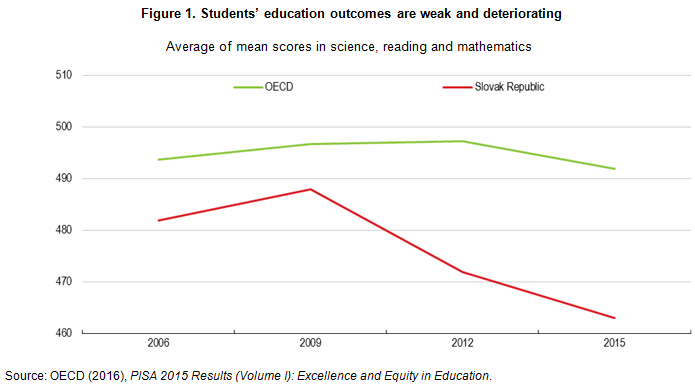
The Slovak education system is not properly preparing students for the labour market. PISA outcomes for 15 year-old Slovaks are weak in international comparison and have deteriorated over time (Figure 1). At the same time, secondary schools fail to overcome the differences in learning outcomes stemming from students’ socio-economic backgrounds. Almost one-third of 15 year-old Slovak students did not obtain even a basic level of proficiency in assessed subjects. This is worrying, as weaker students have limited access to employment and better paying jobs. Slovak tertiary education is among the weakest in the OECD. University research quality as measured by international rankings is low even in a regional comparison. As a result, an increasing number of students choose to study abroad to get a better education.

slovakia2017future

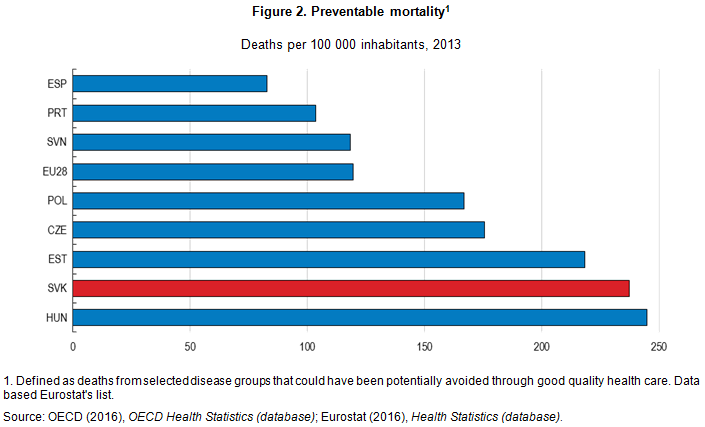
Regarding health-care outcomes, Slovakia ranks poorly in international comparisons. Life expectancy at birth is shorter than in countries with similar or lower living standards. Life expectancy at 65 and health-adjusted life expectancy are among the lowest in the OECD. Infant mortality is high and more people in Slovakia die of diseases that could have been prevented (Figure 2). Improving the health-care system could bring large gains in well-being. For example, improving it to the EU level could save about 5000  lives per year.

slovakia2017mortality

Over the last decade the Slovak economy has improved markedly in terms of macroeconomic fiscal and financial-stability outcomes. Nevertheless, it is important to undertake significant reform of the public services, especially education and health care, in order to spread the benefits of solid economic performance more equitably across Slovak society.

Further reading:

OECD (2017), OECD Economic Surveys: Slovak Republic 2017, OECD Publishing, Paris, http://dx.doi.org/10.1787/eco_surveys-svk-2017-en

Šiškovič, M. and M. Játi (2015), “Čo skutočne merajú medzinárodné rebríčky vysokých škôl”, Komentár 01/2015, Inštitút vzdelávacej politiky, Ministerstvo školstva, vedy, výskumu a športu SR.

U21 (2016), Ranking of National Higher Education Systems, Melbourne Institute of Applied Economic and Social Research, University of Melbourne.


Estonia: Using fiscal space for a more inclusive growth

By Pierre Beynet, Head of Division, OECD Economics Department

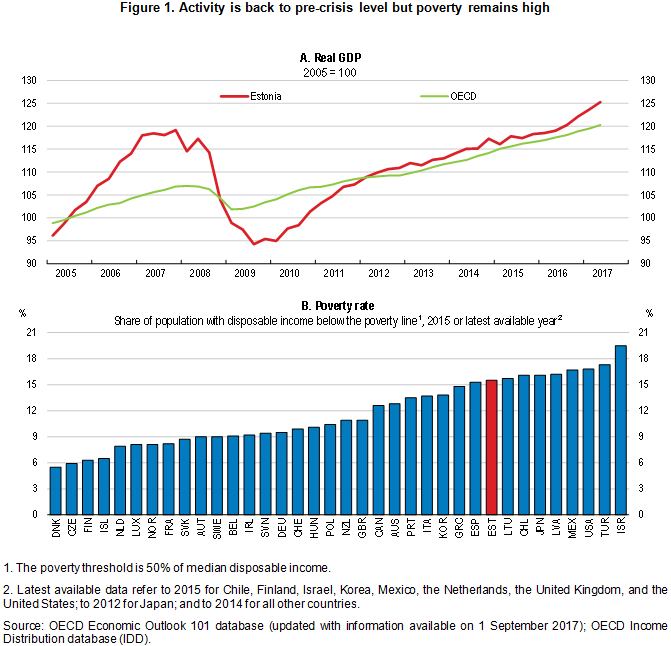
Estonian growth is picking up again strongly in 2017 and the level of activity has finally surpassed its pre-crisis level, almost 10 years after the outset of the financial crisis (Figure 1, panel A). However, poverty remains among the highest in the OECD (Figure 1, Panel B).

To make growth more inclusive, the 2017 OECD economic survey argues that Estonia should make its tax and benefits policies more redistributive, but also use more actively its large fiscal space by allowing a small fiscal deficit in the longer term (OECD, 2017).

Beynet estonia

Market income inequality is high (Figure 2, Panels A), but the redistributive effects of the Estonian tax and benefit system is low (Figure 2, Panel B). It leaves a considerable proportion of the population at risk of poverty, notably the unemployed, disabled and low-educated. The old-aged are also more at risk of poverty, in particular because of the relatively low level of pensions.

Beynet2esto

The government is already working on important redistributive measures. For instance, the planned increase in the personal income tax allowance, which is steeper at lower wage levels, will improve the progressivity to the tax system from 2018. However, the lowest income earners will not benefit from this measure since they are exempt from the personal income tax. Besides, the level of spending allocated to protection of the most vulnerable is low: around 31% of total public spending in 2014 went on social spending, some 9 percentage points less than the EU average. The targeting of social programmes is also poor, with means-tested measures accounting for a low share in total social spending.

Fiscal room is available for further measures to make growth more inclusive. Estonia has the lowest gross public debt relative to GDP in the OECD (Maastricht debt is at around 10%) and a structural budget surplus since 2009. Fiscal policy has been tight over past years, despite economic slack. The government plans a small structural deficit in 2018, 2019 and 2020, which is welcome, but the current fiscal rule imposes a return to a balanced budget in structural terms from 2021.

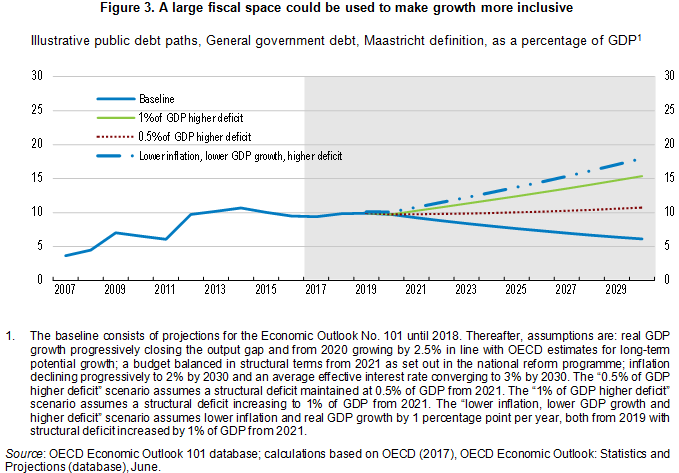
Beyond 2020, financing growth-enhancing measures could require revising the fiscal rule. Maintaining a small structural deficit for an extended period would not undermine the long-term sustainability of public finances. For instance, a persistent deficit of 0.5% of GDP would result in Maastricht debt reaching less than 11% of GDP in 2030 (Figure 3). In the same vein, increasing the deficit by 1% of GDP would still maintain a prudent debt level, even if coupled with 1 percentage point lower inflation and GDP growth (Figure 3).

Beynt3esto

References

OECD (2017), OECD Economic Survey of Estonia, OECD Publishing, Paris.


Latvia: time to reboot inclusive productivity growth

by Andrés Fuentes Hutfilter and Naomitsu Yashiro, Latvia Desk, OECD Economics Department

Latvia’s economy is growing strongly. Driven by the recovery of exports and investment as well as strong private consumption, real GDP growth is expected to strengthen from 2% in 2016 to around 4% this year and next. Exporters have gained market shares. More disbursement of EU structural funds is boosting investment. Real wage growth is supporting private consumption. Growth is also underpinned by the government’s strong track-record in pursuing pro-growth reforms. Administrative burdens to entrepreneurship have been reduced and the efficiency of the judiciary has been enhanced. The quality of education and training has improved and active labour market policies have been upgraded. Government finances are solid: The government budget was in balance in 2016 and government debt is 40% of GDP, lower than in most OECD countries.

Latvia2017thegapImportant challenges remain. Productivity is lower than in other Baltic or central European economies and the gap with leading OECD economies remains large (chart A). Yet, productivity growth has slowed after the financial crisis, as elsewhere. To converge to the living standards of high income countries, Latvia has to reinvigorate productivity. As the 2017 Economic Survey of Latvia argues, better integration in global value chains, especially in sectors characterised with rapid technology changes, is key. Latvia has made progress in diversifying its exports. For example, exports of ICT services have increased. But most exports still rely on low-value added activities, such as wood processing or transit transport services.
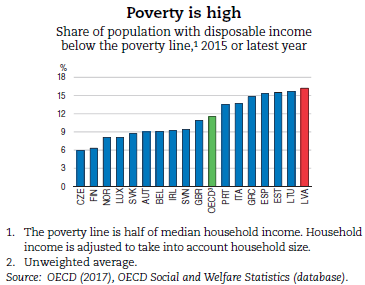
Latvia2017povertyPoverty is among the highest in OECD countries (chart B) and is concentrated in some regions in part reflecting high unemployment. Lack of access to good and affordable housing makes it more difficult for low-income workers to move to well-paying jobs. Access to health services and higher education are also uneven and limit access to economic opportunities for low income households. Many young Latvians emigrate. These issues and policies to address them are analysed in the 2017 Economic Survey of Latvia.

Further reading

OECD (2017), OECD Economic Surveys: Latvia 2017, OECD Publishing, Paris.


Continuing the reform process in France to improve job and income prospects

by Nicola Brandt and Pierre Guérin, France Desk, Country Studies Branch, OECD Economics Department

Economic growth is strengthening in France, supported by consumption and investment, and the labour market is gradually recovering, as past reductions of comparatively high labour and business taxes are starting to take effect. However, GDP and employment growth are still lagging relative to the euro-area average (Figure 1). As in many other OECD countries, a weakening of productivity gains is limiting the government’s ability to continue providing its citizens with a high level of social protection and good prospects for high-quality jobs and rising incomes. The new government is passing a major labour market reform. It is also reducing business and labour taxes on low wages and plans to strengthen workers’ rights to unemployment benefits, while tightening obligations to accept job offers. It intends to make the pension system more universal by aligning rights across different regimes, and ease access to high-quality vocational training and adult learning. This ambitious reform agenda can make an important contribution to securing stronger and more inclusive growth and job creation.

France2017ref1

High levels of public spending, while contributing to low poverty and good health care, requires burdensome taxes that limit firms’ ability to invest and create jobs. The new government has set an ambitious target to reduce public expenditures by three points of GDP by 2022. The recently released OECD Economic Survey of France proposes structural reforms that would help cut inefficient and non-essential spending, while better targeting public money where it is most needed. This includes lowering the relatively high public payroll, by not replacing every public servant who retires, reducing overlap in sub-central governments’ competencies and merging France’s often particularly small municipalities, aligning different pension regimes to increase transparency and reduce administrative costs, and gradually raising the minimum retirement age. In health care, improving prevention, while limiting unnecessary prescriptions and treatments would go a long way in containing spending growth, while preserving and further improving overall good health outcomes. Education spending needs to be better targeted at schools with many struggling pupils and public infrastructure spending should focus on poor neighbourhoods that suffer from poor connection to public transport.

Unemployment is still high, and spells are long, particularly for young people; too many of them are not in employment, education nor training. Those who do work often find it difficult to  begin their careers, as most new hires are on temporary contracts few of whom are transformed into permanent jobs. The ongoing labour market reform aims at facilitating negotiations in small firms and simplifies the governance of firm-level institutions representing employees. Also, the needs of small and medium-sized enterprises (SMEs) will be better taken into account as sector-level agreements will have to include explicit provisions for them. This will allow firms and workers to better adapt their working conditions to their specific needs and makes it easier for small and innovative firms to enter the market and grow, promoting productivity growth. Moreover, labour courts setting indemnities for unfair dismissals will now be constrained by a binding range.  Compared to other countries, indemnities in France are indeed particularly variable, and limiting their range will reduce uncertainty for employers regarding dismissal costs, reducing hurdles to hiring on open-ended contracts. However, the Survey also points out that the quality of France’s labour court procedures needs to improve. They  are unusually lengthy, and judgements are appealed in roughly 70% of the cases. One solution would be to introduce professional judges to support the lay assessors who currently handle the process. France is indeed the only OECD country besides Mexico where such legal actions are reviewed by lay assessors alone.

Too many French adults have weak basic skills (Figure 2). Access to training is hampered by a complex training system that is characterised by a large number of training and financing schemes.  The recently introduced personal training account (compte personel de formation, CPF) is difficult to use and provides access only to a limited number of training offers that differ by sector. The government intends to  implement a national vocational training plan of 15 billion euros.  To maximize the impact of that investment the Survey recommends improving information about providers  by strengthening  the quality label system so that workers become fully aware of the label and can understand it. The CPF should be simplified and give access to all training measures that have obtained a quality label. The number of competing schemes should be reduced to concentrate financing on one measure that works.

Fra2017ref2

Further reading

OECD (2017), OECD Economic Surveys: France 2017, OECD Publishing, Paris.


Insight from the OECD Household Dashboard: Why household incomes don’t always track changes in GDP

By Jennifer Ribarsky, Head of Sectoral and National Accounts, OECD Statistics Directorate

A key indicator of households’ material conditions, or economic well-being, is per capita household income, after deducting taxes and social contributions and including social benefits. It provides a better gauge than gross domestic product (GDP) of the resources households have at their disposal to buy goods and services or save for the future.

Over the very long term the average annual growth rates of the two statistics tend to be similar, since the incomes earned by households account for a large share of the total income generated through production in the economy, as recorded by GDP. However, over shorter time periods, especially during severe economic recessions or rapid expansions, trends in household disposable income and GDP may differ significantly. Many factors can contribute to such a divergence; for instance, changes in the government’s policies related to taxes or social benefits, or in how companies allocate their earnings between dividends, retained earnings and compensation of employees.

To see these factors in action, let’s look at recent data for Norway and Greece. Figure 1 shows how GDP and household income have evolved there since the first quarter of 2007, right before the start of the global financial crisis. The figure shows that in the crisis years 2008-2009, GDP per capita was falling in both countries, though faster in Greece. However, government intervention – though a reduced budget surplus in Norway and an increased deficit in Greece – cushioned households from the negative effects of the economic contraction.

stat insight household

Starting from 2010, the picture in the two countries becomes very different. With Greece’s fiscal deficit hitting 15% of GDP in 2009, the European sovereign debt crisis and a deep and prolonged recession, the government ended its support to household income. This retrenchment in government spending, as well as the substantial falls in compensation of employees and self-employed income, meant that household incomes in Greece began falling precipitously in 2010. Even though Greece’s per capita GDP has started to recover slightly in recent quarters, household disposable incomes today remain near their lowest levels since the precipitous decline.

Norwegian households have been in a much more favourable position. As a resource rich country, Norway’s  revenue from the oil and gas sector has for years resulted in large government surpluses that were channelled into a sovereign wealth fund. The Norwegian government continued to sustain household incomes after 2010 by reducing the surplus saved into the fund. However, government intervention was not the primary driver of the longer term Norwegian trend of household income growth outpacing GDP. Since 2007 the share of company earnings going to compensation of employees has increased, and the share going to dividends or retained earnings has declined. Rising employee compensation is thus the main reason for Norwegian household incomes growing 20% more than real GDP per capita since just before the crisis, though the gap has narrowed slightly in the last two years.

To see how households are doing in other OECD countries, visit our dashboard on households’ economic well-being which contains a range of household indicators and has recently been updated to include data through Q1 2017.

Further reading:

Ribarsky, J., C. Kang and E. Bolton  (2016), “The drivers of differences between growth in GDP and household adjusted disposable income in OECD countries“, OECD Statistics Working Papers, No. 2016/06, OECD Publishing, Paris.


Where should Slovakia look for workers?

by Gabriel Machlica, Slovak Republic Desk, OECD Economics Department

Slovakia’s economy continues to perform extremely well. More and more people are able to find jobs. Employment and hours worked are already at the highest since independence. The unemployment rate has fallen below historical norms. Nevertheless, more qualified people are needed. Difficulty in hiring qualified labour has become the main complaint of Slovak businesses. Shortages affect over half of all manufacturers and are particularly acute in the automotive sector. More than 80% of the sector’s suppliers signalled that labour availability and quality are major problems. Moreover, the demand for qualified IT workers is estimated to be four times the supply.

In this regard, the 2017 Slovak Economic Survey argued that the authorities should step up efforts to improve education, ease barriers for foreign workers and enhance labour market access for disadvantaged groups. At the same time, more focus should be placed on the large Slovak diaspora and encourage them to return home.

Almost one-tenth of the population now lives abroad, which is well above the OECD average (Figure 1, Panel A). Most of them left the country in the last decade. Slovak emigrants are mostly young and educated. Unfortunately, many Slovak emigrants with tertiary education work in low skilled jobs abroad (Figure 1, Panel B), which represents sunk costs for the education system.

slovakia2017immigrants

The government should try harder to attract return migrants. Although there are already two schemes to do so, they both support only a limited number of individuals with marginal impact. The authorities should scale up these programmes and monitor their effectiveness to ensure continuing good value for money. More importantly, the government should also develop a comprehensive strategy to maintain ties with the large expatriate community. A new information system could connect with the diaspora and facilitate its engagement. It should be able to target and address emigrants soon after emigration, as the probability of return decreases after five years of living abroad. Many OECD countries are providing online portals with details on job, training and business opportunities. These portals also help young adults studying abroad find information about work and internship offers back home, and companies could use the contact network to find employees among those studying abroad.

Encouraging emigrants to return home can help to increase the supply of skilled labour. This will  address labour shortages. At the same time return migrants can bring home new skills, networks and financial capital, which can help spur innovation and growth.

Further reading:

OECD (2017), OECD Economic Surveys: Slovak Republic 2017, OECD Publishing, Paris. http://dx.doi.org/10.1787/eco_surveys-svk-2017-en

Pungas, E., O. Toomet, T. Tammaru and K. Anniste (2012), “Are Better Educated Migrants Returning? Evidence from Multi-Dimensional Education Data”, NORFACE Migration Discussion Paper, No. 2012-18. www.norface-migration.org/publ_uploads/NDP_18_12.pdf


Retraining can enable ageing Slovenians to keep pace with new technologies

by Rory O’Farrell, Slovenia Desk, OECD Economics Department

While workers in many OECD countries are worried whether robots will take their jobs, the inhabitants of the Slovenian town of Kočevje are less concerned. In 2016 Japanese robotics firm, Yaskawa, announced plans to produce robots in Kočevje, which could create up to 200 jobs. This is a continuation of a pattern seen since independence whereby Slovenia has continued to shift from traditional manufacturing to business services and high-tech production. However, not all Slovenians have been included in this progress.

Modernisation has mainly been achieved by training young Slovenians to fill new occupations. In contrast, those with obsolete skills tend to retire or become unemployed rather than retrain, leaving Slovenia with persistent long-term unemployment, and amongst the lowest employment rates of older workers in the OECD. An ageing population means this is no longer sustainable, and labour shortages are already emerging. To meet the need for skills that complement investment in knowledge-based capital, and the new technologies brought by foreign firms, more responsive education and training solutions are needed.

Slovenia2017blog1

Slovenia performs poorly in terms of providing workers the opportunity to retrain later in life. While it has an effective system of vocational education, workers lack some basic skills that enable them to retrain later in life. Also, although tertiary attainment has increased rapidly, high fees for part-time students make it unattractive for older Slovenians to pursue tertiary education. There is also a lack of incentives to retrain, as wages rise automatically with age and thus do not reflect the relative demand for different occupations, and unemployment and disability insurance have served as pathways to early retirement.

The just-released OECD Economic Survey of  Slovenia outlines how a more flexible education and training system can help create a more flexible labour market. Policies such as greater problem-based learning for vocational students, more adult training, and equalising fees for part-time and full-time students can help workers adapt to future changes in the labour market. This can help ensure all Slovenians benefit from future economic growth.

Find out more:

OECD (2017), OECD Economic Surveys: Slovenia 2017, OECD Publishing, Paris.