Mind the gaps: boosting productivity and reducing inequality in Chile

Antoine Goujard and Paula Garda, OECD Economics Department, Chile/Colombia desk

Chile has been one of the fastest-growing economies in the OECD in recent decades. Sound macroeconomic management, bold structural reforms, such as trade and investment liberalisation, and buoyant natural-resource sectors, supported fast convergence in living standards (Panel A). However, progress has slowed: declining productivity gains are limiting prospects for rising incomes and better-quality jobs; and inequality remains stubbornly high (Panels B and C).

Chile2018productivity blog.png

Chile is at a turning point if it is to continue raising the living standards of all. The 2018 OECD Economic Survey of Chile projects a solid expansion of the economy by 2.9% in 2018 and in 2019. Chile will benefit from more favourable global economic conditions and stronger world trade. The rebound in copper prices will also support short-term growth.

The cyclical recovery offers a key opportunity to address the country’s low and stagnant productivity and its persistently high inequality. An ambitious reform agenda could increase GDP per capita by over 5% in ten years and lower inequality, notably through better-quality jobs, according to OECD estimates. This calls for increasing competitive pressures and incentives for innovation, reducing the administrative burden, improving labour market regulations and raising social spending and the employability of all by more training.

Greater productivity would be a major boost for broader-based export growth (Chapter 1 of the Survey). Competition and simplified administrative procedures, notably licences and permits, are key for better competitiveness. The simplification process should include more stakeholders and stronger ex-ante and ex-post evaluations (OECD, 2016). Systematic reviews of competitive pressures and additional technical assistance and mentoring for young and smaller firms would support entrepreneurship and ease access to export markets. Together with higher and well-targeted support for R&D, this will raise innovation and productivity growth. At the same time, further infrastructure investment, notably in intermodal connections, railways and digital networks (OECD, 2017a), are needed to bridge remaining connectedness gaps and to reduce congestion.

Chile has to do more to realise the full potential of its people. Productivity boosting reforms need to go hand-in-hand with measures to raise skills and make the labour market more inclusive (Chapter 2 of the Survey). The recent education reforms will support teaching quality and skills, lowering inequalities (OECD, 2017b). However, continuing to strengthen the quality of education and developing apprenticeships would improve opportunities for all. Female employment and the skills of the youth would benefit greatly from better access to early childcare and extended daycare opening hours. Providing additional relevant training for vulnerable workers would support productivity and employment, notably for women, the lower skilled and the youth. Lower restrictions on permanent contracts and broader access to unemployment insurance would also ease labour market adjustment for workers and firms and increase quality-jobs, thereby reducing informality and boosting well-being.

Further reading:

OECD (2018), OECD Economic Surveys: Chile 2018, OECD publishing.

OECD (2017a), Infrastructure Governance Review: Chile – Gaps and governance standards of public infrastructure, OECD publishing.

OECD (2017b), Education in Chile, Reviews of National Policies for Education, OECD publishing.

OECD (2016), OECD Reviews of Regulatory Reform – Regulatory Policy in Chile, Government Capacity to Ensure High –Quality Regulation, OECD publishing.


Statistical Insights: New evidence shows that almost 40% of people are economically vulnerable in the OECD

By Carlotta Balestra, Policy Analyst, OECD Statistics Directorate

Stat-Insights-200_fwLooking at poverty and vulnerability through an assets lens

Households’ economic well-being is usually measured by income. But what if there is an interruption in the flow of income? Or an unexpected expense? Such events highlight the importance of wealth accumulation to sustain people’s economic well-being. New evidence on the distribution of wealth shows that  in the OECD  many people, who are not considered income poor, are nevertheless economically vulnerable in the event of  a sudden loss of income, e.g. through unemployment, family breakdown, or disability.  If they were to suddenly stop receiving income, such people would not have enough ready assets to keep living above the poverty line for more than three months.

Key findings

Since incomes can be saved and assets can generate returns, one might expect households’ incomes and assets to be closely correlated. However, OECD data on wealth distribution shows that this correlation is far from perfect.  In particular, the elderly tend to have substantial assets, but lower incomes.  Overall, in the OECD area, less than one in three households belongs to the same quintiles for both income and wealth.

Figure 1 shows that, on average in the OECD, 11% of people are both income and asset poor, and another 36% are not income poor but are economically vulnerable because of insufficient ready assets.

Fig 1 Stat insight feb 2018

The scope of the problem varies widely across countries. In Greece and Latvia, for example, more than half of the population lacks enough liquid financial wealth to maintain just above poverty‑level income for three months. By contrast, the share is much lower in Korea and Japan.

Figure 2 shows how different population groups are affected by economic vulnerability. Vulnerability tends to be highest among working‑age two-parent households and those headed by a person with only a primary or secondary education. Economic vulnerability also diminishes with the age of the head of household, as assets are generally accumulated over one’s life.Fig 2 Stat insight feb 2018

The fact that so many individuals who are not income poor are still vulnerable to sudden losses of regular income – whether from losing their jobs, family breakdown, disability or other causes – needs to be factored into policies. One issue that may need addressing is waiting periods.  While most OECD countries have social safety nets, access to relief may involve a significant delay to establish or assess eligibility, during which families may incur significant distress.

The measure explained

Definitions of asset-based poverty vary, depending on which assets are considered, what income level is deemed necessary for an adequate standard of living, and how long that income level could be maintained from cashing in available assets. We define relevant assets as excluding housing wealth, since people still need a place to live even when they have no income. An adequate income level is defined as the standard OECD poverty line of 50% of median disposable income; and we assume that assets would need to yield three months of that income.  So individuals are “asset poor” if they do not have enough liquid financial wealth to keep them above the standard poverty line if their incomes stopped for three months. Evidence on alternative asset-based poverty measures is available in the OECD Wealth Distribution Database.

In the OECD Wealth Distribution Database, household net wealth means the real and financial assets held by private households resident in the country, net of liabilities. Assets and liabilities are classified based on the nomenclature in the OECD Guidelines for Micro Statistics on Household Wealth, which distinguishes five categories of non-financial assets, eight categories of financial assets, and three categories of financial liabilities. The data in the OECD Wealth Distribution Database are by household, rather than by persons or adults: contrary to the convention when analysing household income, no adjustment is made for differences in household size.

Where to find the underlying data?

OECD Wealth Distribution Database, https://stats.oecd.org/Index.aspx?DataSetCode=WEALTH

Further reading

Balestra, C. and R. Tonkin (2018), “Inequality in household wealth across OECD countries”, OECD Statistics Working Papers, OECD Publishing, Paris, forthcoming.

Murtin, F. and M. Mira d’Ercole (2015), “Household wealth inequality across OECD countries: new OECD evidence”, Statistics Brief, No. 21, June, http://www.oecd.org/std/household-wealth-inequality-across-OECD-countries-OECDSB21.pdf

OECD (2017), How’s Life? 2017: Measuring Well-being, OECD Publishing, Paris.

http://dx.doi.org/10.1787/how_life-2017-en

OECD (2015), In It Together: Why Less Inequality Benefits All, OECD Publishing, Paris.

http://dx.doi.org/10.1787/9789264235120-en

OECD (2013), OECD Framework for Statistics on the Distribution of Household Income, Consumption and Wealth, OECD Publishing, Paris.

http://dx.doi.org/10.1787/9789264194830-en

OECD (2013), OECD Guidelines for Micro Statistics on Household Wealth, OECD Publishing, Paris.

http://dx.doi.org/10.1787/9789264194878-en


How does ageing affect income redistribution?

By Mikkel Hermansen, Economist, OECD Economics Department

In many advanced countries, the share of citiziens having reached post-retirement age is growing fast. Since elderly rely for a good part on a public pension scheme for income support, population ageing tends to result in more income redistribution, in particular in the form cash transfers. However, insofar as ageing also means a growing share of population in groups that are close to retirement age, but still considered as part of the working-age population, a more interesting question is how this facet of ageing affects redistribution. As we show in a recent paper on “Income redistribution through taxes and transfers across OECD countries” ageing actually tends to reduce income redistribution when the latter is measured as the reallocation of resources between people in working-age to limit the influence of redistribution across lifetime. This is primarily a result of ageing being associated with higher employment rates among seniors.

The purpose of redistribution is to reduce income inequality. Therefore it is natural to measure redistribution as the difference between the Gini coefficients of households incomes before and after personal income taxes and cash transfers.[1] This is done only for the working-age population (age 18-65)  to avoid the influence of public pensions, mostly reflecting that people pay taxes in working-age they then receive back as benefits in retirement age.

But how does ageing then affect redistribution? As Figure 1 shows, the working-age population has been ageing over the last two decades in the sense that the composition has changed towards relatively more seniors and fewer people below age 40.

ageinghh1

Such ageing of the working-age population tends to produce two counteracting effects on redistribution. It may drive redistribution:

  • upwards since seniors (age 55-64) approaching retirement are more likely to receive transfers than younger age groups and such transfers are likely to be sizeable, e.g. from early retirement, pension benefits available before age 65 or disability insurance.
  • downwards since more seniors tend to work longer than in the past. Rising life expectancy has generally been associated with more years in good health, which, combined with widespread policy reforms to reduce early withdrawal from the labour market, has implied substantive increases in employment rates among seniors.

A simple empirical exercise shows that the share of seniors in total employment has risen more than the share of seniors in the working-age population in most OECD countries (Figure 2). This suggests that the employment effect has tended to dominate and ageing has thus exerted a downward pressure on redistribution in most OECD countries. We confirm this by computing the change in redistribution with and without the senior group and find for most countries a larger decline in redistribution when including seniors. Nevertheless, for most countries the impact on measured redistribution is limited and is therefore not the main factor driving the overall  decline in redistribution observed  in most OECD countries since the mid-1990s.

ageinghh2

[1] The difference is scaled by the Gini coefficient for households incomes before taxes and transfers to account for cross-country differences in the initial level of market income inequality. See Section 3.4 in Causa and Hermansen (2017) for details.

References

Causa, O. and M. Hermansen (2017), “Income redistribution through taxes and transfers across OECD countries”, OECD Economics Department Working Papers, No. 1453, OECD Publishing, Paris, http://dx.doi.org/10.1787/bc7569c6-en.


Income redistribution through taxes and transfers across OECD countries: A focus on the bottom 40 per cent

By Orsetta Causa, Senior Economist, OECD Economics department

Tax and transfer systems are fundamental pillars of an inclusive growth policy agenda that aims at sharing the benefits of growth more equally and securing decent living standards for those in most need.  A new OECD report by Causa and Hermansen (2017) (“Income redistribution through taxes and transfers across OECD countries”) documents that redistribution through taxes and transfers has tended to decline across OECD countries since the mid-1990s. By and large, the decline in overall redistribution across OECD countries over the last decades has been primarily driven by a decline in redistribution by cash transfers. This is not surprising insofar as cash transfers account for the bulk of redistribution.

While the analysis cannot disentangle between policy and non-policy drivers of such decline in redistribution, this picture raises the concern that welfare systems are becoming less effective at ensuring income adequacy among vulnerable households. This question can be addressed by focusing on developments in market (or pre-tax and transfer) income and redistribution among households in “the bottom 40%” of the distribution. In order to isolate the effect of changes in population structure within that group, the composition of households is adjusted according to the working status of adults and the presence of children, two key parameters affecting the “need” for redistribution. This delivers the following insights, focusing on developments over the last two decades:

  • Income support provided by social transfers to bottom 40% workless households has declined in the majority of countries for which data are available (Figure 1). Given the overwhelming weight of transfers relative to market income among that group, their disposable income declined markedly relative to median income. In the majority of countries for which data are available, cash transfers have become increasingly ineffective at preventing workless households from falling into relative poverty, especially in the presence of children.

Iineq1

  • By contrast with workless households, income support provided by taxes and transfers to bottom 40% working households has increased in the majority of countries for which data are available (Figure 2). The increase in net transfer support was largely driven by declines in income taxes and social security contributions that tended to mitigate widespread declines in market incomes.

Iineq2

The decline in redistribution may to some extent reflect the effects of tax and transfer reforms to make work pay for individuals with low earnings potential and weak labour market attachment. Concluding from this that such reforms were inappropriate would fail to consider redistribution policies as part of broader policy packages to make growth more inclusive. For example well-designed policy packages should combine tax and transfer policies to make work pay and boost jobs with policies to improve employability, skill adaptability and wage prospects. In other words, to raise job quality for less-skilled and at-risk individuals such as disadvantaged youth and immigrants, but also for older workers facing displacement in declining sectors. The policy implication is that tax and transfer reforms should be designed within an array of complementary policy instruments to address equity and efficiency objectives, taking into account country-specific context, constraints and social preferences.

References

Causa, O. and M. Hermansen (2017), “Income redistribution through taxes and transfers across OECD countries”, OECD Economics Department Working Papers, No. 1453, OECD Publishing, Paris, http://dx.doi.org/10.1787/bc7569c6-en.


Income redistribution through taxes and transfers across OECD countries

By Orsetta Causa and Mikkel Hermansen, OECD Economics department

Many OECD countries have been facing a prolonged period of low growth and stagnating income of the poorest. This challenges governments’ fiscal redistribution, all the more so in a context where new forms of work are calling into question the effectiveness of traditional social safety nets and population ageing is putting pressure on public finances. Yet, the system of taxes and transfers  that underpins social protection  is a fundamental pillar of an inclusive growth policy agenda that aims at sharing the benefits of growth more equally. A new OECD report by Causa and Hermansen (2017) (“Income redistribution through taxes and transfers across OECD countries”) takes stock of the extent to which tax and transfer systems mitigate market income inequality today, and how this has changed over a period of rising globalisation and rapid technological change.

Redistribution through taxes and transfers has tended to decline across OECD countries since the mid-1990s

Since the mid-1990s, the redistributive effect of taxes and transfers has declined in the majority of OECD countries for which data are available (Figure 1, Panel A). The trend towards less redistribution was most pronounced over the pre-crisis period, and was temporarily reversed during the first phase of the crisis, reflecting the cushioning impact of automatic stabilisers and fiscal discretionary measures. The decline in redistribution was particularly pronounced in some Nordic countries, which are among the most egalitarian OECD countries. Admittedly, the extent of the decline observed in these countries was amplified by high levels of redistribution prevailing in the mid-1990s due to high unemployment. The steadily improving labour market outlook during the subsequent decade reduced the need for redistribution. The inequality-reducing effect of redistribution also declined among the least egalitarian of OECD countries, especially Israel, but also Australia and Canada. Trends in redistribution were more heterogeneous over the most recent decade, with increases in around half of OECD countries, in particular those hardest hit by the crisis (Figure 1, Panel B).

Orsetta1

The decline in redistribution was largely driven by insurance transfers to working-age households

By and large, the decline in redistribution across OECD countries has been primarily driven by a decline in redistribution by cash transfers, which is not surprising insofar as cash transfers account for the bulk of redistribution. Personal income taxes also contributed but played a less important and more heterogeneous role across countries (Figure 2, Panel A). In turn, the decline in transfer redistribution was largely driven by insurance transfers (e.g. unemployment insurance, work-related sickness and disability benefits). This was partly mitigated by more redistributive assistance transfers (e.g. minimum income transfers, means- or income-tested social safety net) in some countries such as Germany and the United Kingdom (Figure 2, Panel B). Assistance transfers are in many OECD countries less redistributive than insurance transfers, for instance due to low take-up but also due to relatively low benefit amounts, so that their size is generally smaller than insurance transfers.

Orsetta2

Policy implications

One finding highlighted  in Causa and Hermansen (2017) is a fairly widespread shift in transfer policy from out-of-work to in-work support, at least partly driven by reforms to make work pay, especially for workers with weak labour market attachment. While this is likely to have mitigated market income inequalities by spurring employment growth, it could have contributed to the decline in redistribution. This should not lead to the conclusion that countries have no choice but to trade more efficiency for less equity. The reason is that redistribution policies should be considered as part of broader policy packages to make growth more inclusive. For example, well-designed inclusive growth packages should combine tax and transfer policies to make work pay and boost jobs with policies to improve employability, skill adaptability and wage prospects. To the extent that such packages have not been broadly deployed by OECD countries, potentially reflecting budgetary constraints, reductions in market income inequality induced by such reforms have not been sufficient to prevent disposable income inequality from rising.

References

Causa, O. and M. Hermansen (2017), “Income redistribution through taxes and transfers across OECD countries”, OECD Economics Department Working Papers, No. 1453, OECD Publishing, Paris, http://dx.doi.org/10.1787/bc7569c6-en.


Switzerland’s productivity puzzle: Being a leader and an underperformer

by Patrice Ollivaud, Economist, Switzerland Desk, OECD Economics Department

Switzerland is among the leaders in many global rankings including on R&D, innovation, infrastructure, universities and competitiveness. It is well integrated in global value chains, specialised in some high-value-added activities and home of many large multinationals. These factors should contribute to high, and rising, labour productivity. However, it has been falling behind other OECD countries, including the United States (Figure 1). Switzerland’s labour productivity still ranks amongst the top-10 OECD countries, but its growth performance has been poor in recent decades. During the 2000s its GDP per capita growth was driven mainly by an increasing employment rate, which reached record highs. That no longer has much scope to continue, which calls for focusing policy efforts on bolstering productivity to sustain Swiss living standards.

swissproductiv

The recently published OECD Economic Survey of Switzerland (OECD, 2017) studies Swiss labour productivity from a firm-level perspective using the KOF Swiss Innovation Survey database. The results point to a growing gap between Swiss frontier firms and the rest (Figure 2), similar to the pattern observed in other OECD countries (Andrews et al., 2016). This is particularly the case in the services sector.

Labour productivity growth is higher in firms that have introduced innovations and those with a larger share of high-skilled employees. However, fewer and fewer firms conduct R&D, while they spend more and more francs on it. This accentuates the concentration of R&D in a limited number of firms (around two-third of patents over 2006-11 originated from just 20 firms) and in pharmaceuticals (which accounted for nearly 30% of Switzerland’s business R&D in 2013). In addition, small firms report facing constraints in finding workers with needed skills.

This suggests the existence of a two-speed economy. A small segment of firms does extremely well. Others are suffering, driving the weak overall labour productivity growth outcome.

Swissprod2

Facilitating firm entry and exit are key ingredients for business dynamism and boosting productivity growth. Furthermore, entrepreneurship is not very high for the 18-24 year-old population. Several recommendations would boost the creation of innovative start-ups:

  • Promoting incubators at higher education institutions
  • Increasing the share of academic staff with entrepreneurial skills
  • Facilitating collaboration between firms through universities and research laboratories.

Risk-taking would also be facilitated – pushing up start-up rates – if Switzerland implemented a personal bankruptcy regime, allowing honest, hard-working entrepreneurs to have a second chance.

Bibliography:

Andrews, D., C. Criscuolo and P. Gal (2016), “The Best versus the Rest: The Global Productivity Slowdown, Divergence across Firms and the Role of Public Policy”, OECD Productivity Working Papers, No. 5, OECD Publishing, Paris, http://dx.doi.org/10.1787/63629cc9-en

OECD (2017), OECD Economic Surveys: Switzerland 2017, OECD Publishing, Paris, http://dx.doi.org/10.1787/eco_surveys-che-2017-en


Statistical Insights: Merchandise trade statistics without asymmetries

by Fabienne Fortanier, Head of Trade Statistics Section, OECD Statistics Directorate

Stat-Insights-200_fwTo properly understand global trade patterns we need high quality, consistent and harmonised statistics on international merchandise trade. Currently available statistics, however, fall short of this standard. In theory the exports of country A to country B should mirror the imports of country B from country A, but in practice this is rarely the case. To tackle this issue the OECD, through its Working Party on International Trade in Goods and Services Statistics, bringing together over 40 countries, has developed a transparent and replicable approach for reconciling international merchandise trade statistics. The first version of the resulting dataset is now available.

How large are trade asymmetries?

Table 1 shows some of the largest asymmetries in reported global trade, by main product category. And they are very large. For example, the US reports USD 35 billion more imports of electrical machinery from China than China reports as exports to the US; accounting for around one-third of the actual value traded. The twelve top discrepancies alone (out of nearly 100 products and over 200 countries), account for USD 182 billion, or 1% of global merchandise trade.

Tab 1 Stat insight dec 2017

Why do trade asymmetries exist?

Asymmetries in international merchandise trade statistics exist for a variety of reasons. First of all, exports and imports are valued differently: exports are valued ‘free on board’ (FOB), but imports include the ‘costs of insurance and freight’ (CIF). This margin however averages just 5% of international trade flows (Miao and Fortanier, 2017) and so explains only a small part of the discrepancies. Differences in customs regimes and methodologies also have an effect, as do differences in confidentiality policies, product classifications, and time of recording.

But the most important source of discrepancy is the convention that merchandise trade statistics record imports by country of origin and exports by country of last known destination. This inevitably means that import data will not mirror export data – and the gaps are steadily widening as global production chains become more complex.

Resolving asymmetries – the measure explained

The OECD has developed a four-step process to reconcile merchandise trade asymmetries (Figure 1). First, data are collected and organised, and imports are converted to FOB prices to match the valuation of exports. Secondly, data are adjusted for several specific large problems known to drive asymmetries. Presently these include ‘modular’ adjustments for unallocated and confidential trade, for re-exports by Hong Kong, China, for Swiss non-monetary gold, and for clear-cut cases of product misclassifications. The list of modules is expected to grow over time. In the third step, adjusted data are balanced using a ‘Symmetry Index’ that weights exports and imports, giving a higher weight to the country with less asymmetry in its reported bilateral trade flows. This Index reflects the share of a reporter’s bilateral trade for which the absolute difference with the reported mirror flow is 10% or less of the sum of these two flow values. All calculations are made at the detailed product level (HS 6-digit), and the dataset is available at this level. However, in a final step, the data are also converted to Classification of Products by Activity (CPA) products to better align with National Accounts statistics, such as in national Supply-Use tables.

Fig 1 Stat insight dec 2017

As a concrete example of how adjustments are made, take re-exports by Hong Kong, China (hereafter Hong Kong). Hong Kong is a major hub for international merchandise trade, and re‑exports account for no less than 96% of its total exports. This leads to large asymmetries, because, following international methodological standards, Hong Kong reports exports to those countries where the products are sent, but the same countries report them as imports not from Hong Kong, but from the country in which they were originally produced.

These asymmetries can be reduced by using the Hong Kong Census Office’s detailed 6-digit data on the country of origin of its re-exports. Table 2 illustrates this in the case of data for 2011 on trade in Harmonised System product category 851762 (“Machines for the reception, conversion & transmission/regeneration of voice, images and other data”). The first data column shows the reported figures by each respective country, and the second column, the adjusted figures. The first column shows that China recorded nearly USD 5 billion of exports to the US, with Hong Kong exporting a further USD 2.1 billion, virtually all of which (USD 1.9 billion) were re-exports from China. In contrast, and consistent with the country of origin principle, the US recorded virtually all of its imports of these goods as coming from China (nearly 9 billion USD), with negligible amounts from Hong Kong. The second column reattributes US imports passing through Hong Kong as imports from Hong Kong, reducing imports attributed to China by the same amount. Note that this does not change China or Hong Kong’s reported exports, or the total value of the US’s reported imports. But changing the geographical attribution of US imports reduces the asymmetry between China and the US by almost half, and practically eliminates the asymmetry between Hong Kong and the US.

Applying this method reduces asymmetries between Hong Kong exports and partner country imports by 60% overall, and to practically zero for many partner countries. Asymmetries between country pairs like the US and China that trade significantly via Hong Kong are also reduced by 5-10%.

Importantly, by tracking the physical flow of goods, the approach adopted in the database provides a means to better highlight the port and transportation services, related to ‘entrepôt’ transactions, in trade in value added statistics.

Tab 2 Stat insight dec 2017

Where to find the underlying data

The database currently contains data for 83 countries for all 2-digit CPA products for the period 2007 to 2014. More countries and years (from 2002 to 2016) will be added in Q1 2018 and updates will be conducted on an annual basis from hereon in. The plan over the next two years will be to accelerate the production process such that the most timely data are available with a lag of no more than one year to the reference period. Further work to reduce asymmetries in official data, including through bilateral and multilateral meetings, is under way in collaboration with national statistical offices and other international organisations.

Further reading


Norway’s economy, a need to ensure policies can cope with upcoming challenges

By Philip Hemmings, OECD Economics Department

In its latest Economic Survey for Norway , the OECD underscores the importance of policy facilitating transition away from oil-related activities and helping businesses seize opportunities from digitalisation and globalisation, through providing i) macroeconomic and financial stability, and ii) improvements to structural-policy settings. It also recommends making public expenditure services more efficient, so as to reduce the injection of oil-money into the economy and to ensure an equitable participation in oil-wealth returns across future generations. An in-depth look at public spending on transport infrastructure is also discussed.

The Norwegian economy continues to perform well, despite low oil prices. Output growth is recovering, wellbeing remains high in many dimensions, and Norway stands as one of the OECD’s most inclusive countries in terms of income equality, labour participation and gender gaps.

Norway 2017

Source: OECD Economic Outlook 102 database.

Norway bli 2017

For Norway’s society to remain inclusive as its petroleum resources decline and its population ages, the business sector will have to diversify to non-oil sectors and continue to exploit opportunities from globalisation and technological change. The policy environment is business-friendly in general, with sound framework conditions and macroeconomic management. In particular, the floating exchange rate has proved a critical mechanism in adjustment to shocks. Also, the protection from ‘Dutch disease’ provided by Norway’s main wealth fund supports diversification of the economy. However, policy cannot afford to stand still. The house-price correction that is currently underway in a context of high household debt potentially poses near-term policy challenges.

Also, Norway, similar to many other economies, has experienced a step-down in productivity growth. In addition, unit labour costs remain comparatively high. Policy needs to help business seize opportunities from globalisation and facilitate diversification away from oil-related activities; this is the theme of Chapter 1 of the OECD’s latest Survey. The dynamism of Norwegian businesses would be helped if the public sector became more efficient. This would create room for lowering taxes, including those taxes that most strongly influence businesses costs and returns. The large role of publicly-financed services and investments in the economy means that returns to efficiency gains are substantial. However, oil-and-gas wealth has traditionally diminished motivation for seeking such gains. Chapter 2 of the OECD’s Survey focuses on transport infrastructure investment. Such investment can widen economic opportunities for business and increase welfare for households. Realising these returns requires that transport-infrastructure investment is well chosen and implemented efficiently.

References

OECD (2018), OECD Economic Survey, Norway, OECD Publishing, Paris.


High household debt: a challenge for medium-term growth?

By Filippo Gori and Théodore Renault, OECD Economics Department

The global economy is now growing in sync at his fastest pace in years, but financial vulnerabilities create challenges for medium-term growth. Private indebtedness, including of households, remains a source of concern, as set out in the special chapter of our latest Economic Outlook on “Resilience in a time of high debt”. Household debt ratios in many advanced economies as well as some emerging markets have trended up from the late 1990s, mostly peaking up around the onset of the financial crisis and stabilising at historically high levels thereafter. Household debt dynamics over the past decade nevertheless exhibit significant cross-country variation. Indebtedness has continued to rise from high levels in the Scandinavian countries, Australia and Canada, whereas some deleveraging has occurred in a few countries (Figure 1). In EMEs, household debt remains below the levels experienced by advanced economies, but it has been buoyant over the last years particularly in some Asian economies.

householddebt blog 12-2017

High and rising indebtedness creates vulnerabilities and exposes households to shocks via a number of channels. First, household debt ratios are closely linked to house prices and the credit cycle in mortgages can have strong effects on the price of dwellings. Among OECD countries, those that experienced the strongest increase in household debt since the crisis have also seen the steepest rise in house prices (André, 2016). Housing booms often lead to busts which cause severe economic downturns, as during recent global financial crisis. OECD research suggests that global risk indicators such as the global credit-to-GDP or global house prices appear to be predictive signals of future recessions (Figure 2; Hermansen and Röhn, 2017). Moreover, high household debt, alongside slow growth of disposable incomes, also implies that debt service costs may weigh on medium-term consumption growth, particularly for lower-income households.

householddebt blog2 12-2017

Reducing financial vulnerabilities and enhancing the resilience of households and financial systems in times of high private debt requires an integrated approach. An appropriate use of macro-prudential measures such as loan-to-value (LTV) or debt-to-income (DTI) is needed to prevent unsustainable credit fuelling housing dynamics. Easing strict regulations or controls that affect housing supply, including land-use regulations at the local level, could also help reduce vulnerabilities arising from high household debt.

References

OECD (2017), OECD Economic Outlook, Volume 2017 Issue 2, OECD Publishing, Paris.

André, C. (2016), “Household Debt in OECD Countries: Stylised Facts and Policy Issues”, OECD Economics Department Working Papers, No. 1277, OECD Publishing, Paris. http://dx.doi.org/10.1787/5jm3xgtkk1f2-en

OECD Economic Resilience website

Caldera Sánchez, A., et al. (2017), “Strengthening Economic Resilience: Insights from the Post-1970 Record of Severe Recessions and Financial Crisis”, OECD Economic Policy Papers, No. 20, OECD Publishing, Paris. http://dx.doi.org/10.1787/6b748a4b-en

Hermansen, M. and O. Röhn (2017), “Economic resilience: The usefulness of early warning indicators in OECD countries”, OECD Journal: Economic Studies, Vol. 2016/1. http://dx.doi.org/10.1787/eco_studies-2016-5jg2ppjrd6r3


Zombie firms and weak productivity: what role for policy?

by Dan Andrews, Müge Adalet McGowan and Valentine Millot, Productivity Workstream, OECD Economics Department

Weak productivity growth is a major problem afflicting our societies. It curbs growth in incomes and endangers the sustainability of our social security systems. An important, but often ignored, source of the productivity slowdown is the increasing prevalence of weakly productive firms and, among them, “zombie firms” – i.e. firms that would typically exit or be forced to restructure in a competitive market. In this context, a new OECD study shows that this prevalence is closely related to weaknesses in the banking system and insolvency regimes. It argues that reviving productivity growth will partly depend on the policies that restore banking health and effectively facilitate the exit or restructuring of weak firms, while simultaneously coping with any social costs that arise from a heightened churning of firms and jobs.

The problem

The prevalence and productive resources sunk in “zombie” firms – defined as old firms that have persistent problems meeting their interest payments – have risen since the mid-2000s in a number of OECD countries (Figure 1). In Italy, for example, the share of the industry capital stock sunk in zombie firms rose from 7% to 19% between 2007 and 2013. Zombie firms represent a drag on productivity growth as they congest markets and divert credit, investment and skills from flowing to more productive and successful firms and contribute to slowing down the diffusion of best practices and new technologies across our economies.

zombie congestion 12-2017

Data from figure available here.

What can policy do?

New OECD indicators suggest that there is much scope to improve the design of insolvency regimes to accelerate the restructuring or exit of weak firms and thus revive productivity growth (Figure 2). For example, insolvency reforms that reduce barriers to corporate restructuring and the personal cost associated with entrepreneurial failure could translate into a decline in the zombie capital share of at least 9 percentage points in Spain, Italy or Portugal – countries where the zombie capital share stood at 28%, 19% and 16% in 2013, respectively.  The good news is that in recent years insolvency reforms have already taken place in a number of countries, which are likely to partly achieve some of these gains.

Barriers to exit 12-2017

Data from figure available here.

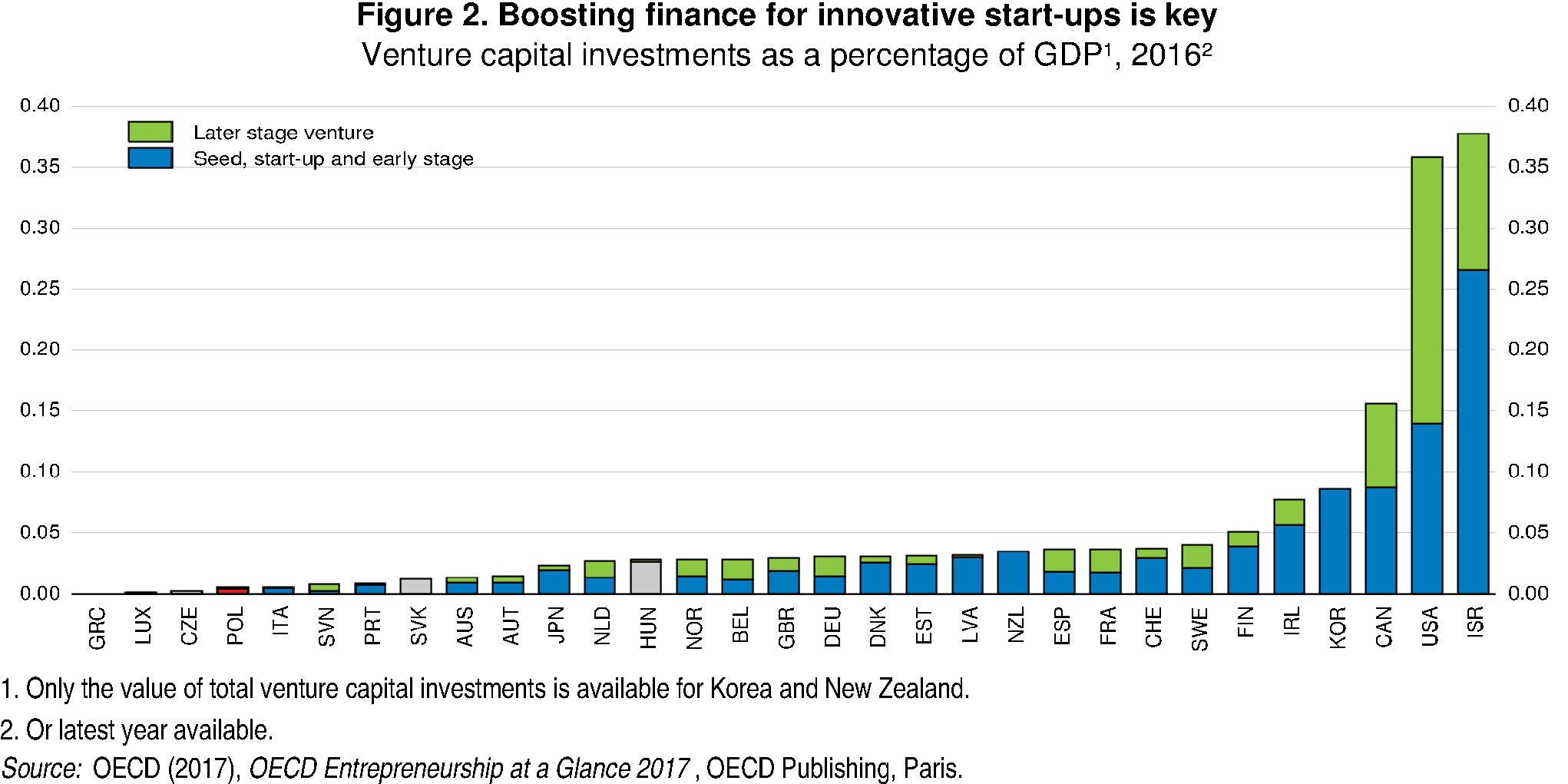
Zombie firms are more likely to be connected to weak banks, suggesting that zombie congestion partly stems from bank forbearance – i.e. the tendency for weak banks to bet on the resurrection of failing firms. This underscores the importance of a more aggressive policy to resolve non-performing loans, but this can only be truly effective if accompanied by complementary reforms to insolvency regimes. Distortions in the banking sector also highlight the importance of market-based financing instruments for productivity growth, with the inherent debt bias in corporate tax systems and the lack of venture capital financing emerging as key barriers to technological diffusion.

Finally, reforms that accelerate corporate restructuring should be coupled with policies to manage the social costs of worker displacement. Job search and retraining programs turn out to be effective in returning workers displaced by firm exit to work, particularly in environments where barriers to firm entry are low as this stimulates job creation.


References

Adalet McGowan, M., D. Andrews and V. Millot  (2017), “Confronting the Zombies: Policies for Productivity Revival“, OECD Economics Department Policy Papers, No. 21.

Andrews, D. and F. Petroulakis (2017), “Breaking the Shackles: Zombie Firms, Weak Banks and Depressed Restructuring in Europe”, OECD Economics Department Working Papers, No. 1433.

Adalet McGowan, M., D. Andrews and V. Millot  (2017), “Insolvency Regimes, Technology Diffusion and Productivity Growth: Evidence from Firms in OECD Countries“, OECD Economics Department Working Papers, No. 1425.

Adalet McGowan, M., D. Andrews and V. Millot (2017), “Insolvency regimes, zombie firms and capital reallocation”, OECD Economics Department Working Papers, No. 1399.

Adalet McGowan, M., D. Andrews and V. Millot (2017), “The Walking Dead?: Zombie Firms and Productivity Performance in OECD Countries”, OECD Economics Department Working Papers, No. 1372.

Andrews, D. and A. Saia  (2017), “Coping with creative destruction: Reducing the costs of firm exit“, OECD Economics Department Working Papers, No. 1353.

Adalet McGowan, M. and D. Andrews (2016), “Insolvency Regimes And Productivity Growth: A Framework For Analysis”, OECD Economics Department Working Papers, No. 1309.