Helping Americans Work Again

Douglas Sutherland, Senior Economist, US Desk, Economics Department.

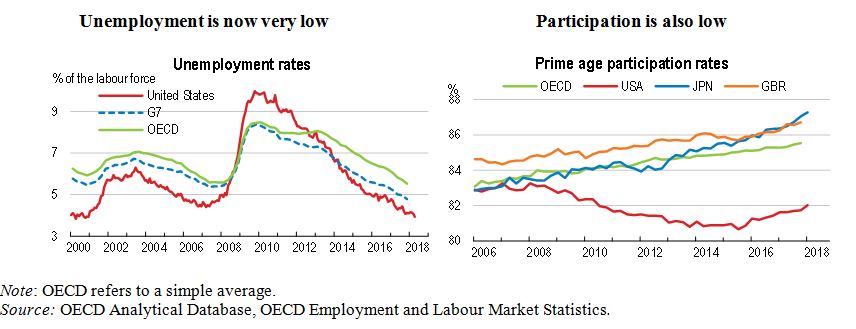
The economic expansion in the United States is now one of the longest on record, although it has been sluggish in comparison with previous recoveries. While job growth has reduced the unemployment rate to historically-low levels, many people still remain on the sidelines of the labour market, as shown by the low participation rates of prime age workers.

US1

The participation of women has increased, but many men remain out of the labour force. This is especially the case for young men with no college education and in states hit particularly hard by economic shocks, such as West Virginia where only 53% of working-age individuals participate (Varghese and Sutherland, 2018). Globalisation and automation have displaced workers, especially in the industrial heartland, and many of these workers have experienced difficulties in finding new employment. As they adjust only slowly to these shocks, these locations are characterized by high unemployment, low participation and poverty. This is partly explained by the limited amount of support provided to workers in the United States to find new jobs, compared to other OECD countries.

The interstate migration response to employment shocks, which contributed to the reallocation of workers to places with strong job growth, appears to have diminished during the past decade. Furthermore, these migration patterns show less of a population shift to urban agglomerations than elsewhere in the OECD. One factor contributing to this is that changing jobs has become more difficult over time. One of the constraints of interstate migration has been the availability of affordable housing, particularly in booming areas (Guichard, 2018). Restrictive zoning policies appear to be hindering the provision of more affordable housing, limiting employment opportunities and ultimately undermining growth. Sprawling cities can also make accessing jobs by public transport very difficult. Improving mass transit systems where appropriate would help improve accessibility and federal spending could be used to encourage States and localities to move towards mixed-use planning permissions to address housing affordability concerns.

US2.JPG

References:

Guichard, S. (2018), “The Decline in US Labour Force Participation: Some Insights from Regional Divergence”, OECD Economics Department Working Papers, Forthcoming.

OECD (2018), Economic Surveys: United States, OECD Publishing, Paris.

Varghese, N. and D. Sutherland (2018), “The Impact of Individual Characteristics on Labour Market Transitions: A Pseudo Panel Approach”, OECD Economics Department Working Papers, Forthcoming.


Stronger Growth but Risks loom large

By Álvaro S. Pereira, OECD Chief Economist ad interim, Economics Department

After a lengthy period of weak growth, the world economy is finally growing around 4%, the historical average of the past few decades.

This is good news. And this news is even better knowing that, in part, the stronger growth of the world economy is supported by a welcome rebound in investment and in world trade. The recovery in investment is particularly worth emphasising, since the fate of the current expansion will be highly dependent on how investment will perform.

Although long anticipated, the pick-up in investment remains weaker than in past expansions. The same is true for global trade, which is expected to grow at a respectable, albeit not spectacular, rate, unless it is derailed by trade tensions.

However, contrary to previous periods, 4% world growth is not due to rising productivity gains or sweeping structural change. This time around the stronger economy is largely due to monetary and fiscal policy support.

EO1.JPG

For many years, monetary policy was the only game in town. During the international financial crisis, central banks cut interest rates aggressively, injected funds into the economy and purchased assets at a record pace in an attempt to boost the economy.

In contrast, in most countries, fiscal policy remained prudent or even became contractionary. Still, historically low interest rates provided an opportunity for governments to use their available fiscal space to help foster growth, as the OECD argued forcefully in 2016. Many OECD governments are now following this advice. At first, the resources enabled by lower interest payments were used by governments to avoid cutting expenditures or raising taxes. With the improving economic situation, many governments have started to undertake additional fiscal easing.

Now that monetary policy is finally starting to return to normal, governments are stepping in to provide fiscal policy support. We can say that fiscal policy is the new game in town: three quarters of OECD countries are now undertaking fiscal easing. The fiscal stimulus in some countries is very significant, while it is less ambitious in other countries. Still, this fiscal easing will have important repercussions for the world economy. In the short run, it will add to growth. However, countries that have been experiencing longer expansions might find that this fiscal stimulus (where it is large) will also add to inflationary pressures in the medium term. Only time will tell if these short-run gains might be offset by some medium-term pain. What matters is that, in making these choices, governments are fully aware of the medium-term impact of their policies, and do not focus only on the short-term benefits from fiscal stimulus.

EO2

The strong growth we are witnessing is also associated with robust job creation in many economies. In fact, it is particularly satisfying to see that in the OECD area, unemployment is set to reach its lowest level since 1980, even though it remains high in some countries. Thanks to this robust job creation and the related intensifying labour shortages, we are now projecting a rise in real wages in many countries. This increase is still somewhat modest. However, there are clear signs that wages are finally on the way up. This is an important development, since the global crisis had a severe impact on household incomes, particularly for the unskilled and low-income workers.

EO3.JPG

In spite of all this good news, risks loom large for the global outlook. What are these risks? First and foremost, an escalation of trade tensions should be avoided. It is worth remembering that, in part, the rise in trade restrictions is nothing new. After all, more than 1200 new trade restrictions have been implemented by G20 countries since the outset of the global financial crisis in 2007. Still, as outlined in Chapter 2, since the world economy is much more integrated and linked today than in the past, a further escalation of trade tensions might significantly affect the economic expansion and disrupt vital global value chains.

Another important risk going forward is related to the rise in oil prices. Oil prices have risen by close to 50% over the past year. Persistently higher oil prices will push up inflationary pressures and will aggravate external imbalances in many countries.

In the past few years, very low interest rates have encouraged borrowing by households and corporations in some countries and led to overvaluation of assets (e.g. houses, equities) in many others. In this context, rising interest rates might be challenging for highly indebted countries, families and corporations. Of course, this rise in interest rates has been widely anticipated and should thus not cause any major disruptions. Nevertheless, if inflation rises more than expected and central banks are forced to raise rates at a faster pace, it is likely that market sentiment could shift abruptly, leading to a sudden correction in asset prices.

A swifter rise in interest rates in advanced economies might also continue to lead to significant currency depreciation and volatility in some emerging market economies (EMEs) that are highly reliant on external financing and facing internal or external imbalances. Geopolitical tensions might also contribute to sudden market corrections or a further rise in oil prices. Brexit and policy uncertainty in Italy could add pressures to the expansion in the euro area.

What does this all mean for policy? Since private and public debt remain high in some countries, improving productivity, decreasing debt levels and building fiscal buffers is key to strengthen the resilience of economies. As monetary and fiscal policies will not be able to sustain the expansion forever and might even contribute to financial risks, it is absolutely essential that structural reforms become a priority. In the past couple of years, few countries have undertaken substantial structural reforms. Most of the countries that reformed are large EMEs, such as Argentina, Brazil and India. In the advanced economies, important labour reforms were introduced in France and a sweeping tax reform was implemented in the United States. However, as the 2018 OECD Going for Growth points out, these important exceptions do not counter the rule that reform efforts have been lagging.

Why is this important? Because the only way to sustain the current expansion and to make growth work for all is to undertake productivity-enhancing reforms. As many OECD Education Policy Reviews and OECD National Skills Strategies show, it is crucial to redesign curricula to develop the cognitive, social and emotional skills that enable success at work, and to improve teaching quality and the resources necessary to deliver those skills effectively. In many countries, investment in quality early childhood education and vocational education and apprenticeships are of particular importance. Skills-enhancing labour-market reforms are also crucial. Reforms to boost competition, improve insolvency regimes, reduce barriers to entry in services and cut red tape are also key for making our economies more dynamic, more inclusive and more entrepreneurial. Investment in digital infrastructure will also be essential in this digital age. In addition, there are significant opportunities to reduce trade costs in both goods and, in particular, services, boosting growth and jobs across the world.

In spite of stronger growth, there is no time for complacency. Structural reforms are vital to sustain the current expansion and to mitigate risks. Therefore, at this juncture of the world economy, it is truly crucial to give reforms a chance. After monetary and fiscal policies have done their jobs, it is time for reforms to sustain the expansion, to improve well-being, and to make growth work for all.

References

Economic Outlook, May 2018.


La croissance s’affermit, mais des risques assombrissent fortement l’horizon

Álvaro S. Pereira, Chef économiste de l’OCDE par intérim, Département des affaires économiques

Après une longue période de croissance atone, l’activité économique mondiale croît enfin au rythme d’environ 4 %, qui correspond à la moyenne historique des dernières décennies.

C’est une bonne nouvelle, et qui apparaît encore meilleure lorsque l’on sait que ce rebond de la croissance de l’économie mondiale est, pour partie, le résultat d’un redémarrage opportun de l’investissement et des échanges mondiaux. La reprise de l’investissement mérite tout particulièrement d’être soulignée, sachant que l’avenir de l’expansion actuelle dépendra fortement de l’évolution de l’investissement.

Bien qu’anticipé depuis longtemps, le redressement de l’investissement demeure plus timide que lors des phases d’expansion passées. Il en va de même pour les échanges mondiaux, dont on attend qu’ils progressent à un rythme respectable, sans toutefois être spectaculaire, à moins que des tensions commerciales ne viennent les mettre en péril.

EO1.JPG

Cependant, contrairement à ce qui avait pu être observé précédemment, cette croissance mondiale de 4 % ne repose pas sur un accroissement des gains de productivité ou sur une évolution structurelle profonde. Cette fois, l’intensification de l’activité économique est dans une large mesure imputable au soutien procuré par les politiques monétaire et budgétaire.

Pendant de nombreuses années, la politique monétaire a été le seul levier utilisé. Durant la crise financière internationale, les banques centrales ont procédé à des réductions draconiennes des taux d’intérêt, elles ont injecté des fonds dans l’économie et acquis des actifs à un rythme sans précédent dans l’espoir de donner un coup de fouet à l’activité économique.

Dans la plupart des pays, en revanche, la politique budgétaire est restée guidée par la prudence, voire est devenue restrictive. Au demeurant, le niveau historiquement bas des taux d’intérêt offrait aux pouvoirs publics l’occasion d’employer la marge de manœuvre budgétaire dont ils disposaient pour contribuer à relancer la croissance, selon la position défendue avec force par l’OCDE en 2016. Un grand nombre de pays de l’OCDE suivent désormais ce conseil. Dans un premier temps, les États ont utilisé les ressources dégagées par la diminution des versements d’intérêts pour éviter d’avoir à comprimer les dépenses ou à augmenter les impôts. La situation économique s’améliorant, nombre d’entre eux se sont désormais engagés sur la voie d’un nouvel assouplissement budgétaire.

Maintenant que la politique monétaire commence enfin à revenir à la normale, les pouvoirs publics s’emploient à soutenir l’activité par la politique budgétaire. On peut dire que la politique budgétaire est le levier qui a désormais la faveur des pouvoirs publics : les trois quarts des pays de l’OCDE s’engagent à présent sur la voie d’un assouplissement budgétaire. La relance budgétaire est très ample dans certains pays, et moins ambitieuse dans d’autres. Pourtant, cet assouplissement budgétaire aura des répercussions importantes sur l’économie mondiale. À court terme, il renforcera la croissance. Cependant, les pays ayant connu de plus longues périodes d’expansion s’apercevront peut-être que cette relance budgétaire (lorsqu’on lui donne de l’ampleur) accentue également les tensions inflationnistes à moyen terme. Seul le temps nous dira si les gains à court terme seront contrebalancés par des effets douloureux à moyen terme. Ce qui compte, c’est que les responsables de l’action gouvernementale, au moment de choisir telle ou telle option, soient pleinement conscients de l’impact à moyen terme de leurs politiques, et ne se bornent pas à considérer uniquement les avantages à court terme de la relance budgétaire.

EO2

La forte croissance que nous observons va également de pair avec une création d’emplois vigoureuse dans de nombreuses économies. De fait, il est particulièrement satisfaisant de constater que dans la zone OCDE, le chômage devrait atteindre son plus bas niveau depuis 1980, même s’il reste élevé dans certains pays. Compte tenu de la vitalité de la création d’emplois et de l’accentuation des pénuries de main‑d’œuvre qui en résulte, nous prévoyons désormais une progression des salaires réels dans de nombreux pays. Cette hausse est encore assez timide, mais on perçoit des signes indiquant clairement que les salaires sont enfin sur une pente ascendante. Il s’agit d’une évolution importante, sachant que la crise mondiale avait eu de graves effets sur les revenus des ménages, en particulier pour les travailleurs peu qualifiés et à faible revenu.

EO3.JPG

Malgré toutes ces bonnes nouvelles, des risques assombrissent fortement les perspectives mondiales. Quels sont-ils ? D’abord et avant tout, une escalade des tensions commerciales, qui doit être évitée. N’oublions pas que, pour une part, un recours accru à des restrictions commerciales n’a rien de nouveau. La preuve en est que plus de 1 200 restrictions nouvelles ont été instituées par des pays du G20 depuis que la crise financière mondiale a éclaté en 2007. Au demeurant, comme indiqué dans le chapitre 2, parce que l’économie mondiale est beaucoup plus intégrée et interconnectée aujourd’hui que par le passé, une nouvelle escalade des tensions commerciales pourrait porter gravement atteinte à l’expansion de l’activité économique et déclencher des perturbations dans des chaînes de valeur mondiales essentielles.

Un autre risque important est lié à l’envolée des cours du pétrole. Ceux-ci ont augmenté de près de 50 % au cours de l’année écoulée. La persistance de cette tendance intensifiera les tensions inflationnistes et accentuera les déséquilibres extérieurs dans nombre de pays.

Ces dernières années, le niveau très bas des taux d’intérêt a encouragé les ménages et les entreprises à recourir à l’emprunt dans certains pays et a abouti à une surévaluation des actifs (notamment des logements et des actions) dans beaucoup d’autres. Dans ce contexte, un relèvement des taux d’intérêt pourrait mettre en difficulté les pays, les familles et les entreprises lourdement endettés. Certes, cette augmentation des taux d’intérêt a été largement anticipée et ne devrait donc pas induire de perturbations majeures. Néanmoins, si l’inflation augmente davantage que prévu et si les banques centrales sont contraintes de relever plus rapidement les taux d’intérêt, les perceptions sur les marchés pourraient s’inverser brusquement et conduire à un ajustement brutal des prix des actifs.

Une remontée plus rapide des taux d’intérêt dans les économies avancées pourrait également entraîner encore d’importants phénomènes de volatilité et de dépréciations des monnaies dans certaines économies de marché émergentes qui sont très tributaires des financements extérieurs et sont confrontées à des déséquilibres internes et externes. Les tensions géopolitiques pourraient également favoriser de brusques corrections du marché ou un nouvel essor des cours du pétrole. Le Brexit et l’incertitude autour de l’action gouvernementale qui sera menée en Italie ne font qu’ajouter aux pressions qui pèsent sur l’expansion dans la zone euro.

Que faut-il en déduire pour l’action publique ? Parce que la dette publique et la dette privée demeurent élevées dans certains pays, il est primordial de rehausser la productivité, de faire baisser les niveaux d’endettement et de constituer des marges de manœuvre budgétaires pour renforcer la résilience des économies. Étant donné que les politiques monétaire et budgétaire ne permettront pas d’alimenter indéfiniment l’expansion et pourraient même contribuer à accroître les risques financiers, il est absolument essentiel que la priorité soit donnée aux réformes structurelles. Ces dernières années, rares sont les pays qui ont engagé des réformes structurelles d’envergure. La plupart de ceux qui ont mené des réformes sont de grandes économies de marché émergentes, comme l’Argentine, le Brésil et l’Inde. Du côté des économies avancées, une importante réforme du travail a été adoptée en France et une réforme fiscale de grande ampleur est entrée en vigueur aux États-Unis. Cependant, comme souligné dans l’édition 2018 d’Objectif croissance, ces exceptions notables n’empêchent pas que les réformes ont pris du retard.

Pourquoi est-ce important ? Parce que le seul moyen d’entretenir l’expansion actuelle et de faire en sorte que la croissance bénéficie à tous consiste à entreprendre des réformes destinées à améliorer la productivité. Comme le montre l’OCDE dans de nombreux Examens des politiques nationales d’éducation et Stratégies nationales sur les compétences, il est primordial de repenser les cursus pour développer les compétences cognitives, sociales et émotionnelles indispensables à la réussite dans le monde du travail, et d’améliorer la qualité de l’enseignement ainsi que les ressources nécessaires pour favoriser une acquisition efficace de ces compétences. Dans beaucoup de pays, l’investissement dans une éducation de qualité pour les jeunes enfants ainsi que dans l’enseignement professionnel et l’apprentissage revêt une importance particulière. Il est en outre capital d’entreprendre des réformes du marché du travail propres à améliorer les compétences. Des réformes axées sur l’intensification de la concurrence, l’amélioration des régimes de faillite, l’abaissement des obstacles à l’entrée dans les secteurs de services et la simplification des procédures administratives sont aussi des ingrédients essentiels pour que nos économies deviennent plus dynamiques, plus inclusives et plus propices à l’entrepreneuriat. Les investissements dans les infrastructures numériques seront aussi fondamentaux à l’ère du numérique. Par ailleurs, il existe de vastes possibilités de réduction des coûts commerciaux sur les marchés de biens mais aussi et surtout de services, laissant entrevoir des perspectives de croissance et de création d’emplois dans le monde entier.

Malgré le regain de croissance, l’heure n’est pas à l’excès de confiance. Les réformes structurelles sont la clé de la poursuite de l’expansion actuelle et de l’atténuation des risques. C’est pourquoi, à ce point de bascule pour l’économie mondiale, il est véritablement capital de donner une chance aux réformes. Les politiques monétaire et budgétaire ayant rempli leur office, le moment est venu de faire en sorte que les réformes prennent le relais et qu’elles concourent à soutenir l’expansion, à améliorer le bien-être et à produire une croissance bénéfique pour tous.

Références

Perspectives économiques, mai 2018.


Un Mayor crecimiento, aunque se advierten importantes riesgos

Álvaro S. Pereira, Economista Jefe interino, Departamento de Economía de la OCDE

Después de un largo período de débil crecimiento, la economía mundial finalmente está creciendo alrededor del 4%, cercano al promedio histórico de las últimas décadas.

Esta es una buena noticia, y es aún mejor sabiendo que, en parte, el mayor crecimiento de la economía mundial está respaldado por una recuperación positiva de la inversión y del comercio mundial. Cabe destacar especialmente la recuperación de la inversión, ya que el futuro de la actual expansión dependerá en gran medida del buen comportamiento de la inversión.

Aunque se esperaba desde hace mucho tiempo, el repunte de la inversión sigue siendo más débil que en expansiones anteriores. Lo mismo ocurre con el comercio mundial, que se espera crezca a un ritmo aceptable, aunque no espectacular, a menos que se vea frenado por las tensiones comerciales.

Sin embargo, a diferencia de períodos anteriores, el crecimiento mundial del 4% no se debe al aumento de la productividad ni a un cambio estructural radical. Esta vez, el fortalecimiento de la economía se debe en gran medida al apoyo de la política monetaria y fiscal.

EO1.JPG

Durante muchos años, la política monetaria fue la única carta sobre la mesa. Durante la crisis financiera internacional, los bancos centrales recortaron de manera drástica los tipos de interés, inyectaron fondos en la economía y compraron activos a un ritmo récord en un intento por impulsar la economía.

En cambio, en la mayoría de los países, la política fiscal siguió siendo prudente o incluso se contrajo. No obstante, los tipos de interés históricamente bajos brindaron a los gobiernos la oportunidad de utilizar el espacio fiscal disponible para ayudar a fomentar el crecimiento, como firmemente argumentó la OCDE en 2016. Muchos gobiernos de la OCDE siguen ahora esta recomendación. En un principio, los recursos habilitados por la reducción de los pagos de intereses fueron utilizados por los gobiernos para evitar recortar gastos o aumentar los impuestos. Con la mejora de la situación económica, muchos gobiernos han comenzado a emprender una relajación fiscal adicional.

Ahora que la política monetaria está finalmente empezando a volver a la normalidad, los gobiernos están interviniendo para proporcionar apoyo con la política fiscal. Podemos decir que la política fiscal es la nueva carta que se añade a la partida: tres cuartas partes de los países de la OCDE están llevando a cabo una relajación fiscal. El estímulo fiscal en algunos países es muy significativo, mientras que en otros es menos ambicioso. No obstante, esta relajación fiscal  tendrá  importantes repercusiones para la economía mundial. A corto plazo, contribuirá al crecimiento. Sin embargo, los países que han experimentado expansiones más prolongadas podrían encontrarse con que este estímulo fiscal (en los casos en que es importante) también se sumará a las presiones inflacionarias a medio plazo. Sólo el tiempo dirá si las ganancias de corto plazo podrían verse compensadas por impactos  negativos  de medio plazo. Lo que importa es que, al tomar estas decisiones, los gobiernos sean plenamente conscientes del impacto a medio plazo de sus políticas, y no se centren únicamente en los beneficios de corto plazo de los estímulos fiscales.

EO2

El fuerte crecimiento que estamos presenciando también está asociado a una fuerte creación de empleo en muchas economías. De hecho, es especialmente satisfactorio comprobar que en los países de la OCDE el desempleo va a alcanzar su nivel más bajo desde 1980, aunque en algunos países sigue siendo elevado. Gracias a esta sólida creación de empleo y a la consiguiente intensificación de la escasez de mano de obra, ahora se prevé un aumento de los salarios reales en muchos países, a pesar de que este aumento es todavía modesto. Sin embargo, hay señales claras de que los salarios están finalmente aumentando. Se trata de un acontecimiento importante, ya que la crisis mundial tuvo un grave impacto en los ingresos de los hogares, en particular de los trabajadores no cualificados y de bajos ingresos.

EO3.JPG

A pesar de todas estas buenas noticias, se advierten importantes riesgos en el panorama mundial. ¿Cuáles son estos riesgos? Ante todo, debe evitarse un aumento de las tensiones comerciales. Es importante recordar que, en parte, el aumento de las restricciones comerciales no es nada nuevo. Después de todo, los países del G20 han implementado más de 1.200 nuevas restricciones al comercio desde el inicio de la crisis financiera mundial en 2007. No obstante, como se señala en el Capítulo 2, dado que la economía mundial está mucho más integrada e interconectada hoy que en el pasado, una mayor escalada de las tensiones comerciales podría afectar significativamente la expansión económica y perturbar las vitales cadenas de valor mundiales.

Mirando hacia el futuro, otro riesgo importante está relacionado con el aumento de los precios del petróleo que han aumentado cerca del 50% en el último año. Esta persistente subida incrementará las presiones inflacionarias y agravará los desequilibrios externos en muchos países.

En los últimos años, los extremadamente bajos tipos de interés han alentado el endeudamiento de los hogares y las empresas en algunos países, y han dado lugar a la sobrevaloración de activos (por ejemplo, viviendas, acciones) en muchos otros. En este contexto, los crecientes los tipos de interés podrían ser un reto para los fuertemente endeudados países, familias y empresas. Además, esta subida de los tipos de interés se ha anticipado ampliamente y, por lo tanto, no debería causar ninguna perturbación importante. Sin embargo, si la inflación aumenta más de lo previsto y los bancos centrales se ven obligados a subir los tipos de interés a un ritmo más rápido, es probable que la confianza del mercado cambie bruscamente, dando lugar a una repentina corrección de los precios de los activos.

Una subida más rápida de los tipos de interés en las economías avanzadas también podría seguir provocando una depreciación significativa de la moneda y volatilidad en algunas economías emergentes (EMEs) ya que dependen en gran medida de la financiación externa y se enfrentan a desequilibrios internos o externos. Las tensiones geopolíticas también podrían contribuir a correcciones repentinas del mercado o a una nueva subida de los precios del petróleo. Brexit y la incertidumbre política en Italia podrían añadir presiones a la expansión en la zona del euro.

¿Qué significa todo esto para la política? Dado que la deuda pública y privada sigue siendo elevada en algunos países, la mejora de la productividad, la disminución de los niveles de deuda y la creación de amortiguadores fiscales son clave para fortalecer la resiliencia de las economías. Puesto que las políticas monetaria y fiscal no podrán sostener la expansión de manera permanente e incluso podrían acentuar los riesgos financieros, es absolutamente esencial que las reformas estructurales se conviertan en una prioridad. En los últimos dos años, pocos países han emprendido reformas estructurales sustanciales. La mayoría de los países que aplicaron reformas son grandes EMEs, como Argentina, Brasil e India. En las economías avanzadas, se introdujeron importantes reformas laborales en Francia, y se aplicó una amplia reforma fiscal en los Estados Unidos. Sin embargo, como señala la publicación de la OCDE Going for Growth, de 2018, éstas importantes excepciones no contradicen la regla de que los esfuerzos de reforma han sido rezagados.

¿Por qué es esto importante? Porque la única manera de mantener la expansión actual y hacer que el crecimiento funcione para todos es emprender reformas que aumenten la productividad. Como demuestran numerosos estudios de la OCDE sobre la revisión de políticas educativas (Education Policy Reviews) y las estrategias nacionales de la OCDE en materia de competencias (National Skills Strategies), es fundamental rediseñar los planes de estudio para desarrollar las competencias cognitivas, sociales y emocionales que permiten el éxito en el trabajo, y mejorar la calidad de la enseñanza y los recursos necesarios para impartir esas competencias de manera eficaz. En muchos países, la inversión en educación de calidad para la primera infancia, la formación profesional y los programas de aprendices revisten especial importancia. También son cruciales las reformas del mercado laboral que mejoren las habilidades. Las reformas para impulsar la competencia, mejorar los regímenes de insolvencia, reducir los obstáculos a la entrada en el sector de los servicios y reducir la burocracia también son fundamentales para hacer que nuestras economías sean más dinámicas, más incluyentes y más emprendedoras. La inversión en infraestructura digital también será esencial en esta era digital. Además, existen importantes oportunidades para reducir los costes del comercio de bienes y, en particular, de los servicios, impulsando el crecimiento y el empleo en todo el mundo.

A pesar de un crecimiento más fuerte, no hay tiempo para la autocomplacencia. Las reformas estructurales son vitales para mantener la expansión actual y mitigar los riesgos. Por lo tanto, en esta coyuntura de la economía mundial, es realmente crucial dar una oportunidad a las reformas. Después de que las políticas monetarias y fiscales hayan cumplido sus objetivos, es hora de que las reformas sostengan la expansión, mejoren el bienestar y hagan que el crecimiento funcione para todos.

Referencias

Perspectivas económicas OCDE, mayo 2018.


Sustainably financing pensions and healthcare in Thailand

By Adam Bogiatzis, Economist, South East Asia Desk, Economics Department.

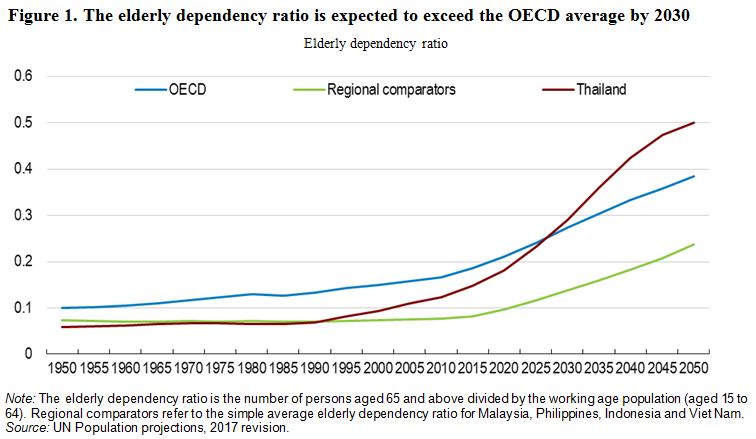
Thailand has made remarkable socio-economic progress over the past several decades. Poverty has plummeted and access to education and health services has become near universal. As is commonly the case, improved health outcomes and expanded opportunities – particularly for women – have led to higher life expectancy, a declining fertility rate and ultimately an ageing population. However, the rate of Thailand’s ageing is exceptional, particularly given its stage of development. Indeed, Thailand’s elderly dependency ratio far exceeds that of other emerging economies in the region (including Indonesia, the Philippines, Malaysia and Viet Nam) and is expected to surpass the OECD average by 2030 (Figure 1).

Thailand 3.JPGWith a rapidly ageing population, the public burden to provide social pensions (which will need to increase to improve very low replacement ratios and safeguard against elderly poverty) and healthcare will grow considerably. Indeed, the Initial Assessment Report of the Multi-dimensional Review of Thailand notes that although Thailand’s current fiscal position is healthy, structural reforms to the pension and healthcare systems are needed to ensure fiscal sustainability (OECD, 2018).
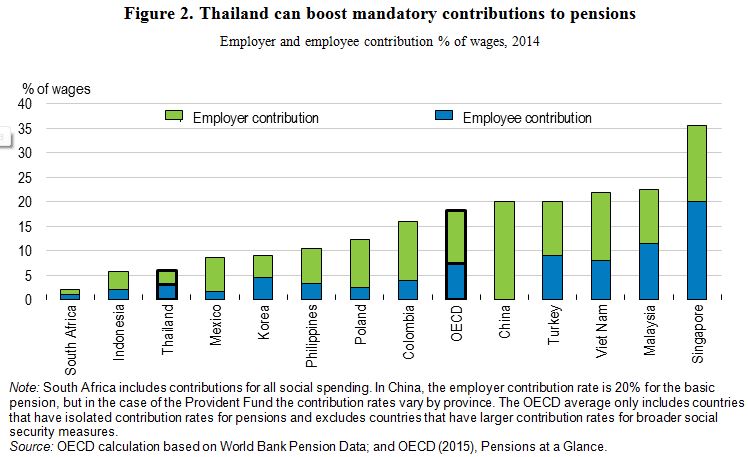
On pensions, Thailand’s shrinking labour force and longer retirements mean there are fewer work years available to support the burgeoning number of retirees. As a first step, the pensionable age of the private pension scheme (55 years and over) should be aligned with the public sector and the social pension scheme (60 years and over), with transitional arrangements put in place for current or imminent retirees. Moreover, consideration should be given to progressively raising the official retirement age in line with life expectancy. Indeed postponing retirement is an efficient way to both raise retirement income and improve financial sustainability (OECD, 2017). Thailand should also gradually increase the mandated private sector contribution rate (i.e. the share of wages mandatorily contributed to a pension fund). Under the national private pension fund, employers and employees combined contribute 6% of wages. This is below the contribution rates for comparator countries and the OECD average (Figure 2).

Thailand 3 bis.JPGIn healthcare, Thailand should avoid near-term regressive and often ineffective blanket cuts to the health budget and instead implement targeted structural reforms that will be beneficial over the longer run. For example, to prevent overburdening of hospitals, Thailand should increase health provision through preventive and primary care by boosting the number of family physicians and general practitioners, particularly in rural areas. Healthcare financing should also be reformed by reducing the exemptions on co-payments and allowing greater private contributions from those able to afford it.
Tax revenues are, and will continue to be, the dominant source of finance for Thailand’s pension and healthcare systems. The government provides an old-age allowance to 82% of people aged over 60 and accounts for 78% of total healthcare expenditure – a share higher than the OECD average and regional comparator countries including Indonesia, Malaysia, the Philippines and Viet Nam. Therefore, a complementary set of reforms that boost revenue is needed. In this regard, Thailand needs to broaden the tax base whilst improving efficiency by relying more heavily on less distortive taxes such as those on consumption, property and inheritances. Moreover, the government should continue its efforts to improve collection efficiency by easing compliance through technological innovation, providing incentives that discourage tax avoidance and informality, and strengthening enforcement on tax evasion.

References

OECD (2018), Multi-dimensional Review of Thailand: Volume 1. Initial Assessment, OECD Development Pathways, OECD Publishing, Paris.
OECD (2017a), Pensions at a Glance 2017: OECD and G20 Indicators, OECD Publishing, Paris.
OECD (2015), Pensions at a Glance 2015: OECD and G20 Indicators, OECD Publishing, Paris.


Thailand is advancing in participatory and evidence-based regulatory reform

By Hidekatsu Asada, Head of South East Asia Desk, and Abu Zeid Mohd Arif, Economist, South East Asia Desk, Economics Department

Reforming the public sector, long a priority for Thailand, involves several challenges. Among these, insufficient public participation in policy-making is undermining the efficient allocation of resources toward public needs and development goals. Additionally, the under-development of evidence-based regulations hampers the creation of a business-friendly environment essential for higher value-added activities. Thailand has undertaken reforms to address these issues by adopting OECD guidelines on promoting public consultation in policy-making and strengthening regulatory impact assessment (RIA), as documented in the Initial Assessment Report of Thailand’s Multi-dimensional Country Review (OECD, 2018).

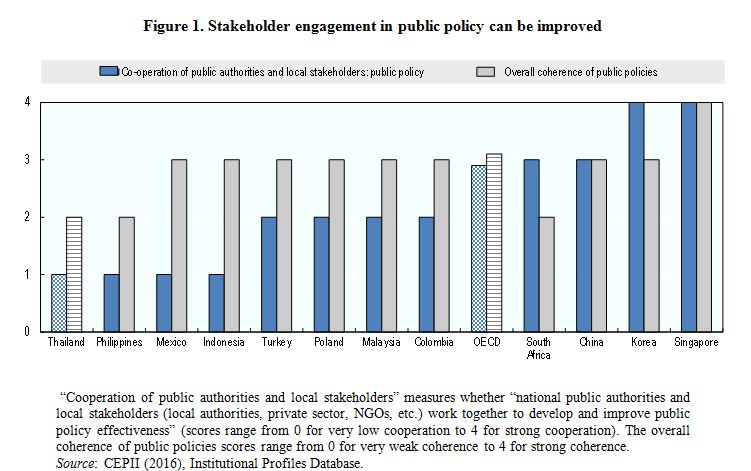
Nevertheless, further improvement is needed. Thailand still ranks behind most comparators in terms of co-operation between local stakeholders and bureaucratic efficacy in developing and improving public policies (Figure 1). Insufficient public consultation continues to hamper the effective and efficient delivery of public services, particularly in rural areas. This is partly due to Thailand’s highly centralised, Bangkok-centric, governance structure.

Thailand 4.JPG
To address these issues, Thailand has released Public Consultation Guidelines to help government officials carry out public consultations with relevant stakeholders (NESDB, 2016a). The guidelines take into consideration the OECD Guiding Principles for Public Consultation, which highlight the need for active participation early in the policy process (OECD, 2001). While this is welcome, it is vital to ensure that the guidelines are actively followed across ministries and agencies.

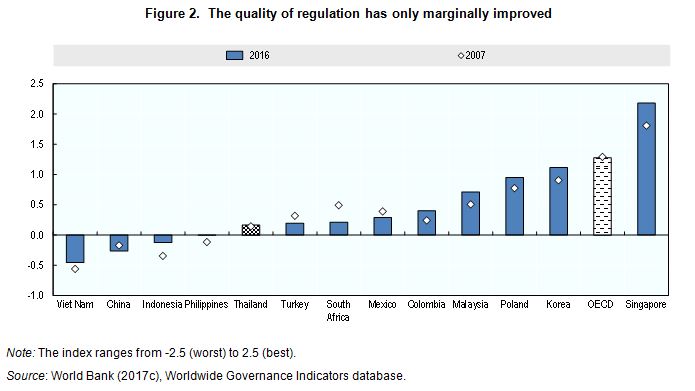
Thailand also needs to boost regulatory quality. Measured by the perception of the government’s ability to formulate and implement sound policies and regulations that permit and promote private sector development, it has only scantly improved over the past decade, when measured against regional comparators (Figure 2).

Thailand 4 bis.JPG
Against this backdrop, the government has stepped up regulatory reform efforts to foster a more business-friendly environment. To improve regulatory effectiveness, Thailand has beefed up its RIA laws. In the early 2000s, legislation was introduced to implement mandatory RIAs which are in line with the OECD Reference Checklist for Regulatory Decision-Making (OECD, 1995). However, compliance has remained weak owing to the lack of a dedicated agency to scrutinise RIA reports. Moreover, RIAs insufficiently cover subordinate laws, guidelines are underdeveloped, there is limited capacity among officials to conduct RIAs and insufficient consultation with stakeholders.

Under the new 2017 Constitution, RIA laws were strengthened ensuring mandatory consultation with stakeholders prior to the introduction of new regulations, and broadening coverage to subordinate laws. The government also published a set of guidelines in 2016 to improve public awareness and the capacity of officials to conduct RIAs (NESDB, 2016b). The guidelines include the standard format for RIAs and the procedure for stakeholder consultations. Moving forward, RIAs could be further expanded to include ex-post analysis after implementation of the regulations.

References

NESDB (2016a), Public Consultation Guidelines, Office of the National Economic and Social Development Board, Bangkok.
NESDB (2016b), Regulatory Impact Analysis Guidelines For The Thailand Government, Office of the National Economic and Social Development Board, Bangkok.


Boosting export performance in Chile

by Antoine Goujard, Chile Desk, Economics Department

Chile’s export growth has disappointed over the past two decades. In particular, exports of goods and services – in volume – have only grown at 1.1% annually over 2009-17 and at around 2.0% for non-copper products and services, compared to 4.2% in the average Latin American country (Panels A and B).

Chile’s weak export performance reveals structural weaknesses. Beyond copper and copper-related products that are highly dependent on external demand, export growth has been weak in manufacturing and services sectors. At the same time, with low investment in innovation and skills, productivity gains have stalled (Panel C). Exports remain mostly natural-resource based (Panel D) and highly concentrated across products, firms and destinations, with SMEs participating little in international trade.

To enhance inclusive growth potential decisive policy efforts are needed to improve productivity and competitiveness, and broaden the export base. The 2018 OECD Economic Survey shows that while the implementation of the 2014-18 Productivity Agenda and measures to raise the efficiency of electricity markets have been positive steps, more efforts are needed to raise productivity in four key areas:

  1. Strengthening competition. Perceived market dominance that tends to reduce efficiency and raise rents, is among the worst in the OECD. Competition is limited in key sectors, such as telecommunications, maritime services and railways. The recent strengthening of the competition framework is welcome, but systematic reviews of competitive pressures are needed. Moreover, the guidelines issued by the OECD (2016b) should be used to review existing regulations from a competition perspective according to a set schedule, and pro-competitive and streamlining measures should be implemented rapidly.
  2. Simplifying the business environment. Administrative procedures, such as licenses and permits, are burdensome, notably for smaller and younger firms complicating entry of new businesses. Streamlining unnecessary and complex regulations would allow substantial productivity gains. Improving the digital procedures for firms (Escritorio Empresa), and focusing on ex-post controls for businesses that have low associated sanitary and environmental risks, would ease firm creation and growth. On the trade side, simplifying regulations of preferential trade agreements would help SMEs to go global. Going forward, the regulatory process should build on all stakeholders and strengthened ex-ante and ex post evaluations such as the new productivity assessments (OECD, 2016a).
  3. Increasing innovation and skills. Business investment in R&D and innovation is particularly weak, while entrepreneurial and managing skills are low and unequal. Increasing public support for R&D and innovation, and strengthening its evaluation, would help develop public-private links and ease R&D financing for SMEs. Additional technical assistance and mentoring for young and smaller firms, building on the recent Centros de Desarrollo de Negocios, would also support firm growth, innovation and access to export markets.
  4. Improving logistic and digital infrastructure. Investment in intermodal connections, railways and digital networks is needed to bridge connectedness gaps (OECD, 2017b). Developing national and local infrastructure strategies, integrating the regulation of public and private ports and better accounting for environmental damages in transport taxes and road pricing would ensure money is well spent. Fully integrating the single window mechanism for exports and imports (SICEX) with the domestic logistic infrastructure and with regional partners would deliver significant synergies and gains for exports.

xports and chile 2018

Find out more:

OECD (2018), OECD Economic Surveys: Chile 2018, OECD Publishing.

OECD (2017a), OECD Economic Outlook (November 2017), OECD Publishing.

OECD (2017b), Infrastructure Governance Review: Chile – Gaps and governance standards of public infrastructure, OECD publishing.

OECD (2016a), OECD Reviews of Regulatory Reform – Regulatory Policy in Chile, Government Capacity to Ensure High –Quality Regulation, OECD Publishing.

OECD (2016b), Competition Assessment Toolkit – Volume I: Principles, OECD Publishing.

Goujard, A. (2018), “Boosting export performance in Chile”, OECD Economics Department Working Papers, forthcoming, OECD Publishing.


Achieving an inclusive and sustainable recovery in Greece

by Mauro Pisu and Tim Bulman, Greece Desk, Economics Department

Greece is finally recovering from a deep depression. In 2017 GDP expanded by 1.3%, according to initial estimates, and is projected to accelerate to 2% in 2018 and 2.3% in 2019 (Figure 1). Labour market reforms have improved competitiveness and exports are leading the expansion. Overall the economy is becoming more open. Exports rose from 24% of GDP in 2008 to 34% in 2017. Employment is rising strongly while the external and fiscal imbalances are being addressed. Public finances are outperforming European Stability Mechanism (ESM) Stability Support programme’s targets, helping to restore fiscal credibility. Financial markets are taking notice, with bond spreads falling and agencies upgrading their ratings of Greece’s public debt.

Greece1.JPG

Despite these positive developments, the long crisis has left deep scars in the society that have yet to heal. GDP per capita is still 25% below its pre-crisis level. The public debt is still high. Wages are low. Though poverty has stabilised, it remains near a record high, especially among the young and families.

The OECD’s 2018 Economic Survey of Greece suggests that maintaining the reform momentum and strengthening reform ownership will be essential to sustaining the recovery and moving towards a more inclusive and prosperous society. Keeping the reform momentum is crucial to tackle the three key challenges highlighted in the 2018 Survey: Improving debt sustainability, sustaining job growth and reducing poverty, boosting investment.

The public debt has stabilised but at about 175% of GDP is still one of the largest in the world. A three-pronged strategy would place this on a downward path for the long-term (Figure 2). This includes: additional pro-growth reforms; large but realistic primary surpluses; and additional debt restructuring, as needed:

  • Pro-growth reforms, focusing on improving the functioning of public administration and product markets as well as boosting labour force participation, will do most to bolster long term GDP growth.
  • Maintaining the primary surplus above 2% of GDP into the long-term will be challenging but can be achieved through further broadening the tax base – by improving tax collection and reducing the informal economy – and improving spending effectiveness – by using spending reviews regularly and continuing the ambitious public administration reform.
  • As concerns debt restructuring, locking-in the currently low interest rates on concessional loans would reduce public debt below 80% of GDP by the 2050s, under prudent assumptions, if combined with additional pro-growth reforms.

Greece2.JPG

For Greece’s recovery to be inclusive, it must be rich in jobs. Greece’s recent labour market reforms have improved flexibility and supported job creation. However, over 1 million people are still unemployed, three-quarters for over a year. New jobs often pay the minimum wage, and are part-time or temporary. Reintroducing sectoral collective wage agreements should aim at maintaining the flexibility of the current system, ensuring wages align with productivity and better protecting individuals from labour market risks. They should cover broad working conditions and have no automatic extensions. Since small firms employ most workers, wage agreements need also to be flexible enough to take into account their specific circumstances.

The number of Greeks suffering from poverty doubled between 2010 and 2016, to almost 2.4 million on some measures, harming families with children the most. Recent reforms have already started to address this problem by better targeting social programmes. However, the many small and poorly targeted programmes and cumbersome administrative processes lower the effectiveness of and access to the welfare system. Progress towards better targeting social programmes and simplifying administrative processes should continue so as to create a fairer and more effective welfare system.

Investment has dropped by 60% since the onset of the crisis and has yet to recover, because of a mixture of weak demand, tight financial conditions and structural problems. The productive stock capital is now falling, dragging down GDP growth.

Recent reforms have already improved important areas of the investment climate, but Greece’s business environment still lags other countries. Further addressing product market restrictions, improving regulatory quality and transparency through Regulatory Impact Assessments, completing the land registry, and fully implementing the legislated insolvency reforms are priorities the OECD survey highlights.

Greece also needs to continue tackling the challenges facing its banking sector. Governance standards have improved drastically but these still need to become entrenched practices. Addressing the large stock of non-performing loans will require fully implementing out-of-court workout procedures and e-auctions, and strengthening temporary tax incentives to encourage the disposal of banks’ non-performing loans. Carefully phasing out capital controls, while preserving financial stability, will also be needed to restore access to finance.

References:

OCDE (2018) OECD Economic Surveys: Greece 2018 OECD Publishing.


A balancing act: Why inequality increased in the Nordics

Mr. Jon Pareliussen, Economist, Sweden/Finland desk, Economics Department

The Nordics are rightly renowned for being inclusive societies with low inequality compared to other OECD countries. However, some of the largest inequality increases over the past few decades took place in Sweden, Finland and Denmark. A newly released article  building on previous OECD work discusses how market forces, demographic trends and redistribution together shaped the income distribution of the Nordics.

It may seem like a paradox that the Nordics, which are very open economies, heavily integrated in global value chains and front-runners in the use of new technologies, have not seen even more widening distributions of market incomes. However, the extent to which skill-biased technological change and other forces widening the earnings distribution of workers will actually drive up inequality depends on a number of factors, and key policies and institutions in the Nordics play a dampening role. First, institutions such as unions and collective bargaining, employment protection legislation and minimum wages dampen the direct effect of market trends on earnings. Second, higher demand for skills are met by publicly-funded higher education, increasing the supply of skilled workers and thus holding back skills premiums. Third, a widening earnings distribution among workers coincided with increasing employment, limiting the overall effect on inequality.

Nordic1.JPG

With a relatively modest overall impact from market forces, explanations for increasing inequality must be sought elsewhere:

  • Demographic trends have been relatively strong drivers of inequality in the Nordics. Household structure, with more single-headed households has widened income dispersion in Denmark, Finland, Norway and Sweden. Ageing has increased inequality significantly in Finland, and immigration has increased inequality in Norway, Denmark and Sweden.
  • Redistribution through taxes and transfers has weakened significantly in Denmark, Finland and Sweden, notably due to less insurance transfers (i.e. unemployment, sickness, disability insurance) and only partially offset by more assistance (i.e. means-tested) transfers. Income taxes have played a less important and more heroegneous role, as progressivity increased in Sweden while it decreased in Denmark and Iceland.

Technological and demographic pressures are set to continue going forward, and these challenges need to be embraced. Continued flexibility and constructiveness of the social dialogue and improvements to education are essential to seize opportunities from technological change and avoid a widening wage distribution. Making social insurance and welfare transfers more flexible and agile would improve workers’ protection in a rapidly changing world of work. Improving benefit system design so that work always pays, notably in Denmark and Finland, and linking benefits to real-time income registries are important steps to this end.

The Nordics demonstrate that equity and efficiency can be compatible if incentives are right. Low inequality and strong safety nets can even be an advantage in today’s globalised world, which requires constant adaptation. Reaping the full benefits from globalisation and technological progress requires broad support, which is easier to muster when the social dialogue is constructive and representative, when everyone is given opportunities to fulfil their potential, risks are shared and losers compensated.

References:
Pareliussen, J. K., Hermansen, M., André, C. and Causa, O. (2018), Income Inequality in the Nordics from an OECD perspective, Nordic Economic Policy Review 2018.


Will the inflation genie escape the bottle? New evidence on globalisation, competition and inflation

By Dan Andrews, Peter Gal and William Witheridge, Economics Department

Markets and commentators are speculating that there may be a sustained pick-up in inflation in the United States, after years of subdued price pressures. Along with continued solid US jobs growth and low unemployment, there are tentative signs of higher wage growth and the fiscal stimulus will also boost short-term growth. Global growth is also getting stronger (OECD, 2018a).

As well as these recent developments, longer-term worldwide trends which have kept inflation generally low since the mid-1990s may also be reversing. In particular, globalisation appears to have stalled since the crisis, aggregate demand in strengthening and output gaps have closed or are generally close to zero in most major countries. Moreover, there is mounting evidence of rising market power in services sectors. Together, these trends risk letting the inflation genie out of the bottle.

Declining inflation in many countries over the past few decades at the same time as rising global competition has led to a debate on the importance of globalisation for domestic inflation. Auer, Borio and Filardo (2017) at the BIS have argued that rising GVC integration has accentuated the importance of global factors – particularly global economic slack – for domestic inflation. However, recent research at the ECB (Tagliabracci, Osbat and Koester, forthcoming) and at the US Federal Reserve (Yellen, 2017) has disputed this conjecture.

Figure 1 shows that global value chain (GVC) integration expanded significantly from 1995 until the crisis, while inflation remained relatively subdued. In the post-crisis period, GVCs flattened off and remained around the pre-crisis peak, while producer price inflation has fallen dramatically and remains very low on average across industries for our sample of countries.*

Figure 1

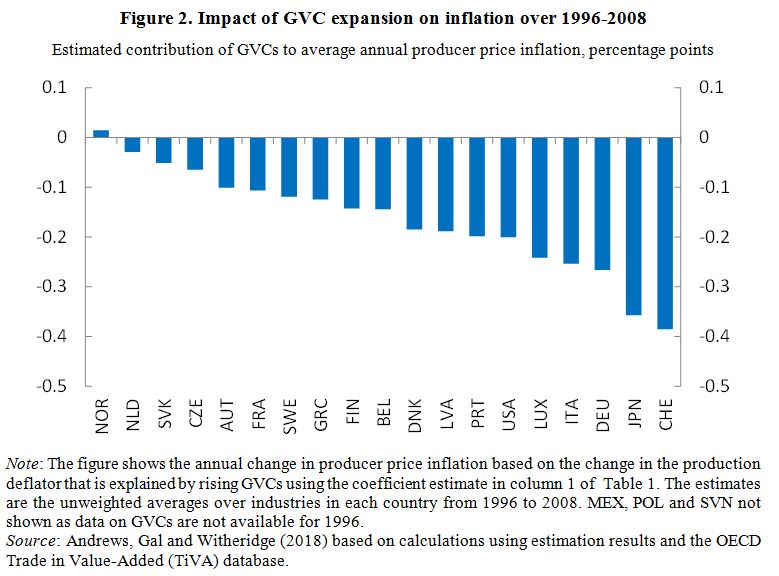
Motivated by this pattern, our new analysis of prices and globalisation (Andrews, Gal and Witheridge, 2018) goes beyond existing research by using recently released cross-country OECD data on prices and GVCs by industry, rather than at the country level, which allow us to control for time-varying country-specific and global shocks. We find that stronger Backward GVC Participation – that is, domestic producers relying more on foreign value added content – is associated with lower producer price inflation at the industry level. For example, we estimate that the rise in GVCs from the mid-1990s up to the crisis reduced annual producer price inflation by 0.15 percentage points on average, but this effect is more than double in some OECD countries (Figure 2).

Figure 2.JPG

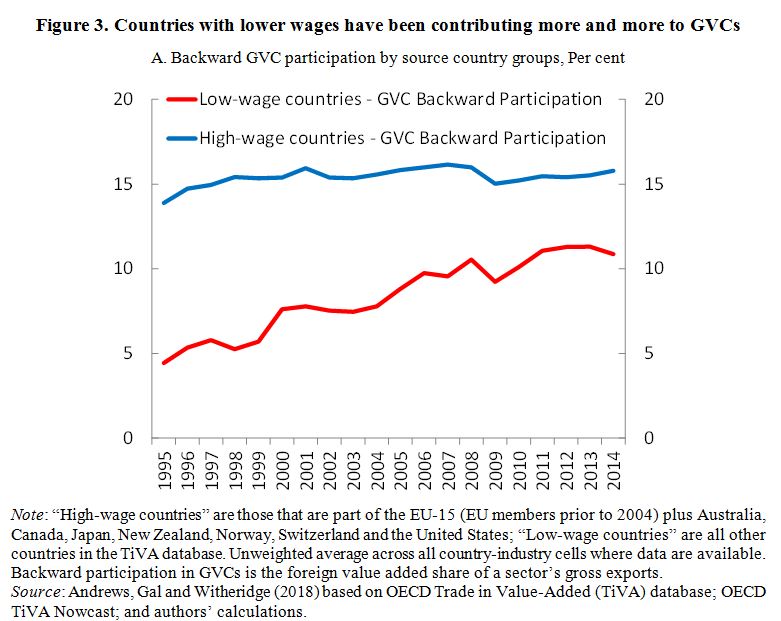
Confirming the existence of a cost-reduction and wage moderation channel, we also show that higher backward GVC participation is associated with lower wages and rising productivity in the importing countries and industries, especially when low-wage countries are integrated in their supply chains. This channel is likely to have contributed to lower inflation in recent years as the structure of the source (i.e. supplying) countries in GVCs has moved increasingly towards low-wage countries (Figure 3), despite a stall in the overall level of GVC integration (Figure 1). Therefore, inflation in advanced economies could remain low if the composition of GVCs continues to shift towards low-wage countries.

Figure 3.JPG

Moreover, we find that a high level of GVC integration can also dampen producer price inflation by accentuating the impact of global economic slack on domestic inflation. This provides new industry-level evidence to support the finding of Auer et al (2017) who use aggregate data covering the pre-crisis period. We show this by using a similar approach combining bilateral industry-level GVC and national output gap data to measure changes in global slack over time.

This implies that weak global demand has a larger disinflationary impact when GVC participation is higher. For example, given our sample of countries facing an average global output gap of -1.5 per cent in 2014, we estimate that annual producer price inflation was on average 0.25 percentage points lower in 2014 than for 1996 GVC levels. This figure is more than 0.5 percentage points, however, for countries that experienced a particularly large rise in GVC participation. But with slowing expansion of GVCs since the crisis, coupled with stronger aggregate demand and output gaps closing in most countries, this could lead to greater inflationary pressures in the medium term.

The third longer-term trend posing an upside risk to inflation is declining competition and market contestability. We exploit harmonised cross-country firm-level data to show an increasing trend in mark-ups, which suggests rising market power in services sectors (Figure 4). This upward trend in mark-ups is consistent with other estimates for the United States (De Loecker and Eeckhout, 2017) and other OECD countries (Calligaris et al, 2018). In turn, in these market services sectors we find a significant positive correlation between producer price inflation and mark-ups within industries since the early 2000s. This leads us to conjecture that if market power continues to rise it may pose a further risk to letting the inflation genie out of the bottle.

Figure 4.JPG
This analysis suggests that the expansion of GVCs facilitated by trade liberalisation and advances in technology has put downward pressure on producer prices, with potential implications for monetary policy. Looking forward, a continuation of the stalling globalisation observed since the crisis poses an upside risk to future inflation. This provides a further reason to resist the rising threat of trade protectionism in the global economy.

In addition, if more intense competition in product and labour markets contributed to global disinflation in over recent decades (Rogoff, 2003), then it follows that waning structural reform ambition (OECD, 2018b) – against the backdrop of strengthening global growth – could lead to inflationary pressures. Given the growing importance of ICT-based activities in the economy, as well as evidence of increasing market power in those industries, policy efforts to adapt anti-trust and pro-competitive market regulations to the digital age will not only bring benefits to long-run productivity growth but will also be desirable from a monetary policy perspective.

References:

Andrews, D.,  P. Gal and W. Witheridge (2018), “A Genie in a Bottle? Globalisation, Competition and Inflation”, OECD Economics Department Working Papers, No. 1462.

Auer, R., C. Borio and A. Filardo (2017), “The globalisation of inflation: The growing importance of global value chains”, BIS Working Papers, No. 602, January.

Calligaris, S., C. Criscuolo and L. Marcolini (2018), “Digital and market transformations”, OECD Science, technology and industry working papers, forthcoming.

De Loecker, J. and J. Eeckhout (2017), “The Rise of Market Power and the Macroeconomic Implications”, NBER Working Papers No. 23687.

* The sample of countries are: Austria, Belgium, Czech Republic, Denmark, Finland, France, Germany, Greece, Italy, Japan, Luxembourg, Latvia, Mexico, Netherlands, Norway, Poland, Portugal, Slovenia, Slovak Republic, Sweden, Switzerland and the United States.