by Jarmila Botev, Balázs Égert, Zuzana Smidova, David Turner, OECD Economics Department
Human capital is widely regarded as a fundamental input in the theoretical growth literature. Recommendations to boost it feature prominently among reform priorities for a great number of countries (Figure 1). Yet, paradoxically, quantifying the macroeconomic effects of human capital has often proven frustratingly elusive.
As this blogpost explains, in part this is due to the challenge of measuring human capital. A newly released OECD measure of human capital works well in productivity regressions, providing the “missing” link between growth and human capital.
Human capital can be defined as the stock of knowledge, skills and other personal characteristics of people that helps them to be productive. Such knowledge is gained in formal education (e.g. early childhood care, compulsory schooling and adult training programmes) but also informally, via on-the-job learning and work experience. Health also influences one’s productivity. Nevertheless, there is no widely accepted empirical measure that captures all these dimensions across many countries and over time.
The early macroeconomic growth literature used various quantitative measures of education as a proxy for human capital, including literacy rates or enrolment rates at various levels of education. More recent studies use mean years of schooling (average number of completed years of education of a country’s entire population). However, the link of these proxies to macroeconomic outcomes has generally been poor. A meta-analysis of 60 studies published over the period of 1989-2011 found that around 20% of the reported coefficient estimates on human capital have the “wrong” (negative) sign (Benos and Zotou, 2014). In a dozen of papers by Robert J. Barro, based on similar specifications, techniques and datasets, only about a half of the coefficient estimates is positive and statistically significant. Recent OECD studies confirm the difficulty of finding a robust positive effect of human capital on income per capita or productivity levels when looking at the OECD countries (Botev et al., 2019; Guillemette et al, 2017, Fournier and Johanson 2016).
And, this is the paradox, the widely accepted importance of human capital, but the difficulty of finding an empirically relevant measure of it — which our recent work addresses. The OECD’s newly released human capital measure combines an up-to-date dataset of mean years of schooling (the 2018 update of Goujon et al, 2016) with rates of return based on recent evidence on wage premia compiled mostly by the World Bank (Psacharopoulos and Patrinos, 2004; Montenegro and Patrinos, 2014). Unlike earlier studies, it applies different returns for five groups of countries and three periods. Including such measure of human capital in various macroeconomic productivity regressions yields significant and positive relationships that economists have been looking for.
Covid-19 (coronavirus) hit China at the start of December and outbreaks have spread more widely. The virus is bringing considerable human pain. It is also resulting in significant economic disruption from quarantines, restrictions on travel, factory closures and a sharp decline in many service sector activities.
The world economy is in its most precarious position since the global financial crisis.
Global growth, cooling for the past two years to a subdued level, has been dealt a nasty blow by the coronavirus. High frequency indicators such as coal demand, suggest the Chinese economy slowed sharply in the first quarter of 2020. As China accounts for 17% of global GDP, 11% of world trade, 9% of global tourism and over 40% of global demand of some commodities, negative spillovers to the rest of the world are sizeable. There is mounting evidence of sharp declines in tourism, supply chain disruptions, weak commodity demand and falling consumer confidence.
How far the epidemic spreads will determine economic prospects.
Even under a best-case scenario of containment to China and limited outbreaks in other countries as we see today, the OECD expects a sharp slowdown in world growth in early 2020. We have revised our projection for the year from an already low 3% in November to only 2.4%, lower than in any year since the financial crisis. In a downside-risk scenario where epidemics break out in some other countries across the globe, the slowdown will be sharper and more prolonged. Our modelling suggests that the level of world GDP would fall as low as 1.5% this year, halving the OECD’s previous 2020 projection from last November of 3%. Containment measures and fear of infection would hit production as well as spending hard and drive many of the epidemic affected countries into outright recession.
Governments cannot afford to wait.
Regardless of where the virus spreads, the world economy, previously weakened by persistent trade and political tensions, has already suffered a sharp setback. Households are uncertain and apprehensive. Firms in sectors such as tourism, electronics and automobiles are already reporting supply disruptions and/or a collapse in demand. The world economy is now too fragile for governments to gamble on an automatic sharp bounce-back.
Containing the epidemic and limiting cases of serious illness is the policy priority.
Limiting travel, quarantines and cancelling events are required to contain the epidemic. Increased government spending should be first directed to the health sector, tackling virus outbreaks and supporting research. Complementary policy action can at least mitigate the economic and social fallout.
Supporting vulnerable households and firms is essential.
Containment measures and the fear of infection can cause sudden stops in economic activity. Beyond health, the priority should be on allowing short-time working schemes and providing vulnerable households temporary direct transfers to tide them over loss of income from work shutdowns and layoffs. Increasing liquidity buffers to firms in affected sectors is also needed to avoid debt default of otherwise sound enterprises. Reducing fixed charges and taxes and credit forbearance would also help to reduce the pressure on firms facing an abrupt falloff in demand.
If the epidemic spreads outside China, the G20 should lead a coordinated policy response.
Countries should cooperate on support to health care in countries where it is needed, as well as on containment measures. In addition, if countries announced coordinated fiscal and monetary support, confidence effects would compound the effect of policies. This would help reverse the drubbing in confidence that a more widespread outbreak would provoke. It would also be more effective than working alone. Our work presented in the Economic Outlook 2019 shows that if G20 economies implement stimulus measures collectively, rather than alone, the growth effects in the median G20 economy will be 1/3 higher after just two years. Some would say it is trite to call for international cooperation. However, in this globally connected economy and society, the coronavirus and its economic and social fallout is everyone’s problem, even if firms decide in the wake of this virus shock to repatriate production and make it a bit less interdependent.
Faire face aux répercussions de l’épidémie de coronavirus
Category: Economic outlook,Posts in French,Uncategorized
written by oecdecoscope | March 18, 2020
de Laurence Boone, Cheffe économiste de l’OCDE
Une épidémie de coronavirus (Covid-19) vient de frapper la Chine en ce début d’année et des foyers se déclarent dans de nombreux pays. Le virus est la cause d’une souffrance humaine considérable. Il est aussi à l’origine de perturbations économiques non négligeables résultant des mesures de quarantaine, des restrictions aux déplacements, de la fermeture d’usines et de la forte contraction de l’activité dans de nombreux secteurs de services. Si l’on ne tient compte que de la situation actuelle, la flambée de l’épidémie entraînerait un recul de 0.5 point de pourcentage de la croissance du PIB mondial, qui serait ramenée à 2.4 % cette année. Cependant, l’incertitude demeure quant à l’évolution de l’épidémie : elle pourrait continuer à se propager, ce qui induirait une aggravation de ses effets sur le plan humain ainsi qu’un tassement plus marqué de la croissance mondiale. Si l’épidémie devait toucher les économies avancées de l’OCDE avec la même intensité que la Chine, la croissance mondiale serait divisée par deux par rapport à nos prévisions du mois de novembre.
L’économie mondiale se trouve dans la position la plus périlleuse qu’elle ait connue depuis la crise financière mondiale.
La croissance mondiale, qui s’est essoufflée pendant les deux dernières années jusqu’à atteindre son faible niveau actuel, a subi de plein fouet l’épisode du coronavirus. Les indicateurs à haute fréquence comme la demande de charbon, qui se situe à 60 % de son niveau normal, donnent à penser que l’économie chinoise a accusé un fort ralentissement au premier trimestre 2020. Parce que la Chine représente 17 % du PIB mondial, 11 % du commerce mondial, 9 % du tourisme mondial et plus de 40 % de la demande mondiale de certains produits de base, les retombées négatives sur le reste du monde sont considérables. Des signes de plus en plus probants attestant un repli prononcé de l’activité dans le secteur du tourisme, des ruptures dans les chaînes d’approvisionnement, une atonie de la demande de produits de base et une érosion de la confiance des consommateurs, sont perceptibles.
L’étendue de l’épidémie sera un paramètre déterminant des perspectives économiques.
Même dans un scénario où l’épidémie serait circonscrite à la Chine et ne donnerait lieu qu’à des flambées limitées dans les autres pays, comme c’est le cas aujourd’hui, l’OCDE s’attend à un fort ralentissement de la croissance dans le monde début 2020. Nous avons ramené notre prévision pour l’année, qui était déjà basse, soit 3 %, à 2.4 % seulement, le chiffre le plus faible depuis la crise financière. Dans un scénario de propagation de l’épidémie à certains autres pays du globe, le ralentissement serait plus prononcé et plus prolongé. Notre modélisation laisse à penser que la croissance mondiale en 2020 pourrait alors ne pas dépasser 1.5 %. Les mesures de confinement et la peur de l’infection porteraient un rude coup à la production ainsi qu’aux dépenses et entraîneraient un grand nombre de pays touchés par l’épidémie dans une véritable récession.
Les pouvoirs publics ne peuvent se permettre d’attendre.
Indépendamment de l’étendue de la propagation du virus, l’économie mondiale, précédemment éprouvée par la persistance de tensions commerciales et politiques, a déjà essuyé un coup de frein brutal. Les ménages sont en proie à l’incertitude et à l’appréhension. Les entreprises dans des secteurs comme le tourisme, l’électronique et l’automobile font d’ores et déjà état de ruptures d’approvisionnement et/ou d’un effondrement de la demande. L’économie mondiale est désormais trop fragile pour que les pouvoirs publics puissent se permettre de tabler sur un fort rebond automatique.
La priorité des gouvernements est de contenir l’épidémie et de limiter le nombre de cas graves.
La limitation des déplacements, des mesures de quarantaine et l’annulation de manifestations s’imposent pour endiguer l’épidémie. Il conviendrait d’orienter les dépenses publiques supplémentaires consenties d’abord vers le secteur de la santé afin de combattre la flambée du nombre de cas et de mettre au point un vaccin. Les actions complémentaires susceptibles d’être engagées peuvent à tout le moins viser à atténuer les répercussions économiques et sociales de l’épidémie.
Il est essentiel d’apporter un soutien aux ménages et aux entreprises les plus vulnérables.
Les mesures de confinement et la peur de l’infection peuvent déclencher des interruptions soudaines de l’activité économique. Au-delà de la santé, la priorité devrait être d’autoriser la mise en place de dispositifs de chômage partiel et l’octroi aux ménages vulnérables de transferts directs pour les protéger des pertes de revenus provoquées par les fermetures d’entreprises et les licenciements. Il est également indispensable d’accroître les volants de liquidités dont disposent les entreprises dans les secteurs concernés pour éviter que des entreprises structurellement saines ne se trouvent en défaut de paiement. En plus d’une réduction des charges fixes et des impôts, une certaine indulgence de la part des créanciers aiderait également à relâcher la pression qui s’exerce sur les entreprises confrontées à un fléchissement soudain de la demande.
Si l’épidémie se propageait au-delà des frontières de la Chine, il conviendrait que le G20 pilote une relance budgétaire et monétaire coordonnée.
Le but serait de contribuer à inverser l’effondrement de la confiance que provoquerait une propagation plus large de la maladie. Une action collective serait en outre plus efficace que des actions isolées. Pour ce qui est du soutien à apporter aux pays qui en ont besoin en matière de santé et des mesures de confinement, les pays devraient coopérer. De plus, si des pays annonçaient un soutien budgétaire et monétaire coordonné, cette annonce aurait des effets sur la confiance qui se conjugueraient à ceux des politiques menées. Nos travaux montrent que si les économies du G20 mettaient en œuvre des mesures de relance de manière collective plutôt qu’isolément, leurs effets sur la croissance dans l’économie du G20 médiane seraient amplifiés d’un tiers au bout de deux ans seulement. D’aucuns n’hésiteraient pas à dénoncer la banalité d’un appel à la coopération internationale. Néanmoins, dans une économie et une société connectées à l’échelle planétaire, le coronavirus et ses retombées économiques et sociales sont l’affaire de tous, même si des entreprises décident, au lendemain de cette crise, de rapatrier leur production et d’aller vers un peu moins d’interdépendance.
Promoting inclusive growth in Ireland in the context of population ageing and continued technological diffusion
Category: Ireland,Uncategorized
written by oecdecoscope | March 18, 2020
By Haruki Seitani and Ben Westmore, Ireland Desk, OECD Economics Department.
The Irish economy has performed well in recent years. The unemployment rate has plummeted by over 10 percentage points since 2012 to around 5% and the average real wage well exceeds the OECD average. Nevertheless, economic uncertainty is elevated and Irish policymakers face significant challenges from population ageing and in making the most of further technological progress. Ireland is also unlikely to achieve its carbon emission reduction targets in the coming decade based on current policy settings. The 2020 OECD Economic Survey of Ireland explores ways to address these challenges.
First, recent improvements in Ireland’s fiscal position have largely reflected unexpected corporate tax receipts and interest savings. Non-recurring receipts have been partly used to fund within-year cost overruns in areas such as health and social welfare. General government debt per capita remains very high compared with other OECD countries, a legacy of the financial crisis. Given the downside risks weighing on the economy, including an increase in barriers to trade between the United Kingdom and the European Union, the government should commit to saving windfall tax receipts and ensuring fiscal prudence.
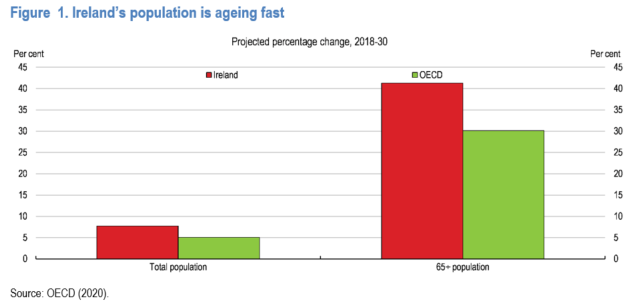
Second, Ireland’s population is set to age faster than in most OECD countries (Figure 1). Simulations suggest that public health and pension costs could rise by ½ per cent of GDP by 2030 and by 6½ per cent of GDP by 2060. To meet these obligations, opportunities for greater public spending efficiency and revenue sources that minimise economic distortions need to be identified.
Third, technological change is transforming Ireland’s economy, leading to new jobs and innovative products that benefit consumers. Nevertheless, the adoption of new technologies has been uneven across sectors and has had scant productivity impact, particularly in sectors with low firm turnover. Furthermore, there is a shortage of the skills needed to ensure that new technologies have the maximum positive impact (Figure 2). Further adoption of new technologies can be encouraged through a reduction in barriers to firm entry and their productivity potential better realised through the cultivation of complementary skills. Policy settings in other areas, including competition and the labour market, also need to be revisited to adapt to features of digitally-intensive markets.
The Survey’s key recommendations to cope with these challenges include:
• Using windfall corporate tax revenues to pay down government debt or to further build up the Rainy Day Fund. • Broadening the tax base to prepare for future ageing costs, by streamlining the Value Added Tax system and more regular revaluation of the local property tax base. At the same time, public spending efficiency needs to be enhanced through the establishment of universal access to primary care and better health budget controls. • A gradual increase in the carbon tax rate and other measures that will benefit the environment, including the introduction of congestion charging in the busiest locations, further investment in public transport, abolition of preferential VAT rates for synthetic fertilisers and greater afforestation. • Promoting inclusive technological diffusion through improving the licensing process for start-ups, increasing financial assistance for and flexibility of training programmes, harmonising labour market regulations across forms of employment, and enhancing the enforcement powers of the competition authority.
To ensure this target is met, the French government developed a “National Low Carbon Strategy”, which acts as a roadmap for implementing a low-emission transition in each sector of the economy. For example, GHG emissions from industry account for almost one fifth of emissions in France, equivalent to total GHG emissions of Romania, and, under the proposed sectoral plan, will be reduced by a quarter within the next ten years.
France is currently employing two main carbon pricing mechanisms:
A carbon tax on fossil fuel consumption, starting at 7 euros per tonne of CO2 and now amounting to 45 euros per tonne, in place since 2014.
These increasingly stringent carbon pricing policies have taken place in a period of rising industrial energy costs generating concerns about their impact on the competitiveness of the manufacturing sector. At first glance, such concerns appear to be borne out. Recent trends show real output and total employment in the sector decreased by 5% and 26%, respectively, between 2001 and 2016.
However, a recent OECD report, shed another light on this issue. This study is the first to estimate the impact of energy prices and carbon taxes on the environmental and economic performance using data at the firm and industry level.
What does the OECD study tell us?
At the firm level, a 10% increase in energy costs results in a 6% decline in energy use, a 9% decrease in carbon emissions, and a 2% decrease in the number of full-time employees within one year. However, these jobs are not lost, but are reallocated to other firms.
At the industry level, there is no statistical link between energy prices and net job creation, indicating that jobs lost at affected firms are compensated by increases in employment in other firms operating in the same sector during the same year.
These effects vary both between industries and according to the size of the firm and their energy intensity: For example,
When facing the same increase in the energy cost, firms in the wearing apparel industry reduces their carbon emissions twice as much as firms producing non-metallic minerals.
Reallocation of workers in the food products industry is half the reallocation in the basic metals industry.
On average, large and energy intensive firms experience greater reduction in carbon emissions and greater job reallocation than smaller and energy efficient firms.
With this, the paper is able to measure the causal effect of the carbon tax on the aggregate manufacturing sector since its introduction in 2014. Figure 1 plots the carbon tax on the left axis (green line) together with the impacts of the carbon tax on the French manufacturing sector’s jobs (purple line) and carbon emissions (red line) on the right axis. In five years, the carbon tax decreased carbon emissions by 5%. The net effect on employment is much smaller in magnitude and even slightly positive at +0.8%.
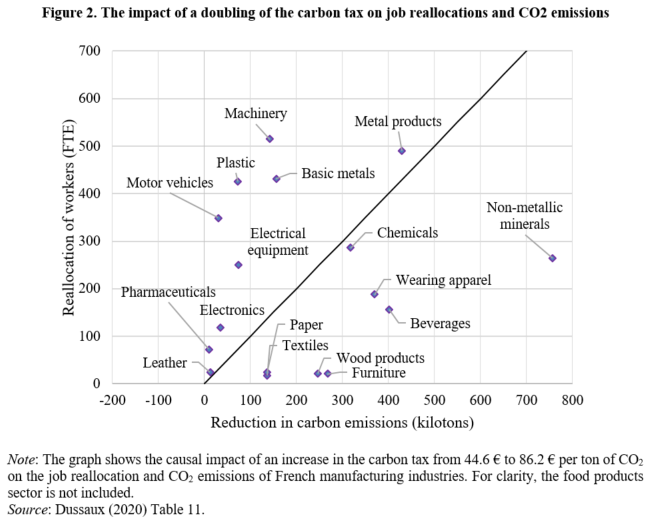
Finally, the paper considers a scenario where the carbon tax is doubled from its current rate of 45 € per tonne of CO2. Figure 2 shows the simulated effect of the tax increase on job reallocations and carbon emissions for each manufacturing industry. These job reallocations are not net job losses, but the number of people forced to change jobs (within the same industry or between industries).
A simulated doubling of the carbon tax highlights significant heterogeneity across sectors. Several industries such as furniture, wood products, paper, and textiles experience large reductions in carbon emissions with little job reallocation. On the contrary, the motor vehicles and the plastic industries experience larger job reallocations and smaller declines in carbon emissions. Other industries such as metal products experience large job reallocation and emissions reduction because of their size.
Higher energy prices and carbon taxes are effective at reducing carbon emissions, but costs of job reallocation must be considered…
Although the carbon tax enables the French manufacturing sector to meet its carbon budget and does not affect total employment negatively, it however generates non-negligible job reallocations in several industries. Because these reallocation effects have redistributive implications and generate costs for workers who are forced to change jobs, these results call for complementary labour market policies that minimise those costs on affected workers and ease between-firms adjustments in employment. Moreover, since these transition costs are typically highly localised in regions specialised in polluting activities, they can also translate into potentially significant regional effects and thus political costs.
References:
Dussaux, D. (2020), “The joint effects of energy prices and carbon taxes on environmental and economic performance: Evidence from the French manufacturing sector”, OECD Environment Working Papers, No. 154, OECD Publishing, Paris, https://doi.org/10.1787/b84b1b7d-en.
Structural reforms are key for a more prosperous and inclusive India
Category: India,Uncategorized
written by oecdecoscope | March 18, 2020
by Laurence Boone, OECD Chief Economist, Isabelle Joumard and Christine de la Maisonneuve, India Desk, OECD Economics Department
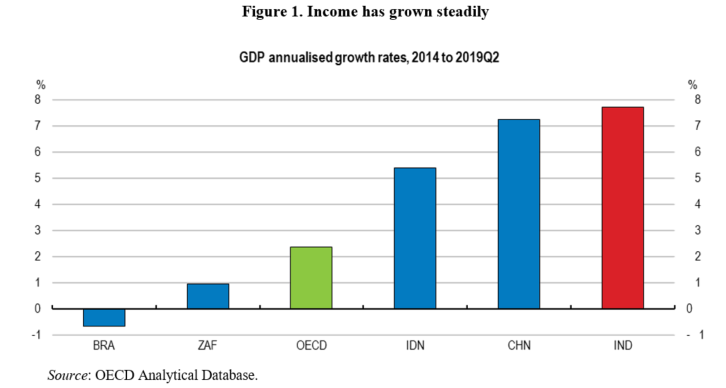
Income has increased fast in recent years and millions of Indians have been lifted out of poverty. India has also become a key player in the global economy. The implementation of an ambitious set of reforms has supported economic activity and helped put a break on inflation and on both fiscal and current account deficits. Reforms such as: • The Goods and Services tax replacing a myriad of indirect taxes. • A leaner corporate income tax structure bringing India more on par with peers. • The Insolvency and Bankruptcy Code speeding up the reallocation of resources from declining firms and industries to those with more promising prospects. • Electricity reached all villages in 2018 and; • Almost 100 million toilets have been built since 2014.
Nevertheless, economic activity is slowing down and challenges remain, notably:
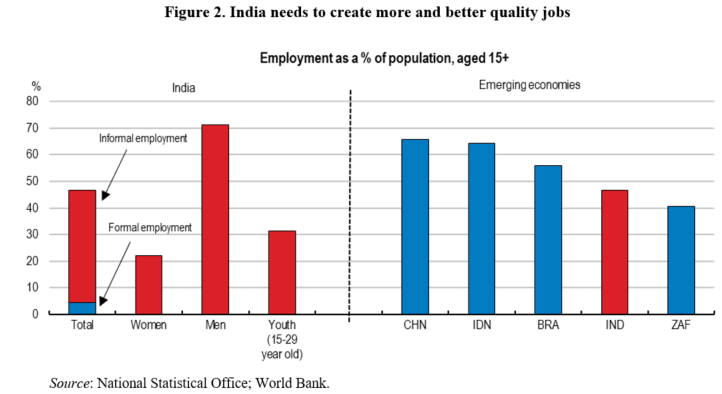
• The creation of quality jobs has not matched the number of new comers on the labour market, resulting in under-employment and rising unemployment. Women and the youth are most affected. • Nearly 90% of jobs are informal without job protection • Inequality in wealth and in access to public services remains wide. • A large share of the population suffers from severe air pollution. • Corporate investment as a share of GDP no longer declines but has failed to rebound. • Construction has weakened despite large housing and infrastructure needs.
Boosting incomes with macroeconomic policies has limits. Policy interest rates can be cut further but their impact on lending rates is limited by high administered deposit rates. Large non-performing assets in financial companies’ balance sheets also weigh on the supply of loans. The already high public sector borrowing requirements and debt to GDP ratio limit the government’s ability to support demand.
Boosting growth and making it more inclusive require accelerating the pace of structural reforms. Slower growth in partner countries and geopolitical uncertainties have recently taken a toll on economic activity. However, remaining constraints to create jobs and grow businesses – including the ongoing stress in the financial sector – also play a role. Already passed reforms should be fully implemented, e.g. by adding new judicial personal and benches to hasten bankruptcy proceedings. Labour, land and financial regulations should be modernised to attract investors and create more quality jobs and income. It is a critical moment, with opportunities to seize as companies around the globe are considering relocating their production sites in the wake of changing input costs and trade tensions.
The full benefits of structural reforms take time to unleash while costs are often born upfront. Setting a timetable by which government actions could be assessed may help avoid a political backlash. People losing from the reforms may need support to adjust (e.g. skilling programmes) or income support.
Delivering better public services and social protection for all Indians is also key to promote wellbeing.
India should train more doctors and nurses to meet the population’s needs. It should also build a sound and fair retirement system. Putting more public resources on health and social transfers will require rebuilding fiscal space. Two avenues should be considered. On the spending side, further reforms should help raising the effectiveness of existing schemes, by better directing support to those in need, and containing public enterprises’ financing needs. On the revenue side, there is scope to mobilise additional revenue from property and the personal income tax (OECD, 2017).
By Piritta Sorsa, Jens Arnold and Paula Garda, OECD Economics Department
Why is growth persistently low and so unevenly distributed in emerging Latin America compared to emerging Asia despite a huge potential? Potential growth is ranging around 2-3% in the region. Some refer to dependence on commodities, poor education, weak business environments or corruption as possible causes. But the question is deeper and more complex. A crucial factor for Latin America is low productivity, often related to a poor use of available resources. Across the region, many workers and significant amounts of capital are stuck in activities that are not efficient. The reasons for this are many, but two important forces stand out: high informality and weak competition.
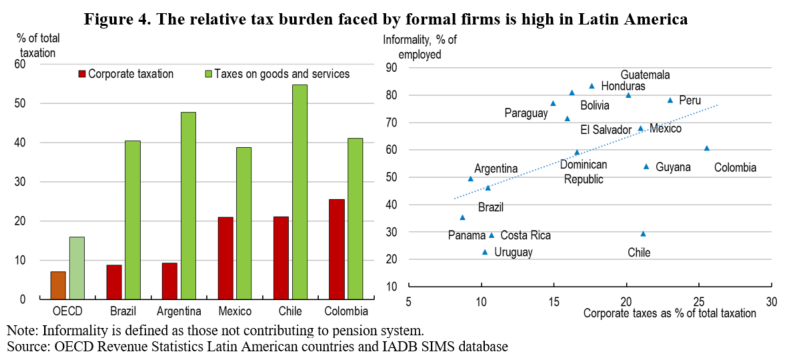
High and persistent informality in the region leaves workers more vulnerable and deprives them from social protection, thus contributing to inequality. For example, old age poverty in Colombia is high as low-skilled workers spend much of their working lives in informal employment, without pension contributions (OECD, 2019[1]). In Brazil and Argentina, informal workers retire later than others for the same reason, until they eventually reach the age to benefit from a non-contributory pension (OECD, 2019[2]; OECD, 2018[3]). In Mexico, poverty and informality are highly correlated among regions (OECD, 2019[4]). Informality also tends to maintain companies small with often low productivity as growing would face high costs of formalisation. Indeed, informal-sector productivity in the average LAC country is only between 25 and 75 percent of total labour productivity, and productivity decreases as informality rises (Loayza, 2018[5]). Informality also reduces the tax base for corporate and personal income taxes, reducing the capacity of the public sector to boost productivity and reduce inequality, and requires a higher tax burden on larger formal companies.
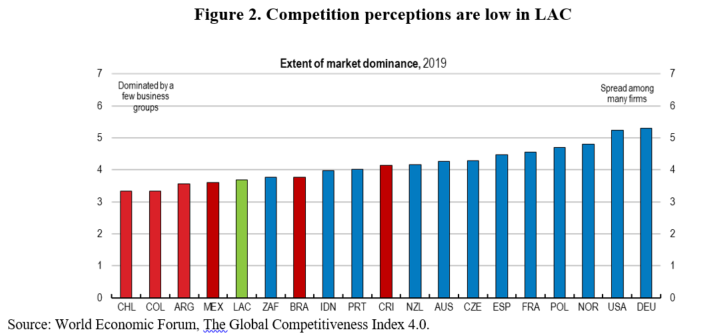
Weak competition is a second reason behind low productivity and is often reflected in high concentration (Figure 2). Entry barriers can protect existing activities that have little future growth potential at the cost of new dynamic and productive firms. Weak competition creates rents and lowers the share of wages in value-added worsening income distribution. Higher prices for consumers reduce purchasing power, affecting disproportionally low-income households.
Reducing informality for productivity and equity
The causes of informality are multiple. Informality is often a consequence of high costs of hiring formal workers, both wage and non-wage, especially in relation to labour productivity, given low educational outcomes.
Where high informality and weak competition coincide, as is the case in many Latin American countries, the consequences for both growth and equity can be particularly severe. For emerging Latin America to grow stronger and better share the fruits of growth, dealing with informality and competition should be priority.
Labour informality is often caused by rigid labour regulation. High firing costs of workers can discourage formal-sector hiring and promote inequality (Loayza, 2018[5]; OECD, 2018[6]; Heckman and Pages, 2000[7]). In Mexico, a labour reform in 2012 reduced hiring and firing costs, introduced different models of contracting and brought changes to the resolution of labour conflicts. Formal salaried jobs increased in the aftermath (OECD, 2019[4]). Minimum wages can be high compared to productivity or average wages keeping most workers informal. In Colombia, the minimum wage is close to the median wage and two thirds of workers earn less than that (OECD, 2019[1]). High payroll taxes can also have a detrimental effect on informality rates (Bobba, Flabbi and Levy, 2018[8]). Antón and Rastaletti (2018[9]) show how lowering employer social security contributions could lead to a substantial increase of labour formalisation. At a minimum, lower employer contributions could be offered temporarily for hiring low-skilled workers that enter the formal sector for the first time (OECD, 2017[10]). Lowering payroll taxes in Colombia helped reduce informality after the 2012 reform (Kugler et al., 2017[11]; Morales and Medina, 2016[12]; Fernández and Villar, 2016[13]; Bernal et al., 2017[14]). While incentives are crucial, better enforcement also needs to be part of any formalisation strategy.
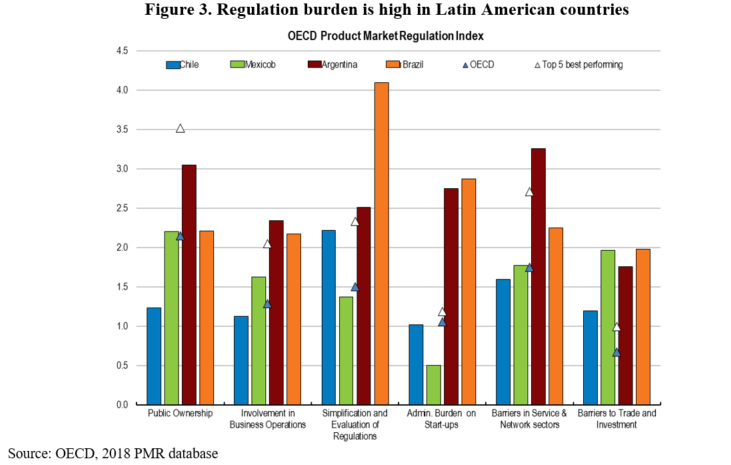
Cumbersome administrative barriers and high taxes can keep companies informal. Latin America stands out in this respect (Figure 3). The tax burden on formal companies is also high compared to the OECD and positively associated to informality rates (Figure 4). To promote formalisation, regulatory and tax systems should be simple, with gradual increases in the tax burden as firms grow, so as not to discourage growth, and keep marginal tax rates as low as possible (Loayza, 2018[5]). These characteristics are crucial to encourage investment and employment in growing and larger companies.
Many countries in the region have implemented simplified schemes and reduced costs for small taxpayers with the aim of reducing informality. For example, Mexico introduced a special simplified regime for SMEs (Regimén de Incoporación Fiscal, RIF) in 2014, which induced 1.5 million informal firms to join the tax system (OECD, 2018[15]). In Brazil, a special tax regime for microenterprises (Microemprendedor Invididual, MEI) reduced the cost of formalisation and contributions to social security as of 2008. This regime helps explain the rising formalisation of the self-employed, including of women (OECD, 2012[16]). In Argentina, a simplified tax regime called Monotributo helped formalise self-employed workers. In Colombia, the tax reform in 2018 introduced a new simplified tax scheme (Simple) for small firms, and there are signs of positive impact on firm formalisation during 2019. At the same time, these regimes have to be designed carefully. When participation thresholds for special SME tax regimes are set too high, the effectiveness for formalisation declines while fiscal cost and threshold effects rise, as in the case of Brazil’s Simples Nacional (OECD, 2018[3]). At times, simplifying the general tax regime may be preferable over creating exceptions.
Education and skill levels are also linked with informality. Countries with lowest informality rates tend to have significantly higher levels of human capital (Docquier, Müller and Naval, 2017[17]). It is not a coincidence that the decrease in informality over recent decades in Latin America went hand in hand with steady progress towards universal education. Evidence shows that improvements in education have been an important driving force behind falling informality in Colombia and Brazil (International Monetary Fund, 2018[18]; OECD, 2018[3]).
Increasing competition for productivity and equity
In Latin America, the same complex rules that discourage formal job creation often coincide with overly strict regulations that stifle competition. Competition is affected by how easily firms can enter or exit markets, by the extent of license requirements for starting or expanding a business and by competitive pressures from imports. Relatively high trade protection adds to this in a number Latin American countries, shielding domestic producers from international competition (OECD, 2018[3]). All of this tends to raise prices for consumers and keep resources in low-productivity activities where informality is widespread, for both workers and firms.
These circular relationships suggest that it is important for the public sector to take stock of burdens that even well-intended regulations and codes can impose on private activity. Disincentives for firms to go formal will inevitably preclude workers from the benefits of formal jobs, while unnecessary barriers to competition will keep more jobs in activities with limited potential for productivity and wage growth. To foster formal job creation, all parts of a country’s regulatory framework should be simple and clear, promote competition, and facilitate both market entry and exit of firms (Loayza, Oviedo and Serven, 2005[19]).
Getting there
A comprehensive strategy is needed to deal with both informality and competition. It involves simplifying labour regulations, keeping administrative burdens and license requirements for companies as easy as possible, facilitating market entry and reducing trade barriers. Bringing more workers and firms into the formal sector would bring about broader social and labour protection, fairer wages, a more even tax burden and higher potential growth. Many of these policies are politically difficult as they involve dealing with vested interests and require appropriate sequencing. But that is not an excuse for inaction. These reforms should be accompanied with training and other active labour market policies for affected workers, as the informal sector often fulfils the function of absorbing excess labour supply, especially during transitions or economic recessions. Reforms to improve quality and relevance of education to raise worker productivity and policies that can raise investment and boost firm productivity should be also part of the strategy.
References
Antón, A. and A. Rasteletti (2018), Imposición al trabajo en contextos de alta informalidad laboral: Un marco teórico para la simulación de reformas tributarias y de seguridad social, Inter-American Development Bank, Washington, D.C., http://dx.doi.org/10.18235/0001467.
Bernal, R. et al. (2017), “Switching from Payroll Taxes to Corporate Income Taxes: Firms’ Employment and Wages after the Colombian 2012 Tax Reform”, IDB Technical Note, No. 1268, Inter-American Development Bank.
Bobba, M., L. Flabbi and S. Levy (2018), “Labor Market Search, Informality and Schooling Investments”, Interamerican Development Bank, https://publications.iadb.org/en/publication/12928/labor-market-search-informality-and-schooling-investments.
Docquier, F., T. Müller and J. Naval (2017), “Informality and Long-Run Growth”, The Scandinavian Journal of Economics, Vol. 119/4, pp. 1040-1085, http://dx.doi.org/10.1111/sjoe.12185.
Fernández, C. and L. Villar (2016), “The Impact of Lowering the Payroll Tax on Informality in Colombia”, No. 72, Fedesarrollo, http://hdl.handle.net/11445/3300.
Heckman, J. and C. Pages (2000), “The Cost of Job Security Regulation: Evidence from Latin American Labor Markets”, NBER working paper, No. 7773, National Bureau of Economic Research, http://dx.doi.org/10.3386/w7773.
International Monetary Fund (2018), “Colombia: Selected Issues”, Country Report, No. 18/129, http://www.imf.org.
Kugler, A. et al. (2017), “Do Payroll Tax Breaks Stimulate Formality? Evidence from Colombia’s Reform”, NBER Working Paper Series, http://www.nber.org/papers/w23308.
Loayza, N. (2018), “Informality : Why Is It So Widespread and How Can It Be Reduced?”, Research and Policy Briefs, No. 20, World Bank, http://documents.worldbank.org/curated/en/130391545228882358/Informality-Why-Is-It-So-Widespread-and-How-Can-It-Be-Reduced.
Loayza, N., A. Oviedo and L. Serven (2005), “The impact of regulation on growth and informality – cross-country evidence”, Policy, Research working paper World Bank 3623, http://documents.worldbank.org/curated/en/212041468134383114/The-impact-of-regulation-on-growth-and-informality-cross-country-evidence.
Morales, L. and C. Medina (2016), “Assessing the Effect of Payroll Taxes on Formal Employment: The Case of the 2012 Tax Reform in Colombia”, Borradores de Economia, Banco de la Republica, http://www.banrep.gov.co/en/borrador-971.
The G20’s Enhanced Structural Reform Agenda: Real progress but not good enough
Category: Structural reform,Uncategorized
written by oecdecoscope | March 18, 2020
by Tomasz Kozluk, Nicolas Ruiz, Agnes Cavaciuti, Dorothée Rouzet, Oliver Röhn, Lukas Lehner, and Colombe Ladreit de Lacharrière, Aida Caldera Sánchez and Asa Johansson
The global economy is fragile. In the OECD’s November Economic Outlook global growth is projected to have slowed to 2.9% in 2019 and barely reach 3% in 2020. Persistent trade conflicts and high uncertainties are undermining confidence, trade and investment. The consequences can be long-lasting, with a real risk of the global economy being locked into a long period of structurally low growth. As a result, it will be more difficult to deliver broad gains in productivity, wages and living standards making people’s lives better, for all.
The global economic slowdown comes on top of increasing pressures from global “mega-trends”. Globalisation, digitalisation, population ageing and environmental degradation are shaping tomorrow’s living standards and well-being. Inequality and poverty remain major concerns, both in advanced and emerging-market G20 economies. In the absence of renewed reform dynamism, economies are poorly prepared to tackle these challenges.
In a push to address these challenges, under the Chinese Presidency in 2016 G20 leaders agreed to an Enhanced Structural Reform Agenda. This agenda comprised G20 priority areas and guiding principles for structural reform, and a set of quantitative indicators to track the evolution of policy settings and outcomes. The OECD was tasked to assess progress and has just published its second report under the G20’s Enhanced Structural Reform Agenda to Ministers and Governors (ESRA). The ESRA report provides an overview of collective G20 progress and structural policy achievements, as well as individual notes assessing progress for each G20 member country since 2017.
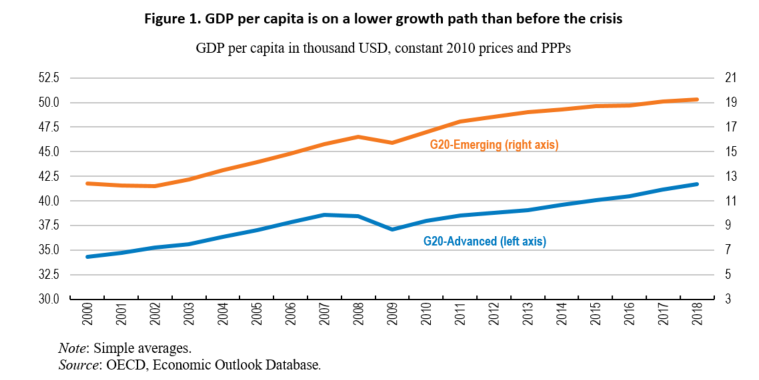
The report shows that the G20 has made real progress in a number of areas, but more efforts are warranted to put G20 economies on a path of rising living standards and opportunities for all. Significant examples include reforms to lift employment and make labour markets more inclusive (e.g. France or Japan). Regulatory simplification and tax policy have also been used to support firms’ investment and growth in some countries (e.g. China, India, United States). These reforms mark significant progress, but there is still work to do. GDP per capita in G20 countries, both advanced and emerging, is on a lower growth path than prior to the global financial crisis. This reflects not only less favourable demographic trends but also the consequences of the past decade of sub-par investment and productivity growth. In the longer term, higher productivity growth will be crucial to ensure strong and sustainable increases in living standards.
While poverty and inequality have fallen in the past decade in many emerging economies, such as Brazil and Indonesia, disposable income inequality remains high. In many advanced economies, lower-income households benefitted little from economic growth in the years following the global financial crisis, raising concerns that many are not sharing in the gains from growth. Some progress has been made on environmental sustainability, but G20 countries have yet to act in order to achieve the long-term objectives set out in the Paris Agreement.
Faced with these pressing challenges, G20 governments must take action to steer their economies towards stronger, more inclusive and sustainable growth. The specific structural reform priorities under the G20’s Enhanced Structural Reform Agenda differ across countries, but each G20 country can pursue more ambitious policy packages to boost productivity and inclusiveness together. By identifying the areas where progress is needed, this report helps countries to develop and deliver ambitious agendas.
Ensuring the continuing success of the Austrian economy in the face of the ageing challenge
Category: Uncategorized
written by oecdecoscope | March 18, 2020
by Dennis Dlugosch and Rauf Gönenç, Austria Desk, OECD Economics Department
Austria is a highly successful OECD economy. It has combined strong economic growth and social cohesion across all its regions over the past two decades. GDP per capita is now the 6th highest in the EU and the 11th highest in OECD, slightly above Germany, Finland and Denmark. Myriad competitive small-and-medium firms across regions provide generally well-paying jobs to workers with good vocational qualifications. The welfare system supported by well-organised social partnership secures an effective social safety net.
Our latest Economic Survey of Austria emphasises that the three global megatrends demographics, digitalisation and increased fragmentation of goods and services across firms and countries raise particularly important challenges for Austria. Among these megatrends, the changing demographics is particularly salient, given that the working age population in Austria is projected to fall by 14% until 2050 (Figure 1).
The ageing of the population raises three distinct pressures: first, despite welcome recent parametric changes, the long-term balances of the generous (high-contribution/high-benefit) pension system is exposed to substantial risks. The effective retirement age for both men and women are below their official retirement age and stay well below comparable countries. Austria has opted for periodic legislative amendments rather than automatic changes in the retirement age and contribution and benefit rates – a method exposed to high political uncertainties. The Survey recommends firmer links between demographic changes and parametric adjustments. More effective life-long learning programmes and more supportive work organisations should also help older workers to stay longer in the labour force.
Second, more than eight out of ten Austrian SMEs consider already today the lack of talent a major impediment to upscaling through investment (EIB, 2018). Ageing will further aggravate this skill constraint. The Survey proposes to alleviate the pressure from demographics by activating the untapped skills potentials of so far disadvantaged groups, in particular that of women and migrants. Authorities should ensure high quality child-care and full-day schooling across the country to further boost labour force participation by women, continue to attract high-skilled foreign workers and strengthen the German language learning opportunities and labour force participation potential of migrants and refugees and their families.
The third challenge from ageing concerns ownership and management transitions. As the current owner-manager cohorts hit retirement age, transmissions within or outside current owner families will arise in about one third of the 300 000 SMEs, which will affect around 5-10% of total employment in Austria. Successful transmissions will be key for the future performance of the Austrian economy, in particular for its regional balances. The Survey recommends to enhance the evidence base on business transfers, and to help disseminate good practices in legal, financial and other dimensions of successful ownership transmissions. The re-assessment of the rules concerning the operation of family trusts (“Stiftungsgesetz”) will be necessary.
Paula Garda y Alberto Gonzalez Pandiella, Departamento de Economía de la OCDE
Colombia ha hecho un buen progreso económico y social en las últimas décadas. La aplicación de políticas macroeconómicas sólidas, junto con una demografía y unas condiciones exteriores favorables, sustentó un crecimiento económico resiliente (Gráfica). Los niveles de vida han mejorado considerablemente y la pobreza ha disminuido.
Sin embargo, persisten los desafíos para mantener la performance y promover la convergencia hacia niveles de vida más altos. Los motores tradicionales del crecimiento, en gran medida las industrias extractivas intensivas en capital y los términos de intercambio favorables, han mostrado sus límites. El crecimiento potencial ha descendido debido a la escasa productividad. EL país tiene una de las brechas entre ricos y pobres más altas de América Latina y la OCDE, y las disparidades regionales son elevadas.
Las bases de Colombia para responder a estos desafíos son sólidas. El sólido marco macroeconómico ha sostenido el crecimiento y ha suavizado los ajustes a los shocks en el pasado. Mantener esta reputación es clave. La política fiscal deberá encontrar el equilibrio adecuado. Esto debería incluir una reducción gradual del déficit fiscal estructural, hasta el 1% del PIB en 2022, de acuerdo con la regla fiscal, junto con medidas para mejorar la combinación de impuestos y la eficiencia del gasto. Ampliar las bases impositivas y evaluar los programas sociales y las exenciones tributarias, manteniendo sólo aquellos que tengan un efecto positivo en la productividad o la equidad, deberían ser considerados.
Sólo fomentando la productividad, Colombia puede lograr un mayor y más inclusivo crecimiento, así como una menor dependencia a los recursos naturales. Serán claves el incremento de la competencia y realizar el potencial desaprovechado para hacer de las exportaciones un motor de crecimiento y creación de empleo. A pesar de los esfuerzos por promover la integración comercial a través de los acuerdos comerciales, el país sigue siendo una economía relativamente cerrada, con exportaciones que siguen siendo bajas y poco diversificadas, y gran parte de la economía protegida de la competencia internacional.
Racionalizar las regulaciones, disminuir los aranceles, reducir el uso de barreras no arancelarias, continuar mejorando en infraestructura y mejorar la logística aduanera y portuaria incrementaría la productividad de las empresas. Optimizar los programas de apoyo a la innovación y mejorar el acceso a la financiación incrementaría la competitividad. Avanzar en la digitalización, promoviendo aún más la adopción y uso de tecnologías TIC, mejoraría la competitividad y conexión de las regiones.
Si la productividad y el comercio se convirtieran en motores del crecimiento, aumentarían el bienestar y los niveles de vida. Para asegurarse que los beneficios sean compartidos más ampliamente por todos los colombianos, se necesitan reformas para fomentar empleos de alta calidad. La reducción de los aún elevados niveles de informalidad debería ser prioritaria, ya que beneficia a la productividad, la equidad y las finanzas públicas. La estrategia debería incluir reformas para reducir los costes laborales no salariales, revisar el salario mínimo para que logre un nivel más favorable al empleo, mejorar la calidad y la pertinencia de la educación y formación, e incorporar a más mujeres a los puestos de trabajo en el sector formal creando más y mejores servicios de guardería.
Las políticas sociales podrían ser más eficaces para reducir la desigualdad. Las transferencias condicionadas a los pobres son bajas y una gran parte de los subsidios, como los relacionados con las pensiones y la vivienda, van a parar a los relativamente ricos. Se podría lograr una mayor equidad reasignando más gasto, como el aumento de las transferencias condicionadas, hacia las poblaciones más vulnerables, centrándose en las zonas rurales y las minorías étnicas. Por último, la reforma del sistema de pensiones es urgente para reducir la pobreza en la tercera edad, garantizar la sostenibilidad y aumentar la equidad.