Confronting the Crisis

By Álvaro Santos Pereira, OECD Chief Economist ad interim

The global economy is reeling from the largest energy crisis since the 1970s. The energy shock has pushed up inflation to levels not seen for many decades and is lowering economic growth all around the world. In the new OECD Economic Outlook, we are now forecasting that world growth will decline to 2.2% in 2023 and bounce back to a relatively modest 2.7% in 2024. Asia will be the main engine of growth in 2023 and 2024, whereas Europe, North America and South America will see very low growth.

Higher inflation and lower growth are the hefty price that the global economy is paying for Russia’s war of aggression against Ukraine. Although prices were already creeping up due to the rapid rebound from the pandemic and related supply chain constraints, inflation soared and became much more pervasive around the world following Russia’s invasion.

As a consequence of the unexpected surge in prices, real wages are falling in many countries, slashing purchasing power. This is hurting people everywhere. If inflation is not contained, these problems will only become worse. Thus, fighting inflation has to be our top policy priority right now.

Central banks around the world are increasing interest rates to curb inflation and anchor inflation expectations in their respective economies. This strategy is starting to pay off. For example, in Brazil, the central bank moved swiftly, and inflation has started to come down in recent months. In the United States, the latest data also seem to suggest some progress in the fight against inflation. Nevertheless, monetary policy should continue to tighten in the countries where inflation remains high and broad-based.

In the fight against rising prices, it is also essential that fiscal policy works hand-in-hand with monetary policy. Fiscal choices that add to inflationary pressures will result in even higher policy rates to control inflation. This means that policy support to shield families and firms from the energy shock should be targeted and temporary, protecting vulnerable households and firms without adding to inflationary pressures and increasing public debt burdens. Governments have already done a lot to ease the economic pain from high energy and food prices, including price caps, price and income subsidies and reduced taxes. However, since energy prices are likely to remain high and volatile for some time, untargeted measures to keep prices down will become increasingly unaffordable, and could discourage the needed energy savings.

Energy markets remain among the significant downside risks around this outlook. Europe has gone a long way to replenish its natural gas reserves and curb demand, but this winter in the Northern Hemisphere will certainly be challenging. The situation might be even more complicated in the winter of 2023-2024, as replenishing gas reserves might prove more difficult next year. Higher gas prices, or outright gas supply disruptions, would entail significantly weaker growth and higher inflation in Europe and the world in 2023 and 2024.

Rising interest rates will also pose many challenges and risks. Debt repayment will be more expensive for firms, governments and households who have variable rate debt obligations or when taking on new debt. We are particularly concerned about low-income countries, over half of which are already in (or at high risk of) debt distress and now face tightening financial conditions. Currency depreciation vis-à-vis the US dollar in many of these countries, and in emerging markets, adds to these risks.

Russia’s war against Ukraine is also aggravating global food insecurity by putting pressure on prices, supplies, and food affordability. Some of the most vulnerable people around the globe face the highest risk of food insecurity, and many governments lack the means to address this problem. Keeping markets open and agricultural goods flowing, as well as providing well-targeted aid, should be the utmost priority to avoid further food disruptions and hunger in many of these countries.

Policies for a stronger recovery

Policymakers must take bold policy actions to confront these challenging times. In addition to monetary and fiscal policies, it is time for governments to go back to structural policies to tackle some of the most pressing current issues.

First, investing in energy security and diversifying energy supplies is imperative. To prevent energy disruptions, many countries are reverting temporarily to more polluting and carbon-emitting energy sources. However, high energy prices and concerns about energy security are also encouraging governments and firms to diversify energy sources and boost investment in renewables. Strengthening energy grids and investing in energy efficiency and green technologies will need to be high on political agendas to ensure that we reach our net zero emissions goals. The OECD aims to support this effort through its Inclusive Forum on Carbon Mitigation Approaches (IFCMA), a forum of dialogue between countries at different stages of development that will allow us to better understand and analyse diverse policy approaches to carbon mitigation and their effects.

Second, governments need to keep markets open and international trade flowing. This will strengthen competitive pressures and will help alleviate supply constraints. In contrast, pursuing protectionist policies would be a serious setback for many countries, in particular the world’s poorest, and would significantly damage the global economy.

Third, fostering employment is essential to boost potential growth and achieve a stronger and more inclusive recovery. For example, governments should work to decrease the gaps in employment rates between men and women in countries where these gaps remain high. Investing in skills is also essential, to counteract the human capital losses that occurred during the pandemic, especially for the most vulnerable, and address the persistent and emerging skill shortages that many countries are facing.

Summing up

We are currently facing a very difficult economic outlook. Our central scenario is not a global recession, but a significant growth slowdown for the world economy in 2023, as well as still high, albeit declining, inflation in many countries. Risks remain significant. In these difficult and uncertain times, policy has once again a crucial role to play: further tightening of monetary policy is essential to fight inflation, and fiscal policy support should become more targeted and temporary. Accelerating investment in the adoption and development of clean energy sources and technologies will be crucial to diversifying energy supplies and ensuring energy security. A renewed focus on structural policies will allow policymakers to foster employment and productivity, as well as to make growth work for all. In other words, it is in our hands to overcome this crisis. And if we choose to undertake the right set of policies, we will certainly increase our chances of success.

Editorial from the OECD Economic Outlook, November 2022


Mortgage rates are rising: Should we be concerned?

By Damien Puy and Kimiaki Shinozaki, OECD Economics Department.

Mortgage interest rates are now rising in many OECD countries, reflecting the ongoing tightening of monetary policy by most central banks. This raises important questions about the impact on household finances and house prices, and the implications for financial stability. The latest OECD Economic Outlook (OECD, 2022) discusses these issues. Overall, financial stress among households should be contained in most OECD countries due to relatively strong balance sheets and the moderate use of adjustable-rate mortgages (ARM). However, pockets of risk do exist, and the outlook for house prices remains very uncertain. Many macroprudential authorities have already taken steps to limit over-indebtedness and reinforce banks’ capital buffers, but further preventive steps may be warranted. At the same time, structural reforms in housing markets are called for in most countries, often to increase supply responsiveness.

Mortgage rates are climbing, but fixed-rate loans dominate the mortgage landscape

Mortgage rates have started to increase in several OECD economies (Figure 1, Panel A). The rise has been particularly strong in the United States, where rates rose by almost 2 percentage points in a few months. This may deter prospective homebuyers, but the impact on existing homeowners should be small in most large OECD countries. As of 2020, the median share of adjustable-rate mortgages across OECD countries was around 45%, and, except for Japan, all G7 economies had much lower shares (Figure 1, Panel B). Notably, borrowers in France, Germany, the United Kingdom and the United States rely almost entirely on fixed-rate mortgage contracts, which come with fixed payments over the life of the loan. In contrast, ARM contracts account for over 80% of the total in the Baltics and in several Nordic and Eastern European countries.

Figure 1. Mortgage rates are rising, but most homeowners are shielded by fixed-rate contracts

Note: Rates in Panel A based on newly issued adjustable-rate mortgages. Latest data refer to July 2022 (for Canada, Japan and the USA), June 2022 (for New Zealand, Sweden and the United Kingdom) and May 2022 (for the remaining countries). In Panel B, the level of household credit is measured as of 2021 Q3, and the average share (in value) of ARM at issuance in 2020 is used to proxy for the importance of each type of mortgage in each country.
Source: National central banks, national statistics agencies, BIS, European Mortgage Federation, and OECD calculations.

Will households be able to cope with higher debt service burdens?

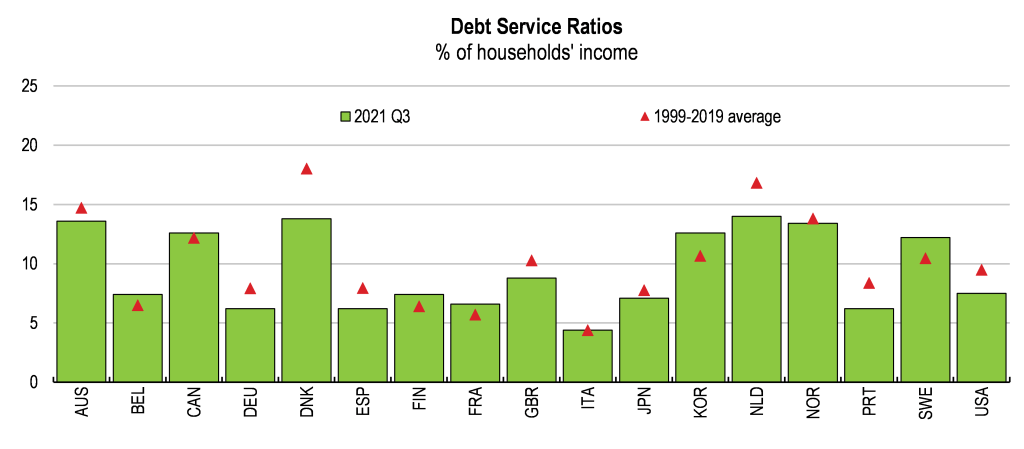
Household debt, which mainly consists of mortgage loans, has grown substantially over the past decade in most OECD countries. Nonetheless, the extended period of low interest rates since the global financial crisis (GFC) has left average debt service ratios in the household sector close to or even below their long-term norms (Figure 2), suggesting that some rise in debt service burdens should be manageable for most households. Moreover, the rise in household debt during the pandemic has been matched by a significant rise in household savings, which should support the repayment capacity of many households exposed to adjustable rates. However, aggregate numbers conceal important risks that the repayment capacity of low-income borrowers could deteriorate, given the withdrawal of pandemic income support measures and higher inflation. Financially fragile borrowers in countries with independent monetary policies and rising inflation pressures are particularly exposed to the risk of a substantial rise in debt servicing costs, especially in countries where the ratio of mortgage costs to disposable income is already high for the lowest income quintile, such as Australia (van Hoenselaar et al., 2021).

Figure 2. Moderate debt service ratios limit risks in housing markets

Source: BIS Credit Database; and OECD calculations.

Effective macroprudential policies are needed to limit risks from swings in house prices

House prices rose strongly and quickly in most OECD countries during the pandemic. Between the fourth quarter of 2019 and the fourth quarter of 2021, real house prices rose by 13% in the median OECD economy, leading to stretched valuations in many countries. For many reasons, the pandemic has exacerbated pre-existing tensions in real estate markets. Exceptionally accommodative monetary conditions, a surge in household savings and unprecedented fiscal support all boosted housing demand, with housing supply temporarily curtailed by mobility restrictions and logistical bottlenecks.

The future evolution of house prices is uncertain. Higher financing costs should moderate future housing demand, helping the rise in house prices to abate. However, in the short run, supply constraints could continue to sustain price increases. Although the supply of new construction slowed down only moderately during the pandemic, new housing permits and starts dropped significantly in many OECD countries. This gap, along with ongoing supply bottlenecks and labour shortages, is likely to amplify the structural housing shortages affecting many countries, helping to sustain prices.

Given the large uncertainty surrounding the outlook, it is critical that there are adequate buffers in the banking sector to ensure resilience to unexpected fluctuations in property markets. Stronger regulation in the aftermath of the GFC has limited risk-taking, helped to strengthen underwriting standards, and raised bank capital ratios. Most countries already have macroprudential policies in place to limit over-indebtedness and reinforce banks’ capital buffers, but the continued build-up of housing market vulnerabilities may merit further preventive measures to limit medium-term risks, such as additional steps to lower loan-to-value or debt service-to-income ratios.

Over time, in addition to macroprudential instruments, reforms in rental regulation and property taxation may also be effective tools to address more structural housing pressures. Those tools, along with stronger public investment in social housing and potential land use reforms, especially in job-rich urban areas, could ease the tensions that are still likely to prevail in the medium and long term (OECD, 2021).

References

OECD (2021), Brick by Brick: Building Better Housing Policies, OECD Publishing, Paris, https://doi.org/10.1787/b453b043-en.

OECD (2022), OECD Economic Outlook, Volume 2022 Issue 1, OECD Publishing, Paris, https://doi.org/10.1787/62d0ca31-en.

van Hoenselaar, F., et al. (2021), “Mortgage finance across OECD countries”, OECD Economics Department Working Papers, No. 1693, OECD Publishing, Paris, https://doi.org/10.1787/f97d7fe0-en.


The Price of War

By Laurence Boone, OECD Chief Economist and Deputy Secretary-General.

The world is set to pay a hefty price for Russia’s war against Ukraine. A humanitarian crisis is unfolding before our eyes, leaving thousands dead, forcing millions of refugees to flee their homes and threatening an economic recovery that was underway after two years of the pandemic. As Russia and Ukraine are large commodity exporters, the war has sent energy and food prices soaring, making life much harder for many people across the world.

The extent to which growth will be lower and inflation higher will depend on how the war evolves, but it is clear the poorest will be hit hardest. The price of this war is high and will need to be shared.

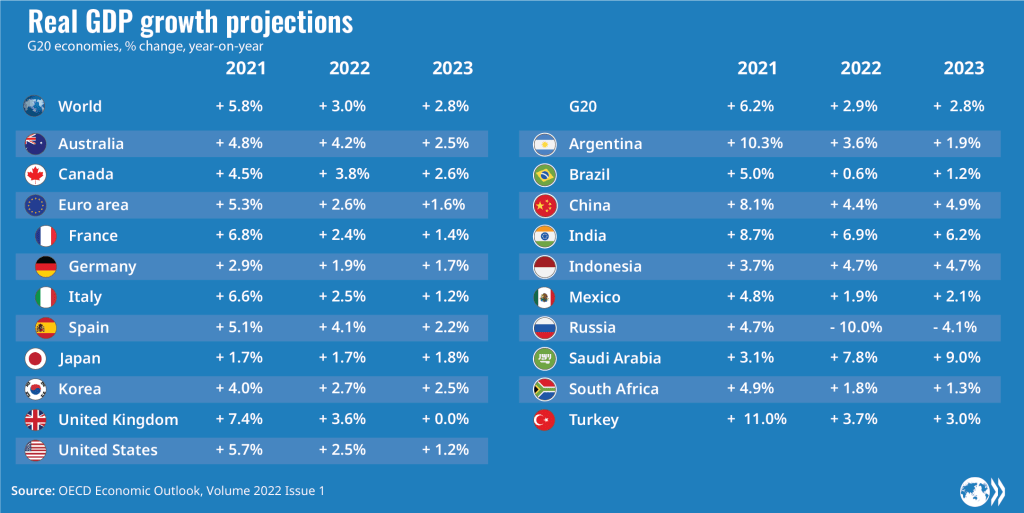
The global economy is set to weaken sharply in our projections. We estimate world growth to be 3% in 2022 – down from the 4½ per cent we projected last December – and 2¾ per cent in 2023. Inflation projections now stand at nearly 9% in OECD countries in 2022, twice what we were previously projecting. Elevated inflation across the globe is eroding households’ real disposable income and living standards, and in turn lowering consumption. Uncertainty is deterring business investment and threatening to curb supply for years to come. At the same time, China’s zero-Covid policy continues to weigh on the global outlook, lowering domestic growth and disrupting global supply chains.

With risks biased to the downside, the price of war could be even higher. The conflict is disrupting the distribution of basic food and energy, fuelling higher inflation everywhere and threatening low-income countries in particular. European economies are struggling to wean themselves off Russian fuel. But because alternative energy sources may not be easy to ramp up quickly, there is a risk of higher prices or even shortages. If the war escalates or becomes more protracted, the outlook would worsen, particularly for low-income countries and Europe.

Limiting Russia’s ability to finance the war, as is intended by an embargo on Russian oil exports, is essential for speeding up an end to this devastating conflict.

Meanwhile, we must minimise the humanitarian, economic and social consequences.

The first urgency is to avoid a food crisis. Today, the world is producing enough cereals to feed everyone, but prices are very high and the risk is that this production will not reach those who need it most. Global cooperation is needed to ensure that food reaches consumers at affordable prices, in particular in low-income and emerging-market economies. This may require more international aid as well as cooperation in the logistics of shipping and distributing to countries in need. The flaws of global vaccine distribution are still fresh in our memory. Let’s not repeat them.

Second, inflation has strong distributional effects. It will help drive down debt, including public debt, but it is also eroding real income, savings and purchasing power. At the same time, it may affect firms’ profits and capacity to invest and create jobs. Inflation is a burden, which must be shared fairly among people and firms, between profit and wages. Governments also have to play a role through support targeted to those most vulnerable to rising food and energy inflation.

Next, monetary and fiscal policy need to adjust to these extraordinary circumstances.

Globally, the elevated levels of inflation and employment today suggest there is no longer a need for monetary policy accommodation. However, in many regions inflation is driven by food and energy. If monetary policy cannot address such supply shocks, it can send signals that it will not allow inflation to rise or spread further. Removing accommodation is therefore warranted across the globe, but with particular caution in Europe where supply-driven inflation dominates. Conversely, wherever inflation is driven by over-buoyant demand, as in the United States, monetary policy can tighten faster to reduce such excess.

Fiscal policy management is particularly complex. Because of the current levels of growth, employment and inflation, the need for economy-wide income support has disappeared and should be replaced by better targeted measures. The war in Ukraine has raised the need for higher public investment in defence and for greater urgency in the transition to greener energy. This comes on top of other investment needs like health, digitalisation, ageing and education, and as public debts remain high. This conundrum can only be resolved with a stronger focus on prioritisation from governments. In Europe, the integration of the region and high exposure to the war calls for more solidarity in defence and energy spending.

The war has exposed how energy security and climate mitigation are intertwined. Governments need to shift gear to accelerate the energy transition. The emergency response to an energy crisis has turned out to be a stark scramble for alternative sources of fossil fuels and an increase in coal use. This can only be temporary as it is the opposite of what the world needs, which is a rapid increase in investment in, and consumption of, cleaner energy. But clean energy requires inputs, minerals and intermediate materials which come from all over the planet. Put simply, the cleaner the energy, the larger and the more geographically diverse the value chains will have to be. There will be no climate mitigation without open trade and resilient global value chains.

The world is already paying the price for Russia’s aggression. The choices made by policymakers and citizens will be crucial to determining how that price will be distributed across people and countries.

Editorial from the OECD Economic Outlook, June 2022


Unleashing Romania’s potential to converge faster towards OECD standards

By Caroline Klein and Yosuke Jin, OECD Economics Department

Romania’s economic growth has been impressive over the past decades: its income per capita has reached about 60% of the OECD average, vs. only around 30% two decades ago. However, the COVID-19 crisis put a halt to progress in living standards, despite a strong rebound of activity after the lockdown in 2020. The recovery remains fraught with risks, including further restrictions in response to the sharp rise in infection cases, persistent supply chains disruptions and stronger than expected inflationary pressures.  

Romania is also facing major long-term challenges, with an ageing population, still prevalent poverty, especially in rural areas and in the Roma population, slowing productivity growth, and high air pollution. The implementation of the National Recovery and Resilience Plan is a unique opportunity to address these challenges, as the plan includes EUR 14.2 billion of grants, amounting to around 6.5% of GDP, and important structural reforms. The OECD forecasts GDP to grow at around 4.5% on average over the next two years, in part owing to this plan. But, for its benefits to spread in the longer term, the plan should be used effectively to accelerate the digital and the green transitions.  

Against this background, the 2022 OECD Economic Survey of Romania presents recommendations on reforms that would help Romania converge towards OECD standards. 

Firstly, the budget and the current account deficits have deepened to worrying levels, calling for prudent macroeconomic policies. In particular, the budget deficit reached 9% of GDP in 2020. Room to reduce public spending is limited. Essential public services, such as education and health, are underfunded, and the green transition requires considerable investments. At the same time, tax revenues are low by OECD norms, amounting to 26% of GDP against 34% on average in the OECD in 2019. To restore Romania’s fiscal space and make the tax system fairer and more efficient, the modernisation of the tax administration should accelerate, inefficient reduced tax rates and special provisions be eliminated, and less distortive taxes, such as property taxes, raised. The reform of the pension system, whose previous design undermined the sustainability of public finances, is also a central part of the consolidation strategy. It should include the harmonisation of the legal retirement ages and a revised benefit formula. 

Secondly, policies should promote equality of opportunities. Around 30% of the Romanian population is at risk of poverty or social exclusion, one of the highest rates in the EU. Poverty hit those detached from the labour market, a group in which youth, women and the Roma are overrepresented (Figure 1). Around a quarter of the working age population has below upper secondary education, too many young people leave school before getting adequate qualifications to thrive in the labour market, and participation in adult education is low. The funding system of schools should be reformed, as schools do not receive adequate resources to support vulnerable students. Strengthening training and guidance services in public employment services would also help developing upskilling options. Childcare and long-term care services need to be expanded. Women would benefit most, as, like in many OECD countries, they are the main informal caregivers. Romania lags most OECD countries in access to high-quality healthcare, especially in rural areas. Developing mobile health centres would help address shortages and increase vaccination rates from very low levels. 

Figure 1. Some groups have difficulties to join the labour market 

Labour market participation rate, %

PEERS comprises Czech Republic, Estonia, Hungary, Latvia, Lithuania, Poland, Slovenia, and Slovak Republic.
Data for Roma refer to 2016, The OECD average for Roma is the average of Czech Republic, Greece, Spain, Hungary, Portugal, and Slovak Republic.”
Source: OECD, Labour Force Statistics; Eurostat, Labour Force Statistics; and European Union Agency for Fundamental Rights (2017), EU-MIDIS II: Second European Union Minorities and Discrimination Survey.

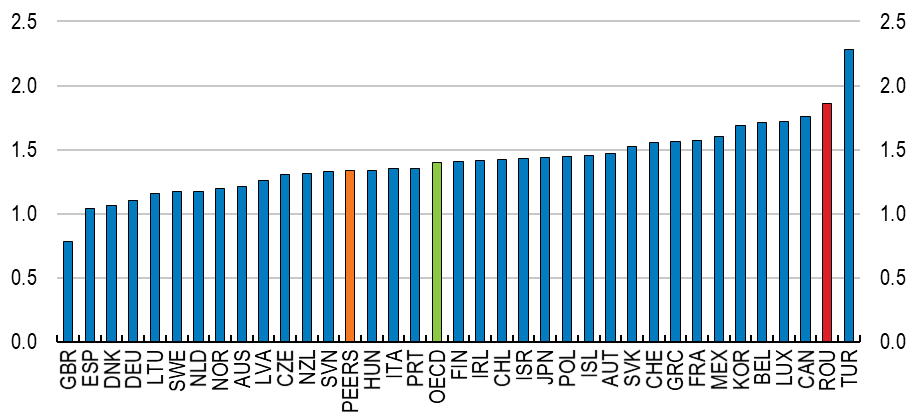
Thirdly, improving the business environment is key to foster productivity growth. The creation of highly innovative firms is limited in Romania compared with OECD countries. In parallel, around 30% of companies were loss making in 2019, suggesting market discipline is weak. For prospective firms to enter and grow unimpeded in the market, the regulatory framework needs to be improved, as it is among the most restrictive according to the OECD Product Market Regulation Indicators (Figure 2). Administrative burden on entrepreneurship and state control must be reduced. As many firms are undercapitalised, access to finance should be enhanced significantly by developing risk capital markets. Courts are congested, with a high number of backlog cases, lengthening insolvency procedures. To facilitate the smooth exit of unprofitable firms, out-of-court mechanisms should be developed, and judicial efficiency enhanced, beginning by collecting sufficient data to accurately assess the functioning of the court system. 

Figure 2. Product market regulation needs to be improved

2018, index scale 0-6 from least to most restrictive

Note: PEERS comprises the Czech Republic, Hungary, Lithuania, Latvia, Slovakia, Slovenia, and Poland.
Source: OECD (2018), Product Market Regulation Database

The quality of infrastructure remains low compared with OECD countries, undermining sustainable productivity growth and regional development. Romania should seize the unprecedented opportunity offered by EU funds to invest in road and rail. The absorption of EU funds must be accelerated by ensuring policy consistency to implement prioritised investment projects without disruption. Finally, the rule of law is fundamental for a market economy to function properly. 88% of companies consider corruption is a problem when doing business in Romania. Recent efforts by the Romanian government to fight corruption should be intensified. 

References 

OECD (2022), OECD Economic Surveys: Romania 2022, OECD Publishing, Paris, https://doi.org/10.1787/e2174606-en.  


Platforms killed the offline star? Online platforms and the productivity of incumbent firms

By Hélia Costa, Giuseppe Nicoletti, Mauro Pisu, Christina von Rueden

Over the past decade, online platforms have become ubiquitous. People and firms increasingly turn to online platforms to exchange goods and services (including accommodation, retail products, personal and professional services) (Figure 1A). The COVID-19 shock further increased online-platform use even as they allowed people and firms to keep working and producing while respecting physical distancing rules (Figure 1B).

However, the impact of online platforms on economies and societies is complex, uncertain and hotly debated. In some cases, as the COVID-19 shock attests, online platforms can positively contribute to economies’ resilience to shocks involving severe disruptions to physical economic activity. At the same time, their long-term impacts on jobs, competition, productivity dynamics, data privacy and security, and other socio-economic dimensions are still poorly understood and likely to be mediated by policy responses.

Figure 1. Platform activity has accelerated, particularly during the COVID-19 crisis

Panel A: Platform activity has been on the rise

Panel B: Platform activity surged during the COVID-19 crisis

Note: Panel A depicts the total number of platforms in all G20 countries (left axis) and the average platform activity (expressed in the number of visits to all platforms’ websites in each country over each country’s population) across 12 G20 countries for which data are available for all years (right axis). Panel B shows the growth in online-platform activity in areas allowing for physical distancing (measured as the change of the Google Trends searches for online platforms) in the first 6 months of 2020 relative to the first six months of 2019.
Source: Costa et al. (2021a) and OECD (2020).

Against this backdrop, in two recent papers (Costa et al., 2021a and Costa et al., 2021b) we use novel data sources to document the diffusion of online platforms across OECD and G20 countries (with the exception of China and Colombia) over the past 10 years and investigate their impact on firm-level productivity growth. We focus on platforms allowing two or more distinct but interdependent sets of users (firms or individuals) to exchange goods or services via the Internet. Using web-scraping techniques, we create the most comprehensive list yet of online platforms active in each of the 43 countries covered in this study over 2013-2019. We classify platforms in nine areas of activity (e.g. accommodation, personal services, transportation). The final list covers about 1 300 platforms and includes not only large and well-known platforms but also smaller and country-specific ones. We proxy online-platform use with online platforms’ website traffic data (i.e. the number of visits to online platforms’ websites).

How do online platforms affect the productivity of incumbent firms?

Online platforms could affect productivity through a variety of channels. First, platforms in direct competition with incumbent firms (such as Uber or Airbnb) can encourage innovation, raising incumbent firms’ productivity or force the exit of the less productive ones. Second, platforms that connect existing service providers with consumers (such as Booking.com or Thefork) can contribute to incumbent firm productivity growth by enhancing market transparency – through for instance review systems and price comparisons – and providing improved services such as booking systems and logistics. At the same time, platforms could hinder aggregate productivity growth by weakening market selection, making it easier for small and less productive firms to enter the market and survive (Schwellnus et al., 2019).

Our results indicate that online platform activity is positively associated with labour productivity growth of incumbent firms. Point estimates suggest that doubling online-platform activity is on average associated with a 2.3 percentage point increase in firm-level labour productivity growth. These productivity gains are attributable to increases in value added and not reductions in employment. Access to services provided by online platforms, such as logistics, marketing, tailored advertising, dispute resolutions and others can make it easier for incumbent forms to reach new clients and improve service quality, boosting firms’ revenues and value added.

The productivity benefits generated by online platforms differ across firms. They are larger for SMEs – with a positive and significant relationship evident for firms with up to 100 employees (Figure 2, Panel A) – and for mid-range productivity firms (Figure 2, Panel B).

Figure 2. Online-platform activity benefits mostly productivity of small firms and can help lower-productive firms to catch up to the technological frontier

Panel A: Change in firm-level labour productivity growth attributable to a one standard deviation in online-platform activity in the same sector, by firm size (number of employees)

Panel B: Change in firm-level labour productivity growth attributable to a one standard deviation increase in online platform activity in the same sector, by firm labour productivity level

Note: Bars’ colour and stars indicate statistical significance level:*** 1%, **5%, *10%. Bars measure marginal effects of increasing activity by one standard deviation in percentage points, by size category (Panel A: number of employees; Panel B: labour productivity classes). Platform activity is measured by the number of visits to a platform’s website. Panel B: Labour productivity classes are defined for each sector and year and labour productivity is lagged by two years to diminish the risk of endogeneity bias. Results using once-lagged productivity remain similar.
Source: Costa et al. (2021b).

The winner-take-all dynamics that characterise online platforms’ operations can lead to market dominance based also on the accumulation and exploitation of proprietary data on user behaviour (OECD, 2018). Our analysis indicates that higher persistence among the largest platforms (i.e., less reshuffling amongst largest platforms) weakens the positive association of platform activity with firm-level productivity growth. This is indicative that less contestable online-platform markets lower the productivity benefits of online platform activity for incumbent firms.

Overall, our analysis suggests that platform diffusion can contribute to firm-level productivity growth, helping SMEs overcome barriers hampering their growth and facilitating the catch up of laggard firms towards the productivity frontier. The results also point to the importance of keeping online-platform markets open and contestable for realising such productivity benefits.

References

Costa, H., Nicoletti, G., Pisu, M., and Von Rueden, C. (2021a), “Welcome to the digital jungle: Measuring online platform diffusion”, OECD Economics Department Working Papers, No. 1683, OECD Publishing, Paris, https://doi.org/10.1787/b4e771d7-en.

Costa, H., Nicoletti, G., Pisu, M., and Von Rueden, C. (2021b), “Are platforms killing the offline star? Platform diffusion and the productivity of incumbent firms”, OECD Economics Department Working Papers, No. 1682, OECD Publishing, Paris, https://doi.org/10.1787/1e2bbe10-en.

OECD (2020), “The Role of Digital Platforms in Weathering the COVID-19 Shock, OECD Policy Responses to Coronavirus (COVID-19)”, http://www.oecd.org/coronavirus/policy-responses/the-role-of-online-platforms-in-weathering-the-covid-19-shock-2a3b8434/.

OECD (2018), Rethinking Antitrust Tools for Multi-Sided Platforms 2018, OECD Publishing, https://www.oecd.org/daf/competition/rethinking-antitrust-tools-for-multi-sided-platforms.htm.

Schwellnus, C. et al. (2019), “Gig economy platforms: Boon or Bane?”, OECD Economics Department Working Papers, No. 1550, OECD Publishing, Paris, https://dx.doi.org/10.1787/fdb0570b-en.


How will rising shipping cost affect inflation in OECD countries?

cargo ship at sea

by Sophie Guilloux-Nefussi and Elena Rusticelli, OECD Economics Department

How will rising shipping cost affect inflation in OECD countries?

Extraordinary demand and supply factors have pushed up freight prices

Shipping cost rates have soared in recent months due to the conjunction of booming demand for consumer durables from Asia and supply-side bottlenecks created by sanitary restrictions in ports and terminals. These have slowed loading and unloading operations and crew changes. Prices of containerised freight started to rise in the second half of 2020 and rose further in the first quarter of 2021, when the average quarterly increase across the main indices of global shipping costs ranged between 30% and 65% (Figure 1).

Figure 1:  Container shipping prices are on the rise since mid-2020

On the demand side, the pandemic led to a global demand drop at the start of 2020, followed by a quick recovery at the end of the same year. Pent-up demand caused by lockdowns in the first half of 2020, shifts in consumption patterns towards durable goods, and government income support all strengthened demand for goods when transportation services were still limited.

On the supply side, multiple factors are compounding shipping delays. Vessels are currently used at almost full capacity and containers remain scarce. Congestion at ports, and lower productivity at terminals and inland depots have also led to bottlenecks. Distancing rules and reinforced hygiene standards have increased intervals between crew shifts. These have prolonged processing times at ports, hampered the return of containers to Asia and generated delays along the entire shipping chain. The March blockage in the Suez Canal also added to shipping disruption and tensions.

This atypical situation is expected to persist for a few more months. Port congestion continues to be a big bottleneck in the United States, where all loading/unloading slots for cargoes from/to Asia are fully booked throughout the second quarter of 2021. The reopening of European economies is also impacting supply and demand. In this context, industry experts do not foresee any normalisation of prices before the end of 2021.

Rising shipping costs could push up inflation temporarily in OECD countries

To which extent will the observed rise in global shipping costs impact inflation across OECD countries? The empirical approach to answer this question proceeds in two steps: first, quantifying the pass-through of shipping costs to merchandise import price inflation, and, second, assessing the transmission of import price inflation to consumer price inflation.

In the baseline scenario, shipping costs are assumed to rise by 50% in the first quarter of 2021 and to stabilise at the same level for the rest of the year, in line with the recent industry experts’ projections. However, the uncertainty around forthcoming container freight rates remains high and, therefore, two alternative scenarios are considered: one of anticipated normalisation in which shipping costs gradually decline to a price level slightly higher than prior to the pandemic starting from the second half of 2021, and one of delayed normalisation in which the initial rise is followed by a further 10% increase in each of the three remaining quarters of 2021.

Figure 2 – Effect of global shipping costs developments on OECD merchandise import prices and consumer prices

In the first quarter, the observed rise in shipping costs is estimated to boost merchandise import price inflation (year-on-year) in OECD countries by 2.5 percentage points on average. After four quarters, depending on the scenario, the impact on merchandise import price inflation could still be between 0.6 to 3.5 percentage points (Figure 2, Panel A). Notwithstanding the swift reaction of import costs, the pass-through to consumer price inflation would be modest. The overall rise in CPI inflation would be by about 0.2 percentage points after four quarters, with no major divergence across the three scenarios (Figure 2, Panel B). Consumer price inflation would start to recede gradually thereafter and settle back over the following 2-year period, reflecting the large inertia in price adjustments of consumption goods. Given the relatively small portion of transport costs normally incorporated in final goods value, this result is not surprising1 and is in line with previous estimates available for the US economy (based on a different methodology).2

Arguably, the rise in ocean shipping costs could compound with other input costs pressures − due to global shortages in specific industries like semiconductors − and rising commodity prices to further push up inflation  in the coming months.  However, these cost-push pressures are expected to be temporary. Inflation expectations are well anchored and global spare capacity remains sizeable. As a result, a significant and sustained pick-up in underlying inflation is unlikely beyond a few quarters and monetary authorities should look through these transitory relative price shocks.

References:

ECB (2021), “What is driving the recent surge in shipping costs?”, Economic Bulletin, Issue 3 / 2021 – Box 1.

Guilloux-Nefussi, S. and E. Rusticelli (forthcoming 2021), “Recent developments in input costs on global markets and their consequences on inflation in OECD countries”.

Herriford, T., E. Johnson, N. Sly, and A. Lee Smith (2016), “How Does a Rise in International Shipping Costs Affect U.S. Inflation?,” Macro Bulletin, Federal Reserve Bank of Kansas City.

OECD (2021), “Rising container shipping costs could push up near-term inflation in OECD countries”, OECD Economic Outlook No 109 (Edition 2021/1), Chapter 1, Box 1.3.


The Netherlands: Building a stronger recovery

By Daniela Glocker, OECD Economics Department

The Netherlands is recovering from its largest economic contraction since the Second World War. Almost overnight, the COVID-19 outbreak restricted people’s daily lives. Work and education shifted to take place from home. Many businesses offering non-essential but close contact jobs could not easily adjust, leading to a reduction in working hours or number of employed. Travel, social interactions, shopping, cultural and leisure activities were restricted to hold back the spread of the virus. The Dutch government swiftly implemented a comprehensive support package, and extended and adjusted the measures several times in response to prolonged restrictions. These policies reduced uncertainty and protected people, businesses and jobs. In combination with structural and institutional strengths and a high level of digitalisation, the generous fiscal support helped the country to weather the COVID-19 crisis with limited economic damage compared to many OECD countries (Figure 1).  

Figure 1. The economy contracted less than elsewhere
Real GDP, Index Q4 2019=100

Note: The pre-crisis growth path is based on the November 2019 OECD Economic Outlook projection, with linear extrapolation for 2022 based on trend growth in 2021.
Source: OECD Economic Outlook 106 and 109 databases.

The start of the vaccination campaign earlier this year marked the beginning of the end of the health emergency. As the Dutch roll up their sleeves, restrictions are progressively lifted, business and consumer confidence are improving, and the economy is set to recover gradually. The 2021 Economic Survey of the Netherlands foresees annual growth of 2.7% in 2021 and 3.7% in 2022, with GDP recovering the pre-crisis level at the beginning of 2022. Private consumption will drive the recovery as households can eat out, shop and enjoy many of the social, cultural and leisure possibilities that have been off-limits during the pandemic. Nevertheless, private consumption will be held back by households facing an increase in pension premiums and rising unemployment as the result of support measures being phased out. Uncertainties still abound. Quicker than expected vaccine roll out can contribute to faster economic growth, especially if returning confidence spurs people to spend some of the savings amassed during the pandemic. On the other hand, potential outbreaks of vaccine-resistant virus strains could postpone the recovery. Well-targeted fiscal support should remain in place in the short term to support the recovery, but the government should also plan forward and carefully weigh permanent spending increases against pressures emerging from population ageing and related health care expenditures. 

The 2021 Economic Survey of the Netherlands argues that coming out of the pandemic is an opportunity to build back stronger, fairer and greener, by addressing some long-standing structural challenges:  

  • In the Netherlands, a high share of workers are on non-standard contracts. This trend has increased over recent years, driven largely by lower labour costs for the self-employed and other non-standard workers than for regular employed. During the crisis, self-employed and other flexible workers on freelance or on-call contracts were more likely to lose their job as the job retention scheme mainly protected workers on permanent contracts. Temporary contracts are also used more frequently in hospitality and service sectors, which were hit hard by the COVID-19 crisis, in lower skilled occupations and among young workers. Although the government provided some income support for the self-employed, the crisis may have exacerbated income inequality. Implementing the Commission for the Regulation of Work recommendations is key to reducing labour market duality. More should also be done to reduce the gap in part-time work between women and men. 
  • People living in the Netherlands are exposed to the risk of local air pollution and to climate change risks such as floods, as large parts of the country are below sea level. People’s exposure to nitrogen emissions remains among the highest in the EU owing to high population density, high industrial and agricultural production and being home to Europe’s main seaport. A High Court ruling in 2019 stipulated a re-evaluation of permits for a range of nitrogen emitting activities, notably for construction and agriculture projects near natural preservation areas. The available nitrogen space for new developments remains limited, constraining new investment in infrastructure, buildings and agriculture. Greenhouse gas emissions are also high compared to the EU average, and a High Court ruling in 2019 mandated a 25% reduction compared to 1990 levels by the end of 2020. This prompted a reduction in coal power capacity and other measures. The 2020 target was just met, owing in part to the COVID-19 crisis that reduced economic activity and mobility. Long-run prosperity and people’s well-being hinge on the reduction of local air pollution and greenhouse gas emissions, which requires concrete national-level actions, as well as enhanced regional and international cooperation. 
  • High debt and a high share of illiquid assets, mainly housing, held by households create macroeconomic and financial vulnerabilities. Household debt is at more than 200% of disposable income, among the highest in the OECD, mainly consisting of mortgages. Limited housing supply and favourable tax treatment for owner-occupied housing have contributed to soaring house prices. As a result, home-owners are not only better off compared to people not yet owning a house, i.e. often the young and people on non-standard work contracts, due to higher equity, but also compared to investors of other assets. A possible future correction in house prices is a risk to economic growth, as households who suffer large capital losses tend to cut back on consumption in order to continue servicing their debt. A more balanced housing market with affordable prices and a better functioning rental market would not only reduce inequality and macroeconomic risks but also boost growth. A coherent package of reforms is needed, including to the tax treatment of owner-occupied housing, spatial planning and rental regulations.  

As the Netherlands re-emerges from the shadows of the pandemic, and people and businesses are weaned off emergency support, it is not the time to return to the old ways. It is the time to build a new future. A future that is better.  


The Tortoise and the Hare: The Race Between Vaccine Rollout and New COVID Variants

by David Turner, Balázs Égert, Yvan Guillemette and Jarmila Botev, OECD Economics Department

Variants of the virus causing COVID-19, notably the so-called ‘UK variant’, account for a large part of the resurgence of infections in many OECD countries since the latter part of 2020. Seasonal effects also drive fluctuations in virus incidence. More recently, vaccination has been very effective at curbing COVID-19 infections, substituting for lockdown policies at much lower costs to the economy. Those are among the main findings of a recent Economics Department Working Paper ­– The Tortoise and the Hare: The Race Between Vaccine Rollout and New COVID Variants – an update to a previous version of the study published last year.

The study relates country-level daily reproduction numbers for OECD countries to several potential explanatory factors, including containment policies, public-health policies, seasonal conditions, the prevalence of variants, vaccination rates as well as proxies for spontaneous behavioural changes and natural immunity, all at once within the same framework. It also relates containment policies to the OECD weekly GDP tracker to study their effects on economic activity.

Some new variants of the virus are estimated to be able to boost the effective reproduction number by up to 50%. Seasonal effects are also found to increase the effective reproduction number in fall/winter, in some countries by up to 25% relative to summer. The rapidity of these adverse shocks represent a major challenge to policy-makers because they can coincide and take full effect over a matter of a few months. The two effects together can potentially boost reproduction numbers by up to 90%.

Thankfully, vaccination is found to powerfully reduce the spread of the virus. The estimated effects can be stated in intervention-equivalent terms (see figure). Fully vaccinating…

  • 7% of the population is equivalent to either complete school closure, requiring people not to leave the house with minimal exceptions, or banning all public gatherings;
  • 15% of the population is equivalent to closing down all-but-essential workplaces;
  • 20% of the population is equivalent to closing down all-but-essential workplaces as well as public transport;
  • 50% of the population is equivalent to simultaneously applying all of the above restrictions as well as closing all international borders.

And, of course, vaccination does not have the damaging effects on economic activity that lockdown policies have, rather it boosts activity by enabling lockdown policies to be eased. The study’s results are used to examine a few scenarios that differ in the presence of COVID variants and the speed of vaccination.

In a baseline scenario without variants nor vaccines, stringent containment policies are needed to keep the reproduction number below 1, and the situation is nevertheless precarious in that many factors, including seasonal influences, have the potential to push the reproduction number above 1 and so lead to a surge in infections.

Another scenario assumes that the UK variant becomes predominant, leading to an increase in transmissibility of the virus by 35%. It shows that with only 13% of the population fully vaccinated (which corresponds to the OECD median in mid-May), the reproduction number remains above 1. Policy-makers then face difficult choices about which containment policies to tighten further. For instance, schools might need to remain closed full time, which would be just sufficient to keep the reproduction number below 1.

A more optimistic scenario illustrates how quick vaccine rollout not only avoids the need to tighten containment polices despite the presence of the UK variant, but enables those in place to be progressively relaxed. For example, with 40% of the population fully vaccinated (which is close to the shares in the United States and United Kingdom at end-May), there is no need for any stay-at-home requirements or workplace closure and restrictions on gatherings can start to be relaxed, which has the added benefit of raising GDP by 4% relative to the baseline scenario.

Together, the scenarios suggest that a rapid rollout of vaccinations is needed to compensate for the pressure from more infectious variants and avoid a cycle of stop-and-go mitigation policies. For those countries now going into summer, it is also important that policy-makers are not lulled into a false sense of security by the temporary decline in reproduction numbers due to seasonal factors, as in the summer of 2020. Failure to vaccinate a sufficient share of the population could then lead to a resurgence of the virus in the winter as seasonal factors reverse.

Further reading

Turner, D., B. Égert, Y. Guillemette and J. Botev (2021), “The Tortoise and the Hare: The Race Between Vaccine Rollout and New COVID Variants”, OECD Economics Department Working Papers, No. 1672, Paris, OECD Publishing.


América Latina tras el COVID-19: cómo impulsar una recuperación tan deseada

Jens Arnold, Aida Caldera-Sánchez, Paula Garda, Alberto González Pandiella, Alvaro S. Pereira. Departamento de Economía, OCDE

América Latina es una de las regiones más golpeadas por el COVID-19 y tendrá una recuperación más lenta. La región ha concentrado cerca de 1 millón de muertes, o un tercio del total de muertes por COVID-19 en el mundo. En términos económicos también es la región que más se ha visto afectada en mundo con una caída del PIB de alrededor de 7% en 2020, comparado con 5% de media en la OCDE. Esto es debido a las características estructurales de la región: sistemas sanitarios y redes de seguridad social débiles, grandes sectores informales, fuerte dependencia del turismo, gran proporción del empleo en ocupaciones no compatibles con el trabajo a distancia, y un margen limitado para el apoyo fiscal. Hacia adelante la OCDE prevé que el crecimiento de seis grandes economías de la región, que abarcan alrededor del 85% del PIB de América Latina, sea del 4.9% en 2021, y un 2.8% en 2022 (Tabla). La recuperación de la actividad económica se ha frenado a inicios del 2021, frente a las nuevas medidas de contención en la mayoría de los países de la región, y se retomará a medida que avanzan los procesos de vacunación y mejora la situación sanitaria. Pero la recuperación será gradual, sin recuperar el terreno perdido en el PIB per-cápita ni siquiera en 2022 (Gráfico 1).

Existe una alta incertidumbre en torno a la evolución de la pandemia y los procesos de vacunación, así como importantes vulnerabilidades. La prioridad inmediata en la región debe ser evitar más brotes del COVID-19, fortaleciendo los sistemas de salud y acelerando la vacunación, siguiendo el ejemplo de Chile que ha visto uno de los procesos de vacunación más rápidos del mundo. En este sentido, la cooperación internacional y la efectiva distribución de vacunas a través de COVAX será crucial. En algunas economías de la región el incremento de los precios de las materias primas está dando un respiro a las apretadas arcas fiscales y un viento de cola a la inversión y al crecimiento económico. El aumento de las remesas y el crecimiento de la economía global también apoyan positivamente, particularmente a las economías más abiertas. Sin embargo, la región tiene cuentas fiscales frágiles y es muy sensible a cambios en las condiciones financieras globales, como se vio a inicios del 2021. Episodios de violencia y malestar social, presentes desde antes de la pandemia, siguen siendo un riesgo más que vigente, que podrían retrasar la recuperación. El incremento de la deuda pública, debido a los esfuerzos que han hecho muchos países para paliar los efectos negativos del COVID-19, dejan sólo un estrecho margen para la política fiscal, si no se hacen reformas (como ya lo discutimos aquí), y es una de las principales vulnerabilidades en la región. Asimismo, se aproximan años de elecciones en varios de los países de la región. Todos esos factores crean un ambiente de incertidumbre y volatilidad.

Para lograr la tan deseada recuperación, América Latina tiene que revertir el impacto negativo de la pandemia y continuar reduciendo la pobreza y las desigualdades, que ya eran altas antes de la pandemia. Las cifras en algunos países de la región ya comienzan a mostrar que la pobreza y la desigualdad de ingresos se han incrementado, con pérdidas de empleo que alcanzan a más de 14 millones de personas desde que empezó la pandemia. Los más vulnerables fueran los más afectados: las mujeres, los más jóvenes, y los trabajadores informales (Gráfica 2, panel A). La recuperación del empleo es incipiente, pero está liderada por los informales, amenazando con un aumento persistente de la informalidad. Y esto es aún más grave para los jóvenes, ya que los primeros trabajos tienden a tener impactos duraderos en sus carreras y salarios.

El cierre de las escuelas puede tener graves consecuencias a largo plazo. Con 300 días de escuela perdidos, el doble de la media de países OCDE (panel B), América Latina ha sido la región del mundo donde las escuelas han estado más tiempo cerradas. A día de hoy, unos 114 millones de estudiantes siguen sin poder asistir en persona. El efecto es aún más negativo para los más vulnerables, aquellos que no tienen acceso a educación digital y conectividad, y a tantos niños de hogares más desfavorecidos que han abandonado la educación escolar por completo. Es probable que la pandemia amplíe las ya elevadas brechas de resultados educativos por nivel socioeconómico, impactando negativamente los salarios futuros y la productividad e incrementando fuertemente la desigualdad de oportunidades (como lo demuestran Lustig y coautores aquí). El cierre de escuelas limita además el crecimiento del empleo femenino, que ha sido uno de los más impactados por la pandemia. 

Es más urgente que nunca emprender reformas que permitan una rápida recuperación asegurando al mismo tiempo que nadie se quede atrás. Las trasferencias monetarias, el mayor acceso a los beneficios de desempleo y/o subsidios al empleo y a la contratación son fundamentales para mitigar los impactos negativos de la crisis y acelerar la recuperación. Y más allá de la necesidad de mantenerlos hasta que la recuperación esté afianzada, este es el momento oportuno para repensar y fortalecer los mecanismos de protección social de forma permanente (como lo hemos hablado aquí). Esfuerzos para reducir la carga regulatoria son particularmente pertinentes en este momento ya que facilitarían la creación de empresas y empleos formales sin impactos significativos en los presupuestos. Como por ejemplo reduciendo los elevados costes de registro para las empresas (especialmente las PYMEs y las empresas nuevas), o costes laborales no salariales elevados (e.g. Colombia) o las contribuciones a la seguridad social para los trabajadores de bajos ingresos (Argentina).

No menos importantes son mejorar la educación y los sistemas de capacitación. Programas de recuperación y para reintegrar en el sistema educativo a aquellos que lo abandonaron durante la pandemia son fundamentales para revertir los impactos negativos de los cierres de escuelas. Reasignar más recursos hacia las etapas más tempranas de la educación (preescolar y primaria) y la escolarización a jornada completa (e.g. Colombia) ayudaría a hacer los sistemas educativos de la región más equitativos y paliar los efectos de la pandemia. Reforzar los sistemas de capacitación ayudaría a los trabajadores, en especial a los más vulnerables, a encontrar trabajos de calidad en el mundo post-Covid.

Lo que la región haga ahora determinará la rapidez con la que se recupere y el tipo de recuperación. No es momento de retirar el apoyo fiscal a las economías y debilitar la incipiente recuperación, pero los países deben comenzar el proceso de discusión e identificación de las reformas para recomponer la situación fiscal. Una implementación creíble, que puede ser gradual, es clave para asegurar la sostenibilidad de las finanzas públicas y revertir los aumentos de pobreza y desigualdades. En muchos países de la región, la fuerte y necesaria acción de las políticas fiscales en apoyo de los más afectados dejará cuentas a pagar en el futuro. Los países tendrán que aumentar los ingresos fiscales y repensar algunos gastos existentes. En el actual contexto de incertidumbre en los mercados financieros, será importante reforzar la voluntad de pagar esa cuenta en el futuro para no afectar el acceso a financiamiento y aumentar los gastos con intereses, porque eso dejaría aún menos recursos para áreas prioritarias como salud, educación o protección social.

Con la recuperación afianzada se puede crear el consenso social para lograr una mayor progresividad tanto en los impuestos como en los beneficios sociales. Todos los países de la región tienen margen para incrementar la eficiencia del gasto, focalizar el gasto social en los más vulnerables, incrementar la progresividad de los impuestos sobre la renta y reforzar la lucha contra la evasión fiscal. Incrementar el uso de impuestos verdes, siempre que se compense a los más vulnerables, tiene el doble beneficio de acelerar la transición hacia una economía baja en carbono e incrementar recursos fiscales. Fortalecer los marcos fiscales, incluyendo las reglas fiscales y los consejos fiscales independientes ayudaría a incrementar la credibilidad en la sustentabilidad de las finanzas públicas.

Tabla. Perspectivas Económicas para América Latina

Nota: AL es la media ponderada por PIB a paridad de poderes de compra de los 6 países en la tabla.
Fuente: Perspectivas Económicas de la OCDE n. 109, mayo 2021.

Gráfico 1. La pandemia está dejando un daño duradero en América Latina

Nota: AL se refiere a la media ponderada por PIB a paridad de poderes de compra de Argentina, Brasil, Chile, Colombia, Costa Rica y México.
Fuente: Perspectivas Económicas de la OCDE N. 109, mayo 2021 y N. 106, noviembre de 2019.

Gráfico 2. El impacto desigual del COVID-19

Nota: En el Panel A, AL es el promedio simple de Argentina, Brasil, Chile, Colombia y México. En el Panel B, AL es el promedio simple de Argentina, Brasil, Chile, Colombia, Costa Rica y México. Informales medidos como trabajadores sin seguridad social, salvo en Colombia que son trabajadores en empresas de menos de 5 empleados. El cierre de escuelas se mide en días desde marzo 2020 hasta abril 2021. La definición de cierre parcial se refiere a sólo algunos niveles o categorías, por ejemplo, sólo la escuela secundaria, o sólo las escuelas públicas. Cierres regionales cuentan como ½.
Fuente: Cálculos de la OCDE en base a Encuestas del Mercado laboral: INE- ENE para Chile, INEGI-ENEO nuevo y ENEO para México, DANE-GHEI-Mensual, IGEB-PNAD para Brasil, INDEC- EPH para Argentina y Oxford COVID-19 Government Response Tracker.

Para leer en más detalle sobre las proyecciones macroeconómicas, así como los principales desafíos estructurales ir al reporte en la o la versión español y portugués o versión inglés (que incluye proyecciones para todos los países de la OECD y principales desafíos).

Información detallada para estos 6 países con sus notas país correspondientes:

Argentina | Brasil | Chile | Colombia | Costa Rica | México


Una recuperación fuera de lo común

También disponibe en English | Français | Portugués | Deutsche

Laurence Boone | OECD Chief Economist
Laurence Boone,
Economista Jefe de la OCDE

Nos reconforta comprobar que las perspectivas económicas están mejorando, pero nos preocupa que lo hagan de una forma tan dispar. El crecimiento mundial sigue recuperándose pese a los nuevos rebrotes del virus, menos frecuentes, pero más dispersos por el mundo. Prevemos que el producto global crecerá casi un 6% este año, un auge impresionante tras la contracción del 3½ por ciento de 2020. Aunque la recuperación permitirá que la mayor parte del mundo retorne a niveles prepandémicos de PIB para finales de 2022, esto dista mucho de ser suficiente. La economía mundial permanece por debajo de su trayectoria de crecimiento previa a la pandemia y son demasiados los países de la OCDE en los que a finales de 2022 no se habrán alcanzado los niveles de vida esperados antes de la pandemia.

Las contundentes medidas de política han sentado las bases para la recuperación sanitaria y económica. Dieciséis meses después del inicio de la pandemia, muchos países controlan mejor los nuevos brotes del virus. Los gobiernos han administrado cerca de 2.000 millones de dosis de vacunas, y la capacidad mundial de ensayo, producción y administración de vacunas ha mejorado rápidamente. La red de protección que los gobiernos han desplegado con sus políticas no tiene precedente y ha preservado el tejido económico, empresas y empleos en la mayoría de las economías avanzadas y en algunas economías emergentes. Nunca antes las políticas públicas habían proporcionado un apoyo tan rápido y eficaz en una crisis —en el ámbito sanitario, con el desarrollo de vacunas en tiempo récord, y en los frentes monetario, fiscal y financiero—. Como consecuencia, el sector manufacturero está creciendo rápidamente, el comercio de mercancías repunta con fuerza a medida que las fronteras se reabren, y los viajes se están reanudando poco a poco. Además, la reapertura trae consigo un fuerte incremento del consumo y de las horas trabajadas. Esto es muy alentador, ya que debería limitar las secuelas de la crisis.

No obstante, persisten demasiados factores adversos.

Resulta sumamente inquietante que no estén llegando suficientes vacunas a los países emergentes y de bajos ingresos. Esto expone a estas economías a una grave amenaza, porque tienen menos capacidad para apoyar la actividad económica que las economías avanzadas. Si el virus provocara un nuevo debilitamiento del crecimiento, este sería más difícil de amortiguar y causaría nuevos incrementos de la pobreza extrema e incluso posibles problemas de financiación soberana si en los mercados financieros se dispararan las alarmas. Esto resulta aún más preocupante porque, dejando a un lado el impacto sobre las vidas y los medios de subsistencia, el coste económico y social a escala mundial de mantener cerradas las fronteras hace que parezcan insignificantes los costes de ampliar el acceso de estos países a vacunas, pruebas diagnósticas y suministros sanitarios. 

En términos más generales, mientras la gran mayoría de la población mundial no esté vacunada, todos nosotros seguiremos siendo vulnerables a la aparición de nuevas variantes. La imposición de nuevos confinamientos y la intermitencia de las actividades económicas podrían socavar gravemente la confianza. Las empresas, hasta ahora bien protegidas pero a menudo más endeudadas que antes de la pandemia, podrían quebrar. Los miembros más vulnerables de la sociedad correrían el riesgo de sufrir períodos prolongados de inactividad o reducciones de ingresos, lo que agravaría las desigualdades, tanto dentro de los países como entre ellos, y podría desestabilizar las economías.   

Un nuevo riesgo que está suscitando mucho debate es la posibilidad de un ascenso de la inflación. Los precios de las materias primas han subido rápidamente. Los cuellos de botella en algunos sectores y las perturbaciones del comercio están generando tensiones en los precios. Estas perturbaciones deberían de empezar a desaparecer a finales de año, a medida que la capacidad de producción se normalice y el consumo recupere el equilibrio, con un aumento del consumo de servicios en detrimento del de bienes. En los mercados de trabajo continúa habiendo mucha holgura, lo que limita el crecimiento de los salarios. Así las cosas, estamos seguros de que, mientras las expectativas de inflación sigan bien ancladas y el crecimiento de los salarios permanezca moderado, los bancos centrales continuarán vigilantes pero no reaccionaran a estas subidas de precios temporales. Lo que es más preocupante es el riesgo de que los mercados financieros sí reaccionen ante las subidas temporales de los precios y los ajustes de los precios relativos, lo que provocaría un ascenso de los tipos de interés de mercado y de la volatilidad. Hay que estar vigilantes.

Cuando se produzcan cuellos de botella en sectores con una elevada concentración de la producción, como los chips electrónicos, y esto ponga en peligro grandes partes de la cadena de suministro, los gobiernos deberían hacer todo lo que esté en su mano para reducir esas tensiones, mediante una intensificación de la cooperación en materia comercial y medidas encaminadas a diversificar las fuentes de suministros. Una de las principales lecciones de esta crisis es la necesidad de prestar más atención a la resiliencia de las cadenas de suministro, como demuestra la escalada de precios en sectores en los que la producción está excesivamente concentrada. En términos más generales, los gobiernos también tienen un  papel que jugar para afrontar los riesgos de inflación aplicando políticas que eleven el crecimiento del producto potencial y refuercen la competencia y el comercio.

Ahora que los países navegan hacia mejores perspectivas, sería peligroso creer que los gobiernos ya están haciendo lo suficiente para lograr un crecimiento más fuerte y de mejor calidad, especialmente teniendo en cuenta el objetivo de descarbonización. Proporcionar apoyo flexible y condicionado a la evolución de la economía a ciudadanos y empresas es esencial para anclar las expectativas de que el apoyo fiscal continuará y se focalizará, hasta que las economías hayan retornado o se acerquen mucho al pleno empleo. En particular, es crucial apuntalar los balances de pequeñas empresas viables por medio de aplazamientos de impuestos o subsidios. También resulta esencial que se ponga en marcha suficiente inversión pública para las transiciones digital y ecológica y que los fondos se gasten de forma rápida y eficiente. Esto también contribuiría a fomentar la inversión privada en los citados ámbitos. Por último, para reforzar la confianza se deberían dar señales de que se va a establecer un marco fiscal claro, eficaz y sostenible y de que se están elaborando planes fiscales a medio plazo. Estos deberían estar basados en evaluaciones del gasto público, para garantizar que las prioridades se ajustan a los objetivos y a las necesidades de los ciudadanos, así como en revisiones de los impuestos, con el fin de que el sistema tributario sea justo, eficiente y progresivo. 

La economía mundial navega actualmente hacia la recuperación, con múltiples fricciones. El riesgo de que no se alcance o no se generalice un crecimiento pospandémico suficiente es elevado. Esto dependerá en buena medida de la adopción de marcos de política flexibles y sostenibles, así como de la calidad de la cooperación internacional.

Editorial de las Perspectivas Económicas de la OCDE