Ensuring high but sustainable growth in Türkiye

A tower in the historic part of Istanbul

By Sébastien Turban, Economist, OECD

Türkiye has been one of the fastest-growing economies in the OECD over the past decade, leading to a significant improvement of labour market and social outcomes. However, the income gap with OECD countries remains large. In addition, growth had become unsustainable in the years following the Covid crisis since it relied excessively on domestic demand, which lead to large internal and external imbalances in 2022, notably very high inflation and a sizeable current account deficit.

In this context, the new 2025 OECD Economic Survey of Türkiye (OECD, 2025a) contains four main messages:

  1. Prudent macroeconomic policies are a pre-requisite for sustainable growth.
  2. Higher productivity gains are needed to speed up convergence towards other OECD economies.
  3. The economy would hugely benefit from a higher labour force participation of women.
  4. A greener economy requires more ambitious policies, notably transitioning away from coal.

Following the May 2023 elections, a more prudent macro-economic policy mix has been implemented. The Central Bank has gradually raised interest rates, and the government is planning a fiscal consolidation for the coming years. This policy has started to bear fruits, with a reduction of imbalances, including a gradual fall in inflation (Figure 1). Maintaining tight monetary policy and fiscal discipline will be essential until inflation is firmly under control. Over the long term, improving public finances will require structural reforms. This includes reducing the scope of reduced VAT rates, a broader income tax base (in particular by tackling informality), and targeting better social assistance to help reduce the high level of inequalities.

Productivity has increased faster in Türkiye than other OECD countries in the last decades, but potential GDP per worker remains relatively low. Higher productivity gains, in particular in services sectors, require supporting innovation, upskilling the labour force, and reducing barriers to the conduct of business activity. The Economic Survey discusses three important steps in this respect.

  • Firstly, Türkiye could boost homegrown innovation by supporting collaborations between businesses and research to promote broader technology adoption.
  • Secondly, the skills of the labour force could be improved to adapt to future challenges. Important skills mismatches remain and incentives for tertiary education institutions to offer courses more aligned with labour market needs could be further enhanced.
  • Finally, business dynamism in Türkiye remains hampered by tighter regulations relative to other OECD countries (Figure 2). In particular, barriers in professional services could be lowered.

Boosting the participation of women in the labour force would hugely benefit the economy. This would increase the pool of talents the economy needs, especially as population is ageing, with a contribution to growth of working-age population set to decline. The labour force participation of women aged between 15 and 64 years old, at 40.9% in 2023, remains significantly below the OECD average of 66.7% (Figure 3). A combination of policies would help closing the gap between women and men on labour markets, such as expanding public investment in early childhood education and care (ECEC), introducing shareable paid parental leave, and increasing child-related benefits.

Finally, achieving the ambitious target of zero net emissions of carbon by 2053 will require more ambitious policies since greenhouse gas emissions are still growing. Türkiye has made recent progress in its climate change strategy by ratifying the Paris Agreement in 2021, updating its Nationally Determined Contribution in 2023 and documenting strategies and action plans thoroughly. However, current policies are likely to be insufficient to achieve the ambitious objectives. In particular, two important steps can be taken to bring the reduction in emissions forward. First, the effective carbon tax should be higher. Today, the effective price of carbon in Türkiye is EUR 8 per ton of CO2 equivalent, against EUR 62 in the OECD (OECD, 2023). Second, Türkiye will need to transition away from coal for energy supply as this polluting energy source still represents 26% of energy supply (against 12% in the OECD) and contributes to emissions of fine particulates with significant adverse health effects (OECD, 2025b).

References

OECD (2025a), OECD Economic Surveys: Türkiye 2025, OECD Publishing, Paris,
https://doi.org/10.1787/d01c660f-en.

OECD (2025b), Environment at a Glance Indicators, OECD Publishing, Paris,
https://doi.org/10.1787/ac4b8b89-en.

OECD (2023), Effective Carbon Rates 2023: Pricing Greenhouse Gas Emissions through Taxes and Emissions Trading, OECD Series on Carbon Pricing and Energy Taxation, OECD Publishing, Paris, https://doi.org/10.1787/b84d5b36-en.


Upgrading Turkey’s macroeconomic policy institutions to boost the recovery after the COVID-19 shock

by Dennis Dlugosch and Rauf Gönenç

Past OECD Economic Surveys of Turkey had underscored that Turkey’s transition towards more transparent and rule-based macroeconomic  – fiscal, monetary and macrofinancial – and structural – product, labour and capital market- policy frameworks would better mobilise the potential of the economy and Turkish people and deliver stronger and more sustainable growth.

In the aftermatch of the COVID-19 shock, the 2021 Survey emphasises that the need to strengthen policy institutions and frameworks remains central to facilitate the recovery from the pandemic and to support the transition to a less volatile economy.

To support the economy during the pandemic, the government has some fiscal space to take necessary measures, at least in the short-term. However, so far, policymakers have relied almost entirely on quasi-fiscal channels like public bank lending and government credit guarantees (see Figure 1). This helped to minimise the immediate fiscal bill of the pandemic, but at the cost of transparency of the subsidy and its targeting to the businesses and households most in need. Further costs for public finances may also come in the form of contingent liabilities of a yet undetermined magnitude. The 2021 OECD Economic Survey recommends that future support related to the pandemic should be provided in a more transparent and coherent fiscal policy framework. Such a coherent policy framework should encompass fiscal, quasi-fiscal but also monetary and financial policies. The publication of a regular Fiscal Policy Report would contribute significantly to increase the transparency of all public financial liabilities.

The pandemic has amplified Turkey’s longstanding monetary policy challenges. Inflation had remained well above target for many years before the pandemic. The OECD Survey recommends to restore a strong institutional basis for monetary policy by restoring the independence of the Central Bank, including with the help of legislative measures reinforcing the inamovibility and extending the tenure of its management.  Establishing an active communication system on various aspects of its foreign reserve position would address information needs of domestic and international investors for a more detailed net reserves gauages.

Despite significant progress in the prudential regulation of Turkish banks following good international practices since the 2000s, the economic implications of the COVID-19 shock are adding to pressures on credit quality, already weakened by the turning of the credit cycle in recent years. One concern relates to the large weight of banking and credit channels in financial intermediation, with a resulting significant increase in debt leverage in the business sector. Further, the role of government-owned financial institutions and capital allocation regulations considerably expanded. Related risks in the overall operation of the financial system increased with the Covid-19 shock, as government support was mainly provided through credit instruments further increasing firms’ and households’ indebtedness. Public banks gained a large weight in credit markets, and prudential leniency mesures delayed the reporting of bad loans and adjustments in bank balance sheets. The OECD Survey recommends to reinforce the institutional basis of macrofinancial policies, with policymakers communicating actively on how they evaluate and address the risks of deterioration in banks’ asset quality, publishing the results of the stress tests of individual banks and of the banking system as a whole, and involving the Turkish Competition Authority to ensure a level playing field between public and private banks, as well as between public and private borrowers in access to finance.

Strengthening Turkey’s macroeconomic policy institutions would increase policy credibility, reduce risk-premia, encourage long-term capital inflows and help to boost the recovery. As a result, improved domestic and international confidence, lower risk premia and thus lower long-term interest rates would provide a more favourable foundation for strong and sustainable growth. Building on the remarkably entrepreneurial and young population and a very dynamic business sector, a strong macroeconomic foundation would allow well-designed structural policies to lift employment rates of women and men, job quality, household incomes and well being. A priority should be to address informal and semi-informal practices, for example by reducing high employment costs and rigid employment rules but also to remove any remaining regulatory barriers to the upscaling of smaller firms. Increasing the provision and quality of early child education would allow for more inclusive employment opportunities. Improving the eco-system for equity financing, for example through incentives in the corporate tax system, would provide the business sector with additional means to grow in the aftermath of the pandemic.

Reference
OECD (2021), OECD Economic Surveys: Turkey 2021, OECD Publishing, Paris.
https://doi.org/10.1787/2cd09ab1-enCD


Improving the quality of business investment in Turkey

by Rauf Gonenc, Head of the Turkey Desk, OECD Economics Department

Turkey’s business sector exhibits one of the highest investment rates among OECD countries. However, the 2018 Economic Survey of Turkey (OECD, 2018) suggests that the quality of investment could be enhanced by overcoming the fragmentation of the business sector and by improving the current business environment. A comprehensive micro dataset allowed to distinguish four types of firms whose investment dynamics and challenges differ: i) small businesses with a high degree of informality, ii) medium-sized family firms, iii) large listed corporations, and iv) skilled young start-ups. There is room for increasing the share of knowledge-based and long-term investments – notably innovation, training, digitalisation and R&D investments – in all these types of firms at lower and internationally competitive investment costs.

The small informal businesses – which employ the largest share of Turkey’s labour force – have very  limited access to bank credits and no access to external equity capital as of today. Their ability to fund long-term knowledge-based assets is highly restricted. Medium-sized family firms which have played a central role in Turkey’s strong growth over the past decade are better endowed, and keener, to invest in long-term assets, but are over-leveraged vis-à-vis domestic banks, which restricts their additional investment capacity. Domestic bank loans are also typically of short maturity and entail roll-over risks for the financing of long-term investments. Even so, the majority of family firms refrain from reaching out to securities markets and to external shareholders. Large, listed firms have, in contrast, a good access to national and international debt and equity securities markets, but Turkey’s high risk premia increase their cost of financing above international competitors’. The last group of young skilled start-ups is backed by myriad government incentives at their phase of emergence, but need more risk-sharing and long-term private capital to continue to expand.

Turkeyinvestment2018

Cultivating Turkey’s equity eco-system would help these different types of firms to develop their long-term, knowledge-based, productivity-enhancing investments. Some obstacles include limited financial transparency of firms, incompatibilities between local and international governance standards, complex and frequently changing tax and subsidy systems, and too restrictive labour market rules which reduce the flexibility of firms and amplify investment risks in the formal sector. The modernisation of the business environment in all these domains would accelerate the emergence of more equity-specialised financial intermediaries, accounting experts, legal and financial advisors, research analysts and market makers. The development of this eco-system is essential for improving mutual confidence between all types of enterprises and potential investors from their local, national and international environments.

The modernisation of the business environment has been ranking high on the government’s agenda for some time. Domestic and regional geo-political circumstances have so far limited progress, and even led to setbacks in some areas such as the rule of law, judiciary independence or the fight against corruption. With the tempering of political uncertainties after the June 2018 elections, a window of opportunity opens for resuming the reform process. The OECD Survey suggests that a three-fold modernisation strategy emphasising i) the formalisation of informal and semi-formal businesses, ii) the introduction of more state-of-the-art management and digital skills in all types of firms, and iii) the rebalancing of financing structures from debt to equity would help the entire business fabric to upgrade the quality of capital formation. Progress would not only contribute to the rebalancing of growth through a more productive and internationally competitive business sector, but also to social inclusion and cohesion through the creation of high-quality formal sector jobs in the entire country.

Find out more:

OECD (2016), OECD Economic Surveys: Turkey 2016, OECD Publishing, Paris.

OECD (2018), OECD Economic Surveys: Turkey 2018, OECD Publishing, Paris.


Growth remains buoyant in Turkey but fundamentals need to be strengthened

by Volker Ziemann, Turkey Desk, OECD Economics Department

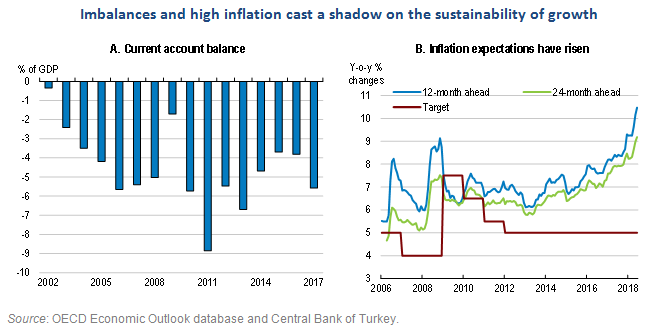
Despite numerous headwinds and adverse shocks, Turkey’s real GDP has grown by more than 34% over the past 5 years, faster than any other OECD country except for Ireland and only slightly less than China and India. The revision of national accounts in early 2017 not only pointed at higher than previously accounted growth since the global financial crisis, but also exhibited much higher shares for private consumption and investment, notably construction, in overall output underscoring long-lasting imbalances (e.g. OECD, 2016). Indeed, despite a significant rebound of exports in late 2017 and early 2018, growth still excessively relies on domestic demand amplifying the Turkish economy’s dependence on capital inflows (Panel A). Expansionary fiscal policy ahead of the June 2018 elections had further amplified these imbalances. The clear outcome of the polls should allow the government to implement fiscal restraint and realign its policies with the government’s Medium-Term Programme. It is essential to make progress with the transparency of general government accounts according to national accounting standards to preserve the hard-won credibility of public finances.

Turkey2018macro1

Inflation has been on the rise and remained in double-digit territory since early 2017 undermining confidence, international competitiveness and households’ purchasing power. Inflation expectations have continued to drift away from the 5% target (Panel B). Market participants increasingly questioned the central bank’s capacity to conduct a credible and forward-looking policy of inflation targeting amid doubts about its independence. Despite substantial increases in the central bank’s average funding rate, the mere fact of using the unorthodox late night liquidity window as a main funding tool spurred doubts about the commitment to maintain a tight stance over an extended period to re-anchor expectations and bring about disinflation. Against this backdrop, the simplification of monetary policy around a single standard interest rate in June 2018 is a welcome step towards re-establishing credibility. Going forward, a firm commitment from all stakeholders to the central bank’s independence would be supportive and help the bank to fulfil its mandate.

Alongside sound fiscal and monetary policy, the improvement of governance institutions and the reform of the banking sector were the main pillars of Turkey’s economic success over the past 15 years. While the banking sector still looks solid, a recent deterioration in the perceived quality of public governance and the stalling EU Accession process weigh on the business environment in general and the economy’s capacity to attract foreign direct investment in particular. The government’s goal to improve Turkey’s position in the Doing Business indicator is promising and should be used as an anchor to resume progress with respect to the rule of law, judiciary independence and the fight against corruption.

Find out more:

OECD (2016), OECD Economic Surveys: Turkey 2016, OECD Publishing, Paris.

OECD (2018), OECD Economic Surveys: Turkey 2018, OECD Publishing, Paris.


Reaping the benefits of global value chains to rebalance the Turkish economy

By Volker Ziemann, Economist, Turkey Desk, Country Studies Branch, OECD Economics Department

The growing role of global value chains (GVCs) in international production processes is of critical importance for Turkey’s development. Participation in GVCs is one of the key drivers of successful productivity diffusion in a globalised world. Despite major progress, Turkey still lags behind most comparable countries in terms of exported value added per capita.

Backward integration, that is the use of foreign inputs to produce final and intermediate goods exported by Turkish firms, often entails import competition, in particular in manufacturing and services, and accelerates the reallocation of domestic resources towards the most competitive firms. Backward integration also facilitates the diffusion of knowledge either indirectly through learning from suppliers or directly via knowledge spillovers from foreign direct investment.

Forward integration, that is the production of intermediate inputs used in other countries’ exports, increases and diversifies the potential market, leverages the use of Turkey’s human, capital and natural resources, and, as a result, contributes to rebalancing the Turkish economy. Increased production for foreign markets requires convergence of product standards toward international best practices and triggers virtuous feedback loops between productivity, innovation, human capital endowment and living standards.

While Turkey incorporates an increasing share of foreign value added in its own exports (backward participation), its capacity to provide intermediate inputs to other countries’ exports (forward participation) is still limited (see Figure).

Turkey GVC 2016

Source: OECD/WTO (2016), “Trade in value added”, OECD-WTO: Statistics on Trade in Value Added (database). DOI: http://dx.doi.org/10.1787/data-00648-en.

The 2016 OECD Economic Survey of Turkey argues that Turkey’s participation in GVCs remains below potential owing to institutional features that hamper efficient allocation of capital and labour, obstacles inherent in bilateral trade agreements and entry regulations, underdeveloped human capital and insufficient investment in innovation, R&D and knowledge-based capital. The Survey further identifies substantial room for progress in corporate governance and managerial skills, as well as the use of ICT tools in production and management processes.

Progress along these dimensions would make Turkish firms more competitive, strengthen Turkey’s backward and forward trade linkages and contribute to rebalancing growth. The adjustment process towards a more export-oriented economy operating on a level playing field needs to be flanked by dedicated industrial, social and environmental policies to alleviate adverse consequences on displaced firms and workers and the ecosystem.

Find out more:

OECD (2016), OECD Economic Surveys: Turkey 2016, OECD Publishing, Paris.


Strengthening the Turkish manufacturing sector to rebalance growth

By Rauf Gonenc, Head of the Turkey Desk, Country Studies Branch, OECD Economics Department

Turkey’s economy continued to grow strongly despite substantial domestic and regional headwinds. However, external imbalances have widened making the economy vulnerable to external shocks. The 2016 OECD Economic Survey of Turkey calls for rebalancing to alleviate the enduring tension between growth and external sustainability. A more competitive manufacturing sector, with a heavier weight in the economy and higher net exports is key here.

The Survey documents drivers and bottlenecks for the growth and diversification of Turkey’s manufacturing sector. It suggests that the sector’s segmentation and the outsized tail of poorly performing firms undermine aggregate productivity growth. Indeed, low productivity eases job creation in the short term, but undermines it in the long run and holds back improvements in living standards because of competitiveness losses. A core of well-performing firms (“frontier firms”) is not growing at full potential because of shortcomings in the policy framework. Intermediary (“follower”) firms sustain competition and deliver jobs, but tend to fall behind in productivity. Lower productivity units (“laggards”), which employ a large share of the low-skilled majority of the working age population, survive mostly thanks to the incomplete enforcement of rules and regulations. The resulting stalemate requires a coherent strategy of “systemic upgrading” of the business environment.

Turkey productivity 2016

A number of structural features entrench the deep segmentation between different types of firms, hinder productivity diffusion and curb higher-productivity firms’ share of total employment:

  • Human capital falls behind reflected in weak general management know-how, foreign language proficiency and basic digitalisation knowledge of business owners, as well as limited access to vocational training for their employees.
  • Lack of formalisation and transparency hampers firms’ access to banking and financial services, to the stock market and to international partnerships.
  • Notwithstanding improvements in the 2000s, the credibility of governance institutions needs to be improved further. Young firms are particularly affected by pressures arising from illicit practices, non-level playing competition and political unpredictability.
  • Turkey’s rigid employment regulations deprive law-abiding enterprises of the wide range of employment forms available in other OECD countries. More flexible employment forms are accessible for informal and semi-formal businesses. These jobs, however, are precarious and lack social protection.

Removing these bottlenecks would allow Turkish firms to operate in compliance with the law and on a level-playing field, under supportive regulations, taxation and innovation incentives. They could then achieve stronger productivity gains and the most promising firms could grow faster. A credible flexicurity system needs to be put in place that facilitates adjustment in the labour market while protecting those affected by structural change.

Find out more:

OECD (2016), OECD Economic Surveys: Turkey 2016, OECD Publishing, Paris.